REVIEW 5 major objections 6 minor 29 references
Causal Evidence for the Primordiality of Colors in Trans-Neptunian Objects
T0 review · 5 major / 6 minor · reviewed 2026-08-06 · deepseek-v4-flash
Pith's one-line read A causal analysis of 229 trans-Neptunian objects concludes, at 98.7% confidence, that surface color drives orbital inclination, making TNO colors predominantly primordial.
desk verdict Clever causal-discovery application undermined by an overclaimed certainty and a circular latent-confounder interpretation. read the letter →
The pith
A machine-rendered reading of the paper's core claim, the machinery that carries it, and where it could break.
The reading
What carries the argument
The central object is a Partial Ancestral Graph (PAG), a causal graph that encodes direction information while allowing for unmeasured variables. It is produced by Fast Causal Inference (FCI), a constraint-based causal discovery algorithm that tests conditional independences among measured variables; the PAG's edge symbols distinguish 'is an ancestor of,' 'is not an ancestor of,' and 'shares a latent common cause.' The paper's decisive result is the edge color $\circ\!\to i$, which says inclination is not an ancestor of color. The analysis uses a linear conditional independence test on power-transformed data at stringent thresholds, and the same graph is recovered with untransformed data, with a non-linear test, and when each TNO subpopulation is jackknifed out.
What would settle it
Rerun the same causal analysis on a TNO sample that includes a measured proxy for collisional resurfacing, such as crater density or albedo, and condition on that proxy. If the color–inclination association weakens or reverses, or a color←inclination edge appears, the primordial-color conclusion is refuted; a collisional family with demonstrably altered surfaces showing such an edge would be a direct contradiction.
Extended reading notes
Core claim
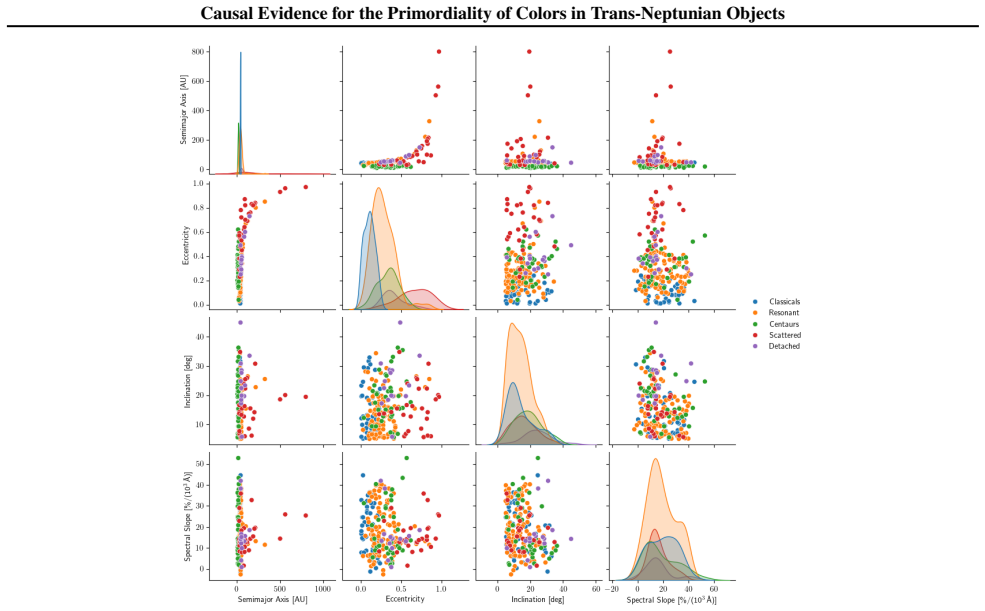
The paper's central claim is that the colors of trans-Neptunian objects are predominantly primordial, set by the chemical composition of their formation location. The evidence is a Partial Ancestral Graph learned from 229 objects at a 98.7% significance threshold, whose decisive edge states that inclination is not an ancestor of color; the authors take this to mean that color is the root cause of the inclination distribution, with formation location acting through inclination-raising secular resonances. A second edge, stating that current semimajor axis is not an ancestor of color, disfavors irradiation-driven color modification. A third, a latent common cause between eccentricity and inclination, matches the dynamical signature of an external perturber, and the authors read it as a blind rediscovery of Neptune. Together these edges lead to the conclusion that TNO colors reflect conditions at formation rather than subsequent collisional or radiative evolution.
Load-bearing premise
The claim presumes that the unobserved factor linking color and inclination is the primordial formation location; if some later process such as collision-driven resurfacing is the real common cause, the conclusion that colors are primordial does not follow.
Editorial extensions
If this is right
- If colors are set at formation, the color–inclination correlation becomes a map of where each TNO formed in the protoplanetary disk.
- Collisional resurfacing models that make inclination drive color are excluded as dominant, because that causal direction is disallowed.
- Irradiation-driven color models are disfavored because the current semimajor axis is not an ancestor of color.
- The same causal pipeline, without physical inputs, identifies a latent common cause of eccentricity and inclination that the authors interpret as the dynamical signature of Neptune.
- The inferred graph is robust to removing any one TNO subpopulation, so the result is not driven by classicals, resonants, centaurs, scattered, or detached objects alone.
Reading between the lines
- Beyond the paper, the same pipeline could be applied to asteroid families or exoplanet populations, where primordial-versus-evolutionary color questions also arise, to test whether such formation-location locking is a general planetary-system phenomenon.
- An open extension is to treat the rediscovery of Neptune as a template for predicting other unseen perturbers; a distant massive planet would be expected to imprint a similar latent-common-cause signature on the eccentricity and inclination of outer TNOs.
- The 98.7% figure constrains the direction color→inclination but does not by itself exclude a common cause; future data on physical properties such as albedo, density, or cratering state would be needed to confirm that the common cause is indeed formation location rather than a later process.
Editorial analysis
A structured set of objections, weighed in public.
Referee Report
Summary. The paper applies the Fast Causal Inference (FCI) algorithm to a sample of 229 trans-Neptunian objects (TNOs), using semimajor axis, eccentricity, inclination, and spectral slope (color). The output is a Partial Ancestral Graph (PAG) with three edges: eccentricity is not an ancestor of semimajor axis, eccentricity and inclination share a latent common cause, and inclination is not an ancestor of color. The authors interpret these edges as causal evidence for the primordial origin of TNO colors: they claim that color is causally antecedent to inclination, that models involving irradiation or collisional color modification are excluded, and that the analysis 'rediscovers' Neptune. The paper argues that these conclusions follow with high certainty from a purely data-driven, model-agnostic procedure.
Significance. The paper is a clear and well-written demonstration of a modern causal discovery method applied to an astrophysical dataset. The FCI implementation is standard, the robustness checks (jackknife by subpopulation, multiple conditional independence tests, different significance thresholds) are thoughtful, and the authors make their code and data publicly available. If the causal interpretation were valid, the conclusion that TNO colors are predominantly primordial would be an important contribution to the solar-system community. However, the central claim as stated is not supported by the PAG output: the edge color ◦→ i does not establish that color causes inclination, and the assumption that colors are primordial is built into the interpretation of the latent confounder. These are load-bearing issues that undermine the paper's main conclusion.
major comments (5)
- [§2.3, Fig. 2, §3.2, §4] The PAG edge color ◦→ i is interpreted as evidence that 'TNO color is causally antecedent to inclination' (abstract and §4), but the paper's own legend in §2.3 states that X ◦→ Y means 'Y is not an ancestor of X.' Therefore the edge only rules out i → color; it does not assert color → i. The causal direction from color to inclination is an interpretation, not a result of the algorithm. This overreach is central to the paper's claim of primordiality.
- [§3.1, Fig. 2 caption] The '98.7% certainty' is the per-test conditional-independence significance level α=0.013, not a posterior probability for the PAG or for any causal edge. The paper states this correctly in §3.1 but then transfers the number to the conclusion ('with 98.7% certainty that TNO color is causally antecedent to inclination'), which is not justified. The number of tests performed and any multiple-testing correction are not reported, so the claimed confidence is not well defined.
- [§2.1, §3.2] The analysis is circular with respect to the primordiality of colors. Section 2.1 states as a 'fundamental assumption' that colors are primordial and are a proxy for initial semimajor axis. Section 3.2 then interprets the unobserved confounder that the PAG leaves open between color and inclination as 'the formation location itself.' The conclusion that colors are predominantly primordial therefore rests on an assumption that is equivalent to the claim being tested. A non-primordial latent confounder—for example, a collisional or irradiation-related variable that affects both surface color and, through size or dynamics, orbital inclination—would produce the same PAG but make the central conclusion false. The paper acknowledges this possibility in §3.2 but does not address it in the interpretation.
- [§3.2] The claim that the model 'excludes' irradiation and collisional evolution is too strong. The PAG only excludes i as an ancestor of color (edge (iii)); no edge involving a and color is listed, and even if an edge color ◦→ a were present it would only rule out a → color, not indirect or latent mechanisms. Collisional resurfacing or irradiation could enter through an unobserved confounder, as the paper itself concedes for the color–inclination link. The data do not distinguish these scenarios from the primordial-formation-location interpretation.
- [§3.2] The 'Neptune rediscovery' argument is an interesting illustrative exercise but does not validate the method for the color question. The e ↔ i edge in the PAG indicates only a latent common cause; many mechanisms could produce such dependence, and Neptune is one possible identification, not a consequence of the causal discovery algorithm. This interpretive step is not evidence that the other edges are correctly interpreted as causal.
minor comments (6)
- [Abstract] The phrase 'with 98.7% certainty' should be reworded to 'with per-test significance α=0.013' or similar, to avoid conveying a posterior probability.
- [§3.1] The sentence 'removing any subsample of 48 Classicals, 102 Resonant, 36 Centaurs, 28 Scattered, or 15 Detached TNOs results in no change' is unclear; it should read 'removing each subpopulation in turn' or similar.
- [§3.2] The notation 'color ← a' is not defined in the paper; the standard edge notation from §2.3 should be used, e.g., 'a → color' or 'a is not an ancestor of color.'
- [§2.1] The parenthetical list of subpopulations is missing a verb; 'it consists of a total of 229 TNOs including hot classicals, centaurs, and resonant/scattered objects, in a dataset for which discovery biases were modeled' is grammatically awkward.
- [§3.1] The choice of α=0.09 for the KCI test is not justified; a brief explanation of how this threshold was selected would improve reproducibility.
- [Acknowledgements] The GitHub URL is malformed ('/gtbhttps:'); it should be 'https://github.com/ZehaoJin/causalTNOs'.
Circularity Check
The conclusion that TNO colors are predominantly primordial is the paper's own Section 2.1 assumption restated; the unobserved confounder left open by the PAG is simply declared to be formation location.
-
self definitional
[Section 2.1 (Data), with the interpretation in Section 3.2 and the conclusion in Section 4]
"A fundamental assumption of this work is that colors are primordial, and thus strongly correlated to the initial location of a TNO. Hereafter, we treat colors as a proxy for the initial semimajor axis of the objects."
The paper's central conclusion—'the colors of TNOs are predominantly primordial'—is exactly this 'fundamental assumption' restated. The data-driven PAG delivers only the conditional-independence result 'inclination is not an ancestor of color' (Figure 2, edge iii), which is then read as 'color (proxy for formation location) causes inclination.' Because 'color' was defined as the primordial formation location, the conclusion that colors are primordial is true by stipulation, not derived from the causal test. No measured variable or conditional-independence test can falsify the assumption once color is identified with initial semimajor axis.
-
other
[Section 3.2 (Astrophysical Interpretation)]
"Note that this link, however, leaves open the possibility of an unobserved confounder causing both color and the inclination. This confounder can be the formation location itself, if we were to assume the color and initial location to be two distinct variables instead of the color being a proxy for location."
The PAG edge color∘→i is compatible with a latent confounder, as the paper itself states. The paper then selects 'formation location' as that confounder and immediately concludes that only the 'primordial origins' model remains. Selecting formation location is the primordial-origin hypothesis itself; any latent variable affecting both color and inclination, such as collisional resurfacing or irradiation history, would produce the same PAG while invalidating the conclusion. The identity of the confounder is not tested by the data, so the dismissal of collisional and irradiation models is not a causal discovery but a consequence of the chosen confounder identity.
1 more flagged steps
-
self citation load bearing
[Section 1 (Introduction); Section 2.1 (Data); reference to Ali-Dib et al. 2021]
"They concluded that, in causality theory jargon, eccentricity (e) and inclination (i) are caused by the colors, which are indicative of the formation location."
Ali-Dib et al. (2021) is a prior paper by a present co-author, and this quoted sentence already asserts the paper's target claim that colors are indicative of the formation location. That prior assertion is cited in Section 1 to motivate the 'primordial origin hypothesis' and is then encoded as the 'fundamental assumption' in Section 2.1. The present causal analysis does not independently test this premise: it adopts it as the definition of 'color' and later reports primordiality as the conclusion. The load-bearing premise therefore traces to a self-citation whose conclusion equals the present result.
full rationale
The FCI/PAG analysis is a legitimate data-driven procedure, and the specific graph output—especially edge (iii), 'inclination is not an ancestor of color'—is a genuine empirical result rather than an input. However, the paper's central astrophysical conclusion, that TNO colors are predominantly primordial, is stipulated in Section 2.1, where colors are assumed primordial and treated as a proxy for initial semimajor axis. Section 3.2 then interprets the same proxy as formation location causing inclination and selects 'formation location' as the latent confounder that the PAG explicitly leaves open, before concluding that only the primordial-origin model remains. The collisional and irradiation alternatives are dismissed not by conditional-independence tests but by the identity assigned to the confounder, which is exactly the claim under test. The prior conclusion in Ali-Dib et al. (2021), by a present co-author, is cited to support this assumption, making the self-citation part of the load-bearing chain. The 98.7% value is an alpha level for individual conditional-independence tests, not a posterior probability over the causal or PAG statement; that is a statistical overstatement rather than a circular step, so it does not affect the circularity score. Because part of the result (the color∘→i edge and the Neptune sanity check) is genuinely data-derived, the circularity is substantial but partial rather than total.
Assumptions & free parameters
free parameters (2)
- Significance threshold alpha =
α = 0.013 (also 0.02, 0.09 for robustness)
- Yeo-Johnson transform parameters =
Estimated per variable
assumptions (4)
- ad hoc to paper Colors are primordial (color is a proxy for formation location).
- domain assumption The sample is an independent and identically distributed draw from the TNO population, without selection bias.
- domain assumption An unobserved common cause of eccentricity and inclination is a single massive perturber (Neptune).
- ad hoc to paper The only possible non-primordial color-modification pathways are direct causation from inclination or semimajor axis.
Cite this review
Pith. "Pith review of Causal Evidence for the Primordiality of Colors in Trans-Neptunian Objects." pith.science (2026). https://pith.science/paper/FZYYPYLI
@misc{pith2026250703760,
  author       = {Pith},
  title        = {Pith review of: Causal Evidence for the Primordiality of Colors in Trans-Neptunian Objects},
  year         = {2026},
  howpublished = {\url{https://pith.science/paper/FZYYPYLI}},
  note         = {Machine review of arXiv:2507.03760}
}
read the original abstract
The origins of the colors of Trans-Neptunian Objects (TNOs) represent a crucial unresolved question, central to understanding the history of our Solar System. Recent observational surveys have revealed correlations between the eccentricity and inclination of TNOs and their colors. This has rekindled the long-standing debate on whether these colors reflect the conditions of TNO formation or their subsequent collisional evolution. In this study, we address this question with 98.7% certainty, using a model-agnostic, data-driven approach based on causal graphs. First, as a sanity check, we demonstrate how our model can replicate the currently accepted paradigms of TNOs' dynamical history, blindly and without any orbital modeling or physics-based assumptions. In fact, our causal model (with no knowledge of the existence of Neptune) predicts the existence of an unknown perturbing body, i.e., Neptune. We then show how this model predicts, with high certainty, that the color of TNOs is the root cause of their inclination distribution, rather than the other way around. This strongly suggests that the colors of TNOs reflect an underlying dynamical property, most likely their formation location. Moreover, our causal model excludes formation scenarios that invoke substantial color modification by subsequent irradiation. We therefore conclude that the colors of TNOs are predominantly primordial.
Figures

Reference graph
Works this paper leans on
-
[1]
The Rarity of Very Red Trans-Neptunian Objects in the Scattered Disk
Ali-Dib , M., Marsset , M., Wong , W.-C., and Dbouk , R. The Rarity of Very Red Trans-Neptunian Objects in the Scattered Disk . The Astronomical Journal, 162 0 (1): 0 19, July 2021. doi:10.3847/1538-3881/abf6ca
-
[2]
Brown , M. E., Schaller , E. L., and Fraser , W. C. A Hypothesis for the Color Diversity of the Kuiper Belt . The Astrophysical Journal Letters, 739 0 (2): 0 L60, October 2011. doi:10.1088/2041-8205/739/2/L60
-
[3]
Fisher, R. A. On the " Probable Error " of a Coefficient of Correlation Deduced from a Small Sample . Metron, 1: 0 3--32, 1921
work page 1921
-
[4]
Jewitt , D. C. and Luu , J. X. Colors and Spectra of Kuiper Belt Objects . The Astronomical Journal, 122 0 (4): 0 2099--2114, October 2001. doi:10.1086/323304
doi:10.1086/323304 2001
-
[5]
Jin , Z., Pasquato , M., Davis , B. L., Macci \`o , A. V., and Hezaveh , Y. Beyond Causal Discovery for Astronomy: Learning Meaningful Representations with Independent Component Analysis . arXiv e-prints, art. arXiv:2410.14775, October 2024. doi:10.48550/arXiv.2410.14775
-
[6]
Causal Discovery for Galaxy Evolution
Jin , Z., Pasquato , M., Davis , B., Maccio , A., and Hezaveh , Y. Causal Discovery for Galaxy Evolution . In American Astronomical Society Meeting Abstracts, volume 245 of American Astronomical Society Meeting Abstracts, pp.\ 120.03D, January 2025 a
work page 2025
-
[7]
Jin , Z., Pasquato , M., Davis , B. L., Deleu , T., Luo , Y., Cho , C., Lemos , P., Perreault-Levasseur , L., Bengio , Y., Kang , X., Macci \`o , A. V., and Hezaveh , Y. Causal Discovery in Astrophysics: Unraveling Supermassive Black Hole and Galaxy Coevolution . The Astrophysical Journal, 979 0 (2): 0 212, February 2025 b . doi:10.3847/1538-4357/ad9ded
-
[8]
Secular perturbations of asteroids with high inclination and eccentricity
Kozai , Y. Secular perturbations of asteroids with high inclination and eccentricity . The Astronomical Journal, 67: 0 591--598, November 1962. doi:10.1086/108790
doi:10.1086/108790 1962
Show all 29 references
-
[9]
Lidov , M. L. The evolution of orbits of artificial satellites of planets under the action of gravitational perturbations of external bodies . Planetary Space Science, 9 0 (10): 0 719--759, October 1962. doi:10.1016/0032-0633(62)90129-0
1962 doi
-
[10]
Luu , J. X. and Jewitt , D. C. Color Diversity Among the Centaurs and Kuiper Belt Objects . The Astronomical Journal, 112: 0 2310, November 1996. doi:10.1086/118184
1996 doi
-
[11]
C., Pike , R
Marsset , M., Fraser , W. C., Pike , R. E., Bannister , M. T., Schwamb , M. E., Volk , K., Kavelaars , J. J., Alexandersen , M., Chen , Y.-T., Gladman , B. J., Gwyn , S. D. J., Lehner , M. J., Peixinho , N., Petit , J.-M., and Wang , S.-Y. Col-OSSOS: Color and Inclination Are ...
2019 doi
-
[12]
and Nesvorn \'y , D
Morbidelli , A. and Nesvorn \'y , D. Kuiper belt: formation and evolution . In Prialnik , D., Barucci , M. A., and Young , L. (eds.), The Trans-Neptunian Solar System, pp.\ 25--59. 2020. doi:10.1016/B978-0-12-816490-7.00002-3
2020 doi
-
[13]
Murray , C. D. and Dermott , S. F. Solar System Dynamics . 1999. doi:10.1017/CBO9781139174817
1999 doi
-
[14]
T., Buchanan , L
Nesvorn \'y , D., Vokrouhlick \'y , D., Alexandersen , M., Bannister , M. T., Buchanan , L. E., Chen , Y.-T., Gladman , B. J., Gwyn , S. D. J., Kavelaars , J. J., Petit , J.-M., Schwamb , M. E., and Volk , K. OSSOS XX: The Meaning of Kuiper Belt Colors . The Astronomical Journ...
2020 doi
-
[15]
Bringing causality to astronomy
Pasquato , M. Bringing causality to astronomy . In EAS2024, European Astronomical Society Annual Meeting, pp.\ 362, July 2024
2024
- [16]
-
[17]
Causality
Pearl, J. Causality. Cambridge university press, 2009
2009
-
[18]
E., Fraser , W
Schwamb , M. E., Fraser , W. C., Bannister , M. T., Marsset , M., Pike , R. E., Kavelaars , J. J., Benecchi , S. D., Lehner , M. J., Wang , S.-Y., Thirouin , A., Delsanti , A., Peixinho , N., Volk , K., Alexandersen , M., Chen , Y.-T., Gladman , B., Gwyn , S. D. J., and Petit ...
2019 doi
-
[19]
An anytime algorithm for causal inference
Spirtes, P. An anytime algorithm for causal inference. In Richardson, T. S. and Jaakkola, T. S. (eds.), Proceedings of the Eighth International Workshop on Artificial Intelligence and Statistics, volume R3 of Proceedings of Machine Learning Research, pp.\ 278--285. PMLR, 04--0...
2001
-
[20]
Causal inference in the presence of latent variables and selection bias
Spirtes, P., Meek, C., and Richardson, T. Causal inference in the presence of latent variables and selection bias. In Proceedings of the Eleventh Conference on Uncertainty in Artificial Intelligence, pp.\ 499--506, August 1995
1995
-
[21]
Causation, Prediction, and Search
Spirtes, P., Glymour, C., and Scheines, R. Causation, Prediction, and Search. The MIT Press, 01 2001. ISBN 9780262284158. doi:10.7551/mitpress/1754.001.0001. URL https://doi.org/10.7551/mitpress/1754.001.0001
2001 doi
- [22]
-
[23]
Stern , S. A. Evidence for a Collisional Mechanism Affecting Kuiper Belt Object Colors . The Astronomical Journal, 124 0 (4): 0 2297--2299, October 2002. doi:10.1086/342863
2002 doi
-
[24]
Sur l'application des s \'e ries de M
von Zeipel , H. Sur l'application des s \'e ries de M. Lindstedt \`a l' \'e tude du mouvement des com \`e tes p \'e riodiques . Astronomische Nachrichten, 183 0 (22): 0 345, March 1910. doi:10.1002/asna.19091832202
1910 doi
-
[25]
and Brown , M
Wong , I. and Brown , M. E. The Bimodal Color Distribution of Small Kuiper Belt Objects . The Astronomical Journal, 153 0 (4): 0 145, April 2017. doi:10.3847/1538-3881/aa60c3
2017 doi
-
[26]
and Johnson, R
Yeo, I. and Johnson, R. A. A new family of power transformations to improve normality or symmetry. Biometrika, 87 0 (4): 0 954--959, 12 2000. ISSN 0006-3444. doi:10.1093/biomet/87.4.954. URL https://doi.org/10.1093/biomet/87.4.954
-
[27]
On the completeness of orientation rules for causal discovery in the presence of latent confounders and selection bias
Zhang, J. On the completeness of orientation rules for causal discovery in the presence of latent confounders and selection bias. Artificial Intelligence, 172 0 (16-17): 0 1873--1896, 2008
2008
-
[28]
Kernel-based Conditional Independence Test and Application in Causal Discovery
Zhang , K., Peters , J., Janzing , D., and Schoelkopf , B. Kernel-based Conditional Independence Test and Application in Causal Discovery . arXiv e-prints, art. arXiv:1202.3775, February 2012. doi:10.48550/arXiv.1202.3775
-
[29]
Causal-learn: Causal discovery in python
Zheng, Y., Huang, B., Chen, W., Ramsey, J., Gong, M., Cai, R., Shimizu, S., Spirtes, P., and Zhang, K. Causal-learn: Causal discovery in python. Journal of Machine Learning Research, 25 0 (60): 0 1--8, 2024
2024
Reviewed August 6, 2026 · model on record in the stance chip above.
Discussion (0). Continue with ORCID to comment.