REVIEW 4 major objections 4 minor 66 references
The paper claims rug-pull scams on meme coins leave a multi-dimensional fingerprint—contract backdoors, on-chain anomalies, liquidity manipulation, and social silence—that a simple MLP can read, reporting 0.927 accuracy and 0.952 AUC-ROC.
Reviewed by Pith at T0; open to challenge. T0 means a machine referee read the full paper against a public rubric. the ladder, T0–T4 →
T0 review · deepseek-v4-flash
2026-08-05 00:10 UTC pith:G2MOFH7N
load-bearing objection The case study and taxonomy are worth a skim, but the ML evaluation is broken: the label protocol fabricates positives and leaks the label into the features, so the 0.952 AUC is meaningless. the 4 major comments →
From Viral to Void: Multi-Dimensional Behavioral and Contractual Analysis for Rug Pull Identification
The pith
A machine-rendered reading of the paper's core claim, the machinery that carries it, and where it could break.
Core claim
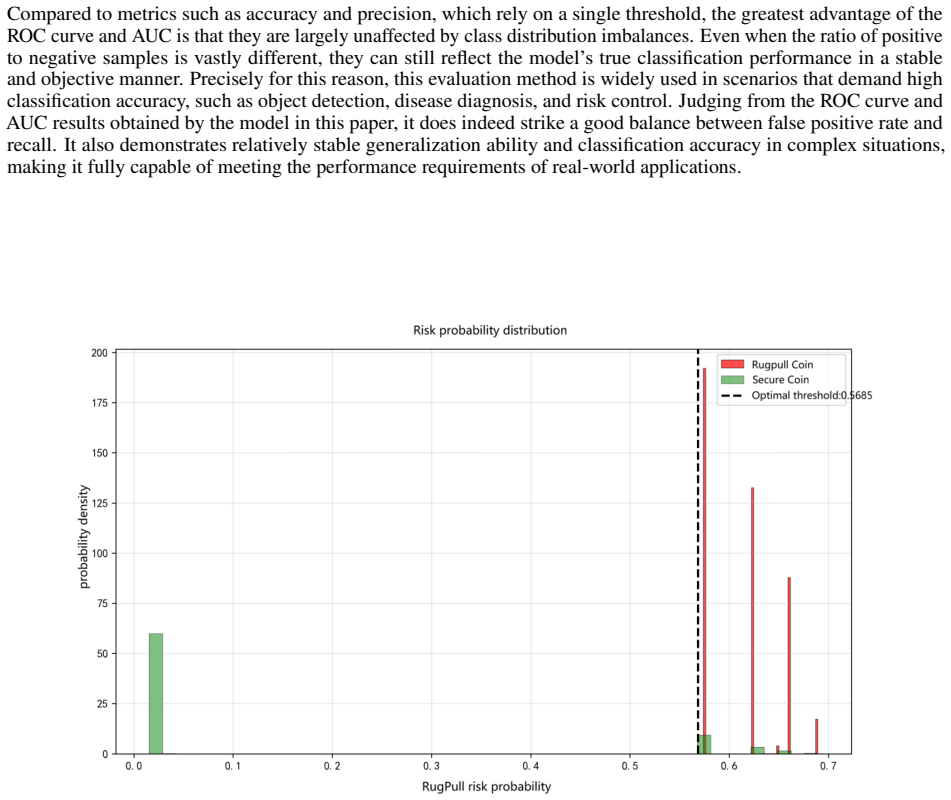
A rug pull is a four-stage process—deployment, liquidity injection, fake trading, capital withdrawal—and each stage leaves measurable on-chain and off-chain traces. A three-layer MLP fed all traces at once can separate rug-pull tokens from safe ones. Features span contract flags, liquidity health, transaction behavior, and social presence. SMOTE and focal loss handle the 15% positive class; the 0.5685 threshold maximizes validation F1. Reported test metrics: accuracy 0.927, precision 0.812, recall 0.763, F1 0.787, AUC-ROC 0.952, PR-AUC 0.834. Social-presence features rank first in importance. A Flask tool demonstrates batch screening on 200 tokens.
What carries the argument
The analytical backbone is the constant-product AMM identity x·y = k: when a project withdraws almost all liquidity, the remaining pool amounts approach zero and the token price collapses. The detection backbone is a three-layer MLP over an 11-feature vector combining contract, liquidity, transaction, and social signals, trained with SMOTE oversampling and focal loss, with the decision threshold chosen by maximizing validation F1. These connect: the AMM identity makes liquidity withdrawal a decisive signal, and the MLP learns to weight it alongside the other feature families.
Load-bearing premise
The load-bearing premise is that the training labels are true—roughly 900 of 6,000 tokens are genuine rug pulls, judged by chain_patrol_status, liquidity_removed, expiration_date, or, when none apply, random 15% labeling—and if those labels are wrong or circular (liquidity_removed is both a label and an input), the reported accuracy, F1, and AUC do not measure detection ability.
What would settle it
Take 1,000 newly launched meme tokens never seen by the model, follow them for 90 days, and compare the model's risk scores against rug pulls confirmed by post-hoc investigation (liquidity drain, team token dump, contract takeover), not by the liquidity_removed field. If the AUC on this prospective cohort is near 0.5, or if high-risk calls are mostly tokens that merely lack social media, the central claim fails.
If this is right
- Rug-pull risk can be scored automatically from public on-chain data plus social-media presence, allowing warnings in time to act rather than after the funds are gone.
- A token with no Twitter account, no Telegram community, and no website becomes a high-risk signal on its own; social silence is treated as a first-class detection feature.
- Combining SMOTE with focal loss raises recall for the rare positive class from 0.576 (unprocessed MLP) to 0.763, suggesting the imbalance-handling recipe transfers to other rare-fraud detection tasks.
- The four-phase fingerprint derived from the BOBU case gives rule-based early-warning thresholds (W > 10, Gini > 0.8, withdrawal ratio > 90%, mixer interaction within an hour) that can be used in dashboards without any neural network.
- The Flask screening tool makes the claimed performance usable for batch risk assessment and high-risk ranking, not just an offline experiment.
Where Pith is reading between the lines
- The four-stage case fingerprint should transfer to other EVM chains such as BSC and Polygon, because the same AMM identity governs price collapse; however, each chain's token standards and DEX routing would need recalibration of thresholds.
- Because has_twitter, has_telegram, and has_website rank as the most important features, a natural adversarial test is whether attackers can evade the model by minting cheap social accounts; the paper does not examine that attack.
- The 70% risk rate on the 200-token deployment batch reflects the model's threshold, not true market prevalence; a prospective study on newly launched tokens would show how performance holds when the positive-class base rate drifts.
Editorial analysis
A structured set of objections, weighed in public.
Referee Report
Summary. The paper proposes an MLP-based pipeline for detecting meme-coin rug pulls on Ethereum. It builds an 11-feature system spanning contract, liquidity, transaction, and social dimensions, applies SMOTE and Focal Loss to handle class imbalance, and selects a decision threshold on the validation set. The authors report test-set accuracy 0.927, F1 0.787, and AUC-ROC 0.952, outperforming LR, RF, and XGBoost, and describe a Flask-based detection tool. A detailed BOBU case study is used to motivate the feature set and quantitative thresholds.
Significance. If the empirical results were valid, the paper would be a useful applied contribution: it integrates diverse feature dimensions, addresses the class-imbalance problem, and ships a deployable tool. The BOBU case study and the quantitative heuristics in Tables 1 and 2 are constructive and provide concrete detection signals. However, the central empirical claim is not supported by the current experimental design. The labeling protocol in §5.1 includes randomly generated positive labels and uses liquidity_removed as a label while liquidity-related metrics are treated as input features. The paper does not provide a label-source breakdown, a complete feature list, code, or repeated-split statistics, so the reported AUC cannot be interpreted as evidence of detecting genuine rug pulls. The contribution is contingent on redoing the data-labeling and evaluation protocol.
major comments (4)
- [§5.1, Dataset and Feature Engineering] The labeling protocol has three explicit sources and a random fallback: 'If none of these sources provide explicit labeling information, positive samples are randomly generated at a rate of 15%.' This fabricates arbitrary positives and directly sets the 15% class prior that the paper then treats as the natural imbalance motivating SMOTE and Focal Loss. The paper does not report how many of the ~900 positive samples come from each branch. If the random branch is substantial, the model was partly trained on noise, and the reported metrics do not measure rug-pull detection. Please provide the label-source breakdown and rerun the experiments using only explicitly verified labels, or justify why random labels are valid ground truth.
- [§3.4.1, Table 1, §5.1] The label definition overlaps with the input feature set. §5.1 assigns positive=1 when liquidity_removed is True, while §3.4.1 and Table 1 define liquidity withdrawal and lock-up metrics as input-side detection features. Unless the full 11-feature list excludes liquidity_removed and all direct derivatives, the model can learn the labeling rule from the inputs, artificially inflating the AUC. The manuscript does not enumerate the 11 features, so this overlap cannot be ruled out. Please disclose the complete feature list, remove any label-derived variables from the inputs, and re-evaluate.
- [§5.4, Experimental Results] The headline metric is inconsistent. The abstract, Table 4, and text state AUC-ROC=0.952, but the ROC-curve paragraph in §5.4 reports 'the AUC value is 0.9255' and discusses that value as the result. In addition, §5.3.4 selects the threshold by maximizing F1 on the validation set, while §5.4 and the deployment description use a threshold based on the Youden index (0.5685). Because precision, recall, and F1 depend on this threshold, the evaluation protocol must be stated consistently and the numbers reconciled.
- [§5.3.1, Table 4] All results come from a single 7:1:2 split with no error bars, multiple seeds, or cross-validation. Given the small positive class (~900), the random-label branch, and SMOTE, the point estimates, especially F1 and PR-AUC, are likely unstable. Please report repeated stratified splits or k-fold cross-validation with mean and standard deviation for every model, and state whether differences between models are statistically meaningful.
minor comments (4)
- [§5.1] The manuscript says '11 valid features' but never lists them; the feature-importance analysis in §5.4 names only four. Please include a table of all features, their definitions, and their data sources.
- [Table 4] Table 4 includes MLP (SMOTE only) but no MLP (Focal-only) row, although §5.4 reports Focal-only results. Add the missing row for completeness.
- [§5.4, field validation] The 200-token field validation reports a 70% risk rate, which is difficult to reconcile with the 15% base rate in the training data and is asserted to match 'industry reality' without supporting evidence. Clarify how the 200 samples were selected and what the 70% rate is supposed to demonstrate.
- [§4, Case Studies] The BOBU case is from Binance Smart Chain, while the dataset is described as Ethereum-based. Clarify whether the dataset and experiments include BSC tokens and whether cross-chain differences are accounted for in the features and results.
Circularity Check
Labeling rule makes liquidity_removed both label and input, and randomly fabricates 15% of positives, so reported 0.952 AUC may reflect label leakage/noise rather than genuine rug-pull detection.
specific steps
-
self definitional
[Section 5.1 (labeling protocol) and Section 3.4.1 / Table 1 (liquidity-withdrawal features)]
"If not, check the liquidity_removed field. If the value is True, also assign a value of 1. ... Liquidity withdrawal: One-time withdrawal of the vast majority ... Withdrawal ratio = Withdrawal amount / Deposit amount ... >90%"
The positive label is assigned whenever liquidity_removed is True, while the model's feature set includes the same liquidity-withdrawal behavior (Table 1's withdrawal ratio; Table 3's 'Withdrawal Rate'). The paper states these detection features directly feed the multimodal detection model. Thus the model can learn the labeling rule by reading back the liquidity-removed signal used to define the label. The reported AUC/accuracy therefore measures the model's ability to reproduce its own labeling rule, not an independent ability to detect rug pulls.
-
other
[Section 5.1, final sentence of labeling protocol]
"If none of these sources provide explicit labeling information, positive samples are randomly generated at a rate of 15%."
For the fallback branch, positive labels are random coin flips independent of all features. No classifier can genuinely detect such labels; on that subset the apparent true-positive rate is just the random draw. The 15% positive prior used to justify SMOTE and Focal Loss is not an observed property of the data but is manufactured by the labeling rule. The paper provides no label-source breakdown, so the reported 0.952 AUC mixes any real signal from explicit labels with this constructed noise, making the headline detection claim uninterpretable.
full rationale
The paper's central empirical claim—MLP+SMOTE+Focal Loss achieves accuracy 0.927, F1 0.787, and AUC-ROC 0.952—rests entirely on the ground-truth labels defined in Section 5.1. That protocol is circular in two ways. First, it treats liquidity_removed as a label condition while the feature set (Section 3.4.1, Tables 1 and 3) includes the same liquidity-withdrawal behavior as a model input, so the classifier can trivially reproduce the label from a feature that is by construction highly predictive of it. Second, for tokens without explicit labels, the paper randomly generates 15% positive labels, injecting a synthetic class prior and unverifiable noise into the evaluation set. Because no label-source breakdown, code, or data are provided, the reported metrics cannot be separated into genuine signal and label leakage/randomness. The paper does contain substantial non-circular descriptive and case-study content, and the many self-citations are background, not load-bearing; however, the detection result itself is not self-contained and reduces in part to the constructed labeling rule. Hence the high circularity score.
Axiom & Free-Parameter Ledger
free parameters (6)
- Table 1 anomaly thresholds =
W>10, rho>0.9, HHI>0.25, Gini>0.8, withdrawal ratio>90%, lock-up<30 days
- R_deploy weights =
w1=w2=w3=0.3, w4=0.1
- SMOTE sampling_strategy =
0.6
- Focal loss parameters =
gamma=2, alpha_t=0.7*(Nmaj/Nmin)
- Dynamic decision threshold =
0.5685
- Random positive label rate =
15%
axioms (4)
- domain assumption The label sources (chain_patrol_status, liquidity_removed, expiration_date) are reliable indicators of rug pulls.
- domain assumption The selected 11 features capture rug pull behavior.
- standard math Standard formulas for AMM, Gini, HHI, and correlation are applicable to token data.
- ad hoc to paper Randomly generated labels are an acceptable substitute for ground truth.
Cite this review
Pith. "Pith review of From Viral to Void: Multi-Dimensional Behavioral and Contractual Analysis for Rug Pull Identification." pith.science (2026). https://pith.science/paper/G2MOFH7N
@misc{pith2026260801609,
  author       = {Pith},
  title        = {Pith review of: From Viral to Void: Multi-Dimensional Behavioral and Contractual Analysis for Rug Pull Identification},
  year         = {2026},
  howpublished = {\url{https://pith.science/paper/G2MOFH7N}},
  note         = {Machine review of arXiv:2608.01609}
}
read the original abstract
As the blockchain and decentralized finance (DeFi) ecosystems continue to expand and mature, rug pull scams involving meme coins are occurring with increasing frequency, posing a threat to the security of investors' assets and the healthy development of the industry. Rug Pull scams are characterized by extremely low deployment costs, covert execution, rapid fund transfers, and high detection difficulty. Traditional manual reviews or fixed rules struggle to meet real-time early warning requirements, and existing detection methods generally suffer from issues such as a single feature dimension, inadequate handling of class imbalance, and weak model generalization and interpretability. To address these shortcomings, this paper focuses on the detection of Ethereum-based rug pull scams. First, we clarify their definitions, types, and harm mechanisms, and construct a multi-dimensional feature system based on dimensions such as malicious smart contract design, on-chain transaction anomalies, liquidity manipulation, and social media disclosures. Next, using the "Second Uncle Coin"(token symbol: BOBU) case as an example, we reconstruct the attack process and derive quantitative detection metrics. Subsequently, a risk detection model based on a Multi-Layer Perceptron (MLP) is designed. We employ a combined strategy of SMOTE oversampling and Focal Loss to address the issue of sample imbalance, dynamically search for optimal thresholds to balance precision and recall, and incorporate gradient pruning and early stopping to enhance training stability. Experiments show that the model achieves an accuracy of 0.927, an F1 score of 0.787, and an AUC-ROC of 0.952 on the test set, outperforming traditional methods. Finally, a visualizable web-based detection system is developed using the Flask framework, enabling batch risk assessment, high-risk ranking display, and result export functions.
Figures



Reference graph
Works this paper leans on
-
[1]
Blockchain security based on cryptography: a review.CoRR, abs/2508.01280, 2025
Wenwen Zhou, Dongyang Lyu, and Xiaoqi Li. Blockchain security based on cryptography: a review.CoRR, abs/2508.01280, 2025
Pith/arXiv arXiv 2025
-
[2]
Chunyi Zhang, Fengjiao Dou, and Xiaoqi Li. Dos attacks and defense technologies in blockchain systems: A hierarchical analysis.ArXiv, abs/2507.22611, 2025
-
[3]
Yuhuan Yang, Shipeng Ye, and Xiaoqi Li. A multi-layered security analysis of blockchain systems: From attack vectors to defense and system hardening.arXiv preprint arXiv:2504.09181, 2025
Pith/arXiv arXiv 2025
-
[4]
Pengfei Gao, Dechao Kong, and Xiaoqi Li. Implementation and security analysis of cryptocurrencies based on ethereum.arXiv preprint arXiv:2504.21367, 2025
Pith/arXiv arXiv 2025
-
[5]
Y . Zhou, J. Sun, F. Ma, Y . Chen, Z. Yan, and Y . Jiang. Stop pulling my rug: Exposing rug pull risks in crypto token to investors. InProceedings of the 46th International Conference on Software Engineering: Software Engineering in Practice, pages 228–239, 2024
work page 2024
-
[6]
B. Mazorra, V . Adan, and V . Daza. Do not rug on me: Leveraging machine learning techniques for automated scam detection.Mathematics, 10(6):949, 2022
work page 2022
- [7]
-
[8]
Xiangfan Wu, Ju Xing, and Xiaoqi Li. Exploring vulnerabilities and concerns in Solana smart contracts.arXiv preprint arXiv:2504.07419, 2025
Pith/arXiv arXiv 2025
-
[9]
S. Miao, W. Qiu, S. Zhuo, F. Shen, D. Lin, X. Yu, C. Tat-Seng, and Z. Zheng. Unidetect: Llm-driven universal fraud detection across heterogeneous blockchains, 2026. arXiv:2604.12329. 19
Pith/arXiv arXiv 2026
-
[10]
D. Sun, W. Ma, L. Nie, and Y . Liu. Sok: Comprehensive analysis of rug pull causes, datasets, and detection tools in defi, 2024. arXiv:2403.16082
work page internal anchor Pith review Pith/arXiv arXiv 2024
- [11]
-
[12]
Y . Wang, Q. Zheng, X. Li, L. Wang, and L. Lin. Cosemignn: Blockchain fraud detection with dynamic graph neural networks based on co-association of semi-supervised.Expert Systems with Applications, 298:129853, 2026
work page 2026
-
[13]
F. Frankart, T. Simonetto, M. Cordy, O. Papageorgiou, N. Pocher, and G. Fridgen. The feature-space illusion: Exposing practical vulnerabilities in blockchain gnn fraud detection, 2026. https://hdl.handle.net/10993/68067
work page 2026
-
[14]
W. Chen, Z. Zheng, J. Cui, E. Ngai, P. Zheng, and Y . Zhou. Detecting ponzi schemes on ethereum: Towards healthier blockchain technology. InProceedings of the 2018 World Wide Web Conference (WWW ’18), pages 1409–1418, 2018
work page 2018
-
[15]
M. Vasek and T. Moore. Analyzing the bitcoin ponzi scheme ecosystem.Financial Cryptography and Data Security, 10958:101–112, 2019
work page 2019
-
[16]
P. Qian, R. Cao, Z. Liu, W. Li, M. Li, L. Zhang, Y . Xu, J. Chen, and Q. He. Comprehensive review of smart contract and defi security: Attack, vulnerability detection, and automated repair.Expert Systems with Applications, 291:128431, 2025
work page 2025
- [17]
-
[18]
J. Crisostomo, F. Bacao, and V . Lobo. Machine learning methods for detecting smart contracts vulnerabilities within ethereum blockchain – a review.Expert Systems with Applications, 268:126353, 2025
work page 2025
-
[19]
G. Iuliano and D. D. Nucci. Smart contract vulnerabilities, tools, and benchmarks: An updated systematic literature review.Journal of Systems and Software, 236:112788, 2026
work page 2026
-
[20]
Z. A. Khan and A. S. Namin. A survey of vulnerability detection techniques by smart contract tools.IEEE Access, 12:70870–70910, 2024
work page 2024
- [21]
-
[22]
Xiaoqi Li, Hailu Kuang, Wenkai Li, Zongwei Li, and Shipeng Ye. Ckg-llm: Llm-assisted detection of smart con- tract access control vulnerabilities based on knowledge graphs.Proceedings of the IEEE/ACM 48th International Conference on Software Engineering, 2025
work page 2025
-
[23]
Jiuyang Bu, Wenkai Li, Zongwei Li, Zeng Zhang, and Xiaoqi Li. SmartBugBert: BERT-enhanced vulnerability detection for smart contract bytecode.arXiv preprint arXiv:2504.05002, 2025
arXiv 2025
-
[24]
Wenkai Li, Xiaoqi Li, Yingjie Mao, and Yuqing Zhang. Interaction-aware vulnerability detection in smart contract bytecodes.IEEE Transactions on Dependable and Secure Computing, 23(1):298–315, 2026
work page 2026
-
[25]
IntelliCon: Confidence-based approach for fine-grained vulnerability analysis in smart contracts
Yiming Shen, Kunhua Li, Lin Mao, Wenkai Li, and Xiaoqi Li. IntelliCon: Confidence-based approach for fine-grained vulnerability analysis in smart contracts. InInternational Conference on Blockchain and Trustworthy Systems, pages 45–59. Springer, 2023
work page 2023
-
[26]
Xiaoqi Li, Zongwei Li, Wenkai Li, Zeng Zhang, and Lei Xie. Atomgraph: Tackling atomicity violation in smart contracts using multimodal gcns.Proceedings of the IEEE/ACM 48th International Conference on Software Engineering, 2025
work page 2025
-
[27]
Xiaoqi Li, Wenkai Li, Zhiquan Liu, Yuqing Zhang, and Yingjie Mao. Penetrating the hostile: Detecting DeFi protocol exploits through cross-contract analysis.IEEE Transactions on Information Forensics and Security, 20:11759–11774, 2025
work page 2025
-
[28]
R. Belchior, A. Vasconcelos, S. Guerreiro, and M. Correia. A survey on blockchain interoperability: Past, present, and future trends.ACM Computing Surveys, 54(8):1–41, 2022
work page 2022
-
[29]
Yuchen Ding, Hongli Peng, and Xiaoqi Li. A comprehensive study of exploitable patterns in smart contracts: From vulnerability to defense.ArXiv, abs/2504.21480, 2025
Pith/arXiv arXiv 2025
-
[30]
Z. Lin, J. Chen, J. Wu, W. Zhang, Y . Wang, and Z. Zheng. Crpwarner: Warning the risk of contract-related rug pull in defi smart contracts.IEEE Transactions on Software Engineering, 50(6):1534–1547, 2024
work page 2024
-
[31]
T. Durieux, J. F. Ferreira, R. Abreu, and P. Cruz. Empirical review of automated analysis tools on 47,587 ethereum smart contracts. InProceedings of the ACM/IEEE 42nd International Conference on Software Engineering, pages 530–541, 2020. 20
work page 2020
-
[32]
C. F. Torres, M. Steichen, and R. State. The art of the scam: Demystifying honeypots in ethereum smart contracts,
-
[33]
H. O. Demir, S. Z. Parlat, and A. Gumus. Ethereum blockchain smart contract vulnerability detection using deep learning. In2023 7th International Symposium on Innovative Approaches in Smart Technologies (ISAS), pages 1–5, 2023
work page 2023
-
[34]
X. Tang, Y . Du, A. Lai, Z. Zhang, and L. Shi. Deep learning-based solution for smart contract vulnerabilities detection.Scientific Reports, 13(1):20106, 2023
work page 2023
- [35]
- [36]
-
[37]
Xiaoqi Li, Zongwei Li, Wenkai Li, Yuqing Zhang, and Xin Wang. No more hidden pitfalls? exposing smart contract bad practices with LLM-powered hybrid analysis.ACM Trans. Softw. Eng. Methodol., February 2026
work page 2026
- [38]
-
[39]
Wenkai Li, Zongwei Li, Xiaoqi Li, Chunyi Zhang, Xiaoyan Zhang, and Yuqing Zhang. Beyond the hype: A large-scale empirical analysis of on-chain transactions in nft scams.ArXiv, abs/2512.01577, 2025
arXiv 2025
-
[40]
F. Victor and A. M. Weintraud. Detecting and quantifying wash trading on decentralized cryptocurrency exchanges. InProceedings of the Web Conference 2021, pages 23–32, 2021
work page 2021
-
[41]
M. Weber, G. Domeniconi, J. Chen, D. K. I. Weidele, C. Bellei, T. Robinson, and C. E. Leiserson. Anti- money laundering in bitcoin: Experimenting with graph convolutional networks for financial forensics, 2019. arXiv:1908.02591
Pith/arXiv arXiv 2019
-
[42]
A. R. Sai, J. Buckley, and A. Le Gear. Characterizing wealth inequality in cryptocurrencies.Frontiers in Blockchain, 4:730122, 2021
work page 2021
- [43]
-
[44]
D. Yaremus, J. Li, A. Kalacheva, I. V odolazov, and Y . Yanovich. Detecting rug pulls in decentralized exchanges: Machine learning evidence from the ton blockchain, 2025. arXiv:2509.01168
Pith/arXiv arXiv 2025
-
[45]
W. Chen, K. Yang, Z. Yu, Y . Shi, and C. L. P. Chen. A survey on imbalanced learning: Latest research, applications and future directions.Artificial Intelligence Review, 57(6):137, 2024
work page 2024
-
[46]
A. A. Shawn. Machine learning-driven detection of suspicious on-chain activity for strengthening security in blockchain-based financial transactions.Pacific Journal of Business Innovation and Strategy, 2(4):159–172, 2025
work page 2025
-
[47]
N. V . Chawla, K. W. Bowyer, L. O. Hall, and W. P. Kegelmeyer. Smote: Synthetic minority over-sampling technique.Journal of Artificial Intelligence Research, 16:321–357, 2002
work page 2002
- [48]
-
[49]
Haibo He, Yang Bai, E. A. Garcia, and Shutao Li. Adasyn: Adaptive synthetic sampling approach for imbalanced learning. In2008 IEEE International Joint Conference on Neural Networks, pages 1322–1328, 2008
work page 2008
- [50]
-
[51]
S. Matharaarachchi, M. Domaratzki, and S. Muthukumarana. Enhancing smote for imbalanced data with abnormal minority instances.Machine Learning with Applications, 18:100597, 2024
work page 2024
- [52]
- [53]
-
[54]
W. S. Salem, I. El-Hasnony, A. Abu Elfetouh, and A. Rezk. Enhancing fraud detection in imbalanced datasets: A comparative study of machine learning and deep learning algorithms with smote preprocessing.Mansoura Journal for Computer and Information Sciences, 20(1):1–21, 2025. 21
work page 2025
-
[55]
Exploring oversampling techniques for fraud detection with imbalanced classes
Sultan Alharbi, Abdulrhman Alorini, Khaled Alahmadi, Hadeel Alhosaini, Yeqian Zhu, and Xianzhi Wang. Exploring oversampling techniques for fraud detection with imbalanced classes. In2023 11th International Conference on Informatics, Electronics & Vision (ICIEV), 2023
work page 2023
-
[56]
M. Zhu, Y . Zhang, Y . Gong, C. Xu, and Y . Xiang. Enhancing credit card fraud detection: A neural network and smote integrated approach, 2024. arXiv:2405.00026
Pith/arXiv arXiv 2024
-
[57]
T.-Y . Lin, P. Goyal, R. Girshick, K. He, and P. Dollar. Focal loss for dense object detection. In2017 IEEE International Conference on Computer Vision (ICCV), pages 2999–3007, 2017
work page 2017
-
[58]
Q. Chen, Z. Chen, T. Maul, K. Li, and J. Yin. Outlier exposure with focal loss for out-of-distribution detection. In 2023 6th International Conference on Algorithms Computing and Artificial Intelligence, pages 248–253, 2023
work page 2023
-
[59]
I. P. Malashin, I. S. Masich, V . S. Tynchenko, A. P. Gantimurov, V . A. Nelyub, and A. S. Borodulin. Minimizing unnecessary tax audits using multi-objective hyperparameter tuning of xgboost with focal loss.Frontiers in Artificial Intelligence, 8:1669191, 2025
work page 2025
- [60]
-
[61]
Facial recognition leveraging generative adversarial networks.ArXiv, abs/2505.11884, 2025
Zhongwen Li, Zongwei Li, and Xiaoqi Li. Facial recognition leveraging generative adversarial networks.ArXiv, abs/2505.11884, 2025
arXiv 2025
-
[62]
D. P. Kingma and J. Ba. Adam: A method for stochastic optimization, 2014. arXiv:1412.6980
Pith/arXiv arXiv 2014
-
[63]
Chen and C
T. Chen and C. Guestrin. Xgboost: A scalable tree boosting system. InProceedings of the 22nd ACM SIGKDD International Conference on Knowledge Discovery and Data Mining, pages 785–794, 2016
2016
-
[64]
T. Albalawi and S. Dardouri. Enhancing credit card fraud detection using traditional and deep learning models with class imbalance mitigation.Frontiers in Artificial Intelligence, 8:1643292, 2025
work page 2025
-
[65]
S. M. Darwish, S. EL-Naggar, and S. M. Elkaffas. Securing financial transactions: Exploring the role of lightweight blockchain-enabled deep learning for fraud detection in fintech systems.Cybersecurity, 9(1):8, 2026
work page 2026
-
[66]
Defensible design for openclaw: Securing autonomous tool-invoking agents.ArXiv, abs/2603.13151, 2026
Zongwei Li, Wenkai Li, and Xiaoqi Li. Defensible design for openclaw: Securing autonomous tool-invoking agents.ArXiv, abs/2603.13151, 2026. 22
discussion (0)
Sign in with ORCID, Apple, or X to comment. Anyone can read and Pith papers without signing in.