REVIEW 2 major objections 5 minor 1 cited by
Quantum Spin Liquid in a depleted triangular lattice Iridate K$_x$Ir$_y$O$_2$
T0 review · 2 major / 5 minor · reviewed 2026-08-14 · deepseek-v4-flash
Pith's one-line read K0.85Ir0.79O2 is a candidate gapless quantum spin liquid.
desk verdict A solid first characterization of a genuinely new stuffed-honeycomb iridate; the gapless QSL claim is plausible but underdetermined by bulk thermodynamic data, so referee it with the disorder question on the table. read the letter →
The pith
A machine-rendered reading of the paper's core claim, the machinery that carries it, and where it could break.
The reading
What carries the argument
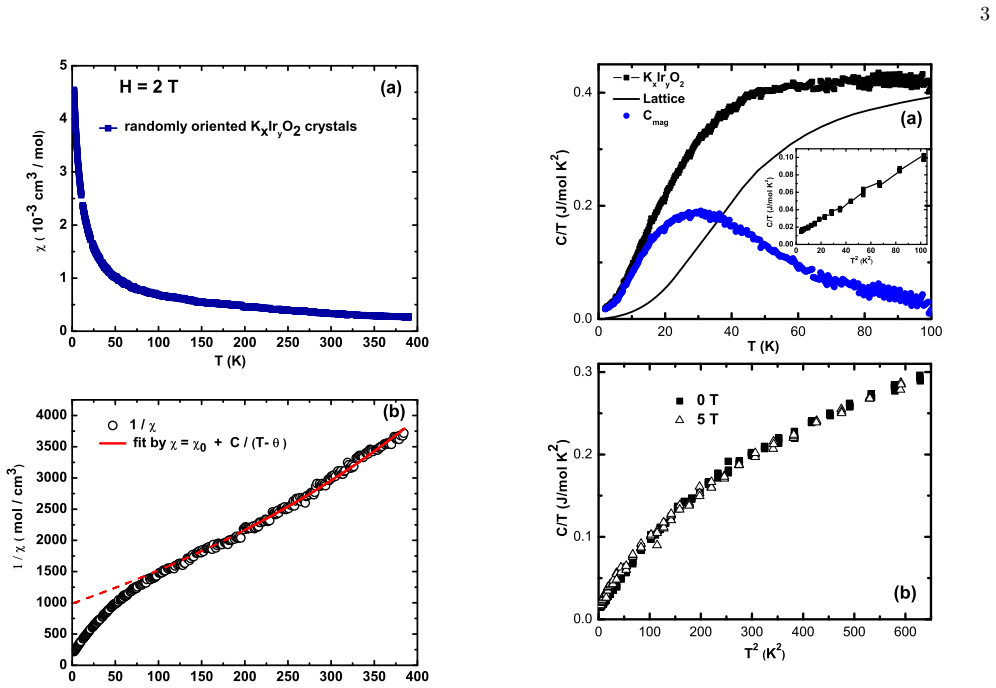
The structural motif is the depleted triangular lattice: layers of edge-sharing IrO6 octahedra form a perfect honeycomb lattice, with iridium atoms partially occupying the hexagonal voids, so the material sits between the triangular and honeycomb limits and is expected to generate bond-directional, Kitaev-like anisotropic exchange under strong spin-orbit coupling. The argument for gaplessness is carried by a subtraction: the heat capacity of Na2SnO3, rescaled for atomic mass, is taken as the approximate lattice phonon background; subtracting it leaves a magnetic Cmag with a broad ~30 K anomaly and a T-linear term. That subtraction is what converts the raw C/T data into evidence for gapless spin-liquid excitations.
What would settle it
Measure the phonon density of states of K0.85Ir0.79O2 directly with inelastic neutron scattering, or measure heat capacity of a nonmagnetic isostructural analogue with similar mass, and recompute the magnetic contribution; if the T-linear term and the ~30 K broad anomaly vanish under an accurate phonon subtraction, the gapless quantum spin liquid interpretation is refuted. Similarly, muon spin rotation or neutron diffraction below 1.8 K detecting static magnetic order or spin freezing would falsify the no-order claim.
Extended reading notes
Core claim
On its own terms, the paper's central claim is that K0.85Ir0.79O2 hosts a gapless quantum spin liquid state. The evidence chain runs as follows: susceptibility fits give S_eff = 1/2 and $\theta$ = -180(9) K, indicating strongly interacting antiferromagnetic moments; no transition or spin-glass cusp is seen in susceptibility down to 1.8 K; and heat capacity shows no sharp anomaly, a broad ~30 K maximum insensitive to a 5 T field, and a low-temperature C approximately gamma T + $\beta$ $T^{3}$ with gamma about 10 mJ/mol $K^{2}$. The T-linear term in an insulator is presented as the signature of gapless excitations of an unconventional nature. The authors acknowledge deviations from a pure Kitaev model, including the negative Weiss temperature and the T-linear rather than $T^{2}$ heat capacity, but maintain that the data are consistent with a gapless quantum spin liquid state.
Load-bearing premise
The claim that the heat capacity contains a magnetic T-linear term depends on the assumption that Na2SnO3, rescaled for mass, is a good stand-in for the phonon contribution in K0.85Ir0.79O2; if the true lattice background differs, the broad anomaly and the T-linear term could change, and so could the gapless conclusion.
Editorial extensions
If this is right
- K0.85Ir0.79O2 becomes a new experimental platform for Kitaev physics on a lattice that interpolates between triangular and honeycomb geometries.
- The absence of magnetic order down to 1.8 K despite |theta| approx 180 K establishes a strong-frustration regime in a 5d spin-orbit Mott insulator.
- The T-linear heat capacity with gamma approx 10 mJ/mol K^2 implies the low-energy excitations are gapless; if the quantum spin liquid picture is right, this is consistent with a spinon Fermi surface rather than a gapped Z2 spin liquid.
- The field insensitivity of the specific heat near 30 K suggests the broad anomaly is not due to conventional magnons or a field-tunable transition.
- The stoichiometry can be tuned through the potassium content x, so varying x between the triangular and honeycomb regimes provides a direct way to map the evolution of magnetic phases between these limits.
Reading between the lines
- If the gapless quantum spin liquid interpretation survives a more accurate phonon subtraction, the residual gamma would imply a spinon Fermi surface; a natural test is low-temperature thermal conductivity, which should show a finite residual term in a clean enough sample.
- The role of stacking faults is not settled by this paper; a disorder-driven explanation of the power-law heat capacity would make the material a random-singlet or valence-bond-glass candidate, so distinguishing stacking-fault disorder from intrinsic quantum spin liquid physics is a key next measurement.
- The comparison with Na2SnO3 could be validated by measuring heat capacity of a nonmagnetic isostructural analogue with similar mass, or by tuning x into the triangular regime to see how the broad anomaly and gamma evolve.
Signed reviews
Editorial analysis
A structured set of objections, weighed in public.
Referee Report
Summary. The paper reports the discovery and bulk characterization of a new layered iridate, K0.85Ir0.79O2, whose Ir layers form a honeycomb lattice with partially occupied triangular voids, placing it between the triangular and honeycomb lattice limits relevant to Kitaev physics. Magnetic susceptibility measurements on single crystals show S_eff = 1/2 local moments with a Curie-Weiss temperature of approximately -180 K and no magnetic order or spin freezing down to 1.8 K. Heat capacity measurements show no sharp anomaly, a broad maximum near 30 K that is insensitive to magnetic field, and a T-linear low-temperature term with gamma ~ 10 mJ/mol K^2 after subtracting an approximate lattice contribution based on Na2SnO3. The authors interpret these results as consistent with a gapless quantum spin liquid, while explicitly noting that the possible role of stacking-fault disorder in producing the low-temperature power-law behavior requires future investigation.
Significance. If the gapless QSL interpretation holds, this material is a valuable new experimental platform that interpolates between the triangular and honeycomb lattices in the context of Kitaev-Heisenberg physics. The paper's strengths include the growth and identification of a new iridate family, careful bulk susceptibility and heat-capacity measurements, standard and transparent fitting procedures, and an appropriately cautious phrasing in several passages that acknowledges the approximate lattice subtraction and the potential role of disorder. However, the evidence presented is exclusively bulk thermodynamic; no microscopic probe is reported, and the central QSL claim is underdetermined relative to a disorder-driven random-singlet or valence-bond-glass scenario. The significance is therefore real but conditional on additional experimental substantiation.
major comments (2)
- [Heat Capacity] The extraction of the magnetic heat capacity C_mag and, in particular, the T-linear coefficient gamma ~ 10 mJ/mol K^2 depends entirely on the assumption that Na2SnO3, rescaled for atomic mass, accurately represents the phonon contribution of K0.85Ir0.79O2. The manuscript acknowledges this is 'approximate' but provides no error estimate, no sensitivity analysis, and no alternative phonon model. Because the broad anomaly near 30 K and the T-linear term are the central evidence for gapless excitations, this subtraction is load-bearing; if the true lattice contribution differs, the inferred gamma and anomaly could be substantially altered. The authors should show the raw C/T versus T^2 data with the fitted lattice contribution, quantify the uncertainty in gamma, and discuss whether a phonon or defect contribution could mimic the reported behavior.
- [Summary and Discussion] The reported observations—no magnetic order, a broad field-insensitive C/T anomaly, and a T-linear or power-law low-temperature heat capacity—are also the standard signatures of a random-singlet or valence-bond-glass state driven by disorder, and the paper itself notes that 'the possible role of disorder (apparent in the stacking faults) in producing the power-law C(T) at low temperatures also needs investigation.' The title and abstract nevertheless assert a quantum spin liquid, while the evidence is only 'consistent with' that interpretation. Without microscopic probes such as muSR, neutron scattering, or low-temperature thermal conductivity, or a quantitative characterization of the stacking-fault disorder, the data cannot distinguish intrinsic spinon excitations from a disordered singlet state. The authors should either add such evidence or explicitly reframe the central claim as a candidate gapless QSL and state in the abstract and title that a disorder-driven scenario is equally consistent with the current data.
minor comments (5)
- [Heat Capacity] The sentence 'similar to the behaviour seen in several quantum spin liquid materials like.' is incomplete and ends abruptly; it should either be completed or removed.
- [Introduction] The word 'ellusive' should be 'elusive'.
- [Summary and Discussion] The word 'interplotes' should be 'interpolates'.
- [Summary and Discussion] The formula K0.85(Ir0.39/3Ir2/3)O2 is ambiguous; writing the fractional occupation explicitly as K0.85(Ir0.39/3Ir2/3)O2 would improve readability.
- [Magnetic Susceptibility] The Curie-Weiss fit is described as applying to data 'above T≈200 K' but the temperature range of the fit and the goodness of fit are not reported; stating the exact fit range and residuals would aid reproducibility.
Circularity Check
No circularity: the paper reports measurements and standard fits, and its QSL interpretation is a consistency argument, not a derivation from the conclusion.
full rationale
The paper is an experimental characterization of K0.85Ir0.79O2. Its central claim that the material is a gapless quantum spin liquid candidate is supported by susceptibility and heat-capacity data: Curie-Weiss analysis gives S_eff = 1/2 and theta = -180 K; no magnetic order or spin freezing is observed down to 1.8 K; heat capacity shows a field-insensitive broad anomaly near 30 K and a T-linear low-temperature term with gamma ~ 10 mJ/mol K^2. None of these steps is circular in the sense of the analysis. The Curie-Weiss fit is a standard two-parameter fit to high-temperature susceptibility, not a fit that assumes the QSL conclusion. The T-linear term is extracted from the measured heat capacity with an approximate lattice subtraction using Na2SnO3, which is an external reference compound, not a self-citation and not a parameter fitted to the target data. The QSL interpretation is explicitly stated as 'consistent with' the data (abstract and Summary), not derived from a model whose inputs already encode the outcome. The paper does invoke its own prior structural work (ref. 34) for the crystal structure, but that is ordinary citation of a separately reported experimental/DFT determination and does not by itself establish the magnetic ground state. The main weakness, acknowledged by the authors, is that a disorder-driven random-singlet state could also explain the power-law C(T) and lack of magnetic order; but that is an underdetermination/correctness concern, not circularity. No equation is defined in terms of the claim, no fitted parameter is relabeled as a prediction, and no load-bearing uniqueness theorem is imported from the authors' own work. Therefore the circularity score is 0.
Assumptions & free parameters
free parameters (4)
- Curie-Weiss chi0 =
-1.1(7) x 10^-4 cm3/mol
- Curie constant C =
0.391(3) cm3 K/Ir mol
- Weiss temperature theta =
-180(9) K
- gamma (T-linear heat capacity coefficient) =
10 mJ/mol K^2
assumptions (3)
- domain assumption Ir4+ in edge-sharing octahedra with strong spin-orbit coupling gives an effective spin-1/2 moment
- domain assumption Na2SnO3 heat capacity, rescaled for mass, approximates the lattice heat capacity of K0.85Ir0.79O2
- domain assumption Collection of randomly oriented crystals gives an isotropic powder average susceptibility
Cite this review
Pith. "Pith review of Quantum Spin Liquid in a depleted triangular lattice Iridate K$_x$Ir$_y$O$_2$." pith.science (2026). https://pith.science/paper/G3AEWWGS
@misc{pith2026190808475,
  author       = {Pith},
  title        = {Pith review of: Quantum Spin Liquid in a depleted triangular lattice Iridate K$_x$Ir$_y$O$_2$},
  year         = {2026},
  howpublished = {\url{https://pith.science/paper/G3AEWWGS}},
  note         = {Machine review of arXiv:1908.08475}
}
abstract
We report discovery of a new iridate family K$_x$Ir$_y$O$_2$ with depleted triangular lattice planes made up of edge sharing IrO$_6$ octahedra separated by K planes. Such a material interpolates between the triangular and honeycomb lattices and is a new playground for Kitaev physics. The materials are Mott insulators with $y = 1 - x/4$. Physical property measurements for the $x \approx 0.85$ material are reported. Using magnetic susceptibility $\chi$ versus temperature $T$ measurements we find $S_{eff} = 1/2$ moments interacting strongly with a Weiss temperature $\theta \approx - 180$~K and no magnetic order or spin freezing down to $T = 1.8$~K\@. Heat capacity shows a broad maximum around $30$~K which is insensitive to magnetic fields and a $T$-linear low temperature behaviour with $\gamma \sim 10$~mJ/mol~K$^2$. These results are consistent with a gapless QSL state in K$_{0.85}$Ir$_{0.79}$O$_2$.
Figures

Forward citations
Cited by 1 Pith paper
-
Large off diagonal exchange couplings and spin liquid states in $\mathbf{C_3}$ symmetric iridates
C3-symmetric K2IrO3 is predicted to have off-diagonal exchange couplings about ten times larger than Na2IrO3, and exact diagonalization shows such couplings can stabilize spin liquid phases.
Reference graph
Works this paper leans on
- [1]
-
[2]
Balents, Nature (London) 464 , 199 (2010)
L. Balents, Nature (London) 464 , 199 (2010)
work page 2010
- [3]
- [4]
-
[5]
J. Chaloupka, G. Jackeli, and G. Khaliullin, Phys. Rev. Lett. 105 , 027204 (2010)
work page 2010
-
[6]
S. M. Winter, A. A. Tsirlin, M. Daghofer, J. van den Brink, Y. Singh, P. Gegenwart, and R. Valenti, J. of Phys: Condensed Matter 29 , 493002 (2017)
work page 2017
- [7]
- [8]
Show all 38 references
-
[9]
X. Liu, T. Berlijn, W-G. Yin, W. Ku, A. Tsvelik, Y-J. Kim, H. Gretarsson, Y. Singh, P. Gegenwart, and J. P. Hill, Phys. Rev. B 83 (22), 220403(R) (2011)
2011
-
[10]
Kimchi and Y.-Z
I. Kimchi and Y.-Z. You, Phys. Rev. B 84 , 180407(R) (2011)
2011
-
[11]
S. K. Choi, R. Coldea, A. N. Kolmogorov, T. Lancaster, I. I. Mazin, S. J. Blundell, P. G. Radaelli, Y. Singh, P. Gegenwart, K. R. Choi, S. W. Cheong, P. J. Baker, C. Stock, and J. Taylor. Phys. Rev. Lett. 108 , 127204 (2012)
2012
-
[12]
F. Ye, S. Chi, H. Cao, B. C. Chakoumakos, J. A. Fernandez-Baca, R. Custelcean, T. F. Qi, O. B. Korneta, and G. Cao, Phys. Rev. B 85 , 180403(R) (2012)
2012
-
[13]
Singh, S
Y. Singh, S. Manni, J. Reuther, T. Berlijn, R. Thomale, W. Ku, S. Trebst, and P. Gegenwart. Phys. Rev. Lett. 108 , 127203 (2012)
2012
-
[14]
Gretarsson, J
H. Gretarsson, J. P. Clancy, X. Liu, J. P. Hill, E. Bozin, Y. Singh, S. Manni, P. Gegenwart, J. Kim, A. H. Said, D. Casa, T. Gog, M. H. Upton, H-S. Kim, J. Yu, V. M. Katukuri, L. Hozoi, J. van den Brink, Young-June Kim, Phys. Rev. Lett. 110 , 076402 (2013)
2013
-
[15]
Comin, G
R. Comin, G. Levy, B. Ludbrook, Z.-H. Zhu, C. N. Veenstra, J. A. Rosen, Y. Singh, P. Gegenwart, D. Stricker, J. N. Hancock, D. vanderMarel, I. S. Elfimov, and A. Damascelli. Phys. Rev. Lett. 109 , 266406 (2012)
2012
-
[16]
Chaloupka, G
J. Chaloupka, G. Jackeli, and G. Khaliullin, Phys. Rev. Lett. 110 , 097204 (2013)
2013
-
[17]
Gretarsson, J
H. Gretarsson, J. P. Clancy, Y. Singh, P. Gegenwart, J. P. Hill, J. Kim, M. H. Upton, A. H. Said, D. Casa, T. Gog, Y-J. Kim, Phys. Rev. B 87 , 220407(R) (2013)
2013
-
[18]
Foyevtsova, H
K. Foyevtsova, H. O. Jeschke, I. I. Mazin, D. I. Khomskii, R. Valenti, Phys. Rev. B 88 , 035107 (2013)
2013
-
[19]
V. M. Katukuri, S. Nishimoto, V. Yushankhai, A. Stoyanova, H. Kandpal, S. Choi, R. Coldea, I. Rousochatzakis, L. Hozoi, and J. van den Brink, New J. Phys. 16 , 013056 (2014)
2014
-
[20]
Yamaji, Y
Y. Yamaji, Y. Nomura, M. Kurita, R. Arita, and M. Imada, Phys. Rev. Lett. 113 , 107201 (2014)
2014
-
[21]
Sizyuk, C
Y. Sizyuk, C. Price, P. Wo ̈lfle, and N. B. Perkins, Phys. Rev. B 90, 155126 (2014)
2014
-
[22]
S. H. Chun, J-W. Kim, J. Kim, H. Zheng, C. C. Stoumpos, C. D. Malliakas, J. F. Mitchell, K. Mehlawat, Yogesh Singh, Y. Choi, T. Gog, A. Al-Zein, M. Moretti Sala, M. Krisch, J. Chaloupka, G. Jackeli, G. Khaliullin, and B. J. Kim, Nature Phys. 11 , 462(2015)
2015
-
[23]
Kitagawa, T
K. Kitagawa, T. Takayama, Y. Matsumoto, A. Kato, R. Takano, Y. Kishimoto, S. Bette, R. Dinnebier, G. Jackeli, and H. Takagi, Nature (London) 554 , 341 (2018)
2018
-
[24]
Abramchuk, C
M. Abramchuk, C. Ozsoy-Keskinbora, J. W. Krizan, K. R. Metz, D. C. Bell, and F. Tafti, J. Am. Chem. Soc. 139 , 15371 (2017)
2017
-
[25]
Y. S. Choi, C. H. Lee, S. Lee, Sungwon Yoon, W.-J. Lee, J. Park, Anzar Ali, Yogesh Singh, Jean-Christophe Orain, Gareoung Kim, Jong-Soo Rhyee, Wei-Tin Chen, Fangcheng Chou, and Kwang-Yong Choi, Phys. Rev. Lett. 122 , 167202 (2019)
2019
-
[26]
Kimchi and A
I. Kimchi and A. Vishwanath, Phys. Rev. B 89 , 014414 (2014)
2014
-
[27]
Rousochatzakis, U
I. Rousochatzakis, U. K. Rossler, J. van den Brink, and M. Daghofer, Phys. Rev. B 93 , 104417 (2016)
2016
-
[28]
Huang, M
Q. Huang, M. L. Foo, R. A. Pascal, J. W. Lynn, B. H. Toby, T. He, H. W. Zandbergen, and R. J. Cava, Phys. Rev. B 70 , 184110 (2004)
2004
-
[29]
Jansen and R
M. Jansen and R. Hoppe, Z. Anorg. Allg. Chem. 408 , 97 (1974)
1974
-
[30]
Hironaka, K
Y. Hironaka, K. Kubota, and S. Komaba, Chem. Com- mun. 53 , 3693 (2017)
2017
-
[31]
Nakamura, J
S. Nakamura, J. Ohtake, N. Yonezawa, and S. Iida, J. Phys. Soc. Japan 65 , 358 (1996)
1996
-
[32]
Shibasaki, T
S. Shibasaki, T. Nakano, I. Terasaki, K. Yubuta, and T. Kajitani, Journal of Physics: Condensed Matter 22 , 115603 (2010)
2010
-
[33]
Zhang, S.-T
B.-B. Zhang, S.-T. Dong, Y. B. Chen, L.-Y. Zhang, J. Zhou, S. H. Yao, Z.-B. Gu, S.-T. Zhang, and Y.-F. Chen, Cryst. Eng. Comm. 15 , 5050 (2013)
2013
-
[34]
R. D. Johnson, I. Broeders, K. Mehlawat, Y. Li, Yogesh Singh, R. Valenti, and R. Coldea, arXiv:1908.04584v1 (2019)
2019 arXiv
-
[35]
J. Nasu, M. Udagawa, and Y. Motome, Phys. Rev. B 92 , 115122 (2015)
2015
-
[36]
Yamaji, T
Y. Yamaji, T. Suzuki, T. Yamada, S. I. Suga, N. Kawashima, and M. Imada, Phys. Rev. B 93 , 174425 (2016)
2016
-
[37]
Manni, Synthesis and investigation of frustrated Honeycomb lattice iridates and rhodates
S. Manni, Synthesis and investigation of frustrated Honeycomb lattice iridates and rhodates. Ph.D. thesis, Georg-August-Universität Göttingen (2014)
2014
-
[38]
Freund, S
F. Freund, S. C. Williams, R. D. Johnson, R. Coldea, P. Gegenwart, and A. Jesche, Nature Scientific Reports 6 , 35362 (2016). references document
2016
Reviewed August 14, 2026 · model on record in the stance chip above.
Discussion (0). Continue with ORCID to comment.