Solving Nonequilibrium Dynamics via Influence Matrix Bootstrap: Floquet-PXP Model
Pith reviewed 2026-06-26 20:23 UTC · model grok-4.3
The pith
The influence matrix with generalized zipper conditions and numerical bootstrap solves nonequilibrium dynamics in the Floquet-PXP model, exposing initial-state dependence.
A machine-rendered reading of the paper's core claim, the machinery that carries it, and where it could break.
Core claim
Using the influence matrix approach on the Rule 201 quantum cellular automaton, generalized zipper conditions permit exact solutions of local dynamics, while a numerical bootstrap at finite but large bond dimensions uncovers initial-state-dependent nonequilibrium behavior, including the response of oscillating dynamics to perturbations, non-thermal relaxation under conservation laws, exact entanglement growth, and a hidden Markov order structure in multitime correlations.
What carries the argument
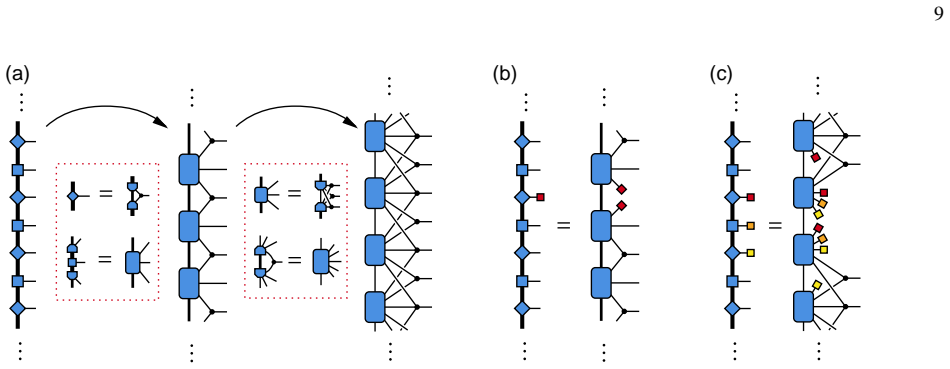
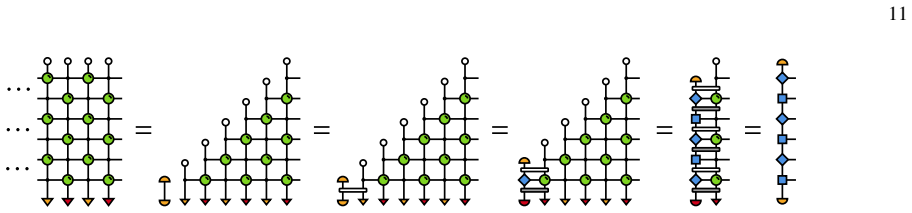
The influence matrix, a tensor-network object encoding the many-body dynamics, solved exactly by generalized zipper conditions for local operators and approximately by bootstrap at finite bond dimension.
If this is right
- Persistent oscillating dynamics can be analyzed under local non-integrable perturbations.
- Non-thermal relaxation occurs in a manner constrained by conservation laws.
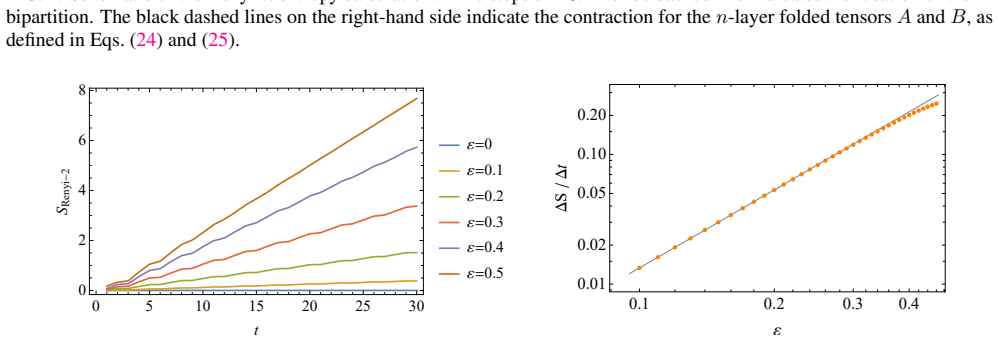
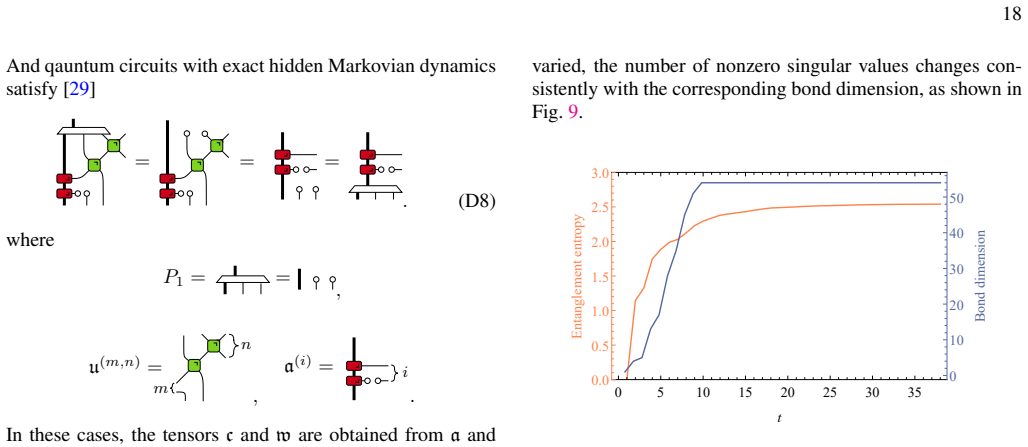
- Entanglement growth is obtained exactly for a broad class of initial states.
- Multitime correlations exhibit a refined hidden Markov order separating finite-length and long-range memory components.
- Unified treatment of nonthermalizing and thermalizing regimes becomes possible in a single model.
Where Pith is reading between the lines
- This bootstrap technique for influence matrices may extend to other Floquet or Trotterized integrable systems to classify their dynamical phases.
- Direct comparison with Rydberg atom array experiments could validate the predicted initial-state dependence of relaxation and entanglement.
- The split-index matrix-product-state representation of the influence matrix suggests a general way to separate memory scales in quantum channels.
- Classical Rule 201 cellular automaton dynamics might share analogous structures with the quantum version studied here.
Load-bearing premise
The influence matrix admits exact solutions via generalized zipper conditions for local dynamics and can be numerically bootstrapped at finite but large bond dimensions to capture the claimed landscape of initial-state dependent behavior.
What would settle it
An experiment in a Rydberg atom array measuring entanglement growth or relaxation rates for different initial states that either matches or deviates from the influence matrix predictions.
Figures
read the original abstract
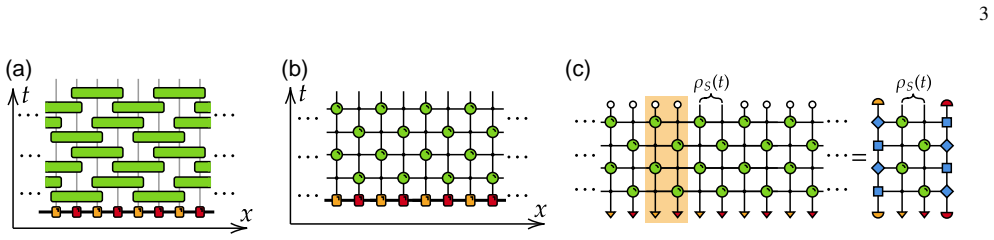
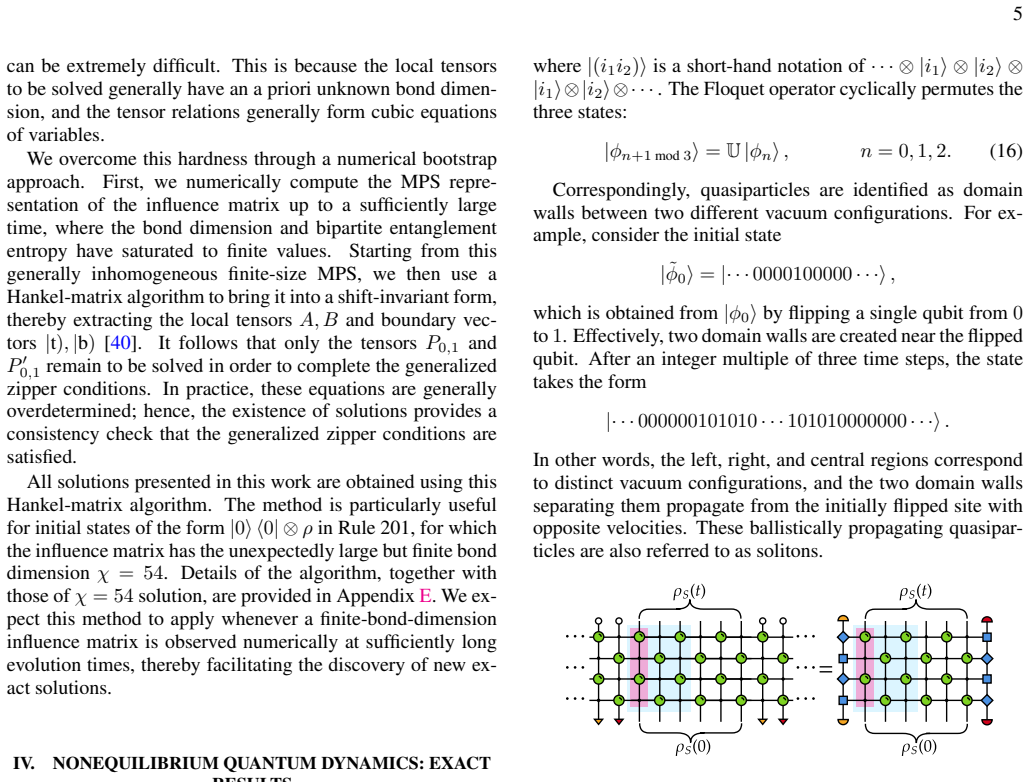
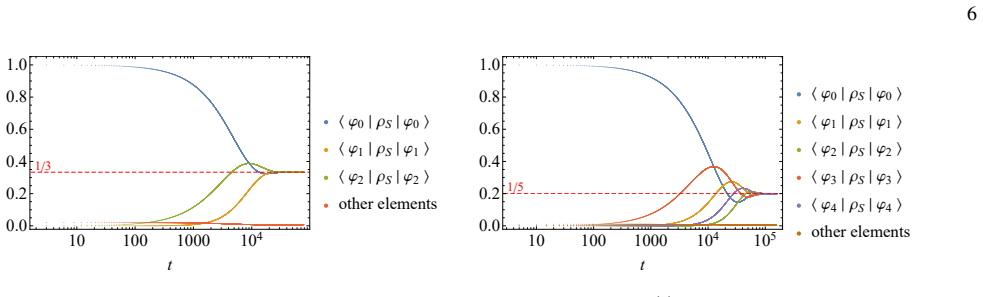
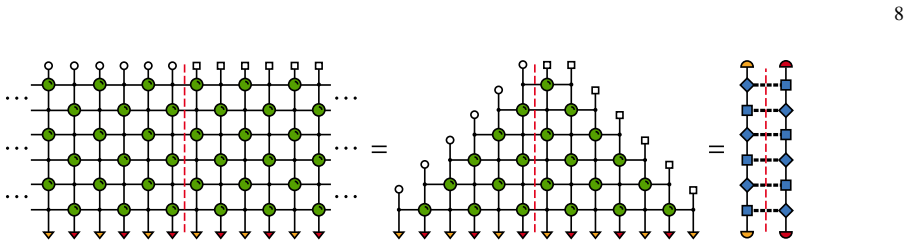
Studies of integrable systems have profoundly deepened the fundamental understanding of quantum many-body physics. While equilibrium properties such as ground states and thermodynamics can often be characterized efficiently, accurately characterizing nonequilibrium integrable dynamics remains a significant challenge. Here, we address this problem in the "Rule 201" quantum cellular automaton, an integrable Trotterization of the PXP Hamiltonian. Using the tensor-network approach of the influence matrix, we develop local conditions called generalized zipper conditions that allow exact solutions of local dynamics. We also introduce a numerical bootstrap method for solving influence matrices with finite but relatively large bond dimensions. This uncovers a rich landscape of nonequilibrium behavior exhibiting initial-state dependence. As an example, we investigate the fate of persistent oscillating dynamics under local non-integrable perturbations, and present analytical results for non-thermal relaxation constrained by conservation laws. We also obtain numerically exact results for entanglement growth across a broad class of initial states. Furthermore, from an information-theoretic perspective, we identify a refined structure of multitime correlations termed the hidden Markov order: the memory encoded in the dynamics separates into finite-length and long-range distributed components, which becomes transparent in an exact split-index matrix-product-state representation of the influence matrix. Our approach enables unified investigations of nonthermalizing and thermalizing regimes of nonequilibrium dynamics within a single analytically tractable model, and can be tested experimentally in state-of-the-art quantum simulators such as Rydberg atom arrays.
Editorial analysis
A structured set of objections, weighed in public.
Referee Report
Summary. The paper claims to solve nonequilibrium dynamics in the integrable 'Rule 201' quantum cellular automaton (Floquet-PXP model) via the influence matrix tensor-network approach. It develops generalized zipper conditions enabling exact solutions for local dynamics, introduces a numerical bootstrap method at finite but relatively large bond dimensions to uncover initial-state dependent behavior, analyzes the fate of oscillations under non-integrable perturbations, derives analytical results for non-thermal relaxation constrained by conservation laws, obtains numerically exact entanglement growth for broad initial states, and identifies a hidden Markov order structure in multitime correlations via an exact split-index MPS representation of the influence matrix. The approach unifies nonthermalizing and thermalizing regimes in one model, with experimental relevance to Rydberg arrays.
Significance. If the results hold, this provides a new analytically tractable framework for nonequilibrium integrable dynamics that bridges regimes previously studied separately, with the hidden Markov order offering information-theoretic insight into dynamical memory. Strengths include the exact zipper conditions for local dynamics and the bootstrap enabling numerical access to a rich landscape of behaviors; these could enable falsifiable predictions testable in quantum simulators.
major comments (2)
- [Abstract and method development paragraphs] Abstract and method development paragraphs: the central claim of 'numerically exact' results for entanglement growth and the rich landscape of initial-state dependent behavior (including distinction between thermalizing and nonthermalizing regimes) rests on the influence matrix bootstrap at finite but 'relatively large' bond dimensions; however, no convergence tests with increasing bond dimension, error bounds on multitime correlations, or analysis of truncation effects for long-time/global observables are provided, leaving open whether finite-D errors could obscure the claimed distinctions.
- [Abstract] Abstract: the assertion that generalized zipper conditions 'allow exact solutions of local dynamics' is load-bearing for the analytical results on non-thermal relaxation and the exact split-index MPS representation, yet the manuscript provides neither the explicit form of these conditions nor a derivation verifying they close without approximation or residual error.
minor comments (1)
- [Abstract] The abstract refers to 'numerically exact' results without qualifying the bond dimension or providing a reference to the specific numerical data or figures supporting this.
Simulated Author's Rebuttal
We thank the referee for their careful reading of the manuscript and for highlighting its potential significance in providing a unified framework for nonequilibrium dynamics in the Floquet-PXP model. We address the two major comments point by point below, with revisions planned where the concerns identify gaps in the current presentation.
read point-by-point responses
-
Referee: [Abstract and method development paragraphs] Abstract and method development paragraphs: the central claim of 'numerically exact' results for entanglement growth and the rich landscape of initial-state dependent behavior (including distinction between thermalizing and nonthermalizing regimes) rests on the influence matrix bootstrap at finite but 'relatively large' bond dimensions; however, no convergence tests with increasing bond dimension, error bounds on multitime correlations, or analysis of truncation effects for long-time/global observables are provided, leaving open whether finite-D errors could obscure the claimed distinctions.
Authors: We agree that the absence of explicit convergence tests and error bounds weakens the support for the 'numerically exact' characterization at the finite bond dimensions employed. In the revised manuscript we will add systematic comparisons of entanglement growth and multitime correlation functions across a range of increasing bond dimensions, include quantitative error estimates where feasible, and discuss truncation effects on long-time observables to confirm that the reported distinctions between initial states and regimes remain robust. revision: yes
-
Referee: [Abstract] Abstract: the assertion that generalized zipper conditions 'allow exact solutions of local dynamics' is load-bearing for the analytical results on non-thermal relaxation and the exact split-index MPS representation, yet the manuscript provides neither the explicit form of these conditions nor a derivation verifying they close without approximation or residual error.
Authors: The current manuscript does not present the explicit algebraic form of the generalized zipper conditions or a self-contained derivation of their exact closure. We will revise the main text (and add an appendix if necessary) to state the conditions explicitly and derive that they close without residual error for local observables, thereby grounding the analytical claims on non-thermal relaxation and the split-index MPS representation. revision: yes
Circularity Check
No significant circularity detected; method development is self-contained
full rationale
The paper develops generalized zipper conditions for exact local dynamics and a numerical bootstrap for finite-bond-dimension influence matrices as new tools within the tensor-network framework. No load-bearing steps reduce by construction to fitted inputs, self-definitions, or self-citation chains; the central claims concern the method's ability to reveal initial-state-dependent behavior and multitime correlation structure, which rest on the independent construction of these conditions rather than renaming or circular fitting. This is a standard methodological contribution with external testability via quantum simulators.
Axiom & Free-Parameter Ledger
axioms (1)
- domain assumption Tensor-network representations can capture the influence of past dynamics on future evolution in integrable systems
invented entities (2)
-
generalized zipper conditions
no independent evidence
-
influence matrix bootstrap
no independent evidence
Forward citations
Cited by 1 Pith paper
-
Exact subsystem dynamics in the deterministic Floquet-PXP model
Rule 201 in the deterministic Floquet-PXP model admits exact finite-dimensional MPO influence matrices for subsystem dynamics that solve algebraic conditions.
Reference graph
Works this paper leans on
-
[1]
quantum defects
to the bottom of the diagram. Then, using the first two relations in Eq. (9), these projectors can be propa- gated through each layer. Next, applying the top-boundary, bulk, and bottom-boundary conditions sequentially, the action of the spatial transfer matrix is reduced, compressing the bond dimension from4×χtoχ. The top-down elimination of ten- sors is ...
-
[2]
Rigol, V
M. Rigol, V . Dunjko, V . Yurovsky, and M. Olshanii, Relaxation in a completely integrable many-body quantum system: An ab initio study of the dynamics of the highly excited states of 1d lattice hard-core bosons, Phys. Rev. Lett.98, 050405 (2007)
2007
-
[3]
Rigol, V
M. Rigol, V . Dunjko, and M. Olshanii, Thermalization and its mechanism for generic isolated quantum systems, Nature452, 854 (2008)
2008
-
[4]
D’Alessio, Y
L. D’Alessio, Y . Kafri, A. Polkovnikov, and M. Rigol, From quantum chaos and eigenstate thermalization to statistical me- chanics and thermodynamics, Adv. Phys.65, 239–362 (2016)
2016
-
[5]
Gogolin and J
C. Gogolin and J. Eisert, Equilibration, thermalisation, and the emergence of statistical mechanics in closed quantum systems, Rep. Prog. Phys.79, 056001 (2016)
2016
-
[6]
O. A. Castro-Alvaredo, B. Doyon, and T. Yoshimura, Emergent hydrodynamics in integrable quantum systems out of equilib- rium, Phys. Rev. X6, 041065 (2016)
2016
-
[7]
Bertini, M
B. Bertini, M. Collura, J. De Nardis, and M. Fagotti, Transport in out-of-equilibriumxxzchains: Exact profiles of charges and currents, Phys. Rev. Lett.117, 207201 (2016)
2016
-
[8]
Doyon, S
B. Doyon, S. Gopalakrishnan, F. Møller, J. Schmiedmayer, and R. Vasseur, Generalized hydrodynamics: A perspective, Phys. Rev. X15, 010501 (2025)
2025
-
[9]
Bernien, S
H. Bernien, S. Schwartz, A. Keesling, H. Levine, A. Omran, H. Pichler, S. Choi, A. S. Zibrov, M. Endres, M. Greiner,et al., Probing many-body dynamics on a 51-atom quantum simulator, Nature551, 579 (2017)
2017
-
[10]
C. J. Turner, A. A. Michailidis, D. A. Abanin, M. Serbyn, and Z. Papi´c, Weak ergodicity breaking from quantum many-body scars, Nat. Phys.14, 745–749 (2018)
2018
-
[11]
S. Choi, C. J. Turner, H. Pichler, W. W. Ho, A. A. Michailidis, Z. Papi´c, M. Serbyn, M. D. Lukin, and D. A. Abanin, Emergent su(2) dynamics and perfect quantum many-body scars, Phys. Rev. Lett.122, 220603 (2019)
2019
-
[12]
Iadecola and S
T. Iadecola and S. Vijay, Nonergodic quantum dynamics from deformations of classical cellular automata, Phys. Rev. B102, 180302 (2020)
2020
-
[13]
J. W. P. Wilkinson, K. Klobas, T. c. v. Prosen, and J. P. Garra- han, Exact solution of the floquet-pxp cellular automaton, Phys. Rev. E102, 062107 (2020)
2020
-
[14]
Giudici, F
G. Giudici, F. M. Surace, and H. Pichler, Unraveling pxp many- body scars through floquet dynamics, Phys. Rev. Lett.133, 190404 (2024)
2024
- [15]
-
[16]
M. C. Ba ˜nuls, M. B. Hastings, F. Verstraete, and J. I. Cirac, Ma- trix product states for dynamical simulation of infinite chains, Phys. Rev. Lett.102, 240603 (2009)
2009
-
[17]
M ¨uller-Hermes, J
A. M ¨uller-Hermes, J. I. Cirac, and M. C. Ba ˜nuls, Tensor net- work techniques for the computation of dynamical observables in one-dimensional quantum spin systems, New J. Phys.14, 075003 (2012)
2012
-
[18]
Lerose, M
A. Lerose, M. Sonner, and D. A. Abanin, Influence matrix approach to many-body floquet dynamics, Phys. Rev. X11, 021040 (2021)
2021
-
[19]
Sonner, A
M. Sonner, A. Lerose, and D. A. Abanin, Influence functional of many-body systems: Temporal entanglement and matrix- 22 product state representation, Ann. Phys.435, 168677 (2021), special issue on Philip W. Anderson
2021
-
[20]
Ye and G
E. Ye and G. K.-L. Chan, Constructing tensor network influence functionals for general quantum dynamics, J. Chem. Phys.155, 044104 (2021)
2021
-
[21]
Bertini, P
B. Bertini, P. Kos, and T. c. v. Prosen, Exact correlation func- tions for dual-unitary lattice models in1 + 1dimensions, Phys. Rev. Lett.123, 210601 (2019)
2019
-
[22]
Piroli, B
L. Piroli, B. Bertini, J. I. Cirac, and T. c. v. Prosen, Exact dynamics in dual-unitary quantum circuits, Phys. Rev. B101, 094304 (2020)
2020
-
[23]
X.-H. Yu, Z. Wang, and P. Kos, Hierarchical generalization of dual unitarity, Quantum (2023)
2023
-
[24]
Bertini, C
B. Bertini, C. De Fazio, J. P. Garrahan, and K. Klobas, Exact quench dynamics of the floquet quantum east model at the de- terministic point, Phys. Rev. Lett.132, 120402 (2024)
2024
-
[25]
H.-R. Wang, I. Vilkoviskiy, and D. A. Abanin, Temporal com- plexity hierarchies in solvable quantum many-body dynamics, arXiv:2510.21927
-
[26]
Giudice, G
G. Giudice, G. Giudici, M. Sonner, J. Thoenniss, A. Lerose, D. A. Abanin, and L. Piroli, Temporal entanglement, quasipar- ticles, and the role of interactions, Phys. Rev. Lett.128, 220401 (2022)
2022
-
[27]
Klobas, B
K. Klobas, B. Bertini, and L. Piroli, Exact thermalization dy- namics in the “rule 54” quantum cellular automaton, Phys. Rev. Lett.126, 160602 (2021)
2021
-
[28]
Klobas and B
K. Klobas and B. Bertini, Exact relaxation to gibbs and non- equilibrium steady states in the quantum cellular automaton rule 54, SciPost Phys.11, 106 (2021)
2021
-
[29]
Klobas and B
K. Klobas and B. Bertini, Entanglement dynamics in rule 54: Exact results and quasiparticle picture, Scipost Phys.11, 107 (2021)
2021
-
[30]
Wang, X.-Y
H.-R. Wang, X.-Y . Yang, and Z. Wang, Exact hidden markovian dynamics in quantum circuits, Phys. Rev. Lett.133, 170402 (2024)
2024
-
[31]
Bobenko, M
A. Bobenko, M. Bordemann, C. Gunn, and U. Pinkall, On two integrable cellular automata, Commun.Math. Phys.158, 127 (1993)
1993
-
[32]
P. N. Jepsen, J. Amato-Grill, I. Dimitrova, W. W. Ho, E. Demler, and W. Ketterle, Spin transport in a tunable heisenberg model realized with ultracold atoms, Nature588, 403 (2020)
2020
-
[33]
P. N. Jepsen, W. W. Ho, J. Amato-Grill, I. Dimitrova, E. Demler, and W. Ketterle, Transverse spin dynamics in the anisotropic heisenberg model realized with ultracold atoms, Phys. Rev. X 11, 041054 (2021)
2021
-
[34]
P. N. Jepsen, Y . K. Lee, H. Lin, I. Dimitrova, Y . Margalit, W. W. Ho, and W. Ketterle, Long-lived phantom helix states in heisen- berg quantum magnets, Nat. Phys.18, 899 (2022)
2022
-
[35]
Cecile, S
G. Cecile, S. Gopalakrishnan, R. Vasseur, and J. De Nardis, Hydrodynamic relaxation of spin helices, Phys. Rev. B108, 075135 (2023)
2023
-
[36]
Popkov, X
V . Popkov, X. Zhang, F. G¨ohmann, and A. Kl¨umper, Chiral ba- sis for qubits and spin-helix decay, Phys. Rev. Lett.132, 220404 (2024)
2024
-
[37]
Taranto, F
P. Taranto, F. A. Pollock, S. Milz, M. Tomamichel, and K. Modi, Quantum markov order, Phys. Rev. Lett.122, 140401 (2019)
2019
-
[38]
R. J. Baxter, Exactly solved models in statistical mechanics (Academic Press, 1982)
1982
-
[39]
Prosen, Many-body quantum chaos and dual-unitarity round- a-face, Chaos31(2021)
T. Prosen, Many-body quantum chaos and dual-unitarity round- a-face, Chaos31(2021)
2021
-
[40]
Haegeman and F
J. Haegeman and F. Verstraete, Diagonalizing transfer matrices and matrix product operators: A medley of exact and computa- tional methods, Annu. Rev. Condens8, 355 (2017)
2017
-
[41]
Balle, X
B. Balle, X. Carreras, F. M. Luque, and A. Quattoni, Spectral learning of weighted automata: A forward-backward perspec- tive, Mach. Learn.96, 33–63 (2013)
2013
-
[42]
Bertini, F
B. Bertini, F. H. L. Essler, S. Groha, and N. J. Robinson, Prethermalization and thermalization in models with weak in- tegrability breaking, Phys. Rev. Lett.115, 180601 (2015)
2015
-
[43]
Durnin, M
J. Durnin, M. J. Bhaseen, and B. Doyon, Nonequilibrium dy- namics and weakly broken integrability, Phys. Rev. Lett.127, 130601 (2021)
2021
-
[44]
Bertini, K
B. Bertini, K. Klobas, V . Alba, G. Lagnese, and P. Calabrese, Growth of r´enyi entropies in interacting integrable models and the breakdown of the quasiparticle picture, Phys. Rev. X12, 031016 (2022)
2022
-
[45]
D. T. Stephen, Non-onsite symmetries and quantum telepor- tation in split-index matrix product states, Quantum9, 1738 (2025)
2025
-
[46]
Klobas, M
K. Klobas, M. Vanicat, J. P. Garrahan, and T. Prosen, Ma- trix product state of multi-time correlations, J. Phys. A: Math. Theor.53, 335001 (2020)
2020
-
[47]
Lerose, M
A. Lerose, M. Sonner, and D. A. Abanin, Overcoming the en- tanglement barrier in quantum many-body dynamics via space- time duality, Phys. Rev. B107, L060305 (2023)
2023
discussion (0)
Sign in with ORCID, Apple, or X to comment. Anyone can read and Pith papers without signing in.