REVIEW 3 major objections 5 minor 23 references
Ordinary first-person human videos can be turned into robot-trainable mixed-reality demos that keep object geometry and full-hand motion.
Reviewed by Pith at T0; open to challenge. T0 means a machine referee read the full paper against a public rubric. the ladder, T0–T4 →
T0 review · grok-4.5
2026-07-14 15:27 UTC pith:G4BSWCL4
load-bearing objection Clean systems packaging of object-preserving full-hand FPV-to-humanoid synthesis; retargeting metrics look real, but the robot-trainable claim outruns the evidence. the 3 major comments →
AgenticFocus: Object-Preserving Mixed Reality Synthesis from Human FPV Video for Dexterous Humanoid Learning
The pith
A machine-rendered reading of the paper's core claim, the machinery that carries it, and where it could break.
Core claim
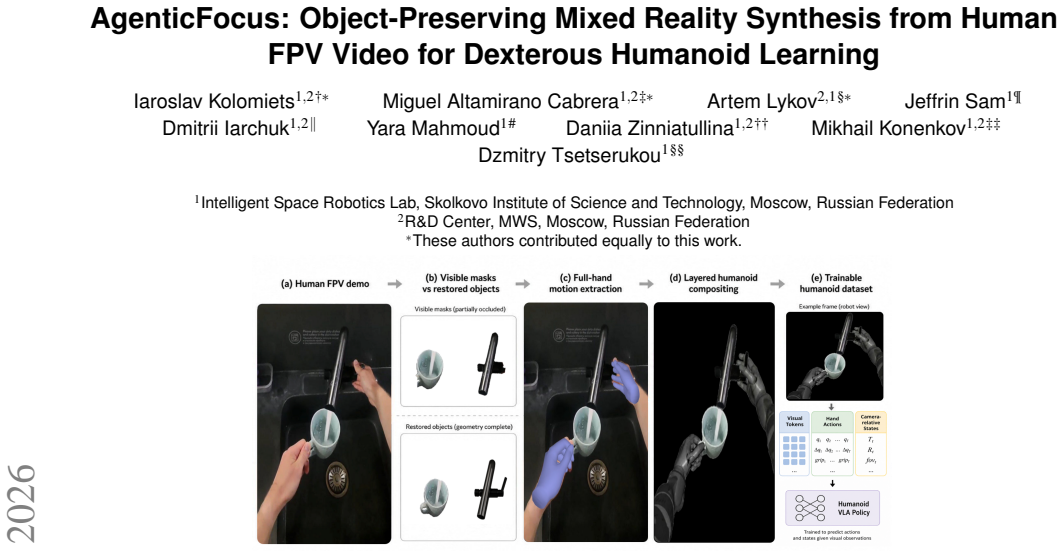
AgenticFocus shows that ordinary monocular human FPV videos can be converted into synchronized robot-trainable demonstrations by restoring occluded object geometry, retargeting full-hand motion through camera-relative alignment, and layered mixed-reality compositing, yielding lower mean 3D trajectory error and smoother wrist motion (SPARC −5.18 versus −5.56 and −6.05) than prior cross-embodiment baselines.
What carries the argument
AgenticFocus pipeline: object-preserving inpainting plus stable object-template reinsertion, camera-relative full-hand retargeting to a multi-fingered humanoid, and layered compositing (full-hand pass plus near-contact thumb pass) that keeps task objects and plausible contact depth while pairing visuals with robot actions and states.
Load-bearing premise
That restoring a clean object template after actor removal and layering a full-hand render with a near-contact thumb pass is enough to keep contact geometry and depth ordering accurate for training multi-fingered robot policies.
What would settle it
Train the same humanoid visuomotor policy on AgenticFocus demos versus the two baselines on the same FPV clips and measure whether AgenticFocus yields reliably higher real-robot success on contact-rich grasps of small objects; or measure residual object-geometry and depth-ordering error at contact frames against ground-truth meshes.
Editorial analysis
A structured set of objections, weighed in public.
Referee Report
Summary. AgenticFocus proposes a Mixed Reality pipeline that converts ordinary monocular human FPV videos into synchronized humanoid training demonstrations. It isolates task-relevant objects (VLM + SAM2), restores occluded object geometry via an object-preserving inpainting mask Minpaint and template reinsertion, reconstructs full-hand motion (WiLoR/HaMeR-style), retargets it to Unitree G1 + BrainCo hands through camera-relative mapping (Eq. 2) and EMA-smoothed IK (Eq. 3), and composites via layered full-hand / near-contact thumb / object-template rendering. The paper reports lower mean 3D trajectory error and smoother wrist SPARC (−5.18 vs −5.56 Masquerade and −6.05 Do as I Do; 75 episodes, 95% CIs) under a shared protocol on EPIC-KITCHENS and internal clips, and claims the resulting focused visuals + actions/states constitute robot-trainable supervision for dexterous humanoid policies without specialized capture hardware.
Significance. If the pipeline truly yields usable visuomotor supervision at scale from ordinary FPV, it would lower a central data barrier for multi-fingered humanoids in household, assistive, and service settings, and would be a practical alternative to mocap gloves, stereo rigs, and scene-specific twins. Strengths include a constructive (non-end-to-end generative) decomposition, explicit object-preserving inpainting, full-hand rather than gripper-level retargeting, quantitative comparison against two external baselines with bootstrap CIs, and open acknowledgment that policy training is future work. The contribution is therefore of clear applied interest to the robotics and embodied-AI community, provided the leap from retargeting fidelity to trainability is either demonstrated or more carefully scoped.
major comments (3)
- The abstract, introduction, and contributions frame AgenticFocus as producing “robot-trainable demonstrations” and “supervision … suitable for training reactive humanoid visuomotor policies.” §§3.2–3.3 and Figs. 3–4 evaluate only intermediate retargeting fidelity (mean 3D trajectory error and wrist SPARC). No object-reconstruction error, contact-consistency, depth-ordering, or grasp-feature metric is reported for the template reinsertion (§2.2) or layered compositing (§2.4), and the Conclusion explicitly defers downstream policy training. Trajectory/SPARC gains therefore do not yet establish the central trainability claim; either add a minimal policy or contact-geometry evaluation, or substantially narrow the claim language to “retargeted visual-action pairs with improved kinematic fidelity.”
- §2.3, Eqs. (2)–(3): retargeting depends on free parameters β (workspace scale), T_offset (virtual camera), α (EMA), and fixed wrist-orientation corrections, plus monocular hand/object estimators. The paper does not report sensitivity of trajectory error or SPARC to these choices, nor failure modes under heavy occlusion or embodiment mismatch. Without such analysis (or fixed public defaults and ablations), it is unclear whether the reported gains over Masquerade and Do as I Do are robust or pipeline-tuned.
- §2.4 layered compositing (full articulated-hand pass + near-contact thumb pass + object template) is presented as preserving “plausible depth ordering” and “near-contact depth cues,” yet no quantitative or even systematic qualitative protocol (e.g., contact-frame occlusion consistency, multi-view check, or human preference study) is given. Because contact-rich geometry is load-bearing for the “dexterous” claim, this axiom needs either measurement or clearer limitation language.
minor comments (5)
- Affiliation line and author list contain spacing/encoding artifacts (“T echnology”, “T ara”, “†∗” style markers); clean for camera-ready.
- Eq. (4) writes et =100 ∥…∥2 with an unusual “=100” placement; clarify units conversion and notation.
- Fig. 3 and Fig. 4 captions are clear, but absolute trajectory-error magnitudes (cm) and the ground-truth source for “ground-truth trajectory” are not stated in the text of §3.2; add a short sentence on how GT is obtained for FPV clips.
- Related work cites concurrent arXiv preprints (EgoEngine, Do as I Do, etc.) appropriately; ensure final versions and page numbers are updated if available at revision.
- Index terms and abstract SPARC numbers match the body; keep consistent if any re-computation is done after ablations.
Circularity Check
No derivation-chain circularity: constructive MR pipeline with external baselines and external SPARC metric.
full rationale
AgenticFocus is an engineering pipeline (object-preserving inpainting, camera-relative full-hand retargeting via Eq. 2, EMA smoothing via Eq. 3, layered compositing), not a first-principles derivation that claims to predict quantities from fitted inputs. Trajectory error and SPARC are empirical comparisons against external methods (Masquerade, Do as I Do) under a shared protocol, using an external smoothness metric (Balasubramanian et al.). EMA smoothing is a design choice that can improve SPARC by construction, but the paper does not redefine SPARC as a derived theorem or rename a fit as a prediction; it reports comparative scores. There is no self-citation load-bearing uniqueness claim, no uniqueness theorem imported from the same authors, no ansatz smuggled via self-citation, and no self-definitional X↔Y loop. Intermediate-metric evaluation without downstream policy training is a validity gap, not circularity of the derivation chain. Score 0 with empty steps is the honest finding.
Axiom & Free-Parameter Ledger
free parameters (4)
- workspace scaling factor β
- EMA smoothing coefficient α
- virtual camera offset T_offset
- fixed wrist-orientation corrections
axioms (5)
- domain assumption Visible object masks plus a single clean-frame template suffice to restore full object geometry under heavy hand occlusion after actor removal.
- domain assumption Monocular 3D hand reconstruction (WiLoR/HaMeR-style) plus MuJoCo IK yields embodiment-consistent full-hand trajectories for Unitree G1 + BrainCo.
- domain assumption Camera-relative Probot = β Rcam Phuman + Toffset aligns human FPV motion to the robot viewpoint without stereo or scene reconstruction.
- ad hoc to paper Layered compositing (full hand pass + near-contact thumb pass + object template) produces robot-trainable near-contact depth cues.
- domain assumption Lower trajectory error and higher SPARC on retargeted wrists imply better supervision for reactive humanoid policies.
invented entities (2)
-
AgenticFocus pipeline
no independent evidence
-
object-preserving inpainting mask Minpaint
no independent evidence
read the original abstract
Human egocentric video is a scalable supervision source for humanoid policy learning, but current pipelines struggle with hand-object occlusion, oversimplified motion, or specialized capture hardware. We introduce AgenticFocus, a Mixed Reality synthesis pipeline that converts ordinary first-person-view human videos into robot-trainable demonstrations by restoring occluded object geometry, reconstructing full-hand motion, and retargeting it to a humanoid embodiment through camera-relative alignment and layered compositing. The resulting dataset pairs focused visual observations with synchronized robot actions and states. AgenticFocus achieves lower trajectory error and smoother wrist motion than cross-embodiment baselines, with SPARC scores of -5.18 versus -5.56 and -6.05.
Figures


Reference graph
Works this paper leans on
-
[1]
M. Ahn et al. Do as i can, not as i say: Grounding language in robotic affordances.arXiv preprint arXiv:2204.01691, 2022. 2
Pith/arXiv arXiv 2022
-
[2]
S. Balasubramanian, A. Melendez-Calderon, and E. Burdet. A robust and sensitive metric for quantifying movement smoothness.IEEE Transactions on Biomedical Engineering, 59(8):2126–2136, 2012. doi: 10.1109/TBME.2011.2179545 3
-
[3]
Brohan et al
A. Brohan et al. Rt-2: Vision-language-action models transfer web knowledge to robotic control. 2023. 1
2023
-
[4]
Damen et al
D. Damen et al. The epic-kitchens dataset: Collection, challenges and baselines.IEEE Transactions on Pattern Analysis and Machine Intelligence, 43(11):4125–4141, 2021. 1, 3
2021
-
[5]
Driess et al
D. Driess et al. Palm-e: An embodied multimodal language model. In International Conference on Machine Learning (ICML), 2023. 2
2023
-
[6]
Hoque, P
R. Hoque, P. Huang, D. J. Yoon, M. Sivapurapu, and J. Zhang. Egodex: Learning dexterous manipulation from large-scale egocen- tric video. InInternational Conference on Learning Representations (ICLR), 2026. 1, 2
2026
-
[7]
W. Huang et al. Inner monologue: Embodied reasoning through plan- ning with language models.arXiv preprint arXiv:2207.05608, 2022. 2
Pith/arXiv arXiv 2022
-
[8]
M. Kim, K. Pertsch, S. Karamcheti, T. Xiao, A. Balakrishna, S. Nair, R. Rafailov, E. Foster, G. Lam, P. Sanketi, et al. Open- vla: An open-source vision-language-action model.arXiv preprint arXiv:2406.09246, 2024. 1, 2
Pith/arXiv arXiv 2024
-
[9]
Lepert, J
M. Lepert, J. Fang, and J. Bohg. Masquerade: Learning from in-the- wild human videos using data-editing. InProc. 2026 IEEE Int. Conf. on Robotics and Automation (ICRA). IEEE, 2026. 1, 2, 3
2026
-
[10]
Li, C.-Z
Z. Li, C.-Z. Lu, J. Qin, C.-L. Guo, and M.-M. Cheng. Towards an end- to-end framework for video inpainting. InProc. IEEE/CVF Conf. on Computer Vision and Pattern Recognition (CVPR), pp. 17541–17550,
-
[11]
Z. Li, W. Yang, W. Zhao, Y . Ma, Y . Tu, P. Marttinen, and J. Pajarinen. Bridging the embodiment gap: Disentangled cross-embodiment video editing.arXiv preprint arXiv:2605.03637, 2026. 1
Pith/arXiv arXiv 2026
-
[12]
Y . Liu, S. Cheng, X. Yin, W. C. Shin, A. Cueva, Y . Yang, Z. Chen, C. Zhang, and D. Xu. Egoengine: From egocentric human videos to high-fidelity dexterous robot demonstrations.arXiv preprint arXiv:2606.12604, 2026. 1, 2
Pith/arXiv arXiv 2026
-
[13]
Milgram and F
P. Milgram and F. Kishino. A taxonomy of mixed reality visual displays.IEICE Transactions on Information and Systems, E77- D(12):1321–1329, 1994. 2
1994
-
[14]
S. Mori, S. Ikeda, and H. Saito. A survey of diminished reality: Tech- niques for visually concealing, eliminating, and seeing through real objects.IPSJ Transactions on Computer Vision and Applications, 9(1):17, 2017. 2
2017
-
[15]
N. Nechyporenko, R. Hoque, C. Webb, M. Sivapurapu, and J. Zhang. Armada: Augmented reality for robot manipulation and robot-free data acquisition.arXiv preprint arXiv:2412.10631, 2024. 2
Pith/arXiv arXiv 2024
-
[16]
Open X-Embodiment Collaboration, A. O’Neill, et al. Open x- embodiment: Robotic learning datasets and rt-x models.arXiv preprint arXiv:2310.08864, 2023. 1, 2
Pith/arXiv arXiv 2023
-
[17]
B. Paliwal, H. Etukuru, W. Liang, P. Abbeel, N. M. M. Shafiullah, and J. Malik. Do as i do: Dexterous manipulation data from everyday human videos.arXiv preprint arXiv:2606.19333, 2026. 1, 2, 3
Pith/arXiv arXiv 2026
-
[18]
Pavlakos, D
G. Pavlakos, D. Shan, I. Radosavovic, A. Kanazawa, D. Fouhey, and J. Malik. Reconstructing hands in 3D with transformers. InIEEE/CVF Conf. on Computer Vision and Pattern Recognition (CVPR), 2024. 3
2024
-
[19]
R. A. Potamias, J. Zhang, J. Deng, and S. Zafeiriou. Wilor: End-to- end 3d hand localization and reconstruction in-the-wild, 2025. 3
2025
-
[20]
N. Ravi et al. Sam 2: Segment anything in images and videos.arXiv preprint arXiv:2408.00714, 2024. 2
Pith/arXiv arXiv 2024
-
[21]
Todorov, T
E. Todorov, T. Erez, and Y . Tassa. Mujoco: A physics engine for model-based control. InProc. 2012 IEEE/RSJ Int. Conf. on Intelligent Robots and Systems (IROS), pp. 5026–5033, 2012. 3
2012
-
[22]
C. Wang, H. Shi, W. Wang, R. Zhang, L. Fei-Fei, and C. K. Liu. Dex- cap: Scalable and portable mocap data collection system for dexterous manipulation. InRobotics: Science and Systems (RSS), 2024. 1, 2
2024
-
[23]
S. Wang et al. World action models: The next frontier in embodied ai. arXiv preprint arXiv:2605.12090, 2026. 1
Pith/arXiv arXiv 2026
discussion (0)
Sign in with ORCID, Apple, or X to comment. Anyone can read and Pith papers without signing in.