REVIEW 4 major objections 6 minor 14 references
LLM-Driven Approach to Modeling Tool Interoperability in Automotive Domain
T0 review · 4 major / 6 minor · reviewed 2026-08-02 · deepseek-v4-flash
Pith's one-line read A large language model, given only the source model instance and target metamodel as prompt text, can migrate automotive models between Ecore and SysML v2 with complete semantic matching and no handwritten transformation rules, the paper re
desk verdict A real, reproducible LLM-prompting pipeline for model instance mapping and metamodel merging, but the evaluation is too thin and contains an internal inconsistency that undercuts the 'structurally valid' claim. read the letter →
The pith
A machine-rendered reading of the paper's core claim, the machinery that carries it, and where it could break.
The reading
What carries the argument
The load-bearing mechanism is the dynamically constructed prompt that embeds the complete source instance and target metamodel as text, turning the LLM into a 'model transformation engine' that infers correspondences in context. For Ecore targets, a Python-based validator loads the target metamodel and generated XMI instance to check XML well-formedness, metamodel conformance, containment, references, multiplicities, attribute types, and mandatory features; for SysML, validation is delegated to a replaceable conformance checker. Because generation and validation are separate stages, a non-compliant output can be fed back into an update prompt for iterative correction. The metamodel-merging v
What would settle it
Run the same four transformation scenarios on models that exceed the LLM's context window (for example, a 200k-token automotive model) or on a target metamodel whose class names have been randomized; if semantic mapping accuracy drops or the pipeline cannot complete without segmentation, the claim that LLMs can replace rule-based transformation for practical automotive interoperability fails for realistic scale or non-lexical correspondences.
Extended reading notes
Core claim
On the paper's own terms, the central claim is that semantic model migration can be generated directly by an LLM rather than derived from explicit transformation rules. The workflow asks the user for a target metamodel and a source instance, embeds both in full into a prompt, and instructs the LLM to return only a target-compliant model; a validation stage then checks conformance and can trigger iterative refinement. The authors demonstrate this on four scenarios spanning Ecore and SysML v2 and report complete semantic mapping in all cases, while noting that strict SysML v2 syntax remains the bottleneck (syntax correctness of 40–80% depending on model and direction). For metamodel merging, t
Load-bearing premise
The pipeline assumes the complete source model instance and target metamodel fit inside the LLM's context window, so the demonstrated 100% semantic mapping only transfers to models small enough to be embedded whole in a single prompt.
Editorial extensions
If this is right
- Engineers can migrate instance models across heterogeneous modeling tools by prompting an LLM with the source instance and target metamodel, bypassing the need to write or maintain ATL/QVT transformation rules.
- Ecore/XMI targets can be produced with near-perfect structural validity, so the practical bottleneck for cross-tool interoperability shifts to textual SysML v2 serialization rather than semantic understanding.
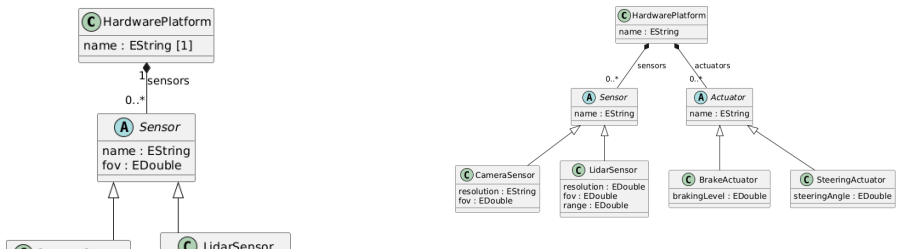
- Metamodel merging can unify complementary concepts (e.g., sensors and actuators) from different languages into a single target representation, enabling one downstream toolchain.
- Locally deployable LLMs can achieve these results without sending proprietary automotive models to external services, addressing data-control concerns.
- Automated validation integrated into the pipeline means residual syntax errors are detected and can be corrected iteratively, so end-to-end correctness is enforced by the workflow rather than by generation alone.
Reading between the lines
- The 100% semantic matching was measured on a small benchmark (one hardware platform, five component instances, a 27-element target metamodel); on production-scale automotive models the mapping may not hold if the source and target cannot be embedded in full, so the headline result should be read as a feasibility demonstration rather than a scaling guarantee.
- Because the method relies on the LLM's ability to infer correspondences from names and structure, its robustness is likely to depend on lexical and structural similarity; an adversarial test with obfuscated or unrelated naming conventions would clarify whether the mapping is genuinely semantic or largely name-based.
- The iterative validation loop generates a natural dataset of failed SysML v2 outputs; mining those failures to create few-shot examples or grammar-constrained decoding is a direct, testable way to close the syntax gap the paper reports.
- A broader implication is that MDE toolchains could treat transformation as an on-demand generated artifact rather than a maintained asset; the cost then shifts from rule maintenance to prompt design and validation infrastructure.
Editorial analysis
A structured set of objections, weighed in public.
Referee Report
Summary. The paper proposes an LLM-driven workflow for model interoperability in the automotive domain. Given a source model instance and a target metamodel, the pipeline uses a locally deployed LLM (Gemma or Qwen) to generate a target-compliant model instance directly, without hand-written transformation rules. A second workflow merges two metamodels into a chosen target representation. The approach is implemented in n8n and validated with custom validators for Ecore/XMI and SysML v2. The evaluation covers four instance-mapping scenarios and two metamodel-merging scenarios, reporting semantic matching and syntax correctness percentages over five runs per model, plus execution times. The paper claims that LLMs can significantly reduce manual transformation effort while generating structurally valid target models.
Significance. If the claims are supported, the contribution is a useful proof-of-concept: semantic model migration between Ecore and SysML v2 via prompted LLMs, with automated validation, no hand-coded transformation rules, and local deployment for information-flow control. The paper ships a public implementation and a reproducible n8n pipeline, which are concrete strengths. However, the evaluation is very small (one manually prepared automotive scenario, 5 components, 16 attributes, 5 runs per model), the semantic-match scores are at ceiling, and there is an internal inconsistency in the reported syntax correctness for the SysML→Ecore row. The general claim of producing 'structurally valid target models' is stronger than what the data currently show, especially for SysML-v2-target scenarios where syntax correctness falls to 40–60%.
major comments (4)
- [Section V, Table I (SysML v2→Ecore row)] Table I reports 100% syntax correctness for both models on SysML v2→Ecore, but the text immediately after Table I states that 'in few cases - Gemma generated non-standard XMI serialization (e.g., qualified containment elements)' and that 'minor serialization-related corrections were required to obtain a fully compliant model.' Since syntax correctness is defined earlier as the percentage of the 5 runs that pass the validation script, any run that needed corrections did not pass as generated. The current reporting is internally inconsistent. Please report as-generated pass rates and document any post-generation corrections separately, or state explicitly that Table I includes manually corrected artifacts. This is load-bearing because the abstract's 'structurally valid target models' claim relies on these numbers.
- [Section V, Tables I and II, abstract] For SysML-v2-target outputs, the reported syntax correctness is 80%/60% for Ecore→SysML v2, 60%/40% for SysML v2→SysML v2, and 60%/40% for the merge into SysML v2. Thus, in the majority of SysML-target scenarios, a substantial fraction—and for Qwen a majority—of runs do not pass structural validation as generated. The abstract's claim that the approach generates 'structurally valid target models' is therefore an overstatement of the evidence. The paper mentions an iterative refinement step (step 6) with an update prompt, but it does not evaluate that step. Either qualify the claim to the scenarios and models where validation passes, or add an evaluation of the refinement loop and report final post-refinement pass rates.
- [Section III (step 5) and Section V] The Ecore validator is specified concretely (Python/PyEcore, with a list of checks), but the SysML v2 validator is described only as 'a SysML-specific conformance checker as supported by the underlying modeling environment.' No concrete checker, version, or configuration is provided. Because all SysML syntax-correctness numbers depend on this validator, the reported results are not reproducible without that information. Please specify the exact SysML v2 conformance checker used in the evaluation, or provide the validation script in the repository.
- [Section V (benchmark description)] The evaluation uses one manually prepared automotive hardware scenario (1 platform, 5 component instances, 16 attribute-value assignments, 5 containment relationships) and five runs per model. Semantic matching is reported as 100% in every scenario, with no inter-rater reliability, no per-run variation, and no confidence intervals. The task is small enough that ceiling effects are plausible, and the complete source model and target metamodel are embedded in the prompt, as the authors acknowledge in Section VI when deferring large-model handling to MCP/RAG. This evidence does not support a general claim about automotive-scale model interoperability. Please report per-run results, define the semantic-matching procedure more precisely, and explicitly discuss how the results would transfer to models that exceed the context window.
minor comments (6)
- [Section V] Typo: 'While For the SysML v2→Ecore transformation' should read 'For the SysML v2→Ecore transformation'.
- [Table I and Table II] The 'Time (s)' rows render as '5.146.5' and '15.258.3', which appear to be concatenated values (e.g., 5.1 and 46.5). Please format these as two separate numbers for clarity.
- [Abstract and Section II] Minor typos: 'defacto standard' should be 'de facto standard'; 'the authors oproposed' should be 'the authors proposed'.
- [Figure 2 caption] Figure 2's caption is identical to Figure 1's caption ('Integrated code generation toolchain based on n8n.'). It should describe the screenshot shown.
- [Section V] The GitHub repository URL contains apparent spaces: 'https://github.com/np-tum-air/tum hal4sdv model mapper/'. Please provide a corrected, clickable URL.
- [Section V] The phrase 'A benchmark is based on representative automotive hardware models' is grammatically awkward; consider 'The benchmark is based on...'.
Circularity Check
No circularity: the LLM mapping/merging claims are evaluated against expert ground truth and external metamodel validation; self-citations are background, not load-bearing.
full rationale
The paper contains no fitted parameters, no definition of the target quantity in terms of itself, and no self-citation that supplies the central claim. The claimed capability (LLMs produce semantically matching, structurally validated model instances) is tested empirically: 'Reference transformations were manually prepared with expert support and used as the ground truth for evaluation,' and syntax is measured as 'percentage of tries (out of 5) when the generated instance model passes the corresponding validation script.' The validation is an external conformance check against the target metamodel (PyEcore for Ecore, a SysML-specific checker for SysML), so a generated artifact is not accepted by definition; it must satisfy independent structural constraints. The self-citations ('builds upon our previous experiences in LLM-driven Ecore metamodel construction [12], model instance creation and validation [11]'; the update prompt 'in a similar way as in our previous work [12]'; future MCP/RAG work 'building upon our previous work from [17]') are implementation/background references and do not constitute the evidence for the paper's claims. One reporting inconsistency exists outside circularity: the SysML v2→Ecore row of Table I is listed as 100% syntax for Gemma while the text states that 'in few cases - Gemma generated non-standard XMI serialization (e.g., qualified containment elements)' and 'minor serialization-related corrections were required to obtain a fully compliant model.' That is an evaluation-consistency concern, not a circular-derivation concern. Overall, no circular steps are present.
Assumptions & free parameters
assumptions (4)
- domain assumption The complete source model instance and target metamodel can be embedded in the LLM prompt.
- domain assumption Element names and structural context in source and target artifacts are sufficient for the LLM to infer semantic correspondences.
- domain assumption Structural conformance validation (PyEcore / SysML checker) is a sufficient correctness gate for generated models.
- domain assumption Manually prepared reference transformations are an unbiased ground truth for semantic matching.
Cite this review
Pith. "Pith review of LLM-Driven Approach to Modeling Tool Interoperability in Automotive Domain." pith.science (2026). https://pith.science/paper/G4H6DBH3
@misc{pith2026260714659,
  author       = {Pith},
  title        = {Pith review of: LLM-Driven Approach to Modeling Tool Interoperability in Automotive Domain},
  year         = {2026},
  howpublished = {\url{https://pith.science/paper/G4H6DBH3}},
  note         = {Machine review of arXiv:2607.14659}
}
read the original abstract
Interoperability between heterogeneous modeling tools remains a significant challenge in Model-Driven Engineering (MDE), particularly in the automotive domain where multiple modeling languages, as well as defacto standard proprietary and open-source tools coexist. This paper presents an LLM-driven approach for automated model interoperability by considering two relevant aspects: 1) mapping model instances to a target metamodel 2) merging of metamodels. The proposed methodology is demonstrated through transformations involving Ecore and SysML v2 based metamodels and incorporates structural validation of generated model instances against user-defined target models. Automotive case studies illustrate the feasibility of the approach and show that large language models can significantly reduce manual transformation effort while generating structurally valid target models for cross-tool interoperability.
Figures


Reference graph
Works this paper leans on
-
[1]
Integration of Heteroge- neous Tools to a Seamless Automotive Toolchain,
G. Macher, E. Armengaud, and C. Kreiner, “Integration of Heteroge- neous Tools to a Seamless Automotive Toolchain,” inSystems, Soft- ware and Services Process Improvement (EuroSPI 2015), CCIS, vol. 543, Cham, Switzerland: Springer, 2015, pp. 51–62, doi: 10.1007/ 978-3-319-24647-5 5
2015
-
[2]
CATIA Magic – Model-Based Systems Engineer- ing,
Dassault Syst `emes, “CATIA Magic – Model-Based Systems Engineer- ing,” Available: https://www.3ds.com/products/catia/catia-magic/, Ac- cessed: Jul. 2026
2026
-
[3]
IBM Engineering Systems Design Rhapsody,
IBM, “IBM Engineering Systems Design Rhapsody,” Available: https://www.ibm.com/products/engineering-systems-design-rhapsody/, Accessed: Jul. 2026
2026
-
[4]
Systems Modeling Language (SysML) Version 2.0 Specification,
Object Management Group (OMG), “Systems Modeling Language (SysML) Version 2.0 Specification,” 2025. [Online]. Available: https://www.omg.org/spec/SysML/
2025
-
[5]
Eclipse Modeling Framework (EMF),
Eclipse Foundation, “Eclipse Modeling Framework (EMF),” Available: https://eclipse.dev/modeling/emf/, Accessed: Jul. 2026
2026
-
[6]
ATL: A Model Transformation Tool,
F. Jouault, F. Allilaire, J. B ´ezivin, and I. Kurtev, “ATL: A Model Transformation Tool,”Science of Computer Programming, vol. 72, no. 1–2, pp. 31–39, Jun. 2008
2008
-
[7]
Meta Object Facility (MOF) 2.0 Query/View/Transformation (QVT),
Object Management Group (OMG), “Meta Object Facility (MOF) 2.0 Query/View/Transformation (QVT),” Version 1.3, Jun. 2016. [Online]. Available: https://www.omg.org/spec/QVT/
2016
-
[9]
Integrating SysML v2 into a GRAG LLM Pipeline: Design, Implementation and Evaluation,
E. Bader, J.-A. Gross, K. Polanec, M. M. Peter, and C. Neure- iter, “Integrating SysML v2 into a GRAG LLM Pipeline: Design, Implementation and Evaluation,” inProc. IEEE International Sym- posium on Systems Engineering (ISSE), Vienna, Austria, 2025, doi: 10.1109/ISSE65546.2025.11369999
arXiv 2025
Show all 14 references
-
[10]
Text to Model via SysML: Auto- mated Generation of Dynamical System Computational Models from Unstructured Natural Language Text via Enhanced System Modeling Language Diagrams,
M. A. Hendricks and A. Cicirello, “Text to Model via SysML: Auto- mated Generation of Dynamical System Computational Models from Unstructured Natural Language Text via Enhanced System Modeling Language Diagrams,”arXiv preprint arXiv:2507.06803, 2025. [Online]. Available: https...
2025 arXiv
-
[11]
GenAI for Automotive Software Development: From Requirements to Wheels,
N. Petrovic, F. Pan, V . Zolfaghari, K. Lebioda, A. Schamschurko, and A. Knoll, “GenAI for Automotive Software Development: From Requirements to Wheels,” arXiv preprint arXiv:2507.18223, 2025
2025 arXiv
-
[13]
n8n: Workflow Automation Platform,
n8n, “n8n: Workflow Automation Platform,” Available: https://n8n.io/, Accessed: July 2026
2026
-
[15]
Gemma 4 31B IT,
Google, “Gemma 4 31B IT,” Hugging Face, 2026. [Online]. Available: https://huggingface.co/google/gemma-4-31B-it. Accessed: Jul. 2026
2026
-
[16]
Qwen3.5-122B-A10B,
Qwen Team, “Qwen3.5-122B-A10B,” Hugging Face, 2026. [Online]. Available: https://huggingface.co/Qwen/Qwen3.5-122B-A10B. Accessed: Jul. 2026
2026
-
[17]
Querying Large Automotive Software Models: Agentic vs. Direct LLM Approaches,
L. Mazur, N. Petrovic, J. P. Miranda, A. Radermacher, R. Rasche, and A. Knoll, “Querying Large Automotive Software Models: Agentic vs. Direct LLM Approaches,” inProc. 2nd International Generative AI and Computational Language Modelling Conference (GACLM), Valencia, Spain, 2025...
2025
Reviewed August 2, 2026 · model on record in the stance chip above.
Discussion (0). Sign in to comment.