REVIEW 3 major objections 5 minor 2 cited by
Multi-Sensor Object Anomaly Detection: Unifying Appearance, Geometry, and Internal Properties
T0 review · 3 major / 5 minor · reviewed 2026-08-11 · deepseek-v4-flash
Pith's one-line read This paper claims that fusing RGB, infrared, and point cloud data through decision-level fusion yields 96.1% object-level AUROC on a new 15-category industrial anomaly detection dataset, outperforming every single sensor.
desk verdict The dataset is a genuine contribution and deserves peer review, but the paper's headline fusion claim is confounded by the decision gating module and needs a controlled ablation. read the letter →
The pith
A machine-rendered reading of the paper's core claim, the machinery that carries it, and where it could break.
The reading
What carries the argument
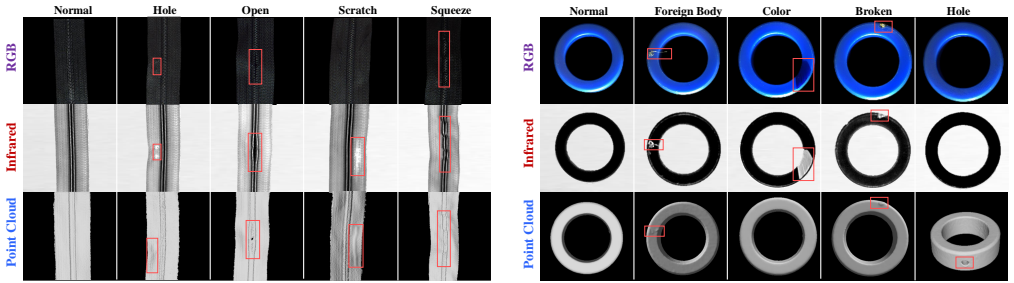
The load-bearing machinery is a three-way decision-level fusion pipeline. Each modality gets its own memory bank built from normal training samples, using a nearest-neighbor scoring function over pretrained visual features for RGB and infrared images and pretrained point-cloud features for the 3D scans; at test time each sensor produces an anomaly score from the distance of the test features to its memory bank. A learnable decision gating unit, implemented as a one-class support vector machine, merges the three scores into the final object-level anomaly score. The data collection is equally central: lock-in infrared thermography applies periodic thermal stimulation tuned per object to expose subsurface defects, the laser scanner uses a dual-scan strategy with iterative closest point alignment to build complete point clouds, and annotations are made per modality only where the anomaly is actually visible.
What would settle it
Re-collect infrared data on fresh defects with thermal stimulation parameters fixed before inspection and without access to defect labels; if single-sensor infrared AUROC falls materially below 90.9% and the triple-fusion margin over RGB+IR shrinks, the reported fusion advantage was inflated by protocol tuning.
Extended reading notes
Core claim
MulSen-AD is a real-world, object-level dataset of 2,035 samples across 15 categories, each with aligned RGB, infrared, and point cloud data collected from factory parts with manually induced real-world defects. The paper's central discovery is that the three sensors are complementary: in the test set, 43.7% of anomalies are visible in all three modalities, while 9.4% are visible only in RGB, 9.2% only in infrared, and 4.3% only in the point cloud. On this basis the authors argue that multi-sensor fusion is necessary for comprehensive anomaly detection, and support it with MulSen-TripleAD, a decision-level fusion baseline that reaches 96.1% object-level AUROC, substantially above every single-sensor result and above all dual-sensor combinations tested.
Load-bearing premise
The infrared results assume the per-object thermal stimulation parameters were chosen without knowledge of which samples were defective or what defects existed; if the protocol was tuned with that knowledge, the reported single-sensor IR and fusion gains could be inflated.
Editorial extensions
If this is right
- Triple fusion raises object-level AUROC to 96.1%, roughly five points above the best single sensor (RGB at 91.1%) and more than one point above the best dual combination (RGB+IR at 94.8%).
- Point-cloud-only detection reaches only 66.8% AUROC, so relying on geometry alone would miss a third of the defects that the full system catches.
- In the test set, 43.7% of anomalies are visible to all three sensors, while 9.4%, 9.2%, and 4.3% are visible only to RGB, infrared, and point cloud, respectively; the dataset is therefore designed so no single sensor can cover every defect type.
- Because every modality is annotated only where the anomaly is visible, the benchmark supports separate localization evaluation for each sensor, not just a single fused score.
Reading between the lines
- The strong result is object-level; per-pixel point-cloud localization is far weaker (pixel-F1-max of 0.111), so in practice the third sensor mainly helps flag defective objects rather than pinpoint where the defect is.
- Since RGB+infrared fusion already reaches 94.8% AUROC, factories without laser scanning could capture most of the benefit using optical plus thermal imaging alone on similar product lines.
- The reported infrared performance depends on lock-in parameters chosen per object; if those parameters were tuned with knowledge of the defects, a blind re-test would likely lower both the single-sensor infrared number and the apparent fusion gain.
- The single-3D benchmark shows existing point-cloud detectors top out near 86% even on a 3D-only evaluation, suggesting the bottleneck for the 3D modality is feature quality rather than the fusion rule.
Signed reviews
Editorial analysis
A structured set of objections, weighed in public.
Referee Report
Summary. The paper introduces MulSen-AD, a new industrial object-level anomaly detection dataset with aligned RGB, lock-in infrared thermography, and laser-scanned point clouds for 15 product categories, together with pixel/point-level annotations and a benchmark. It also proposes MulSen-TripleAD, an unsupervised decision-level fusion baseline built on DINO features for RGB/IR and PointMAE features for point clouds, with per-modality PatchCore-style memory banks and a learnable OCSVM decision gating unit. The main empirical claim is that fusing all three sensors reaches 96.1% object-level AUROC, substantially above single-sensor RGB (91.1%), IR (90.9%), and point-cloud (66.8%) performance, and above dual-sensor combinations. The dataset and code are promised to be released.
Significance. If the results hold, the dataset is a valuable contribution: it is among the first to combine RGB, infrared, and point-cloud modalities in a single industrial anomaly detection benchmark, with a nontrivial collection pipeline and modality-specific annotation protocol. The paper also ships a reproducible baseline built from standard, publicly available components (DINO, PointMAE, PatchCore, M3DM-style gating), which makes the benchmark easy to adopt. The central scientific claim—that multi-sensor fusion substantially outperforms single-sensor detection—is plausible but not cleanly established by the supplied experiments, because the single-sensor arms are missing the decision gating module that is present in the fusion arms, and because no statistical uncertainty is reported on small per-category test sets. The dataset contribution can stand even if the fusion claim needs additional support.
major comments (3)
- [§5.2, Table 5] The headline comparison in Table 5 is confounded. The 'Single' rows are explicitly described as being 'without decision gating', while the 'Double' and 'Triple' rows include the learnable OCSVM decision gating unit borrowed from M3DM. Thus the 91.1% RGB vs. 96.1% triple comparison varies both the number of sensors and the presence/absence of the learned fusion module. A controlled ablation is needed: report single-modality performance with the same gating unit applied to that one modality, and also report parameter-free fusion rules (e.g., max or mean of per-sensor normalized PatchCore scores) for all sensor combinations. Without these controls, the reported fusion gain cannot be attributed to multi-sensor complementarity rather than to the additional learnable parameters.
- [Table 5, per-category rows] The per-category numbers do not consistently support the claim that triple fusion is best. In Table 5, Screen drops from 0.981 (RGB+IR) to 0.938 (RGB+IR+PC); Flat Pad drops from 0.950 (IR) to 0.863 (RGB+IR+PC); Solar Panel drops from 0.977 (RGB+IR) to 0.949 (RGB+IR+PC). With an average of only about 33 abnormal test objects per category and no error bars or repeated-seed variance, the aggregate 1.3-point advantage of triple over RGB+IR (96.1 vs. 94.8) is not demonstrated to be meaningful. The paper should provide confidence intervals or per-seed results, and should discuss why fusion sometimes degrades performance.
- [§3.3 and Supplementary Table 7] The infrared results depend on the per-object lock-in thermography parameters (period and frequency) reported in Supplementary Table 7, which are said to be chosen according to material and thickness. The paper does not state whether these parameters were selected without knowledge of the anomaly types and anomalous samples. If the thermal stimulation settings were tuned while the defect labels or defective specimens were known, the 90.9% single-sensor IR AUROC and the subsequent fusion gain could be inflated. Please disclose the parameter-selection protocol explicitly, e.g., whether it was fixed before inspecting anomalies, and ideally provide a sensitivity analysis showing that IR performance is stable to reasonable variations of these settings.
minor comments (5)
- [References] Reference [39] is cited for the DINO feature extractor used for RGB and infrared images, but the reference is titled 'DINO: DETR with Improved Denoising Anchor Boxes', which is a different DINO (object detection). The self-supervised visual feature extractor DINO should be cited as Caron et al., 2021. This is important for reproducibility.
- [Table 4 vs. Supplementary Table 8] Point-cloud object-level AUROC for PatchCore(PointMAE) appears as 0.683 in Table 4 but as 0.840 in Supplementary Table 8. The paper explains that the settings differ (MulSen-AD object labeling vs. 3D-AD labeling), but the table captions and text should make this distinction explicit and consistent, since the discrepancy is confusing.
- [§3.3 vs. Table 2] Table 2 lists the RGB camera resolution as 1920×1200, while §3.3 states that the RGB camera captured images at 1280×960. Please clarify which resolution was used for the released dataset and for the experiments.
- [Figure numbering] The figure numbering is inconsistent: §4.2 refers to 'Figure 8' for the pipeline, but the pipeline is shown as Figure 6; §5.4 refers to 'Fig. 8' for qualitative localization, but the qualitative figure is numbered Figure 7. Please renumber the figures throughout.
- [§2, Related work] The sentence 'MVTec-AD, BTAD, MPDD, and VisA is a series of single view photo-realistic industrial anomaly detection datasets' has a subject-verb agreement error and should be rewritten.
Circularity Check
No circular derivation: MulSen-TripleAD is built from external pretrained extractors and PatchCore/M3DM memory banks, and the 96.1% AUROC is an empirical benchmark result on a new dataset, not a quantity equal to its inputs by construction.
full rationale
The paper's central contribution is a new multimodal dataset plus a baseline (MulSen-TripleAD) that combines RGB, infrared, and point cloud features with PatchCore-style memory banks and an M3DM-style decision gating unit. The only equations in the method, Eq. (1)-(3), define the anomaly score as a nearest-neighbor distance against per-modality memory banks built from normal training samples; nothing in this construction fits the anomaly labels or assumes the conclusion that fusion helps. The headline 96.1% AUROC is measured on held-out test anomalies, so it is an empirical benchmark result rather than a quantity that is equal to an input by definition. The paper does cite the authors' prior Anomaly-ShapeNet work [15], but only as a related 3D anomaly dataset and for the standard AUROC evaluation protocol ('Following [5, 15], we use the Area Under the Receiver Operating Characteristic Curve'), which is not load-bearing. There is no imported uniqueness theorem, no ansatz smuggled in through a self-citation, and no fitted parameter renamed as a prediction. Two concerns raised in review are real but are not circularity: the Table 5 single-sensor rows omit the learned decision gating unit while the dual/triple rows include it, which confounds the ablation claim, and the lock-in thermal stimulation parameters could in principle have been tuned with knowledge of anomalies. Both are experimental-validity issues external to the derivation chain; they do not make the multi-sensor result reduce to the paper's own inputs. Accordingly, the paper is self-contained against external benchmarks and receives a score of 1 for a minor, non-load-bearing self-citation rather than any substantive circularity.
Assumptions & free parameters
free parameters (2)
- Lock-in period per object =
30 to 90 seconds depending on object
- Lock-in frequency per object =
0.2 to 2.0 Hz depending on object
assumptions (5)
- domain assumption PatchCore's nearest-neighbor deviation scoring is a valid unsupervised anomaly score for all three modalities
- domain assumption DINO and PointMAE features transfer from ImageNet/ShapeNet pretraining to industrial RGB, infrared, and point cloud data
- domain assumption Manual modality-specific annotations are accurate and complete
- ad hoc to paper Thermal stimulation parameters are selected without using anomaly labels
- standard math Standard mathematical tools (ICP alignment, AUROC calculation) are correct and applicable
Cite this review
Pith. "Pith review of Multi-Sensor Object Anomaly Detection: Unifying Appearance, Geometry, and Internal Properties." pith.science (2026). https://pith.science/paper/G5AAV7R7
@misc{pith2026241214592,
  author       = {Pith},
  title        = {Pith review of: Multi-Sensor Object Anomaly Detection: Unifying Appearance, Geometry, and Internal Properties},
  year         = {2026},
  howpublished = {\url{https://pith.science/paper/G5AAV7R7}},
  note         = {Machine review of arXiv:2412.14592}
}
read the original abstract
Object anomaly detection is essential for industrial quality inspection, yet traditional single-sensor methods face critical limitations. They fail to capture the wide range of anomaly types, as single sensors are often constrained to either external appearance, geometric structure, or internal properties. To overcome these challenges, we introduce MulSen-AD, the first high-resolution, multi-sensor anomaly detection dataset tailored for industrial applications. MulSen-AD unifies data from RGB cameras, laser scanners, and lock-in infrared thermography, effectively capturing external appearance, geometric deformations, and internal defects. The dataset spans 15 industrial products with diverse, real-world anomalies. We also present MulSen-AD Bench, a benchmark designed to evaluate multi-sensor methods, and propose MulSen-TripleAD, a decision-level fusion algorithm that integrates these three modalities for robust, unsupervised object anomaly detection. Our experiments demonstrate that multi-sensor fusion substantially outperforms single-sensor approaches, achieving 96.1% AUROC in object-level detection accuracy. These results highlight the importance of integrating multi-sensor data for comprehensive industrial anomaly detection.
Figures


Figures from the paper (10 more)




Forward citations
Cited by 2 Pith papers
-
Towards High-Resolution 3D Anomaly Detection: A Scalable Dataset and Real-Time Framework for Subtle Industrial Defects
The paper introduces a high-resolution 3D defect dataset and a fast handcrafted-feature detector that reports state-of-the-art results.
-
Visual Anomaly Detection under Complex View-Illumination Interplay: A Large-Scale Benchmark
M2AD, a large-scale benchmark with 120 view-illumination configurations per object, shows that state-of-the-art visual anomaly detection methods drop markedly when viewpoint and lighting vary together.
Reference graph
Works this paper leans on
-
[1]
Emerging trends in autonomous vehicle perception: Multi- modal fusion for 3d object detection
Simegnew Yihunie Alaba, Ali C Gurbuz, and John E Ball. Emerging trends in autonomous vehicle perception: Multi- modal fusion for 3d object detection. World Electric Vehicle Journal, 15(1):20, 2024. 3
work page 2024
-
[2]
Transfusion: Robust lidar-camera fusion for 3d object detection with transformers
Xuyang Bai, Zeyu Hu, Xinge Zhu, Qingqiu Huang, Yilun Chen, Hongbo Fu, and Chiew-Lan Tai. Transfusion: Robust lidar-camera fusion for 3d object detection with transformers. In Proceedings of the IEEE/CVF conference on computer vision and pattern recognition, pages 1090–1099, 2022. 3
work page 2022
-
[3]
Mvtec ad — a comprehensive real-world dataset for unsupervised anomaly detection
Paul Bergmann, Michael Fauser, David Sattlegger, and Carsten Steger. Mvtec ad — a comprehensive real-world dataset for unsupervised anomaly detection. In 2019 IEEE/CVF Conference on Computer Vision and Pattern Recognition (CVPR), pages 9584–9592, 2019. 1, 2
work page 2019
-
[4]
Beyond dents and scratches: Logical constraints in unsupervised anomaly detection and localization
Paul Bergmann, Kilian Batzner, Michael Fauser, David Sat- tlegger, and Carsten Steger. Beyond dents and scratches: Logical constraints in unsupervised anomaly detection and localization. International Journal of Computer Vision, 130 (4):947–969, 2022. 1, 2
work page 2022
-
[5]
The mvtec 3d-ad dataset for unsupervised 3d anomaly detec- tion and localization
Paul Bergmann, Xin Jin, David Sattlegger, and Carsten Steger. The mvtec 3d-ad dataset for unsupervised 3d anomaly detec- tion and localization. In Proceedings of the 17th International Joint Conference on Computer Vision, Imaging and Computer Graphics Theory and Applications. SCITEPRESS - Science and Technology Publications, 2022. 2, 6
work page 2022
-
[6]
The eyecandies dataset for unsupervised multimodal anomaly detection and localization
Luca Bonfiglioli, Marco Toschi, Davide Silvestri, Nicola Fioraio, and Daniele De Gregorio. The eyecandies dataset for unsupervised multimodal anomaly detection and localization. In Proceedings of the Asian Conference on Computer Vision, pages 3586–3602, 2022. 2
work page 2022
-
[7]
Comple- mentary pseudo multimodal feature for point cloud anomaly detection
Yunkang Cao, Xiaohao Xu, and Weiming Shen. Comple- mentary pseudo multimodal feature for point cloud anomaly detection. Pattern Recognition, 156:110761, 2024. 1
work page 2024
-
[8]
A survey on visual anomaly detection: Challenge, approach, and prospect
Yunkang Cao, Xiaohao Xu, Jiangning Zhang, Yuqi Cheng, Xiaonan Huang, Guansong Pang, and Weiming Shen. A survey on visual anomaly detection: Challenge, approach, and prospect. arXiv preprint arXiv:2401.16402, 2024. 1
arXiv 2024
Show all 49 references
-
[9]
Deformable feature aggregation for dynamic multi-modal 3d object detection
Zehui Chen, Zhenyu Li, Shiquan Zhang, Liangji Fang, Qin- hong Jiang, and Feng Zhao. Deformable feature aggregation for dynamic multi-modal 3d object detection. In European conference on computer vision , pages 628–644. Springer,
-
[10]
Cflow- ad: Real-time unsupervised anomaly detection with localiza- tion via conditional normalizing flows
Denis Gudovskiy, Shun Ishizaka, and Kazuki Kozuka. Cflow- ad: Real-time unsupervised anomaly detection with localiza- tion via conditional normalizing flows. In Proceedings of the IEEE/CVF Winter Conference on Applications of Computer Vision (WACV), pages 98–107, 2022. 7
2022
-
[11]
Back to the feature: Clas- sical 3d features are (almost) all you need for 3d anomaly detection
Eliahu Horwitz and Yedid Hoshen. Back to the feature: Clas- sical 3d features are (almost) all you need for 3d anomaly detection. In Proceedings of the IEEE/CVF Conference on Computer Vision and Pattern Recognition (CVPR) Workshops, pages 2968–2977, 2023. 7
2023
-
[12]
Epnet: Enhancing point features with image semantics for 3d object detection
Tengteng Huang, Zhe Liu, Xiwu Chen, and Xiang Bai. Epnet: Enhancing point features with image semantics for 3d object detection. In Computer Vision–ECCV 2020: 16th European Conference, Glasgow, UK, August 23–28, 2020, Proceedings, Part XV 16, pages 35–52. Springer, 2020. 3
2020
-
[13]
Deep learning-based defect detection of metal parts: evaluating current methods in complex conditions
Stepan Jezek, Martin Jonak, Radim Burget, Pavel Dvorak, and Milos Skotak. Deep learning-based defect detection of metal parts: evaluating current methods in complex conditions. In 2021 13th International Congress on Ultra Modern Telecom- munications and Control Systems and Wor...
2021
-
[14]
Cfa: Coupled-hypersphere-based feature adaptation for target- oriented anomaly localization
Sungwook Lee, Seunghyun Lee, and Byung Cheol Song. Cfa: Coupled-hypersphere-based feature adaptation for target- oriented anomaly localization. IEEE Access , 10:78446– 78454, 2022. 7
2022
-
[15]
Towards scalable 3d anomaly detec- tion and localization: A benchmark via 3d anomaly synthe- sis and a self-supervised learning network
Wenqiao Li, Xiaohao Xu, Yao Gu, Bozhong Zheng, Shenghua Gao, and Yingna Wu. Towards scalable 3d anomaly detec- tion and localization: A benchmark via 3d anomaly synthe- sis and a self-supervised learning network. arXiv preprint arXiv:2311.14897, 2023. 2, 3, 6
2023 arXiv
-
[16]
Deepfusion: Lidar-camera deep fusion for multi-modal 3d object detection
Yingwei Li, Adams Wei Yu, Tianjian Meng, Ben Caine, Ji- quan Ngiam, Daiyi Peng, Junyang Shen, Yifeng Lu, Denny Zhou, Quoc V Le, et al. Deepfusion: Lidar-camera deep fusion for multi-modal 3d object detection. In Proceedings of the IEEE/CVF Conference on Computer Vision and Pat...
2022
-
[17]
Real3d-ad: A dataset of point cloud anomaly detection
Jiaqi Liu, Guoyang Xie, Ruitao Chen, Xinpeng Li, Jinbao Wang, Yong Liu, Chengjie Wang, and Feng Zheng. Real3d-ad: A dataset of point cloud anomaly detection. In Advances in Neural Information Processing Systems, pages 30402–30415. Curran Associates, Inc., 2023. 7
2023
-
[18]
Real3d- ad: A dataset of point cloud anomaly detection
Jiaqi Liu, Guoyang Xie, Ruitao Chen, Xinpeng Li, Jinbao Wang, Yong Liu, Chengjie Wang, and Feng Zheng. Real3d- ad: A dataset of point cloud anomaly detection. Advances in Neural Information Processing Systems, 36, 2024. 1, 2
2024
-
[19]
Deep industrial image anomaly detection: A survey
Jiaqi Liu, Guoyang Xie, Jinbao Wang, Shangnian Li, Chengjie Wang, Feng Zheng, and Yaochu Jin. Deep industrial image anomaly detection: A survey. Machine Intelligence Research, 21(1):104–135, 2024. 1
2024
-
[20]
Simplenet: A simple network for image anomaly detection and localization
Zhikang Liu, Yiming Zhou, Yuansheng Xu, and Zilei Wang. Simplenet: A simple network for image anomaly detection and localization. In 2023 IEEE/CVF Conference on Computer Vision and Pattern Recognition (CVPR), pages 20402–20411,
2023
-
[21]
Gdxray: The database of x-ray images for nonde- structive testing
Domingo Mery, Vladimir Riffo, Uwe Zscherpel, German Mondragón, Iván Lillo, Irene Zuccar, Hans Lobel, and Miguel Carrasco. Gdxray: The database of x-ray images for nonde- structive testing. Journal of Nondestructive Evaluation, 34 (4):42, 2015. 2
2015
-
[22]
Vt-adl: A vision trans- former network for image anomaly detection and localization
Pankaj Mishra, Riccardo Verk, Daniele Fornasier, Claudio Piciarelli, and Gian Luca Foresti. Vt-adl: A vision trans- former network for image anomaly detection and localization. In 2021 IEEE 30th International Symposium on Industrial Electronics (ISIE). IEEE, 2021. 1, 2
2021
-
[23]
Radar voxel fusion for 3d object detection
Felix Nobis, Ehsan Shafiei, Phillip Karle, Johannes Betz, and Markus Lienkamp. Radar voxel fusion for 3d object detection. Applied Sciences, 11(12):5598, 2021. 3
2021
-
[24]
Clocs: Camera- lidar object candidates fusion for 3d object detection
Su Pang, Daniel Morris, and Hayder Radha. Clocs: Camera- lidar object candidates fusion for 3d object detection. In 2020 IEEE/RSJ International Conference on Intelligent Robots and Systems (IROS), pages 10386–10393. IEEE, 2020. 3
2020
-
[25]
Masked autoencoders for point cloud self-supervised learning
Yatian Pang, Wenxiao Wang, Francis EH Tay, Wei Liu, Yonghong Tian, and Li Yuan. Masked autoencoders for point cloud self-supervised learning. In Computer Vision–ECCV 2022: 17th European Conference, Tel Aviv, Israel, October 23–27, 2022, Proceedings, Part II, pages 604–621. Springer,
2022
-
[26]
Towards to- tal recall in industrial anomaly detection
Karsten Roth, Latha Pemula, Joaquin Zepeda, Bernhard Schölkopf, Thomas Brox, and Peter Gehler. Towards to- tal recall in industrial anomaly detection. In Proceedings of the IEEE/CVF Conference on Computer Vision and Pattern Recognition, pages 14318–14328, 2022. 5, 6
2022
-
[27]
Towards total re- call in industrial anomaly detection
Karsten Roth, Latha Pemula, Joaquin Zepeda, Bernhard Schölkopf, Thomas Brox, and Peter Gehler. Towards total re- call in industrial anomaly detection. In 2022 IEEE/CVF Con- ference on Computer Vision and Pattern Recognition (CVPR), pages 14298–14308, 2022. 7
2022
-
[28]
Pvel-ad: A large- scale open-world dataset for photovoltaic cell anomaly de- tection
Binyi Su, Zhong Zhou, and Haiyong Chen. Pvel-ad: A large- scale open-world dataset for photovoltaic cell anomaly de- tection. IEEE Transactions on Industrial Informatics, 19(1): 404–413, 2023. 2
2023
-
[29]
Duong, Chanh D
Tran Dinh Tien, Anh Tuan Nguyen, Nguyen Hoang Tran, Ta Duc Huy, Soan T.M. Duong, Chanh D. Tr. Nguyen, and Steven Q. H. Truong. Revisiting reverse distillation for anomaly detection. In 2023 IEEE/CVF Conference on Com- puter Vision and Pattern Recognition (CVPR), pages 24511– 2...
2023
-
[30]
Lang, Bassam Helou, and Oscar Bei- jbom
Sourabh V ora, Alex H. Lang, Bassam Helou, and Oscar Bei- jbom. Pointpainting: Sequential fusion for 3d object detection. In Proceedings of the IEEE/CVF Conference on Computer Vision and Pattern Recognition (CVPR), 2020. 3
2020
-
[31]
Pointaugmenting: Cross-modal augmentation for 3d object detection
Chunwei Wang, Chao Ma, Ming Zhu, and Xiaokang Yang. Pointaugmenting: Cross-modal augmentation for 3d object detection. In Proceedings of the IEEE/CVF Conference on Computer Vision and Pattern Recognition (CVPR) , pages 11794–11803, 2021. 3
2021
-
[32]
Real-iad: A real-world multi-view dataset for benchmarking versatile industrial anomaly detection,
Chengjie Wang, Wenbing Zhu, Bin-Bin Gao, Zhenye Gan, Jianning Zhang, Zhihao Gu, Shuguang Qian, Mingang Chen, and Lizhuang Ma. Real-iad: A real-world multi-view dataset for benchmarking versatile industrial anomaly detection,
-
[33]
Multimodal industrial anomaly detection via hybrid fusion
Yue Wang, Jinlong Peng, Jiangning Zhang, Ran Yi, Yabiao Wang, and Chengjie Wang. Multimodal industrial anomaly detection via hybrid fusion. In Proceedings of the IEEE/CVF Conference on Computer Vision and Pattern Recognition (CVPR), pages 8032–8041, 2023. 7
2023
-
[34]
Multimodal industrial anomaly detection via hybrid fusion
Yue Wang, Jinlong Peng, Jiangning Zhang, Ran Yi, Yabiao Wang, and Chengjie Wang. Multimodal industrial anomaly detection via hybrid fusion. In Proceedings of the IEEE/CVF Conference on Computer Vision and Pattern Recognition , pages 8032–8041, 2023. 5, 6
2023
-
[35]
Self-supervised pre-training for transferable multi-modal perception
Xiaohao Xu, Tianyi Zhang, Jinrong Yang, Matthew Johnson- Roberson, and Xiaonan Huang. Self-supervised pre-training for transferable multi-modal perception. arXiv preprint arXiv:2405.17942, 2024. 3
2024 arXiv
-
[36]
Deepinteraction: 3d object detection via modal- ity interaction
Zeyu Yang, Jiaqi Chen, Zhenwei Miao, Wei Li, Xiatian Zhu, and Li Zhang. Deepinteraction: 3d object detection via modal- ity interaction. Advances in Neural Information Processing Systems, 35:1992–2005, 2022. 3
1992
-
[37]
Multi- modal virtual point 3d detection
Tianwei Yin, Xingyi Zhou, and Philipp Krähenbühl. Multi- modal virtual point 3d detection. Advances in Neural Infor- mation Processing Systems, 34:16494–16507, 2021. 3
2021
-
[38]
Draem - a discriminatively trained reconstruction embedding for sur- face anomaly detection
Vitjan Zavrtanik, Matej Kristan, and Danijel Skocaj. Draem - a discriminatively trained reconstruction embedding for sur- face anomaly detection. In Proceedings of the IEEE/CVF International Conference on Computer Vision (ICCV), pages 8330–8339, 2021. 7
2021
-
[39]
Dino: Detr with improved denoising anchor boxes for end-to-end object detection
Hao Zhang, Feng Li, Shilong Liu, Lei Zhang, Hang Su, Jun Zhu, Lionel M Ni, and Heung-Yeung Shum. Dino: Detr with improved denoising anchor boxes for end-to-end object detection. arXiv preprint arXiv:2203.03605, 2022. 5, 6
2022 arXiv
-
[40]
Learning feature inversion for multi-class anomaly de- tection under general-purpose coco-ad benchmark, 2024
Jiangning Zhang, Chengjie Wang, Xiangtai Li, Guanzhong Tian, Zhucun Xue, Yong Liu, Guansong Pang, and Dacheng Tao. Learning feature inversion for multi-class anomaly de- tection under general-purpose coco-ad benchmark, 2024. 7
2024
-
[41]
Destseg: Segmentation guided denoising student-teacher for anomaly detection
Xuan Zhang, Shiyu Li, Xi Li, Ping Huang, Jiulong Shan, and Ting Chen. Destseg: Segmentation guided denoising student-teacher for anomaly detection. In Proceedings of the IEEE/CVF Conference on Computer Vision and Pattern Recognition (CVPR), pages 3914–3923, 2023. 7
2023
-
[42]
Logicode: An llm-driven framework for logical anomaly detection
Yiheng Zhang, Yunkang Cao, Xiaohao Xu, and Weiming Shen. Logicode: An llm-driven framework for logical anomaly detection. IEEE Transactions on Automation Sci- ence and Engineering, pages 1–0, 2024. 2
2024
-
[43]
Rangelvdet: Boosting 3d object detection in lidar with range image and rgb image
Zehan Zhang, Zhidong Liang, Ming Zhang, Xian Zhao, Hao Li, Ming Yang, Wenming Tan, and Shiliang Pu. Rangelvdet: Boosting 3d object detection in lidar with range image and rgb image. IEEE Sensors Journal, 22(2):1391–1403, 2021. 3
2021
-
[44]
Pad: A dataset and benchmark for pose-agnostic anomaly detection, 2023
Qiang Zhou, Weize Li, Lihan Jiang, Guoliang Wang, Guyue Zhou, Shanghang Zhang, and Hao Zhao. Pad: A dataset and benchmark for pose-agnostic anomaly detection, 2023. 2
2023
-
[45]
Spot-the-difference self-supervised pre- training for anomaly detection and segmentation, 2022
Yang Zou, Jongheon Jeong, Latha Pemula, Dongqing Zhang, and Onkar Dabeer. Spot-the-difference self-supervised pre- training for anomaly detection and segmentation, 2022. 1, 2 Multi-Sensor Object Anomaly Detection: Unifying Appearance, Geometry, and Internal Properties Suppleme...
2022
-
[46]
Objects with higher density and larger volume generally require a longer duration
Data Collection Details As described in Sec 3.3 of the main text, the duration of ther- mal stimulation in Lock-in infrared thermography depends on the material properties and size of the objects. Objects with higher density and larger volume generally require a longer duratio...
-
[47]
To provide a more intuitive view of our dataset, below are additional dataset samples
More Dataset Samples Due to page limit, only a few dataset samples are shown in the main text. To provide a more intuitive view of our dataset, below are additional dataset samples. Note that the first row represents the RGB image, the second row represents the infrared image,...
-
[48]
For RGB/Infrared feature extraction, we use the ViT-B/8 model, which is pretrained on ImageNet with DINO
Implementation details We employ two Transformer-based feature extractors to in- dependently extract features from RGB/Infrared and point cloud data. For RGB/Infrared feature extraction, we use the ViT-B/8 model, which is pretrained on ImageNet with DINO. This model processes ...
-
[49]
Here we show the Single 3D Bench- mark, including object-level Auroc in Table 8, point-level Auroc in Table 9
Single 3D Benchmark Due to the page limit, we only give the MulSen-AD Bench- mark in the main text. Here we show the Single 3D Bench- mark, including object-level Auroc in Table 8, point-level Auroc in Table 9. In the MulSen-AD setting, an object is labeled as abnormal if any ...
Reviewed August 11, 2026 · model on record in the stance chip above.
Discussion (0). Continue with ORCID to comment.