REVIEW 3 major objections 5 minor 1 cited by
Two-component Dark Matter and low scale Thermal Leptogenesis
T0 review · 3 major / 5 minor · reviewed 2026-08-10 · deepseek-v4-flash
Pith's one-line read Two dark matter species are made to share one coupling with the cosmic matter–antimatter asymmetry, and the paper maps where all constraints overlap.
desk verdict Novel two-component DM/leptogenesis correlation, but the quantitative BAU regions rest on an incomplete Boltzmann treatment that needs a referee. read the letter →
The pith
A machine-rendered reading of the paper's core claim, the machinery that carries it, and where it could break.
The reading
What carries the argument
The central object is the one-loop vertex correction to $N_1\to\ell_\alpha\eta_1$, where the internal line is cut on the singlet $\phi$ and the second inert doublet $\eta_2$. Its imaginary part, computed in Appendix C, is proportional to $\mathrm{Im}(h_{22\alpha}\,y_{12\phi}\,\mu_{12\phi}\,h^*_{11\alpha})$, and it is this imaginary part that generates the CP asymmetry $\varepsilon_{N_1}$. The same $\mu_{12\phi}\,\eta_1^\dagger\eta_2\phi$ interaction controls the $\eta_1\leftrightarrow\phi$ conversion processes used in the dark matter Boltzmann equations, and a small mass splitting between the two dark matter components makes the conversion efficient enough to share the relic density correctly. The second load-bearing element is the scotogenic one-loop neutrino mass formula with two inert doublets, which through the Casas–Ibarra parametrization determines the Yukawa couplings $h_{kk\alpha}$ from neutrino data.
What would settle it
Include the omitted scattering terms, such as $N_1\phi\to\ell_\alpha\eta_2^\dagger$ and $N_1\eta_1\to\ell_\alpha V_\mu$, in the $Y_{N_1}$ evolution equation and recompute $Y_{B-L}$ for the benchmark points of Table 2; if the final asymmetry shifts by more than an order of magnitude, the BAU-allowed region shown in Figures 5 and 10 is not stable under the full Boltzmann dynamics.
Extended reading notes
Core claim
The paper claims that in a model with two inert doublets ($\eta_1,\eta_2$), two right-handed neutrinos ($N_1,N_2$), and a real singlet $\phi$, stabilized by a $\mathbb{Z}_2\otimes\mathbb{Z}_2'$ symmetry, the CP asymmetry in $N_1\to \ell_\alpha \eta_1$ decay receives a one-loop vertex correction whose imaginary part is proportional to $\mathrm{Im}(h_{22\alpha}\,y_{12\phi}\,\mu_{12\phi}\,h^*_{11\alpha})$. Because this correction is independent of the tiny Yukawa couplings fixed by neutrino masses, the Davidson–Ibarra bound is evaded and TeV-scale leptogenesis becomes possible even though the decay parameter $K_{N_1}$ is always in the strong-washout regime. The same couplings $y_{12\phi}$ and $\mu_{12\phi}$ enter the $\eta_1\leftrightarrow\phi$ conversion processes that set the two dark matter relic densities, and the inert doublets also appear in the one-loop radiative neutrino mass formula. The paper therefore establishes a concrete correlation: baryon asymmetry, active neutrino masses, and both dark matter components are governed by overlapping parameters, and it identifies the surviving parameter space after imposing the observed baryon asymmetry, neutrino oscillation data, relic density, direct and indirect detection limits, and collider bounds.
Load-bearing premise
The account assumes that the coupled Boltzmann equations track the asymmetry accurately even though some scattering processes that change the right-handed neutrino abundance are left out.
Editorial extensions
If this is right
- If the central claim is correct, thermal leptogenesis can proceed at the TeV scale in a two-right-handed-neutrino setup without invoking the Davidson–Ibarra bound, because the new vertex-coupling combination is free from the neutrino-mass constraints.
- The same parameter point that reproduces the observed baryon asymmetry must also reproduce the dark matter relic density, so future direct detection experiments such as LUX-ZEPLIN, PandaX-xT, and XLZD can directly probe the leptogenesis-favored region.
- The two-component structure relaxes the restrictive inert-doublet relic-density window, because the singlet $\phi$ can carry the missing abundance through $\eta_1\leftrightarrow\phi$ conversion, opening parameter space that a single-component inert doublet model would exclude.
- The $\eta_1$-$\phi$ conversion requires a small mass splitting $\Delta m\lesssim 10$ GeV, giving a sharp, testable prediction for the mass spectrum that connects the dark matter sector to leptogenesis.
Reading between the lines
- The same vertex-loop relation should generate a correlation between the neutrino mass ordering and the size of the CP asymmetry, since the imaginary part $\mathrm{Im}(h_{22\alpha}\,y_{12\phi}\,\mu_{12\phi}\,h^*_{11\alpha})$ depends on the Casas–Ibarra rotation parameters; scanning both orderings could reveal which ordering makes the baryon asymmetry easier to generate.
- The paper leaves the WIMP-pFIMP branch ($\lambda_{\phi H}\sim 10^{-12}$) for future work; in that branch the singlet would decouple from direct detection while still contributing through conversions, so the two dark matter components would separate cleanly in future detection channels.
- The charged components of the inert doublets are within collider reach for the benchmark points, so a search for the associated charged-scalar signatures at the HL-LHC could provide an indirect probe of the leptogenesis scale even if the right-handed neutrinos are too heavy to produce directly.
Editorial analysis
A structured set of objections, weighed in public.
Referee Report
Summary. The manuscript proposes an extension of the scotogenic model with two inert doublets, two right-handed neutrinos, and a real scalar singlet, stabilized by a Z2 x Z2' symmetry, so that the lightest inert doublet component and the singlet form a two-component dark matter sector. Neutrino masses arise radiatively at one loop, while the baryon asymmetry is generated by thermal leptogenesis from the decay of the lightest right-handed neutrino N1, with the CP asymmetry sourced by a vertex correction that involves the two DM scalars through the couplings y12phi and mu12phi. The authors solve coupled Boltzmann equations for N1 and B-L, scan over model parameters satisfying neutrino oscillation data and the observed baryon asymmetry, and then impose DM relic density, direct and indirect detection limits, and collider and lepton-flavor constraints. The central claim is that the same couplings and masses control the CP asymmetry, DM-DM conversion, and the radiative neutrino mass generation, establishing a three-way correlation among baryon asymmetry, DM, and neutrino masses, with several benchmark points and combined plots shown in Figs. 5 and 10.
Significance. If the correlation holds, the model is a useful proof of principle that low-scale leptogenesis and a two-component DM sector can be tied together by explicit couplings, rather than merely coexisting in the same model. The paper has clear strengths: the appendices contain a detailed analytic derivation of the neutrino mass matrix and the CP asymmetry, including an explicit comparison with the literature in the limiting case; the DM analysis uses micrOMEGAS-6.0 for coupled Boltzmann equations; and the parameter scans incorporate a broad set of current constraints from LEP, LHC, MEG II, LUX-ZEPLIN, and Fermi-LAT. The manuscript is also honest about the residual sign discrepancy with reference [47] and about the fact that some scattering processes affect N1 number densities. However, the reliability of the leptogenesis calculation in the strong-washout regime is the main load-bearing element, and the completeness of the scattering set in the Boltzmann equations is not established, which makes the claimed quantitative correlation provisional until that point is addressed.
major comments (3)
- [Section 4, eq. (4.2)] The Boltzmann equation for Y_B-L omits the crossed ΔL=1 washout processes N_i + l -> eta_i + V and N_i + l -> eta_j + phi, together with their CP conjugates. These processes are kinematically open for the benchmark points (for example, the condition m_N1 > m_eta2 + m_phi in eq. (4.5)) and they involve the same Yukawa and gauge couplings as the included processes eta_i N_i -> l V and N_i phi -> l eta_j. In the strong-washout regime, where the final Y_B-L is set by a balance between production and washout, the omission could shift the BAU-satisfying regions in Figs. 5 and 10. The text after eq. (4.4) concedes that 'some scattering processes significantly impact the number density of N1', which shows that the scattering set is not demonstrated to be complete. Please include the missing terms or provide a quantitative rate comparison showing that they are negligible for Y_B-L in the scanned parameter region.
- [Appendix C, text after eq. (C.14)] The authors state that their CP asymmetry agrees with reference [47] in the limit m_eta -> 0 and m_phi -> 0 'except for a negative sign'. Since the overall sign of epsilon_N1 determines whether the resulting baryon asymmetry has the observed positive sign, and since the scan in Fig. 5 implicitly depends on the sign through Im(F_vertex), this discrepancy must be resolved rather than reported. Please trace the sign difference to a specific convention (for example, the definition of the C matrix or the orientation of the loop momentum) and demonstrate that the positive-BAU solutions are not an artifact of this convention choice.
- [Equations (4.5) and (5.3), and Fig. 2 caption] The Casas-Ibarra rotation angles are fixed differently in different parts of the paper: eq. (4.5) sets a=1, b=0.4 for the leptogenesis scan, the caption of Fig. 2 uses a=0.1, b=0.3 for the decay parameter plot, and eq. (5.3) uses a=0, b=0.175 for the DM scan. Because Fig. 14 shows that epsilon_N1 can vary by orders of magnitude in some regions of the (a,b) plane, the choice of different angles in the leptogenesis and DM analyses could affect the claimed correlation. Please clarify which parameter sets were used for Figs. 5 and 10 and justify that the overlap between BAU-satisfying and DM-allowed regions is not an artifact of choosing different CI angles in the two analyses.
minor comments (5)
- [Section 4, after eq. (4.4)] The sentence admitting that 'some scattering processes significantly impact the number density of N1' does not identify which processes are meant; please list them explicitly and state whether they are included in the dY_N1/dz equation, since otherwise the reader cannot evaluate the consistency of the Boltzmann treatment.
- [Fig. 10 caption] The caption states that the color bar shows the baryon asymmetry for each point, but it does not say whether the plotted points are selected by requiring Y_DeltaB to match the observed value or merely colored by its value; please state the selection criterion explicitly.
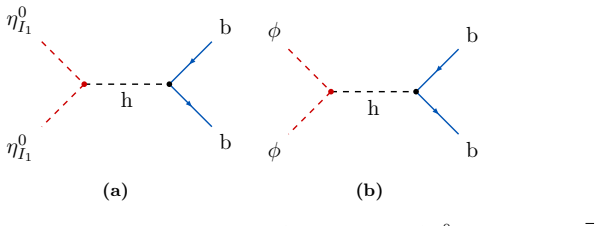
- [Section 5.2, text after eq. (5.5)] The sentence beginning 'The annihilation cross-section, <sigma v>_etaI1 etaI1 -> b b, proportionally depends on the parameters m_etaI1 0. 0.2 0.4' contains garbled or missing content and should be rephrased as a complete sentence.
- [Section 2, Table 1] The table caption reads 'T able 1' rather than 'Table 1'; please fix the typo.
- [Equations (4.1) and (4.5)] The notation for the inert doublet masses is inconsistent: eq. (4.1) uses mu_eta2 while eq. (4.5) uses m_etaI2; please unify the notation throughout.
Circularity Check
No significant circularity: the baryon asymmetry is used as an external constraint, while the DM, neutrino-mass, and lepton-flavor outputs are independently computed.
full rationale
The paper's central claim is that the couplings y12phi and mu12phi enter both the N1 decay vertex correction (hence the CP asymmetry epsilon_N1, eqs. C.12-C.13) and DM-DM conversion / relic density (eqs. 5.2). This is a parameter-overlap claim, not a derivation of an output from its own input. The observed baryon asymmetry is imposed as a constraint in Figs. 5 and 10: y12phi and mu12phi are free parameters scanned to satisfy Y_DeltaB, and the same couplings are then fed into independent Boltzmann equations for the two DM components. The relic density, direct-detection cross sections, and lepton-flavor-violating rates are not forced by the BAU fit; they depend on additional couplings and processes that do not enter epsilon_N1. Neutrino masses are imported through the Casas-Ibarra parametrization (B.14), which re-expresses the Yukawa couplings in terms of the measured neutrino masses and mixings; this is standard parameterization practice and does not by itself produce the observed baryon asymmetry. The self-citations present (e.g., ref. [53] for two-component DM cross sections, and refs. [48, 51] for related leptogenesis studies) supply standard or externally checkable formulas and are not load-bearing for the central derivation; no uniqueness theorem or ansatz is smuggled in via citation. The admitted incompleteness of scattering processes in eq. (4.2) is a robustness/correctness concern about the size of the leptogenesis result, not a circularity.
Assumptions & free parameters
free parameters (7)
- CI rotation angles (a, b) =
a=1, b=0.4 (leptogenesis scan); a=0, b=0.175 (DM scan)
- y12ϕ =
2.555 to 3.001 (Table 2)
- µ12ϕ =
0.5 mϕ to 2 mϕ
- mN1 =
2.2 to 6.4 TeV (Table 2)
- mη0_I1, mϕ =
scanned from 25 to 700 GeV
- λ11ϕ, λϕH, λ'11H, λ''11H =
scanned up to 1; λϕH ~ 0.1 for WIMP-WIMP
- λij, λkkϕ =
set to 1 in the scans
assumptions (8)
- domain assumption The Standard Model is the correct low-energy description apart from the new fields.
- domain assumption The Z2⊗Z2' symmetry is exact, ensuring the stability of the two DM candidates and forbidding tree-level lepton-number-violating decays.
- domain assumption The one-loop radiative diagram (fig. 12) is the sole source of neutrino mass; no tree-level seesaw contributes.
- domain assumption Electroweak sphalerons convert the B-L asymmetry to baryon asymmetry at T_sph ~ 130 GeV with the standard conversion factor, though the explicit coefficient is not stated.
- ad hoc to paper All model parameters are real except the Yukawa couplings h_iiα, which carry the CP-violating phase.
- domain assumption The unflavored Boltzmann equations in eq. (4.2) are adequate for computing the final baryon asymmetry.
- ad hoc to paper Scatterings that are not explicitly included in the asymmetry evolution do not significantly change the result.
- domain assumption Only the WIMP-WIMP regime (λϕH ~ 0.1) is considered for dark matter.
invented entities (5)
-
N1 (lightest right-handed neutrino)
-
N2 (heavier right-handed neutrino)
-
η1 (inert doublet)
-
η2 (second inert doublet)
-
ϕ (real scalar singlet)
Cite this review
Pith. "Pith review of Two-component Dark Matter and low scale Thermal Leptogenesis." pith.science (2026). https://pith.science/paper/G5DAOFO5
@misc{pith2026241221202,
  author       = {Pith},
  title        = {Pith review of: Two-component Dark Matter and low scale Thermal Leptogenesis},
  year         = {2026},
  howpublished = {\url{https://pith.science/paper/G5DAOFO5}},
  note         = {Machine review of arXiv:2412.21202}
}
abstract
The observable cosmos exhibits sizable baryon asymmetry, small active neutrino masses, and the presence of dark matter (DM). To address these phenomena together, we propose a two component DM scenario in an extension of Scotogenic model, imposing $\mathbb{Z}_2 \otimes \mathbb{Z}_2^{\prime}$ symmetry. The electroweak sphaleron process converts the $\rm Y_{B-L}^{}$ yield, generated through the Leptogenesis mechanism, into the baryon asymmetry ($\rm Y_{\Delta B}^{}$) at $\rm T_{\rm sph}\sim 130$ GeV, the sphalerons decoupling temperature. In this framework, the CP asymmetry as well as the radiative neutrino mass generation explicitly involve the two DM particles, thus establishing a correlation between the baryon asymmetry, DM and observed active neutrino masses. We study in details the allowed parameter space available after considering all the constraints from the three phenomena as well as from the collider search limits, and outline the region which could potentially be tested in future DM detection experiments through direct or indirect detection searches, lepton flavor-violating decays, etc.
Figures


Figures from the paper (11 more)




Forward citations
Cited by 1 Pith paper
-
A Non-Holomorphic Modular $A_4$ Framework for Resonant Leptogenesis with Gravitational Wave Signatures
A non-holomorphic modular A4 seesaw model yields quasi-degenerate right-handed neutrinos, enabling resonant leptogenesis at ~10^6 GeV and a double-peaked gravitational-wave signature.
Reference graph
Works this paper leans on
-
[47]
Leptogenesis and the Higgs Portal
M. Le Dall and A. Ritz,Leptogenesis and the Higgs Portal,Phys. Rev. D90(2014) 096002 [1408.2498]
work page Pith review arXiv 2014
-
[2]
Sakharov,Violation of CP Invariance, C asymmetry, and baryon asymmetry of the universe,Pisma Zh
A.D. Sakharov,Violation of CP Invariance, C asymmetry, and baryon asymmetry of the universe,Pisma Zh. Eksp. Teor. Fiz.5(1967) 32
1967
-
[3]
Fukugita and T
M. Fukugita and T. Yanagida,Baryogenesis Without Grand Unification,Phys. Lett. B174 (1986) 45
1986
-
[4]
M. D’Onofrio, K. Rummukainen and A. Tranberg,Sphaleron Rate in the Minimal Standard Model,Phys. Rev. Lett.113(2014) 141602 [1404.3565]
arXiv 2014
-
[5]
W. Buchmuller, P. Di Bari and M. Plumacher,Some aspects of thermal leptogenesis,New J. Phys.6(2004) 105 [hep-ph/0406014]
arXiv 2004
-
[6]
W. Buchmuller, P. Di Bari and M. Plumacher,Leptogenesis for pedestrians,Annals Phys.315 (2005) 305 [hep-ph/0401240]
arXiv 2005
-
[7]
S. Davidson, E. Nardi and Y. Nir,Leptogenesis,Phys. Rept.466(2008) 105 [0802.2962]
arXiv 2008
-
[8]
The Little Review on Leptogenesis
A. Pilaftsis,The Little Review on Leptogenesis,J. Phys. Conf. Ser.171(2009) 012017 [0904.1182]
work page Pith review arXiv 2009
Show all 80 references
-
[9]
Pilaftsis and T.E.J
A. Pilaftsis and T.E.J. Underwood,Resonant leptogenesis,Nucl. Phys. B692(2004) 303 [hep-ph/0309342]
2004 arXiv
-
[10]
Hugle, M
T. Hugle, M. Platscher and K. Schmitz,Low-Scale Leptogenesis in the Scotogenic Neutrino Mass Model,Phys. Rev. D98(2018) 023020 [1804.09660]
2018 arXiv
-
[11]
Alanne, T
T. Alanne, T. Hugle, M. Platscher and K. Schmitz,Low-scale leptogenesis assisted by a real scalar singlet,JCAP03(2019) 037 [1812.04421]
2019 arXiv
-
[12]
Dasgupta, P.S.B
A. Dasgupta, P.S.B. Dev, S.K. Kang and Y. Zhang,New mechanism for matter-antimatter asymmetry and connection with dark matter,Phys. Rev. D102(2020) 055009
2020
-
[13]
Borah, A
D. Borah, A. Dasgupta and D. Mahanta,Dark sector assisted low scale leptogenesis from three body decay,Phys. Rev. D105(2022) 015015 [2008.10627]
2022 arXiv
-
[14]
Kamionkowski and M.S
M. Kamionkowski and M.S. Turner,Thermal relics: Do we know their abundances?,Phys. Rev. D42(1990) 3310. – 26 –
1990
-
[15]
Jungman, M
G. Jungman, M. Kamionkowski and K. Griest,Supersymmetric dark matter,Phys. Rept.267 (1996) 195 [hep-ph/9506380]
1996 arXiv
-
[16]
L.J. Hall, K. Jedamzik, J. March-Russell and S.M. West,Freeze-In Production of FIMP Dark Matter,JHEP03(2010) 080 [0911.1120]
2010 arXiv
-
[17]
Profumo, K
S. Profumo, K. Sigurdson and L. Ubaldi,Can we discover multi-component WIMP dark matter?,JCAP12(2009) 016 [0907.4374]
2009 arXiv
-
[18]
Drozd, B
A. Drozd, B. Grzadkowski and J. Wudka,Multi-Scalar-Singlet Extension of the Standard Model - the Case for Dark Matter and an Invisible Higgs Boson,JHEP04(2012) 006 [1112.2582]
2012 arXiv
-
[19]
Q.-H. Cao, E. Ma, J. Wudka and C.P. Yuan,Multipartite dark matter,0711.3881
-
[20]
Feldman, Z
D. Feldman, Z. Liu, P. Nath and G. Peim,Multicomponent Dark Matter in Supersymmetric Hidden Sector Extensions,Phys. Rev. D81(2010) 095017 [1004.0649]
2010 arXiv
-
[21]
Heeck and H
J. Heeck and H. Zhang,Exotic Charges, Multicomponent Dark Matter and Light Sterile Neutrinos,JHEP05(2013) 164 [1211.0538]
2013 arXiv
-
[22]
Tomozawa,Two components of dark matter in the DAMA data,Int
Y. Tomozawa,Two components of dark matter in the DAMA data,Int. J. Mod. Phys. A23 (2008) 4811 [0806.1501]
2008 arXiv
-
[23]
Malekjani, S
M. Malekjani, S. Rahvar and D.M.Z. Jassur,Two Component Baryonic-Dark Matter Structure Formation in Top-Hat Model,New Astron.14(2009) 398 [0706.3773]
2009 arXiv
-
[24]
Daikoku, H
Y. Daikoku, H. Okada and T. Toma,Two Component Dark Matters inS4 ×Z 2 Flavor Symmetric Extra U(1) Model,Prog. Theor. Phys.126(2011) 855 [1106.4717]
2011 arXiv
-
[25]
Biswas, D
A. Biswas, D. Majumdar, A. Sil and P. Bhattacharjee,Two Component Dark Matter : A Possible Explanation of 130 GeVγ−Ray Line from the Galactic Centre,JCAP12(2013) 049 [1301.3668]
2013 arXiv
-
[26]
M. Aoki, J. Kubo and H. Takano,Two-loop radiative seesaw mechanism with multicomponent dark matter explaining the possibleγexcess in the Higgs boson decay and at the Fermi LAT, Phys. Rev. D87(2013) 116001 [1302.3936]
2013 arXiv
-
[27]
Gu,Multi-component dark matter with magnetic moments for Fermi-LAT gamma-ray line,Phys
P.-H. Gu,Multi-component dark matter with magnetic moments for Fermi-LAT gamma-ray line,Phys. Dark Univ.2(2013) 35 [1301.4368]
2013 arXiv
-
[28]
Bhattacharya, A
S. Bhattacharya, A. Drozd, B. Grzadkowski and J. Wudka,Two-Component Dark Matter, JHEP10(2013) 158 [1309.2986]
2013 arXiv
-
[29]
Ma,Verifiable radiative seesaw mechanism of neutrino mass and dark matter,Phys
E. Ma,Verifiable radiative seesaw mechanism of neutrino mass and dark matter,Phys. Rev. D 73(2006) 077301 [hep-ph/0601225]
2006 arXiv
-
[30]
Kaplan, M.A
D.E. Kaplan, M.A. Luty and K.M. Zurek,Asymmetric Dark Matter,Phys. Rev. D79(2009) 115016 [0901.4117]
2009 arXiv
-
[31]
Davoudiasl and R.N
H. Davoudiasl and R.N. Mohapatra,On Relating the Genesis of Cosmic Baryons and Dark Matter,New J. Phys.14(2012) 095011 [1203.1247]
2012 arXiv
-
[32]
Zurek,Asymmetric Dark Matter: Theories, Signatures, and Constraints,Phys
K.M. Zurek,Asymmetric Dark Matter: Theories, Signatures, and Constraints,Phys. Rept.537 (2014) 91 [1308.0338]
2014 arXiv
-
[33]
Barman, D
B. Barman, D. Borah, S.J. Das and R. Roshan,Non-thermal origin of asymmetric dark matter from inflaton and primordial black holes,JCAP03(2022) 031 [2111.08034]
2022 arXiv
-
[34]
Cui and M
Y. Cui and M. Shamma,WIMP Cogenesis for Asymmetric Dark Matter and the Baryon Asymmetry,JHEP12(2020) 046 [2002.05170]
2020 arXiv
-
[35]
Davoudiasl, D.E
H. Davoudiasl, D.E. Morrissey, K. Sigurdson and S. Tulin,Hylogenesis: A Unified Origin for Baryonic Visible Matter and Antibaryonic Dark Matter,Phys. Rev. Lett.105(2010) 211304 [1008.2399]. – 27 –
2010 arXiv
-
[36]
Falkowski, J.T
A. Falkowski, J.T. Ruderman and T. Volansky,Asymmetric Dark Matter from Leptogenesis, JHEP05(2011) 106 [1101.4936]
2011 arXiv
-
[37]
Petraki and R.R
K. Petraki and R.R. Volkas,Review of asymmetric dark matter,Int. J. Mod. Phys. A28 (2013) 1330028 [1305.4939]
2013 arXiv
-
[38]
Y. Cui, L. Randall and B. Shuve,A WIMPy Baryogenesis Miracle,JHEP04(2012) 075 [1112.2704]
2012 arXiv
-
[39]
Bernal, F.-X
N. Bernal, F.-X. Josse-Michaux and L. Ubaldi,Phenomenology of WIMPy baryogenesis models, JCAP01(2013) 034 [1210.0094]
2013 arXiv
-
[40]
Kumar and P
J. Kumar and P. Stengel,WIMPy Leptogenesis With Absorptive Final State Interactions,Phys. Rev. D89(2014) 055016 [1309.1145]
2014 arXiv
-
[41]
Racker and N
J. Racker and N. Rius,Helicitogenesis: WIMPy baryogenesis with sterile neutrinos and other realizations,JHEP11(2014) 163 [1406.6105]
2014 arXiv
-
[42]
Dasgupta, C
A. Dasgupta, C. Hati, S. Patra and U. Sarkar,A minimal model of TeV scale WIMPy leptogenesis,1605.01292
-
[43]
Borah, A
D. Borah, A. Dasgupta and S.K. Kang,TeV Scale Leptogenesis via Dark Sector Scatterings, Eur. Phys. J. C80(2020) 498 [1806.04689]
2020 arXiv
-
[44]
Dasgupta, P.S
A. Dasgupta, P.S. Bhupal Dev, S.K. Kang and Y. Zhang,New mechanism for matter-antimatter asymmetry and connection with dark matter,Phys. Rev. D102(2020) 055009 [1911.03013]
2020 arXiv
-
[45]
Croon, H
D. Croon, H. Davoudiasl and R. Houtz,Leptogenesis enabled by dark matter,Phys. Rev. D106 (2022) 035006 [2204.07584]
2022 arXiv
-
[46]
Borah, A
D. Borah, A. Dasgupta and S.K. Kang,Two-component dark matter with cogenesis of the baryon asymmetry of the Universe,Phys. Rev. D100(2019) 103502 [1903.10516]
2019 arXiv
-
[48]
Mahanta and D
D. Mahanta and D. Borah,Fermion dark matter withN2 leptogenesis in minimal scotogenic model,JCAP11(2019) 021 [1906.03577]
2019 arXiv
-
[49]
Y. Abe, T. Ito and K. Yoshioka,Leptonic CP asymmetry and Light flavored scalar,JHEP01 (2023) 019 [2110.11096]
2023 arXiv
-
[50]
Ghosh, P
D.K. Ghosh, P. Ghosh, K. Mukherjee and N. Narendra,A singlet scalar assistedN2 Leptogenesis and Pseudo-Scalar Dark Matter,2409.17067
-
[51]
Bhattacharya, N
S. Bhattacharya, N. Mondal, R. Roshan and D. Vatsyayan,Leptogenesis, dark matter and gravitational waves from discrete symmetry breaking,JCAP06(2024) 029 [2312.15053]
2024 arXiv
-
[52]
Davidson and A
S. Davidson and A. Ibarra,A Lower bound on the right-handed neutrino mass from leptogenesis,Phys. Lett. B535(2002) 25 [hep-ph/0202239]
2002 arXiv
-
[53]
Bhattacharya, P
S. Bhattacharya, P. Poulose and P. Ghosh,Multipartite Interacting Scalar Dark Matter in the light of updated LUX data,JCAP04(2017) 043 [1607.08461]
2017 arXiv
-
[54]
Bhattacharya, S
S. Bhattacharya, S. Chakraborti and D. Pradhan,Electroweak symmetry breaking and WIMP-FIMP dark matter,JHEP07(2022) 091 [2110.06985]
2022 arXiv
-
[55]
Bhattacharya, J
S. Bhattacharya, J. Lahiri and D. Pradhan,Dynamics of the pseudo-FIMP in presence of a thermal Dark Matter,2212.07622
-
[56]
Bhattacharya, J
S. Bhattacharya, J. Lahiri and D. Pradhan,Detection possibility of a Pseudo-FIMP in presence of a thermal WIMP,2212.14846
-
[57]
Bhattacharya, L
S. Bhattacharya, L. Kolay and D. Pradhan,Multiparticle scalar dark matter withZN symmetry,2410.16275. – 28 – [58]ATLAScollaboration,Measurement of the Z boson invisible width at s=13 TeV with the ATLAS detector,Phys. Lett. B854(2024) 138705 [2312.02789]. [59]CMScollaboration,P...
2024 arXiv
-
[64]
Lundstrom, M
E. Lundstrom, M. Gustafsson and J. Edsjo,The Inert Doublet Model and LEP II Limits,Phys. Rev. D79(2009) 035013 [0810.3924]
2009 arXiv
-
[65]
Swiezewska and M
B. Swiezewska and M. Krawczyk,Diphoton rate in the inert doublet model with a 125 GeV Higgs boson,Phys. Rev. D88(2013) 035019 [1212.4100]
2013 arXiv
-
[66]
Arhrib, R
A. Arhrib, R. Benbrik and N. Gaur,H→γγin Inert Higgs Doublet Model,Phys. Rev. D85 (2012) 095021 [1201.2644]
2012 arXiv
-
[67]
Belanger, B
G. Belanger, B. Dumont, A. Goudelis, B. Herrmann, S. Kraml and D. Sengupta,Dilepton constraints in the Inert Doublet Model from Run 1 of the LHC,Phys. Rev. D91(2015) 115011 [1503.07367]
2015 arXiv
-
[68]
Abouabid, A
H. Abouabid, A. Arhrib, R. Benbrik, J. El Falaki, B. Gong, W. Xie et al.,One-loop radiative corrections toe+e− →Zh 0/H 0A0 in the Inert Higgs Doublet Model,JHEP05(2021) 100 [2009.03250]. [69]ATLAScollaboration,Search for charginos and neutralinos in final states with two boost...
2021 arXiv
-
[70]
Banerjee, F
S. Banerjee, F. Boudjema, N. Chakrabarty and H. Sun,Relic density of dark matter in the inert doublet model beyond leading order for the low mass region: 1. Renormalisation and constraints,Phys. Rev. D104(2021) 075002 [2101.02165]
2021 arXiv
-
[71]
Ghosh, P
A. Ghosh, P. Konar and S. Seth,Precise probing of the inert Higgs-doublet model at the LHC, Phys. Rev. D105(2022) 115038 [2111.15236]. [72]CMScollaboration,Search for invisible decays of a Higgs boson produced through vector boson fusion in proton-proton collisions at√s=13 TeV...
2022 arXiv
-
[73]
Dercks and T
D. Dercks and T. Robens,Constraining the Inert Doublet Model using Vector Boson Fusion, Eur. Phys. J. C79(2019) 924 [1812.07913]
2019 arXiv
-
[74]
Belanger, A
G. Belanger, A. Mjallal and A. Pukhov,Two dark matter candidates: The case of inert doublet and singlet scalars,Phys. Rev. D105(2022) 035018 [2108.08061]. [75]MEGcollaboration,Search for the lepton flavour violating decayµ + →e +γwith the full dataset of the MEG experiment,Eur...
2022 arXiv
-
[77]
Toma and A
T. Toma and A. Vicente,Lepton Flavor Violation in the Scotogenic Model,JHEP01(2014) 160 [1312.2840]
2014 arXiv
-
[78]
Vicente and C.E
A. Vicente and C.E. Yaguna,Probing the scotogenic model with lepton flavor violating – 29 – processes,JHEP02(2015) 144 [1412.2545]
2015 arXiv
-
[79]
Valiente,Neutrino Masses and Lepton Flavor Physics Beyond the Standard Model, Ph.D
P.E. Valiente,Neutrino Masses and Lepton Flavor Physics Beyond the Standard Model, Ph.D. thesis, U. Valencia (main), 2023
2023
-
[80]
Hundi,Lepton flavor violating Z and Higgs decays in the scotogenic model,Eur
R.S. Hundi,Lepton flavor violating Z and Higgs decays in the scotogenic model,Eur. Phys. J. C82(2022) 505 [2201.03779]. [81]Particle Data Groupcollaboration,Review of particle physics,Phys. Rev. D110(2024) 030001
2022 arXiv
-
[82]
Casas and A
J.A. Casas and A. Ibarra,Oscillating neutrinos andµ→e, γ,Nucl. Phys. B618(2001) 171 [hep-ph/0103065]
2001 arXiv
-
[83]
Alberico and S.M
W.M. Alberico and S.M. Bilenky,Neutrino oscillations, masses and mixing,Phys. Part. Nucl. 35(2004) 297 [hep-ph/0306239]
2004 arXiv
-
[84]
Griest and D
K. Griest and D. Seckel,Three exceptions in the calculation of relic abundances,Phys. Rev. D 43(1991) 3191
1991
-
[85]
Edsjo and P
J. Edsjo and P. Gondolo,Neutralino relic density including coannihilations,Phys. Rev. D56 (1997) 1879 [hep-ph/9704361]
1997 arXiv
-
[86]
Alguero, G
G. Alguero, G. Belanger, F. Boudjema, S. Chakraborti, A. Goudelis, S. Kraml et al., micrOMEGAs 6.0: N-component dark matter,Comput. Phys. Commun.299(2024) 109133 [2312.14894]. [87]XENONcollaboration,Dark Matter Search Results from a One Ton-Year Exposure of XENON1T,Phys. Rev. ...
2024 arXiv
-
[90]
Baudis,DARWIN/XLZD: A future xenon observatory for dark matter and other rare interactions,Nucl
L. Baudis,DARWIN/XLZD: A future xenon observatory for dark matter and other rare interactions,Nucl. Phys. B1003(2024) 116473 [2404.19524]. [91]PandaXcollaboration,PandaX-xT: a Multi-ten-tonne Liquid Xenon Observatory at the China Jinping Underground Laboratory,2402.03596
2024 arXiv
-
[92]
Tang and B.-L
J. Tang and B.-L. Zhang,Asymptotic analysis of binned likelihoods and the neutrino floor, Phys. Rev. D108(2023) 062004 [2304.13665]
2023 arXiv
-
[93]
Giudice, A
G.F. Giudice, A. Notari, M. Raidal, A. Riotto and A. Strumia,Towards a complete theory of thermal leptogenesis in the SM and MSSM,Nucl. Phys. B685(2004) 89 [hep-ph/0310123]
2004 arXiv
-
[94]
Antusch, P
S. Antusch, P. Di Bari, D.A. Jones and S.F. King,Leptogenesis in the Two Right-Handed Neutrino Model Revisited,Phys. Rev. D86(2012) 023516 [1107.6002]
2012 arXiv
-
[95]
Esteban, M.C
I. Esteban, M.C. Gonzalez-Garcia, A. Hernandez-Cabezudo, M. Maltoni and T. Schwetz, Global analysis of three-flavour neutrino oscillations: synergies and tensions in the determination ofθ 23,δ CP, and the mass ordering,JHEP01(2019) 106 [1811.05487]
2019 arXiv
-
[96]
Esteban, M.C
I. Esteban, M.C. Gonzalez-Garcia, M. Maltoni, T. Schwetz and A. Zhou,The fate of hints: updated global analysis of three-flavor neutrino oscillations,JHEP09(2020) 178 [2007.14792]. – 30 –
2020 arXiv
Reviewed August 10, 2026 · model on record in the stance chip above.
Discussion (0). Continue with ORCID to comment.