REVIEW 2 major objections 6 minor 14 references
Predicted Janus SnSSe monolayer: a comprehensive first-principle study
T0 review · 2 major / 6 minor · reviewed 2026-08-14 · deepseek-v4-flash
Pith's one-line read The paper predicts that a Janus-structure SnSSe monolayer is stable and would combine a 0.83 eV gap, high hole mobility, quartz-like piezoelectricity, strong light absorption, and a high thermoelectric power factor.
desk verdict A competent, standard first-principles prediction of a new Janus monolayer that is likely stable, but the thermoelectric headline rests on an inferred rather than computed lattice thermal conductivity. read the letter →
The pith
A machine-rendered reading of the paper's core claim, the machinery that carries it, and where it could break.
The reading
What carries the argument
The central object is the Janus SnSSe monolayer, a 1T-phase two-dimensional crystal in which a tin layer is bonded to sulfur on one face and selenium on the other, reducing the symmetry from the parent 1T-SnS2/SnSe2 structure to the 3m point group. The argument is carried by this symmetry breaking: removing inversion symmetry is what allows piezoelectricity and an out-of-plane polarization, and the resulting polar field plus the flat valence-band character produces high hole mobility. The quantitative predictions are generated by a chain of standard first-principles tools: density functional theory with spin-orbit coupling for the band structure, deformation-potential theory for carrier mobilities, density-functional perturbation theory for elastic and piezoelectric tensors, and the Boltzmann transport equation in the constant scattering-time approximation for the Seebeck coefficient and power factor.
What would settle it
A direct first-principles calculation of the phonon Boltzmann transport for SnSSe, or a thermal-conductivity measurement on a synthesized monolayer, would settle the thermoelectric claim: if the lattice thermal conductivity turns out to be several times larger than that of SnS2 or SnSe2, the high power factor alone would not make SnSSe a promising thermoelectric material.
Extended reading notes
Core claim
Using density functional theory with spin-orbit coupling, the authors find that Janus SnSSe monolayer is dynamically and mechanically stable, with an indirect band gap of 0.83 eV. They calculate carrier mobilities that are strongly anisotropic and higher for holes than electrons, a piezoelectric strain coefficient $d_{11}$ of 2.251 pm/V that is close to that of α-quartz, visible-light absorption coefficients above $10^4$ cm$^{-1}$ along the in-plane direction, and a room-temperature power factor that is very high for both n- and p-type doping. On this basis they conclude that the monolayer is a promising thermoelectric material, provided the lattice thermal conductivity is as low as that inferred from related Janus and tin-chalcogenide monolayers.
Load-bearing premise
The thermoelectric conclusion relies on the premise, not calculated in this paper, that the SnSSe monolayer has ultra-low lattice thermal conductivity, transferred from calculations on MoSSe, ZrSSe, PtSSe, SnS2, and SnSe2 rather than computed for SnSSe itself.
Editorial extensions
If this is right
- A synthesis route analogous to the one that produced Janus MoSSe—selective replacement of one chalcogen layer—should be able to produce SnSSe monolayers.
- The monolayer would be a small-gap 2D semiconductor with hole-dominated transport, useful for transistors and sensors.
- Applying uniaxial strain in the basal plane generates both in-plane and out-of-plane piezoelectric polarizations, enabling electromechanical actuation or energy harvesting.
- The strong visible-light absorption along the in-plane direction suggests the sheet could serve as a photocatalyst for solar water splitting.
- The high calculated power factor, combined with the inferred ultra-low lattice thermal conductivity, would yield a high thermoelectric figure of merit.
Reading between the lines
- If the lattice thermal conductivity of SnSSe is indeed as low as that of SnS2 and SnSe2, the Janus monolayer's thermoelectric figure of merit could substantially exceed that of the parent sheets, because the power factor calculated here is higher; this is a quantitative prediction the paper stops short of making.
- The strain-induced convergence of the conduction bands toward the Γ point suggests tensile strain could be used to further enhance n-type thermoelectric performance, an optimization the paper notes but does not quantify.
- Since the optical and transport calculations rest on the GGA-PBE functional, a hybrid-functional or GW recalculation could shift the 0.83 eV gap and the resulting power factor; repeating the key quantities with such methods would be a direct test.
- The same broken-mirror-symmetry mechanism should endow other predicted Janus tin chalcogenides (SnSTe, SnSeTe) with piezoelectricity and low thermal conductivity, making the family a systematic platform for 2D thermoelectrics.
Signed reviews
Editorial analysis
A structured set of objections, weighed in public.
Referee Report
Summary. The paper predicts a Janus SnSSe monolayer by first-principles DFT. It reports dynamic stability from phonon dispersions, mechanical stability from elastic constants, an indirect-band-gap semiconducting character (0.83 eV with GGA+SOC), strain-tunable gaps, carrier mobilities from deformation-potential theory, piezoelectric coefficients from DFPT, optical absorption spectra, and electronic transport coefficients from Boltzmann transport theory within the constant scattering time approximation. The central claims are that SnSSe is dynamically and mechanically stable, has a high power factor, a piezoelectric d11 comparable to alpha-quartz, visible-light absorption, and is a promising thermoelectric material. The thermoelectric conclusion, however, is based on the assumption, stated in Section VIII, that SnSSe has ultra-low lattice thermal conductivity by analogy with SnS2/SnSe2 and other Janus TMDs, rather than on a computed value for SnSSe.
Significance. If the thermoelectric claim were properly supported, the paper would be a useful first-principles prediction of a stable Janus SnSSe monolayer with a combination of piezoelectric, optical, and transport properties. The structural, electronic, and stability calculations are competently executed with standard methods, and the explicit treatment of SOC for effective masses and Seebeck coefficients is a strength. The authors also compare with the synthesized MoSSe system, which gives context for experimental feasibility. The main weakness is that the load-bearing thermoelectric conclusion relies on an uncalculated lattice thermal conductivity, and the quantitative optical and transport values depend on a somewhat arbitrary 2D thickness convention. These issues are fixable within the scope of the manuscript, but they need to be addressed before publication.
major comments (2)
- [Section VIII (Electronic transport properties), final paragraph] The thermoelectric conclusion is not supported by an actual calculation for SnSSe. The text states that 'the SnSSe monolayer should have ultra low lattice thermal conductivity' based on Refs. 29-31 and 47, but no phonon Boltzmann transport calculation, Grüneisen parameter analysis, or anharmonic force-constant calculation for SnSSe is presented. Since the figure of merit is zT = S²σT/(κ_e + κ_l), a high power factor alone does not establish that SnSSe is a promising thermoelectric material; the symmetry lowering in the Janus structure and the different atomic masses could either reduce or increase κ_l relative to SnS2/SnSe2. Please either compute κ_l for SnSSe with the same methodology as for the parent compounds, or explicitly reframe the thermoelectric statement as a conjecture requiring verification.
- [Section II (Computational detail) and Section VIII] The quantitative values of the optical absorption coefficients and of the power factor S²σ depend on the choice d = Lz = 20 Å used to renormalize 2D quantities. This convention is acknowledged in Section II, but the abstract and Section VIII report 'high absorption coefficients' and 'very high power factor' without stating how sensitive these values are to d. For a central quantitative claim, please provide the dependence on d or adopt a physically motivated effective thickness; otherwise the magnitude of S²σ cannot be compared meaningfully with values obtained using a different normalization convention.
minor comments (6)
- [Section III, paragraph after Fig. 1] The text reads 'With Pt sandwiched between the S and Se layers'; this should be 'Sn', not 'Pt', since the compound is SnSSe.
- [Section VII, Eq. (14)] In the text following Eq. (14), 'the energy of the incident phonon' should be 'the energy of the incident photon'.
- [Table II and Section V, Eq. (4)] The effective masses for holes are listed as negative values, while Eq. (4) uses m* in the denominator. Please state explicitly that absolute values of the effective masses are used in the mobility formula, or define m* = |m*|.
- [Throughout] The title and text use 'first-principle'; the standard term is 'first-principles'.
- [Section III] The paper reports the lattice constant and elastic constants but not the full optimized atomic coordinates. Providing the structural parameters in fractional coordinates would improve reproducibility for other groups.
- [Section IV] All quantitative electronic and optical results are obtained at the GGA-PBE level. Please add a sentence noting that the band gap and optical onset are expected to be underestimated at this level, so the quoted 0.83 eV gap should be interpreted as a PBE-level value.
Circularity Check
No significant circularity: the paper's target-material predictions are first-principles calculations, and the thermoelectric claim rests on an uncalculated analogy, not on a circular reduction.
full rationale
The paper is a direct first-principles (DFT/DFPT) study of SnSSe. Every target-material quantity that enters the abstract—lattice constants, phonon spectrum, elastic constants, band gaps (GGA and GGA+SOC), strain dependence, carrier mobilities via deformation-potential theory, piezoelectric coefficients via DFPT, optical absorption from the dielectric function, and Seebeck/power factor via BoltzTrap—is computed from the stated PBE(+SOC) Hamiltonian without fitting to SnSSe experimental data. The mobility calculation uses computed C2D, effective masses, and deformation potentials; the transport calculation uses the computed tau within the constant-scattering-time approximation. These are parameter-free chains of calculation, not self-referential definitions. The one inference not computed in this paper is the Section VIII claim that 'the SnSSe monolayer should have ultra low lattice thermal conductivity'; the paper extrapolates from prior calculations on SnS2/SnSe2 (Ref. 47) and MoSSe/PtSSe/ZrSSe (Refs. 29–31). Because the present work does not calculate kappa_l for SnSSe, the thermoelectric conclusion is a missing-support inference, but it is not a circular reduction: the cited prior results are independent first-principles calculations on other materials, and no fitted parameter is renamed as a prediction. The self-citations (Refs. 29, 30, 50) are normal author citations to their own earlier independent calculations and are not used to forbid alternatives or to smuggle in the target answer. Therefore no circularity step is identified.
Assumptions & free parameters
free parameters (1)
- 2D layer thickness d used for normalization =
20 Å
assumptions (7)
- domain assumption The PBE exchange-correlation functional accurately describes the electronic structure, band gap, effective masses, and optical response of SnSSe.
- domain assumption The harmonic phonon approximation and finite-displacement method are sufficient to establish dynamic stability.
- domain assumption Bardeen-Shockley deformation potential theory gives reliable intrinsic carrier mobilities for this 2D material.
- domain assumption The constant scattering time approximation and rigid band approximation describe doping-dependent electronic transport.
- domain assumption The independent-particle dielectric function without excitonic effects captures the optical absorption.
- ad hoc to paper Janus SnSSe has ultra-low lattice thermal conductivity like SnS2/SnSe2 and MoSSe.
- standard math The 3m point-group symmetry determines the piezoelectric tensor form.
Cite this review
Pith. "Pith review of Predicted Janus SnSSe monolayer: a comprehensive first-principle study." pith.science (2026). https://pith.science/paper/G5IUELPY
@misc{pith2026190802908,
  author       = {Pith},
  title        = {Pith review of: Predicted Janus SnSSe monolayer: a comprehensive first-principle study},
  year         = {2026},
  howpublished = {\url{https://pith.science/paper/G5IUELPY}},
  note         = {Machine review of arXiv:1908.02908}
}
read the original abstract
The Janus structure, by combining properties of different transition metal dichalcogenide (TMD) monolayers in a single polar material, has attracted increasing research interest because of their particular structure and potential application in electronics, optoelectronics and piezoelectronics. In this work, Janus SnSSe monolayer is predicted by means of first-principles calculations, which exhibits dynamic and mechanical stability. By using generalized gradient approximation (GGA) plus spin-orbit coupling (SOC), the Janus SnSSe monolayer is found to be an indirect band-gap semiconductor, whose gap can easily be tuned by strain. High carrier mobilities are obtained for SnSSe monolayer, and the hole mobility is higher than the electron mobility. For SnSSe monolayer, a uniaxial strain in the basal plane can induce both strong in-plane and much weaker out-of-plane piezoelectric polarizations, which reveals the potential as a piezoelectric two-dimensional (2D) material. The high absorption coefficients in the visible light region are observed, suggesting a potential photocatalytic application. Calculated results show that SnSSe monolayer has very high power factor, making it a promising candidate for thermoelectric applications. Our works reveal that the Janus SnSSe structure can be fabricated with unique electronic, optical, piezoelectric and transport properties, and can motivate related experimental works.
Figures


Figures from the paper (5 more)



Reference graph
Works this paper leans on
-
[10]
It is because that the VBM changes from Γ point to another point along Γ-K direc- tion
With a/a0 from 0.94 to 1.04, the ∆ decrease monotonously, and then a rapid decrease from 1.04 to 1.06. It is because that the VBM changes from Γ point to another point along Γ-K direc- tion. The strain can tune the positions of conduction band extrema (CBE), and the second CBE changes from K point to Γ point, when strain varies from compressive strain to ...
-
[12]
Using symmetry analysis, the piezoelectric coefficients of TMD monolay- ers have been calculated with density functional pertur- bation theory (DFPT)
-
[13]
In general, the two-layer chalcogen atoms in TMD monolayers are same element
Many studies of heat transport properties of TMD monolayers have been reported, and strain effects on their heat transport properties have been investigated 14–19. In general, the two-layer chalcogen atoms in TMD monolayers are same element. If the two-layer chalco- gen atoms are different, Janus monolayer will be con- structed, and then the symmetry will b...
-
[14]
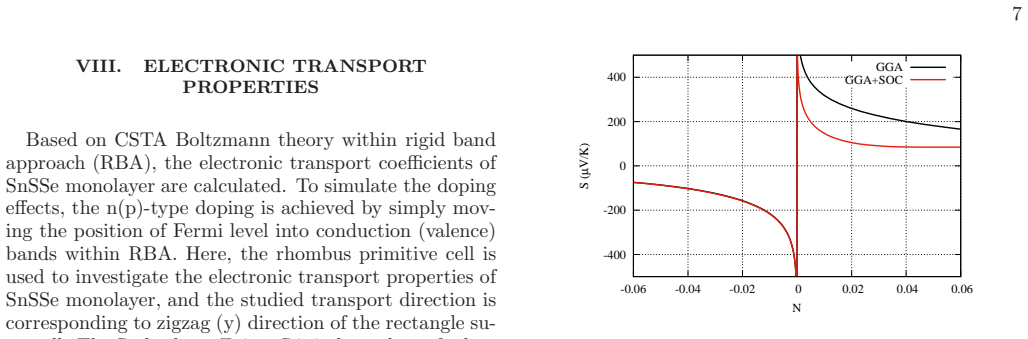
The lattice thermal conduc- tivity of Janus MoSSe/PtSSe/ZrSSe monolayer is lower than MoS 2/PtS2/ZrS2 monolayer 29–31. Thus, the SnSSe monolayer should have ultra low lattice thermal conduc- tivity, which suggests that Janus monolayer SnSSe may be a potential thermoelectric material. IX. DISCUSSIONS AND CONCLUSION Monolayer SnX 2 (X = S, Se) have been rec...
-
[15]
The Janus SnXY (X/Y=S, Se, Te) monolayer should also have ultra low 8 lattice thermal conductivity, and they may be promising candidates for thermoelectric applications. In summary, the electronic structures, carrier mo- bilities, piezoelectric properties, optical properties and transport coefficients of Janus SnSSe monolayer are sys- tematically studied fr...
-
[16]
The high absorption coefficients in the visible light region can be observed along xx/yy direction
The piezoelectric coefficient d11 of SnSSe monolayer is comparable with one of α-quartz commonly used 3D piezoelectric material 52. The high absorption coefficients in the visible light region can be observed along xx/yy direction. The electronic transport calculations suggest that Janus monolayer SnSSe may be a potential thermoelectric material. Our works ca...
work page 2004
-
[23]
The mechanical and elec- FIG. 1. (Color online) The top view (a) and side view (b) crystal structure of Janus SnSSe monolayer. The large balls represent Sn atoms, and the small balls for S/Se atoms. The black and red lines represent the rhombus primitive cell and the rectangle supercell. tronic properties of Janus monolayer MXY (M=Ti, Zr, Hf, V, Nb, Ta, C...
-
[24]
A significant Rashba spin splitting can be induced by intrinsic out-of-plane built-in electric field in monolayer Janus WSeTe
Show all 14 references
-
[25]
The elec- tronic and optical properties of MoSSe-WSSe vertical and lateral heterostructures have been studied by the first- principles calculations
Janus MoSSe and PtSSe monolayers are predicted to be potential wide solar- spectrum water-splitting photocatalyst 26,27. The elec- tronic and optical properties of MoSSe-WSSe vertical and lateral heterostructures have been studied by the first- principles calculations
-
[28]
The lattice thermal conductiv- ities of MoSSe/ZrSSe/PtSSe monolayer are predicted by linearized phonon Boltzmann equation, which are much lower than that of the MoS 2/ZrS2/ PtS2 monolayers 29–31. In this work, inspiring from the already synthesized 1T structure of SnS 2/SnSe26...
-
[33]
We use popular GGA of Perdew, Burke and Ernzerhof (GGA-PBE) 34 as the exchange- correlation potential, and the SOC was included self-consistently 35–38. To attain reliable results, we use a 30 × 30 × 1 k-point meshes in the first Brillouin zone (BZ) for the self-consistent calc...
-
[45]
Along xx/yy and zz directions, strong anisotropy in the optical spectra can be observed due to distinct optical selection rules
The dielectric function and absorption coefficient of SnSSe monolayer are calculated along xx/yy and zz directions, and are plotted in Figure 7 and Figure 8 . Along xx/yy and zz directions, strong anisotropy in the optical spectra can be observed due to distinct optical selectio...
-
[47]
Due to three atoms in the unit cell, the 3 acoustic and 6 optical phonon branches are observed
To confirm the stability of SnSSe monolayer, the phonon dispersion of Janus monolayer SnSSe is plotted in Figure 2 , which shows no imaginary modes, suggest- ing that monolayer SnSSe is dynamically stable. Due to three atoms in the unit cell, the 3 acoustic and 6 optical phonon...
-
[50]
To simulate biaxial strain, a/a0 is used witha/a0<1 (a/a0>1) being compressive (tensile) strain, where a and a0 are the strained and unstrained lattice constant, respectively
Here, the effects of biaxial strain on the electronic structures of SnSSe monolayer are examined. To simulate biaxial strain, a/a0 is used witha/a0<1 (a/a0>1) being compressive (tensile) strain, where a and a0 are the strained and unstrained lattice constant, respectively. The ...
Reviewed August 14, 2026 · model on record in the stance chip above.
Discussion (0). Continue with ORCID to comment.