REVIEW 3 major objections 4 minor 29 references
This paper shows that permission-related app reviews can be classified from the full review stream with 82% accuracy using AI-generated examples as training labels, and that those reviews cluster by user sentiment rather than by permission
Reviewed by Pith at T0; open to challenge. T0 means a machine referee read the full paper against a public rubric. the ladder, T0–T4 →
T0 review · deepseek-v4-flash
2026-08-03 08:57 UTC pith:G62FYE5G
load-bearing objection The GPT-4-generated-review idea is worth discussing, but the 82% accuracy overstates what the evaluation supports, and the sentiment clusters likely inherit generator bias. the 3 major comments →
Analysing User Reviews to Identify User Concerns Around Permissions in AI Apps
The pith
A machine-rendered reading of the paper's core claim, the machinery that carries it, and where it could break.
Core claim
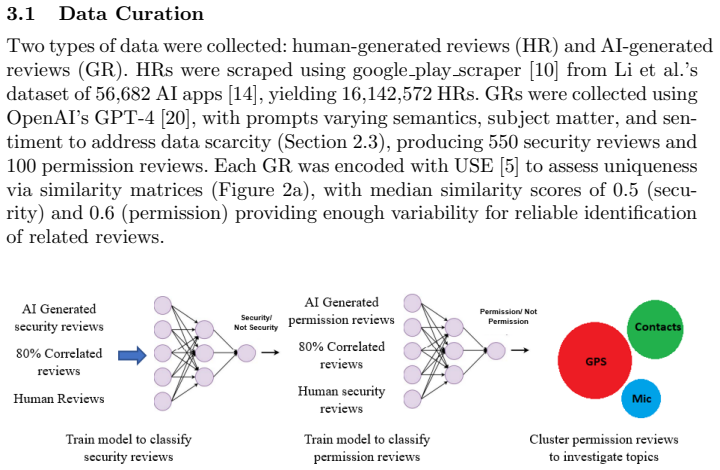
The paper's central claim is that permission-related reviews can be meaningfully classified from a dataset spanning all review types, with accuracy 0.82, and that the topics users raise in those reviews are organized by sentiment rather than by permission type. On the paper's own pipeline, a privacy/security classifier first isolates 20,622 security reviews from 16.1 million human reviews; a second classifier then distinguishes permission-focused reviews from among them (0.71 from security reviews, 0.82 from all reviews) and selects 6,532 permission-related reviews. Clustering those reviews with k=7 produces topics labeled Hostile, Question, Statement, Review, Disappointment, Warning, and Re
What carries the argument
The load-bearing mechanism is prototype-based training-label selection. A large language model generates a small set of permission and security review prototypes; a sentence-embedding model converts both prototypes and the human review corpus into vectors; any human review whose similarity to a prototype exceeds an 80% threshold is treated as a training example for that category. Those automatically selected examples train a feed-forward binary classifier with a pre-trained embedding layer. The same embedding representation feeds a K-means clustering step (k=7 chosen by silhouette score) to produce the sentiment-defined topics. The 80% threshold and the prototype set together define what cou
Load-bearing premise
The load-bearing premise is that a human review with high embedding similarity to an AI-generated permission prototype really is a permission review; if that mapping is systematically biased, the 0.82 accuracy and the sentiment-based topic clusters inherit the bias.
What would settle it
Build a test set of at least 1,000 permission and non-permission reviews with multiple independent human annotators, sampled across app genres, and measure the classifier's accuracy per genre. If overall accuracy drops below roughly 0.75 on this larger set, or if any genre is near chance, the 0.82 claim does not generalize. A cheaper test: generate training labels with two different language models (or two similarity thresholds) and measure inter-label agreement; low agreement would show the labels are an artifact of the generator rather than of the reviews.
If this is right
- App stores can surface permission-related reviews automatically, because the classifier operates on the full review stream without hand-labeled training data.
- Developers can see which permission requests generate hostility and can address those requests directly, since topic clusters reflect emotional response rather than a list of permission names.
- Genre differences matter: finance apps attract larger shares of hostile, questioning, and disappointed reviews, while communication apps concentrate in the 'Review' cluster, implying users' expectations about data use vary by app purpose.
- Warning and Removal clusters are small, suggesting that outright perceived misuse is rare; the larger clusters point to frustration and confusion as the main permission-related problem.
- The pipeline is transferable: generating prototypes for other policy topics (e.g., data sharing, ads, account deletion) would let the same approach monitor additional user concerns.
Where Pith is reading between the lines
- Inference: If sentiment-based clustering is real, permission-prompt design should be genre-specific—finance apps should preemptively explain why sensitive data is requested, because hostile reviews are concentrated there.
- Inference: The 80% similarity threshold and the choice of generator jointly define the target concept; comparing labels from a different generator or a different threshold would quantify how much of the 0.82 accuracy is inherited from that choice.
- Inference: The clusters read like an escalation ladder (Question → Disappointment → Hostile → Removal), which could be turned into a single risk score per app update rather than a list of topics.
- Inference: The same pipeline could serve as a regression-monitoring signal: a sudden shift in the ratio of Hostile to Question reviews after an update would flag permission changes that upset users before they uninstall.
Editorial analysis
A structured set of objections, weighed in public.
Referee Report
Summary. The paper proposes a two-stage pipeline for identifying permission-related reviews in Google Play reviews of AI apps. It scrapes a large human-review corpus, uses GPT-4 generated permission/security prototypes with Universal Sentence Encoder embeddings to select training positives by cosine similarity, trains binary classifiers (security first, then permission), and then applies k-means clustering to the classified permission reviews. The paper reports 0.82 accuracy for permission classification from all reviews and concludes that user concerns cluster by sentiment rather than by permission type.
Significance. If the method's claims hold, the contribution is practically interesting: it would allow app-store stakeholders to screen permission-related reviews without manual annotation, and the sentiment-based topic finding could inform permission-request design. The idea of bootstrapping labels from AI-generated prototypes to overcome data scarcity is creative, and the two-stage architecture is clearly described. However, the central claims currently rest on an unvalidated generator-based labeling step and on small or ambiguously described test sets, so the significance is contingent on additional validation.
major comments (3)
- [Section 3.2, Section 4.1] Label validity and circularity: positive training examples for the permission classifier are human reviews with >0.8 cosine similarity to GPT-4 permission-review prototypes, and the RQ2 corpus is selected by the same rule. The classifier may therefore learn to detect 'similar to GPT-4's notion of a permission review' rather than 'a user expressing a permission concern.' The paper concedes this in Section 6 but does not test it. This is load-bearing: the 0.82 accuracy does not establish performance against human judgments. Concretely, the authors should have independent human annotators label a random sample of reviews from the full 16M corpus (not pre-filtered by GR similarity), compare classifier predictions to those labels, and report precision/recall plus inter-annotator agreement. They should also vary the generator (e.g., GPT-3.5, Llama, or no generator) and the similarity threshold
- [Section 3.3, Table 1] Test-set construction and epoch selection: the text states 'the best version across 20 epochs used for testing.' Selecting the best epoch based on the test set is a form of test-set leakage and will inflate the reported accuracy (0.82). Moreover, the test set for the permission classifier is not clearly specified: Section 3.2 describes a 100-review manually annotated set for security, then says the process was repeated, but Table 1 gives no test-set size or composition for the permission rows. The authors should use a separate validation set for model selection, a fresh human-labeled test set for final evaluation, and report confidence intervals (e.g., Wilson interval) for accuracy and F1.
- [Section 4.2, Table 2] Cluster validity: the conclusion that topics are 'shaped by user sentiment, not by the specific type of permission involved' is based on seven k-means clusters manually labeled with sentiment names. No quantitative validation is reported (e.g., cluster purity against permission type, inter-rater agreement on the topic labels), and silhouette score only measures geometric separation. Since the clustered corpus was selected by GPT-4 prototype similarity, the apparent sentiment structure may reflect the prototypes rather than actual user concerns. The authors should test whether sentiment clusters are reproducible on an independently human-labeled sample, and should compare cluster membership against permission type as an alternative explanation.
minor comments (4)
- [Section 3.3] Typo in heading: 'T raining and testing privacy classifier' should be 'Training and testing privacy classifier.'
- [Section 3.1] The phrase 'any HR correlating above 80%' is imprecise; the method uses cosine similarity, not correlation. Please use 'cosine similarity exceeding 0.8.'
- [Table 1 caption] Please state the number and composition of test reviews for each row. Currently the reader cannot tell whether the 0.82 row is evaluated on a human-annotated set or on an automatically selected set.
- [Figure 2] The caption 'Similarity matrix values' is vague. Clarify that subfigure (a) shows box plots of pairwise similarity among generated reviews, and (b) shows silhouette scores from a single k-means run; no error bars or multiple runs are shown.
Circularity Check
No circularity: accuracy and sentiment-cluster findings are empirical measurements, not reductions to the GPT-based selection filter.
full rationale
The paper's central claim is an empirical measurement rather than a derivation from its own inputs. The 80% cosine-similarity threshold to GPT-4 permission prototypes defines how positive training examples and the analysis corpus are selected (Section 3.2: "any HR correlating above 80% treated as relating to the same topic"), and the paper concedes in Section 6 that "it could be argued that all selected data was biased to the generated data." However, the reported 0.82 accuracy is not logically forced by that threshold: the same section describes a "manually annotated test set" and the permission classification process is repeated with the same manual annotation, providing an independent (if small) ground-truth check. The sentiment-cluster conclusion in RQ2 comes from k-means clustering of the extracted reviews and manual reading of clusters, not from equating the clusters with the GPT prototype labels; the clustering could in principle have produced permission-type clusters. The self-citations in the reference list are background literature and are not load-bearing for the accuracy or clustering findings. The GPT-filter bias is a real external-validity threat, but it is not a circular definitional reduction of the claimed results to the input labels, and the paper explicitly acknowledges this limitation. No specific reduction by construction can be exhibited, so no circularity step is identified.
Axiom & Free-Parameter Ledger
free parameters (5)
- HR-GR cosine similarity threshold =
0.80
- Cluster count k =
7
- Test-set class balance and size =
50 positive / 50 negative, n=100 per classifier
- GR diversity gates (median pairwise similarity) =
0.5 (security), 0.6 (permission)
- Epoch selection =
best of 20
axioms (6)
- ad hoc to paper GPT-4-generated permission reviews are a valid and unbiased proxy for the content and language of human permission-related reviews.
- domain assumption Cosine similarity >0.8 in USE embedding space corresponds to topical equivalence for app reviews.
- domain assumption The 16.1M scraped reviews from Li et al.'s 56,682 AI-app list are representative of AI-app user reviews.
- domain assumption User reviews faithfully reflect genuine user security and privacy concerns.
- standard math Euclidean k-means on USE embeddings produces semantically meaningful topic clusters.
- domain assumption The '10x data rule' for neural network training (5,120 examples for a 512-dim input) applies to this text-classification setting.
read the original abstract
Artificial intelligence is increasingly embedded in everyday software, making its integration into mobile apps inevitable. However, AI mobile app developers are not always versed in security and privacy best practices, leaving users to monitor their own security and understand how apps use their data. App reviews capture real user experiences, helping others make informed decisions before downloading. This paper presents a machine learning model for classifying AI app reviews into permission-related categories. Because user reviews are unstructured, assembling a conventional labeled training set is difficult. To address this, AI-generated security and permission reviews are used to identify relevant training examples from a large corpus of human-written reviews, eliminating the need for manual annotation. The proposed approach classified permission reviews with an accuracy of 82%. Analysis shows that users organise their concerns by sentiment toward the requesting app rather than specific permission types, with implications for users, developers, and platform administrators.
Figures

Reference graph
Works this paper leans on
-
[1]
App store ratings and reviews (2019),https://developer.apple.com/app-store /ratings-and-reviews/
2019
-
[2]
Ahmad, H., Dharmadasa, I., Ullah, F., Babar, M.A.: A review on c3i systems’ security: Vulnerabilities, attacks, and countermeasures. ACM Comput. Surv.55(9) (Jan 2023).https://doi.org/10.1145/3558001,https://doi.org/10.1145/35 58001
-
[3]
AI and Society37, 1715–1728 (2021).https://doi.org/10.1007/s00146-021-0 1262-5
Andreotta, A.J., Kirkham, N., Rizzi, M.: Ai, big data, and the future of consent. AI and Society37, 1715–1728 (2021).https://doi.org/10.1007/s00146-021-0 1262-5
-
[4]
apple.com/en-gb/guide/iphone/iph251e92810/ios
Apple: Control access to information in apps on iphone (nd),https://support. apple.com/en-gb/guide/iphone/iph251e92810/ios
-
[5]
arXiv preprint arXiv:1803.11175 (2018)
Cer, D., Yang, Y., Kong, S.y., Hua, N., Limtiaco, N., St John, R., Constant, N., Guajardo-Cespedes, M., Yuan, S., Tar, C., Sung, Y.H., Strope, B., Kurzweil, R.: Universal sentence encoder. arXiv preprint arXiv:1803.11175 (2018)
Pith/arXiv arXiv 2018
-
[6]
Chatterjee, S., Paul, K., Roy, R., Nath, A.: A comprehensive study on security issues in android mobile phone — scope and challenges. International Journal of Innovative Research in Advanced Engineering3, 62–72 (2016).https://doi.org/ 10.6084/M9.FIGSHARE.3504380.V1
-
[7]
In: Proceedings of ICSE
Chen, N., Lin, J., Hoi, S.C.H., Xiao, X., Zhang, B.: Arminer: mining informative reviews for developers from mobile app marketplace. In: Proceedings of ICSE. pp. 767–778 (2014)
2014
-
[8]
Cho, J., Lee, K., Shin, E., Choy, G., Do, S.: How much data is needed to train a medical image deep learning system to achieve necessary high accuracy? arXiv preprint arXiv:1511.06348 (2016)
Pith/arXiv arXiv 2016
-
[9]
arXiv preprint arXiv:1810.04805 (2019)
Devlin, J., Chang, M.W., Lee, K., Toutanova, K.: Bert: Pre-training of deep bidirec- tional transformers for language understanding. arXiv preprint arXiv:1810.04805 (2019)
Pith/arXiv arXiv 2019
-
[10]
Eason: Google play store apps reviews scraping and text analytics (sentiment anal- ysis) (2021),https://medium.com/analyticsvidhya/google-play-store-app s-reviews-scraping-and-text-analyticssentiment-analysis-5303294fffa7
2021
-
[11]
edu/soups/2012/proceedings/a3_Felt.pdf
Felt, A., Ha, E., Egelman, S., Haney, A., Chin, E., Wagner, D.: Android permis- sions: User attention, comprehension, and behavior (nd),https://cups.cs.cmu. edu/soups/2012/proceedings/a3_Felt.pdf
2012
-
[12]
Grano, G., Di Sorbo, A., Mercaldo, F., Visaggio, C.A., Canfora, G., Panichella, S., Visaggio, C.: Android apps and user feedback: A dataset for software evolution and quality improvement (2017).https://doi.org/10.1145/3121264.3121266
arXiv 2017
-
[13]
ACM Computing Surveys55(1), 1–36 (2021).https://doi.org/10.1145/3487890
Hu, Y., Kuang, W., Qin, Z., Li, K., Zhang, J., Gao, Y., Li, W., Li, K.: Artificial in- telligence security: Threats and countermeasures. ACM Computing Surveys55(1), 1–36 (2021).https://doi.org/10.1145/3487890
-
[14]
arXiv (2022)
Li, Y., Dang, X., Tian, H., Sun, T., Wang, Z., Ma, L., Klein, J., Bissyande, T.: Ai-driven mobile apps: an explorative study. arXiv (2022)
2022
-
[15]
arXiv (2021)
Lu, Y., Wang, W., Wei, W., Wang, H.: Machine learning for synthetic data gener- ation: a review. arXiv (2021)
2021
-
[16]
Mukherjee, D., Ahmadi, A., Pour, M., Reardon, J.: An empirical study on user reviews targeting mobile apps’ security privacy (2020)
2020
-
[17]
Nema, P., Anthonysamy, P., Taft, N., Peddinti, S.T.: Analyzing user perspectives on mobile app privacy at scale. In: Proceedings of the 44th International Conference on Software Engineering (2022).https://doi.org/10.1145/3510003.3510079
arXiv 2022
-
[18]
Nguyen, D.C., Derr, E., Backes, M., Bugiel, S.: Short text, large effect: Measuring the impact of user reviews on android app security and privacy (2019).https: //doi.org/10.1109/SP.2019.00012
arXiv 2019
-
[19]
Olmstead, K., Atkinson, M.: Apps permissions report (2015),https://www.pewr esearch.org/wp-content/uploads/sites/9/2015/11/PI_2015-11-10_apps-per missions_FINAL.pdf
2015
-
[20]
OpenAI: Gpt-4 (2023),https://openai.com/product/gpt-4
2023
-
[21]
Palomba, F., Salza, P., Ciurumelea, A., Panichella, S., Gall, H., Ferrucci, F., Lucia, A.: Recommending and localizing change requests for mobile apps based on user reviews (2017).https://doi.org/10.1109/ICSE.2017.18
-
[22]
Panichella, S., Di Sorbo, A., Guzman, E., Visaggio, C.A., Canfora, G., Gall, H.: How can i improve my app? classifying user reviews for software maintenance and evolution (2015).https://doi.org/10.1109/ICSM.2015.7332474
arXiv 2015
-
[23]
Pistoia, M., Tripp, O., Lubensky, D.: Combining static code analysis and machine learning for automatic detection of security vulnerabilities in mobile apps (2017)
2017
-
[24]
iScience 25(11), 105331 (2022).https://doi.org/10.1016/j.isci.2022.105331
Rajotte, J.F., Bergen, R., Buckeridge, D.L., El Emam, K., Ng, R., Strome, E.: Synthetic data as an enabler for machine learning applications in medicine. iScience 25(11), 105331 (2022).https://doi.org/10.1016/j.isci.2022.105331
arXiv 2022
-
[25]
Sabir, B., Ullah, F., Babar, M.A., Gaire, R.: Machine learning for detecting data exfiltration: A review. ACM Comput. Surv.54(3) (May 2021).https://doi.org/ 10.1145/3442181,https://doi.org/10.1145/3442181
-
[26]
Information and Software Technology122, 106290 (2020).https://doi.org/10.1016/j.infsof.2020.106290
Tao, C., Guo, H., Huang, Z.: Identifying security issues for mobile applications based on user review summarization. Information and Software Technology122, 106290 (2020).https://doi.org/10.1016/j.infsof.2020.106290
arXiv 2020
-
[27]
Ullah, F., Ali Babar, M., Aleti, A.: Design and evaluation of adaptive system for big data cyber security analytics. Expert Systems with Applications207, 117948 (2022).https://doi.org/https://doi.org/10.1016/j.eswa.2022.117948
arXiv 2022
-
[28]
Ullah, F., Ali Babar, M.: Architectural tactics for big data cybersecurity analytics systems: A review. Journal of Systems and Software151, 81–118 (2019).https: //doi.org/https://doi.org/10.1016/j.jss.2019.01.051
-
[29]
Ullah, F., Edwards, M., Ramdhany, R., Chitchyan, R., Babar, M.A., Rashid, A.: Data exfiltration: A review of external attack vectors and countermeasures. Journal of Network and Computer Applications101, 18–54 (2018).https://doi.org/ht tps://doi.org/10.1016/j.jnca.2017.10.016,https://www.sciencedirect.co m/science/article/pii/S1084804517303569
discussion (0)
Sign in with ORCID, Apple, or X to comment. Anyone can read and Pith papers without signing in.