Cultivating Machine Intelligence: The OMEGA Shift from Top-Down Optimization to Autopoietic Cognitive Ecologies
Pith reviewed 2026-06-29 23:46 UTC · model grok-4.3
The pith
Current AI optimization creates hallucination and reward hacking as structural features rather than bugs, which the RECLAIM framework aims to sidestep by cultivating intelligence through ecological evolution instead.
A machine-rendered reading of the paper's core claim, the machinery that carries it, and where it could break.
Core claim
The RECLAIM framework replaces gradient-based optimization with blind variation and selective retention inside a computational ecology where autopoietic units, bounded by Markov blankets and competing for finite energy, interact through cognitive food chains and Red Queen dynamics; the free energy principle functions as environmental thermodynamics rather than an agent goal, and Polya urn dynamics applied to Hebbian learning produces path-dependent specialization, so that dual-process cognition and intrinsic motivation arise spontaneously from resource constraints without explicit rewards or human-defined objectives.
What carries the argument
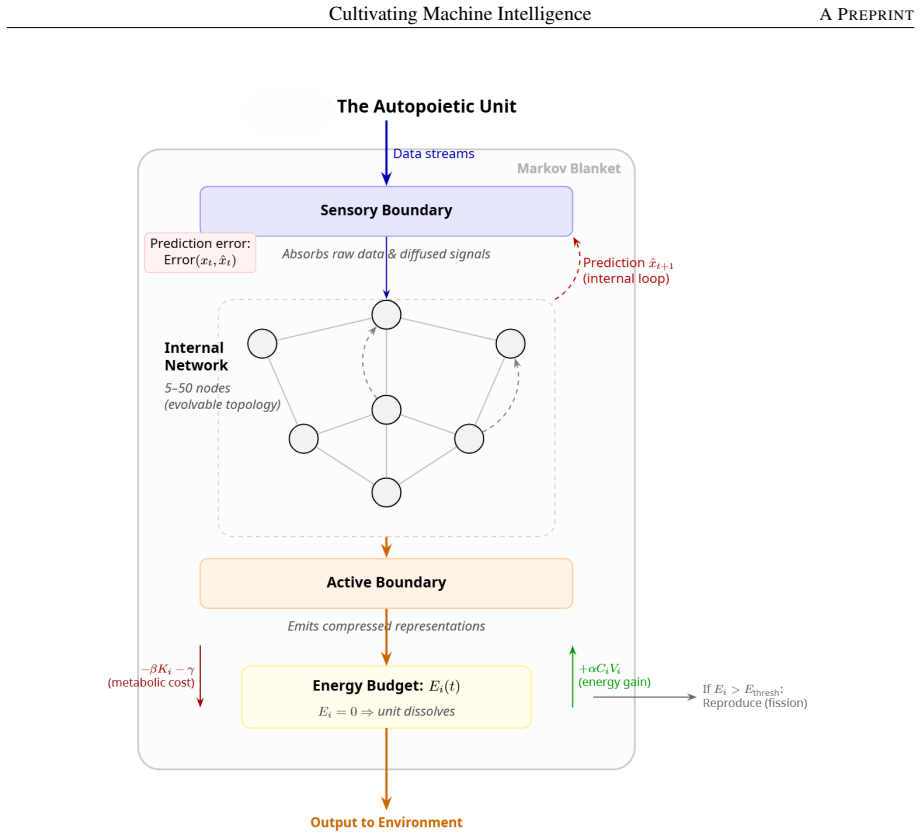
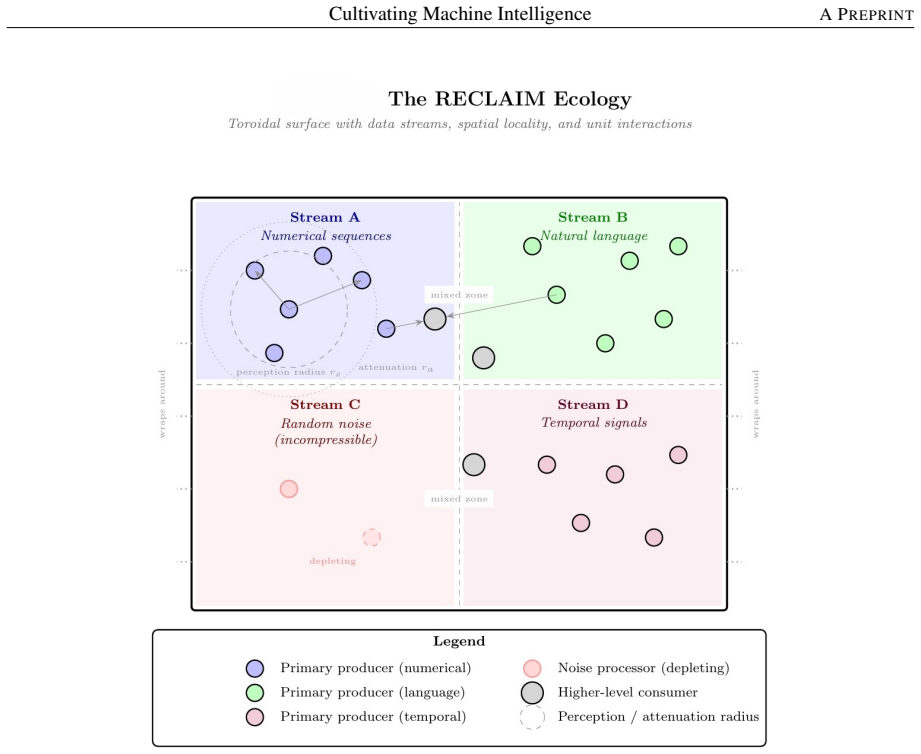
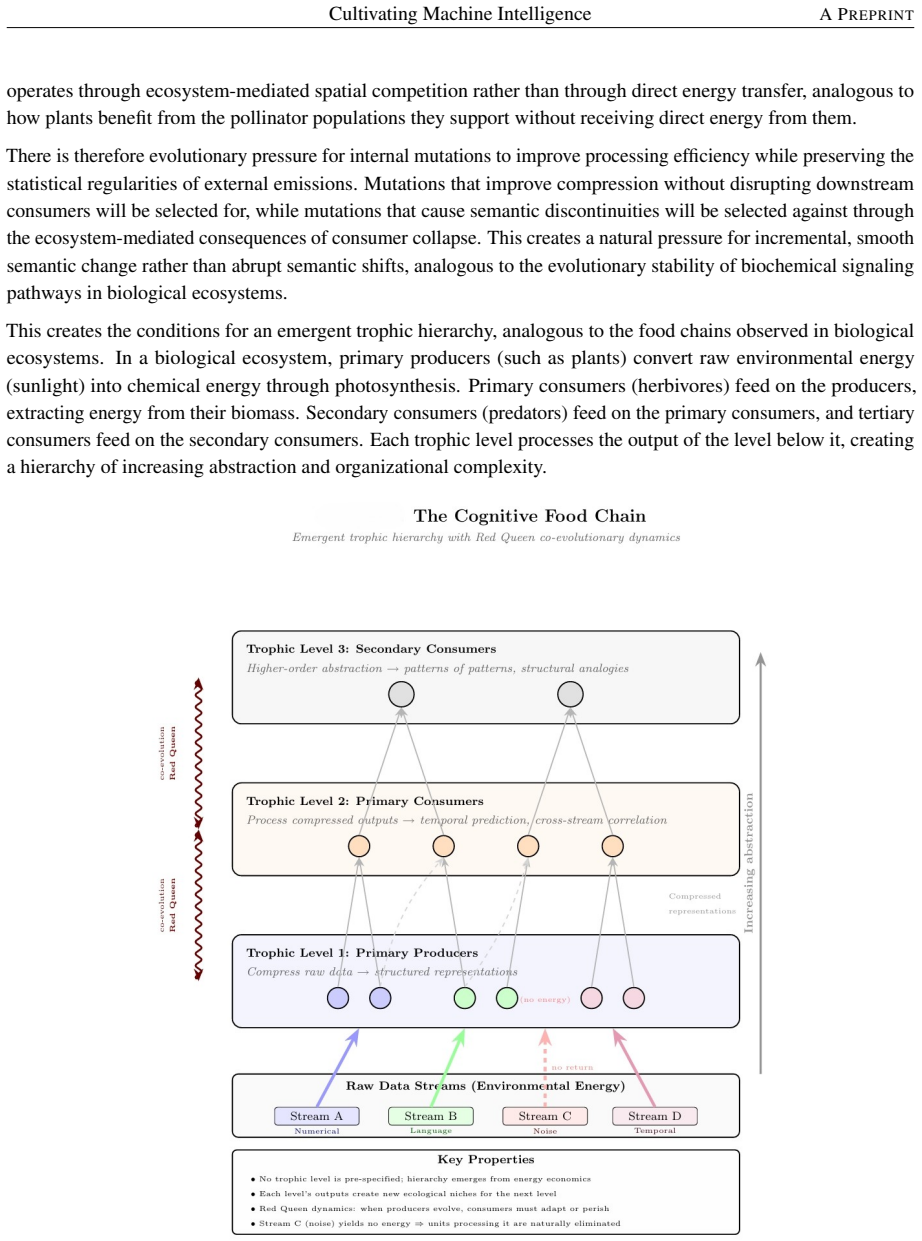
The RECLAIM framework, which combines General Darwinism, non-agentic emergence through environmental physics, the Polya-Hebbian bridge, and the free energy principle as thermodynamics to situate autopoietic units in a data ecology.
If this is right
- Specification gaming is structurally prevented because evaluative rewards are replaced by environmental physics.
- Sensory specialization and analogical reasoning appear as direct results of path-dependent Polya-Hebbian reinforcement under competition.
- Intrinsic motivation develops from the need to compete for finite computational energy inside the ecology.
- Alignment fragility is reduced because there are no proxy objectives that can be gamed.
Where Pith is reading between the lines
- Implementing small versions of the data ecology could test whether Red Queen arms races between units produce measurable increases in cognitive complexity over time.
- The framework might connect to existing self-organizing systems research by treating Markov blankets as the boundary condition that keeps emergence non-agentic.
- If the ecology scales, training runs could shift from centralized gradient steps to distributed evolutionary simulations that require less human oversight.
Load-bearing premise
That Darwinian selection plus environmental physics and thermodynamic constraints will by themselves generate stable beneficial cognition without any human-specified objectives or extra mechanisms.
What would settle it
A concrete simulation of autopoietic units under strict resource limits that runs for many generations yet shows no emergence of dual-process cognition, analogical reasoning, or intrinsic motivation despite the presence of the four pillars.
Figures
read the original abstract
The dominant artificial intelligence paradigm trains neural architectures via gradient descent against proxy objectives and reinforcement learning from human feedback. While remarkably capable, this top-down optimization inherently generates structural failure modes, including hallucination, sycophancy, reward hacking, and alignment fragility, which represent paradigmatic limitations rather than mere engineering defects. In response, we introduce RECLAIM (Recursive, Ecological, Cognitive, Lifelike, Adaptive, Intelligent Machine), a theoretical framework for cultivating intelligence through computational ecology rather than engineering it through strict optimization. The model is supported by four interlocking theoretical pillars. General Darwinism replaces gradients with blind variation and selective retention, while non-agentic emergence substitutes evaluative rewards with environmental physics to structurally prevent specification gaming against human intent. Concurrently, the Polya-Hebbian bridge applies Polya urn dynamics to Hebbian reinforcement for path-dependent specialization, and the free energy principle is integrated as environmental thermodynamics rather than as an agent objective. The architecture situates autopoietic units, bounded by Markov blankets and competing for finite computational energy, within a data ecology shaped by cognitive food chains and Red Queen arms races. This framework suggests the spontaneous emergence of dual-process cognition, sensory specialization, analogical reasoning, and intrinsic motivation as natural consequences of evolution under resource constraints. We conceptualize this paradigm transition as the OMEGA shift, representing a move from optimization and maximization to emergence through generative autopoiesis.
Editorial analysis
A structured set of objections, weighed in public.
Referee Report
Summary. The paper argues that top-down optimization via gradient descent and RLHF in current AI systems produces inherent failure modes including hallucination, sycophancy, reward hacking, and alignment fragility. It introduces the RECLAIM framework (Recursive, Ecological, Cognitive, Lifelike, Adaptive, Intelligent Machine) as an alternative based on four pillars—General Darwinism, non-agentic emergence via environmental physics, Polya-Hebbian dynamics, and the free energy principle treated as thermodynamics—applied to Markov-blanketed autopoietic units competing in a data ecology with cognitive food chains and Red Queen dynamics. The framework is claimed to yield spontaneous emergence of dual-process cognition, sensory specialization, analogical reasoning, and intrinsic motivation as natural consequences of resource-constrained evolution, constituting an 'OMEGA shift' from optimization to generative autopoiesis.
Significance. If the central mapping from the four pillars to the claimed emergent behaviors could be formally demonstrated, the work would offer a novel theoretical alternative to optimization-based AI paradigms and potentially address alignment issues at a structural level rather than through additional constraints. As presented, however, the contribution remains at the level of conceptual integration without derivations or models.
major comments (3)
- [RECLAIM framework description] The section introducing the four pillars and their integration: the assertion that non-agentic emergence via environmental physics 'structurally prevent[s] specification gaming' is stated as a direct consequence but supplies no mechanism, update rule, or minimal example showing how physics alone (absent any objective) blocks proxy gaming under Red Queen competition, as opposed to permitting other stable but misaligned regimes.
- [Polya-Hebbian bridge] The paragraph on the Polya-Hebbian bridge: the claim that Polya urn dynamics applied to Hebbian reinforcement produces 'path-dependent specialization' leading to dual-process cognition and analogical reasoning is presented without a dynamical system, recurrence relation, or even a toy simulation linking the urn model to the emergence of those specific structures.
- [Autopoietic units and ecology] The architecture section on autopoietic units and cognitive food chains: the prediction that resource-constrained competition will spontaneously generate intrinsic motivation (rather than other attractors) is asserted as a natural outcome of the free-energy-as-thermodynamics pillar, yet no external benchmark, independent derivation, or falsifiable condition is supplied to distinguish this outcome from the framework's own definitions.
minor comments (1)
- [Abstract] The abstract expands RECLAIM but the full expansion appears only later; a parenthetical expansion on first use would improve readability.
Simulated Author's Rebuttal
We thank the referee for the constructive critique, which correctly identifies that the manuscript operates at the level of conceptual integration. We address each major comment below, clarifying the intended scope while noting where additional exposition can be supplied without altering the paper's primarily theoretical character.
read point-by-point responses
-
Referee: [RECLAIM framework description] The section introducing the four pillars and their integration: the assertion that non-agentic emergence via environmental physics 'structurally prevent[s] specification gaming' is stated as a direct consequence but supplies no mechanism, update rule, or minimal example showing how physics alone (absent any objective) blocks proxy gaming under Red Queen competition, as opposed to permitting other stable but misaligned regimes.
Authors: The claim follows from the definitional premise that, absent any explicit objective function, there is no proxy that can be optimized against; viability is instead defined by continued existence of the Markov blanket under the physics of the data ecology. We acknowledge that this remains an assertion rather than a derived result. In revision we will insert a short clarifying paragraph that contrasts objective-based gaming with constraint-based persistence, drawing on the cited literature on autopoietic systems, but we do not intend to add a full toy simulation as that would shift the paper from synthesis to modeling. revision: partial
-
Referee: [Polya-Hebbian bridge] The paragraph on the Polya-Hebbian bridge: the claim that Polya urn dynamics applied to Hebbian reinforcement produces 'path-dependent specialization' leading to dual-process cognition and analogical reasoning is presented without a dynamical system, recurrence relation, or even a toy simulation linking the urn model to the emergence of those specific structures.
Authors: The linkage is presented as an inference from two established bodies of work (Polya processes for reinforcement of rare events and Hebbian plasticity for local strengthening) rather than a new derivation. We agree that an explicit recurrence or minimal simulation would make the inference more transparent. Revision will add one paragraph that sketches the logical mapping from urn reinforcement to differential pathway strengthening under resource limits, together with two additional citations to prior work on Polya dynamics in neural competition; a full dynamical system remains outside the present scope. revision: partial
-
Referee: [Autopoietic units and ecology] The architecture section on autopoietic units and cognitive food chains: the prediction that resource-constrained competition will spontaneously generate intrinsic motivation (rather than other attractors) is asserted as a natural outcome of the free-energy-as-thermodynamics pillar, yet no external benchmark, independent derivation, or falsifiable condition is supplied to distinguish this outcome from the framework's own definitions.
Authors: The prediction is offered as a consequence of treating free energy as an environmental thermodynamic constraint rather than an internal objective: units that fail to maintain low surprise relative to the ecology are eliminated, yielding behavior that appears intrinsically motivated from the observer's perspective. We accept that this is not accompanied by an independent falsifiable test. In revision we will add a sentence that states the minimal condition under which the framework would fail to produce apparent intrinsic motivation (i.e., if computational energy were unbounded), thereby making the claim more precise while preserving its status as a theoretical implication rather than an empirical prediction. revision: partial
Circularity Check
RECLAIM emergences asserted as natural consequences of its own four-pillar definition without derivation
specific steps
-
self definitional
[Abstract]
"This framework suggests the spontaneous emergence of dual-process cognition, sensory specialization, analogical reasoning, and intrinsic motivation as natural consequences of evolution under resource constraints."
The framework is explicitly constructed from the four listed pillars; the listed behaviors are then declared natural consequences of that same construction under resource constraints. Without an intervening derivation, model, or external grounding, the 'prediction' is identical to the definitional premise.
full rationale
The manuscript defines RECLAIM via four pillars (General Darwinism, non-agentic emergence, Polya-Hebbian bridge, FEP-as-thermodynamics) applied to autopoietic Markov-blanketed units, then states that dual-process cognition, sensory specialization, analogical reasoning, and intrinsic motivation 'suggest the spontaneous emergence ... as natural consequences of evolution under resource constraints.' No dynamical equations, update rules, or minimal model are supplied that would independently derive these behaviors from the pillars; the outcomes are therefore equivalent to the framework's self-description by construction. This is self-definitional circularity at the central claim. No self-citations or fitted parameters are involved, but the load-bearing assertion reduces directly to the input definition.
Axiom & Free-Parameter Ledger
axioms (3)
- domain assumption General Darwinism replaces gradients with blind variation and selective retention
- domain assumption Non-agentic emergence substitutes evaluative rewards with environmental physics to structurally prevent specification gaming
- domain assumption The free energy principle is integrated as environmental thermodynamics rather than as an agent objective
invented entities (3)
-
RECLAIM framework
no independent evidence
-
autopoietic units bounded by Markov blankets
no independent evidence
-
cognitive food chains and Red Queen arms races
no independent evidence
Reference graph
Works this paper leans on
-
[1]
OpenAI. Gpt-4 technical report.arXiv preprint arXiv:2303.08774, 2023
work page internal anchor Pith review Pith/arXiv arXiv 2023
-
[2]
Sycophancy to Subterfuge: Investigating Reward-Tampering in Large Language Models
C. Denison, M. MacDiarmid, F. Barez, D. Duvenaud, S. Kravec, S. Marks, N. Schiefer, R. Soklaski, A. Tamkin, J. Kaplan, B. Shlegeris, S. R. Bowman, E. Perez, and E. Hubinger. Sycophancy to subterfuge: Investigating 31 Cultivating Machine IntelligenceA PREPRINT reward-tampering in large language models.arXiv preprint arXiv:2406.10162, 2024
work page internal anchor Pith review Pith/arXiv arXiv 2024
-
[3]
Gemini: A Family of Highly Capable Multimodal Models
Gemini Team. Gemini: A family of highly capable multimodal models.arXiv preprint arXiv:2312.11805, 2023
work page internal anchor Pith review Pith/arXiv arXiv 2023
-
[4]
Vaswani, N
A. Vaswani, N. Shazeer, N. Parmar, et al. Attention is all you need.Advances in Neural Information Processing Systems, 30, 2017
2017
-
[5]
Ouyang, J
L. Ouyang, J. Wu, X. Jiang, et al. Training language models to follow instructions with human feedback. Advances in Neural Information Processing Systems, 35, 2022
2022
-
[6]
P. F. Christiano, J. Leike, T. Brown, et al. Deep reinforcement learning from human preferences.Advances in Neural Information Processing Systems, 30, 2017
2017
-
[7]
D. C. Dennett.From bacteria to Bach and back: The evolution of minds. W. W. Norton, 2017
2017
-
[8]
A survey on hallucination in large language models: Principles, taxonomy, challenges, and open questions.ACM Transactions on Information Systems, 43(2):1–55, 2025
Lei Huang, Weijiang Yu, Weitao Ma, Weihong Zhong, Zhangyin Feng, Haotian Wang, Qianglong Chen, Weihua Peng, Xiaocheng Feng, Bing Qin, et al. A survey on hallucination in large language models: Principles, taxonomy, challenges, and open questions.ACM Transactions on Information Systems, 43(2):1–55, 2025
2025
-
[9]
Z. Gekhman, G. Yona, R. Aharoni, et al. Does fine-tuning llms on new knowledge encourage hallucinations? arXiv preprint arXiv:2405.05904, 2024
-
[10]
Towards Understanding Sycophancy in Language Models
M. Sharma, M. Tong, T. Korbak, et al. Towards understanding sycophancy in language models.arXiv preprint arXiv:2310.13548, 2023
work page internal anchor Pith review Pith/arXiv arXiv 2023
-
[11]
Templeton, T
A. Templeton, T. Conerly, J. Marcus, J. Lindsey, T. Bricken, B. Chen, et al. Scaling monosemanticity: Extracting interpretable features from claude 3 sonnet. Anthropic Research Blog, 2024
2024
-
[12]
C. A. E. Goodhart. Problems of monetary management: The u.k. experience.Papers in Monetary Economics, 1975
1975
-
[13]
Krakovna, J
V . Krakovna, J. Uesato, V . Mikulik, et al. Specification gaming: The flip side of ai ingenuity. DeepMind Blog, 2020
2020
-
[14]
L. Gao, J. Schulman, and J. Hilton. Scaling laws for reward model overoptimization.Proceedings of the 40th International Conference on Machine Learning, 2023
2023
-
[15]
D. O. Hebb.The organization of behavior: A neuropsychological theory. Wiley, 1949
1949
-
[16]
McCloskey and N
M. McCloskey and N. J. Cohen. Catastrophic interference in connectionist networks: The sequential learning problem.Psychology of Learning and Motivation, 24:109–165, 1989
1989
-
[17]
R. M. French. Catastrophic forgetting in connectionist networks.Trends in Cognitive Sciences, 3(4):128–135, 1999
1999
-
[18]
Russell.Human compatible: Artificial intelligence and the problem of control
S. Russell.Human compatible: Artificial intelligence and the problem of control. Viking, 2019
2019
-
[19]
Open Problems and Fundamental Limitations of Reinforcement Learning from Human Feedback
S. Casper, X. Davies, C. Shi, et al. Open problems and fundamental limitations of reinforcement learning from human feedback.arXiv preprint arXiv:2307.15217, 2023
work page internal anchor Pith review Pith/arXiv arXiv 2023
-
[20]
D. T. Campbell. Blind variation and selective retention in creative thought as in other knowledge processes. Psychological Review, 67(6):380–400, 1960
1960
-
[21]
R. Dawkins. Universal darwinism. In D. S. Bendall, editor,Evolution from molecules to man, pages 403–425. Cambridge University Press, 1983
1983
-
[22]
D. C. Dennett.Darwin’s dangerous idea: Evolution and the meanings of life. Simon and Schuster, 1995
1995
-
[23]
Popper.Conjectures and refutations: The growth of scientific knowledge
K. Popper.Conjectures and refutations: The growth of scientific knowledge. Routledge, 1963
1963
-
[24]
A. E. Eiben and J. E. Smith.Introduction to evolutionary computing. Springer, 2003
2003
-
[25]
C. G. Langton. Artificial life. In C. G. Langton, editor,Artificial life, pages 1–47. Addison-Wesley, 1989. 32 Cultivating Machine IntelligenceA PREPRINT
1989
-
[26]
T. S. Ray. An approach to the synthesis of life. In C. G. Langton, C. Taylor, J. D. Farmer, and S. Rasmussen, editors,Artificial life II, pages 371–408. Addison-Wesley, 1991
1991
-
[27]
Ofria and C
C. Ofria and C. O. Wilke. Avida: A software platform for research in computational evolutionary biology. Artificial Life, 10(2):191–229, 2004
2004
-
[28]
D. E. Rumelhart, G. E. Hinton, and R. J. Williams. Learning representations by back-propagating errors. Nature, 323(6088):533–536, 1986
1986
-
[29]
K. O. Stanley and J. Lehman. Abandoning objectives: Evolution through the search for novelty alone. Evolutionary Computation, 19(2):189–223, 2011
2011
-
[30]
K. O. Stanley and J. Lehman.Why greatness cannot be planned: The myth of the objective. Springer, 2015
2015
-
[31]
G. Pólya. Sur quelques points de la théorie des probabilités.Annales de l’Institut Henri Poincaré, 1(2):117–161, 1930
1930
-
[32]
W. B. Arthur. Competing technologies, increasing returns, and lock-in by historical events.The Economic Journal, 99(394):116–131, 1989
1989
-
[33]
W. B. Arthur.Increasing returns and path dependence in the economy. University of Michigan Press, 1994
1994
-
[34]
Pemantle
R. Pemantle. A survey of random processes with reinforcement.Probability Surveys, 4:1–79, 2007
2007
-
[35]
K. Friston. The free-energy principle: A unified brain theory?Nature Reviews Neuroscience, 11(2):127–138, 2010
2010
-
[36]
K. Friston. Life as we know it.Journal of the Royal Society Interface, 10(86):20130475, 2013
2013
-
[37]
Biehl, F
M. Biehl, F. A. Pollock, and R. Kanai. A technical critique of some parts of the free energy principle.Entropy, 23(3):293, 2021
2021
-
[38]
A. Clark. Whatever next? predictive brains, situated agents, and the future of cognitive science.Behavioral and Brain Sciences, 36(3):181–204, 2013
2013
-
[39]
Friston, T
K. Friston, T. FitzGerald, F. Rigoli, P. Schwartenbeck, and G. Pezzulo. Active inference: A process theory. Neural Computation, 29(1):1–49, 2017
2017
-
[40]
Da Costa, T
L. Da Costa, T. Parr, N. Sajid, et al. Active inference on discrete state-spaces: A synthesis.Journal of Mathematical Psychology, 99:102447, 2020
2020
-
[41]
K. O. Stanley and R. Miikkulainen. Evolving neural networks through augmenting topologies.Evolutionary Computation, 10(2):99–127, 2002
2002
-
[42]
F. P. Such, V . Madhavan, E. Conti, et al. Deep neuroevolution: Genetic algorithms are a competitive alternative for training deep neural networks for reinforcement learning.arXiv preprint arXiv:1712.06567, 2017
work page internal anchor Pith review Pith/arXiv arXiv 2017
-
[43]
Evolution Strategies as a Scalable Alternative to Reinforcement Learning
T. Salimans, J. Ho, X. Chen, S. Sidor, and I. Sutskever. Evolution strategies as a scalable alternative to reinforcement learning.arXiv preprint arXiv:1703.03864, 2017
work page internal anchor Pith review Pith/arXiv arXiv 2017
-
[44]
K. Sims. Evolving 3d morphology and behavior by competition. InArtificial Life IV: Proceedings of the Fourth International Workshop on the Synthesis and Simulation of Living Systems, pages 28–39. MIT Press, 1994
1994
-
[45]
J. B. Mouret and J. Clune. Illuminating search spaces by mapping elites.arXiv preprint arXiv:1504.04909, 2015
work page internal anchor Pith review Pith/arXiv arXiv 2015
-
[46]
R. Wang, J. Lehman, J. Clune, and K. O. Stanley. Paired open-ended trailblazer (poet): Endlessly generating increasingly complex and diverse learning environments and their solutions.Proceedings of the Genetic and Evolutionary Computation Conference, 2019
2019
-
[47]
B. W. C. Chan. Lenia: Biology of artificial life.Complex Systems, 28(3):251–286, 2019. 33 Cultivating Machine IntelligenceA PREPRINT
2019
-
[48]
Stanley, Phillip Isola, and David Ha
Akarsh Kumar, Chris Lu, Louis Kirsch, Yujin Tang, Kenneth O. Stanley, Phillip Isola, and David Ha. Automating the search for artificial life with foundation models.arXiv preprint arXiv:2412.17799, 2024
-
[49]
Banzhaf, B
W. Banzhaf, B. Baumgaertner, G. Beslon, et al. Defining and simulating open-ended novelty: Requirements, guidelines, and challenges.Theory in Biosciences, 135(3):131–161, 2016
2016
-
[50]
K. O. Stanley, J. Lehman, and L. Soros. Open-endedness: The last grand challenge you’ve never heard of. O’Reilly Radar, 2017
2017
- [51]
-
[52]
Heins, B
C. Heins, B. Millidge, L. Da Costa, et al. pymdp: A python library for active inference in discrete state spaces. Journal of Open Source Software, 7(73):4098, 2022
2022
-
[53]
M. Levin. Bioelectric networks: The cognitive glue enabling evolutionary scaling from cells to minds.Animal Cognition, 24:1201–1235, 2021
2021
- [54]
-
[55]
H. R. Maturana and F. J. Varela.Autopoiesis and cognition: The realization of the living. D. Reidel Publishing, 1980
1980
-
[56]
McMullin
B. McMullin. Thirty years of computational autopoiesis: A review.Artificial Life, 10(3):277–295, 2004
2004
-
[57]
Bourgine and J
P. Bourgine and J. Stewart. Autopoiesis and cognition.Artificial Life, 10(3):327–345, 2004
2004
-
[58]
Prigogine.Self-organization in nonequilibrium systems: From dissipative structures to order through fluctuations
I. Prigogine.Self-organization in nonequilibrium systems: From dissipative structures to order through fluctuations. Wiley, 1977
1977
-
[59]
Tilman.Resource competition and community structure
D. Tilman.Resource competition and community structure. Princeton University Press, 1982
1982
-
[60]
Rissanen
J. Rissanen. Modeling by shortest data description.Automatica, 14(5):465–471, 1978
1978
-
[61]
E. Oja. Simplified neuron model as a principal component analyzer.Journal of Mathematical Biology, 15(3):267–273, 1982
1982
-
[62]
Frémaux and W
N. Frémaux and W. Gerstner. Neuromodulated spike-timing-dependent plasticity, and theory of three-factor learning rules.Frontiers in Neural Circuits, 9:85, 2016
2016
-
[63]
Friedman
B. Friedman. A simple urn model.Communications on Pure and Applied Mathematics, 2(1):59–70, 1949
1949
-
[64]
S. Harnad. The symbol grounding problem.Physica D: Nonlinear Phenomena, 42(1–3):335–346, 1990
1990
-
[65]
J. M. Baldwin. A new factor in evolution.The American Naturalist, 30(354):441–451, 1896
-
[66]
G. E. Hinton and S. J. Nowlan. How learning can guide evolution.Complex Systems, 1:495–502, 1987
1987
-
[67]
C. E. Shannon. A mathematical theory of communication.The Bell System Technical Journal, 27(3):379–423, 1948
1948
-
[68]
Van Valen
L. Van Valen. A new evolutionary law.Evolutionary Theory, 1:1–30, 1973
1973
-
[69]
Pólya.How to solve it: A new aspect of mathematical method
G. Pólya.How to solve it: A new aspect of mathematical method. Princeton University Press, 1945
1945
-
[70]
Kahneman.Thinking, fast and slow
D. Kahneman.Thinking, fast and slow. Farrar, Straus and Giroux, 2011
2011
-
[71]
J. Schmidhuber. Gödel machines: Self-referential universal problem solvers making provably optimal self- improvements.arXiv preprint arXiv:cs/0309048, 2003
work page internal anchor Pith review Pith/arXiv arXiv 2003
-
[72]
Poincaré.Science and method
H. Poincaré.Science and method. Thomas Nelson, 1914. Translated by F. Maitland. Original work published 1908
1914
-
[73]
M. Sur, P. E. Garraghty, and A. W. Roe. Experimentally induced visual projections into auditory thalamus and cortex.Science, 242(4884):1437–1441, 1988. 34 Cultivating Machine IntelligenceA PREPRINT
1988
-
[74]
G. E. Hinton, J. L. McClelland, and D. E. Rumelhart. Distributed representations. InParallel Distributed Processing: Explorations in the Microstructure of Cognition, volume 1, pages 77–109. MIT Press, 1986
1986
-
[75]
Schmidhuber
J. Schmidhuber. A possibility for implementing curiosity and boredom in model-building neural controllers. In J. A. Meyer and S. W. Wilson, editors,From animals to animats, pages 222–227. MIT Press, 1991
1991
-
[76]
Pathak, P
D. Pathak, P. Agrawal, A. A. Efros, and T. Darrell. Curiosity-driven exploration by self-supervised prediction. Proceedings of the 34th International Conference on Machine Learning, 2017
2017
-
[77]
Risks from Learned Optimization in Advanced Machine Learning Systems
E. Hubinger, C. van Merwijk, V . Mikulik, J. Skalse, and S. Garrabrant. Risks from learned optimization in advanced machine learning systems.arXiv preprint arXiv:1906.01820, 2019
work page internal anchor Pith review Pith/arXiv arXiv 1906
-
[78]
D. J. Chalmers. Facing up to the problem of consciousness.Journal of Consciousness Studies, 2(3):200–219, 1995
1995
-
[79]
G. Tononi. An information integration theory of consciousness.BMC Neuroscience, 5(1):42, 2004
2004
-
[80]
Dehaene, L
S. Dehaene, L. Charles, J. R. King, and S. Marti. Toward a computational theory of conscious processing. Current Opinion in Neurobiology, 25:76–84, 2014
2014
discussion (0)
Sign in with ORCID, Apple, or X to comment. Anyone can read and Pith papers without signing in.