REVIEW 6 major objections 6 minor 51 references
Incorporating Domain Knowledge into Materials Tokenization
T0 review · 6 major / 6 minor · reviewed 2026-08-07 · deepseek-v4-flash
Pith's one-line read A tokenizer that preserves material concepts improves materials-science language models by 4% on generation and 2% on classification tasks.
desk verdict Useful materials-aware tokenizer with real evidence, but the headline gains are optimistic because λ is tuned on the evaluation benchmark and corpus overlap is not addressed. read the letter →
The pith
A machine-rendered reading of the paper's core claim, the machinery that carries it, and where it could break.
The reading
What carries the argument
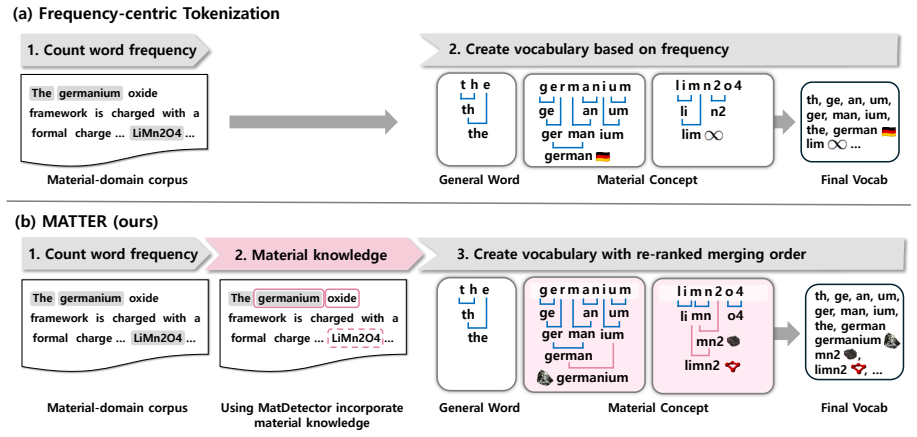
The central mechanism is a material-concept detector called MatDetector, a named-entity recognizer trained on material names, formulas, and synonyms drawn from PubChem with noise-augmented training data. MATTER combines MatDetector's relevance score with raw word frequency through the reweighting rule $\mathrm{freq}_{\mathrm{mat}}(w) = \mathrm{freq}_{\mathrm{origin}}(w) + \lambda \cdot \frac{\hat{y}_{\mathrm{mat}}(w)}{1 - \hat{y}_{\mathrm{mat}}(w)}$, then feeds these adjusted frequencies into WordPiece-style iterative merging. This re-ranks which token pairs are merged first, so material-relevant substrings are combined before generic high-frequency merges split them apart.
What would settle it
Search the 150K tokenization corpus for sentences from MatSci-NLP, MatScholar, SOFC, and MaScQA; if any appear, retrain MATTER and all baselines on a corpus with those documents removed and check whether the 4% and 2% average gains shrink.
Extended reading notes
Core claim
MATTER claims that infrequent but semantically central material concepts such as germanium, PbI2, and LFP are fragmented by frequency-centric tokenizers, and that injecting domain knowledge at vocabulary-construction time fixes this. The paper reports that models trained with MATTER tokenization outperform BPE, WordPiece, SAGE, and PickyBPE baselines with an average gain of 4% on generation tasks and 2% on classification tasks, and that preserving material concepts as whole tokens improves morpheme segmentation and produces more chemically meaningful nearest neighbors in embedding space.
Load-bearing premise
The claim rests on the assumption that the 150K-paper corpus used to build the vocabulary does not overlap with the downstream evaluation sets, so the gains reflect tokenization rather than domain-frequency matching.
Editorial extensions
If this is right
- Material names and formulas such as germanium, PbI2, and LFP remain single tokens instead of being split into semantically empty pieces.
- On MatSci-NLP generation tasks, MATTER improves average Micro-F1 by 3% and Macro-F1 by 5% over the strongest baseline.
- On classification benchmarks, MATTER improves average Micro-F1 by 1.6% and Macro-F1 by 1.8%.
- Material morpheme segmentation reaches 59.9 F1 with MATTER, compared with 44.3 for WordPiece.
- Subword embedding neighborhoods become chemically meaningful, such as germanium near dithiocarbamate and borohydride.
Reading between the lines
- The same re-ranking recipe should transfer to other scientific domains that have a concept detector, but the paper only tests materials science.
- A clean test of MatDetector's contribution would be to replace it with a general chemical extractor and measure how much of the gain remains.
- Because the paper does not state whether MatSci-NLP, MatScholar, and SOFC texts were excluded from the 150K tokenization corpus, part of the reported gain could come from corpus overlap rather than semantic preservation.
- The fixed $\lambda = 1$ weighting works empirically, but an automatic selection procedure would be needed to make the method easy to deploy in new domains.
Editorial analysis
A structured set of objections, weighed in public.
Referee Report
Summary. The paper proposes MATTER, a materials-science tokenizer that combines WordPiece-style frequency statistics with a learned material-concept detector (MatDetector). MatDetector scores candidate words by relevance to the materials domain, and MATTER re-ranks token-merging decisions by adding a weighted material prior to the original frequency (Eq. 3). The authors report that MATTER improves generation and classification performance on materials benchmarks by roughly 4% and 2%, respectively, and also report gains in morpheme segmentation, token-quality metrics, and QA tasks. The manuscript includes an ablation study of the material signal, a comparison with ChemDataExtractor as an alternative detector, and a statistical-significance appendix.
Significance. The central idea—injecting domain knowledge into subword vocabulary construction rather than only into model pretraining—is timely and potentially useful for scientific NLP. The paper is strengthened by releasing code, by evaluating across a wide range of downstream tasks (seven generation tasks, five classification tasks, QA, and morpheme segmentation), and by including an honest Limitations section. If the reported gains survive a properly controlled evaluation, MATTER would be a practical contribution. However, the current evidence is weakened by the way the hyperparameter λ is selected, by an unstated relationship between the tokenization corpus and the evaluation datasets, and by an internal inconsistency in the definition of the material signal. These issues are load-bearing for the headline 4%/2% claim.
major comments (6)
- [§4.6 and Figure 5] The hyperparameter λ is selected on MatSci-NLP and then used for all experiments, including the results in Tables 1 and 2. Figure 5 sweeps λ over MatSci-NLP, and the text states that 'both ChemDataExtractor and MatDetector achieved their highest performance at λ=1' and that 'all preceding experiments in this study were conducted using this optimal setting.' Because λ controls which tokens enter the vocabulary, choosing it on the same benchmark whose Micro-F1/Macro-F1 are later reported makes the reported gains optimistic by construction and invalidates the paired t-tests in Appendix D for that benchmark. The Limitations section mentions manual selection but does not state that a held-out split was used. Please either use a development split for λ selection or report results for a range of λ values with the selection rule stated explicitly.
- [§3.2, Eqs. (1)–(3), and Algorithm 1] There is a type mismatch in the core formula. Equation (1) defines \hat{y}(w) as an argmax over labels, and Eq. (2) returns either a label in {material} or ∅. However, Eq. (3) and Algorithm 1, line 7, treat \hat{y}_{mat}(w) as a numeric probability by computing \hat{y}_{mat}(w)/(1-\hat{y}_{mat}(w)). If \hat{y}_{mat}(w) is a label, this expression is undefined; if it is meant to be the probability of the predicted material class, that probability was never defined. This needs to be corrected and made unambiguous, since Eq. (3) is the mechanism by which material knowledge enters the tokenizer.
- [§4.1, §3.2, and §4.4] The authors never state whether any of the downstream evaluation documents (MatSci-NLP, MatScholar, SOFC, MaScQA) are excluded from the 150K-paper corpus used to build the vocabulary, nor whether they overlap with the 42K Semantic Scholar papers used to train MatDetector. Since MATTER rewards material concepts via frequencies computed from this corpus, inclusion of evaluation documents would differentially boost MATTER relative to frequency-only baselines. The validation of MatDetector in §4.4 is performed on MatScholar and SOFC, but no intersection analysis with the tokenization corpus is reported. Please report the overlap between the tokenization corpus, the MatDetector training corpus, and each downstream evaluation set, and rerun the main comparisons after excluding any overlapping documents.
- [Appendix D] The paired t-tests are not a valid basis for the claim that MATTER's gains are statistically significant. The tests treat individual tasks (e.g., NER, RC, EAE) as independent samples, but these tasks are not independent draws from a common distribution, and the 'Overall' row is a derived average of the other rows, so it is not an independent observation. With n=8 or n=5, the test has very low power and the reported p-values should not be interpreted as evidence of generalizable improvement. For a rigorous comparison, use seed-level bootstrap or a mixed-effects model that accounts for task and seed, or report per-task confidence intervals.
- [§4.5 and Figure 3] The 'materials token ratio' reported in Figure 3 is computed by extracting material-related tokens with MatDetector, which is the same detector used to construct MATTER's vocabulary. This makes the metric partly circular: MATTER is designed to retain tokens that MatDetector labels as material, so a high materials token ratio is expected by construction. The manual annotation set in §4.5 and Appendix F addresses only the word-initial token analysis, not the materials token ratio in the same figure. Please compute all token-quality metrics with the external manual annotations, or clearly separate the MatDetector-based metric from the independently validated one.
- [§4.2 vs. Abstract] The abstract and introduction state an 'average performance gain of 4% and 2% in the generation and classification tasks,' while §4.2 reports a 3% Micro-F1 and 5% Macro-F1 gain on generation and 1.6%/1.8% on classification. The relationship between these numbers should be clarified so the reader can tell whether the headline is averaged over Micro-F1 and Macro-F1 or reported differently.
minor comments (6)
- [Appendix D, Tables 12–13] Table 12 uses p<0.05 while Table 13 uses p<0.005; please state the common significance threshold and keep it consistent.
- [Table 17] The table caption says 'from PubMed' but the text and §3.2 refer to PubChem; this appears to be a typo.
- [Eq. (1)] The phrase 'a word w that is split into n subword tokens' is confusing because the input to the detector is a word, not subword tokens; clarify whether the tokens are characters or WordPiece subwords.
- [Table 6 and §G.2] The text says 'the two nearest neighbors' but the table shows five nearest neighbors; please reconcile the wording with the presented results.
- [Table 9 vs. §3.2] Table 9 reports 404,262 training abstracts for MatDetector, while §3.2 describes crawling approximately 42K papers and a fourfold augmentation; the relationship among these numbers should be explained.
- [Tables 2 and 3] Some table formatting is hard to follow (e.g., PC* accuracy values in Table 2 appear under 'val test' columns without clear separation, and Table 3's 'Material Subset' row is not fully described). Please reformat for clarity.
Circularity Check
MATTER's supporting token-quality metric is self-definitional (MatDetector both builds the tokenizer and labels the metric), and the headline 4%/2% gains are inflated by selecting λ on the same MatSci-NLP benchmark on which they are then reported.
-
self definitional
[Section 4.5 'Token Qualities' / Figure 3; Algorithm 1; Eq. (3)]
"To assess material token quality, we extract material-related tokens using MatDetector and compare tokenization methods."
MATTER constructs its vocabulary by re-ranking WordPiece merges using MatDetector scores: Algorithm 1 computes freq_mat(w) = freq_origin(w) + λ·ŷ_mat(w)/(1−ŷ_mat(w)) and merges tokens by these adjusted frequencies. The 'materials token ratio' reported in Figure 3 is then computed by labeling tokens with the same MatDetector. Therefore MATTER is, by construction, the tokenizer that maximizes the very quantity used to claim better token quality. The comparison against WordPiece, SAGE, and PickyBPE on this metric is not independent evidence of semantic preservation; it is a definitional consequence of using MatDetector as both the construction signal and the evaluation label.
-
fitted input called prediction
[Section 4.6 'Comparison of Lambda', Figures 5-6; main results in Tables 1-2 and Appendix D]
"Notably, both ChemDataExtractor and MatDetector achieved their highest performance at λ = 1. Based on this consistent observation across models, all preceding experiments in this study were conducted using this optimal setting."
Figure 5 sweeps λ on MatSci-NLP (Macro-F1 vs. λ), and Table 1 reports MATTER's gains on the same MatSci-NLP benchmark. Selecting λ to maximize MatSci-NLP Macro-F1 and then presenting MatSci-NLP Micro/Macro-F1 as the headline 4%/2% improvement means the reported gain is not a held-out prediction: the evaluation set was used to choose the hyperparameter. The paired t-tests in Appendix D are computed on the same benchmark and do not account for this selection, so they cannot establish that the improvement generalizes. This is test-set tuning that makes the headline results optimistic by construction rather than an independent confirmation of MATTER's advantage.
full rationale
The paper's central method is not a derivation: MATTER is an algorithmic tokenization scheme, and its downstream F1 improvements are empirical measurements. No claim reduces equationally to its input in the sense of a fitted parameter being renamed as a prediction, and the main generation/classification comparisons are run against standard baselines on external benchmarks. However, there are two load-bearing circular or near-circular evaluation choices. First, the 'materials token ratio' evidence (Figure 3) is self-definitional: the same MatDetector that supplies the material-knowledge signal in Eq. (3) and Algorithm 1 is also used to label which tokens count as 'material', so MATTER trivially scores higher on that metric. Second, the hyperparameter λ is selected on the MatSci-NLP benchmark (Section 4.6), and the same benchmark's Micro-F1/Macro-F1 are then reported as the primary generation results and subjected to paired t-tests. This is test-set tuning, which inflates the announced 4%/2% gains and invalidates the t-tests as evidence of generalization. The paper's self-citation to Kim et al. (2024) for ChemDataExtractor's limitations is not load-bearing because Table 5 provides an independent empirical comparison of MatDetector against ChemDataExtractor. The possible overlap between the 150K-paper tokenization corpus and downstream evaluation corpora is a leakage risk, not an internal definitional reduction, and was therefore not counted as a circular step. Overall, the core method has independent content, but the supporting token-quality claim reduces by construction and the headline evaluation is compromised by test-set hyperparameter selection, giving partial circularity.
Assumptions & free parameters
free parameters (1)
- λ (material importance factor) =
1
assumptions (4)
- domain assumption WordPiece merging provides a suitable base tokenization algorithm
- domain assumption MatDetector's confidence score reflects material relevance
- domain assumption The 150K tokenization corpus is representative and disjoint from downstream evaluation sets
- ad hoc to paper The functional form freq_mat = freq_origin + λ*y/(1-y) is a useful way to combine material prior with frequency
Cite this review
Pith. "Pith review of Incorporating Domain Knowledge into Materials Tokenization." pith.science (2026). https://pith.science/paper/G6H6DZYR
@misc{pith2026250611115,
  author       = {Pith},
  title        = {Pith review of: Incorporating Domain Knowledge into Materials Tokenization},
  year         = {2026},
  howpublished = {\url{https://pith.science/paper/G6H6DZYR}},
  note         = {Machine review of arXiv:2506.11115}
}
abstract
While language models are increasingly utilized in materials science, typical models rely on frequency-centric tokenization methods originally developed for natural language processing. However, these methods frequently produce excessive fragmentation and semantic loss, failing to maintain the structural and semantic integrity of material concepts. To address this issue, we propose MATTER, a novel tokenization approach that integrates material knowledge into tokenization. Based on MatDetector trained on our materials knowledge base and a re-ranking method prioritizing material concepts in token merging, MATTER maintains the structural integrity of identified material concepts and prevents fragmentation during tokenization, ensuring their semantic meaning remains intact. The experimental results demonstrate that MATTER outperforms existing tokenization methods, achieving an average performance gain of $4\%$ and $2\%$ in the generation and classification tasks, respectively. These results underscore the importance of domain knowledge for tokenization strategies in scientific text processing. Our code is available at https://github.com/yerimoh/MATTER
Figures


Figures from the paper (2 more)


Reference graph
Works this paper leans on
-
[1]
Waleed Ammar, Dirk Groeneveld, Chandra Bhagavatula, Iz Beltagy, Miles Crawford, Doug Downey, Jason Dunkelberger, Ahmed Elgohary, Sergey Feldman, Vu Ha, et al. 2018. Construction of the literature graph in semantic scholar. arXiv preprint arXiv:1805.02262
arXiv 2018
-
[2]
Khuyagbaatar Batsuren, G \'a bor Bella, Aryaman Arora, Viktor Martinovi \'c , Kyle Gorman, Zden e k Z abokrtsk \`y , Amarsanaa Ganbold, S \'a rka Dohnalov \'a , Magda S ev c \' kov \'a , Kate r ina Pelegrinov \'a , et al. 2022. The sigmorphon 2022 shared task on morpheme segmentation. arXiv preprint arXiv:2206.07615
work page Pith review arXiv 2022
-
[3]
Iz Beltagy, Kyle Lo, and Arman Cohan. 2019. Scibert: A pretrained language model for scientific text. arXiv preprint arXiv:1903.10676
arXiv 2019
-
[4]
Kaj Bostrom and Greg Durrett. 2020. Byte pair encoding is suboptimal for language model pretraining. arXiv preprint arXiv:2004.03720
arXiv 2020
-
[5]
Yizhou Chen, Seira Yamaguchi, Atsushi Sato, Dong Xue, and Kazuhiro Marumoto. 2025. Operando spin observation elucidating performance-improvement mechanisms during operation of ruddlesden--popper sn-based perovskite solar cells. npj Flexible Electronics, 9(1):1
work page 2025
-
[6]
Pavel Chizhov, Catherine Arnett, Elizaveta Korotkova, and Ivan Yamshchikov. 2024. Bpe gets picky: Efficient vocabulary refinement during tokenizer training. In Proceedings of the 2024 Conference on Empirical Methods in Natural Language Processing, pages 16587--16604
work page 2024
-
[7]
Qingchen Deng, Jiangen Li, Xiang Li, Xuye Du, Lanlan Wu, Junrui Wang, and Xinlong Wang. 2024. Incorporating nano-znco-zif particles in the electrospinning polylactide membranes to improve their filtration and antibacterial performances. Polymer Bulletin, 81(15):14067--14081
work page 2024
-
[8]
Jacob Devlin, Ming-Wei Chang, Kenton Lee, and Kristina Toutanova. 2019. https://doi.org/10.18653/v1/N19-1423 BERT : Pre-training of deep bidirectional transformers for language understanding . In Proceedings of the 2019 Conference of the North A merican Chapter of the Association for Computational Linguistics: Human Language Technologies, Volume 1 (Long a...
Show all 51 references
-
[9]
Annemarie Friedrich, Heike Adel, Federico Tomazic, Johannes Hingerl, Renou Benteau, Anika Maruscyk, and Lukas Lange. 2020. The sofc-exp corpus and neural approaches to information extraction in the materials science domain. arXiv preprint arXiv:2006.03039
2020 arXiv
-
[10]
Philip Gage. 1994. A new algorithm for data compression. The C Users Journal, 12(2):23--38
1994
-
[11]
Darren S Gray, Joe Tien, and Christopher S Chen. 2004. High-conductivity elastomeric electronics. Advanced Materials, 16(5):393--397
2004
-
[12]
Yu Gu, Robert Tinn, Hao Cheng, Michael Lucas, Naoto Usuyama, Xiaodong Liu, Tristan Naumann, Jianfeng Gao, and Hoifung Poon. 2021. Domain-specific language model pretraining for biomedical natural language processing. ACM Transactions on Computing for Healthcare (HEALTH), 3(1):1--23
2021
-
[13]
Tanishq Gupta, Mohd Zaki, NM Anoop Krishnan, and Mausam. 2022. Matscibert: A materials domain language model for text mining and information extraction. npj Computational Materials, 8(1):102
2022
-
[14]
Bernal Jim \'e nez Guti \'e rrez, Huan Sun, and Yu Su. 2023. Biomedical language models are robust to sub-optimal tokenization. In The 22nd Workshop on Biomedical Natural Language Processing and BioNLP Shared Tasks, pages 350--362
2023
-
[15]
Valentin Hofmann, Janet Pierrehumbert, and Hinrich Sch \"u tze. 2021. Superbizarre is not superb: Derivational morphology improves bert’s interpretation of complex words. In Proceedings of the 59th Annual Meeting of the Association for Computational Linguistics and the 11th In...
2021
-
[16]
Shu Huang and Jacqueline M Cole. 2022. Batterybert: A pretrained language model for battery database enhancement. Journal of chemical information and modeling, 62(24):6365--6377
2022
-
[17]
Anubhav Jain, Shyue Ping Ong, Geoffroy Hautier, Wei Chen, William Davidson Richards, Stephen Dacek, Shreyas Cholia, Dan Gunter, David Skinner, Gerbrand Ceder, et al. 2013. Commentary: The materials project: A materials genome approach to accelerating materials innovation. APL ...
2013
-
[18]
Junho Kim, Yeachan Kim, Jun-Hyung Park, Yerim Oh, Suho Kim, and SangKeun Lee. 2024. Melt: Materials-aware continued pre-training for language model adaptation to materials science. In Findings of the Association for Computational Linguistics: EMNLP. Association for Computation...
2024
-
[19]
Sunghwan Kim, Jie Chen, Tiejun Cheng, Asta Gindulyte, Jia He, Siqian He, Qingliang Li, Benjamin A Shoemaker, Paul A Thiessen, Bo Yu, et al. 2019. Pubchem 2019 update: improved access to chemical data. Nucleic acids research, 47(D1):D1102--D1109
2019
-
[20]
Pankaj Kumar, Saurabh Kabra, and Jacqueline M Cole. 2024. a database of stress-strain properties auto-generated from the scientific literature using chemdataextractor. Scientific Data, 11(1):1273
2024
-
[21]
Jungseob Lee, Hyeonseok Moon, Seungjun Lee, Chanjun Park, Sugyeong Eo, Hyunwoong Ko, Jaehyung Seo, Seungyoon Lee, and Heui-Seok Lim. 2024. Length-aware byte pair encoding for mitigating over-segmentation in korean machine translation. In Findings of the Association for Computa...
2024
-
[22]
Davis Liang, Hila Gonen, Yuning Mao, Rui Hou, Naman Goyal, Marjan Ghazvininejad, Luke Zettlemoyer, and Madian Khabsa. 2023. Xlm-v: Overcoming the vocabulary bottleneck in multilingual masked language models. In Proceedings of the 2023 Conference on Empirical Methods in Natural...
2023
-
[23]
Tom \'a s Mikolov, Ilya Sutskever, Anoop Deoras, Hai-Son Le, Stefan Kombrink, and Jan Cernocky. 2012. Subword language modeling with neural networks. preprint (http://www. fit. vutbr. cz/imikolov/rnnlm/char. pdf), 8(67)
2012
-
[24]
Sheshera Mysore, Zach Jensen, Edward Kim, Kevin Huang, Haw-Shiuan Chang, Emma Strubell, Jeffrey Flanigan, Andrew McCallum, and Elsa Olivetti. 2019. The materials science procedural text corpus: Annotating materials synthesis procedures with shallow semantic structures. arXiv p...
2019 arXiv
-
[25]
Elsa A Olivetti, Jacqueline M Cole, Edward Kim, Olga Kononova, Gerbrand Ceder, Thomas Yong-Jin Han, and Anna M Hiszpanski. 2020. Data-driven materials research enabled by natural language processing and information extraction. Applied Physics Reviews, 7(4)
2020
-
[26]
Ghanshyam Pilania. 2021. Machine learning in materials science: From explainable predictions to autonomous design. Computational Materials Science, 193:110360
2021
-
[27]
Phillip Rust, Jonas Pfeiffer, Ivan Vuli \'c , Sebastian Ruder, and Iryna Gurevych. 2021. How good is your tokenizer? on the monolingual performance of multilingual language models. In Proceedings of the 59th Annual Meeting of the Association for Computational Linguistics and t...
2021
-
[28]
Craig W Schmidt, Varshini Reddy, Haoran Zhang, Alec Alameddine, Omri Uzan, Yuval Pinter, and Chris Tanner. 2024. Tokenization is more than compression. arXiv preprint arXiv:2402.18376
2024 arXiv
-
[29]
National Science and Technology Council (US). 2011. Materials genome initiative for global competitiveness. Executive Office of the President, National Science and Technology Council
2011
-
[30]
Rico Sennrich. 2015. Neural machine translation of rare words with subword units. arXiv preprint arXiv:1508.07909
2015 arXiv
-
[31]
Rico Sennrich, Barry Haddow, and Alexandra Birch. 2016. https://doi.org/10.18653/v1/P16-1162 Neural machine translation of rare words with subword units . In Proceedings of the 54th Annual Meeting of the Association for Computational Linguistics (Volume 1: Long Papers), pages ...
2016 doi
-
[32]
Aaditya K Singh and DJ Strouse. 2024. Tokenization counts: the impact of tokenization on arithmetic in frontier llms. arXiv preprint arXiv:2402.14903
2024 arXiv
-
[33]
Yu Song, Santiago Miret, and Bang Liu. 2023 a . Matsci-nlp: Evaluating scientific language models on materials science language tasks using text-to-schema modeling. In Proceedings of the Annual Meeting of the Association for Computational Linguistics (ACL). Association for Com...
2023
-
[34]
Yu Song, Santiago Miret, Huan Zhang, and Bang Liu. 2023 b . Honeybee: Progressive instruction finetuning of large language models for materials science. arXiv preprint arXiv:2310.08511
2023 arXiv
-
[35]
Matthew C Swain and Jacqueline M Cole. 2016. Chemdataextractor: a toolkit for automated extraction of chemical information from the scientific literature. Journal of chemical information and modeling, 56(10):1894--1904
2016
-
[36]
Huan Tran, Rishi Gurnani, Chiho Kim, Ghanshyam Pilania, Ha-Kyung Kwon, Ryan P Lively, and Rampi Ramprasad. 2024. Design of functional and sustainable polymers assisted by artificial intelligence. Nature Reviews Materials, pages 1--21
2024
-
[37]
Amalie Trewartha, Nicholas Walker, Haoyan Huo, Sanghoon Lee, Kevin Cruse, John Dagdelen, Alexander Dunn, Kristin A Persson, Gerbrand Ceder, and Anubhav Jain. 2022. Quantifying the advantage of domain-specific pre-training on named entity recognition tasks in materials science....
2022
-
[38]
Vahe Tshitoyan, John Dagdelen, Leigh Weston, Alexander Dunn, Ziqin Rong, Olga Kononova, Kristin A Persson, Gerbrand Ceder, and Anubhav Jain. 2019. Unsupervised word embeddings capture latent knowledge from materials science literature. Nature, 571(7763):95--98
2019
-
[39]
Vineeth Venugopal, Sumit Pai, and Elsa Olivetti. 2022. The largest knowledge graph in materials science-entities, relations, and link prediction through graph representation learning. In AI for Accelerated Materials Design NeurIPS 2022 Workshop
2022
-
[40]
Vineeth Venugopal, Sourav Sahoo, Mohd Zaki, Manish Agarwal, Nitya Nand Gosvami, and NM Anoop Krishnan. 2021. Looking through glass: Knowledge discovery from materials science literature using natural language processing. Patterns, 2(7)
2021
-
[41]
Dixuan Wang, Yanda Li, Junyuan Jiang, Zepeng Ding, Guochao Jiang, Jiaqing Liang, and Deqing Yang. 2024 a . Tokenization matters! degrading large language models through challenging their tokenization. arXiv preprint arXiv:2405.17067
2024 arXiv
-
[42]
Lei Wang, Fei Wu, Xiaoqing Liu, Chong Wang, Wanxin Wang, Mingshi Cui, and Zhaoyang Qu. 2024 b . A joint extraction method for fault text entity relationships in smart grid considering nested entities and complex semantics. Energy Reports, 11:6150--6159
2024
-
[43]
Leigh Weston, Vahe Tshitoyan, John Dagdelen, Olga Kononova, Amalie Trewartha, Kristin A Persson, Gerbrand Ceder, and Anubhav Jain. 2019. Named entity recognition and normalization applied to large-scale information extraction from the materials science literature. Journal of c...
2019
-
[44]
Yonghui Wu, Mike Schuster, Zhifeng Chen, Quoc V Le, Mohammad Norouzi, Wolfgang Macherey, Maxim Krikun, Yuan Cao, Qin Gao, Klaus Macherey, et al. 2016. Google's neural machine translation system: Bridging the gap between human and machine translation. arXiv preprint arXiv:1609.08144
2016 arXiv
-
[45]
Pengcheng Xu, Xiaobo Ji, Minjie Li, and Wencong Lu. 2023. Small data machine learning in materials science. npj Computational Materials, 9(1):42
2023
-
[46]
Shaked Yehezkel and Yuval Pinter. 2023. Incorporating context into subword vocabularies. In Proceedings of the 17th Conference of the European Chapter of the Association for Computational Linguistics, pages 623–--635
2023
-
[47]
Fei Yuan, Shuai Yuan, Zhiyong Wu, and Lei Li. 2024. How vocabulary sharing facilitates multilingualism in llama? In Findings of the Association for Computational Linguistics ACL 2024, pages 12111--12130
2024
-
[48]
Mohd Zaki, NM Anoop Krishnan, et al. 2024. Mascqa: investigating materials science knowledge of large language models. Digital Discovery, 3(2):313--327
2024
-
[49]
Lin Zhang, Zonghui Lu, Zhe Su, Ye Zhang, and Hui He. 2025. Efficiency of carbothermal reduction in treating norm waste containing ba (226ra) so4. Journal of Radioanalytical and Nuclear Chemistry, pages 1--8
2025
-
[50]
online" 'onlinestring :=
ENTRY address archivePrefix author booktitle chapter edition editor eid eprint eprinttype howpublished institution journal key month note number organization pages publisher school series title type volume year doi pubmed url lastchecked label extra.label sort.label short.list...
-
[51]
write newline
" write newline "" before.all 'output.state := FUNCTION n.dashify 't := "" t empty not t #1 #1 substring "-" = t #1 #2 substring "--" = not "--" * t #2 global.max substring 't := t #1 #1 substring "-" = "-" * t #2 global.max substring 't := while if t #1 #1 substring * t #2 gl...
Reviewed August 7, 2026 · model on record in the stance chip above.
Discussion (0). Sign in to comment.