REVIEW 4 major objections 6 minor 18 references
MABLE learns node and graph embeddings from large heterogeneous graphs by coupling masked reconstruction to fixed cosine geometry, without learned discriminators or hard negatives.
Reviewed by Pith at T0; open to challenge. T0 means a machine referee read the full paper against a public rubric. the ladder, T0–T4 →
T0 review · grok-4.5
2026-07-12 05:35 UTC pith:G6Q43C3S
load-bearing objection Clean geometric packaging of known SSL pieces for mineral graphs; theory is fine, but the load-bearing “complementary signal” claim is still mostly qualitative and partly redacted. the 4 major comments →
MABLE: Masked Autoencoding with Bi-Lipschitz Decoding for Embeddings and Graph Metric Learning
The pith
A machine-rendered reading of the paper's core claim, the machinery that carries it, and where it could break.
Core claim
The paper claims that masked autoencoding plus fixed cosine alignment/uniformity, with a bi-Lipschitz feature decoder on a reconstruction slice and Lipschitz pooling, yields node and graph embeddings that carry complementary downstream signal and produce spatially coherent embedding-derived layers on large geospatial mineral-exploration graphs, without learned discriminators or hard-negative selection.
What carries the argument
Bi-Lipschitz feature decoding of a low-dimensional reconstruction slice of each node embedding: accurate reconstruction then forces that slice to preserve feature similarity (Proposition 1), while a contextual slice and Lipschitz pooling carry view-stable graph geometry under fixed cosine losses.
Load-bearing premise
That in-batch unpaired graphs and tokens are good enough contrast for uniformity, and that a constrained linear decoder plus Lipschitz pooling will keep the embeddings semantically useful when geology and sampling are highly non-stationary and absolute location is withheld.
What would settle it
On a held-out copper or Arabian Shield region, check whether compact MABLE components still improve coordinate-only or engineered geophysical baselines, and whether dense embedding fields remain contiguous and geologically coherent rather than collapsing or fragmenting under the same fixed training recipe.
Editorial analysis
A structured set of objections, weighed in public.
Referee Report
Summary. MABLE is a self-supervised framework for node and graph embeddings on large heterogeneous graphs, combining masked feature reconstruction with fixed cosine-similarity alignment and uniformity losses (inspired by spectral contrastive loss) at both node and graph scales. A low-dimensional feature slice of each node embedding is decoded by a bi-Lipschitz linear map so that reconstruction accuracy approximately preserves feature similarity (Proposition 1); a complementary contextual slice is regularized by cross-view matched-node correspondence; and graph embeddings are formed by Lipschitz-controlled (including clipped softmax-attention) pooling with view-alignment and in-batch uniformity. The method is demonstrated on geospatial mineral-exploration data: a redacted local copper study and a large regional Arabian Shield corpus, with dense transfer evaluation over Suwaj. The paper claims that the resulting embeddings provide complementary downstream signal and coherent hypothesis-generating layers without learned discriminators or hard-negative mining.
Significance. If the applied claims hold, MABLE would be a useful contribution to graph self-supervised learning for heterogeneous geospatial corpora: it unifies masked autoencoding with fixed-cosine metric learning, avoids absolute-coordinate shortcuts and hard-negative selection, and supplies geometric stability arguments (bi-Lipschitz decoding, Lipschitz pooling) that are often missing from graph SSL practice. The Arabian Shield scale (≈145k graphs, ≈951M nodes) and the dense 100 m Suwaj transfer setup are operationally interesting for mineral prospectivity. The appendix proofs for Propositions 1–3, Lemma 1, and Corollary 1 are standard and correctly support the stated geometric bounds. The main significance, however, is conditional on quantitative evidence that the embeddings actually transfer and complement engineered features under geographic shift—evidence that is only partially disclosed in the present manuscript.
major comments (4)
- Abstract and §5 claim that “across local copper and regional Arabian Shield studies, MABLE embeddings provide complementary downstream signal.” The only quantitative transfer evidence is the redacted local copper benchmark (Experiment 1 / Study 4; Figure 12; Table 1). The conclusion itself states that embeddings alone fail under geographic holdout and only improve coordinate/geophysical baselines as compact components. Without the full experimental protocol, metrics, effect sizes, and holdout definition for Experiment 1, the load-bearing complementary-signal claim cannot be evaluated. Either restore a complete, non-redacted quantitative study or substantially narrow the abstract/conclusion claims to what the disclosed evidence supports.
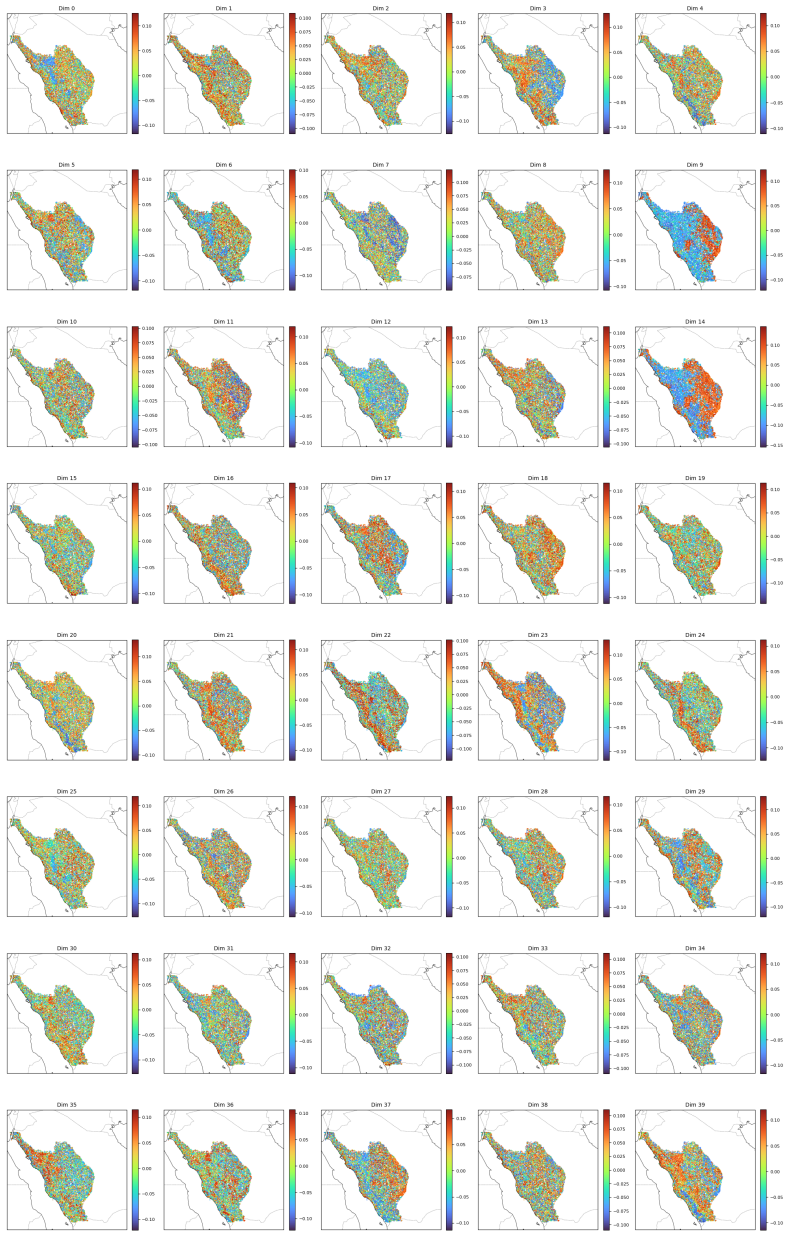
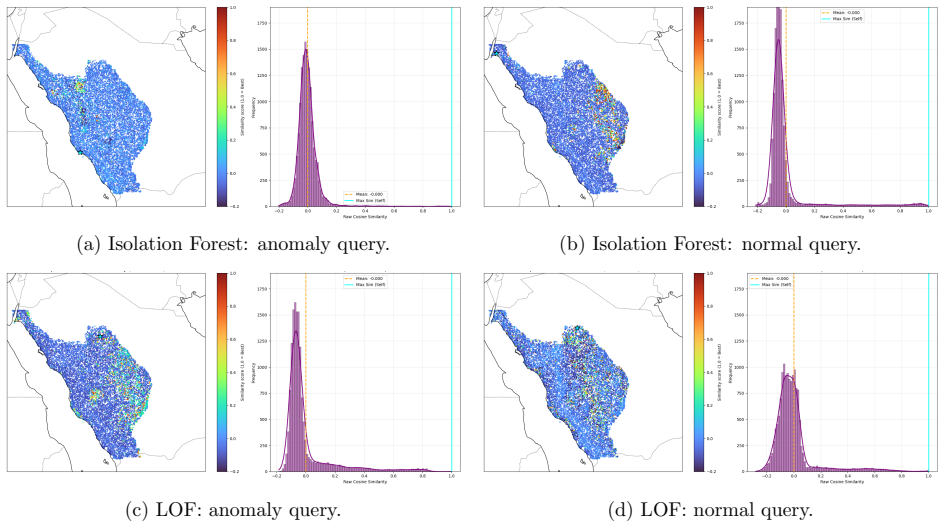
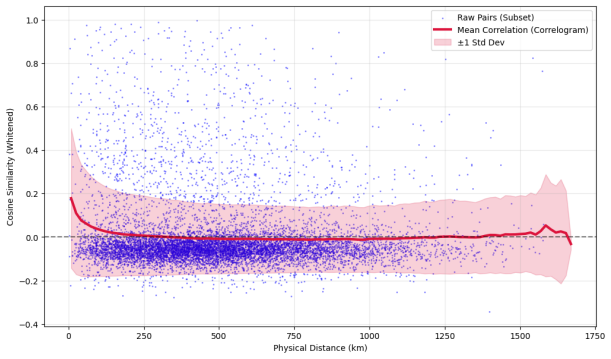
- §4.2.1–4.2.2 present Arabian Shield and Suwaj results almost entirely as unsupervised spatial diagnostics (dimension maps, UMAP/PCA, IF/LOF retrieval, correlograms, Dirichlet energy, K-Means, anomaly/texture rasters). These show spatial coherence but do not measure predictive utility, label agreement, or improvement over baselines. For a method paper whose central applied claim is complementary downstream signal and hypothesis-generating layers, at least one quantitative regional or prospect-scale task (e.g., supervised zonation agreement, prospectivity ranking, or controlled transfer metrics) is needed, or the claim should be reframed as qualitative structure discovery only.
- The paper cites GraphCL, GRACE, BGRL, GraphMAE/GraphMAE2, and Deep Graph Infomax (§1–2) as related graph SSL methods, yet §4 reports no comparison against any of them (or against a plain MAE / plain SCL ablation) under a common backbone and data regime. Without such baselines, it is unclear whether the bi-Lipschitz slice, contextual correspondence, or fixed-cosine surrogates drive gains relative to existing graph SSL. A controlled comparison—or an explicit limitation that only internal ablations are available—is required for the method contribution to be assessable.
- §4.1 states that experiments ran in a proprietary commercial environment and that “most internal low-level implementation details and training hyperparameters are not fully disclosed.” Combined with free parameters listed in the objective (α,β,γ,λ,μ), de, singular-value bands, logit clip c, and augmentation schedules (§3.4, §2.5, §4.1), this severely limits reproducibility and independent verification. At minimum, the paper should release a complete hyperparameter table for the reported runs, the exact loss-weight settings used for each study, and either public code or a sufficiently detailed recipe that another group could reimplement the GeoReformer+MABLE stack on a public geospatial graph corpus.
minor comments (6)
- Table 1 (Appendix A.8) reports only train/val total and component losses for de ∈ {8,15,128}; it does not report downstream metrics. Cross-reference to Figure 12 (RF under spatial holdout) is helpful but incomplete—state which de was used for the main Arabian Shield runs.
- §2.6 correctly labels output-side conditioning as a “design hypothesis” rather than a formal encoder guarantee; the abstract and conclusion sometimes read as if stability of the full pipeline is established. Soften those sentences to match §2.6.
- Appendix A.3’s DV-style MI interpretation is explicitly heuristic under symmetry and small-variance assumptions. A brief forward pointer in §2.2 would prevent readers from treating it as a theorem.
- Notation: f(u) vs f(G,u) and the view operator T are carefully defined in §2.1 but reappear densely in §3; a short notation table would help.
- Figures 1–11 are informative but several captions are long; consider moving quantitative kurtosis/zero-crossing numbers into the main text for easier citation.
- Typo/consistency: “MaskedAutoencoding withBi-Lipschitz” spacing in the title block of the PDF text; also “Veliˇ ckovi´ c” spacing in references.
Circularity Check
No significant circularity: MABLE is a method paper whose losses, bi-Lipschitz/Lipschitz constraints, and propositions are design choices and geometric consequences, not predictions forced by their own inputs.
full rationale
Walking the load-bearing chain: (i) Proposition 1 is a standard triangle-inequality consequence of a bi-Lipschitz decoder plus pointwise reconstruction error; the proof in A.1 does not define the decoder in terms of the claimed proximity bound. (ii) Fixed-cosine surrogates are motivated as normalized SCL / local log-surrogate approximations (§2.2, A.2) and given only a heuristic second-order DV-style reading under explicit symmetry/small-variance assumptions (A.3)—not a closed-form derivation of a measured constant. (iii) Lipschitz pooling stability (Props. 2–3, Lemma 1, Cor. 1) follows from stated operator assumptions and is not self-definitional. (iv) Training objectives (reconstruction, node corr, node/graph align/uniform) are chosen losses, not fitted parameters renamed as predictions. (v) References are external SSL/GNN literature; no load-bearing uniqueness theorem or ansatz is imported from overlapping authors. Empirical claims (spatial coherence, complementary signal) are unsupervised diagnostics or redacted downstream probes, not tautological recoveries of training labels. Residual concerns about evidence strength and proprietary unreproducibility are correctness/support issues, not circularity. Score 0 with empty steps is the honest finding.
Axiom & Free-Parameter Ledger
free parameters (6)
- Loss weights α, β, γ, λ, μ
- Feature-slice dimension de
- Decoder singular-value band [m, L]
- Pooling projection singular-value band and logit clip c
- Masking/drop/rotation augmentation schedule and patch radii
- Graph patch radius / sampling density (e.g., 200 m, 100 m grid)
axioms (5)
- standard math A bi-Lipschitz feature decoder plus small reconstruction error approximately preserves node feature similarity in the reconstruction slice (Prop. 1).
- domain assumption Fixed cosine SCL-style surrogates are adequate replacements for learned discriminators/InfoNCE on geospatial graphs where hard negatives are unreliable.
- domain assumption In-batch unpaired nodes/graphs are useful uniformity contrasts even if not guaranteed semantic negatives.
- domain assumption Edge-free attention-induced connectivity is preferable to hand-crafted k-NN/radius graphs for heterogeneous mineral data.
- ad hoc to paper Output-side bi-Lipschitz decoder and Lipschitz pooling encourage stable encoder representations without layer-wise spectral constraints.
invented entities (2)
-
MABLE objective stack (masked recon + node corr + node/graph cosine uniformity/alignment)
no independent evidence
-
Feature-embedding slice π(z) vs contextual slice ρ(z)
no independent evidence
read the original abstract
We propose MABLE (Masked Autoencoding with Bi-Lipschitz Decoding for Embeddings and Graph Metric Learning), a self-supervised framework for learning node and graph embeddings from large, heterogeneous graphs, demonstrated here on geospatial mineral-exploration data. MABLE combines masked reconstruction with fixed cosine-similarity losses that align matched augmented views while keeping unpaired embeddings well spread. A bi-Lipschitz feature decoder ties a low-dimensional reconstruction component of each node embedding to feature similarity, while matched-node consistency shapes the remaining context used by graph pooling. Lipschitz-controlled pooling helps stabilize graph-level representations under perturbations of retained node embeddings, while augmentation alignment trains robustness to masking, node dropping, and sampling variation. Across local copper and regional Arabian Shield studies, MABLE embeddings provide complementary downstream signal and produce coherent embedding-derived layers for hypothesis generation without learned discriminators or hard-negative selection.
Figures




Reference graph
Works this paper leans on
-
[1]
Association for Computing Machinery. doi: 10.1145/3678717.3691268. URLhttps://doi.org/10.1145/3678717.3691268. Ishaan Gulrajani, Faruk Ahmed, Martin Arjovsky, Vincent Dumoulin, and Aaron Courville. Improved training of wasserstein GANs. InAdvances in Neural In- formation Processing Systems (NeurIPS), volume 30, pages 5767–5777, Long Beach, USA,
-
[2]
URLhttps://papers.nips.cc/paper/2017/hash/ 892c3b60920f561af15af1b7f4ab8af4-Abstract.html
Curran Associates, Inc. URLhttps://papers.nips.cc/paper/2017/hash/ 892c3b60920f561af15af1b7f4ab8af4-Abstract.html. Michael Gutmann and Aapo Hyv¨ arinen. Noise-contrastive estimation: A new estimation principle for unnormalized statistical models. InProceedings of the 13th International Conference on Artificial Intelligence and Statistics (AISTATS), volume...
2017
-
[4]
URLhttps://arxiv. org/abs/1911.05722. CVPR 2020 camera-ready. Kaiming He, Xinlei Chen, Saining Xie, Yanghao Li, Piotr Doll´ ar, and Ross B. Girshick. Masked au- toencoders are scalable vision learners. InProceedings of the IEEE/CVF Conference on Computer Vision and Pattern Recognition (CVPR), pages 15979–15988,
Pith/arXiv arXiv 1911
-
[5]
doi: 10.1109/CVPR52688. 2022.01551. URLhttps://doi.org/10.1109/CVPR52688.2022.01551. R. Devon Hjelm, Alex Fedorov, Samuel Lavoie-Marchildon, Karan Grewal, Phil Bachman, Adam Trischler, and Yoshua Bengio. Learning deep representations by mutual information estimation and maximization.CoRR, abs/1808.06670,
-
[6]
Zhoujing Hou, Fei Liu, Yuxiao Dong, Chao Huang, Mingxuan Ju, Zhen Zhang, Yu Qiao, and Yingyan Lin
URLhttps://arxiv.org/abs/1808.06670. Zhoujing Hou, Fei Liu, Yuxiao Dong, Chao Huang, Mingxuan Ju, Zhen Zhang, Yu Qiao, and Yingyan Lin. Graphmae: Self-supervised masked graph autoencoders. InProceedings of the 28th ACM SIGKDD Conference on Knowledge Discovery and Data Mining, pages 594–604. Association for Computing Machinery,
-
[7]
URLhttps: //doi.org/10.1145/3534678.3539321
doi: 10.1145/3534678.3539321. URLhttps: //doi.org/10.1145/3534678.3539321. Zhoujing Hou, Xiaolin Zhang, Linna Wang, Zhiwei Zhu, Yushun Dong, Mingxuan Ju, Fei Liu, Yi Yang, and Chuan Shi. Graphmae2: A decoding-enhanced masked self-supervised graph learner.Proceedings of the ACM Web Conference 2023 Companion, pages 737–746,
-
[8]
URLhttps://doi.org/10.1145/3543873.3587651
doi: 10.1145/3543873.3587651. URLhttps://doi.org/10.1145/3543873.3587651. Nikita Kitaev, Lukasz Kaiser, and Anselm Levskaya. Reformer: The efficient transformer,
-
[9]
arXiv preprint arXiv:2001.04451, ICLR
URLhttp://arxiv.org/abs/2001.04451. arXiv preprint arXiv:2001.04451, ICLR
Pith/arXiv arXiv 2001
-
[10]
Association for Computing Machinery. ISBN 979-8-4007-0103-0. doi: 10.1145/3580305.3599546. URLhttps://doi.org/10.1145/3580305.3599546. Takeru Miyato, Toshiki Kataoka, Masanori Koyama, and Yuichi Yoshida. Spectral normalization for generative adversarial networks. InInternational Conference on Learning Representations (ICLR), Vancouver, Canada,
-
[11]
doi: 10.1016/j.oregeorev.2024.106215
ISSN 0169-1368. doi: 10.1016/j.oregeorev.2024.106215. Shantanu Thakoor, Corentin Tallec, Mohammad Gheshlaghi Azar, and Petar Veliˇ ckovi´ c. Boot- strapped representation learning on graphs. InInternational Conference on Learning Represen- tations (ICLR),
-
[13]
A¨ aron van den Oord, Yazhe Li, and Oriol Vinyals
URLhttps://arxiv.org/abs/ 2008.10150. A¨ aron van den Oord, Yazhe Li, and Oriol Vinyals. Representation learning with Contrastive Predictive Coding.CoRR, abs/1807.03748,
Pith/arXiv arXiv 2008
-
[14]
Petar Veliˇ ckovi´ c, William Fedus, William L
URLhttp://arxiv.org/abs/1807.03748. Petar Veliˇ ckovi´ c, William Fedus, William L. Hamilton, Pietro Li` o, Yoshua Bengio, and R. Devon Hjelm. Deep graph infomax. InInternational Conference on Learning Representations (ICLR), New Orleans, USA,
-
[15]
URLhttps://proceedings.neurips.cc/paper_files/paper/2021/file/ 2b6921f2c64dee16ba21ebf17f3c2c92-Paper.pdf
Curran As- sociates, Inc. URLhttps://proceedings.neurips.cc/paper_files/paper/2021/file/ 2b6921f2c64dee16ba21ebf17f3c2c92-Paper.pdf. Nemin Wu, Qian Cao, Zhangyu Wang, Zeping Liu, Yanlin Qi, Jielu Zhang, Joshua Ni, Xiaobai Yao, Hongxu Ma, Lan Mu, Stefano Ermon, Tanuja Ganu, Akshay Nambi, Ni Lao, and Gengchen Mai. TorchSpatial: A location encoding framework...
2021
-
[16]
Keyulu Xu, Weihua Hu, Jure Leskovec, and Stefanie Jegelka
URLhttps://proceedings.neurips.cc/paper_files/paper/2024/file/ 9449c2d5b0cc8c9a445752f3ff195a1c-Paper-Datasets_and_Benchmarks_Track.pdf. Keyulu Xu, Weihua Hu, Jure Leskovec, and Stefanie Jegelka. How powerful are graph neural networks? InProceedings of the 7th International Conference on Learning Representations, ICLR ’19, New Orleans, LA, USA,
2024
-
[17]
Manzil Zaheer, Satwik Kottur, Siamak Ravanbakhsh, Barnab´ as P´ oczos, Ruslan Salakhutdi- nov, and Alexander J
URLhttps://proceedings.neurips.cc/paper/ 2020/hash/3fe230348e9a12c13120749e3f9fa4cd-Abstract.html. Manzil Zaheer, Satwik Kottur, Siamak Ravanbakhsh, Barnab´ as P´ oczos, Ruslan Salakhutdi- nov, and Alexander J. Smola. Deep sets. InAdvances in Neural Information Process- ing Systems, volume 30,
2020
-
[18]
Qi Zhang, Yifei Wang, and Yisen Wang
URLhttps://proceedings.neurips.cc/paper/2017/hash/ f22e4747da1aa27e363d86d40ff442fe-Abstract.html. Qi Zhang, Yifei Wang, and Yisen Wang. How mask matters: Towards theoretical understandings of masked autoencoders. InProceedings of the 36th International Conference on Neural Information Processing Systems, NeurIPS ’22, Red Hook, NY, USA,
2017
-
[19]
Renguang Zuo, Yihui Xiong, Ziye Wang, Jian Wang, and Oliver P
URLhttps://arxiv.org/abs/2006.04131. Renguang Zuo, Yihui Xiong, Ziye Wang, Jian Wang, and Oliver P. Kreuzer. A new generation of artificial intelligence algorithms for mineral prospectivity mapping.Natural Resources Research, 32(5):1859–1869, October
Pith/arXiv arXiv 2006
-
[20]
doi: 10.1007/s11053-023-10237-w
ISSN 1573-8981. doi: 10.1007/s11053-023-10237-w. URLhttps: //doi.org/10.1007/s11053-023-10237-w. 29 A Appendix A.1 Proof of Proposition 1 - Node Feature Similarity Preservation. Proof.Recallh(u) =g(e u) withe u =π(f(u)), and assumegis bi-Lipschitz: for alle 1, e2, m∥e1 −e 2∥ ≤ ∥g(e 1)−g(e 2)∥ ≤L∥e 1 −e 2∥. In particular, fore u, ev we have m∥eu −e v∥ ≤ ∥h...
discussion (0)
Sign in with ORCID, Apple, or X to comment. Anyone can read and Pith papers without signing in.