REVIEW 4 major objections 6 minor 1 cited by
LAST SToP For Modeling Asynchronous Time Series
T0 review · 4 major / 6 minor · reviewed 2026-08-09 · deepseek-v4-flash
Pith's one-line read A frozen large language model can forecast, detect anomalies in, and impute irregular timestamped event sequences when they are written as text tuples, and the StoP tuning method beats QLoRA.
desk verdict Promising LLM prompting for asynchronous time series with a useful StoP trick, but the SOTA claim is overstated and the win-rate numbers don't match the table. read the letter →
The pith
A machine-rendered reading of the paper's core claim, the machinery that carries it, and where it could break.
The reading
What carries the argument
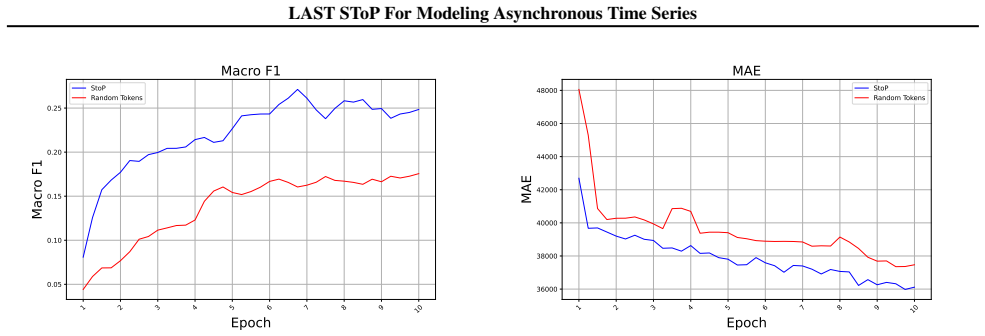
Two objects carry the argument. The first is the LASTS prompt, a system-user-assistant template that turns an asynchronous time series into a comma-separated list of tuples written as (inter-arrival time, event description), with task instructions and dataset context in the system prompt. The second is Stochastic Soft Prompting (StoP), a trainable soft-prompt method that in each training batch samples a random prefix length and back-propagates only through that prefix, while using the full prompt at inference; this makes every prefix a valid standalone prompt and produces a coarse-to-fine structure in which early tokens are diverse and later tokens refine. The separating claim is that this structured stochasticity, not randomness alone, is what gives the performance gain.
What would settle it
A reader could test this by generating a held-out asynchronous series from a known renewal process, fitting LASTS+StoP and a standard Hawkes baseline, and comparing conditional log-likelihood of the inter-arrival times; if the LLM's times do not track the baseline's conditional intensity, the claim that it models timing is refuted.
Extended reading notes
Core claim
The central claim is that the natural-language descriptions attached to events are not noise to be discarded but the main signal: an LLM prompted with LASTS can reason about which event comes next, which event is missing, and which event is out of place, using world knowledge encoded during pretraining. The paper supports this with experiments on three text-annotated activity datasets and five standard temporal-point-process datasets. On the five standard benchmarks, LASTS with StoP beats the compared temporal point process models on 13 of 18 evaluation cells and is top-two on 17 of 18, including all event-type predictions; on the text datasets, StoP outperforms both QLoRA and standard soft prompts on almost every event-type metric. The authors also state that the model has no explicit prior on the time distribution, which they identify as the reason its time error trails specialized point-process models on a few datasets.
Load-bearing premise
The load-bearing premise is that a frozen LLM trained to predict text tokens can produce reliable continuous inter-arrival times from a short textual tuple, even though the paper states (Section 4.4) it has no explicit prior about the time distribution.
Editorial extensions
If this is right
- The same frozen LLM can score forecasting, anomaly detection, and imputation from one prompt format, so new tasks on asynchronous series need prompt text rather than a new architecture.
- Datasets with thousands of distinct event descriptions, where temporal point process models run out of memory or fail to converge, become tractable: LASTS+StoP is reported to work on EPIC-KITCHENS with roughly 20,000 unique narrations.
- StoP-trained prompts can be truncated to any prefix at inference time and still function, allowing prompt length to be traded against cost on the fly.
- Quantitative evidence that event text matters: replacing descriptions with gibberish four-letter strings degrades all metrics, so the method's gains depend on the LLM's world knowledge rather than on the time series structure alone.
- The method also works when only integer event-type indices are available, beating the compared TPP models on most evaluations.
Reading between the lines
- Beyond the paper's experiments, the same prompting should apply to regular time series if numeric readings are verbalized as events, which would unify LLM forecasting for regular and irregular series under one representation.
- Because the authors say the model lacks an explicit time prior, a hybrid that adds a parametric intensity head on top of the LLM's event-type predictions is the most direct repair for the few datasets where its time error is worse.
- If StoP's prefix-validity transfers beyond time series, it becomes a general parameter-efficient adaptation trick: any downstream task could train one long soft prompt and truncate it at inference to trade quality for compute.
Editorial analysis
A structured set of objections, weighed in public.
Referee Report
Summary. The paper proposes LASTS, a prompt-design framework that encodes asynchronous time series (event type, inter-arrival time) as text for a frozen LLM, and introduces Stochastic Soft Prompting (StoP), a prompt-tuning method that trains on random prefixes of a soft prompt. The authors evaluate forecasting, imputation, and anomaly detection on three text-based action datasets (Breakfast, MultiTHUMOS, EPIC-KITCHENS) and forecasting on five standard TPP benchmarks (Amazon, Retweet, Taxi, Taobao, StackOverflow). The main claimed contributions are that LASTS enables LLMs to handle asynchronous time series across multiple tasks, and that StoP outperforms standard soft prompting and QLoRA in terms of Macro-F1 and MAE on these benchmarks.
Significance. If the results hold, the paper is a useful step toward applying LLMs to asynchronous event sequences with natural-language event descriptions, and the StoP mechanism is a simple, parameter-efficient alternative to QLoRA that appears to give consistent gains on event-type prediction. The paper includes informative ablations: the scrambled-names experiment (Appendix A.4) and the random-token-selection control (Appendix A.7) directly support the claim that textual semantics and structured prefix truncation, respectively, drive the gains. The scaling study across 1B/3B/8B backbones (Appendix A.10) is also a strength. However, the headline 'state-of-the-art' claim is overstated for time prediction, the reported win rates in Table 2 are not reproducible as written, and the absence of error bars, parsing details, and code limits the confidence one can place in the quantitative results.
major comments (4)
- [Section 4.4, Table 2, Abstract] The paper states that LASTS+StoP 'outperforming existing TPP models on 13 of the 18 evaluations, and is in the top-2 best models on 17 of the 18 evaluations.' Table 2 contains 16 metric-dataset columns (8 datasets x 2 metrics), of which only 14 have baseline values (both EPIC-KITCHENS entries are OOM for all TPP baselines). A direct count of the table shows 13 wins and 13 top-2 placements among the 14 comparable evaluations, not 17 of 18. More substantively, the abstract's 'state-of-the-art performance across different tasks and datasets' is not supported by the time-prediction results: on Amazon, Retweet, and Taxi, LASTS+StoP RMSE (0.600, 16.498, 0.328) is worse than the best reported TPP baseline (NHP 0.449, NHP 15.623, SAHP 0.319). The authors should correct the win-rate counts and qualify the state-of-the-art claim, e.g., state-of-the-art event-type prediction with competitive time prediction, or report a combined metric across both components.
- [Section 4.4, Appendix A.3, Appendix A.4] The MAE/RMSE numbers in Tables 1 and 2 are obtained by parsing LLM-generated text into (inter-arrival time, event) tuples, but the manuscript never describes the parsing procedure, the handling of malformed or non-tuple outputs, or the fraction of parseable generations. This omission is load-bearing because if invalid outputs were discarded or silently corrected, the reported time errors would be optimistic. Please provide the exact extraction method and the per-dataset parse success rate, and report results under alternative failure-handling policies (e.g., count unparseable outputs as infinite error or clamp to the maximum observed value).
- [All experimental tables (Tables 1, 2, 6, 7, 8, 9)] No measure of variability is reported: every table gives single numbers without error bars, confidence intervals, or multiple seeds. Since StoP is stochastic by design and LLM generation at nonzero temperature is stochastic, the claimed average improvements of 12.69% over SP and 13.55% over QLoRA in Section 4.4 (and detailed in Appendix A.9) could be within noise. Please run at least three seeds for the main comparisons and report mean and standard deviation, or provide a statistical significance test.
- [General reproducibility] The manuscript does not state whether code or data will be released, and the full prompts are given only for the zero-shot setting in Appendix A.3, with the adaptation prompts summarized in Appendix A.5. Because the contribution is a prompt-design and PEFT method, exact prompts for every task and dataset, preprocessing scripts, and the hyperparameter search protocol are necessary for replication. Please include these in a supplement or a public repository.
minor comments (6)
- [Section 1 (Contributions)] There is a typo: 'an novel prompt-tuning mechanism' should be 'a novel prompt-tuning mechanism'.
- [Table 2 caption] The caption says 'Performance of models on next-event's type and type prediction across five real datasets,' but the table shows eight datasets and two metrics (M-F1 and RMSE); the caption should read 'next-event's type and time prediction across eight datasets.'
- [Section 4.5] The statement 'All prefixes are valid prompts in StoP' is a direct consequence of training on random prefixes, not an independent empirical finding; the wording should acknowledge that this is by construction rather than an observed property.
- [Section 4.3] The prompt length of 400 is said to be selected 'through hyperparameter tuning across all datasets and tasks,' but it is not stated whether this selection was performed on the validation sets; please clarify to rule out test-set contamination.
- [Figure 5] The t-SNE dispersion claim is qualitative; consider adding a quantitative dispersion measure (e.g., average pairwise token distance or a clustering index) to support the 'greater diversity' claim for StoP tokens.
- [Appendix A.8] The citation 'Xu et al.' appears without a year or full reference; please provide the complete bibliographic entry.
Circularity Check
No load-bearing circularity; the SOTA and StoP claims are supported by held-out test results. One self-definitional observation, prefix validity in StoP, is used as evidence for a coarse-to-fine structure, but that property is entailed by the training design.
-
self definitional
[Section 4.5, 'All prefixes are valid prompts in StoP', and Section 4.2, StoP definition]
"All prefixes are valid prompts in StoP The training paradigm of StoP forces all prefixes of StoP to act as valid standalone prompts, as they are used as prompts during training for some batches (if trained for long enough). (see Figure 6). This further strengthens our belief that tokens in StoP are arranged from coarse, independent tokens at the beginning to tokens with tokens containing finer information towards the end."
StoP is defined by randomly sampling a prefix P[:l] for each training batch, so every prefix being a usable prompt is a direct consequence of the training procedure rather than an independent empirical finding. The paper presents prefix validity as evidence supporting the coarse-to-fine interpretation, but the interpretation is inferred from a property that was built into the method by construction. This is therefore a self-definitional observation, not a circularity that undermines the paper's central empirical claims, which are evaluated on held-out test sets against external baselines.
full rationale
The paper's main claims are empirical: LASTS prompting enables forecasting, imputation, and anomaly detection on asynchronous time series, and Stochastic Soft Prompting improves over soft prompting and QLoRA. These comparisons are measured on test splits against external baselines (Chronos, LLMTime, LLMProcesses, RMTPP, NHP, SAHP, THP, AttNHP). No fitted parameter is renamed as a prediction, and no derivation reduces a result to the input by construction. The only self-definitional element is the 'all prefixes are valid prompts' observation in Section 4.5, which is entailed by StoP's random-prefix training; it is used to support a post hoc coarse-to-fine narrative, but it is not load-bearing for the performance claims. The paper's own admission that 'our model does not have an explicit prior about the time distribution' (Section 4.4) and the apparent mismatch between the stated '13 of 18 evaluations' and the 16 entries in Table 2 are verifiability or correctness issues, not circularity. Overall circularity is minimal.
Assumptions & free parameters
free parameters (5)
- soft prompt length L =
400
- StoP prefix-length sampling distribution p(l) =
uniform
- learning rates =
2e-4 (QLoRA), 1e-4 (prompt tuning)
- LoRA rank =
4
- few-shot example count k =
5
assumptions (4)
- domain assumption The LLM's pretrained world knowledge about event descriptions transfers to event-sequence prediction tasks.
- domain assumption Next-token prediction loss on the LASTS text prompt is an adequate training signal for the joint distribution of event type and inter-arrival time.
- domain assumption Macro-F1 and MAE/RMSE computed from parsed LLM outputs accurately reflect task performance, assuming parseable outputs.
- domain assumption The TPP baseline results from EasyTPP (Xue et al., 2024) are comparable, despite the present paper's different train/validation/test split (70/10/20) and data preprocessing steps.
Cite this review
Pith. "Pith review of LAST SToP For Modeling Asynchronous Time Series." pith.science (2026). https://pith.science/paper/G6ZFS3KY
@misc{pith2026250201922,
  author       = {Pith},
  title        = {Pith review of: LAST SToP For Modeling Asynchronous Time Series},
  year         = {2026},
  howpublished = {\url{https://pith.science/paper/G6ZFS3KY}},
  note         = {Machine review of arXiv:2502.01922}
}
read the original abstract
We present a novel prompt design for Large Language Models (LLMs) tailored to Asynchronous Time Series. Unlike regular time series, which assume values at evenly spaced time points, asynchronous time series consist of timestamped events occurring at irregular intervals, each described in natural language. Our approach effectively utilizes the rich natural language of event descriptions, allowing LLMs to benefit from their broad world knowledge for reasoning across different domains and tasks. This allows us to extend the scope of asynchronous time series analysis beyond forecasting to include tasks like anomaly detection and data imputation. We further introduce Stochastic Soft Prompting, a novel prompt-tuning mechanism that significantly improves model performance, outperforming existing fine-tuning methods such as QLoRA. Through extensive experiments on real world datasets, we demonstrate that our approach achieves state-of-the-art performance across different tasks and datasets.
Figures


Figures from the paper (9 more)




Forward citations
Cited by 1 Pith paper
-
LiSTEN: Learning Soft Token Embeddings for Neural Audio LLMs
LiSTEN shows that dynamically selecting a few learnable prompt tokens from a shared pool can replace LoRA fine-tuning for audio-language models, matching or beating it with less training data.
Reference graph
Works this paper leans on
-
[1]
write newline
" write newline "" before.all 'output.state := FUNCTION n.dashify 't := "" t empty not t #1 #1 substring "-" = t #1 #2 substring "--" = not "--" * t #2 global.max substring 't := t #1 #1 substring "-" = "-" * t #2 global.max substring 't := while if t #1 #1 substring * t #2 global.max substring 't := if while FUNCTION format.date year duplicate empty "emp...
-
[2]
F., Stella, L., Turkmen, C., Zhang, X., Mercado, P., Shen, H., Shchur, O., Rangapuram, S
Ansari, A. F., Stella, L., Turkmen, C., Zhang, X., Mercado, P., Shen, H., Shchur, O., Rangapuram, S. S., Arango, S. P., Kapoor, S., et al. Chronos: Learning the language of time series. Transactions on Machine Learning Research https://openreview.net/forum?id=gerNCVqqtR, 2024
work page 2024
-
[3]
Bacry, E., Mastromatteo, I., and Muzy, J.-F. Hawkes processes in finance . Market Microstructure and Liquidity, 2015
work page 2015
-
[4]
BEiT: BERT pre-training of image transformers
Bao, H., Dong, L., Piao, S., and Wei, F. BEiT: BERT pre-training of image transformers . International Conference on Learning Representations (ICLR), 2022
work page 2022
-
[5]
BLOOM: A 176B-Parameter Open-Access Multilingual Language Model
BigScience Workshop et al. BLOOM: A 176B-Parameter Open-Access Multilingual Language Model . In arXiv 2211.05100, 2023
arXiv 2023
-
[6]
A., Adeli, E., Altman, R., Arora, S., von Arx, S., Bernstein, M
Bommasani, R., Hudson, D. A., Adeli, E., Altman, R., Arora, S., von Arx, S., Bernstein, M. S., Bohg, J., Bosselut, A., Brunskill, E., et al. On the opportunities and risks of foundation models . arXiv 2108.07258, 2021
arXiv 2021
-
[7]
Brown, T., Mann, B., Ryder, N., Subbiah, M., Kaplan, J. D., Dhariwal, P., Neelakantan, A., Shyam, P., Sastry, G., Askell, A., Agarwal, S., Herbert-Voss, A., Krueger, G., Henighan, T., Child, R., Ramesh, A., Ziegler, D., Wu, J., Winter, C., Hesse, C., Chen, M., Sigler, E., Litwin, M., Gray, S., Chess, B., Clark, J., Berner, C., McCandlish, S., Radford, A.,...
work page 2020
-
[8]
O., Pfister, T., Zheng, Y., Ye, W., and Liu, Y
Cao, D., Jia, F., Arik, S. O., Pfister, T., Zheng, Y., Ye, W., and Liu, Y. TEMPO: Prompt-based Generative Pre-trained Transformer for Time Series Forecasting . In arXiv 2310.04948, 2023
arXiv 2023
Show all 77 references
-
[9]
LLM4TS: Aligning Pre-Trained LLMs as Data-Efficient Time-Series Forecasters
Chang, C., Wang, W.-Y., Peng, W.-C., and Chen, T.-F. LLM4TS: Aligning Pre-Trained LLMs as Data-Efficient Time-Series Forecasters . In arXiv 2308.08469, 2023
2023 arXiv
-
[10]
J., Sun, J., and Liu, C
Chen, M., Shen, L., Li, Z., Wang, X. J., Sun, J., and Liu, C. VisionTS: Visual Masked Autoencoders Are Free-Lunch Zero-Shot Time Series Forecasters . In arXiv 2408.17253, 2024
2024 arXiv
-
[11]
and Vere-Jones, D
Daley, D. and Vere-Jones, D. An Introduction to the Theory of Point Processes: Volume II: General Theory and Structure. Probability and Its Applications. Springer New York, 2007. ISBN 9780387213378
2007
-
[12]
M., Furnari, A., Ma, J., Kazakos, E., Moltisanti, D., Munro, J., Perrett, T., Price, W., and Wray, M
Damen, D., Doughty, H., Farinella, G. M., Furnari, A., Ma, J., Kazakos, E., Moltisanti, D., Munro, J., Perrett, T., Price, W., and Wray, M. Rescaling Egocentric Vision: Collection, Pipeline and Challenges for EPIC-KITCHENS-100 . International Journal of Computer Vision (IJCV), 2022
2022
-
[13]
A decoder-only foundation model for time-series forecasting
Das, A., Kong, W., Sen, R., and Zhou, Y. A decoder-only foundation model for time-series forecasting. In International Conference on Machine Learning (ICML), 2024
2024
-
[14]
Qlora: Efficient finetuning of quantized llms
Dettmers, T., Pagnoni, A., Holtzman, A., and Zettlemoyer, L. Qlora: Efficient finetuning of quantized llms. In Oh, A., Naumann, T., Globerson, A., Saenko, K., Hardt, M., and Levine, S. (eds.), Advances in Neural Information Processing Systems, volume 36, pp.\ 10088--10115. Cur...
2023
-
[15]
S., Mohapatra, C., Naidu, S
Dooley, S., Khurana, G. S., Mohapatra, C., Naidu, S. V., and White, C. ForecastPFN: Synthetically-trained zero-shot forecasting . Advances in Neural Information Processing Systems (NeurIPS), 2024
2024
-
[16]
Recurrent marked temporal point processes: Embedding event history to vector
Du, N., Dai, H., Trivedi, R., Upadhyay, U., Gomez-Rodriguez, M., and Song, L. Recurrent marked temporal point processes: Embedding event history to vector. KDD '16, pp.\ 1555–1564, New York, NY, USA, 2016. Association for Computing Machinery. ISBN 9781450342322
2016
-
[17]
The Llama 3 Herd of Models
Dubey et al. The Llama 3 Herd of Models . In arXiv 2407.21783, 2024
2024 arXiv
-
[18]
Gruver, N., Finzi, M., Qiu, S., and Wilson, A. G. Large language models are zero-shot time series forecasters . Advances in Neural Information Processing Systems (NeurIPS), 2023
2023
-
[19]
Gruver, N., Finzi, M., Qiu, S., and Wilson, A. G. Large language models are zero-shot time series forecasters. Advances in Neural Information Processing Systems, 36, 2024
2024
-
[20]
Hawkes, A. G. Spectra of some self-exciting and mutually exciting point processes . Biometrika, 1971
1971
-
[21]
Analysis of users’ behavior in structured e-commerce websites
Hernandez, S., Alvarez, P., Fabra, J., and Ezpeleta, J. Analysis of users’ behavior in structured e-commerce websites . IEEE Access, 2017
2017
-
[22]
Set functions for time series
Horn, M., Moor, M., Bock, C., Rieck, B., and Borgwardt, K. Set functions for time series. In International Conference on Machine Learning, pp.\ 4353--4363. PMLR, 2020
2020
-
[23]
J., Shen, Y., Wallis, P., Allen-Zhu, Z., Li, Y., Wang, S., Wang, L., and Chen, W
Hu, E. J., Shen, Y., Wallis, P., Allen-Zhu, Z., Li, Y., Wang, S., Wang, L., and Chen, W. Lora: Low-rank adaptation of large language models, 2021. URL https://arxiv.org/abs/2106.09685
2021 arXiv
-
[24]
Huang, G., Sun, Y., Liu, Z., Sedra, D., and Weinberger, K. Q. Deep networks with stochastic depth. In Computer Vision--ECCV 2016: 14th European Conference, Amsterdam, The Netherlands, October 11--14, 2016, Proceedings, Part IV 14, pp.\ 646--661. Springer, 2016
2016
-
[25]
Y., Shi, X., Chen, P.-Y., Liang, Y., Li, Y.-F., Pan, S., and Wen, Q
Jin, M., Wang, S., Ma, L., Chu, Z., Zhang, J. Y., Shi, X., Chen, P.-Y., Liang, Y., Li, Y.-F., Pan, S., and Wen, Q. Time-LLM : Time series forecasting by reprogramming large language models. In International Conference on Learning Representations (ICLR), 2024
2024
-
[26]
Visual causality analysis of event sequence data
Jin, Z., Guo, S., Chen, N., Weiskopf, D., Gotz, D., and Cao, N. Visual causality analysis of event sequence data . IEEE transactions on visualization and computer graphics, 2020
2020
-
[27]
C., Lo, W.-Y., et al
Kirillov, A., Mintun, E., Ravi, N., Mao, H., Rolland, C., Gustafson, L., Xiao, T., Whitehead, S., Berg, A. C., Lo, W.-Y., et al. Segment anything . In IEEE International Conference on Computer Vision (ICCV) , 2023
2023
-
[28]
Interval-censored transformer Hawkes: Detecting information operations using the reaction of social systems
Kong, Q., Calderon, P., Ram, R., Boichak, O., and Rizoiu, M.-A. Interval-censored transformer Hawkes: Detecting information operations using the reaction of social systems . In Proceedings of the ACM Web Conference 2023, 2023
2023
-
[29]
The language of actions: Recovering the syntax and semantics of goal-directed human activities
Kuehne, H., Arslan, A., and Serre, T. The language of actions: Recovering the syntax and semantics of goal-directed human activities . In IEEE Conference on Computer Vision and Pattern Recognition (CVPR) , 2014
2014
-
[30]
Matryoshka representation learning
Kusupati, A., Bhatt, G., Rege, A., Wallingford, M., Sinha, A., Ramanujan, V., Howard-Snyder, W., Chen, K., Kakade, S., Jain, P., et al. Matryoshka representation learning. Advances in Neural Information Processing Systems, 35: 0 30233--30249, 2022
2022
-
[31]
The power of scale for parameter-efficient prompt tuning
Lester, B., Al-Rfou, R., and Constant, N. The power of scale for parameter-efficient prompt tuning . arXiv 2104.08691, 2021
2021 arXiv
-
[32]
Li, X. L. and Liang, P. Prefix-tuning: Optimizing continuous prompts for generation . arXiv 2101.00190, 2021
2021 arXiv
-
[33]
L., Du, Z., Yang, Z., and Tang, J
Liu, X., Ji, K., Fu, Y., Tam, W. L., Du, Z., Yang, Z., and Tang, J. P-tuning v2: Prompt tuning can be comparable to fine-tuning universally across scales and tasks . arXiv 2110.07602, 2021
2021 arXiv
-
[34]
Stochastic optimal control of epidemic processes in networks
Lorch, L., De, A., Bhatt, S., Trouleau, W., Upadhyay, U., and Gomez-Rodriguez, M. Stochastic optimal control of epidemic processes in networks . arXiv preprint arXiv:1810.13043, 2018
2018 arXiv
-
[35]
u dke, D., Bilo s , M., Shchur, O., Lienen, M., and G\
L\" u dke, D., Bilo s , M., Shchur, O., Lienen, M., and G\" u nnemann, S. Add and thin: Diffusion for temporal point processes. In Oh, A., Naumann, T., Globerson, A., Saenko, K., Hardt, M., and Levine, S. (eds.), Advances in Neural Information Processing Systems, volume 36, pp...
2023
-
[36]
Peft: State-of-the-art parameter-efficient fine-tuning methods
Mangrulkar, S., Gugger, S., Debut, L., Belkada, Y., Paul, S., and Bossan, B. Peft: State-of-the-art parameter-efficient fine-tuning methods. https://github.com/huggingface/peft, 2022
2022
-
[37]
A., Durand, T., He, J., Sigal, L., and Mori, G
Mehrasa, N., Jyothi, A. A., Durand, T., He, J., Sigal, L., and Mori, G. A variational auto-encoder model for stochastic point processes . In IEEE Conference on Computer Vision and Pattern Recognition (CVPR) , 2019
2019
-
[38]
and Eisner, J
Mei, H. and Eisner, J. M. The neural hawkes process: A neurally self-modulating multivariate point process. In Guyon, I., Luxburg, U. V., Bengio, S., Wallach, H., Fergus, R., Vishwanathan, S., and Garnett, R. (eds.), Advances in Neural Information Processing Systems, volume 30...
2017
-
[39]
Transformer Embeddings of Irregularly Spaced Events and Their Participants
Mei, H., Yang, C., and Eisner, J. Transformer Embeddings of Irregularly Spaced Events and Their Participants . In International Conference on Learning Representations (ICLR), 2022
2022
-
[40]
Justifying recommendations using distantly-labeled reviews and fine-grained aspects
Ni, J., Li, J., and McAuley, J. Justifying recommendations using distantly-labeled reviews and fine-grained aspects . In Proceedings of the conference on empirical methods in natural language processing and the international joint conference on natural language processing (EMN...
2019
-
[41]
Nguyen, N., Sinthong, P., and Kalagnanam, J
Nie, Y., H. Nguyen, N., Sinthong, P., and Kalagnanam, J. A Time Series is Worth 64 Words: Long-term Forecasting with Transformers . In International Conference on Learning Representations (ICLR), 2023
2023
-
[42]
and Eisner, J
Qin, G. and Eisner, J. Learning how to ask: Querying LM s with mixtures of soft prompts. Association for Computational Linguistics, 2021
2021
-
[43]
Language models are unsupervised multitask learners, 2019
Radford, A., Wu, J., Child, R., Luan, D., Amodei, D., and Sutskever, I. Language models are unsupervised multitask learners, 2019
2019
-
[44]
W., Hallacy, C., Ramesh, A., Goh, G., Agarwal, S., Sastry, G., Askell, A., Mishkin, P., Clark, J., et al
Radford, A., Kim, J. W., Hallacy, C., Ramesh, A., Goh, G., Agarwal, S., Sastry, G., Askell, A., Mishkin, P., Clark, J., et al. Learning transferable visual models from natural language supervision . In International Conference on Machine Learning (ICML), 2021
2021
-
[45]
R., Ghonia, H., Bhagwatkar, R., Khorasani, A., Bayazi, M
Rasul, K., Ashok, A., Williams, A. R., Ghonia, H., Bhagwatkar, R., Khorasani, A., Bayazi, M. J. D., Adamopoulos, G., Riachi, R., Hassen, N., Biloš, M., Garg, S., Schneider, A., Chapados, N., Drouin, A., Zantedeschi, V., Nevmyvaka, Y., and Rish, I. Lag-Llama: Towards Foundation...
-
[46]
F., Choi, D., Turner, R
Requeima, J., Bronskill, J. F., Choi, D., Turner, R. E., and Duvenaud, D. Llm processes: Numerical predictive distributions conditioned on natural language. In ICML 2024 Workshop on In-Context Learning, 2024
2024
-
[47]
Sir-Hawkes: on the relationship between epidemic models and Hawkes point processes
Rizoiu, M.-A., Mishra, S., Kong, Q., Carman, M., and Xie, L. Sir-Hawkes: on the relationship between epidemic models and Hawkes point processes . The Web Confernce, 2018
2018
-
[48]
Modeling irregular time series with continuous recurrent units
Schirmer, M., Eltayeb, M., Lessmann, S., and Rudolph, M. Modeling irregular time series with continuous recurrent units. In International conference on machine learning, pp.\ 19388--19405. PMLR, 2022
2022
-
[49]
C., Januschowski, T., Gasthaus, J., and G \"u nnemann, S
Shchur, O., Turkmen, A. C., Januschowski, T., Gasthaus, J., and G \"u nnemann, S. Detecting anomalous event sequences with temporal point processes. Advances in Neural Information Processing Systems, 34: 0 13419--13431, 2021
2021
-
[50]
Dropout: a simple way to prevent neural networks from overfitting
Srivastava, N., Hinton, G., Krizhevsky, A., Sutskever, I., and Salakhutdinov, R. Dropout: a simple way to prevent neural networks from overfitting. The journal of machine learning research, 15 0 (1): 0 1929--1958, 2014
1929
-
[51]
N., Kaiser, L., and Polosukhin, I
Vaswani, A., Shazeer, N., Parmar, N., Uszkoreit, J., Jones, L., Gomez, A. N., Kaiser, L., and Polosukhin, I. Attention is All you Need . In Advances in Neural Information Processing Systems (NeurIPS), 2017
2017
-
[52]
Lifelongmemory: Leveraging llms for answering queries in long-form egocentric videos
Wang, Y., Yang, Y., and Ren, M. Lifelongmemory: Leveraging llms for answering queries in long-form egocentric videos. arXiv preprint arXiv:2312.05269, 2024
2024 arXiv
-
[53]
Transformers in time series: A survey
Wen, Q., Zhou, T., Zhang, C., Chen, W., Ma, Z., Yan, J., and Sun, L. Transformers in time series: A survey. In International Joint Conference on Artificial Intelligence(IJCAI), 2023
2023
-
[54]
Nyc taxi open data, 2014
Whong, C. Nyc taxi open data, 2014. URL https://chriswhong.com/open-data/foil_nyc_taxi/
2014
-
[55]
Unified training of universal time series forecasting transformers
Woo, G., Liu, C., Kumar, A., Xiong, C., Savarese, S., and Sahoo, D. Unified training of universal time series forecasting transformers. In arXiv 2402.02592, 2024
2024 arXiv
-
[56]
Autoformer: Decomposition transformers with auto-correlation for long-term series forecasting
Wu, H., Xu, J., Wang, J., and Long, M. Autoformer: Decomposition transformers with auto-correlation for long-term series forecasting . Advances in Neural Information Processing Systems (NeurIPS), 2021
2021
-
[57]
An Empirical Analysis of Compute-Optimal Inference for Problem-Solving with Language Models
Wu, Y., Sun, Z., Li, S., Welleck, S., and Yang, Y. An Empirical Analysis of Compute-Optimal Inference for Problem-Solving with Language Models . arXiv 2408.00724, 2024
2024 arXiv
-
[58]
Soft prompt recovers compressed llms, transferably
Xu, Z., Liu, Z., Chen, B., Zhong, S., Tang, Y., Jue, W., Zhou, K., Hu, X., and Shrivastava, A. Soft prompt recovers compressed llms, transferably. In Forty-first International Conference on Machine Learning
-
[59]
and Salim, F
Xue, H. and Salim, F. D. Promptcast: A new prompt-based learning paradigm for time series forecasting . IEEE Transactions on Knowledge and Data Engineering, 2023
2023
-
[60]
Hypro: A hybridly normalized probabilistic model for long-horizon prediction of event sequences
Xue, S., Shi, X., Zhang, J., and Mei, H. Hypro: A hybridly normalized probabilistic model for long-horizon prediction of event sequences . Advances in Neural Information Processing Systems (NeurIPS), 2022
2022
-
[61]
Y., et al
Xue, S., Shi, X., Chu, Z., Wang, Y., Zhou, F., Hao, H., Jiang, C., Pan, C., Xu, Y., Zhang, J. Y., et al. EasyTPP: Towards Open Benchmarking the Temporal Point Processes . International Conference on Learning Representations (ICLR), 2024
2024
-
[62]
C., Smith, K
Yang, X., Chen, A., PourNejatian, N., Shin, H. C., Smith, K. E., Parisien, C., Compas, C., Martin, C., Costa, A. B., Flores, M. G., et al. A large language model for electronic health records . NPJ digital medicine, 2022
2022
-
[63]
An evaluation of statistical approaches to text categorization
Yang, Y. An evaluation of statistical approaches to text categorization. Information retrieval, 1999
1999
-
[64]
Every moment counts: Dense detailed labeling of actions in complex videos
Yeung, S., Russakovsky, O., Jin, N., Andriluka, M., Mori, G., and Fei-Fei, L. Every moment counts: Dense detailed labeling of actions in complex videos . IEEE International Conference on Computer Vision (ICCV) , 2018
2018
-
[65]
Soundstream: An end-to-end neural audio codec
Zeghidour, N., Luebs, A., Omran, A., Skoglund, J., and Tagliasacchi, M. Soundstream: An end-to-end neural audio codec. IEEE/ACM Transactions on Audio, Speech, and Language Processing, 30: 0 495--507, 2021
2021
-
[66]
Are transformers effective for time series forecasting? In Conference on Artificial Intelligence (AAAI), 2023
Zeng, A., Chen, M., Zhang, L., and Xu, Q. Are transformers effective for time series forecasting? In Conference on Artificial Intelligence (AAAI), 2023
2023
-
[67]
Self-attentive Hawkes process
Zhang, Q., Lipani, A., Kirnap, O., and Yilmaz, E. Self-attentive Hawkes process . In International Conference on Machine Learning (ICML), 2020
2020
-
[68]
Irregular multivariate time series forecasting: A transformable patching graph neural networks approach
Zhang, W., Yin, C., Liu, H., Zhou, X., and Xiong, H. Irregular multivariate time series forecasting: A transformable patching graph neural networks approach. In Forty-first International Conference on Machine Learning
-
[69]
R., Gupta, R
Zhang, X., Chowdhury, R. R., Gupta, R. K., and Shang, J. Large language models for time series: A survey. arXiv preprint arXiv:2402.01801, 2024
2024 arXiv
-
[70]
and Yan, J
Zhang, Y. and Yan, J. Crossformer: Transformer utilizing cross-dimension dependency for multivariate time series forecasting . In International Conference on Learning Representations (ICLR), 2023
2023
-
[71]
Counterfactual neural temporal point process for estimating causal influence of misinformation on social media
Zhang, Y., Cao, D., and Liu, Y. Counterfactual neural temporal point process for estimating causal influence of misinformation on social media . Advances in Neural Information Processing Systems (NeurIPS), 2022
2022
-
[72]
A., He, H
Zhao, Q., Erdogdu, M. A., He, H. Y., Rajaraman, A., and Leskovec, J. Seismic: A self-exciting point process model for predicting tweet popularity. In Proceedings of the 21th ACM SIGKDD international conference on knowledge discovery and data mining, pp.\ 1513--1522, 2015
2015
-
[73]
Q., Agarwal, N., Lee, K., and Sun, C
Zhao, Q., Wang, S., Zhang, C., Fu, C., Do, M. Q., Agarwal, N., Lee, K., and Sun, C. Antgpt: Can large language models help long-term action anticipation from videos? In The Twelfth International Conference on Learning Representations, 2024
2024
-
[74]
Informer: Beyond efficient transformer for long sequence time-series forecasting
Zhou, H., Zhang, S., Peng, J., Zhang, S., Li, J., Xiong, H., and Zhang, W. Informer: Beyond efficient transformer for long sequence time-series forecasting . In Conference on Artificial Intelligence (AAAI), 2021
2021
-
[75]
Learning triggering kernels for multi-dimensional Hawkes processes
Zhou, K., Zha, H., and Song, L. Learning triggering kernels for multi-dimensional Hawkes processes . In International Conference on Machine Learning (ICML), 2013
2013
-
[76]
One fits all: Power general time series analysis by pretrained lm
Zhou, T., Niu, P., Sun, L., Jin, R., et al. One fits all: Power general time series analysis by pretrained lm . Advances in Neural Information Processing Systems (NeurIPS), 2023
2023
-
[77]
Transformer Hawkes process
Zuo, S., Jiang, H., Li, Z., Zhao, T., and Zha, H. Transformer Hawkes process . In International Conference on Machine Learning (ICML), 2020
2020
Reviewed August 9, 2026 · model on record in the stance chip above.
Discussion (0). Continue with ORCID to comment.