REVIEW 2 major objections 1 minor 74 references
Logarithmic f(Q) gravity models produce intermediate Hubble constant values between Planck and SH0ES measurements.
Reviewed by Pith at T0; open to challenge. T0 means a machine referee read the full paper against a public rubric. the ladder, T0–T4 →
Logarithmic and nonlinear f(Q) models are constrained via Bayesian MCMC with cosmic chronometers, supernova, and BAO data and remain competitive with ΛCDM, with the logarithmic model yielding intermediate H0 values and lower AIC/BIC penalties.
T0 review reviewed 2026-06-26 challenge →
load-bearing objection The log f(Q) model shifts H0 to intermediate values with lower AIC/BIC than the nonlinear one, but this is a standard MCMC exercise on an existing framework. the 2 major comments →
Non-Metricity Corrections Approach to Alleviate $H _0$ Tension: The Logarithmic and Nonlinear $f(Q)$ Models
The pith
A machine-rendered reading of the paper's core claim, the machinery that carries it, and where it could break.
The reading
Core claim
Within the symmetric teleparallel framework, the logarithmic f(Q) model infers intermediate values of the Hubble constant between the Planck and SH0ES benchmarks for all combinations of cosmic chronometers, Type Ia supernovae, and BAO data, while both models remain statistically competitive with Lambda CDM and the logarithmic variant shows lower AIC and BIC values.
What carries the argument
The logarithmic and nonlinear functional forms of f(Q) in symmetric teleparallel gravity, which introduce geometric corrections to the standard expansion history without a cosmological constant.
Load-bearing premise
The chosen functional forms of f(Q) can be directly constrained by the selected observational datasets without introducing unaccounted systematic biases or inconsistencies in the underlying symmetric teleparallel framework.
What would settle it
A high-precision Hubble constant measurement from future surveys that falls clearly outside the intermediate range predicted by the logarithmic model, or new data where the model fits worse than Lambda CDM according to AIC and BIC, would challenge the central claim.
Editorial analysis
A structured set of objections, weighed in public.
Referee Report
Summary. The manuscript investigates two f(Q) gravity models—a logarithmic and a nonlinear saturation model—within symmetric teleparallel gravity as a means to alleviate the H0 tension. Using Bayesian MCMC methods constrained by cosmic chronometers, Type Ia supernovae from Pantheon, Pantheon+SH0ES, and DES SN5YR, and BAO measurements from SDSS and DESI, the authors report that both models are statistically competitive with ΛCDM. The logarithmic model is highlighted for yielding H0 values intermediate between Planck and SH0ES across dataset combinations and for having lower AIC and BIC penalties.
Significance. Should the findings be substantiated by detailed derivations and robust statistical analysis, this work would contribute to the exploration of modified gravity theories as alternatives to the cosmological constant for addressing cosmological tensions. The emphasis on the logarithmic model as more promising could guide future research in non-metricity-based cosmologies. The comprehensive dataset usage is a positive aspect.
major comments (2)
- [Abstract] Abstract: The abstract summarizes MCMC results and model competitiveness but provides no derivation details, error analysis, or data exclusion criteria, preventing verification that the math supports the stated claim.
- [Abstract] Abstract: The claim that the logarithmic model infers intermediate H0 values between Planck and SH0ES is not supported by any equations; without explicit forms or modified Friedmann equations it is impossible to determine whether these values are independent predictions or direct outputs of parameters fitted to the tension data.
minor comments (1)
- [Abstract] Abstract: The exact functional forms of the logarithmic and nonlinear f(Q) should be stated explicitly to allow assessment of the geometric corrections to the expansion history.
Simulated Author's Rebuttal
We thank the referee for the constructive comments on our manuscript. Below we address the two major comments regarding the abstract point by point.
read point-by-point responses
-
Referee: [Abstract] Abstract: The abstract summarizes MCMC results and model competitiveness but provides no derivation details, error analysis, or data exclusion criteria, preventing verification that the math supports the stated claim.
Authors: Abstracts are by design concise overviews and do not contain full derivations, error budgets or dataset selection protocols; those appear in the body of the paper. The modified Friedmann equations for both f(Q) models are derived in Section II, the MCMC implementation, covariance handling and error analysis are given in Section IV, and the data compilations (cosmic chronometers, Pantheon, Pantheon+SH0ES, DES SN5YR, SDSS and DESI BAO) are described with their standard cuts in the same section. The AIC/BIC comparison is reported in the results tables. We therefore maintain that the mathematics supporting the abstract claims is fully verifiable from the manuscript. revision: no
-
Referee: [Abstract] Abstract: The claim that the logarithmic model infers intermediate H0 values between Planck and SH0ES is not supported by any equations; without explicit forms or modified Friedmann equations it is impossible to determine whether these values are independent predictions or direct outputs of parameters fitted to the tension data.
Authors: The reported H0 values are the posterior means and best-fit values obtained from the MCMC chains when the model parameters are constrained by the combined datasets. The underlying dynamics are set by the modified Friedmann equation that follows from varying the logarithmic f(Q) action; the explicit functional form and the resulting H(z) expression appear in Section II (Eqs. (8)–(10)). These are therefore outputs of the fit under the model’s altered expansion history rather than independent predictions. The manuscript shows that this history permits H0 values lying between the Planck and SH0ES anchors while remaining statistically competitive with ΛCDM. revision: no
Circularity Check
No significant circularity identified
full rationale
The abstract describes a standard Bayesian MCMC analysis constraining two f(Q) functional forms against cosmic chronometers, Pantheon/Pantheon+SH0ES/DES SN compilations, and BAO data, then reporting that the logarithmic model yields intermediate H0 values with lower AIC/BIC. No derivation chain, modified Friedmann equations, explicit f(Q) forms, or self-citations appear in the provided text. Without any quoted equations or load-bearing steps that reduce to fitted inputs by construction, no instances of self-definitional, fitted-input-called-prediction, or self-citation circularity can be exhibited. The reported H0 inference is the direct output of the MCMC fit to the tension-sensitive datasets, but this is the intended statistical procedure rather than a hidden circularity.
Axiom & Free-Parameter Ledger
free parameters (1)
- parameters of the logarithmic and nonlinear f(Q) functions
axioms (1)
- domain assumption FLRW metric applies in symmetric teleparallel gravity with the chosen f(Q) forms
Cite this review
Pith. "Pith review of Non-Metricity Corrections Approach to Alleviate $H _0$ Tension: The Logarithmic and Nonlinear $f(Q)$ Models." pith.science (2026). https://pith.science/paper/G6ZYVVOZ
@misc{pith2026260622262,
  author       = {Pith},
  title        = {Pith review of: Non-Metricity Corrections Approach to Alleviate $H _0$ Tension: The Logarithmic and Nonlinear $f(Q)$ Models},
  year         = {2026},
  howpublished = {\url{https://pith.science/paper/G6ZYVVOZ}},
  note         = {Machine review of arXiv:2606.22262}
}
abstract
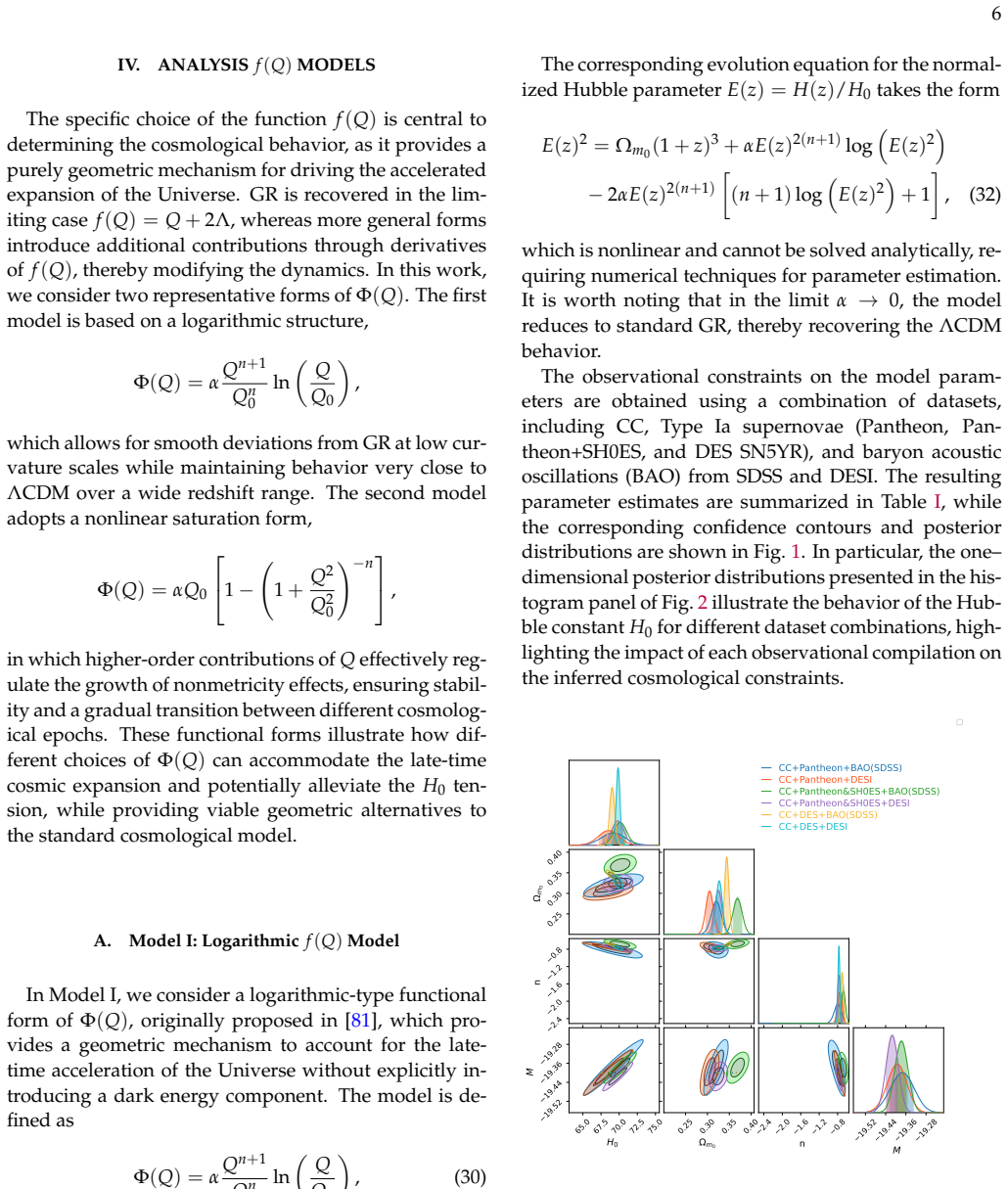
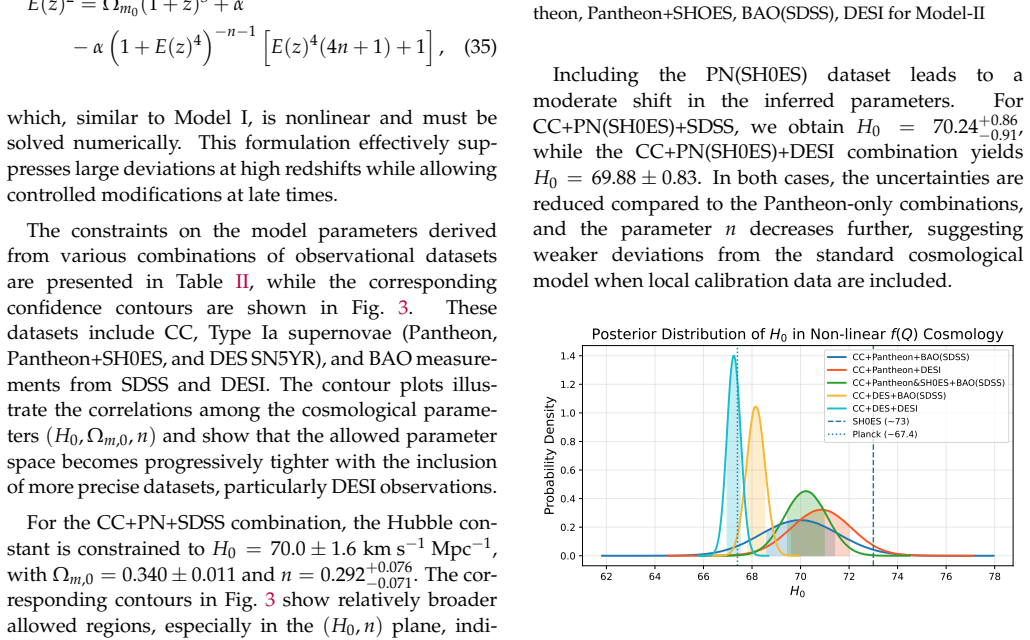
The persistent discrepancy between early-time and late-Universe measurements of the Hubble constant commonly known as the $H_0$ tension remains one of the most pressing open questions in modern cosmology. In this work, we explore whether modifications to the gravitational sector, specifically within the framework of symmetric teleparallel gravity, can offer a viable pathway toward alleviating this tension. We consider two functional forms of $f(Q)$ gravity: a logarithmic model and a nonlinear saturation model, both of which introduce geometric corrections to the standard expansion history without invoking a cosmological constant. Constraining these models through a Bayesian MCMC analysis against a comprehensive suite of observational data, including cosmic chronometers, Type Ia supernova compilations (Pantheon, Pantheon$+$SH0ES, and DES SN5YR), and BAO measurements from SDSS and DESI, we find that both models remain statistically competitive with $\Lambda$CDM. The logarithmic model, in particular, consistently infers intermediate values of $H_0$ between the \textit{Planck} and SH0ES benchmarks across all dataset combinations, and carries lower AIC and BIC penalties, establishing it as the more promising candidate for partially easing the $H_0$ tension within a modified gravity framework.
Figures




Reference graph
Works this paper leans on
-
[1]
Snowmass2021 - Letter of interest cosmology intertwined II: The hubble constant tension,
E. Di Valentinoet al., “Snowmass2021 - Letter of interest cosmology intertwined II: The hubble constant tension,” Astropart. Phys.131(2021) 102605
2021
-
[2]
Challenging the lCDM model: 5σevidence for a dynamical dark energy late-time transition,
M. Scherer, M. A. Sabogal, R. C. Nunes, and A. De Fe- lice, “Challenging the lCDM model: 5σevidence for a dynamical dark energy late-time transition,”Phys. Rev. D 112(2025) 043513
2025
-
[3]
The hubble tension resolved by the desi baryon acoustic os- cillations measurements,
X. D. Jia, J. P . Hu, D. H. Gao, S. X. Yi, and F. Y. Wang, “The hubble tension resolved by the desi baryon acoustic os- cillations measurements,”The Astrophysical Journal Letters 994(2025) no. 1, L22. [4]CosmoV erse NetworkCollaboration, E. Di Valentinoet al., “The CosmoVerse White Paper: Addressing observa- tional tensions in cosmology with systematics a...
2025
-
[4]
A Comprehensive Measurement of the Local Value of the Hubble Constant with 1 km s −1 Mpc−1 Uncertainty from the Hubble Space Telescope and the SH0ES Team,
A. G. Riesset al., “A Comprehensive Measurement of the Local Value of the Hubble Constant with 1 km s −1 Mpc−1 Uncertainty from the Hubble Space Telescope and the SH0ES Team,”Astrophys. J. Lett.934(2022) no. 1, L7
2022
-
[5]
The Perfect Host: JWST Cepheid Ob- servations in a Background-free Type Ia Supernova Host Confirm No Bias in Hubble-constant Measurements,
A. G. Riesset al., “The Perfect Host: JWST Cepheid Ob- servations in a Background-free Type Ia Supernova Host Confirm No Bias in Hubble-constant Measurements,”As- trophys. J. Lett.992(2025) no. 2, L34. [9]H0DNCollaboration, S. Casertanoet al., “The Local Dis- tance Network: a community consensus report on the measurement of the Hubble constant at 1% preci...
2025
-
[6]
Supernova constraints and systematic uncertainties from the first three years of the supernova legacy survey,
A. Conleyet al., “Supernova constraints and systematic uncertainties from the first three years of the supernova legacy survey,”The Astrophysical Journal Supplement Series 192(2010) no. 1,
2010
-
[7]
Detection of the Baryon Acoustic Peak in the Large- Scale Correlation Function of SDSS Luminous Red Galax- ies,
D. J. Eisenstein, I. Zehavi, D. W. Hogg, R. Scoccimarro,et al., “Detection of the Baryon Acoustic Peak in the Large- Scale Correlation Function of SDSS Luminous Red Galax- ies,”The Astrophysical Journal633(2005) no. 2, 560
2005
-
[8]
The clustering of galaxies in the completed SDSS-III Baryon Oscillation Spectroscopic Survey: cosmological analysis of the DR12 galaxy sample,
S. Alam, M. Ata, S. Bailey, F. Beutler,et al., “The clustering of galaxies in the completed SDSS-III Baryon Oscillation Spectroscopic Survey: cosmological analysis of the DR12 galaxy sample,”Monthly Notices of the Royal Astronomical Society470(2017) no. 3, 2617–2652
2017
-
[9]
DESI DR2 results. II. Measurements of baryon acoustic oscillations and cosmological constraints,
A. Raichoor, A. de Mattia, A. J. Ross,et al., “The com- pleted SDSS-IV extended Baryon Oscillation Spectro- scopic Survey: large-scale structure catalogues and mea- surement of the isotropic BAO between redshift 0.6 and 1.1 for the Emission Line Galaxy Sample,”Mon. Not. Roy. Astron. Soc.500(2020) no. 3, 3254–3274. [14]DESICollaboration, M. Abdul Karimet a...
2020
-
[10]
J. Hou, A. G. S ´anchez, A. J. Ross,et al., “The completed SDSS-IV extended Baryon Oscillation Spectroscopic Sur- vey: BAO and RSD measurements from anisotropic clus- tering analysis of the quasar sample in configuration space between redshift 0.8 and 2.2,”Mon. Not. Roy. As- tron. Soc.500(2020) no. 1, 1201–1221
2020
-
[11]
Snowmass2021 - letter of interest cosmology intertwined ii: The hubble constant tension,
E. Di Valentinoet al., “Snowmass2021 - letter of interest cosmology intertwined ii: The hubble constant tension,” Astroparticle Physics131(2021) 102605
2021
-
[12]
Pressure parametrization of dark energy: first and second-order constraints with latest cosmolog- ical data,
H. Cheng, E. D. Valentino, L. A. Escamilla, A. A. Sen, and L. Visinelli, “Pressure parametrization of dark energy: first and second-order constraints with latest cosmolog- ical data,”Journal of Cosmology and Astroparticle Physics 2025(2025) no. 09, 031
2025
-
[13]
Interacting dark energy in the early 2020s: A promising solution to the h0 and cosmic shear tensions,
E. Di Valentino, A. Melchiorri, O. Mena, and S. Vagnozzi, “Interacting dark energy in the early 2020s: A promising solution to the h0 and cosmic shear tensions,”Physics of the Dark Universe30(2020) 100666
2020
-
[14]
New constraints on inter- acting dark energy from desi dr2 bao observations,
E. Silva, M. A. Sabogal, M. Scherer, R. C. Nunes, E. Di Valentino, and S. Kumar, “New constraints on inter- acting dark energy from desi dr2 bao observations,”Phys. Rev. D111(2025) 123511
2025
-
[15]
Scalar-field dark energy models: Current and forecast constraints,
A. J. Shajib and J. A. Frieman, “Scalar-field dark energy models: Current and forecast constraints,”Phys. Rev. D 112(2025) 063508
2025
-
[16]
The dark side of gravity: Modified theories of gravity,
F. S. N. Lobo, “The dark side of gravity: Modified theories of gravity,”Dark Energy-Current Advances and Ideas(2009) 173–204
2009
-
[17]
Modifiedf(R)gravity con- sistent with realistic cosmology: From a matter domi- nated epoch to a dark energy universe,
S. Nojiri and S. D. Odintsov, “Modifiedf(R)gravity con- sistent with realistic cosmology: From a matter domi- nated epoch to a dark energy universe,”Phys. Rev. D74 (2006) 086005
2006
-
[18]
Modified Gauss-Bonnet the- ory as gravitational alternative for dark energy,
S. Nojiri and S. D. Odintsov, “Modified Gauss-Bonnet the- ory as gravitational alternative for dark energy,”Phys. Lett. B631(2005) no. 1-2, 1–6
2005
-
[19]
Testing non-coincident f(Q)-gravity with DESI DR2 BAO and GRBs,
A. Paliathanasis, “Testing non-coincident f(Q)-gravity with DESI DR2 BAO and GRBs,”Physics of the Dark Uni- verse49(2025) 101993
2025
-
[20]
Reconstructing the dark energy density in light of desi bao observations,
M. Berti, E. Bellini, C. Bonvin, M. Kunz, M. Viel, and M. Zumalacarregui, “Reconstructing the dark energy density in light of desi bao observations,”Phys. Rev. D 112(2025) 023518
2025
-
[21]
The Com- plete Light-curve Sample of Spectroscopically Confirmed SNe Ia from Pan-STARRS1 and Cosmological Constraints from the Combined Pantheon Sample,
D. M. Scolnic, D. O. Jones, A. Rest,et al., “The Com- plete Light-curve Sample of Spectroscopically Confirmed SNe Ia from Pan-STARRS1 and Cosmological Constraints from the Combined Pantheon Sample,”Astrophys. J.859 (2018) no. 2, 101
2018
-
[22]
The Pantheon+ Analysis: Cosmological Constraints,
D. Brout, D. Scolnic, B. Popovic,et al., “The Pantheon+ Analysis: Cosmological Constraints,”Astrophys. J.938 (2022) no. 2, 110
2022
-
[23]
The pantheon+ analysis: The full data set and light-curve re- lease,
D. Scolnic, D. Brout, A. Carr, A. G. Riess,et al., “The pantheon+ analysis: The full data set and light-curve re- lease,”The Astrophysical Journal938(2022) no. 2,
2022
-
[24]
Crosschecking Cosmic Distances from DESI BAO and DES SNe
M. Lopez-Hernandez, E. ´O. Colg ´ain, S. Pourojaghi, and M. M. Sheikh-Jabbari, “Crosschecking Cosmic Distances from DESI BAO and DES SNe,”arXiv:2510.04179 [astro-ph.CO]. [30]DESCollaboration, T. M. C. Abbottet al., “Dark Energy Survey Year 1 Results: A Precise H0 Estimate from DES Y1, BAO, and D/H Data,”Mon. Not. Roy. Astron. Soc.480 (2018) no. 3, 3879–3888
work page internal anchor Pith review Pith/arXiv arXiv 2018
-
[25]
D. Collaboration, T. M. C. Abbott, M. Acevedo, M. Aguena, and Others, “The dark energy sur- vey: Cosmology results with 1500 new high-redshift type ia supernovae using the full 5-year dataset,” arXiv:2401.02929 [astro-ph.CO]
work page internal anchor Pith review Pith/arXiv arXiv
-
[26]
A comprehensive measurement of the local value of the hubble constant with 1 km s-1 mpc-1 uncertainty from the hubble space telescope and the sh0es team,
A. G. Riesset al., “A comprehensive measurement of the local value of the hubble constant with 1 km s-1 mpc-1 uncertainty from the hubble space telescope and the sh0es team,”The Astrophysical Journal Letters934(2022) no. 1, L7
2022
-
[27]
Desi and sne: dynamical dark energy,Ω m tension or systematics?,
E. ´O Colg ´ain and M. M. Sheikh-Jabbari, “Desi and sne: dynamical dark energy,Ω m tension or systematics?,” Monthly Notices of the Royal Astronomical Society: Letters 542(2025) no. 1, L24–L30
2025
-
[28]
Cosmic chronome- ters: constraining the equation of state of dark energy. I:H(z)measurements,
D. Stern, R. Jimenez, L. Verde,et al., “Cosmic chronome- ters: constraining the equation of state of dark energy. I:H(z)measurements,”J. Cosmol. Astropart. Phys.2010 15 (2010) no. 02, 008–008
2010
-
[29]
Conformal anisotropic rela- tivistic charged fluid spheres with a linear equation of state,
M. Esculpi and E. Alom ´a, “Conformal anisotropic rela- tivistic charged fluid spheres with a linear equation of state,”EPJC67(2010) 521–532
2010
-
[30]
Cosmographic analysis of the equation of state of the universe through pad ´e approxi- mations,
C. Gruber and O. Luongo, “Cosmographic analysis of the equation of state of the universe through pad ´e approxi- mations,”Phys. Rev. D89(2014) no. 19, 103506
2014
-
[31]
Cosmography and con- straints on the equation of state of the universe in vari- ous parametrizations,
A. Aviles, C. Gruber,et al., “Cosmography and con- straints on the equation of state of the universe in vari- ous parametrizations,”Physical Review D86(2012) no. 12, 123516
2012
-
[32]
Coincident general relativity,
J. B. Jim ´enez, L. Heisenberg, and T. Koivisto, “Coincident general relativity,”Phys. Rev. D98(2018) no. 6, 044048
2018
-
[33]
Cosmology inf(Q)geometry,
J. B. Jim ´enez, L. Heisenberg, T. Koivisto, and S. Pekar, “Cosmology inf(Q)geometry,”Phys. Rev. D101(2020) no. 16, 103507
2020
-
[34]
Logarithmic and Strong Coupling Models in Weyl-Typef(Q,T)Gravity,
R. Bhagat, S. K. Tripathy, and B. Mishra, “Logarithmic and Strong Coupling Models in Weyl-Typef(Q,T)Gravity,” Annalen der Physik538(2026) no. 1, e00429
2026
-
[35]
First evidence that non-metricityf(Q)gravity could challengeΛCDM,
F. K. Anagnostopoulos, S. Basilakos, and E. N. Saridakis, “First evidence that non-metricityf(Q)gravity could challengeΛCDM,”Physics Letters B822(2021) 136634
2021
-
[36]
Test- ingf(Q)gravity with redshift space distortions,
B. J. Barros, T. Barreiro, T. Koivisto, and N. J. Nunes, “Test- ingf(Q)gravity with redshift space distortions,”Physics of the Dark Universe30(2020) 100616
2020
-
[37]
Bouncing cos- mology inf(Q)symmetric teleparallel gravity,
F. Bajardi, D. Vernieri, and S. Capozziello, “Bouncing cos- mology inf(Q)symmetric teleparallel gravity,”EPJP135 (2020) 912
2020
-
[38]
Cosmologi- cal solutions and growth index of matter perturbations in f(Q)gravity,
W. Khyllep, A. Paliathanasis, and J. Dutta, “Cosmologi- cal solutions and growth index of matter perturbations in f(Q)gravity,”Phys. Rev. D103(2021) no. 15, 103521
2021
-
[39]
Accelerating behavior from dy- namical system analysis parameters,
R. Bhagat and B. Mishra, “Accelerating behavior from dy- namical system analysis parameters,”Journal of High En- ergy Astrophysics50(2026) 100483
2026
-
[40]
Dynamical analysis of f(Q) cosmol- ogy,
A. Paliathanasis, “Dynamical analysis of f(Q) cosmol- ogy,”Physics of the Dark Universe41(2023) no. -, 101255
2023
-
[41]
Reconstruction of Tsallis holographic dark energy via modified non-metric gravity: An f(Q, C) approach,
S. Sultana and S. Chattopadhyay, “Reconstruction of Tsallis holographic dark energy via modified non-metric gravity: An f(Q, C) approach,”Journal of High Energy As- trophysics53(2026) 100620
2026
-
[42]
Model−independent reconstruction off(Q)non−metric gravity,
S. Capozziello and R. DAgostino, “Model−independent reconstruction off(Q)non−metric gravity,”Physics Let- ters B832(2022) no. -, 137229
2022
-
[43]
Review on f(q) gravity,
L. Heisenberg, “Review on f(q) gravity,”Physics Reports 1066(2024) 1–78
2024
-
[44]
Effects of matter lagrangian in f(q,t) gravity: The accelerating cosmological model,
R. Bhagat, I. V . Fomin, and B. Mishra, “Effects of matter lagrangian in f(q,t) gravity: The accelerating cosmological model,”Annalen der Physik538(2026) no. 3, e00001
2026
-
[45]
Observational constraints off(Q)gravity,
R. Lazkoz, F. S. N. Lobo, M. Ortiz-Ba ˜nos, and V . Salzano, “Observational constraints off(Q)gravity,”Phys. Rev. D 100(2019) 104027
2019
-
[46]
Constraining exponen- tial f(Q) gravity with cosmic chronometers and Super- novae: A data-driven analysis,
S. Sultana and S. Chattopadhyay, “Constraining exponen- tial f(Q) gravity with cosmic chronometers and Super- novae: A data-driven analysis,”Journal of High Energy As- trophysics48(2025) 100422
2025
-
[47]
Dynamical Sys- tems Analysis of f(Q) Gravity,
C. B ¨ohmer, E. Jensko, and R. Lazkoz, “Dynamical Sys- tems Analysis of f(Q) Gravity,”Universe9(2023) no. 166, 4
2023
-
[48]
Post-Newtonian limit of generalized symmetric teleparallel gravity,
K. Flathmann and M. Hohmann, “Post-Newtonian limit of generalized symmetric teleparallel gravity,”Phys. Rev. D103(2021) no. 12, 044030
2021
-
[49]
Exploring physical properties of minimally deformed strange star model and constraints on maximum mass limit inf(Q)gravity,
S. Maurya, G. Mustafa, M. Govender, and K. N. Singh, “Exploring physical properties of minimally deformed strange star model and constraints on maximum mass limit inf(Q)gravity,”J. Cosmol. Astropart. Phys.2022 (2022) no. 10, 003
2022
-
[50]
Measurements of the Hubble Constant: Tensions in Perspective*,
W. L. Freedman, “Measurements of the Hubble Constant: Tensions in Perspective*,”The Astrophysical Journal919 (2021) no. 1, 16
2021
-
[51]
Implications for the Hubble tension from the ages of the oldest astrophysical objects,
S. Vagnozzi, F. Pacucci, and A. Loeb, “Implications for the Hubble tension from the ages of the oldest astrophysical objects,”Journal of High Energy Astrophysics36(2022) 27– 35
2022
-
[52]
Cosmology intertwined: A review of the particle physics, astrophysics, and cosmology associated with the cosmological tensions and anomalies,
E. Abdallaet al., “Cosmology intertwined: A review of the particle physics, astrophysics, and cosmology associated with the cosmological tensions and anomalies,”J. High Energy Astrophys.34(2022) 49–211
2022
-
[53]
Cosmic Dis- tances Calibrated to 1% Precision with Gaia EDR3 Par- allaxes and Hubble Space Telescope Photometry of 75 Milky Way Cepheids Confirm Tension withΛCDM,
A. G. Riess, S. Casertano, W. Yuan,et al., “Cosmic Dis- tances Calibrated to 1% Precision with Gaia EDR3 Par- allaxes and Hubble Space Telescope Photometry of 75 Milky Way Cepheids Confirm Tension withΛCDM,”As- trophys. J. Lett.908(2021) no. 1, L6
2021
-
[54]
emcee: The MCMC Hammer,
D. Foreman-Mackey, D. W. Hogg, D. Lang, and J. Good- man, “emcee: The MCMC Hammer,”Publications of the Astronomical Society of the Pacific125(2013) no. 925, 306
2013
-
[55]
Raising the bar: new constraints on the Hubble parameter with cosmic chronometers at z∼2,
M. Moresco, “Raising the bar: new constraints on the Hubble parameter with cosmic chronometers at z∼2,” Mon. Not. Roy. Astron. Soc.: Lett.450(2015) L16–L20
2015
-
[56]
Unveiling the Universe with emerging cosmological probes,
M. Moresco, L. Amati, L. Amendola,et al., “Unveiling the Universe with emerging cosmological probes,”Living Rev. Rel.25(2022) 6
2022
-
[57]
Toward a Better Understanding of Cosmic Chronometers: A New Mea- surement ofH(z)at z∼0.7,
N. Borghi, M. Moresco, and A. Cimatti, “Toward a Better Understanding of Cosmic Chronometers: A New Mea- surement ofH(z)at z∼0.7,”Astrophys. J. Lett.928(2022) L4
2022
-
[58]
Observational constrained Weyl type f(Q,T) gravity cosmological model and the dy- namical system analysis,
R. Bhagat and B. Mishra, “Observational constrained Weyl type f(Q,T) gravity cosmological model and the dy- namical system analysis,”Astroparticle Physics163(2024) no. -, 103011
2024
-
[59]
Constraining cosmological pa- rameters based on relative galaxy ages,
R. Jimenez and A. Loeb, “Constraining cosmological pa- rameters based on relative galaxy ages,”The Astrophysical Journal573(2002) no. 1, 37
2002
-
[60]
Improved con- straints on the expansion rate of the Universe up toz∼ 1.1 from the spectroscopic evolution of cosmic chronome- ters,
M. Moresco, A. Cimatti, R. Jimenez,et al., “Improved con- straints on the expansion rate of the Universe up toz∼ 1.1 from the spectroscopic evolution of cosmic chronome- ters,”J. Cosmol. Astropart. Phys.2012(2012) no. 8, 006–006
2012
-
[61]
Cosmological dynam- ics of exponential quintessence constrained by BAO, cos- mic chronometers, and DES-SN5YR/Pantheon + data,
S. Sultana and S. Chattopadhyay, “Cosmological dynam- ics of exponential quintessence constrained by BAO, cos- mic chronometers, and DES-SN5YR/Pantheon + data,” Eur. Phys. J. C86(2026) no. 4, 408
2026
-
[62]
Tracing cosmic evolution through Weyl-Type f(Q,T) gravity model: The- oretical analysis and observational validation,
R. Bhagat, F. Tello-Ortiz, and B. Mishra, “Tracing cosmic evolution through Weyl-Type f(Q,T) gravity model: The- oretical analysis and observational validation,”Physics of the Dark Universe48(2025) 101913. 16
2025
-
[63]
The Absolute Magnitudes of Type IA Su- pernovae,
M. M. Phillips, “The Absolute Magnitudes of Type IA Su- pernovae,”ApJL413(1993) no. -, L105
1993
-
[64]
Fitting f(Q,T) gravity mod- els with aΛCDM limit using H(z) and Pantheon data,
A. N ´ajera and A. Fajardo, “Fitting f(Q,T) gravity mod- els with aΛCDM limit using H(z) and Pantheon data,” Physics of the Dark Universe34(2021) no. -, 100889
2021
-
[65]
Type Ia Supernova Distances at Redshift>1.5 from the Hub- ble Space Telescope Multi-cycle Treasury Programs: The Early Expansion Rate,
A. G. Riess, S. A. Rodney, D. M. Scolnic,et al., “Type Ia Supernova Distances at Redshift>1.5 from the Hub- ble Space Telescope Multi-cycle Treasury Programs: The Early Expansion Rate,”Astrophys. J.853(2018) no. 2, 126
2018
-
[66]
Spectra and Hubble Space Telescope Light Curves of Six Type Ia Supernovae at 0.511<z<1.12 and the Union Compilation*,
T. S. C. P . R. Amanullah, C. Lidman, D. Rubin,et al., “Spectra and Hubble Space Telescope Light Curves of Six Type Ia Supernovae at 0.511<z<1.12 and the Union Compilation*,”Astrophys. J.716(2010) no. 1, 712
2010
-
[67]
The Hubble Space Telescope Cluster Supernova Survey. V . Im- proving the Dark-Energy Constraints abovez>1 and Building an Early-Type-Hosted Supernova Sample*,
N. Suzuki, D. Rubin, C. Lidman, G. Aldering,et al., “The Hubble Space Telescope Cluster Supernova Survey. V . Im- proving the Dark-Energy Constraints abovez>1 and Building an Early-Type-Hosted Supernova Sample*,”ApJ 746(2012) 85
2012
-
[68]
The 6df galaxy survey: baryon acoustic oscilla- tions and the local hubble constant,
F. Beutler, C. Blake, M. Colless, D. H. Jones, L. Staveley- Smith, L. Campbell, Q. Parker, W. Saunders, and F. Wat- son, “The 6df galaxy survey: baryon acoustic oscilla- tions and the local hubble constant,”Monthly Notices of the Royal Astronomical Society416(2011) no. 4, 3017–3032
2011
-
[69]
The clustering of the sdss dr7 main galaxy sample - i. a 4 per cent distance measure at z = 0.15,
A. J. Ross, L. Samushia, C. Howlett, W. J. Percival, A. Bur- den, and M. Manera, “The clustering of the sdss dr7 main galaxy sample - i. a 4 per cent distance measure at z = 0.15,”Monthly Notices of the Royal Astronomical Society449 (2015) no. 1, 835–847. [76]eBOSSCollaboration, G.-B. Zhaoet al., “The cluster- ing of the SDSS-IV extended Baryon Oscillatio...
2015
-
[70]
Planck 2018 results,
N. Aghanim, Y. Akrami,et al., “Planck 2018 results,”As- tronomy and Astrophysics641(2020) 67
2018
-
[71]
The Temperature of the Cosmic Microwave Background,
D. J. Fixsen, “The Temperature of the Cosmic Microwave Background,”Astrophys. J.707(2009) 916–920
2009
-
[72]
A new look at the statistical model identifi- cation,
H. Akaike, “A new look at the statistical model identifi- cation,”IEEE Transactions on Automatic Control19(1974) 716
1974
-
[73]
Estimating the Dimension of a Model,
G. Schwarz, “Estimating the Dimension of a Model,”The Annals of Statistics6(1978) 461
1978
-
[74]
Constraints on f(Q) logarithmic model using gravita- tional wave standard sirens,
J. A. Najera, C. Araoz Alvarado, and C. Escamilla-Rivera, “Constraints on f(Q) logarithmic model using gravita- tional wave standard sirens,”Monthly Notices of the Royal Astronomical Society524(2023) no. 4, 5280–5290
2023
This paper was first reviewed by grok-4.3 on June 26, 2026.
discussion (0)
Sign in with ORCID, Apple, or X to comment. Anyone can read and Pith papers without signing in.