REVIEW 2 major objections 4 minor 8 references
Point disclinations in the Chern-Simons geometric theory of defects
T0 review · 2 major / 4 minor · reviewed 2026-08-14 · deepseek-v4-flash
Pith's one-line read Every spherically symmetric flat SO(3) connection on $\mathbb{R}^3$ is generated by a single arbitrary radial function $f(r)$, and point disclinations appear exactly when $f(0)$ is not an integer multiple of $\pi$.
desk verdict The core flat-connection solution is correct and the paper is a useful addition to the Chern-Simons defect literature, but the claimed regularity condition f(0)=kπ for a continuous n-field is wrong and needs fixing. read the letter →
The pith
A machine-rendered reading of the paper's core claim, the machinery that carries it, and where it could break.
The reading
What carries the argument
The argument moves through three linked pieces. First, the Chern-Simons action (Eq. (2)) whose variation forces the curvature two-form to vanish, which is the equilibrium equation for a single defect. Second, the spherically symmetric ansatz (Eq. (6)): the most general connection is written as the sum of the three invariant tensor structures $\epsilon_{\mu ij}x^j W(r)$, $\delta^{i}_{\mu}V(r)$, and $x_{\mu}x^{i}U(r)/r^2$. Substitution into $F=0$ gives three ODEs (Eqs. (9)-(11)); adding the first two yields $V=\pm\sqrt{1-K^2}/r$, and setting $K=\cos f$ leaves one arbitrary function $f(r)$, with the third equation automatically satisfied. Third, the reconstruction of the orthogonal matrix: along rays the connection components commute, so the path-ordered exponential is an ordinary exponential $S=\exp(f^k\epsilon_{kij})$ with $f^k=(x^k/r)f(r)$, and the $n$-field is $n^i=n_0^j S^i_j$.
What would settle it
Substitute a spherically symmetric ansatz containing every possible invariant tensor structure built from $\delta$, $\epsilon$, and $x$ into the zero-curvature equation and check whether any flat solution exists that is not gauge-equivalent to (16); exhibiting one would show the classification is incomplete. A second check is to see whether some $f$ with $f(0)\notin\pi\mathbb{Z}$ nevertheless yields an $n$-field whose singularity can be removed by a gauge transformation, contradicting the essential-singularity claim.
Extended reading notes
Core claim
The central discovery is a complete classification: the most general spherically symmetric flat SO(3) connection on $\mathbb{R}^3$ is $$A_{\mu}^{i}=\frac{\epsilon_{\mu ij}$x^{{j}}$}{$r^{2}$}(\cos f-1)+\frac{\delta_{\mu}^{i}\sin f}{r}+\frac{x_{\mu}$x^{{i}}$}{$r^{3}$}(r f'-\sin f),$$ where $f(r)$ is an arbitrary sufficiently smooth function and the connection is flat everywhere except possibly the origin. If $f(0)=k\pi$ with $k\in\mathbb{Z}$, the reconstructed unit vector field is continuous at the origin and there is no disclination; if $f(0)\neq k\pi$, the limit of the $n$-field at $r=0$ depends on the path of approach, so the origin is an essential singularity and the connection describes a point disclination.
Load-bearing premise
The load-bearing premise is that the most general spherically symmetric SO(3) connection can be written in exactly the form of ansatz (6), with only the three displayed tensor structures; if a fourth invariant structure exists, then the family (16) is not the most general solution and some point disclinations would be missed.
Editorial extensions
If this is right
- The family (16) is the complete spherically symmetric flat sector: no additional flat connections of this symmetry exist beyond the one-function family.
- The no-defect condition is quantitative: $f(0)$ must be an integer multiple of $\pi$ for the unit field to be continuous at the origin; otherwise a point disclination with an essential singularity appears.
- The hedgehog configuration $n^i=x^i/r$ is realized as a pure-gauge parallel transport, and its unavoidable singularity is tied to the hairy ball theorem.
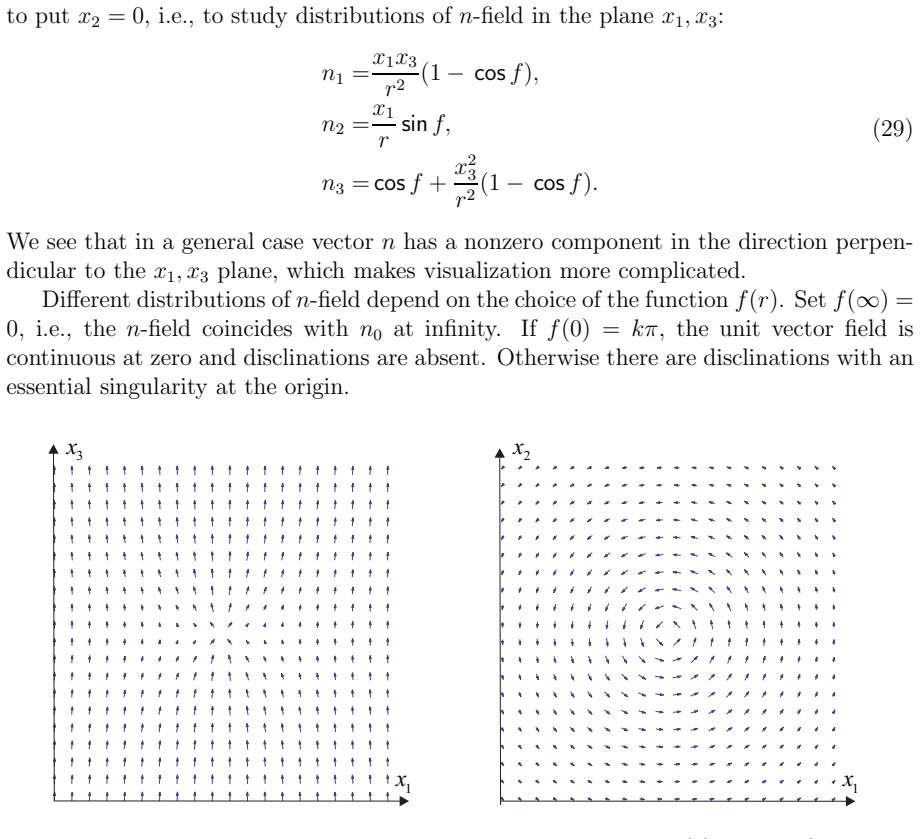
- With a fixed vector at infinity, the explicit formulas (27)-(29) give a directly visualizable point disclination; the example $f=\frac{\pi}{2}e^{-r}$ is shown twisting out of the plane in two sections.
Reading between the lines
- Because the classification rests on the three-term ansatz (6), one could test completeness by deriving all spherically symmetric invariant tensor structures for an SO(3) connection from first principles; a fourth structure that solves $F=0$ would enlarge the family (16).
- The arbitrary function $f(r)$ means point disclinations form an infinite-dimensional family; a natural follow-up is to ask which profiles $f(r)$ are selected by an energetic or dynamical model of a real medium.
- The same flatness condition with a substituted ansatz suggests a route to regularized cores: replacing the essential singularity by a constant-curvature region inside a small radius would produce a nonsingular 'monopole-like' model of a point defect.
Signed reviews
Editorial analysis
A structured set of objections, weighed in public.
Referee Report
Summary. The paper studies point disclinations in the geometric theory of defects using a Chern–Simons action for an SO(3) connection on Euclidean R^3. With the vielbein taken to be flat, the equilibrium equations reduce to zero-curvature equations for the connection. The authors derive the most general spherically symmetric flat SO(3) connection, obtaining the one-parameter family in Eq. (16) with an arbitrary function f(r). They reconstruct the corresponding orthogonal matrix S by path-ordered integration along rays from infinity, given in Eq. (24), and compute the associated unit n-field in Eqs. (27)–(29). They analyze when the n-field is continuous at the origin, claim that f(0)=kπ gives continuity, and present two examples: the hedgehog disclination and a point disclination with f(r)=(π/2)e^{-r}.
Significance. The derivation of the flat-connection family is self-contained and largely correct: the ODE system (9)–(11) is reduced correctly to a single arbitrary function, and the path-ordered integration argument leading to Eq. (22) is sound, including the verification that the relevant matrices commute. The paper therefore provides an explicit, parameter-free (in the sense of containing only one arbitrary function) family of flat spherically symmetric SO(3) connections and demonstrates the reconstruction of the n-field for point disclinations. The main technical flaw is in the boundary classification: the condition f(0)=kπ for continuity of the n-field is wrong for odd multiples of π, which affects the physical interpretation of which member functions describe disclinations. The ansatz (6) is asserted without proof, but it is in fact the correct invariant form under the simultaneous rotation action; this needs to be made explicit to support the claim of generality. Overall, the paper is of interest to the defects-and-gauge-theory community and the central construction is valuable, but the stated classification of regular versus singular origins requires correction.
major comments (2)
- [§2.2, after Eq. (27)] The claimed necessary-and-sufficient condition f(0)=kπ for a continuous n-field at the origin is incorrect for odd k. If f(0)=(2m+1)π, then as r→0, cos f→−1 and (1−cos f)→2, so the terms x_i x_j/r^2 in Eq. (27) retain direction-dependent limits. For example, with f(r)=π e^{−r}, approaching the origin along the positive x3-axis gives n→(0,0,1), while approaching along the x1-axis gives n→(0,0,−1). Thus the n-field is discontinuous for odd multiples of π as well, and a disclination remains. The correct condition for continuity of the n-field at the origin is f(0)=2πm, m∈Z. This affects the sentence 'This is the exceptional case, when n-field is continuous at zero, and disclinations do not appear' and the corresponding classification statements in §2.2 and the Conclusion.
- [§2, Eq. (6)] The assertion that (6) is the most general spherically symmetric SO(3) connection is load-bearing for the classification but is not proved. Under the simultaneous action defined before (6), the three terms are indeed the invariant tensor structures (the identity, the radial projector x_μ x_i/r^2, and the skew-symmetric map ε_{μ i j} x^j), so the ansatz is correct; however, this justification should be stated explicitly in the paper. Without it, the word 'most general' in the abstract and in the statement of Theorem 2.1 is not fully supported by the presented argument.
minor comments (4)
- [Proof of Theorem 2.1] The text states 'The inequality |K| ≤ 0 is necessary and sufficient'; this should read '|K| ≤ 1'.
- [Figure 2 caption and Example two] The caption for Figure 2 specifies f(r):=π e^{−r/2}, while the text of 'Example two' defines f(r):=(π/2)e^{−r}. These should be made consistent.
- [Introduction and §2.2] There are minor grammar issues such as 'Bellow Latin indices' (should be 'Below') and 'The inverse statement may be not true' (should be 'may not be true'); these should be corrected in a final revision.
- [§2.2, Eq. (27)] The use of lowered coordinate indices for n_i while other expressions use upper indices is a notational choice, but the paper should explicitly state the convention once for clarity, since Eqs. (27)–(29) mix upper and lower indices in the same formulas.
Circularity Check
No circularity: the spherically symmetric flat-connection classification follows from direct algebra on the curvature equations, not from its own conclusion.
full rationale
The paper's central derivation is self-contained. The Chern-Simons action yields the zero-curvature equilibrium equations (3), and the spherically symmetric ansatz (6) leads to the curvature components (7)-(8). Setting these to zero gives the ODE system (9)-(11). Theorem 2.1 then solves that system algebraically: adding (9) and (10) gives V^2 = (1-K^2)/r^2, which fixes K = cos f and V = ± sin f/r, after which (10) gives U = ±(r f' - sin f)/r, and (11) is verified identically. No fitted parameter is renamed as a prediction; the arbitrary function f(r) parameterizes the solution family and is not determined by any output quantity. The reconstruction of the orthogonal matrix S by path-ordered integration (19)-(23) is likewise independent of the conclusion. Citations to earlier work by the authors [1]-[4] provide background and the Chern-Simons motivation, but the load-bearing classification is derived in the present paper rather than imported from those references. The ansatz (6) is an assumption about the invariant tensor structures available for a spherically symmetric connection; if that assumption were incomplete, the classification would be incorrect, but that is a mathematical completeness concern, not circularity. Likewise the paper's boundary statement that f(0)=kπ gives a continuous n-field may be mathematically questionable for odd multiples of π, but that issue concerns the validity of a claimed physical criterion, not a reduction of the derivation to its own inputs. Overall, the derivation does not rely on self-definition, fitted inputs, or self-citation chains, so the circularity score is 0.
Assumptions & free parameters
free parameters (1)
- arbitrary function f(r) =
not fitted to data; chosen by hand in examples (e.g., π/2 e^{-r})
assumptions (4)
- standard math R^3 \ {0} is simply connected, so every flat SO(3) connection is pure gauge on that domain.
- domain assumption The vielbein is Euclidean, e_μ^i = δ_μ^i, so elastic stresses are absent and all defect structure is carried by the SO(3) connection.
- domain assumption The Chern-Simons action (2) is the correct effective action for single disclinations, producing zero-curvature equations (3) outside the core.
- ad hoc to paper The most general spherically symmetric SO(3) connection has the form (6).
Cite this review
Pith. "Pith review of Point disclinations in the Chern-Simons geometric theory of defects." pith.science (2026). https://pith.science/paper/G76C7DMH
@misc{pith2026190808473,
  author       = {Pith},
  title        = {Pith review of: Point disclinations in the Chern-Simons geometric theory of defects},
  year         = {2026},
  howpublished = {\url{https://pith.science/paper/G76C7DMH}},
  note         = {Machine review of arXiv:1908.08473}
}
read the original abstract
We use the Chern-Simons action for a SO(3)-connection for the description of point disclinations in the geometric theory of defects. The most general spherically symmetric SO(3)-connection with zero curvature is found. The corresponding orthogonal spherically symmetric SO(3) matrix and n-field are computed. Two examples of point disclinations are described.
Figures

Reference graph
Works this paper leans on
-
[1]
M. O. Katanaev and I. V. Volovich. Theory of defects in solids and three-dimensional gravity. Ann. Phys. , 216(1):1–28, 1992
work page 1992
-
[2]
M. O. Katanaev. Geometric theory of defects. Physics – Uspekhi , 48(7):675–701, 2005. https://arxiv.org/abs/cond-mat/0407469
work page Pith review arXiv 2005
-
[3]
M. O. Katanaev. Geometric methods in mathematical physics. Ve r. 3, 2016. arXiv:1311.0733 [math-ph][in Russian]
work page Pith review arXiv 2016
-
[4]
M. O. Katanaev. Chern-Simons term in the geometric theory of d efects. Phys. Rev. D , 96:84054, 2017. https://doi.org/10.1103/PhysRevD.96.084054 https://arxiv.org/abs/1705.07888 [gr-qc]
work page Pith review arXiv 2017
-
[5]
S. S. Chern and J. Simons. Characteristic forms and geometric in variants. Annals Math., 99(1):48–69, 1974
work page 1974
- [6]
-
[7]
A. M. Polyakov. Particle spectrum in the quantum field theory. JETP Letters , 20(6):194–195, 1974
work page 1974
-
[8]
M. Eisenberg and R. Guy. A Proof of the Hairy Ball Theorem. The Americal Mathe- matical Monthly, 86(7):571–574, 1979. 10
work page 1979
Reviewed August 14, 2026 · model on record in the stance chip above.
Discussion (0). Continue with ORCID to comment.