REVIEW 5 major objections 3 minor 13 references
The paper argues that LLM agents need structured, conflict-checked memory graphs, not flat append-only stores, to reason reliably over long conversations.
Reviewed by Pith at T0; open to challenge. T0 means a machine referee read the full paper against a public rubric. the ladder, T0–T4 →
MOSAIC claims big gains in agent memory accuracy from graph storage and conflict checks, but the gains are not cleanly supported: baselines ran on different base models and one Long-benchmark row is merged from separate runs.
T0 review reviewed 2026-08-02 challenge →
load-bearing objection Good idea, uncontrolled comparison: MOSAIC's headline LoCoMo gain is uninterpretable until baselines are rerun with the same base model and a graph-ablated control is added. the 5 major comments →
Accurate and Efficient Long-Term Memory for LLM Agents
The pith
A machine-rendered reading of the paper's core claim, the machinery that carries it, and where it could break.
The reading
Core claim
On the paper's own terms, the central discovery is that memory organization and validation, rather than raw retrieval or prompt length, are what make long-term agent memory reliable. The framework's edge is threefold: an entity-typed graph with typed edges preserves relational and temporal structure; a neighbor-conditioned stability principle localizes re-scoring to changed neighborhoods so updates stay cheap; and an active conflict-detection step at save time cross-references each new entity against graph neighbors, resolving contradictions before they enter storage. The paper reports that this design achieves 89.35% overall accuracy on the long-conversation QA benchmark, 27.21 percentage p
What carries the argument
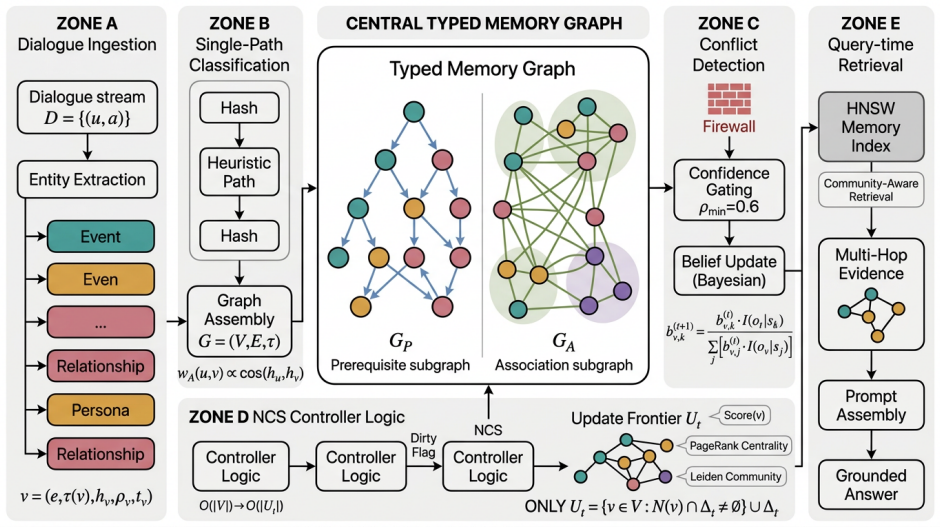
The load-bearing mechanism is the typed memory graph: entities (events, personas, relationships) as nodes, with a prerequisite subgraph capturing logical dependencies and an association subgraph capturing semantic relatedness. On top of it, the neighbor-conditioned stability principle states that a node's score needs recomputation only when a graph neighbor changes, implemented as dirty flags; this keeps per-turn cost bounded by the maximum neighborhood size and gives a convergence guarantee. The other two pillars are hash-accelerated dual-path retrieval, which replaces LLM-based classification with locality-sensitive hashing, and save-time conflict detection, which compares each new entity
Load-bearing premise
The central claim rests on the assumption that published baseline results are comparable to MOSAIC's runs, even though MOSAIC uses a newer, stronger base model; if the base-model gap accounts for the accuracy difference, the 27-point advantage collapses.
What would settle it
Run the strongest flat-memory baselines whose numbers are cited in the paper on the same long-conversation QA benchmark with the exact same base LLM, judge, and extraction prompts as MOSAIC; if those flat stores then also reach roughly 89% accuracy, the paper's claim that graph structure and conflict detection drive the gains is refuted, while if they stay near 62% the claim survives.
If this is right
- If the long-conversation QA result holds, replacing flat memory stores with typed graphs yields the biggest gains on multi-hop and temporal questions, where relations and ordering must be cross-referenced.
- If the conflict-detection result holds, memory systems in safety-critical domains such as clinical, legal, and financial work should treat ingestion-time validation as a first-class requirement; catching 66% of injected errors at write time prevents them from contaminating later retrieval and reasoning.
- If the hash-accelerated retrieval result holds, the accuracy benefits of structured memory can be delivered at near-interactive latency, making the design feasible for deployed agents.
- If the neighbor-conditioned stability convergence theorem holds, memory re-scoring costs stay bounded by neighborhood size rather than total memory size, so the framework remains efficient as the graph grows.
- The analysis of missed conflicts implies that roughly 60% of undetected contradictions lie beyond the nearest-neighbor search radius and 40% are numerically plausible, pointing to concrete extensions of the conflict-checking mechanism.
Where Pith is reading between the lines
- A testable extension is to isolate the contribution of conflict detection from that of graph structure by ablating each component under the same base LLM; the paper does not present such an ablation.
- The neighbor-conditioned stability principle could transfer to other stateful agent designs, such as task-state tracking in information-gathering dialogues, where re-planning only the affected local subproblem may yield similar efficiency gains.
- If the 66% detection rate generalizes beyond hypertension guidelines, conflict-aware memory graphs may serve as a lightweight audit layer, flagging contradictions for human review rather than silently resolving them.
- The reported baseline comparison is not apples-to-apples on base models; a fair head-to-head with baselines running on the same model and judge would tell whether the 27-point gap comes from structure and conflict detection or from model strength.
Editorial analysis
A structured set of objections, weighed in public.
Referee Report
Summary. The paper proposes MOSAIC, a structured, conflict-aware long-term memory framework for LLM agents. It stores memory as an entity-typed graph with prerequisite and association subgraphs, uses hash-accelerated dual-path retrieval to avoid LLM-based classification, and performs active conflict detection at save time by checking new entities against graph neighbors. The authors evaluate MOSAIC on LoCoMo long-conversation QA, HaluMem memory-pipeline benchmarks, and a newly constructed hypertension-guideline error-compounding test. They report 89.35% LoCoMo accuracy (+27.21 pp over Mem0), state-of-the-art HaluMem extraction F1 and QA correctness, 66% conflict detection (vs. 14% for the best baseline), and 0.58 s average retrieval latency. They also present neighbor-conditioned stability (NCS) as a theoretical principle and state two convergence theorems.
Significance. If the empirical claims held, the paper would make a meaningful contribution to LLM-agent memory: it attacks a real problem (silent accumulation of contradictions), proposes a concrete architecture (typed graph storage plus ingestion-time conflict checking), and introduces a useful new evaluation (error-compounding test). The hash-accelerated retrieval is a sensible engineering idea, and the latency measurement is a strength. However, the headline accuracy and conflict-detection claims are not supported by the evidence as presented: baselines are quoted from prior publications using different base LLMs, one HaluMem row is an explicit merge of two runs, and the conflict-detection benefit is not isolated from the underlying LLM judge. The theoretical theorems are stated without proof and appear inconsistent with the implemented scoring function. The central claim that graph structure, rather than the underlying model, drives the gains is therefore unverified.
major comments (5)
- [§4.3, Table 1] The LoCoMo comparison is uncontrolled. MOSAIC uses qwen3.5-plus-2026-02-15, while all baseline rows are quoted verbatim from the Mem0 paper (GPT-4-era models). No same-model baseline is run, and no error bars are given. The +27.21 pp gain over Mem0 cannot be attributed to graph structure or conflict detection; it may reflect the base LLM's extraction/reasoning ability. A matched-model rerun of at least Mem0 and Mem0-Graph under MOSAIC's LLM is required before the central claim can be assessed.
- [Table 2 note] The HaluMem-Long MOSAIC row merges extraction and update metrics from an 'archived full long run' with QA metrics from a 'latest refreshed long answer run.' This is not a single frozen configuration, so it is not comparable to the baseline rows, which were produced by one pipeline. Claims of 'best QA correctness' (70.75%) and 'best extraction F1' (85.84%) on Long therefore lack a valid comparison basis. The same issue is acknowledged in the Discussion, but the table still presents the merged row as if it were a comparable result.
- [§5.3, §3.5] The 66% conflict-detection rate is produced by an LLM conflict-assessor that reads the new entity and its graph neighbors. Without a control condition that runs the same LLM assessor over a flat store (or over an ablated MOSAIC without graph neighbor retrieval), the graph's contribution is unidentified. The benchmark is also authored by the same team; that is not disqualifying, but it strengthens the need for an ablation with an existing baseline. As written, the result demonstrates that a strong LLM with access to a small candidate set can flag many contradictions, not that MOSAIC's graph is the causal factor.
- [§3.4, §3.9, Eq. (1)] Theorems 1 and 2 are stated without proof, and Theorem 2 appears inconsistent with the implemented scoring function. NCS (Definition 2) requires that Score(v) depend only on the neighborhood N(v). However, Eq. (1) includes T(v), the precomputed PageRank centrality in GA, which is a global graph property. PageRank of a node depends on the entire graph structure, not just its immediate neighbors. Therefore the NCS guarantee does not hold for the score implemented in Eq. (1), and the claimed O(Δ_max) per-turn update bound is unsupported. A proof or a corrected scoring function is needed.
- [§1, §3.7, §5] The abstract and Introduction claim that hash-accelerated retrieval achieves 'near-instantaneous lookup with negligible accuracy loss,' but no experiment compares the hash path against the LLM-classification path in terms of downstream QA or extraction accuracy. The only latency figure (0.58 s) is reported without a baseline. Without such a comparison, the 'negligible accuracy loss' claim is an assertion, not a measured result.
minor comments (3)
- [Table 1] Column header 'T emp.' should be 'Temp.'; 'Open' should be 'Open-domain' for readability. Also, the per-category N values in the header row are helpful; consider adding them to the caption of Table 2 as well.
- [§3.8] The text says default m=5 and then §4.3 says top-m=5; this is consistent, but the parameter list in §3.8 is not tied to the experiments. Consider a table of all hyperparameters with values and any sensitivity analysis.
- [§5.2] The arrows in Table 2 are not all self-explanatory: for 'FMR' (false memory rejection), the '↑' in the header conflicts with the fact that lower false-memory rejection is better? Clarify the direction conventions in the caption or in the text.
Circularity Check
No circularity found; reported gains are empirical comparisons and limitations are confounds, not definitional reductions.
full rationale
MOSAIC's central results are empirical evaluations on LoCoMo, HaluMem, and an injected-conflict test; they are not derived from fitted parameters or from the paper's own definitions. The NCS principle is explicitly introduced as Definition 2, and its stated consequences are restatements of that definition rather than predictions claimed to be derived from first principles. Equation (1) is a stated design choice with fixed weights, not a parameter fitted to the reported evaluation quantities. The LoCoMo and HaluMem baseline rows are quoted from prior publications, and the error-compounding baselines are separately obtained with GPT-4o. The base-model mismatch between MOSAIC (qwen3.5-plus) and quoted GPT-4-era baselines is a serious threat to the validity of the +27.21 pp comparison, and the absence of a graph-ablated control weakens the causal attribution to graph structure, but these are correctness risks, not circular reductions. The paper also explicitly discloses that the HaluMem-Long row merges archived extraction/update metrics with a refreshed QA run, which is a measurement-consistency limitation rather than a circular step. Theorems 1 and 2 are asserted without proof, and the global PageRank term in Eq. (1) sits uneasily with the neighborhood-only NCS definition, but an unproved or internally inconsistent theorem is not a circularity. No step in the paper was found where a claimed prediction is equivalent by construction to its input, so the circularity score is 0.
Axiom & Free-Parameter Ledger
free parameters (6)
- association edge threshold θ =
0.4
- confidence gating threshold ρmin =
0.6
- scoring weights α, β, γ =
0.5, 0.3, 0.2
- top-m retrieval count m =
5
- entropy threshold δ (confirmed entity storage) =
not stated
- conflict-detection neighbor count k =
not stated
axioms (5)
- domain assumption Baseline results from prior publications are directly comparable to MOSAIC despite different base LLMs.
- ad hoc to paper The implemented scoring function in Eq. (1) satisfies neighbor-conditioned stability as defined in Definition 2.
- ad hoc to paper The prerequisite graph GP is acyclic (longest directed path L exists and is finite).
- domain assumption LLM-based conflict assessment provides a valid ground truth for contradiction detection.
- domain assumption LoCoMo/HaluMem metric definitions are applied identically across MOSAIC and cited baselines.
Cite this review
Pith. "Pith review of Accurate and Efficient Long-Term Memory for LLM Agents." pith.science (2026). https://pith.science/paper/GA5SAYXW
@misc{pith2026260716211,
  author       = {Pith},
  title        = {Pith review of: Accurate and Efficient Long-Term Memory for LLM Agents},
  year         = {2026},
  howpublished = {\url{https://pith.science/paper/GA5SAYXW}},
  note         = {Machine review of arXiv:2607.16211}
}
read the original abstract
LLM agents augmented with persistent memory can recall past interactions, but existing systems suffer from two limitations: flat, unstructured storage loses relational context needed for multi-hop and temporal reasoning, and reliance on expensive LLM-based classification makes them impractical for latency-sensitive deployment. Without mechanisms to validate new information against stored knowledge, these systems silently accumulate contradictions. We present MOSAIC (Memory-Organized Structured Agent for Information Collection), a structured, conflict-aware long-term memory framework for LLM agents that is substantially more accurate and efficient. MOSAIC introduces three key capabilities: (1) entity-typed graph storage with semantic classification preserving relational structure across events, personas, and relationships, enabling multi-hop and temporal reasoning over conversation history; (2) hash-accelerated dual-path retrieval replacing LLM-based classification with locality-sensitive hashing, achieving near-instantaneous lookup with negligible accuracy loss; and (3) active conflict detection at save time that cross-references new information against existing graph neighbors, triggering updates or deletions for contradictory entries. Evaluated on LoCoMo (long-conversation QA), HaluMem, and a novel clinical-guideline error compounding test, MOSAIC achieves 89.35% accuracy on LoCoMo (+27.21 pp over the best baseline), best HaluMem-Medium extraction F1(86.77%) and HaluMem-Long extraction F1 (85.84%), best QA correctness on both Medium and Long (73.10%, 70.75%), and detects 66% of injected factual conflicts-4.7 times higher than the best baseline (14%)-while hash-accelerated retrieval keeps average search latency at 0.58 s per question.
Figures


Reference graph
Works this paper leans on
-
[1]
Gpt-4 technical report.arXiv preprint arXiv:2303.08774,
Josh Achiam, Steven Adler, Sandhini Agarwal, Lama Ahmad, Ilge Akkaya, Florencia Leoni Aleman, Diogo Almeida, Janko Altenschmidt, Sam Altman, Shyamal Anadkat, et al. Gpt-4 technical report.arXiv preprint arXiv:2303.08774,
-
[4]
10 Darren Edge, Ha Trinh, Newman Cheng, Joshua Bradley, Alex Chao, Apurva Mody, Steven Truitt, Dasha Metropolitansky, Robert Osazuwa Ness, and Jonathan Larson. From local to global: A graph rag ap- proach to query-focused summarization.arXiv preprint arXiv:2404.16130,
-
[7]
Factscore: Fine- grained atomic evaluation of factual precision in long form text generation
Sewon Min, Kalpesh Krishna, Xinxi Lyu, Mike Lewis, Wen-tau Yih, Pang Koh, Mohit Iyyer, Luke Zettle- moyer, and Hannaneh Hajishirzi. Factscore: Fine- grained atomic evaluation of factual precision in long form text generation. InProceedings of the 2023 Con- ference on Empirical Methods in Natural Language Processing, pages 12076–12100,
2023
-
[9]
Zep: a temporal knowl- edge graph architecture for agent memory.arXiv preprint arXiv:2501.13956,
Preston Rasmussen, Pavlo Paliychuk, Travis Beauvais, Jack Ryan, and Daniel Chalef. Zep: a temporal knowl- edge graph architecture for agent memory.arXiv preprint arXiv:2501.13956,
-
[10]
Sentence-bert: Sen- tence embeddings using siamese bert-networks
Nils Reimers and Iryna Gurevych. Sentence-bert: Sen- tence embeddings using siamese bert-networks. InPro- ceedings of the 2019 conference on empirical methods in natural language processing and the 9th interna- tional joint conference on natural language processing (EMNLP-IJCNLP), pages 3982–3992,
2019
-
[13]
A-mem: Agentic memory for llm agents.arXiv preprint arXiv:2502.12110,
Wujiang Xu, Zujie Liang, Kai Mei, Hang Gao, Juntao Tan, and Yongfeng Zhang. A-mem: Agentic memory for llm agents.arXiv preprint arXiv:2502.12110,
-
[1966]
Halumem: Evaluating hallucinations in memory systems of agents.arXiv preprint arXiv:2511.03506,
Ding Chen, Simin Niu, Kehang Li, Peng Liu, Xiangping Zheng, Bo Tang, Xinchi Li, Feiyu Xiong, and Zhiyu Li. Halumem: Evaluating hallucinations in memory systems of agents.arXiv preprint arXiv:2511.03506,
-
[1978]
Memgpt: towards llms as operating systems.arXiv preprint arXiv:2310.08560,
Charles Packer, Vivian Fang, Shishir G Patil, Kevin Lin, Sarah Wooders, and Joseph E Gonzalez. Memgpt: towards llms as operating systems.arXiv preprint arXiv:2310.08560,
-
[2018]
Llama 2: Open foundation and fine-tuned chat models
11 Hugo Touvron, Louis Martin, Kevin Stone, Peter Albert, Amjad Almahairi, Yasmine Babaei, Nikolay Bashlykov, SoumyaBatra, PrajjwalBhargava, ShrutiBhosale, etal. Llama 2: Open foundation and fine-tuned chat models. arXiv preprint arXiv:2307.09288,
-
[2020]
Memos: A memory os for ai system.arXiv preprint arXiv:2507.03724,
Zhiyu Li, Chenyang Xi, Chunyu Li, Ding Chen, Boyu Chen, Shichao Song, Simin Niu, Hanyu Wang, Jiawei Yang, Chen Tang, et al. Memos: A memory os for ai system.arXiv preprint arXiv:2507.03724,
-
[2023]
Fever: a large-scale dataset for fact extraction and verification
James Thorne, Andreas Vlachos, Christos Christodoulopoulos, and Arpit Mittal. Fever: a large-scale dataset for fact extraction and verification. InProceedings of the 2018 Conference of the North American Chapter of the Association for Computa- tional Linguistics: Human Language Technologies, Volume 1 (Long Papers), pages 809–819,
2018
-
[2024]
Yunfan Gao, Yun Xiong, Xinyu Gao, Kangxiang Jia, Jin- liu Pan, Yuxi Bi, Yixin Dai, Jiawei Sun, Haofen Wang, Haofen Wang, et al. Retrieval-augmented generation for large language models: A survey.arXiv preprint arXiv:2312.10997, 2(1):32,
-
[2025]
Prateek Chhikara, Dev Khant, Saket Aryan, Taranjeet Singh, and Deshraj Yadav. Mem0: Building production- ready ai agents with scalable long-term memory.arXiv preprint arXiv:2504.19413,
This paper was first reviewed by deepseek-v4-flash on August 2, 2026.
discussion (0)
Sign in with ORCID, Apple, or X to comment. Anyone can read and Pith papers without signing in.