REVIEW 2 major objections 4 minor 1 cited by
Combinatorial index formulas for Lie algebras of seaweed type
T0 review · 2 major / 4 minor · reviewed 2026-08-14 · deepseek-v4-flash
Pith's one-line read For a type-D seaweed algebra, the index equals 2C + P-tilde, where C counts cycles and P-tilde counts tail-meeting paths in the meander.
desk verdict Valuable type-D meander program with a repairable proof gap and a false Frobenius criterion; deserves refereeing but needs a major revision. read the letter →
The pith
A machine-rendered reading of the paper's core claim, the machinery that carries it, and where it could break.
The reading
What carries the argument
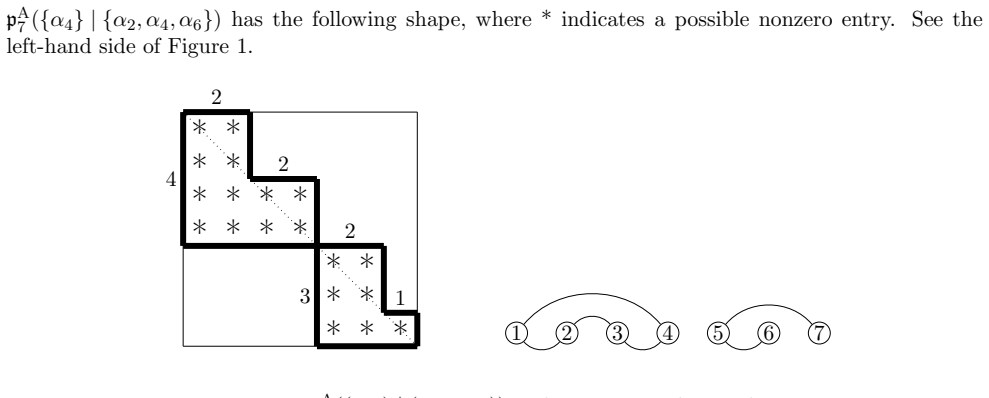
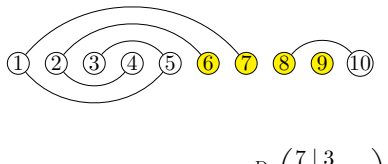
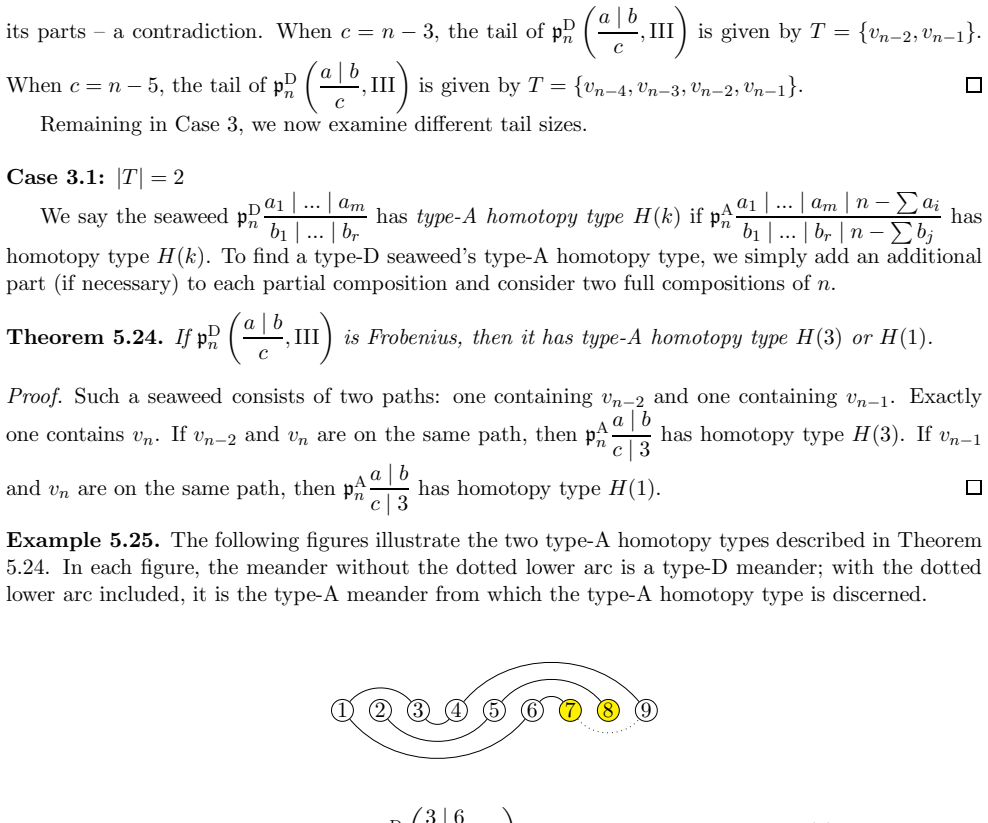
The load-bearing object is the meander, a planar graph whose top edges are laid out according to one composition and bottom edges according to the other, so that each vertex is incident with at most one edge of each kind and the graph decomposes into cycles and paths. For type D the paper adds a distinguished set of vertices, the tail $T_n^D(a|b)$, defined by the difference between the two composition lengths and taking one of three configurations depending on parity and on whether the first composition sums to $n$. The index formulas count cycles and tail-meeting paths of this graph, and the closed-form results additionally use the winding-down moves and homotopy types that reduce a meander to a sequence of component eliminations, together with the observation that in one-parameter cases the relevant permutation is generated by a single difference $\Delta$.
What would settle it
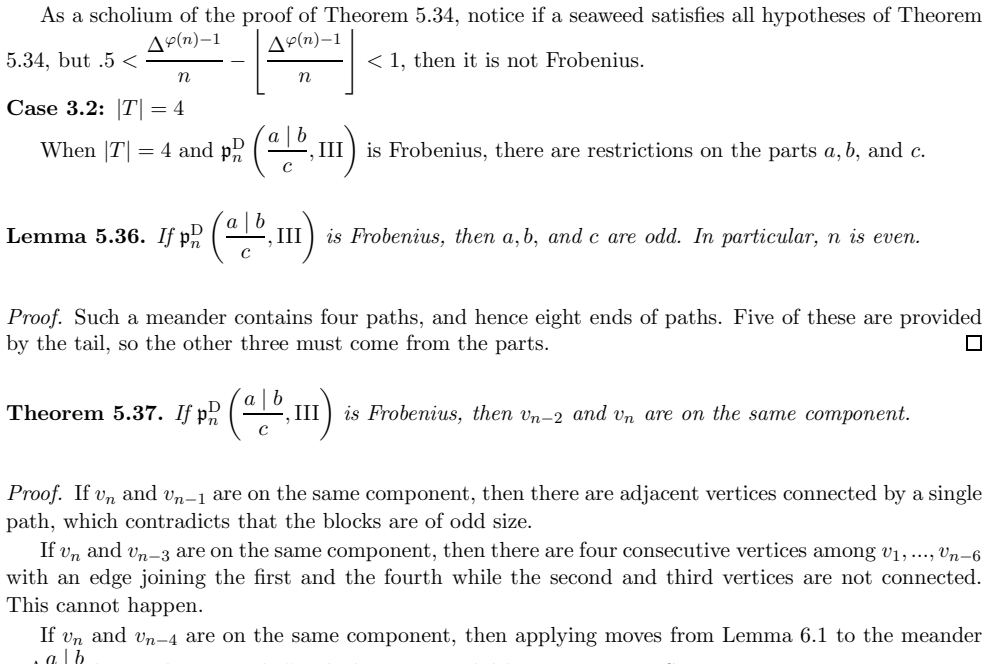
Take the paper's own example $p^D_{14}((5|9)/(9), III)$, whose meander has index zero. With the representative 5 for $\Delta/2 \bmod 7$, the fractional part in Theorem 5.38 is $5^5/14 \approx 0.214$, matching the Frobenius verdict; the congruent representative 12 gives $12^5/14 \approx 0.714$, which would declare the same algebra non-Frobenius. Any convention that fixes representatives must choose the first value, and a direct index calculation on any example where the two representatives straddle 1/2 settles whether the stated condition is correct.
Extended reading notes
Core claim
The paper's central discovery is a graph-theoretic formula for the index of a type-D seaweed subalgebra of $so(2n)$, stated as Theorem 5.10: if $M_n^D(a|b)$ is the meander built from the two partial compositions $a$ and $b$, and $T$ is the associated tail, then $\operatorname{ind} p_n^D(a|b) = 2C + \tilde P$, where $C$ is the number of cycles in the meander and $\tilde P$ is the number of path components containing either zero or two vertices of $T$. Equivalently, the index counts cycles of the top-bottom permutation containing zero or two tail elements. From this base formula the paper derives explicit greatest-common-divisor and congruence tests for Frobenius seaweeds, including the one-part closed forms and the three-part classifications, and proves that four-part seaweeds with a proper second parabolic cannot have their index given by any polynomial gcd formula. It also reduces non-seaweed-shaped type-D seaweeds to seaweed-shaped ones, with the index changing by zero or two, and identifies Frobenius examples among them with type-A meanders of homotopy type $H(2)$.
Load-bearing premise
The Frobenius classification for the four-tail case in Theorem 5.38 depends on treating $\Delta/2$, which is only defined modulo $n/2$, as a concrete integer when forming the fractional part in the theorem's condition; different representatives of the same residue class can change the verdict.
Editorial extensions
If this is right
- A type-D seaweed is Frobenius exactly when its meander is a forest rooted in the tail, so index-zero algebras can be recognized by looking at the picture.
- Tail configuration II can never be Frobenius, so the search for Frobenius algebras reduces to configurations I and III.
- For one-part and three-part seaweeds, index and Frobenius status are decided by gcds and congruence or fractional-part conditions on the part sizes.
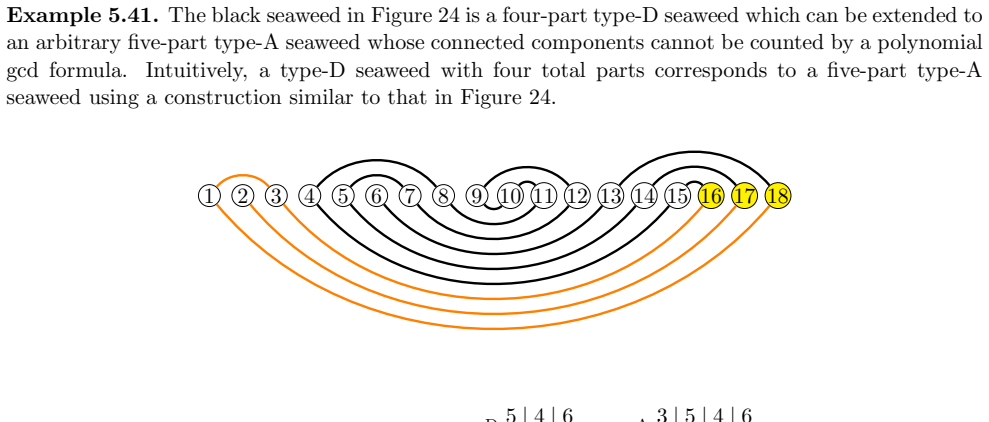
- Four-part seaweeds with a proper second parabolic admit no polynomial gcd index formula, so the list of closed forms is complete at four parts.
- Seaweeds without seaweed shape have index equal to that of a seaweed-shaped cousin, or that value minus two, and the Frobenius ones correspond exactly to type-A meanders of homotopy type $H(2)$.
Reading between the lines
- The fractional-part tests in the paper can be read as a comparison of two modular inverses; this suggests they are checkable by fast modular exponentiation once a representative of $\Delta/2$ is fixed, giving a polynomial-time Frobenius test for one-parameter type-D seaweeds.
- The standard reduction from type C to type B suggests that the same tail formula should yield gcd and congruence classifications for the odd orthogonal family $so(2n+1)$, which the paper does not tabulate explicitly.
- The switch relating non-seaweed-shaped and seaweed-shaped algebras points to an algorithm that needs only the Dynkin subsets, not the matrix realization: replace the exceptional root, compute the seaweed-shaped index, and adjust by 0 or 2 according to whether two specified vertices lie on a path or a cycle.
Signed reviews
Editorial analysis
A structured set of objections, weighed in public.
Referee Report
Summary. The paper develops meander-theoretic index formulas for seaweed subalgebras of so(2n), in parallel with earlier work in types A, B, and C. The authors introduce type-D meanders and a type-D tail with three configurations, prove a combinatorial formula for the index (Theorem 5.10), and use it to derive explicit gcd-type closed formulas and a classification of Frobenius type-D seaweeds, including a negative result in the spirit of Karnauhova-Liebscher. The paper also treats type-D seaweeds without seaweed shape and shows their indices differ from those of associated seaweed-shaped algebras by a constant.
Significance. If correct, the paper would supply a complete tail-based calculus for type-D seaweeds and would advance the program, initiated by Dergachev-Kirillov and Coll-Hyatt-Magnant, of computing indices of seaweed algebras from meander combinatorics in all classical types. The explicit gcd formulas and the type-D analogue of the no-polynomial-gcd obstruction are useful and natural contributions. However, the current version contains a false classification theorem and an unproved reduction in the proof of the central index formula, so the significance is conditional on substantial repair.
major comments (2)
- [Theorem 5.38 and its proof, Section 5.4.3] The stated condition (ii) is not the condition proved. The proof compares residues modulo n/2: after the display beginning 'Let σ1 ...', the congruences are modulo n/2, and the Euler argument yields k1 and k2 modulo n/2. But condition (ii) of the theorem evaluates the fractional part of (Δ/2)^(φ(n/2)-1)/n, which is a statement modulo n. These are not equivalent. For a concrete counterexample, take n=22, a=5, b=17, c=17. Then gcd(a+b,b+c)=gcd(22,34)=2, and Δ=a-c≡10 (mod 22), so Δ/2=5; moreover (5^9)/22 has fractional part 9/22≈0.409<0.5, so the theorem's hypotheses hold. Yet the residue modulo 11 is 9, which is larger than 11/4, and the meander has index 2 rather than 0. Thus Theorem 5.38 is false as stated. The denominator in (ii), and in the scholium following the proof, should be n/2, and the proof must also handle the excluded residue n/4 explicitly.
- [Theorem 5.10, proof, Section 5.4.1] The reduction to the case ∑ai=n is asserted but not proved. Corollary 5.9 is a statement about the index ind, not about the statistic f=2C+P~ used in Theorem 5.10. For a type-D meander with ∑ai<n (tail configurations I with t even, II, and III), no argument is given that f(M^D_n(a|b)) equals the type-C statistic on the reduced data plus the appropriate constant k or k−1. The induction that follows starts only after the reduction, in the case ∑ai=n. This leaves a genuine family of cases unverified in the proof of the central formula. The gap may be repairable, for instance by an explicit edge-contraction lemma in the spirit of Lemma 6.1, but the current text does not supply it.
minor comments (4)
- [Proof of Theorem 5.34] The proof refers to 'equations (3) and (4)' when the displayed congruences are labeled (6) and (7).
- [Scholium after Theorem 5.38] The scholium repeats the modulus error, writing φ(n) instead of φ(n/2) and dividing by n; it should be corrected together with Theorem 5.38.
- [Corollary 5.9] There is a typo in the definition of t: the last summand is written as 'br' rather than 'bi', and the summation index should be made consistent.
- [Theorem 5.26] The word 'Futhermore' should be 'Furthermore'.
Circularity Check
No circular derivation: the type-D meander index formula is anchored in external inductive index formulas and prior graph-theoretic lemmas, with no input being renamed as a prediction.
full rationale
I walked the main derivation chain, focusing on Theorem 5.10 and the later gcd and Frobenius classifications. The proof of Theorem 5.10 reduces, via Corollary 5.9, to the case sum a_i = n and sum b_i <= n. Corollary 5.9 is not a restatement of the graph statistic 2C + P~; it is derived from the cited inductive formulas of Panyushev and Dvorsky (Theorems 5.6, 5.7, and 5.8), which are external results about the index, not about the meander statistic being proved. The inductive steps then compare f(G) with the index using those same external formulas and the graph-contraction moves of Lemma 6.1, cited from the authors' prior work [2]. That lemma is a parameter-free statement about meander moves; its assumptions do not include the target type-D index formula, so citing it is independent mathematical support rather than circularity. Similarly, Theorem 5.26 imports a homotopy-type characterization from [2], but that characterization concerns type-A meanders and gcd conditions, not the type-D index formula being established, and it is used after the central meander formula is already available. I find no place where a fitted parameter is later called a prediction, no quantity defined in terms of the target result, and no uniqueness claim used to force a choice that is itself the paper's conclusion. The known weak point is different: Theorem 5.10's proof does not explicitly justify the f-statistic analogue of Corollary 5.9 when sum a_i < n, and Theorem 5.38's modular condition is not well-defined as stated because Delta/2 is a residue class while the displayed real-number fractional part depends on a representative. These are correctness or completeness gaps, not circular reductions. Accordingly, the circularity score is 0.
Assumptions & free parameters
assumptions (4)
- domain assumption Any seaweed subalgebra is conjugate to a standard one, so index computations may be restricted to standard seaweeds p(Ψ|Ψ').
- standard math The type-C index formula ind = 2C + P~ with the type-C tail (Theorem 4.5) and the inductive index formulas of Panyushev and Dvorsky (Theorems 5.6-5.8) are correct.
- domain assumption The signature and homotopy-type machinery of Coll et al. (Lemma 6.1, Theorem 5.26) transfers from type-A meanders to type-D meanders.
- standard math Euler's totient theorem applies to Delta (or Delta/2) as an integer representative, so the multiplicative inverse is given by Delta^(phi(n)-1).
Cite this review
Pith. "Pith review of Combinatorial index formulas for Lie algebras of seaweed type." pith.science (2026). https://pith.science/paper/GA6JWFT3
@misc{pith2026190803105,
  author       = {Pith},
  title        = {Pith review of: Combinatorial index formulas for Lie algebras of seaweed type},
  year         = {2026},
  howpublished = {\url{https://pith.science/paper/GA6JWFT3}},
  note         = {Machine review of arXiv:1908.03105}
}
read the original abstract
Analogous to the types A, B, and C cases, we address the computation of the index of seaweed subalgebras in the type-D case. Formulas for the algebra's index can be computed by counting the connected components of its associated meander. We focus on a set of distinguished vertices of the meander, called the tail of the meander, and using the tail, we provide comprehensive combinatorial formulas for the index of a seaweed in all the classical types. Using these formulas, we provide all general closed-form index formulas where the index is given by a polynomial greatest common divisor formula in the sizes of the parts that define the seaweed.
Figures

Figures from the paper (25 more)










Forward citations
Cited by 1 Pith paper
-
The index of Lie poset algebras
For type-A Lie poset algebras from posets of height at most two, the paper gives closed-form index formulas, classifies the Frobenius cases, and proves they are absolutely rigid.
Reference graph
Works this paper leans on
-
[1]
A. Belavin and V. Drinfeld. Solutions of the Classical Ya ng-Baxter Equation for Simple Lie Algebras. Funktsional. Anal. i Prilozhen, 16:1–29, 1982
work page 1982
-
[2]
V. Coll, A. Dougherty, M. Hyatt, and N. Mayers. Meander Gr aphs and Frobenius Seaweed Lie Algebras III. Journal of Generalized Lie Theory and Applications, 11(2), 2017
work page 2017
-
[3]
V. Coll, A. Giaquinto, C. Magnant, et al. Meanders and Fro benius Seaweed Lie Algebras. Journal of Generalized Lie Theory and Applications, 5, 2011
work page 2011
-
[4]
V. Coll, M. Hyatt, and C. Magnant. Symplectic Meanders. Communications in Algebra, 45(11):4717–4729, 2017
work page 2017
-
[5]
V. Coll, M. Hyatt, C. Magnant, and H. Wang. Meander Graphs and Frobenius Seaweed Lie Algebras II. Journal of Generalized Lie Theory and Applications, 9(1), 2015
work page 2015
-
[6]
V. Dergachev and A. Kirillov. Index of Lie Algebras of Sea weed Type. J. Lie Theory, 10(2):331–343, 2000
work page 2000
- [7]
-
[8]
A. Dvorsky. Index of Parabolic and Seaweed Subalgebras o f so(2n). Linear Algebra and its Applications, 374:127–142, 2003
work page 2003
Show all 17 references
-
[9]
Elashvili
A. Elashvili. On the Index of Parabolic Subalgebras of Se misimple Lie Algebras. unpublished preprint, 1990
1990
-
[10]
Gerstenhaber and A
M. Gerstenhaber and A. Giaquinto. Boundary Solutions o f the Classical Yang-Baxter Equation. Letters in Mathematical Physics, 40(4):337–353, 1997
1997
-
[11]
Gerstenhaber and A
M. Gerstenhaber and A. Giaquinto. Graphs, Frobenius Fu nctionals, and the Classical Yang-Baxter Equation. arXiv:0808.2423, 2008
2008 arXiv
-
[12]
A. Joseph. On Semi-Invariants and Index for Biparaboli c (Seaweed) Algebras, I. J. Algebra, 305(1):487–515, 2006
2006
-
[13]
Karnauhova and S
A. Karnauhova and S. Liebscher. Connected Components o f Meanders: I. Bi-Rainbow Meanders. arXiv:1504.03099, 2015
2015 arXiv
-
[14]
Panyushev
D. Panyushev. Inductive Formulas for the Index of Seawe ed Lie Algebras. Moscow Mathematical Journal, 1(2):221–241, 2001
2001
-
[15]
Panyushev and O
D. Panyushev and O. Yakimova. On Seaweed Subalgebras an d Meander Graphs in Type C. Pacific Journal of Mathematics, 285(2):485–499, 2016
2016
-
[16]
Panyushev and O
D. Panyushev and O. Yakimova. On Seaweed Subalgebras an d Meander Graphs in Type D. Journal of Pure and Applied Algebra, 222(02):3414–3431, 2017
2017
-
[17]
Tauvel and R
P. Tauvel and R. W. Yu. Sur l’indice de Certaines Alebras de Lie. Annales de l’Institute Fourier, 54:1793–1810, 2004. 27
2004
Reviewed August 14, 2026 · model on record in the stance chip above.
Discussion (0). Continue with ORCID to comment.