REVIEW 3 major objections 5 minor 1 cited by
GDRQ: Group-based Distribution Reshaping for Quantization
T0 review · 3 major / 5 minor · reviewed 2026-08-14 · deepseek-v4-flash
Pith's one-line read Uniform quantization can hold near-full-precision accuracy at 2-bit weights and 4-bit activations if weights and activations are first reshaped into uniform-like distributions and each filter group learns its own quantization scale.
desk verdict A plausible engineering contribution with a clean BN-folding trick, but the ImageNet SOTA claim rests on a weak baseline, uncontrolled comparisons, and a sign error in Eq. 10 — worth refereeing, not accepting as is. read the letter →
The pith
A machine-rendered reading of the paper's core claim, the machinery that carries it, and where it could break.
The reading
What carries the argument
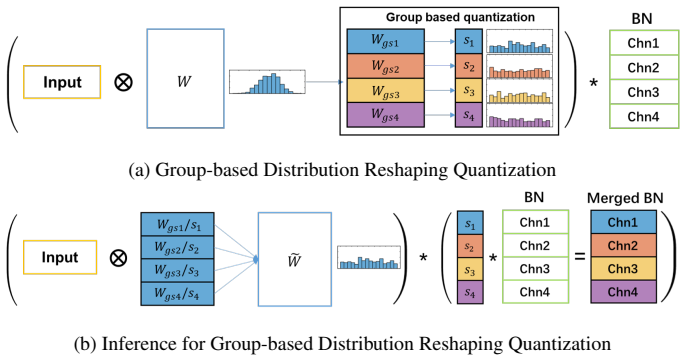
The load-bearing mechanism is the pair of Scale-Clip and Group-based Quantization. Scale-Clip is a distribution-reshaping constraint: values outside $\pm k \cdot \mathrm{mean}(|W|)$ are clipped, and when $k \approx 2$ an approximately uniform distribution emerges; for activations the threshold is updated online rather than re-estimated per batch. Group-based Quantization partitions filters into groups of size $g_s$ and solves $\alpha_l^* = \arg\min_\alpha \|G_l - Q(G_l;\alpha)\|_1 / \|W\|_1$ for each group, giving different quantization bins to different filters. Because each group's scale factor is folded into batch normalization at inference, the bit width and arithmetic stay uniform, and the model remains deployable on fixed-point hardware.
What would settle it
Run ResNet-50 on ImageNet with Scale-Clip reshaping but with one quantization scale per layer instead of per group; if 2-bit/4-bit accuracy drops more than the reported ~1 point, then the group mechanism, not distribution reshaping, is carrying the result. A second check is to measure the first-layer weight histogram after training with $k=2$: if it is not flatter than the unreshaped model's histogram, the claimed reshaping is not happening.
Extended reading notes
Core claim
The claim is that Gaussian- or Laplace-shaped weight distributions are the wrong target for uniform quantization: flatter, uniform-like distributions fit the fixed quantization bins with less quantization loss, and this shape can be induced during training without hurting the full-precision model. Scale-Clip does this by clipping each group of weights at $T_w = k \cdot \mathrm{mean}(|W|)$ with $k$ near 2, so outliers are trimmed and small values spread out, and by maintaining an activation threshold $T_a$ through the running update $T_a = T_a + \lambda(T_a - k \cdot \mathrm{mean}(|A|))$. Group-based Quantization then splits filters into groups, optimizes a separate clipping value $\alpha_l$ per group, and merges the per-group scales into the following batch-normalization layer, so inference adds no extra cost. The paper reports that this framework keeps the 2-bit/4-bit ResNet-50 within 0.9 points of its floating-point top-1 accuracy on ImageNet and keeps low-bit detection and segmentation accuracy nearly intact on PASCAL-VOC and Cityscapes.
Load-bearing premise
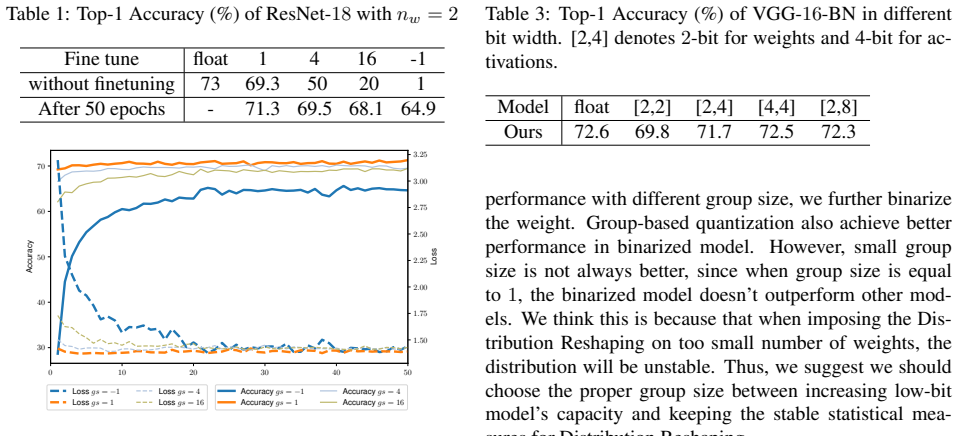
The load-bearing premise is that clipping a full-precision model's weights and activations to spread them evenly across the quantization bins (at roughly twice their average magnitude) leaves the model's accuracy intact; the paper's direct evidence for this premise comes from ResNet-18 on CIFAR-100, while the ImageNet results combine it with per-group quantization.
Editorial extensions
If this is right
- ResNet-50 with 2-bit weights and 4-bit activations keeps under 1% top-1 accuracy drop on ImageNet, so near-lossless low-bit classification is within reach.
- VGG-16-BN with 4-bit weights and 4-bit activations shows essentially no drop from its floating-point model, indicating 4-4 uniform quantization is practical on fixed-point hardware.
- Group-based quantization raises low-bit model capacity without consuming extra bits or extra inference compute, because per-group scales merge into batch normalization.
- The same framework transfers to detection and segmentation: a 2-bit/4-bit Faster R-CNN drops 0.7 mAP on PASCAL-VOC and a 2-bit/4-bit PSPNet drops 0.9 mIoU on Cityscapes.
- Uniform quantization remains FPGA-friendly, unlike non-uniform schemes that require lookup tables or special arithmetic.
Reading between the lines
- The paper validates reshaping alone on ResNet-18/CIFAR-100; a natural extension, not tested here, is an ImageNet ablation that turns Scale-Clip off while keeping group-based quantization, which would isolate how much of the <1% drop comes from redistribution rather than extra per-group capacity.
- The same fixed-bin mismatch that motivates Scale-Clip appears in quantized transformers, whose activations often have large outliers; testing a running-threshold reshaping there is a direct transfer of the paper's idea to another architecture family.
- Because per-group scales are folded into batch normalization, the method points toward co-designing quantization thresholds and normalization statistics in one end-to-end training pass, something the paper's two-stage fine-tuning procedure does not attempt.
Signed reviews
Editorial analysis
A structured set of objections, weighed in public.
Referee Report
Summary. The paper proposes GDRQ, a framework for low-bit uniform quantization that combines two ingredients: Scale-Clip distribution reshaping, which clips weights at k times their mean absolute value and uses a running threshold for activations to push the layer distribution toward uniform; and Group-based Quantization, which splits convolution filters into groups with per-group clipping/scaling factors that are merged into batch normalization at inference. The central claim is a new state of the art: ResNet-50 with 2-bit weights and 4-bit activations loses less than 1% top-1 accuracy on ImageNet, with additional experiments on VGG-16, Faster R-CNN on PASCAL-VOC, and PSPNet on Cityscapes.
Significance. If confirmed, the result would be practically significant because it promises near-full-precision accuracy at very low bit widths while keeping the hardware-friendly uniform quantization format and avoiding extra inference cost by folding group scaling into batch normalization. The paper has a genuine conceptual strength: the observation that uniform-like distributions reduce per-group quantization loss is supported by a simple and correct inequality in Eq. (12), and the derivation of the 2*mean(|W|) clipping threshold from the uniform-density calculation in Eqs. (5)-(7) is clean. However, the headline state-of-the-art claim currently rests on a floating-point baseline well below the standard ResNet-50 accuracy, on comparisons copied from other papers with different training protocols, and on an ImageNet-scale transfer of assumptions that are validated only on ResNet-18/CIFAR-100.
major comments (3)
- [Section 3.2, Eqs. (10)-(11)] The activation threshold update as written is inconsistent with its stated objective. For the objective in Eq. (11), the gradient of (1/2)||T - k*mean(|A|)||^2 with respect to T is (T - k*mean(|A|)), so the gradient-descent update should be T <- T - lambda*(T - k*mean(|A|)). The printed update has a plus sign, yielding T <- (1+lambda)*T - lambda*k*mean(|A|), which does not converge to k*mean(|A|) and may diverge. Because the activation reshaping mechanism is load-bearing for the reported ImageNet, detection, and segmentation results, this sign error must be corrected and the experiments rerun or the text must explain a different intended update.
- [Section 4.3, Table 4] The central state-of-the-art claim in the abstract is relative to a floating-point ResNet-50 baseline of 74.8%, which is below the standard reported accuracy of about 76.1% for ImageNet ResNet-50. The paper attributes this to improper multi-GPU training hyperparameters, but this means the '<1% accuracy drop' is measured from an unusually low baseline, and the comparisons to SYQ, FGQ, and DoReFa-Net are taken from other papers with different training protocols and baselines, so they are not controlled comparisons. The authors should retrain or report a standard ResNet-50 baseline, state the accuracy drop relative to that baseline, and either provide a controlled reimplementation of the comparison methods or clearly restrict the claim to their own training setup.
- [Section 4.1, Section 4.2, Section 4.3] The distribution-reshaping assumption is validated only on ResNet-18 with CIFAR-100, yet it is silently transferred to VGG-16 and ResNet-50 on ImageNet and to detection/segmentation backbones. Table 4 reports only the combined GDRQ result; there is no ImageNet ablation that isolates the effect of Scale-Clip, and no ablation of the group-size choice at ImageNet scale. If the reshaping constraint behaves differently for large-scale models or for the activation statistics of ImageNet, the reported accuracy levels would not follow. An ablation on ImageNet (with and without Scale-Clip, and with at least the group sizes used in the final model) is needed to support the transfer.
minor comments (5)
- [Section 4.1, Fig. 6] In the text after Fig. 6, 'The results are consistent with the results shown in Fig. 6(b)' should probably refer to Fig. 6(a), since the discussion is about quantized-loss before mentioning accuracy.
- [Table 2] The entries '0.1 0.1 0.1 0.1' and '-1.6 -1.4 -1.4 -1.7' are labeled as Top-1 Accuracy but appear to be accuracy drops relative to the float model; the table header and caption should be clarified.
- [Eq. (12)] The per-group quantization loss divides by ||W||_1, the norm of the full layer, while the numerator is the group loss; since the denominator is constant across groups, this is harmless, but the notation should be clarified to avoid implying a group-specific denominator.
- [Conclusion] The conclusion mentions experiments on 'COCO' and 'COCO' in the text, but the reported detection experiments are on PASCAL-VOC; the text should be corrected to match the experimental section.
- [References] Several references are incomplete or malformed, for example Ref. [13] 'C. J., W. Z., S. Venkataramani, C. P. I., S. V., and G. K.'; these should be reconstructed and checked.
Circularity Check
No significant circularity: the Scale-Clip and group-quantization derivations are self-contained, and the SOTA claim is benchmarked against external methods.
full rationale
The paper's derivation chain is not circular. Scale-Clip is motivated by an external, independently testable observation (Han et al.) that uniform distributions quantize better and by an explicit calculation (Eqs. 5-7) showing max(|W|) is approximately 2*mean(|W|) for a uniform distribution; the clipping rule T_w = k*mean(|W|) is an ansatz, not a fit to the reported accuracy. The group-quantization inequality in Section 3.3 is a genuine monotonicity property: splitting W into groups and choosing alpha_i per group can only lower the sum of per-group quantization losses relative to one common alpha, because each per-group minimizer is no worse than the common-alpha loss for that group. The ImageNet SOTA claim is tested against external methods (SYQ, FGQ, DoReFa), not derived from those methods. The validation in Section 4.1 independently varies k and measures both the quantization loss (Eq. 3) and the fine-tuned Top-1 accuracy, so the performance comparison is not forced by construction. The only self-citation is the PSPNet architecture reference [32], which is used as an external backbone and is not load-bearing for the quantization derivation. The one correctness concern, that the activation threshold update in Eq. 10 as written has a sign inconsistent with the stated minimization in Eq. 11, would affect reproducibility but does not constitute circularity, because the target T = k*mean(|A|) is not the paper's accuracy claim. Overall, the central claims are supported by independent experiments and external comparisons rather than by self-referential reasoning.
Assumptions & free parameters
free parameters (4)
- Scale-Clip factor k =
2 (default), candidates 2, 2.5, 3, 4
- Group size gs =
1 for CIFAR classification experiments; values 1, 4, 16, -1 explored; not stated for ImageNet experiments
- Activation update step size lambda =
not specified
- Per-group clipping thresholds alpha_l =
optimized per group via Eq. 12
assumptions (4)
- domain assumption Uniform-like distributions of weights and activations are more amenable to low-bit uniform quantization than Gaussian or Laplace-like distributions.
- domain assumption Forcing weights to a uniform-like distribution via clipping at k times the mean absolute value does not materially hurt full-precision model accuracy.
- domain assumption Quantization loss ||W - Q(W;alpha)|| / ||W|| is a reliable proxy for final task accuracy, and minimizing it per group improves the low-bit model.
- domain assumption The gradient through the quantizer can be obtained via straight-through estimation and the quantized network can be fine-tuned with standard SGD.
Cite this review
Pith. "Pith review of GDRQ: Group-based Distribution Reshaping for Quantization." pith.science (2026). https://pith.science/paper/GACLLFKN
@misc{pith2026190801477,
  author       = {Pith},
  title        = {Pith review of: GDRQ: Group-based Distribution Reshaping for Quantization},
  year         = {2026},
  howpublished = {\url{https://pith.science/paper/GACLLFKN}},
  note         = {Machine review of arXiv:1908.01477}
}
read the original abstract
Low-bit quantization is challenging to maintain high performance with limited model capacity (e.g., 4-bit for both weights and activations). Naturally, the distribution of both weights and activations in deep neural network are Gaussian-like. Nevertheless, due to the limited bitwidth of low-bit model, uniform-like distributed weights and activations have been proved to be more friendly to quantization while preserving accuracy~\cite{Han2015Learning}. Motivated by this, we propose Scale-Clip, a Distribution Reshaping technique that can reshape weights or activations into a uniform-like distribution in a dynamic manner. Furthermore, to increase the model capability for a low-bit model, a novel Group-based Quantization algorithm is proposed to split the filters into several groups. Different groups can learn different quantization parameters, which can be elegantly merged in to batch normalization layer without extra computational cost in the inference stage. Finally, we integrate Scale-Clip technique with Group-based Quantization algorithm and propose the Group-based Distribution Reshaping Quantization (GDQR) framework to further improve the quantization performance. Experiments on various networks (e.g. VGGNet and ResNet) and vision tasks (e.g. classification, detection and segmentation) demonstrate that our framework achieves good performance.
Figures


Figures from the paper (4 more)


Forward citations
Cited by 1 Pith paper
-
Evolution Strategy-Based Calibration for Low-Bit Quantization of Speech Models
Using CMA-ES to jointly optimize activation quantization scales keeps speech-model accuracy near full precision under full INT8 and INT4 quantization.
Reference graph
Works this paper leans on
-
[1]
G. I. e. a. Abadi M, Chu A. Deep learning with differential privacy. pages 308–318, 2016. 4
work page 2016
-
[2]
Z. Cai, X. He, J. Sun, and N. Vasconcelos. Deep learn- ing with low precision by half-wave gaussian quantization. arXiv preprint arXiv:1702.00953, 2017. 2, 7
arXiv 2017
-
[3]
J. Cheng, P.-s. Wang, G. Li, Q.-h. Hu, and H.-q. Lu. Re- cent advances in efficient computation of deep convolu- tional neural networks. Frontiers of Information Technology & Electronic Engineering, 19(1):64–77, 2018. 2
work page 2018
-
[4]
M. Courbariaux, I. Hubara, D. Soudry, R. El-Yaniv, and Y . Bengio. Binarized neural networks: Training deep neu- ral networks with weights and activations constrained to+ 1 or-1. arXiv preprint arXiv:1602.02830, 2016. 1, 2
arXiv 2016
-
[5]
J. Deng, W. Dong, R. Socher, L.-J. Li, K. Li, and L. Fei- Fei. Imagenet: A large-scale hierarchical image database. In Computer Vision and Pattern Recognition, 2009. CVPR
2009
-
[6]
E. L. Denton, W. Zaremba, J. Bruna, Y . LeCun, and R. Fer- gus. Exploiting linear structure within convolutional net- works for efficient evaluation. In Advances in neural infor- mation processing systems, pages 1269–1277, 2014. 1
work page 2014
-
[7]
J. Faraone, N. Fraser, M. Blott, and P. H. Leong. Syq: Learning symmetric quantization for efficient deep neural networks. In Proceedings of the IEEE Conference on Com- puter Vision and Pattern Recognition , pages 4300–4309,
-
[8]
Girshick
R. Girshick. Fast r-cnn. In Proceedings of the IEEE inter- national conference on computer vision , pages 1440–1448,
Show all 38 references
-
[9]
P. Gysel. Ristretto: Hardware-oriented approxima- tion of convolutional neural networks. arXiv preprint arXiv:1605.06402, 2016. 1, 2
2016 arXiv
-
[10]
S. Han, H. Mao, and W. J. Dally. Deep compres- sion: Compressing deep neural networks with pruning, trained quantization and huffman coding. arXiv preprint arXiv:1510.00149, 2015. 1, 2, 4, 5
2015 arXiv
-
[11]
S. Han, J. Pool, J. Tran, and W. J. Dally. Learning both weights and connections for efficient neural networks. pages 1135–1143, 2015. 1
2015
-
[12]
K. He, X. Zhang, S. Ren, and J. Sun. Deep residual learn- ing for image recognition. In Proceedings of the IEEE con- ference on computer vision and pattern recognition , pages 770–778, 2016. 1
2016
-
[13]
C. J., W. Z., S. Venkataramani, C. P. I., S. V ., and G. K. Pact: Parameterized clipping activation for quantized neural networks. arXiv preprint arXiv:1805.06085, 2018. 3, 4, 5
2018 arXiv
-
[14]
H. L., Z. R., and J. T. Kwok. Analysis of quantized models
-
[15]
J. Long, E. Shelhamer, and T. Darrell. Fully convolutional networks for semantic segmentation. In Proceedings of the IEEE conference on computer vision and pattern recogni- tion, pages 3431–3440, 2015. 1
2015
-
[16]
Mellempudi, A
N. Mellempudi, A. Kundu, D. Mudigere, D. Das, B. Kaul, and P. Dubey. Ternary neural networks with fine-grained quantization. arXiv preprint arXiv:1705.01462, 2017. 2
2017 arXiv
-
[17]
Mishra and D
A. Mishra and D. Marr. Apprentice: Using knowledge dis- tillation techniques to improve low-precision network accu- racy. arXiv preprint arXiv:1711.05852, 2017. 1
2017 arXiv
-
[18]
Miyashita, E
D. Miyashita, E. H. Lee, and B. Murmann. Convolu- tional neural networks using logarithmic data representa- tion. arXiv preprint arXiv:1603.01025, 2016. 2
2016 arXiv
-
[19]
L. Q. V . e. a. Neelakantan A, Vilnis L. Adding gradient noise improves learning for very deep networks. arXiv preprint arXiv:1511.06807, 2015. 4
2015 arXiv
-
[20]
Y . P., L. J., S. Zhang, O. S., Q. Y ., and X. J. Understanding straight-through estimator in training activation quantized neural nets. 2019. 3
2019
-
[21]
E. Park, J. Ahn, and S. Yoo. Weighted-entropy-based quan- tization for deep neural networks. In IEEE Conference on Computer Vision and Pattern Recognition (CVPR), 2017. 2, 8
2017
-
[22]
Rastegari, V
M. Rastegari, V . Ordonez, J. Redmon, and A. Farhadi. Xnor-net: Imagenet classification using binary convolu- tional neural networks. In European Conference on Com- puter Vision, pages 525–542. Springer, 2016. 2
2016
-
[23]
Redmon, S
J. Redmon, S. Divvala, R. Girshick, and A. Farhadi. You only look once: Unified, real-time object detection. In Pro- ceedings of the IEEE conference on computer vision and pattern recognition, pages 779–788, 2016. 1
2016
-
[24]
S. Ren, K. He, R. Girshick, and J. Sun. Faster r-cnn: To- wards real-time object detection with region proposal net- works. In Advances in neural information processing sys- tems, pages 91–99, 2015. 1
2015
-
[25]
Sze, Y .-H
V . Sze, Y .-H. Chen, T.-J. Yang, and J. S. Emer. Efficient processing of deep neural networks: A tutorial and survey. Proceedings of the IEEE, 105(12):2295–2329, 2017. 2
2017
-
[26]
K. Wang, Z. Liu, Y . Lin, J. Lin, and S. Han. Haq: Hardware-aware automated quantization. arXiv preprint arXiv:1811.08886, 2018. 3, 4
2018 arXiv
-
[27]
Wang and J
P. Wang and J. Cheng. Fixed-point factorized networks. In Computer Vision and Pattern Recognition (CVPR), 2017 IEEE Conference on, pages 3966–3974. IEEE, 2017. 2
2017
-
[28]
P. Wang, Q. Hu, Y . Zhang, C. Zhang, Y . Liu, J. Cheng, et al. Two-step quantization for low-bit neural networks. In Pro- ceedings of the IEEE Conference on Computer Vision and Pattern Recognition, pages 4376–4384, 2018. 1, 2
2018
-
[29]
B. Wu, Y . Wang, P. Zhang, Y . Tian, P. Vajda, and K. Keutzer. Mixed precision quantization of convnets via differentiable neural architecture search. arXiv preprint arXiv:1812.00090, 2018. 3
2018 arXiv
-
[30]
J. Wu, C. Leng, Y . Wang, Q. Hu, and J. Cheng. Quantized convolutional neural networks for mobile devices. In Pro- ceedings of the IEEE Conference on Computer Vision and Pattern Recognition, pages 4820–4828, 2016. 2
2016
-
[31]
P. Yin, S. Zhang, Y . Qi, and J. Xin. Quantization and train- ing of low bit-width convolutional neural networks for ob- ject detection. arXiv preprint arXiv:1612.06052, 2016. 8
2016 arXiv
-
[32]
H. Zhao, J. Shi, X. Qi, X. Wang, and J. Jia. Pyramid scene parsing network. In IEEE Conf. on Computer Vision and Pattern Recognition (CVPR), pages 2881–2890, 2017. 1
2017
-
[33]
A. Zhou, A. Yao, Y . Guo, L. Xu, and Y . Chen. Incremen- tal network quantization: Towards lossless cnns with low- precision weights. arXiv preprint arXiv:1702.03044, 2017. 1, 2
2017 arXiv
-
[34]
A. Zhou, A. Yao, K. Wang, and Y . Chen. Explicit loss- error-aware quantization for low-bit deep neural networks. In Proceedings of the IEEE Conference on Computer Vision and Pattern Recognition, pages 9426–9435, 2018. 2
2018
-
[35]
S. Zhou, Y . Wu, Z. Ni, X. Zhou, H. Wen, and Y . Zou. Dorefa-net: Training low bitwidth convolutional neural networks with low bitwidth gradients. arXiv preprint arXiv:1606.06160, 2016. 1, 2
2016 arXiv
-
[36]
Zhou, Y .-Z
S.-C. Zhou, Y .-Z. Wang, H. Wen, Q.-Y . He, and Y .-H. Zou. Balanced quantization: An effective and efficient approach to quantized neural networks. Journal of Computer Science and Technology, 32(4):667–682, 2017. 2
2017
-
[37]
C. Zhu, S. Han, H. Mao, and W. J. Dally. Trained ternary quantization. 2016. 1 9
2016
-
[2009]
Ieee, 2009
IEEE Conference on, pages 248–255. Ieee, 2009. 1 8
2009
Reviewed August 14, 2026 · model on record in the stance chip above.
Discussion (0). Continue with ORCID to comment.