REVIEW 1 major objections 2 minor 15 references
SABER achieves positive backward transfer in prompt-based continual learning by selective refinement of earlier prompts.
Reviewed by Pith at T0; open to challenge. T0 means a machine referee read the full paper against a public rubric. the ladder, T0–T4 →
T0 review · grok-4.3
2026-06-28 17:34 UTC pith:GB2TAK2K
load-bearing objection SABER combines prompt-gradient geometry with loss-distribution similarity to enable selective backward refinement in prompt continual learning, delivering claimed positive transfer on several backbones while staying replay-free. the 1 major comments →
Turning Back Without Forgetting: Selective Backward Refinement for Parameter-Efficient Continual Learning
The pith
A machine-rendered reading of the paper's core claim, the machinery that carries it, and where it could break.
Core claim
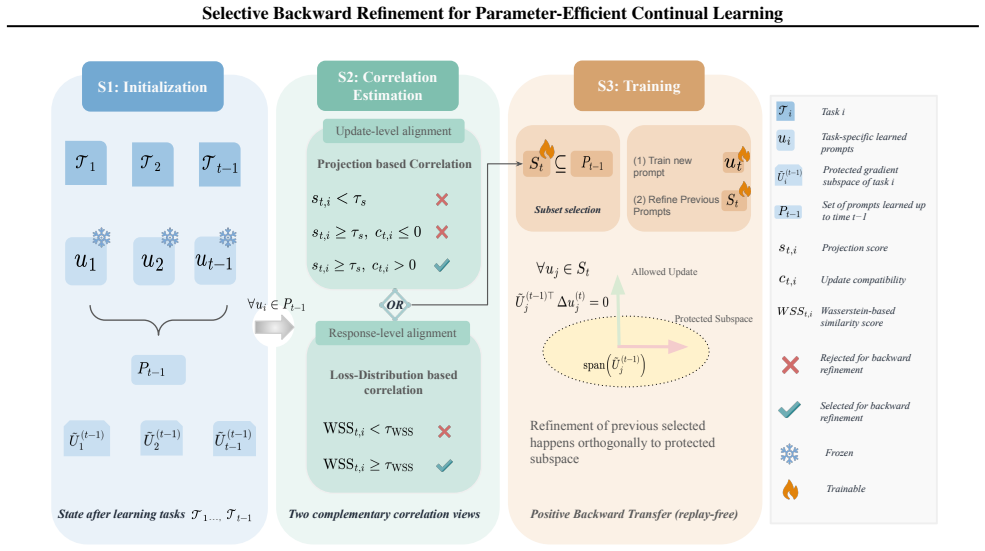
SABER is a replay-free framework that determines when backward refinement is beneficial using complementary task-correlation criteria based on prompt-gradient geometry and loss-distribution similarity, and performs the refinement safely by restricting updates to non-interfering directions in the prompt parameter space, thereby achieving positive backward knowledge transfer without introducing interference.
What carries the argument
SABER framework, which uses task-correlation criteria on prompt gradients and loss distributions to decide when and how to refine earlier prompts safely.
Load-bearing premise
Task-correlation criteria based on prompt-gradient geometry and loss-distribution similarity can reliably identify cases where backward refinement is beneficial and safe without interference.
What would settle it
A controlled experiment on one of the paper's benchmarks in which SABER produces negative backward transfer or measurable interference on earlier tasks compared to the no-refinement baseline.
If this is right
- Positive backward transfer occurs consistently across multiple continual learning benchmarks.
- Overall average performance remains strong on the same benchmarks.
- The approach works across diverse pretrained backbones including T5-Large, LLaMA, and Qwen.
- The method remains replay-free while enabling the new transfer direction.
Where Pith is reading between the lines
- The geometric and distributional criteria could be adapted to measure safe updates in other parameter-efficient continual learning methods beyond prompts.
- If the criteria generalize, they might reduce the need for full replay buffers in lifelong learning systems.
- Task correlations measured this way might also guide forward transfer decisions in the same framework.
Editorial analysis
A structured set of objections, weighed in public.
Referee Report
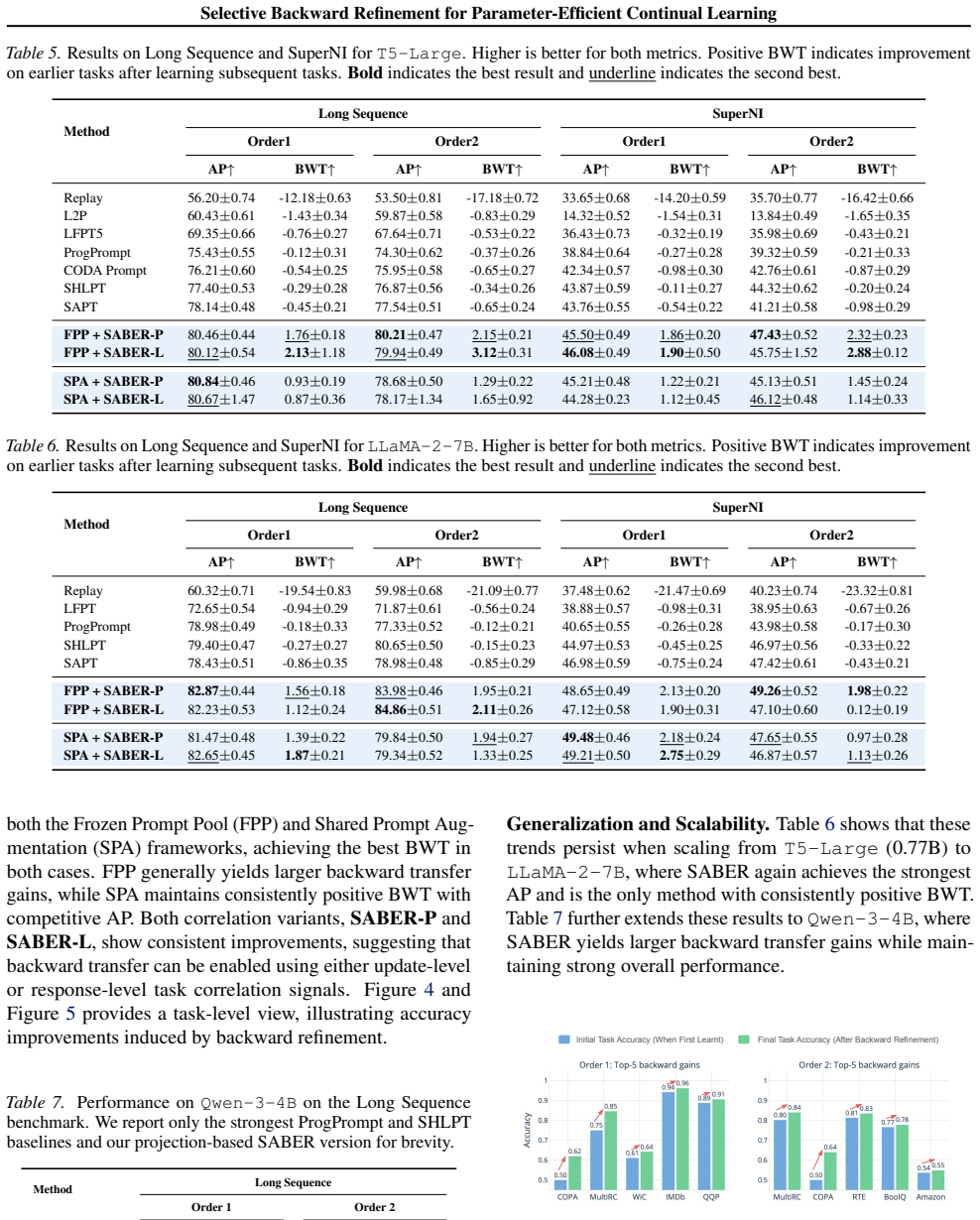
Summary. The paper proposes SABER, a replay-free framework for prompt-based parameter-efficient continual learning that enables controlled positive backward knowledge transfer. It determines when backward refinement is beneficial via complementary task-correlation criteria (prompt-gradient geometry and loss-distribution similarity) and performs it safely by restricting updates to non-interfering directions in prompt parameter space. Experiments across multiple continual learning benchmarks and backbones (T5-Large, LLaMA, Qwen) report that SABER achieves positive backward transfer while preserving strong average performance.
Significance. If the empirical results hold under rigorous controls, the work is significant because it addresses an underexplored limitation of prompt isolation in PECL—namely the inability of later tasks to improve earlier ones—without requiring replay buffers. The combination of geometric and distributional criteria plus directional restriction offers a principled, parameter-efficient mechanism for safe backward transfer, which could improve lifelong adaptation of large models. The public code release supports reproducibility.
major comments (1)
- [Experiments] Experimental section: the central claim of consistent positive backward transfer rests on reported performance numbers whose statistical reporting (standard deviations, number of random seeds, significance tests) and full baseline comparisons are not detailed enough in the provided material to rule out post-hoc selection or missing controls; this directly affects verification of the weakest assumption regarding the reliability of the correlation criteria.
minor comments (2)
- [Introduction] The abstract and introduction would benefit from a brief explicit statement of the precise mathematical form of the two correlation criteria and the non-interfering direction restriction (e.g., the projection or masking operation used).
- [Method] Notation for prompt parameters and gradient quantities should be introduced once and used consistently; occasional shifts between “prompt space” and “parameter space” reduce clarity.
Simulated Author's Rebuttal
We thank the referee for the positive evaluation of SABER's contribution to enabling controlled positive backward transfer in prompt-based continual learning. We address the single major comment on experimental reporting below and will incorporate the requested details in the revision.
read point-by-point responses
-
Referee: [Experiments] Experimental section: the central claim of consistent positive backward transfer rests on reported performance numbers whose statistical reporting (standard deviations, number of random seeds, significance tests) and full baseline comparisons are not detailed enough in the provided material to rule out post-hoc selection or missing controls; this directly affects verification of the weakest assumption regarding the reliability of the correlation criteria.
Authors: We agree that clearer statistical reporting strengthens verification of the correlation criteria. In the revised manuscript we will add: (i) explicit statement that all experiments were run with 5 independent random seeds; (ii) standard deviations for every reported metric in the main tables and appendix; (iii) paired t-test p-values comparing SABER against each baseline on the key backward-transfer and average-performance metrics; and (iv) an expanded baseline table that includes every method cited in the related-work section. These additions will be placed in Section 4 and the new Appendix C. The correlation criteria themselves were defined and fixed prior to any hyper-parameter search on the test sets, so the additional controls will directly address concerns about post-hoc selection. revision: yes
Circularity Check
No significant circularity; empirical method with external criteria
full rationale
The paper proposes an empirical framework (SABER) that selects backward refinement using task-correlation criteria derived from prompt-gradient geometry and loss-distribution similarity, then restricts updates to non-interfering directions. These criteria are defined independently of the target performance metrics (backward transfer and average accuracy) and are evaluated on external benchmarks across multiple backbones. No derivation chain, fitted parameter renamed as prediction, or self-citation load-bearing step appears in the provided text; the central claims rest on experimental outcomes rather than reducing to inputs by construction. The work is self-contained against external benchmarks.
Axiom & Free-Parameter Ledger
axioms (2)
- domain assumption Task-correlation criteria based on prompt-gradient geometry and loss-distribution similarity determine when backward refinement is beneficial
- domain assumption Restricting updates to non-interfering directions in prompt space prevents negative interference
read the original abstract
While prompt-based parameter-efficient continual learning mitigates catastrophic forgetting by isolating task-specific prompts, this isolation also limits later tasks from improving earlier ones, leaving backward knowledge transfer underexplored. We address this limitation by proposing Selective bAckward refinement for positive Backward knowledge transfER (SABER), a replay-free framework that enables controlled backward transfer in prompt-based continual learning. SABER determines when backward refinement is beneficial using complementary task-correlation criteria based on prompt-gradient geometry and loss-distribution similarity, and how to perform refinement safely by restricting updates to non-interfering directions in the prompt parameter space. Extensive experiments across multiple continual learning benchmarks and diverse pretrained backbones, including T5-Large, LLaMA, and Qwen, demonstrate that SABER consistently achieves positive backward transfer while maintaining strong overall average performance. Code is available at https://github.com/OptMN-Lab/SABER-ICML-2026/.
Figures




Reference graph
Works this paper leans on
-
[1]
Yelp sentiment analysis accuracy
task639 dialogue generation Rouge-L 1. Yelp sentiment analysis accuracy
-
[2]
Amazon sentiment analysis accuracy
task1590 dialogue generation Rouge-L 2. Amazon sentiment analysis accuracy
-
[3]
DBpedia topic classification accuracy
task1729 dialogue generation Rouge-L 3. DBpedia topic classification accuracy
-
[4]
Yahoo topic classification accuracy
task181 information extraction Rouge-L 4. Yahoo topic classification accuracy
-
[5]
AG News topic classification accuracy
task748 information extraction Rouge-L 5. AG News topic classification accuracy
-
[6]
MNLI natural language inference accuracy
task1510 information extraction Rouge-L 6. MNLI natural language inference accuracy
-
[7]
QQP paraphrase detection accuracy
task002 question answering Rouge-L 7. QQP paraphrase detection accuracy
-
[8]
RTE natural language inference accuracy
task073 question answering Rouge-L 8. RTE natural language inference accuracy
-
[9]
SST-2 sentiment analysis accuracy
task591 question answering Rouge-L 9. SST-2 sentiment analysis accuracy
-
[10]
WiC word sense disambiguation accuracy
task511 summarization Rouge-L 10. WiC word sense disambiguation accuracy
-
[11]
CB natural language inference accuracy
task1290 summarization Rouge-L 11. CB natural language inference accuracy
-
[12]
COPA question answering accuracy
task1572 summarization Rouge-L 12. COPA question answering accuracy
-
[13]
BoolQA boolean question answering accuracy
task363 sentiment analysis accuracy 13. BoolQA boolean question answering accuracy
-
[14]
MultiRC question answering accuracy
task875 sentiment analysis accuracy 14. MultiRC question answering accuracy
-
[15]
Classify into:
task1687 sentiment analysis accuracy 15. IMDB sentiment analysis accuracy Table 12.Different task order of Long Sequence and SuperNI benchmark. Order SuperNI Benchmark Long Sequence Benchmark 1 task1572 → task363 → task1290 → task181 → task002 → task1510 → task639 → task1729 → task073→task1590→task748→task511→ task591→task1687→task875 MNLI→CB→WiC→COPA→QQP...
2023
discussion (0)
Sign in with ORCID, Apple, or X to comment. Anyone can read and Pith papers without signing in.