REVIEW 3 major objections 4 minor 1 cited by
This paper introduces SALEM, which mitigates logical errors conditioned on measured error syndromes, cutting sampling overhead exponentially and enabling error correction to stay useful above the fault-tolerance threshold.
Reviewed by Pith at T0; open to challenge. T0 means a machine referee read the full paper against a public rubric. the ladder, T0–T4 →
T0 review · deepseek-v4-flash
2026-08-03 13:33 UTC pith:GB6BHD6C
load-bearing objection A genuinely useful idea — condition logical error mitigation on syndrome data — with a clean core proof; the headline above-threshold claim is plausible but rests on unverified approximations, so referee it carefully rather than take it as an established result. the 3 major comments →
Syndrome aware mitigation of logical errors
The pith
A machine-rendered reading of the paper's core claim, the machinery that carries it, and where it could break.
Core claim
Restricting attention to shots with a given measured syndrome s, the logical error channel is Λ_{L|s}, and an EM protocol EM_s can be designed to invert it per syndrome. Aggregating the unbiased per-syndrome estimators with inverse-variance weights yields a SALEM estimator whose shot overhead is the harmonic expectation H[Γ_s] of the per-syndrome overheads, whereas syndrome-blind ExtLEM pays the geometric expectation G[Γ_s] (or its generalization). Under the mild convexity assumptions satisfied by typical EM protocols, the harmonic mean never exceeds the geometric mean, so SALEM's overhead is always at most ExtLEM's and is exponentially smaller when the conditioned infidelities are non-unifo
What carries the argument
The central object is the syndrome-conditioned logical error channel Λ_{L|s} together with inverse-variance (IV) weighting of per-syndrome EM estimators. The key inequality is Γ^{FG}_{SALEM} = H[Γ_s] ≤ G[Γ_s] = Γ^{ExtLEM} — the harmonic expectation of per-syndrome shot overheads is bounded by the geometric expectation (a generalized mean inequality under convexity of the overhead function). This converts the non-uniformity of conditioned logical infidelities ε_{L|s} into an exponential reduction in sampling overhead. Coarse-grained SALEM uses soft-output decoders to partition syndromes into a few subsets, and mid-shot rejection can reduce QPU time.
Load-bearing premise
The whole advantage rests on the leading-order temporal-locality approximation: that logical errors are dominated by fault paths contained in two consecutive gates, so syndrome-conditioned channels can be computed from nearby gates only; near or above the fault-tolerance threshold this expansion parameter is no longer small, and higher-order fault paths could break the prediction.
What would settle it
Compute or measure the actual syndrome-conditioned logical error channels at physical error rates at or above the FT pseudo-threshold (e.g., ε near threshold for a distance-4 surface code) and compare the predicted harmonic/geometric overhead gap with full circuit-level simulation; if the gap disappears or inverts, the temporal-locality approximation fails.
If this is right
- For a fixed number of shots, SALEM reliably executes logical circuits several times larger than ExtLEM and orders of magnitude larger than EC or EC+PS, at the same accuracy.
- The 'SALEM threshold' — the physical error rate at which SALEM beats physical EM — can sit above the standard FT pseudo-threshold at practical volumes, meaning EC has value even when it does not by itself reduce error rates.
- Blowup-rate estimates for distance-3 codes: FG-SALEM reduces the blowup rate from 4 (ExtLEM) to 2.3–3.3 depending on code and decoder, translating to overhead improvement factors of 8–164 at normalized volume Λ=3.
- SALEM can be implemented in a coarse-grained form with a single accepted syndrome subset and a single EM protocol, making it compatible with any EM protocol and requiring only a soft-output decoder for classification.
- Fine-grained SALEM is a generalization of maximum-likelihood decoding: inverting the whole conditioned channel subsumes ML decoding, and its shot overhead is independent of the decoder used.
Where Pith is reading between the lines
- If the temporal-locality approximation degrades near the FT threshold — where physical error rates push against the expansion parameter ε^{t+1} — the actual SALEM overhead at those rates could be higher than the leading-order prediction; a direct simulation at ε comparable to threshold would settle this.
- The syndrome-conditioned channels Λ_{L|s} resemble the soft information produced by 'soft-output' decoders; this suggests a broader tradeoff between classical decoding effort and quantum sampling overhead that could be explored systematically, e.g., by interpolating between FG-SALEM and CG-SALEM.
- Because FG-SALEM's overhead is independent of the decoder (it implicitly upgrades any decoder to ML), SALEM might be used as a benchmark to compare decoders in terms of their effect on quantum sampling overhead, rather than only their logical error rate.
- The results are stated for memory circuits and Clifford-like settings; extending SALEM to universal circuits with non-Clifford gates and magic-state injections would require conditioning on syndrome data across distillation and injection, which the paper leaves open.
Editorial analysis
A structured set of objections, weighed in public.
Referee Report
Summary. The paper introduces syndrome-aware logical error mitigation (SALEM), a protocol that uses syndrome data from error correction to condition the logical error mitigation procedure. The central theoretical result, stated in Theorems 1–3 and Eq. (2), is that the sampling overhead of fine-grained SALEM is the harmonic expectation of per-syndrome overheads, which is bounded above by the geometric expectation corresponding to syndrome-blind ExtLEM under convexity/monotonicity assumptions on the underlying EM protocol. The authors also propose a coarse-grained version with syndrome partitioning and rejection, analyze mid-shot rejection, and present numerical blowup rates for Steane and surface codes using a physical-to-logical characterization (P2LC). The headline claim is that SALEM can outperform physical EM even above the standard fault-tolerance pseudo-threshold, enabling larger circuit volumes at practical physical error rates.
Significance. If the claims hold, SALEM is a significant practical and conceptual advance: it connects error correction with error mitigation in a way that redefines the regime in which EC is useful, and it quantifies a real overhead reduction (exponential in circuit volume) over ExtLEM and EC+PS. The core inequality in Eq. (2) is a clean, parameter-free consequence of the harmonic-geometric mean inequality and Theorem 3's generalized mean inequality is a useful abstraction. The paper also provides concrete numerical evidence for blowup-rate improvements in small codes. The main limitation is that several load-bearing components, especially the P2LC procedure and its error bounds, are deferred to a patent reference [71], and the above-threshold numerical claims rest on approximations whose control in the relevant regime is not established. The authors are explicit about these limitations, which is commendable, but they are currently unresolved.
major comments (3)
- [Appendix 2, Eq. (14)] Proposition 1 states that the temporally-local approximate channel satisfies \tilde\Lambda_{L|s} = \Lambda_{L|s} + O(\epsilon_{L|s}\epsilon). For the 'bad' syndromes that drive the SALEM advantage (where ϵ_{L|s}=O(1)), the absolute error is O(ϵ), not a higher-order term. This is exactly the regime needed for the above-threshold claims in Fig. 2(c) and Eqs. (51)-(54). The paper does not provide a bound that controls this error at the finite physical error rates used in the numerics (ϵ=0.001–0.007 for d=4 in Table II). The full P2LC error analysis is deferred to Ref. [71], a patent. Please provide either a rigorous error bound that remains nontrivial when ϵ_{L|s} is order one, or additional simulations of deep circuits near/above threshold that do not rely on the leading-order locality approximation.
- [Appendix 10b, Table II] The surface-code simulations use two simplifying assumptions: only logical bit-flip errors are tracked, and a final ideal syndrome round removes correctable input errors. The authors state that these assumptions 'do not allow for a simulations of deep memory circuits with repeated error correction,' yet Fig. 2(c) and the threshold analysis in Appendix 11 use these results to draw conclusions about physical error rates around and above the FT threshold. This is a gap between the numerical evidence and the central claim. Please clarify whether the threshold locations and the size of the SALEM advantage are robust to removing these simplifications, or provide direct simulation evidence in the deep-circuit setting.
- [Theorem 2 and Appendix 2] Theorem 2 guarantees unbiasedness for exact syndrome-conditioned channels, but the practical protocol uses approximate channels. The bias bound b_s = O(V ϵ_{L|s}ϵ) is stated without proof, and the detailed P2LC characterization, including its error bounds, is deferred to Ref. [71]. Since Ref. [71] is a patent and not a peer-reviewed or publicly accessible derivation, the preprint does not currently allow an independent check of this load-bearing step. Please include the full proof of Eq. (14) and the P2LC error bounds in the paper, or make the relevant section of the patent available as a supplementary document.
minor comments (4)
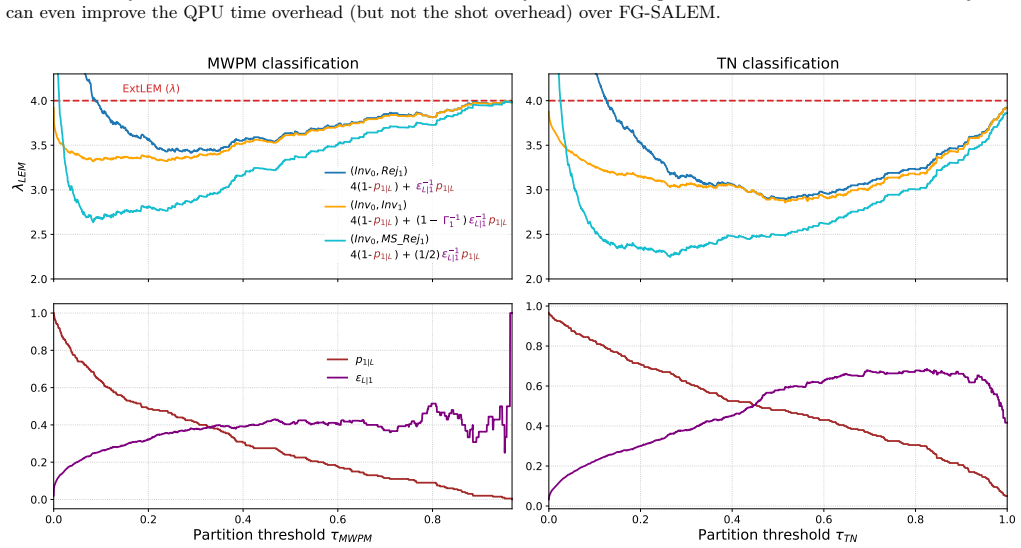
- [Fig. 3 and Appendix 8] The equations in the top legends of Fig. 3 appear in a small font and are hard to read; consider moving them to a table or enlarging. Also, the notation τ_MWPM and τ_TN in the main text is not explicitly defined in the caption.
- [Appendix 10b, TN classification] The sentence 'the latter requires only two TNs' contains a typo: it should read 'the former' (classification) rather than 'the latter' (decoding), since decoding requires 4^k−1 TNs.
- [Appendix 11, Eq. (54)] The transition volume v0 = log V_EC/(λ−λ_SALEM) is derived under the exponential-overhead ansatz Γ=e^{λVϵ}. It would strengthen the argument to state explicitly that this is a leading-order asymptotic description and to comment on how finite-ϵ corrections could affect the threshold crossover.
- [General notation] The symbol s is used both for a local syndrome and for the global syndrome; while the abuse is noted in Appendix 1, it can confuse readers. Consider adding a notation table.
Circularity Check
No circular reduction; SALEM's central overhead inequality is a stand-alone convexity derivation, with only minor self-citations and deferred patent details.
full rationale
The load-bearing claim, Eq. (2) and Theorem 3, is a genuine mathematical derivation: FG-SALEM's overhead is defined as H[Γ_s] from inverse-variance weights (Theorem 1), and the inequality H[Γ_s] ≤ Γ_ExtLEM follows from a stated monotone-convex overhead function f via a generalized mean inequality. No target result is inserted into the equations; the per-syndrome overheads Γ_s are variance bounds, not fitted predictions of the final claim. The syndrome-conditioned channels come from the P2LC construction, but Proposition 1 gives a proof sketch, and the Steane-code characterization is checked against direct Stim simulations (Fig. 10a), so the numerical inputs are not merely imported. The paper does defer full P2LC details and proofs to Ref. [71], a patent filed by the authors' company, and it cites its own Ref. [30] for the underlying idea; these are self-citations and omitted-support issues, but they do not make the main inequality reduce to a self-citation. The above-threshold extrapolation (Fig. 2c, Eqs. (51)-(54)) uses λ_SALEM computed in the ϵ_L→0 limit, and at finite physical error rates near threshold this is an extrapolation risk rather than a circular step. Overall, no specific equation or parameter is shown to be defined in terms of the result it is supposed to predict.
Axiom & Free-Parameter Ledger
free parameters (2)
- Partition threshold τ =
τ ≈ 0.2 (Steane); τ_MWPM and τ_TN optimized per surface-code classifier
- Assumed conditioned logical error for missing fault paths, ϵ_L|missing =
1/2 (assumed)
axioms (6)
- domain assumption The error-corrected gates are t-fault-tolerant, and leading-order logical errors are O(ϵ^{t+1}), arising from t+1 faults in two consecutive gates (Lemma 1, Proposition 1).
- domain assumption The physical error model is known and is a Pauli / circuit-level depolarizing channel with infidelity ϵ (Pauli twirling).
- domain assumption The exact logical error channels Λ_L^{(j)} exist and the iterative construction uses (Λ_L^{(j)})^{-1} (Appendix 1, Eq. (6)).
- domain assumption The shot overhead Γ = f(ϵ) is a monotone increasing convex function of infidelity, e.g., f(ϵ) = e^{λVϵ} (Theorem 3, Example 1).
- domain assumption Surface-code simulations reduce the logical channel to a logical bit-flip channel and assume a final ideal syndrome round (Appendix 10b).
- ad hoc to paper The P2LC characterization procedure and its detailed proofs, deferred to Ref. [71], are correct.
read the original abstract
Broad applications of quantum computers will require error correction (EC). However, hardware roadmaps indicate that physical qubit numbers will remain limited in the foreseeable future, leading to residual logical errors that constrain the size and accuracy of achievable computations. Recent work suggested logical error mitigation (LEM), which applies known error mitigation (EM) methods to logical errors, eliminating their effect at the cost of a runtime overhead. We introduce syndrome-aware logical error mitigation (SALEM), which mitigates logical errors conditioned on the error syndromes measured during error correction. The runtime overhead of SALEM is exponentially lower than that of LEM schemes which do not make use of syndrome data, enabling substantially larger circuit volumes that can be executed accurately. Compared to the routinely used combination of error correction and syndrome rejection (post-selection), SALEM increases the size of reliably executable computations by orders of magnitude. In the practical setting where space and time overheads are fixed and error reduction methods are compared by their resulting estimation errors, we observe a surprising phenomenon: SALEM, which tightly combines EC with EM, can outperform physical EM even above the standard fault-tolerance (pseudo) threshold. Thus, SALEM can make use of EC in regimes of physical error rates where EC is commonly deemed useless.
Figures


Forward citations
Cited by 1 Pith paper
-
Syndrome resampling enhances quantum error correction thresholds
Syndrome resampling increases QEC thresholds and cuts logical errors by up to four orders of magnitude by biasing toward likely syndromes, linked to Rényi coherent information phase transitions.
Reference graph
Works this paper leans on
-
[1]
Logical error channels 9
-
[2]
Temporally-local approximate logical error-channels 10
-
[3]
Fine-grained SALEM 12
-
[4]
FG-SALEM with QP distributions 12
-
[5]
Advantage of FG-SALEM over ExtLEM 13
-
[6]
CG-SALEM The following corollary of Theorems 1-3 describes the shot overhead increase in SALEM due to both coarse- graining and rejection. Corollary 1 (Shot overhead of coarse-grained SALEM)In analogy with Theorem 1, the shot overhead of SALEM with the partition{S k}of global syndromes and IV weights is given byΓ{Sk} SALEM =H[Γ k]. Under the assumptions o...
-
[7]
Violation and derivation of lower bounds for shot overheads in LEM 14
-
[8]
Case study: Binary CG-SALEM with QP distributions 14
-
[9]
Mid-shot rejection 16
-
[10]
Steane code 17 b
Numerical simulations 17 a. Steane code 17 b. Surface codes 18
-
[11]
FT pseudo thresholds for ExtLEM and SALEM 21
-
[12]
We consider realistic ‘circuit-level’ noise mod- els, where each physical operation inGj carries a physical error (or ‘fault’) channel, with infidelityϵ
Logical error channels LetC=G V · · ·G1 denote a faulty error-corrected quantum circuit, comprised of faulty error-corrected logi- cal gatesGj, each including gadgets implementing logical gates, as well as syndrome measurements, decoding and recovery. We consider realistic ‘circuit-level’ noise mod- els, where each physical operation inGj carries a physic...
-
[13]
T emporally-local approximate logical error-channels A downside of the construction of the logical error channels of Appendix 1 is that it is non-local in time, in the sense thatΛ (j) L depends on all gatesG i with i= 1, . . . , j+ 1. We would like the logical channel to be more temporally-local, and easier to compute. Fortu- nately, at leading order, the...
-
[14]
Applying this process forNshots in which M≤Ndistinct syndromess 1,
Fine-grained SALEM AnFG-SALEMprotocolcanbespecifiedbyamapping of global syndromes to corresponding EM protocols and weights, F G-SALEM:s7→(EM s, ws).(15) The EM protocolEM s is applied to shots in which the syndromesis measured, resulting in a ‘mitigated out- come’o. Applying this process forNshots in which M≤Ndistinct syndromess 1, . . . ,sM are measured...
-
[15]
, sj), such that (Λ(j) L|s1:j )−1 = X σ q(j) σ|s1:j σ,(20) whereΛ (j) L|s1:j is the exact logical error channel of the log- ical gateG j
FG-SALEM with QP distributions The protocolsEM s may be based on quasi-probability (QP) distributionsq (j) σ|s1:j ∈R, P σ q(j) σ|s1:j = 1, depending ons 1:j = (s1, . . . , sj), such that (Λ(j) L|s1:j )−1 = X σ q(j) σ|s1:j σ,(20) whereΛ (j) L|s1:j is the exact logical error channel of the log- ical gateG j. Writingq (j) σ|s1:j =W (j) s1:j s(j) σ|s1:j p(j) ...
-
[16]
Advantage of FG-SALEM over ExtLEM We can now compare the shot overhead of FG-SALEM to that of ExtLEM. To make a ‘fair’ comparison, we as- sume that both ExtLEM and FG-SALEM are based on the same underlying EM protocol, which satisfies a func- tional relationΓ =f(ϵ)between the infidelityϵof the mitigated error channel (averaged over all gates in the circui...
-
[17]
However, it is clear that these bounds do hold for ExtLEM, which mitigates ΛL while ignoring syndrome data
Violation and derivation of lower bounds for shot overheads in LEM Known lower bounds on the shot overhead of physi- cal EM do not hold for error-corrected circuits, which involve adaptive operations [47–50]. However, it is clear that these bounds do hold for ExtLEM, which mitigates ΛL while ignoring syndrome data. As an example, if ΛL takes the form of a...
-
[18]
Case study: Binary CG-SALEM with QP distributions As discussed in the main text, binary partitions are useful within CG-SALEM since they reduce and even eliminate the implementation challenges of finer parti- tions. Moreover, the binary case allows for an analytic computation of the blowup rate for CG-SALEM as a function of simple quantities, providing in...
-
[19]
Mid-shot rejection Mid-shot (MS) rejection corresponds to the simple ter- mination of shots once the first rejected syndrome is mea- sured, without waiting for the shot to end. Assuming the shot time is monotonically increasing in the circuit depth, this simple modification reduces the average time per shot, and therefore improves the QPU time overhead re...
-
[20]
Steane code We use Steane’s code, a[[7,1,3]]CSS code, to fully simulate the methods discussed above for the case of a single logical qubit memory
Numerical simulations a. Steane code We use Steane’s code, a[[7,1,3]]CSS code, to fully simulate the methods discussed above for the case of a single logical qubit memory. For syndrome extraction, we employ the 1-FT scheme of Ref. [65]. This scheme uses one ancilla qubit to mea- sure the syndrome and an additional ancilla to flag hook errors. The measurem...
-
[21]
FT pseudo thresholds for ExtLEM and SALEM We explain here the behavior of the FT (pseudo) thresholds for ExtLEM and SALEM described in the main text (Fig. 2(c)). The standard FT (pseudo) thresh- old is defined as the solution toϵL(ϵ) =ϵ. In contrast, the ExtLEM threshold is defined by equating the QPU time overheads of (physical) EM and ExtLEM: VEC eλϵL(ϵ...
-
[22]
Optimal blowup rates with both classifiers and all three variants of binary CG-SALEM are close to those observed ford= 3
Nevertheless, the TN classifier approximatesϵL|s well enough to produce strong partitions, which significantly improve the blowup rate for binary CG-SALEM relative to the MWPM classifier. Optimal blowup rates with both classifiers and all three variants of binary CG-SALEM are close to those observed ford= 3. such that logV EC λV + λSALEM λ ϵL(ϵ) =ϵ.(54) S...
-
[23]
D. W. Berry, R. S. T. Oliver, L. M. D. Ashley, and D. M. W. P. Brown, Quantum algorithm zoo,https: //quantumalgorithmzoo.org/(2020), accessed: 2025- 02-16
2020
-
[24]
Aharonov and M
D. Aharonov and M. Ben-Or, Fault-tolerant quantum computation with constant error rate, inProceedings of the 29th Annual ACM Symposium on Theory of Comput- ing(ACM, 1997) pp. 176–188
1997
-
[25]
Knill, R
E. Knill, R. Laflamme, and W. H. Zurek, Resilient quan- tum computation: error models and thresholds, Proceed- ings of the Royal Society of London. Series A: Mathe- matical, Physical and Engineering Sciences454, 365–384 (1998)
1998
-
[26]
Kitaev, Quantum computations: algorithms and er- ror correction, Russian Mathematical Surveys52, 1191 (1997)
A. Kitaev, Quantum computations: algorithms and er- ror correction, Russian Mathematical Surveys52, 1191 (1997)
1997
-
[27]
P. Aliferis, D. Gottesman, and J. Preskill, Accuracy threshold for postselected quantum computation (2007), arXiv:quant-ph/0703264 [quant-ph]
Pith/arXiv arXiv 2007
-
[28]
Peres, Reversible logic and quantum computers, Phys
A. Peres, Reversible logic and quantum computers, Phys. Rev. A32, 3266 (1985)
1985
-
[29]
P. W. Shor, Scheme for reducing decoherence in quantum computer memory, Physical Review A52, R2493 (1995)
1995
-
[30]
A. M. Steane, Error correcting codes in quantum theory, Physical Review Letters77, 793 (1996)
1996
-
[31]
Error Correction Zoo Contributors, The error correc- tion zoo,https://errorcorrectionzoo.org(2020), on- line resource
2020
-
[32]
Bluvstein, S
D. Bluvstein, S. J. Evered, A. A. Geim, S. H. Li, H. Zhou, T. Manovitz, S. Ebadi, M. Cain, M. Kalinowski, D. Hangleiter,et al., Logical quantum processor based on reconfigurable atom arrays, Nature626, 58 (2024)
2024
-
[33]
M. da Silva, C. Ryan-Anderson, J. Bello-Rivas, A. Chernoguzov, J. Dreiling, C. Foltz, F. Frachon, J. Gaebler, T. Gatterman, L. Grans-Samuelsson,et al., Demonstration of logical qubits and repeated error cor- rection with better-than-physical error rates (2024), arXiv preprint arXiv:2404.02280
Pith/arXiv arXiv 2024
-
[34]
B. W. Reichardt, D. Aasen, R. Chao, A. Chernoguzov, W. van Dam, J. P. Gaebler, D. Gresh, D. Lucchetti, M. Mills, S. A. Moses,et al., Demonstration of quan- tum computation and error correction with a tesseract code, arXiv preprint arXiv:2409.04628 (2024)
Pith/arXiv arXiv 2024
-
[35]
R. Acharya, L. Aghababaie-Beni, I. Aleiner, T. I. Ander- sen, M. Ansmann, F. Arute, K. Arya, A. Asfaw, N. As- trakhantsev, J. Atalaya,et al., Quantum error correc- tion below the surface code threshold, arXiv preprint arXiv:2408.13687 (2024)
Pith/arXiv arXiv 2024
-
[36]
H. Putterman, K. Noh, C. T. Hann, G. S. MacCabe, S. Aghaeimeibodi, R. N. Patel, M. Lee, W. M. Jones, H. Moradinejad, R. Rodriguez,et al., Hardware-efficient quantum error correction using concatenated bosonic qubits, arXiv preprint arXiv:2409.13025 (2024)
Pith/arXiv arXiv 2024
-
[37]
G. M. Sommers, M. Foss-Feig, D. Hayes, D. A. Huse, and M. J. Gullans, Observation of a fault tolerance thresh- old with concatenated codes, Phys. Rev. Res.7, 043271 (2025)
2025
-
[38]
Eickbusch, M
A. Eickbusch, M. McEwen, A. Morvan, B. Ware, T. Wei- del, T. White, K. Wong, B. W. K. Woo, M. Woodson, C. Xing,et al., Demonstration of dynamic surface codes, Nature Physics21, 1994 (2025)
1994
-
[39]
P. S. Rodriguez, J. M. Robinson, P. N. Jepsen, Z. He, C. Duckering, C. Zhao, K.-H. Wu, J. Campo, K. Bagnall, M. Kwon,et al., Experimental demonstration of logical magic state distillation, Nature645, 620 (2025)
2025
-
[40]
K. Yamamoto, Y. Kikuchi, D. Amaro, B. Criger, S. Dilkes, C. Ryan-Anderson, A. Tranter, J. M. Dreil- ing, D. Gresh, C. Foltz,et al., Quantum error-corrected computation of molecular energies, arXiv preprint arXiv:2505.09133 10.48550/arXiv.2505.09133 (2025)
-
[41]
D. Bluvstein, A. A. Geim, S. H. Li, S. J. Evered, J. P. Bonilla Ataides, G. Baranes, A. Gu, T. Manovitz, M. Xu, M. Kalinowski, and collaborators, A fault- tolerant neutral-atom architecture for universal quan- tum computation, Nature 10.1038/s41586-025-09848-5 (2025)
-
[42]
Q. Xu, J. P. Bonilla Ataides, C. A. Pattison, N. Raveen- dran, D. Bluvstein, J. Wurtz, B. Vasić, M. D. Lukin, L. Jiang, and H. Zhou, Constant-overhead fault-tolerant quantum computation with reconfigurable atom arrays, Nature Physics , 1 (2024)
2024
-
[43]
Bravyi, A
S. Bravyi, A. W. Cross, J. M. Gambetta, D. Maslov, P. Rall, and T. J. Yoder, High-threshold and low- overhead fault-tolerant quantum memory, Nature627, 78 (2024), accessed: 2024-10-21
2024
-
[44]
T. R. Scruby, T. Hillmann, and J. Roffe, High-threshold, low-overhead and single-shot decodable fault-tolerant quantum memory, arXiv preprint arXiv:2406.14445 (2024)
Pith/arXiv arXiv 2024
-
[45]
C. Gidney, N. Shutty, and C. Jones, Magic state culti- vation: growing t states as cheap as cnot gates, arXiv preprint arXiv:2409.17595 (2024)
Pith/arXiv arXiv 2024
-
[46]
Google Quantum AI, Google Quantum AI (2024), ac- cessed: 2024-10-21
2024
-
[47]
IBM Quantum, Ibm quantum technology (2024), ac- cessed: 2024-10-21
2024
-
[48]
QuEra Computing, Quera quantum error correction (qec) (2024), accessed: 2024-10-21
2024
-
[49]
Quantinuum,QuantinuumUnveilsAcceleratedRoadmap to Achieve Universal Fault-Tolerant Quantum Comput- ing by 2030 (2023), accessed: 2024-10-21
2030
-
[50]
IonQ, Ionq unveils accelerated roadmap and new tech- nical milestones to propel quantum computing (2024), accessed: 2024-10-21. 24
2024
-
[51]
IQM Quantum Computers, Iqm quantum computers technology roadmap (2024), accessed: 2024-10-21
2024
-
[52]
D. Aharonov, O. Alberton, I. Arad, Y. Atia, E. Bairey, Z. Brakerski, I. Cohen, O. Golan, I. Gurwich, O. Ken- neth,et al., On the importance of error mitigation for quantum computation, arXiv preprint arXiv:2503.17243 (2025)
Pith/arXiv arXiv 2025
-
[53]
J. Preskill, Beyond nisq: The megaquop machine, ACM Transactions on Quantum Computing 10.1145/3723153 (2025), just Accepted
doi:10.1145/3723153 2025
-
[54]
Temme, S
K. Temme, S. Bravyi, and J. M. Gambetta, Error mitiga- tion for short-depth quantum circuits, Phys. Rev. Lett. 119, 180509 (2017)
2017
-
[55]
Li and S
Y. Li and S. C. Benjamin, Efficient variational quantum simulator incorporating active error minimization, Phys- ical Review X7, 021050 (2017)
2017
-
[56]
S. Endo, S. C. Benjamin, and Y. Li, Practical quantum error mitigation for near-future applications, Phys. Rev. X8, 031027 (2018)
2018
-
[57]
Z. Cai, R. Babbush, S. C. Benjamin, S. Endo, W. J. Hug- gins, Y. Li, J. R. McClean, and T. E. O’Brien, Quantum error mitigation, Rev. Mod. Phys.95, 045005 (2023)
2023
-
[58]
A. Mari, N. Shammah, and W. J. Zeng, Extending quantum probabilistic error cancellation by noise scaling, Phys. Rev. A104, 052607 (2021)
2021
-
[59]
Cai, Multi-exponential error extrapolation and com- bining error mitigation techniques for nisq applications, npj Quantum Information7, 80 (2021)
Z. Cai, Multi-exponential error extrapolation and com- bining error mitigation techniques for nisq applications, npj Quantum Information7, 80 (2021)
2021
-
[60]
S. N. Filippov, S. Maniscalco, and G. García-Pérez, Scal- ability of quantum error mitigation techniques: from utility to advantage, arXiv preprint arXiv:2403.13542 (2024)
Pith/arXiv arXiv 2024
-
[61]
Z. Zimborás, B. Koczor, Z. Holmes, E.-M. Borrelli, A. Gi- lyén, H.-Y. Huang, Z. Cai, A. Acín, L. Aolita, L. Banchi, et al., Myths around quantum computation before full fault tolerance: What no-go theorems rule out and what they don’t, arXiv preprint arXiv:2501.05694 (2025)
Pith/arXiv arXiv 2025
-
[62]
O. Lanes, M. Beji, A. D. Corcoles, C. Dalyac, J. M. Gam- betta, L. Henriet, A. Javadi-Abhari, A. Kandala, A. Mez- zacapo, C. Porter,et al., A framework for quantum ad- vantage, arXiv preprint arXiv:2506.20658 (2025)
Pith/arXiv arXiv 2025
-
[63]
D. Aharonov, O. Alberton, I. Arad, Y. Atia, E. Bairey, M. B. Dov, A. Berkovitch, Z. Brakerski, I. Cohen, E. Fuchs,et al., Reliable high-accuracy error mitiga- tion for utility-scale quantum circuits, arXiv preprint arXiv:2508.10997 (2025)
Pith/arXiv arXiv 2025
-
[64]
J. Eisert andJ. Preskill, Mind thegaps: Thefraughtroad to quantum advantage, arXiv preprint arXiv:2510.19928 10.48550/arXiv.2510.19928 (2025), arXiv:2510.19928 [quant-ph]
-
[65]
Y. Kim, A. Eddins, S. Anand, K. X. Wei, E. Van Den Berg, S. Rosenblatt, H. Nayfeh, Y. Wu, M. Zale- tel, K. Temme,et al., Evidence for the utility of quan- tum computing before fault tolerance, Nature618, 500 (2023)
2023
-
[66]
R. Haghshenas, E. Chertkov, M. Mills, W. Kadow, S.-H. Lin, Y.-H. Chen, C. Cade, I. Niesen, T. Be- gušić, M. S. Rudolph,et al., Digital quantum magnetism at the frontier of classical simulations, arXiv preprint arXiv:2503.20870 (2025)
Pith/arXiv arXiv 2025
-
[67]
Google Quantum AI and Collaborators, Observation of constructive interference at the edge of quantum ergod- icity, Nature646, 825 (2025)
2025
-
[68]
F.Alam, J.L.Bosse, I.Čepait˙ e, A.Chapman, L.Clinton, M. Crichigno, E. Crosson, T. Cubitt, C. Derby, O. Dow- inton,et al., Fermionic dynamics on a trapped-ion quan- tum computer beyond exact classical simulation, arXiv preprint arXiv:2510.26300 (2025)
arXiv 2025
-
[69]
Takagi, S
R. Takagi, S. Endo, S. Minagawa, and M. Gu, Funda- mental limits of quantum error mitigation, npj Quantum Information8, 114 (2022)
2022
-
[70]
Takagi, H
R. Takagi, H. Tajima, and M. Gu, Universal sampling lower bounds for quantum error mitigation, Phys. Rev. Lett.131, 210602 (2023)
2023
-
[71]
Tsubouchi, T
K. Tsubouchi, T. Sagawa, and N. Yoshioka, Universal cost bound of quantum error mitigation based on quan- tum estimation theory, Phys. Rev. Lett.131, 210601 (2023)
2023
-
[72]
Y. Quek, D. Stilck França, S. Khatri, J. J. Meyer, and J. Eisert, Exponentially tighter bounds on limitations of quantum error mitigation, Nature Physics20, 1648 (2024)
2024
-
[73]
T. Schuster, C. Yin, X. Gao, and N. Y. Yao, A polynomial-time classical algorithm for noisy quantum circuits, arXiv preprint arXiv:2407.12768 (2024)
Pith/arXiv arXiv 2024
-
[74]
Suzuki, S
Y. Suzuki, S. Endo, K. Fujii, and Y. Tokunaga, Quantum error mitigation as a universal error reduction technique: Applications from the nisq to the fault-tolerant quantum computing eras, PRX Quantum3, 010345 (2022)
2022
-
[75]
Piveteau, D
C. Piveteau, D. Sutter, S. Bravyi, J. M. Gambetta, and K. Temme, Error mitigation for universal gates on en- coded qubits, Phys. Rev. Lett.127, 200505 (2021)
2021
-
[76]
Lostaglio and A
M. Lostaglio and A. Ciani, Error mitigation and quantum-assisted simulation in the error corrected regime, Phys. Rev. Lett.127, 200506 (2021)
2021
-
[77]
Xiong, D
Y. Xiong, D. Chandra, S. X. Ng, and L. Hanzo, Sampling overhead analysis of quantum error mitigation: Uncoded vs. coded systems, IEEE Access8, 228967 (2020)
2020
-
[78]
K. Tsubouchi, Y. Mitsuhashi, K. Sharma, and N. Yosh- ioka, Symmetric clifford twirling for cost-optimal quan- tum error mitigation in early ftqc regime, arXiv preprint arXiv:2405.07720 (2024)
Pith/arXiv arXiv 2024
- [79]
-
[80]
S. C. Smith, B. J. Brown, and S. D. Bartlett, Mitigating errors in logical qubits, Communications Physics7, 386 (2024)
2024
discussion (0)
Sign in with ORCID, Apple, or X to comment. Anyone can read and Pith papers without signing in.