Renormalization effects fade away during inflation
Pith reviewed 2026-06-26 15:42 UTC · model grok-4.3
The pith
Inflation causes renormalization contributions to the primordial spectrum to decay rapidly while physical modes freeze, leaving observable predictions unchanged.
A machine-rendered reading of the paper's core claim, the machinery that carries it, and where it could break.
Core claim
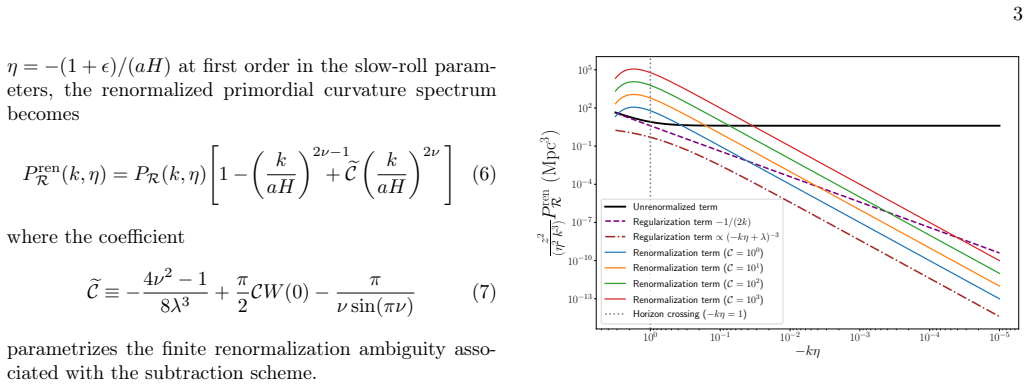
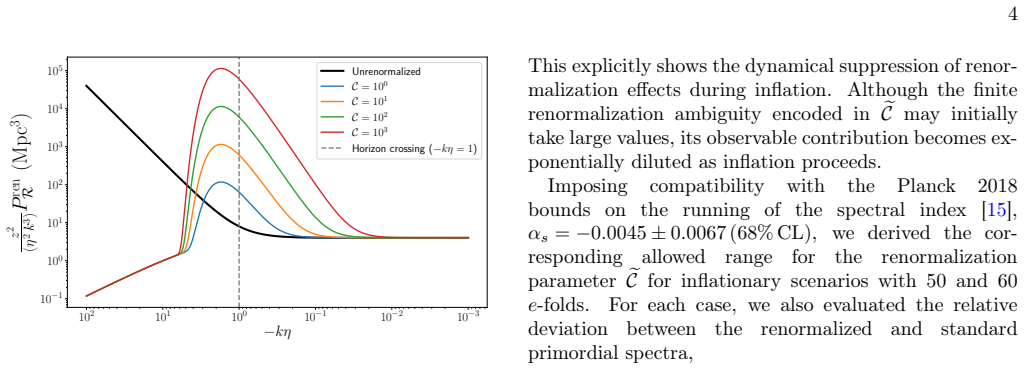
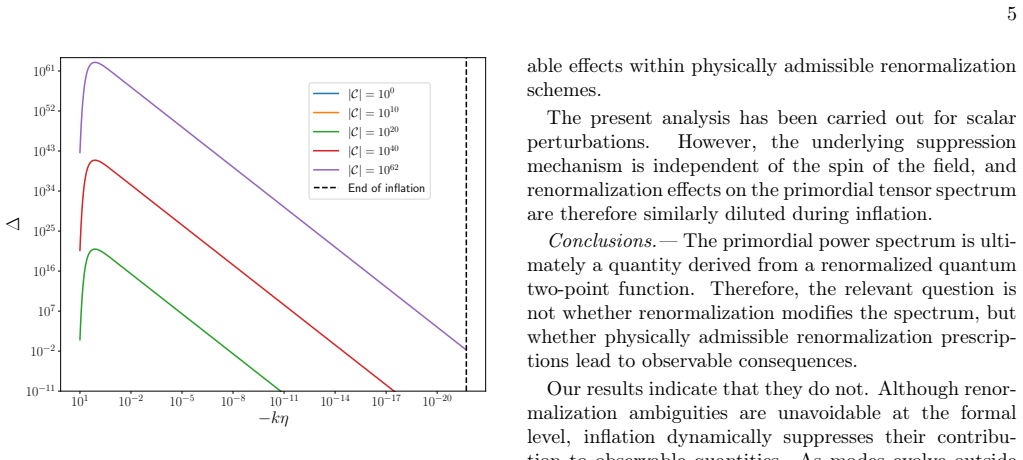
We demonstrate that inflation dynamically suppresses the entire renormalization sector: while super-Hubble perturbations freeze after horizon crossing, renormalization contributions decay rapidly during inflation. As a consequence, the observable primordial spectrum is remarkably insensitive to renormalization ambiguities, providing strong evidence for the robustness under renormalization of standard inflationary predictions at observable scales.
What carries the argument
The dynamical separation during inflation between freezing super-Hubble modes and independently decaying renormalization contributions.
Load-bearing premise
Renormalization contributions can be cleanly separated from the freezing super-Hubble modes and shown to decay independently under the dynamical evolution of inflation.
What would settle it
An explicit calculation in a specific inflationary model showing renormalization terms that remain constant or grow after horizon crossing would falsify the suppression.
Figures
read the original abstract
The renormalization of the primordial inflationary power spectrum has long raised the possibility that ultraviolet effects could significantly alter predictions for cosmological observables. We demonstrate that inflation dynamically suppresses the entire renormalization sector: while super-Hubble perturbations freeze after horizon crossing, renormalization contributions decay rapidly during inflation. As a consequence, the observable primordial spectrum is remarkably insensitive to renormalization ambiguities, providing strong evidence for the robustness under renormalization of standard inflationary predictions at observable scales.
Editorial analysis
A structured set of objections, weighed in public.
Referee Report
Summary. The paper claims that inflation dynamically suppresses renormalization contributions to the primordial power spectrum: while super-Hubble modes freeze after horizon exit, renormalization terms decay rapidly, rendering the observable spectrum insensitive to renormalization ambiguities and thereby supporting the robustness of standard inflationary predictions.
Significance. If the central dynamical separation and decay hold, the result would strengthen in the UV-insensitivity of observable inflationary observables, directly addressing long-standing concerns about renormalization ambiguities in cosmological perturbation theory.
major comments (2)
- [Abstract] Abstract: the claim that renormalization contributions can be cleanly separated from freezing super-Hubble modes and shown to decay independently is asserted without an explicit decomposition procedure, mode equation, counterterm definition, or adiabatic subtraction formula; without these the independent decay cannot be verified and the insensitivity conclusion remains ungrounded.
- [Abstract] The manuscript supplies no derivation or time-evolution argument demonstrating that any residual renormalization piece remains negligible at observable scales rather than being absorbed into the freezing solution; this is the load-bearing step for the central claim.
Simulated Author's Rebuttal
We thank the referee for the constructive comments on the abstract. We will revise the abstract to better reference the explicit technical elements and derivations already present in the manuscript body, thereby addressing the concerns about grounding the claims.
read point-by-point responses
-
Referee: [Abstract] Abstract: the claim that renormalization contributions can be cleanly separated from freezing super-Hubble modes and shown to decay independently is asserted without an explicit decomposition procedure, mode equation, counterterm definition, or adiabatic subtraction formula; without these the independent decay cannot be verified and the insensitivity conclusion remains ungrounded.
Authors: The abstract is a concise summary of the results. The full manuscript supplies the requested elements: the mode equation appears as Eq. (12) in Section II, the counterterm definition and adiabatic subtraction formula (fourth-order) are given in Section III, and the decomposition into freezing super-Hubble modes versus decaying renormalization contributions is derived in Section IV. We will revise the abstract to include brief references to these sections and a short outline of the separation procedure. revision: yes
-
Referee: [Abstract] The manuscript supplies no derivation or time-evolution argument demonstrating that any residual renormalization piece remains negligible at observable scales rather than being absorbed into the freezing solution; this is the load-bearing step for the central claim.
Authors: Section V of the manuscript contains the time-evolution analysis. We solve the renormalized mode equation in the slow-roll regime and demonstrate that renormalization contributions decay as a^{-3} (or faster) during inflation, while super-Hubble modes freeze to a constant value. This dynamical suppression ensures the residual renormalization piece is negligible by the end of inflation for modes that exit the horizon during observable epochs. We will revise the abstract to summarize this decay argument and its implication for observable scales. revision: yes
Circularity Check
No circularity; dynamical suppression claim presented as independent evolution result
full rationale
The abstract asserts that inflation causes renormalization contributions to decay while super-Hubble modes freeze, rendering the spectrum insensitive to ambiguities. No equations, decompositions, or self-citations are supplied in the provided text that would reduce this claim to a fitted parameter, self-definition, or prior author result by construction. The separation and decay are framed as consequences of the dynamical evolution rather than inputs redefined as outputs. This is the normal case of a self-contained physical argument whose validity rests on explicit mode equations or counterterms not shown here to loop back on themselves.
Axiom & Free-Parameter Ledger
Reference graph
Works this paper leans on
-
[1]
A. A. Starobinsky, Phys. Lett. B91, 99 (1980)
1980
-
[2]
A. H. Guth, Phys. Rev. D23, 347 (1981)
1981
-
[3]
A. D. Linde, Phys. Lett. B108, 389 (1982)
1982
-
[4]
Albrecht and P
A. Albrecht and P. J. Steinhardt, Phys. Rev. Lett.48, 1220 (1982)
1982
-
[5]
V. F. Mukhanov and G. V. Chibisov, JETP Lett.33, 532 (1981)
1981
-
[6]
S. W. Hawking, Phys. Lett. B115, 295 (1982)
1982
-
[7]
V. F. Mukhanov, L. A. Kofman, and D. Y. Pogosian, Phys. Lett. B193, 427 (1987)
1987
-
[8]
A. H. Guth and S.-Y. Pi, Physical Review Letters49, 1110 (1982)
1982
-
[9]
J. M. Bardeen, P. J. Steinhardt, and M. S. Turner, Phys. Rev. D28, 679 (1983). 6
1983
-
[10]
V. F. Mukhanov, H. A. Feldman, and R. H. Branden- berger, Phys. Rept.215, 203 (1992)
1992
-
[11]
V.Mukhanov,Physical Foundations of Cosmology(Cam- bridge University Press, 2005)
2005
-
[12]
Sasaki, Prog
M. Sasaki, Prog. Theor. Phys.76, 1036 (1986)
1986
-
[13]
V. F. Mukhanov, Sov. Phys. JETP67, 1297 (1988)
1988
-
[14]
Hinshaw et al., Astrophys
G. Hinshaw et al., Astrophys. J. Suppl.208, 19 (2013)
2013
-
[15]
Y. A. et al., Astronomy & Astrophysics641, A10 (2020)
2020
-
[16]
A. A. et. al, Inflation: Theory and observations (2022), arXiv:2203.08128 [astro-ph.CO]
arXiv 2022
-
[17]
R. M. Wald,Quantum Field Theory in Curved Spacetime and Black Hole Thermodynamics(University of Chicago Press, 1994)
1994
-
[18]
N. D. Birrell and P. C. W. Davies,Quantum Fields in Curved Space(Cambridge University Press, 1982)
1982
-
[19]
L. E. Parker and D. J. Toms,Quantum Field Theory in Curved Spacetime: Quantized Fields and Gravity(Cam- bridge University Press, 2009)
2009
-
[20]
Parker, Amplitude of perturbations from inflation (2007), arXiv:hep-th/0702216 [hep-th]
L. Parker, Amplitude of perturbations from inflation (2007), arXiv:hep-th/0702216 [hep-th]
Pith/arXiv arXiv 2007
-
[21]
I. Agulló, J. Navarro-Salas, G. J. Olmo, and L. Parker, Physical Review Letters103, 10.1103/phys- revlett.103.061301 (2009)
-
[22]
A. del Rio and J. Navarro-Salas, Physical Review D89, 10.1103/physrevd.89.084037 (2014)
-
[23]
del Rio and J
A. del Rio and J. Navarro-Salas, Journal of Physics: Con- ference Series600, 012023 (2015)
2015
-
[24]
Markkanen, Journal of Cosmology and Astroparticle Physics2018(05), 001–001
T. Markkanen, Journal of Cosmology and Astroparticle Physics2018(05), 001–001
-
[25]
S.PlaandB.A.Stefanek,Renormalizationoftheprimor- dial inflationary power spectra (2024), arXiv:2402.14910 [gr-qc]
arXiv 2024
-
[26]
Zhang and B
Y. Zhang and B. Wang, Journal of Cosmology and As- troparticle Physics2018(11), 006–006
-
[27]
A. Ferreiro, S. Monin, and F. Torrenti, Physical Review D109, 10.1103/physrevd.109.045015 (2024)
-
[28]
Negro and S
A. Negro and S. P. Patil, La Rivista del Nuovo Cimento 47, 179–228 (2024)
2024
-
[29]
C. D. Romero, L. J. Garay, M. Martín-Benito, and R. B. Neves,Asymptoticregularizationmethod.Aconstructive approach (2026), arXiv:2604.24292 [hep-th]
Pith/arXiv arXiv 2026
-
[30]
T. S. Bunch and P. C. W. Davies, Proc. Roy. Soc. Lond. A360, 117 (1978)
1978
-
[31]
Baumann, Tasi lectures on inflation (2012), arXiv:0907.5424 [hep-th]
D. Baumann, Tasi lectures on inflation (2012), arXiv:0907.5424 [hep-th]
Pith/arXiv arXiv 2012
-
[32]
Ferreiro and F
A. Ferreiro and F. Torrenti, Physics Letters B840, 137868 (2023)
2023
-
[33]
Seery, Classical and Quantum Gravity27, 124005 (2010)
D. Seery, Classical and Quantum Gravity27, 124005 (2010)
2010
-
[34]
J. C. Collins,Renormalization(Cambridge University Press, 1984)
1984
-
[35]
A. R. Liddle and D. H. Lyth,Cosmological Inflation and Large-Scale Structure(Cambridge University Press, Cambridge, 2000)
2000
-
[36]
E. W. Kolb and M. S. Turner,The Early Universe(West- view Press, 1994)
1994
discussion (0)
Sign in with ORCID, Apple, or X to comment. Anyone can read and Pith papers without signing in.