REVIEW 4 major objections 5 minor 15 references
Locally Linear Image Structural Embedding for Image Structure Manifold Learning
T0 review · 4 major / 5 minor · reviewed 2026-08-14 · deepseek-v4-flash
Pith's one-line read A variant of LLE that swaps the squared Euclidean distance for an SSIM-based distance learns an image structure manifold on which distortion types separate better than LLE, except for impulse noise.
desk verdict A plausible but incremental LLE+SSIM variant whose main empirical claim is not supported by the current, uncontrolled block-wise versus whole-image comparison. read the letter →
The pith
A machine-rendered reading of the paper's core claim, the machinery that carries it, and where it could break.
The reading
What carries the argument
The load-bearing object is the SSIM distance of Eq. (2), $\|\check{x}_1-\check{x}_2\|_S := 1 - SSIM(\check{x}_1,\check{x}_2) = \|\check{x}_1-\check{x}_2\|_2^2 / (\|\check{x}_1\|_2^2 + \|\check{x}_2\|_2^2 + c)$, which is exact only for zero-mean blocks. LLISE replaces the squared Euclidean distance in both stages of LLE with this expression: first, reconstruct each image block from its $k$ neighbours by minimizing the SSIM distance of the residual; second, embed the blocks so that the same reconstruction weights are respected, again using the SSIM distance, under zero-mean and unit-covariance constraints. Because the resulting problems are nonconvex, the paper solves them with ADMM, using one gradient-descent step for the inner update and projections (normalization of the weights; centering and singular-value scaling for the embedded matrix) for the constraint. Kernel LLISE runs the same routine on double-centered kernel matrices, computing distances and gradients through the kernel trick.
What would settle it
Take the trained LLISE embeddings for a fixed block, compute the true SSIM of Eq. (1) between every pair of embedded points, and compare those values with the distance $1-\theta_j(Y_i)$ used in Eq. (14); for any pair whose embedded coordinates are not zero-mean the two orderings will differ, showing the objective being optimized is a normalized squared distance rather than SSIM.
Extended reading notes
Core claim
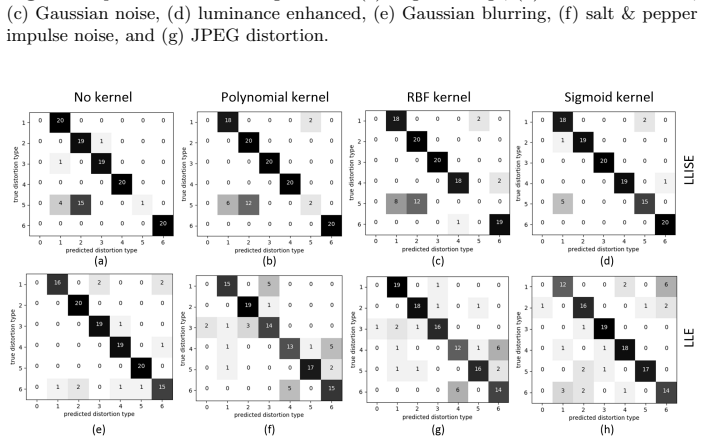
The paper's central claim is that replacing the $\ell_2$ norm with the SSIM distance in both stages of Locally Linear Embedding produces a low-dimensional image structure manifold whose geometry reflects the type of structural degradation rather than the raw intensity error. For each image block, LLISE finds $k$ nearest neighbours, solves for reconstruction weights using the SSIM distance as the error, and then embeds the blocks with those weights fixed, again under the SSIM distance, subject to zero-mean and unit-covariance constraints. The kernel variant carries out the same procedure in a feature space defined by a kernel and centers the kernel matrix instead of the raw blocks. The paper reports confusion-matrix experiments in which the resulting embeddings recognize distortion types better than LLE and kernel LLE for every tested distortion except impulse noise, and out-of-sample tests in which the true distortion is usually among the top two block votes.
Load-bearing premise
In Eq. (2) the SSIM distance is derived under a zero-mean assumption, but the embedding stage applies it to embedded points that are not centered over their coordinates, so the objective being optimized is a normalized squared distance rather than the claimed SSIM distance.
Editorial extensions
If this is right
- Images at equal MSE but different distortion types land in different regions of the LLISE manifold, making distortion type a recognizable dimension.
- The kernel version extends the same separation to feature-space manifolds, so the approach is not limited to linear structure in pixel space.
- Out-of-sample images, including images with mixed distortions, can be embedded by nearest-neighbour reconstruction, and the true distortion is usually among the top two block votes.
- In the reported comparison, LLISE and kernel LLISE outperform LLE and kernel LLE for every tested distortion except impulse noise.
Reading between the lines
- Because Eq. (2) presupposes zero-mean vectors while the embedded points are not centered, a useful control experiment would replace the objective with plain normalized Euclidean distance and check whether the gains persist; this would show whether the mechanism is perceptual or geometric.
- The blockwise construction is not tied to single-scale SSIM; substituting multi-scale SSIM or a learned perceptual distance into the same pipeline is a natural extension that the paper leaves unexplored.
- The evaluation uses one source image with distortions matched in MSE, so whether the structure manifold transfers to diverse natural images remains an open empirical question.
Signed reviews
Editorial analysis
A structured set of objections, weighed in public.
Referee Report
Summary. The paper proposes Locally Linear Image Structural Embedding (LLISE) and its kernel variant as alternatives to Locally Linear Embedding (LLE) for learning what the authors call an 'image structure manifold.' The method replaces the squared Euclidean distance in LLE with an SSIM-based distance for both the reconstruction of each image block from its k nearest neighbors and the embedding step, with the weights computed by ADMM and the embedding constrained to have zero mean and unit covariance. The authors also provide an out-of-sample embedding procedure and a kernelized version. The experiments use 121 distorted versions of a single Lena image (six distortion types plus the original) and 12 out-of-sample images; distortion type is recognized by a 1NN classifier in the learned embedding, with majority voting over blocks for LLISE and one label per whole image for LLE and kernel LLE.
Significance. If the method worked as claimed, replacing the l2 norm with a perceptually motivated SSIM distance in a manifold learning pipeline would be a useful contribution and would provide a concrete bridge between image quality assessment and manifold learning. The paper is clearly written and includes full derivations of the gradients and update rules plus supplementary material, which is valuable for reproducibility. However, the significance is currently limited by three issues: the embedding objective does not actually use an SSIM distance because the embedded vectors are not zero-mean over their coordinates; the projection step for the unit-covariance constraint contains a mathematical error (singular values should be sqrt(n), not n); and the central empirical claim rests on a single image and on a confounded comparison between block-wise LLISE and whole-image LLE. These problems are load-bearing because the paper's novelty and promised application depend on both the SSIM interpretation and the reported empirical advantage.
major comments (4)
- [§2.1, Eqs. (2) and (14)] The SSIM distance in Eq. (2) is derived under the assumption that both vectors have zero mean over their coordinates, as stated in Section 1.1. In the embedding problem (12), however, the arguments Y_i^T 1_j and Y_i^T w_j,i are p-dimensional embedded vectors, and the zero-mean constraint in Eq. (12) is across the n images (sum_j y_j,i = 0), not across the p coordinates. Thus the objective in Eq. (14) is not an SSIM distance but a normalized squared distance with a constant c inherited from the block size q; it does not have the perceptual interpretation claimed. The authors need to either center each embedded vector across its p coordinates before applying Eq. (2), or define and justify a different distance for the embedding space.
- [§2.1, projection step following Eq. (18)] The constraint (1/n) Y_i^T Y_i = I implies that the singular values of Y_i are sqrt(n), not n. The text derives this from the SVD of Y_i but then incorrectly concludes 'Sigma = nI'; with singular values set to n, one obtains (1/n)Y_i^T Y_i = nI, violating the stated constraint. The projection in Eq. (20) should set the singular values to sqrt(n). While this scaling error may not change 1NN classification if applied consistently, it is a concrete algebraic error in a central algorithmic step and should be corrected.
- [§4, Fig. 2 and Table 1] The headline comparison is confounded. LLISE and kernel LLISE are evaluated block-wise with majority voting over all blocks, while Section 4 explicitly states that LLE and kernel LLE do not perform block-wise and provide one label for the whole image. The reported advantage over LLE therefore conflates the proposed SSIM-based distance with the information advantage of patch-level statistics and ensemble voting. A controlled comparison would apply both methods under the same block-wise or whole-image protocol, or at least include a block-wise LLE baseline. Without this control, the sentence 'Except for impulse noise, LLISE and kernel LLISE had better performance compared to LLE and kernel LLE' is not supported.
- [§4, training dataset] The experimental evidence is based on a single Lena image and 121 distorted versions of it, with no multiple source images, no random seeds or confidence intervals, and no statistical testing. The claim that the method is useful for discriminating image distortion types in general is therefore not established. The authors should evaluate on multiple natural images, report variability across images, and ideally compare against a block-wise LLE and other baselines under matched conditions.
minor comments (5)
- [§3.1, Eq. (24)] In Eq. (24), the notation r~wij appears to be a typo for r~wj,i; please make the subscript consistent with the rest of the paper.
- [§2.1, Eq. (3)] The replacement of the standard LLE constraint sum_r r~w = 1 with sum_r (r~w)^2 = 1 is motivated by numerical stability, but it changes the meaning of 'linear reconstruction' and removes translation invariance; a brief discussion of the effect of this change on the learned weights and on the out-of-sample reconstruction (22) would help the reader.
- [Abstract and Section 2] The term 'image structure manifold' is introduced as a new concept but is never formally defined; it would be clearer to state exactly what geometric or topological property is claimed for the learned embedding.
- [§4, Table 1] For LLE and kernel LLE, the table gives only a single label without percentages, while LLISE rows give percentages; providing comparable quantitative information for the baselines would strengthen the comparison.
- [§2.2, out-of-sample embedding] The out-of-sample embedding in Eq. (22) uses only the nearest-neighbor reconstruction weights from the training data; it would be helpful to state whether the embedding coordinates ry(t) are taken from the LLISE or kernel LLISE training embedding and how this choice affects kernel variants.
Circularity Check
No circularity: LLISE's derivation is self-contained, with external SSIM/ADMM machinery; the block-wise vs whole-image comparison is a validity concern, not a circularity concern.
full rationale
LLISE replaces the l2 reconstruction and embedding objectives of LLE with the SSIM-based distance of Eq. (2), which is imported directly from prior external work [2,3,4,6] and is not defined in terms of the paper's own output. The out-of-sample extension follows the standard linear-reconstruction rule [13], and the kernel version uses the conventional kernel trick. No parameter is fitted to the distortion labels: k, q, p, rho, and eta are fixed constants, and the 1NN classifier merely measures separation after unsupervised embedding. The central comparison against LLE/kernel LLE is empirical and is not forced by construction; the paper's equations do not reduce to the reported distortion-recognition results. There are no load-bearing self-citations: the cited SSIM distance and ADMM machinery are from external sources, and no uniqueness theorem is invoked. The clearest weakness is an experimental confound (block-wise evaluation with majority voting for LLISE vs whole-image evaluation for LLE), but that affects the validity of the empirical claim rather than indicating circular reasoning. The zero-mean assumption in Eq. (2) also raises a correctness question for the embedding objective, but again this is not a circularity issue. Thus no load-bearing step is equivalent to its inputs, and the paper is not circular in the sense defined.
Assumptions & free parameters
free parameters (5)
- k (number of nearest neighbors) =
10
- q (block size) =
64 (8x8)
- p (embedding dimension) =
4
- rho (ADMM penalty) and eta (learning rate) =
0.1 for reconstruction, 0.01 for embedding; kernel uses rho=0.01, eta=0.1
- kernel gamma =
1/q
assumptions (5)
- ad hoc to paper The SSIM distance in Eq. (2), ||a-b||_S = ||a-b||_2^2/(||a||_2^2+||b||_2^2+c), is applied to embedded vectors y_j,i even though Eq. (2) was derived under the zero-mean condition on both vectors.
- ad hoc to paper The LLE constraint sum_r r~w = 1 is replaced by sum_r r~w^2 = 1 to avoid weight explosion.
- ad hoc to paper The projection onto the unit covariance constraint (1/n)Y_i^T Y_i = I is implemented by setting all singular values of the matrix to n.
- domain assumption A single gradient descent step per ADMM iteration is sufficient to solve the w and Y subproblems.
- domain assumption The learned embedding is called an image structure manifold that captures structure and discriminates distortions.
invented entities (1)
-
image structure manifold
Cite this review
Pith. "Pith review of Locally Linear Image Structural Embedding for Image Structure Manifold Learning." pith.science (2026). https://pith.science/paper/GBZ7TBDH
@misc{pith2026190809288,
  author       = {Pith},
  title        = {Pith review of: Locally Linear Image Structural Embedding for Image Structure Manifold Learning},
  year         = {2026},
  howpublished = {\url{https://pith.science/paper/GBZ7TBDH}},
  note         = {Machine review of arXiv:1908.09288}
}
abstract
Most of existing manifold learning methods rely on Mean Squared Error (MSE) or $\ell_2$ norm. However, for the problem of image quality assessment, these are not promising measure. In this paper, we introduce the concept of an image structure manifold which captures image structure features and discriminates image distortions. We propose a new manifold learning method, Locally Linear Image Structural Embedding (LLISE), and kernel LLISE for learning this manifold. The LLISE is inspired by Locally Linear Embedding (LLE) but uses SSIM rather than MSE. This paper builds a bridge between manifold learning and image fidelity assessment and it can open a new area for future investigations.
Figures


Reference graph
Works this paper leans on
-
[1]
IEEE signal processing magazine 26(1) (2009) 98–117
Wang, Z., Bovik, A.C.: Mean squared error: Love it or leave it? a new look at signal fidelity measures. IEEE signal processing magazine 26(1) (2009) 98–117
work page 2009
-
[2]
IEEE transactions on image processing 13(4) (2004) 600–612
Wang, Z., Bovik, A.C., Sheikh, H.R., Simoncelli, E.P.: Image quality assessment: from error visibility to structural similarity. IEEE transactions on image processing 13(4) (2004) 600–612
work page 2004
-
[3]
Synthesis Lectures on Image, Video, and Multimedia Processing 2(1) (2006) 1–156
Wang, Z., Bovik, A.C.: Modern image quality assessment. Synthesis Lectures on Image, Video, and Multimedia Processing 2(1) (2006) 1–156
work page 2006
-
[4]
IEEE Transactions on Image Processing 21(4) (2012) 1488– 1499
Brunet, D., Vrscay, E.R., Wang, Z.: On the mathematical properties of the struc- tural similarity index. IEEE Transactions on Image Processing 21(4) (2012) 1488– 1499
work page 2012
-
[5]
Science 290(5500) (2000) 2323–2326
Roweis, S.T., Saul, L.K.: Nonlinear dimensionality reduction by locally linear embedding. Science 290(5500) (2000) 2323–2326
work page 2000
-
[6]
In: International Conference Image Analysis & Recognition, Springer (2014) 167– 176
Otero, D., Vrscay, E.R.: Unconstrained structural similarity-based optimization. In: International Conference Image Analysis & Recognition, Springer (2014) 167– 176
work page 2014
-
[7]
EURASIP journal on Advances in signal processing (2012) 1–9
Zhao, X., Zhang, S.: Facial expression recognition using local binary patterns and discriminant kernel locally linear embedding. EURASIP journal on Advances in signal processing (2012) 1–9
work page 2012
-
[8]
Foundations and Trends R© in Machine learning 3(1) (2011) 1–122
Boyd, S., Parikh, N., Chu, E., Peleato, B., Eckstein, J., et al.: Distributed opti- mization and statistical learning via the alternating direction method of multipliers. Foundations and Trends R© in Machine learning 3(1) (2011) 1–122
work page 2011
Show all 15 references
-
[9]
In: International Conference Image Analysis & Recognition, Springer (2018) 20–29
Otero, D., La Torre, D., Michailovich, O.V., Vrscay, E.R.: Alternate direction method of multipliers for unconstrained structural similarity-based optimization. In: International Conference Image Analysis & Recognition, Springer (2018) 20–29
2018
-
[10]
Cambridge university press (2004)
Boyd, S., Vandenberghe, L.: Convex optimization. Cambridge university press (2004)
2004
-
[11]
Foundations and Trends R© in Opti- mization 1(3) (2014) 127–239
Parikh, N., Boyd, S.: Proximal algorithms. Foundations and Trends R© in Opti- mization 1(3) (2014) 127–239
2014
-
[12]
In: Advances in neural information processing systems
Bengio, Y., Paiement, J.f., Vincent, P., Delalleau, O., Roux, N.L., Ouimet, M.: Out- of-sample extensions for LLE, Isomap, MDS, Eigenmaps, and spectral clustering. In: Advances in neural information processing systems. (2004) 177–184
2004
-
[13]
Journal of machine learning research 4 (2003) 119–155
Saul, L.K., Roweis, S.T.: Think globally, fit locally: unsupervised learning of low dimensional manifolds. Journal of machine learning research 4 (2003) 119–155
2003
-
[14]
In: Pacific-Asia Conference on Knowledge Discovery and Data Mining, Springer (2010) 362–373
Ah-Pine, J.: Normalized kernels as similarity indices. In: Pacific-Asia Conference on Knowledge Discovery and Data Mining, Springer (2010) 362–373
2010
-
[15]
In: Advances in neural information processing systems
Sch¨ olkopf, B.: The kernel trick for distances. In: Advances in neural information processing systems. (2001) 301–307 6 Supplementary Material: Review of Locally Linear Embedding In the paper, we did not completely review the details of LLE [5] for the sake of brevity. Here, ...
2001
Reviewed August 14, 2026 · model on record in the stance chip above.
Discussion (0). Continue with ORCID to comment.