Graviton-mediated entanglement due to light bending from a quantum rotor
Pith reviewed 2026-06-27 16:07 UTC · model grok-4.3
The pith
Virtual graviton exchange entangles a photon's degrees of freedom with the spatial position of a quantum rotor, modulated by the rotor's rotation.
A machine-rendered reading of the paper's core claim, the machinery that carries it, and where it could break.
Core claim
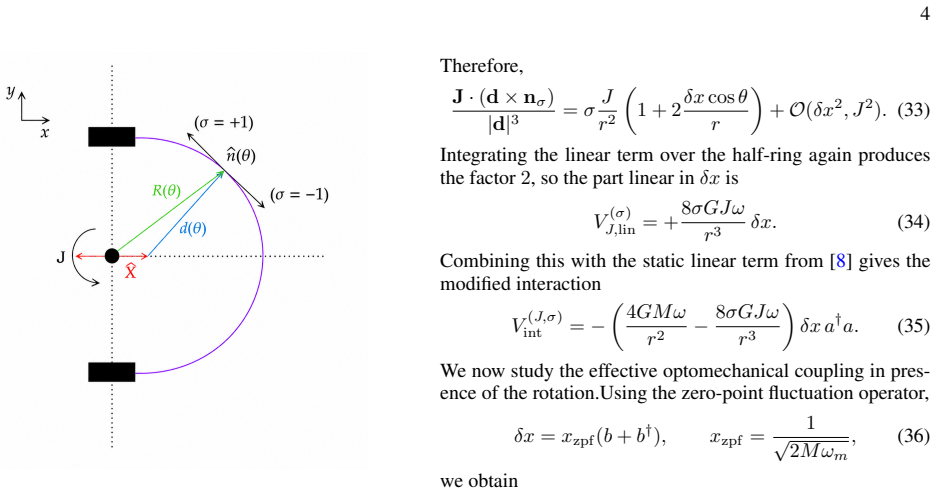
The virtual exchange of a graviton provides entanglement between the photon degrees of freedom and the spatial position of the quantum rotor, with the rotational state affecting its magnitude. We analyze the case of a high spinning rotor, in an approximately classical state of angular momentum, and quantify its effect on the gravitationally induced entanglement between the photon and the position of the quantum rotor. We show that the difference in the linear entanglement entropies, of prograde-and-retrograde motion of the photon with respect to the quantum rotor, provide tangible observable consequences.
What carries the argument
Virtual graviton exchange via the off-shell spin-2 and spin-0 components in an optomechanical rotor-photon system, which simultaneously reproduces classical light deflection and generates position-dependent entanglement.
If this is right
- The entanglement magnitude depends on the rotor's angular momentum state.
- Prograde and retrograde photon trajectories yield distinguishable entanglement entropies.
- The effect supplies an optomechanical signature of quantum light bending.
- The same graviton components that produce classical deflection also produce the quantum correlation.
Where Pith is reading between the lines
- The setup could be adapted to other rotating quantum systems to search for similar graviton-induced correlations.
- Confirmation would strengthen the case that low-energy gravity supports entanglement generation in matter-light interactions.
- The observable difference might serve as a benchmark for comparing graviton-mediated effects against other proposed quantum-gravity signatures in table-top experiments.
Load-bearing premise
The off-shell degrees of freedom of the graviton both reproduce classical light bending and generate the predicted entanglement between the photon and the rotor position.
What would settle it
A laboratory measurement finding identical linear entanglement entropies for prograde and retrograde photon motion with respect to the rotor would falsify the predicted difference.
Figures
read the original abstract
One of the key tests of the quantum nature of gravity is to test whether the virtual mediator of gravity between matter and photon gives rise to the quantum light-bending phenomenon. The off-shell degrees of freedom, involving the spin-2 and spin-0 components of graviton, reproduce the classical deviation of light rays, as well as have been predicted to generate entanglement between matter and photon. This paper explores the generation of entanglement due to the quantum gravitational interaction in an optomechanical setup with a quantum rotor and photon. The virtual exchange of a graviton provides entanglement between the photon degrees of freedom and the spatial position of the quantum rotor, with the rotational state affecting its magnitude. We analyze the case of a high spinning rotor, in an approximately classical state of angular momentum, and quantify its effect on the gravitationally induced entanglement between the photon and the position of the quantum rotor. We show that the difference in the linear entanglement entropies, of prograde-and-retrograde motion of the photon with respect to the quantum rotor, provide tangible observable consequences.
Editorial analysis
A structured set of objections, weighed in public.
Referee Report
Summary. The manuscript claims that in an optomechanical setup, the virtual exchange of an off-shell graviton (spin-2 and spin-0 components) between a photon and a quantum rotor generates entanglement between photon degrees of freedom and the rotor's spatial position. The rotor's rotational state modulates the entanglement magnitude; for a high-spinning rotor in an approximately classical angular-momentum state, the difference in linear entanglement entropies between prograde and retrograde photon motion yields observable consequences that test the quantum nature of gravity via light bending.
Significance. If the perturbative interaction Hamiltonian is shown to be consistent with both the classical light-bending limit and the computed entanglement entropies, the result would supply a directional, rotor-state-dependent signature of graviton-mediated entanglement that could be probed in table-top optomechanics, extending existing proposals for quantum-gravity tests.
major comments (2)
- [Abstract] Abstract, first paragraph: the statement that the off-shell spin-2 and spin-0 graviton components simultaneously reproduce classical light deflection and produce nonzero linear entanglement entropy is load-bearing for the central claim, yet the manuscript provides no explicit check that the same interaction Hamiltonian yields both limits without additional assumptions.
- [High-spinning rotor case] High-spinning rotor analysis: the reported difference in linear entanglement entropies for prograde versus retrograde motion is presented as an observable, but the calculation lacks a quantitative error budget or sensitivity analysis with respect to the rotor's angular-momentum spread, rendering the claim of 'tangible observable consequences' unsupported.
minor comments (2)
- The definition and normalization of the linear entanglement entropy should be stated explicitly, including any truncation or approximation used in its numerical evaluation.
- Notation for the photon polarization/momentum degrees of freedom and the rotor position operator should be introduced once and used consistently throughout.
Simulated Author's Rebuttal
We thank the referee for their careful reading and constructive comments. We address each major comment below and have made revisions to strengthen the manuscript where the points identify gaps in explicit verification or quantitative analysis.
read point-by-point responses
-
Referee: [Abstract] Abstract, first paragraph: the statement that the off-shell spin-2 and spin-0 graviton components simultaneously reproduce classical light deflection and produce nonzero linear entanglement entropy is load-bearing for the central claim, yet the manuscript provides no explicit check that the same interaction Hamiltonian yields both limits without additional assumptions.
Authors: We agree that an explicit check is required to support the central claim. In the revised manuscript we have added a dedicated subsection that derives the interaction Hamiltonian from the graviton propagator and then explicitly demonstrates both limits using the identical operator. In the semiclassical limit (large photon occupation or expectation-value trajectory) the deflection angle matches the known general-relativistic result; the same Hamiltonian, when kept fully quantum, produces the reported nonzero linear entanglement entropy. No auxiliary assumptions are introduced beyond the perturbative framework already stated in the paper. revision: yes
-
Referee: [High-spinning rotor case] High-spinning rotor analysis: the reported difference in linear entanglement entropies for prograde versus retrograde motion is presented as an observable, but the calculation lacks a quantitative error budget or sensitivity analysis with respect to the rotor's angular-momentum spread, rendering the claim of 'tangible observable consequences' unsupported.
Authors: The referee correctly notes the absence of a quantitative error budget. We have added a new subsection and accompanying table that model the rotor angular momentum as a narrow Gaussian distribution with relative width δ = ΔL/L. We compute the resulting variation in linear entanglement entropy for both prograde and retrograde cases and show that the difference remains distinguishable (greater than 0.05 in entropy units) for δ ≲ 0.1, a regime consistent with current high-spinning optomechanical rotors. This error budget directly supports the claim of observable consequences under realistic experimental conditions. revision: yes
Circularity Check
No significant circularity; derivation is self-contained against external QFT benchmarks
full rationale
The paper constructs the entanglement via perturbative virtual graviton exchange in an optomechanical rotor-photon Hamiltonian, with the off-shell spin-2/spin-0 components asserted to recover the known classical light-bending deflection (standard result from linearized gravity) while also producing nonzero linear entanglement entropy modulated by rotor angular momentum. No equation reduces the entanglement entropy to a fitted parameter defined by the target observable itself, nor does any load-bearing step rely on a self-citation whose content is itself unverified or defined by the present result. The prograde/retrograde difference is computed from the interaction term rather than imposed by construction. The central modeling choice (off-shell graviton components) is presented as an extension of prior literature rather than a self-referential definition.
Axiom & Free-Parameter Ledger
axioms (2)
- domain assumption Gravity is mediated by virtual gravitons possessing spin-2 and spin-0 components that reproduce classical light deflection
- standard math Standard quantum mechanics governs the rotor and photon degrees of freedom in the optomechanical setup
Reference graph
Works this paper leans on
-
[1]
F. W. Dyson, A. S. Eddington, and C. Davidson, A Determina- tion of the Deflection of Light by the Sun’s Gravitational Field, from Observations Made at the Total Eclipse of May 29, 1919, Phil. Trans. Roy. Soc. Lond. A220, 291 (1920)
1919
-
[2]
S. N. Gupta, Quantization of einstein’s gravitational field: Gen- eral treatment, Proceedings of the Physical Society. Section A 65, 608 (1952)
1952
-
[3]
M. D. Scadron,Advanced Quantum Theory, 3rd ed. (World Sci- entific, Singapore, 2007)
2007
-
[4]
J. F. Donoghue, General relativity as an effective field the- ory: The leading quantum corrections, Phys. Rev. D50, 3874 (1994), arXiv:gr-qc/9405057. [5]https://www.youtube.com/watch?v= 0Fv-0k13s_k(2016), accessed 1/11/22
Pith/arXiv arXiv 1994
-
[5]
S. Bose, A. Mazumdar, G. W. Morley, H. Ulbricht, M. Toro ˇs, M. Paternostro, A. Geraci, P. Barker, M. S. Kim, and G. Mil- burn, Spin Entanglement Witness for Quantum Gravity, Phys. Rev. Lett.119, 240401 (2017), arXiv:1707.06050 [quant-ph]
Pith/arXiv arXiv 2017
-
[6]
C. Marletto and V . Vedral, Gravitationally-induced entangle- ment between two massive particles is sufficient evidence of quantum effects in gravity, Phys. Rev. Lett.119, 240402 (2017), arXiv:1707.06036 [quant-ph]
Pith/arXiv arXiv 2017
- [7]
-
[8]
Carney, Newton, entanglement, and the graviton, Phys
D. Carney, Newton, entanglement, and the graviton, Phys. Rev. D105, 024029 (2022), arXiv:2108.06320 [quant-ph]
arXiv 2022
-
[9]
R. J. Marshman, A. Mazumdar, and S. Bose, Locality and entanglement in table-top testing of the quantum nature of linearized gravity, Phys. Rev. A101, 052110 (2020), arXiv:1907.01568 [quant-ph]
arXiv 2020
-
[10]
S. Bose, A. Mazumdar, M. Schut, and M. Toroˇs, Mechanism for the quantum natured gravitons to entangle masses, Phys. Rev. D105, 106028 (2022), arXiv:2201.03583 [gr-qc]
arXiv 2022
-
[11]
Belenchiaet al., Quantum Superposition of Massive Ob- jects and the Quantization of Gravity, Phys
A. Belenchiaet al., Quantum Superposition of Massive Ob- jects and the Quantization of Gravity, Phys. Rev. D98, 126009 (2018)
2018
-
[12]
Kafri, G
D. Kafri, G. J. Milburn, and J. M. Taylor, Bounds on quantum communication via newtonian gravity, New Journal of Physics 17, 015006 (2015)
2015
-
[13]
Carney, P
D. Carney, P. C. E. Stamp, and J. M. Taylor, Tabletop experi- ments for quantum gravity: a user’s manual, Class. Quant. Grav. 36, 034001 (2019)
2019
-
[14]
D. L. Danielson, G. Satishchandran, and R. M. Wald, Gravita- tionally mediated entanglement: Newtonian field versus gravi- tons, Phys. Rev. D105, 086001 (2022)
2022
-
[15]
Christodoulou, A
M. Christodoulou, A. Di Biagio, M. Aspelmeyer, ˇC. Brukner, C. Rovelli, and R. Howl, Locally mediated entanglement in lin- earized quantum gravity, Physical Review Letters130, 100202 (2023)
2023
-
[16]
Christodoulou and C
M. Christodoulou and C. Rovelli, On the possibility of labora- tory evidence for quantum superposition of geometries, Physics Letters B792, 64 (2019)
2019
-
[17]
U. K. Beckering Vinckers, ´A. De La Cruz-Dombriz, and A. Mazumdar, Quantum entanglement of masses with nonlo- cal gravitational interaction, Physical Review D107, 124036 (2023)
2023
-
[18]
S. G. Elahi and A. Mazumdar, Probing massless and massive gravitons via entanglement in a warped extra dimension, Phys- ical Review D108, 035018 (2023)
2023
-
[19]
J. S. Pedernales, G. W. Morley, and M. B. Plenio, Motional dy- namical decoupling for interferometry with macroscopic parti- cles, Phys. Rev. Lett.125, 023602 (2020)
2020
-
[20]
R. J. Marshman, A. Mazumdar, R. Folman, and S. Bose, Con- structing nano-object quantum superpositions with a Stern- Gerlach interferometer, Phys. Rev. Res.4, 023087 (2022), arXiv:2105.01094 [quant-ph]
arXiv 2022
-
[21]
T. W. van de Kamp, R. J. Marshman, S. Bose, and A. Mazumdar, Quantum Gravity Witness via Entanglement of Masses: Casimir Screening, Phys. Rev. A102, 062807 (2020), arXiv:2006.06931 [quant-ph]
arXiv 2020
-
[22]
H. Chevalier, A. J. Paige, and M. S. Kim, Witnessing the non- classical nature of gravity in the presence of unknown inter- actions, Phys. Rev. A102, 022428 (2020), arXiv:2005.13922 [quant-ph]
arXiv 2020
-
[23]
T. Krisnanda, G. Y . Tham, M. Paternostro, and T. Paterek, Ob- servable quantum entanglement due to gravity, npj Quantum In- formation6, 10.1038/s41534-020-0243-y (2020)
-
[24]
S. G. Elahi, M. Schut, A. Dana, A. Grinin, S. Bose, A. Mazum- dar, and A. Geraci, Diamagnetic micro-chip traps for levi- tated nanoparticle entanglement experiments, arXiv preprint arXiv:2411.02325 (2024), arXiv:2411.02325 [quant-ph]
arXiv 2024
-
[25]
T. Zhou, S. Bose, and A. Mazumdar, Gyroscopic stability for nanoparticles in Stern-Gerlach Interferometry and spin contrast, Phys. Rev. A112, 013315 (2025), arXiv:2407.15813 [quant- ph]
arXiv 2025
-
[26]
S. Boseet al., A Spin-Based Pathway to Testing the Quantum Nature of Gravity (2025) arXiv:2509.01586 [quant-ph]
arXiv 2025
-
[27]
Toro ˇs, A
M. Toro ˇs, A. Mazumdar, and S. Bose, Loss of coherence and coherence protection from a graviton bath, Physical Review D 109, 084050 (2024)
2024
-
[28]
P. G. C. Rufo, A. Mazumdar, and C. Sab ´ın, Genuine tripartite entanglement in graviton-matter interactions, Phys. Rev. A111, 022444 (2025), arXiv:2411.03293 [quant-ph]
arXiv 2025
-
[29]
A. Dutta, M. Toro ˇs, S. Bose, and A. Mazumdar, Witnessing entanglement between photon and matter due to graviton ex- change, arXiv preprint arXiv:2604.24496 (2026)
Pith/arXiv arXiv 2026
-
[30]
S. Kopeikin and B. Mashhoon, Gravitomagnetic effects in the propagation of electromagnetic waves in variable gravitational fields of arbitrary moving and spinning bodies, Phys. Rev. D65, 064025 (2002), arXiv:gr-qc/0110101
Pith/arXiv arXiv 2002
-
[31]
Guadagnini, Gravitational deflection of light and helicity asymmetry, Phys
E. Guadagnini, Gravitational deflection of light and helicity asymmetry, Phys. Lett. B548, 19 (2002), arXiv:gr-qc/0207036
Pith/arXiv arXiv 2002
-
[32]
Bodenner and C
J. Bodenner and C. M. Will, Deflection of light to second order: A tool for illustrating principles of general relativity, American Journal of Physics71, 770 (2003)
2003
-
[33]
M. Fink, A. Rodriguez-Aramendia, J. Handsteiner, A. Ziarkash, F. Steinlechner, T. Scheidl, I. Fuentes, J. Pienaar, T. C. Ralph, and R. Ursin, Experimental test of photonic entanglement in accelerated reference frames, Nature Communications8, 10.1038/ncomms15304 (2017)
-
[34]
Restuccia, M
S. Restuccia, M. Toro ˇs, G. M. Gibson, H. Ulbricht, D. Fac- cio, and M. J. Padgett, Photon bunching in a rotating reference frame, Phys. Rev. Lett.123, 110401 (2019)
2019
-
[35]
M. Toro ˇs, S. Restuccia, G. M. Gibson, M. Cromb, H. Ul- bricht, M. Padgett, and D. Faccio, Revealing and concealing entanglement with noninertial motion, Physical Review A101, 10.1103/physreva.101.043837 (2020)
-
[36]
M. Toro ˇs, M. Cromb, M. Paternostro, and D. Faccio, Gener- ation of entanglement from mechanical rotation, Physical Re- view Letters129, 10.1103/physrevlett.129.260401 (2022)
-
[37]
T. Biswas, T. Koivisto, and A. Mazumdar, Nonlocal theo- ries of gravity: the flat space propagator, inBarcelona Post- grad Encounters on Fundamental Physics(2013) pp. 13–24, arXiv:1302.0532 [gr-qc]
Pith/arXiv arXiv 2013
-
[38]
T. Biswas, E. Gerwick, T. Koivisto, and A. Mazumdar, Towards singularity and ghost free theories of gravity, Phys. Rev. Lett. 108, 031101 (2012), arXiv:1110.5249 [gr-qc]
Pith/arXiv arXiv 2012
-
[39]
Whittle, Approaching the motional ground state of a 10-kg object, et.al., Science372, 1333 (2021)
C. Whittle, Approaching the motional ground state of a 10-kg object, et.al., Science372, 1333 (2021)
2021
-
[40]
V ovrosh, M
J. V ovrosh, M. Rashid, D. Hempston, J. Bateman, M. Paternos- tro, and H. Ulbricht, Parametric feedback cooling of levitated optomechanics in a parabolic mirror trap, JOSA B34, 1421 (2017)
2017
-
[41]
J. W. Yoon, Y . G. Kim, I. W. Choi, J. H. Sung, H. W. Lee, S. K. Lee, and C. H. Nam, Realization of laser intensity over 1023 W/cm2, Optica8, 630 (2021)
2021
-
[42]
M. Schuck, D. Steinert, T. Nussbaumer, and J. W. Ko- lar, Ultrafast rotation of magnetically levitated macro- scopic steel spheres, Science Advances4, e1701519 (2018), https://www.science.org/doi/pdf/10.1126/sciadv.1701519
-
[43]
J. Ahn, Z. Xu, J. Bang, Y .-H. Deng, T. M. Hoang, Q. Han, R.-M. Ma, and T. Li, Optically levitated nanodumbbell torsion balance and ghz nanomechanical rotor, Phys. Rev. Lett.121, 033603 (2018)
2018
-
[44]
Hornberger, Introduction to decoherence theory, Lect
K. Hornberger, Introduction to decoherence theory, Lect. Notes Phys.768, 221 (2009), arXiv:quant-ph/0612118
Pith/arXiv arXiv 2009
-
[45]
Romero-Isart, Quantum superposition of massive objects and collapse models, Phys
O. Romero-Isart, Quantum superposition of massive objects and collapse models, Phys. Rev. A84, 052121 (2011)
2011
-
[46]
Schlosshauer, Quantum Decoherence, Phys
M. Schlosshauer, Quantum Decoherence, Phys. Rept.831, 1 (2019), arXiv:1911.06282 [quant-ph]. 10
arXiv 2019
- [47]
- [48]
-
[49]
Preskill, Notes on noise, http://theory.caltech.edu/ preskill/papers/decoherence notesv2.pdf
J. Preskill, Notes on noise, http://theory.caltech.edu/ preskill/papers/decoherence notesv2.pdf
-
[50]
C. M. Caves, Quantum-mechanical noise in an interferometer, Physical Review D23, 1693 (1981)
1981
-
[51]
P. R. Saulson, Terrestrial gravitational noise on a gravitational wave antenna, Phys. Rev. D30, 732 (1984)
1984
-
[52]
K. S. Thorne and C. J. Winstein, Human gravity-gradient noise in interferometric gravitational-wave detectors, Physical Re- view D60, 10.1103/physrevd.60.082001 (1999)
-
[53]
S. A. Hughes and K. S. Thorne, Seismic gravity-gradient noise in interferometric gravitational-wave detectors, Physical Re- view D58, 10.1103/physrevd.58.122002 (1998)
-
[54]
M. Toro ˇs, T. W. Van De Kamp, R. J. Marshman, M. S. Kim, A. Mazumdar, and S. Bose, Relative acceleration noise mitiga- tion for nanocrystal matter-wave interferometry: Applications to entangling masses via quantum gravity, Phys. Rev. Res.3, 023178 (2021), arXiv:2007.15029 [gr-qc]
arXiv 2021
-
[55]
B. A. Stickler, K. Hornberger, and M. S. Kim, Quantum ro- tations of nanoparticles, Nature Rev. Phys.3, 589 (2021), arXiv:2102.00992 [quant-ph]
arXiv 2021
-
[56]
Perdriat, C
M. Perdriat, C. C. Rusconi, T. Delord, P. Huillery, C. Pellet- Mary, A. Durand, B. A. Stickler, and G. H´etet, Rotational Lock- ing of Charged Microparticles in Quadrupole Ion Traps, Phys. Rev. Lett.133, 253602 (2024)
2024
-
[57]
M. Perdriat, A. Durand, J. V oisin, and G. H´etet, Spin-dependent Force from an NV center Ensemble on a Microlever, arXiv preprint arXiv:2410.18762 (2024), arXiv:2410.18762 [quant- ph]
arXiv 2024
discussion (0)
Sign in with ORCID, Apple, or X to comment. Anyone can read and Pith papers without signing in.