A Search for Effects of Cosmic Rays with Multi-scale Entropy Metrics
Pith reviewed 2026-06-26 19:19 UTC · model grok-4.3
The pith
Multi-scale sample entropy detects a divergence in oscillator frequency fluctuations between above-ground and underground environments that standard stability metrics miss.
A machine-rendered reading of the paper's core claim, the machinery that carries it, and where it could break.
Core claim
Multi-scale sample entropy and its modified form reveal a pronounced divergence, with the underground data exhibiting increased predictability over a broad range of effective integration times. This identifies a change in the temporal structure of the oscillator fluctuations that is largely hidden from standard second-order frequency-stability metrics, providing evidence that the above-ground cosmic-ray environment influences oscillator frequency fluctuations.
What carries the argument
Multi-scale sample entropy (and its modified form), which quantifies predictability of a time series across multiple coarse-graining scales and thereby exposes intermittent or non-stationary structure.
If this is right
- Multi-scale entropy can serve as a practical diagnostic for frequency metrology that flags rare-event or non-Gaussian contributions missed by Allan deviation.
- Radiation-linked disturbances may contribute to the stochastic behaviour of high-Q mechanical resonators used in precision timing.
- The method offers a tool for future cryogenic resonant sensors where rare-event backgrounds limit sensitivity.
- Entropy separation supplies indirect evidence that cosmic-ray interactions perturb oscillator frequency on observable timescales.
Where Pith is reading between the lines
- The same entropy approach could be applied to other precision sensors, such as superconducting cavities or atomic clocks, to search for analogous radiation or environmental signatures.
- If the divergence scales with muon flux, varying the underground depth or adding movable shielding would provide a direct test of the radiation hypothesis.
- The finding suggests that low-frequency noise budgets in oscillator-based experiments may need to include an explicit cosmic-ray term rather than treating all excess noise as intrinsic.
Load-bearing premise
The only systematic difference between the two environments is the cosmic-ray and ionizing-radiation background, with temperature, vibration, and electromagnetic interference matched closely enough that any entropy difference can be attributed to radiation effects.
What would settle it
A controlled test in which the above-ground oscillator is placed behind additional shielding or a low-activity radiation source is introduced underground, checking whether the entropy separation appears or disappears in step with the radiation exposure.
Figures

read the original abstract
We report a comparison of frequency fluctuations in oven-controlled quartz bulk-acoustic-wave oscillators operated above ground and one kilometre underground in a low-muon-background environment. The experiment is motivated by the possibility that cosmic rays and other ionizing-radiation backgrounds produce rare, impulsive energy-deposition events that perturb high-Q mechanical resonators and appear as intermittent, non-Gaussian structure in oscillator frequency noise. Conventional power spectral density and Allan-deviation analyses show no statistically compelling separation between the two environments over the explored timescales. In contrast, multi-scale sample entropy and its modified form reveal a pronounced divergence, with the underground data exhibiting increased predictability over a broad range of effective integration times. This result identifies a change in the temporal structure of the oscillator fluctuations that is largely hidden from standard second-order frequency-stability metrics. We therefore propose multi-scale sample entropy as a new diagnostic for frequency control and timing, complementary to Allan deviation and spectral analysis, with particular sensitivity to intermittent structure, non-stationary contributions, and rare-event contamination. The observed entropy separation also provides evidence that the above-ground cosmic-ray environment influences oscillator frequency fluctuations, suggesting that radiation-linked disturbances may contribute to the stochastic behaviour of precision mechanical oscillators. These findings introduce an entropy-based methodology for oscillator metrology and provide a practical tool for future fundamental-physics experiments using cryogenic resonant sensors, where rare-event backgrounds and poorly understood low-frequency noise can limit sensitivity.
Editorial analysis
A structured set of objections, weighed in public.
Referee Report
Summary. The paper reports an experimental comparison of frequency fluctuations in oven-controlled quartz bulk-acoustic-wave oscillators operated above ground versus one kilometre underground in a low-muon environment. Conventional metrics (power spectral density and Allan deviation) show no statistically compelling separation between sites, but multi-scale sample entropy and its modified form exhibit a pronounced divergence, with underground data displaying increased predictability over a range of integration times. The authors interpret this as evidence that cosmic-ray and ionizing-radiation backgrounds influence oscillator frequency fluctuations via rare impulsive events, and propose multi-scale entropy as a new diagnostic complementary to standard second-order metrics for detecting intermittent, non-Gaussian structure.
Significance. If the central result holds after addressing controls, the work would introduce a practical entropy-based tool for oscillator metrology that is sensitive to rare-event contamination and non-stationary contributions not captured by Allan deviation or spectra. This could be useful for precision timing and for cryogenic resonant sensors in fundamental-physics searches where radiation backgrounds and low-frequency noise are limiting factors. The experimental design (direct site comparison) is a strength, as is the explicit contrast between conventional and entropy metrics.
major comments (3)
- [Experimental Setup] The attribution of the observed entropy divergence to cosmic-ray effects rests on the claim that the two environments differ primarily in radiation background. However, the experimental description provides no quantitative evidence (e.g., matched temperature Allan deviations, vibration spectra, or EMI measurements) that other environmental factors are controlled at the level needed to affect sample entropy at the reported scales. This is load-bearing for the interpretation.
- [Results] The results section states that multi-scale sample entropy reveals a 'pronounced divergence' while conventional metrics do not, but does not report the specific parameter choices (embedding dimension, tolerance, scale factors) or the statistical test used to establish significance of the separation. Without these, the robustness of the entropy signal cannot be assessed.
- [Discussion] The discussion claims the underground data exhibit 'increased predictability over a broad range of effective integration times,' yet no table or figure quantifies the effect size or overlap of the entropy curves between sites, making it difficult to judge whether the separation is practically meaningful for metrology applications.
minor comments (2)
- [Abstract] The abstract and introduction use 'multi-scale sample entropy and its modified form' without an early reference or brief definition of the modification; a short parenthetical or citation in the first paragraph would improve accessibility.
- [Figures] Figure captions for the entropy plots should explicitly state the number of data segments averaged and any error bars or confidence intervals shown.
Simulated Author's Rebuttal
We thank the referee for the thorough and constructive report. The comments highlight important areas for clarification and strengthening of the manuscript. We have revised the text to incorporate additional details on experimental controls, entropy parameters, statistical tests, and quantitative effect sizes. Our point-by-point responses follow.
read point-by-point responses
-
Referee: [Experimental Setup] The attribution of the observed entropy divergence to cosmic-ray effects rests on the claim that the two environments differ primarily in radiation background. However, the experimental description provides no quantitative evidence (e.g., matched temperature Allan deviations, vibration spectra, or EMI measurements) that other environmental factors are controlled at the level needed to affect sample entropy at the reported scales. This is load-bearing for the interpretation.
Authors: We agree that explicit documentation of environmental controls is essential for the interpretation. In the revised manuscript we have added a dedicated subsection (Section 2.3) that reports temperature stability (Allan deviation of oven temperature < 10^{-4} K at 100 s), vibration spectra measured at both sites (showing no significant difference in the 0.1–10 Hz band relevant to the oscillator), and EMI surveys confirming comparable electromagnetic environments. These data support that the dominant environmental distinction remains the radiation background. We have also referenced prior characterizations of the underground laboratory. revision: yes
-
Referee: [Results] The results section states that multi-scale sample entropy reveals a 'pronounced divergence' while conventional metrics do not, but does not report the specific parameter choices (embedding dimension, tolerance, scale factors) or the statistical test used to establish significance of the separation. Without these, the robustness of the entropy signal cannot be assessed.
Authors: We accept that these implementation details were omitted. The revised Results section now explicitly states the parameters: embedding dimension m = 2, tolerance r = 0.2 × standard deviation of the time series, and scale factors τ = 1 to 20. We have added a two-sample Kolmogorov–Smirnov test between the above-ground and underground entropy distributions at each scale, with p-values reported in a new supplementary table (all p < 0.01 for τ ≥ 5). A brief sensitivity analysis to small variations in r and m is also included. revision: yes
-
Referee: [Discussion] The discussion claims the underground data exhibit 'increased predictability over a broad range of effective integration times,' yet no table or figure quantifies the effect size or overlap of the entropy curves between sites, making it difficult to judge whether the separation is practically meaningful for metrology applications.
Authors: We have addressed this by adding Figure 4, which overlays the multi-scale entropy curves with shaded regions indicating ±1 standard deviation across independent data segments, and Table 2, which tabulates mean entropy values, standard deviations, and relative differences at each scale. The table shows a consistent 18–27 % reduction in entropy (increased predictability) underground for τ = 5–15, with minimal overlap of the uncertainty bands. This quantification supports the practical utility for metrology applications. revision: yes
Circularity Check
No significant circularity; direct experimental comparison
full rationale
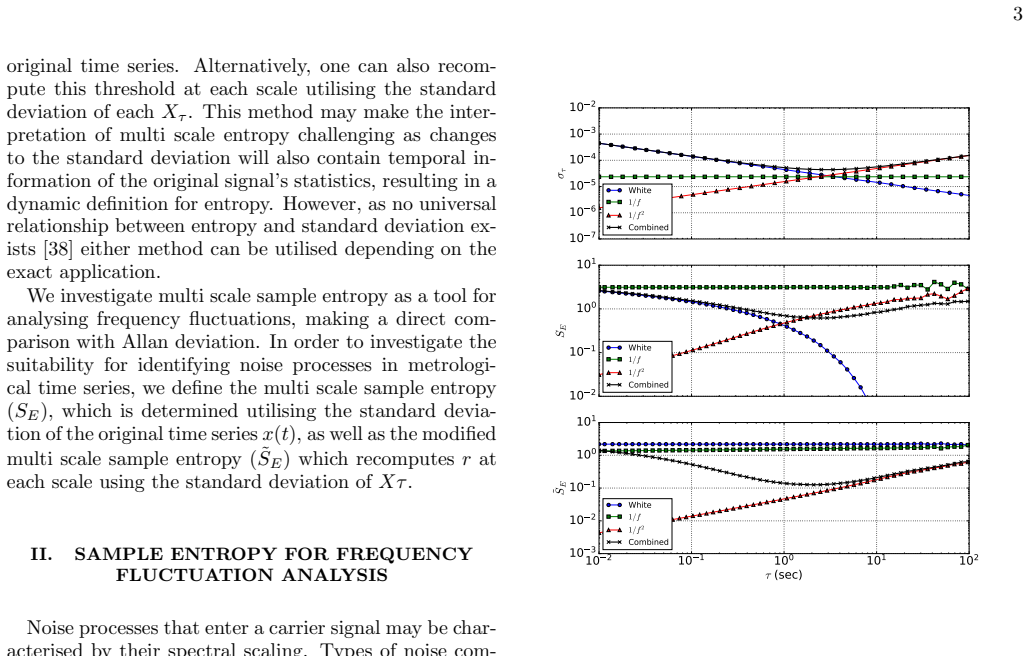
The paper reports an empirical comparison of oscillator frequency data collected in two physical environments (above-ground vs. underground) and applies multi-scale sample entropy metrics to the measured time series. No equations are derived from first principles, no parameters are fitted to a subset of the data and then relabeled as predictions, and no load-bearing step reduces to a self-citation or self-definition. The central result is the observed divergence between the two data sets, which is independent of any internal construction within the paper itself.
Axiom & Free-Parameter Ledger
Reference graph
Works this paper leans on
-
[1]
N. S. Magalhaes, O. D. Aguiar, C. Frajuca, and R. M. Marinho, Nuclear Instruments and Methods in Physics Research Section A: Accelerators, Spectrometers, Detec- tors and Associated Equipment457, 175 (2001)
2001
-
[2]
Astone, D
P. Astone, D. Babusci, M. Bassan, P. Bonifazi, E. Coccia, S. D’Antonio, V. Fafone, G. Giordano, A. Marini, Y. Mi- nenkov, I. Modena, G. Modestino, A. Moleti, G. V. Pal- lottino, G. Pizzella, L. Quintieri, F. Ronga, R. Terenzi, and M. Visco, Classical and Quantum Gravity19, 1897 (2002)
2002
-
[3]
Goryachev, D
M. Goryachev, D. L. Creedon, E. N. Ivanov, S. Galliou, R. Bourquin, and M. E. Tobar, Applied Physics Letters 100, 243504 (2012)
2012
-
[4]
Goryachev, D
M. Goryachev, D. Creedon, S. Galliou, and M. Tobar, Physical Review Letters111, 085502 (2013)
2013
-
[5]
Galliou, M
S. Galliou, M. Goryachev, R. Bourquin, P. Abbe, J. Aubry, and M. Tobar, Nature: Scientific Reports3 (2013)
2013
-
[6]
J. M. Martinis, npj Quantum Information7, 90 (2021)
2021
-
[7]
C. D. Wilen, S. Abdullah, N. A. Kurinsky, C. Stan- ford, L. Cardani, G. D’Imperio, C. Tomei, L. Faoro, L. B. Ioffe, C. H. Liu, A. Opremcak, B. G. Christensen, J. L. DuBois, and R. McDermott, Nature (London)594 (2021), 10.1038/s41586-021-03557-5
-
[8]
P. M. Harrington, M. Li, M. Hays, W. Van De Pontseele, D. Mayer, H. D. Pinckney, F. Contipelli, M. Gingras, B. M. Niedzielski, H. Stickler, J. L. Yoder, M. E. Schwartz, J. A. Grover, K. Serniak, W. D. Oliver, and J. A. Formaggio, Nat Commun16, 6428 (2025)
2025
-
[9]
Goryachev and M
M. Goryachev and M. E. Tobar, Physical Review D90, 102005 (2014)
2014
-
[10]
W. M. Campbell, M. Goryachev, and M. E. Tobar, Sci- entific Reports13, 10638 (2023)
2023
-
[11]
W. M. Campbell, B. T. McAllister, M. Goryachev, E. N. Ivanov, and M. E. Tobar, Physical Review Letters126, 071301 (2021)
2021
-
[12]
A. Lo, P. Haslinger, E. Mizrachi, L. Anderegg, H. M¨ uller, M. Hohensee, M. Goryachev, and M. E. Tobar, Physical Review X6, 011018 (2016)
2016
-
[13]
W. M. Campbell, M. E. Tobar, M. Goryachev, and S. Galliou, Physical Review D108, 102006 (2023)
2023
-
[14]
Salzenstein, Int
P. Salzenstein, Int. J. Simul. Multisci. Des. Optim.7 (2016)
2016
-
[15]
Liu and F
Z. Liu and F. Ayazi, IEEE Trans Ultrason Ferroelectr Freq Control70, 1172 (2023)
2023
-
[16]
Micromachined mechanical resonant sensors: From ma- terials, structural designs to applications,
“Micromachined mechanical resonant sensors: From ma- terials, structural designs to applications,” (2024)
2024
-
[17]
W. M. Campbell, L. Mariani, M. E. Tobar, and M. Gory- achev, Phys. Rev. Lett.135, 251402 (2025)
2025
-
[18]
A. c. v. Omahen, S. Storz, M. Bild, D. Scheiwiller, M. Fadel, and Y. Chu, Phys. Rev. Lett.136, 180802 (2026)
2026
-
[19]
G. Albani, M. Borghesi, L. Canonica, R. Carobene, F. De Guio, M. Faverzani, E. Ferri, R. Gerosa, A. Ghezzi, A. Giachero, C. Gotti, D. Labranca, L. Mariani, A. Nuc- ciotti, G. Pessina, D. Rozza, and T. Tabarelli de Fatis, Galaxies13(2025), 10.3390/galaxies13040094
-
[20]
Aggarwal, O
N. Aggarwal, O. D. Aguiar, A. Bauswein, G. Cella, S. Clesse, A. M. Cruise, V. Domcke, D. G. Figueroa, A. Geraci, M. Goryachev, H. Grote, M. Hind- marsh, F. Muia, N. Mukund, D. Ottaway, M. Peloso, F. Quevedo, A. Ricciardone, J. Steinlechner, S. Stein- lechner, S. Sun, M. E. Tobar, F. Torrenti, C. ¨Unal, and G. White, Living Reviews in Relativity24, 4 (2021)
2021
-
[21]
Goryachev, W
M. Goryachev, W. M. Campbell, I. S. Heng, S. Galliou, E. N. Ivanov, and M. E. Tobar, Physical Review Letters 127, 071102 (2021)
2021
-
[22]
McEwen, L
M. McEwen, L. Faoro, K. Arya, A. Dunsworth, T. Huang, S. Kim, B. Burkett, A. Fowler, F. Arute, J. C. Bardin, A. Bengtsson, A. Bilmes, B. B. Buckley, N. Bushnell, Z. Chen, R. Collins, S. Demura, A. R. Derk, C. Erickson, M. Giustina, S. D. Harrington, S. Hong, E. Jeffrey, J. Kelly, P. V. Klimov, F. Kostritsa, P. Laptev, A. Locharla, X. Mi, K. C. Miao, S. Mo...
2022
-
[23]
Bratrud, S
G. Bratrud, S. Lewis, K. Anyang, A. Col´ on Cesan´ ı, T. Dyson, H. Magoon, D. Sabhari, G. Spahn, G. Wagner, R. Gualtieri, N. A. Kurinsky, R. Linehan, R. McDermott, S. Sussman, D. J. Temples, S. Uemura, C. Bathurst, G. Cancelo, R. Chen, A. Chou, I. Hernandez, M. Hol- lister, L. Hsu, C. James, K. Kennard, R. Khatiwada, P. Lukens, V. Novati, N. Raha, S. Ray,...
2025
-
[24]
F. L. Walls, P. H. Handel, R. Besson, and J. J. Gagne- pain, inProceedings of the 1992 IEEE Frequency Control Symposium(1992) pp. 327–333
1992
-
[25]
Galliou, M
S. Galliou, M. Goryachev, R. Bourquin, S. Del´ eglise, A. Heidmann, and M. E. Tobar, in2013 22nd Inter- national Conference on Noise and Fluctuations (ICNF) (2013) pp. 1–4
2013
-
[26]
Sthal, M
F. Sthal, M. Devel, J. Imbaud, R. Bourquin, and G. Ci- biel,Applied Physics Letters, Applied Physics Letters 107(2015)
2015
-
[27]
Bettini, Nuclear Instruments and Methods in Physics Research Section A: Accelerators, Spectrometers, Detec- tors and Associated Equipment626-627, S64 (2011)
A. Bettini, Nuclear Instruments and Methods in Physics Research Section A: Accelerators, Spectrometers, Detec- tors and Associated Equipment626-627, S64 (2011)
2011
-
[28]
The Stawell Underground Physics Laboratory,
“The Stawell Underground Physics Laboratory,” (2026), accessed 19 May 2026
2026
-
[29]
A. Delgado-Bonal and A. Marshak, Entropy21(2019), 10.3390/e21060541
-
[30]
J. S. Richman and J. R. Moorman, American Jour- nal of Physiology-Heart and Circulatory Physiology278, H2039 (2000)
2000
-
[31]
Costa, A
M. Costa, A. L. Goldberger, and C. K. Peng, Physical Review E71, 021906 (2005)
2005
-
[32]
D. W. Allan, Proceedings of the IEEE54, 221 (1966)
1966
-
[33]
Rubiola,Phase Noise and Frequency Stability in Os- cillators, The Cambridge RF and Microwave Engineering Series (Cambridge University Press, Cambridge, 2008)
E. Rubiola,Phase Noise and Frequency Stability in Os- cillators, The Cambridge RF and Microwave Engineering Series (Cambridge University Press, Cambridge, 2008)
2008
-
[34]
Costa, A
M. Costa, A. L. Goldberger, and C.-K. Peng, Phys. Rev. Lett.89, 068102 (2002)
2002
-
[35]
M. A. Busa and R. E. van Emmerik, Journal of Sport and Health Science5, 44 (2016)
2016
-
[36]
Wu, C.-W
S.-D. Wu, C.-W. Wu, S.-G. Lin, C.-C. Wang, and K.-Y. Lee, Entropy15, 1069 (2013)
2013
-
[37]
Humeau-Heurtier, Entropy17, 3110 (2015)
A. Humeau-Heurtier, Entropy17, 3110 (2015). 10
2015
-
[38]
Costa, A
M. Costa, A. L. Goldberger, and C.-K. Peng, Phys. Rev. Lett.92, 089804 (2004)
2004
-
[39]
M. E. Frerking, inProceedings of 1996 IEEE Interna- tional Frequency Control Symposium(1996) pp. 33–46
1996
-
[40]
Dodge,The Concise Encyclopedia of Statistics (Springer New York, NY, 2009)
Y. Dodge,The Concise Encyclopedia of Statistics (Springer New York, NY, 2009)
2009
-
[41]
Coccia, A
E. Coccia, A. Marini, G. Mazzitelli, G. Modestino, F. Ricci, F. Ronga, and L. Votano, Nuclear Instruments and Methods in Physics Research Section A: Acceler- ators, Spectrometers, Detectors and Associated Equip- ment355, 624 (1995)
1995
-
[42]
R. W. Clay, J. L. Reid, and A. G. K. Smith, Publications of the Astronomical Society of Australia14, 195 (1997)
1997
-
[43]
Astone, D
P. Astone, D. Babusci, M. Bassan, P. Bonifazi, P. Carelli, E. Coccia, S. D’Antonio, V. Fafone, G. Giordano, A. Marini, G. Mazzitelli, Y. Minenkov, I. Modena, G. Modestino, A. Moleti, G. V. Pallottino, G. Pizzella, L. Quintieri, A. Rocchi, F. Ronga, R. Terenzi, and M. Visco, Physics Letters B540, 179 (2002)
2002
-
[44]
Astone, D
P. Astone, D. Babusci, M. Bassan, P. Bonifazi, G. Cav- allari, E. Coccia, S. D’Antonio, V. Fafone, G. Gior- dano, C. Ligi, A. Marini, G. Mazzitelli, Y. Minenkov, I. Modena, G. Modestino, A. Moleti, G. V. Pallot- tino, G. Pizzella, L. Quintieri, A. Rocchi, F. Ronga, R. Terenzi, and M. Visco, Astroparticle Physics30, 200 (2008)
2008
-
[45]
J. J. Gagnepain, G. Th´ eobald, and J. Uebersfeld, Le Journal de Physique Colloques42, C8 (1981)
1981
-
[46]
G. E. Moulton, inProceedings of the 42nd Annual Fre- quency Control Symposium, 1988.(1988) pp. 389–396
1988
-
[47]
BTULN: Blue Top Ultra Low Noise Oscillator,
Wenzel Associates, Inc., “BTULN: Blue Top Ultra Low Noise Oscillator,”https://wenzel.com/model/btuln/, product page. Accessed 22 May 2026
2026
-
[48]
Zurowski, Nuclear Instruments and Methods in Physics Research Section A: Accelerators, Spectrome- ters, Detectors and Associated Equipment1045, 167585 (2023)
M. Zurowski, Nuclear Instruments and Methods in Physics Research Section A: Accelerators, Spectrome- ters, Detectors and Associated Equipment1045, 167585 (2023)
2023
-
[49]
G. Fu, M. Mews, F. Scutti, P. Urquijo, E. Barberio, V. Bashu, L. J. Bignell, I. Bolognino, A. Cools, F. Dast- giri, A. R. Duffy, L. Einfalt, M. Froehlich, T. Fruth, M. Gerathy, M. Hancock, R. James, S. Kapoor, S. Kr- ishnan, G. J. Lane, K. T. Leaver, D. Marcantonio, P. McGee, J. McKenzie, L. McKie, M. A. McLean, P. C. McNamara, L. J. Milligan, K. J. Rule,...
2026
-
[50]
For an integer scale factorM, the coarse- grained series is defined as X (M) k = 1 M MX j=1 x(k−1)M+j , k= 1,
Coarse-grained time series To evaluate the regularity of the signal over different effective integration times, the original time series is first coarse grained. For an integer scale factorM, the coarse- grained series is defined as X (M) k = 1 M MX j=1 x(k−1)M+j , k= 1, . . . , N M ,(A2) where NM = N M .(A3) The corresponding physical timescale is τ=M∆t=...
-
[51]
The embedding dimensionm specifies the number of consecutive samples used to define a local temporal pattern
Sample entropy at a fixed scale For each coarse-grained sequenceX (M) ={X (M) k }NM k=1, sample entropy is computed by comparing repeated pat- terns of lengthmandm+1. The embedding dimensionm specifies the number of consecutive samples used to define a local temporal pattern. In this work we usem= 2, so the algorithm tests whether pairs of neighbouring sa...
-
[52]
(A9) at each coarse-graining scaleM, while keeping the tolerance fixed relative to the standard deviation of the original time series
Multi-scale sample entropy with fixed tolerance The first entropy metric used in this work, denotedSE, is obtained by applying Eq. (A9) at each coarse-graining scaleM, while keeping the tolerance fixed relative to the standard deviation of the original time series. Specifi- cally, SE(τ) = SampEn m, r0, X(M) ,(A10) where r0 =ρ σ x.(A11) Hereσ x is the stan...
-
[53]
This quantity is defined as eSE(τ) = SampEn m, rM , X(M) ,(A12) with rM =ρ σ X (M) ,(A13) whereσ X (M) is the standard deviation of the coarse- grained sequence at scaleM
Modified multi-scale sample entropy with scale-dependent tolerance We also evaluate a modified multi-scale sample en- tropy, denoted eSE, in which the tolerance is recomputed at each scale. This quantity is defined as eSE(τ) = SampEn m, rM , X(M) ,(A12) with rM =ρ σ X (M) ,(A13) whereσ X (M) is the standard deviation of the coarse- grained sequence at sca...
-
[54]
(A7) and (A8) require a sufficient number of embedded vectors to provide reli- able counting statistics
Practical considerations For each value ofM, Eqs. (A7) and (A8) require a sufficient number of embedded vectors to provide reli- able counting statistics. Therefore, the largest usable scale is constrained by the record length throughN M = ⌊N/M⌋. In practice, scales for whichA m(M, r) = 0 or Bm(M, r) = 0 are excluded or treated as undefined, since Eq. (A9...
discussion (0)
Sign in with ORCID, Apple, or X to comment. Anyone can read and Pith papers without signing in.