REVIEW 3 major objections 5 minor 1 cited by
Dust leaves a line-dependent fingerprint in multi-line intensity maps that can survive continuum cleaning and be used to measure attenuation.
Reviewed by Pith at T0; open to challenge. T0 means a machine referee read the full paper against a public rubric. the ladder, T0–T4 →
T0 review · deepseek-v4-flash
2026-08-01 12:33 UTC pith:GDIC43FP
load-bearing objection Careful mock-validation of multi-line LIM with combined dust, continuum, and PCA transfer; the pipeline work is solid, and the recovery tests are honest self-consistency checks, not external validation. the 3 major comments →
Reading Between the Lines: Forward Modeling Dust, Continuum, and Spectral Cleaning for Multi-Line Intensity Mapping
The pith
A machine-rendered reading of the paper's core claim, the machinery that carries it, and where it could break.
Core claim
The central claim is that the cross-channel power spectrum matrix C_ℓ(λ_i, λ_j) of multi-line intensity maps carries a geometric ridge pattern from same-redshift line pairs, and that this pattern survives continuum cleaning well enough to infer the nebular dust attenuation parameter f_neb (the nebular-to-stellar attenuation factor). Dust suppresses the cross-power along each ridge by a factor that depends on rest wavelength, galaxy properties, and redshift, which the paper encodes in a suppression matrix S_ij; this suppression cannot be absorbed into one global amplitude. After removing about 20 PCA modes from the total cube, the cleaned ridge amplitudes, modeled together with the cleaning t
What carries the argument
The central object is the cross-channel angular power spectrum matrix C_ℓ(λ_i, λ_j), whose off-diagonal same-redshift ridges are fixed by rest-wavelength ratios λ_b = λ_a (λ_b,rest / λ_a,rest). The paper compares this matrix across line-only, dust/no-dust, and PCA-cleaned versions, using the dust-suppression matrix S_ij = C_dust / C_nodust and a line transfer function measured by injecting a line-only cube through exactly the same cleaning operation as the total cube.
Load-bearing premise
The conclusions rest on the assumption that the mock galaxy population reproduces real line emission: each line's luminosity is a fixed multiple of star-formation rate with no metallicity or redshift dependence, and every galaxy shares the same slab-geometry Calzetti attenuation with f_neb=2.27.
What would settle it
Measure Balmer-decrement and [O II]/Hα ratios of resolved star-forming galaxies at z≈1–3 in the same volume as a line intensity mapping survey; if these ratios deviate systematically from the predictions of the slab model with f_neb=2.27 and the Calzetti curve, the predicted ridge-suppression matrix S_ij will not match real data, and the recovered effective dust parameter from cleaned maps would be biased.
If this is right
- A single global dust correction is inadequate for line intensity mapping forecasts; dust suppression must be modeled per line pair, wavelength, and redshift.
- The normalized correlation matrix r_ij isolates ridge geometry because multiplicative suppression cancels, while the dimensional C_ℓ carries the dust amplitude information, so both statistics should be used together.
- Removing roughly 15–25 PCA modes, with about 20 as the best single choice, is a workable cleaning prescription for continuum-dominated cubes, but only if the channel-dependent transfer function is part of the likelihood.
- Using the full wavelength–wavelength matrix rather than ridge elements alone, and combining multiple multipoles, tightens constraints on line amplitude and effective dust.
- Nebular dust attenuation can be probed statistically with multi-line intensity mapping, not just the total line emission.
Where Pith is reading between the lines
- If real oxygen-line ratios vary strongly with metallicity, as observations suggest, the fixed line-SFR coefficients in the mock will make ridge contrasts too sharp; a metallicity-dependent extension should weaken ridge amplitudes and broaden the inferred dust constraints.
- The same-redshift ridge geometry could serve as a blind 'geometric lock' to separate line emission from interloping lines and residual continuum before any amplitude inference, extending the paper's cleaning diagnostics to real data.
- The PCA20 optimum is tied to this specific mock; the portable result is the injection-based stopping test, which can be rerun on real observations without truth maps.
- Applying the transfer-function injection method to actual survey data would test whether the cleaning model is accurate, since the recovered f_neb should agree with dust estimates from resolved galaxies in the same volume.
Editorial analysis
A structured set of objections, weighed in public.
Referee Report
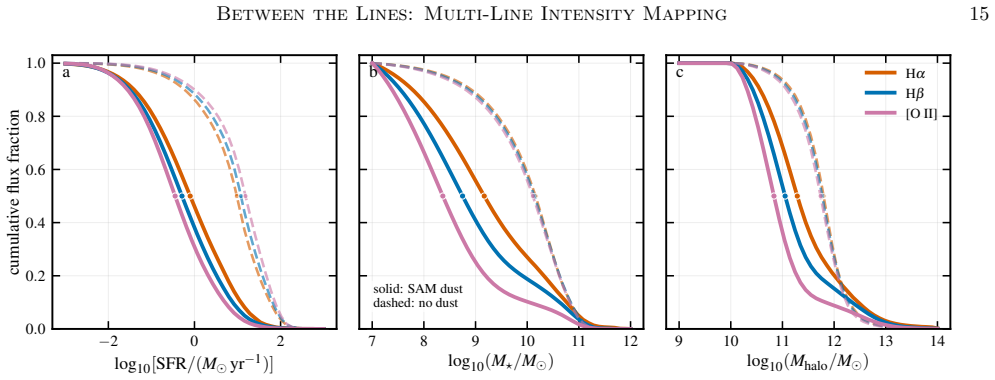
Summary. The paper presents an end-to-end forward model of multi-line intensity mapping (MLIM) for optical/NIR surveys like SPHEREx. It uses a ~2 deg^2 lightcone from the SMDPL simulation populated with the Santa Cruz SAM, assigns Hα, Hβ, [O III], and [O II] luminosities proportional to SFR with fixed population-averaged coefficients, applies a slab-geometry nebular dust attenuation tied to galaxy properties (f_neb=2.27, Calzetti+00 curve), constructs continuum and line maps, and measures cross-channel angular power spectra and normalized correlation matrices. It shows that dust suppresses the line cross-power in a wavelength- and line-pair-dependent way that cannot be represented by a single amplitude, that PCA cleaning with ~20 removed modes optimally balances continuum suppression and line recovery, and that the cleaned cross-channel matrix can recover injected line amplitude and dust parameters in mock inference tests.
Significance. If the results are robust, this framework is a valuable and much-needed tool for interpreting the line signal in SPHEREx-like spectral cubes. The explicit treatment of the cleaning transfer function, the warning that dust is not a single amplitude rescaling, and the demonstration that the normalized correlation matrix is dust-insensitive while the dimensional cross-power is not, are conceptually important and likely to influence future LIM analyses. The use of a public SAM catalog and the publication of clear mock-recovery diagnostics are strengths. However, the quantitative conclusions are drawn from a single realization, and the inference tests are self-consistency checks with the same model used for both data and template, so the external validity of the dust-recovery claim remains unproven.
major comments (3)
- [Sec. 6; Eqs. (43)-(46); Figs. 16-18] The mock inference is circular with respect to the dust and line-luminosity model: the data and the likelihood templates are generated from the same SAM catalog, the same fixed r_i coefficients (Eqs. 3-7), and the same slab/Calzetti dust prescription with f_neb=2.27. Recovering the injected A_dust=0.8 or f_neb=1.7 demonstrates internal consistency only, not that a real SPHEREx-like measurement can constrain effective attenuation if the true galaxy population has different intrinsic line ratios or attenuation curves. The authors acknowledge the simplifications in Secs. 2.2 and 7.5, but the abstract and Sec. 8 state that nebular dust attenuation 'can be probed statistically with MLIM' without this caveat. I request a stress test that uses a different intrinsic line-ratio model (e.g., metallicity-dependent [O II]/Hα from the SAM metallicities) or a different dust prescription, quantifying a
- [Sec. 5; Sec. 6; Eq. (40); Eq. (48)] All quantitative results—the PCA20 optimum, the transfer-quality metric Qtransfer, and the posterior contours—are based on a single 2 deg^2 realization. The covariance model used in the Gaussian likelihood (Eq. 48) is not specified, and no sample-variance or realization noise is propagated into Qtransfer or the MCMC uncertainties. It is therefore unclear whether the PCA20 choice is robust to cosmic variance and whether the quoted 1-σ constraints reflect the true statistical power. The authors should describe the covariance model, and at minimum test the stability of the PCA20 recommendation with a jackknife or a second lightcone realization. This is load-bearing because the central methodological claim (PCA20) is a single-realization statistic.
- [Sec. 2.2; Sec. 4.3; Fig. 8] The fixed line-SFR coefficients r_i mean that the relative amplitudes of the same-redshift ridges are driven solely by dust once the clustering normalization is fixed. In real galaxies, [O II]/Hα and [O III]/Hα vary strongly with metallicity, ionization parameter, and redshift (Kewley+04, Tremonti+04, Sanders+21), so the observed ridge ratios are a convolution of intrinsic ratio variations and dust. The SAM catalog provides metallicities, so the model could naturally include metallicity-dependent oxygen-line luminosities. Without at least a sensitivity test showing how the dust-suppression matrix and the inferred f_neb change when r_OII and r_OIII vary within the observed range, the paper's claim that dust 'cannot be captured via a single correction factor' conflates dust effects with the chosen constant line-ratio model. The text should be more careful to state that the dust signal is s
minor comments (5)
- [Eq. (29)] Please clarify whether f_nu,i,g is the flux density (Jy) or surface-brightness contribution (Jy/sr). The shot-noise formula as written may need a factor of the pixel solid angle to match the power-spectrum units; the current notation is ambiguous.
- [Eq. (48)] The covariance model used for the Gaussian likelihood is not described. The authors should state how sigma_ij is computed (instrumental noise only, or also sample variance and cleaning mode coupling) to assess the quoted uncertainties.
- [Fig. 6 and Fig. 7] The symmetric logarithmic color scales are helpful, but the captions should explicitly mention how negative values are handled and what the white/zero color represents.
- [Sec. 5.1 and Fig. 14] The injection test used as a data-driven stopping criterion injects a line template built from the same line-SFR model. This partially reintroduces the model dependence and should be acknowledged in the text.
- [General] The paper would benefit from a short algorithm box summarizing the forward-modeling steps from SAM catalog to cleaned maps and parameter inference, helping reproducibility.
Circularity Check
No significant circularity: central claims are consequences of the explicit forward model; recovery tests are transparently labeled closed-loop validations.
full rationale
This paper is a forward-modeling study: it builds mock LIM cubes from an external SAM lightcone (Yung et al. 2023), assigns line luminosities with fixed population-averaged ratios (Eqs. 3-7), applies a slab+Calzetti nebular attenuation (Eqs. 8-13), and examines the resulting cross-channel spectra and PCA cleaning. The central claim that dust suppression is line-pair- and wavelength-dependent is a direct, transparent consequence of the adopted attenuation model (Eq. 11: A_neb_X = R_att(lambda_X) A_neb_V and Eq. 13: f_dust = 10^(-0.4A)), not an inference that returns the model's assumptions under a new name. The mock recovery tests in Section 6 are explicitly labeled closed-loop checks: 'we deliberately inject an off-fiducial truth value, A_dust=0.8' and 'we inject an off-fiducial value f_neb=0.75 f_neb,0~1.7.' Because both the mock data and the likelihood templates (Eqs. 43-46) are drawn from the same forward model, recovering these injected values demonstrates internal consistency of the pipeline (interpolation, likelihood, transfer function), not external validity. The paper itself flags this: 'This work serves as a first end-to-end validation of the modeling and inference framework for a LIM survey, not as a survey forecast' (Sec. 7.5). Citations to the authors' own SAM and dust-curve work provide the simulation infrastructure but are external, calibrated models rather than a self-citation 'uniqueness' chain used to forbid alternatives. No fitted parameter is renamed as a prediction, and no step in the claimed derivation is equivalent by definition to its input.
Axiom & Free-Parameter Ledger
free parameters (4)
- Line-SFR coefficients r_i =
r_Ha=1.27e41, r_Hb=0.44e41, r_[OIII]=1.32e41, r_[OII]=0.71e41 (erg/s per Msun/yr)
- Nebular-to-stellar attenuation factor f_neb =
2.27
- Attenuation curve shape (Calzetti+00 parameters) =
(c1,c2,c3,c4) = (44.9,7.56,61.2,0) in Eq. 12
- Number of PCA modes removed N_PCA =
20
axioms (6)
- standard math Case B recombination gives fixed intrinsic H-alpha/H-beta ~ 2.86 and subordinate Balmer line ratios.
- domain assumption Line luminosities are exactly proportional to SFR with constant coefficients r_i for all galaxies and redshifts.
- domain assumption The SMDPL/Santa Cruz SAM lightcone accurately represents the galaxy population relevant for LIM, including clustering and dust properties.
- domain assumption Nebular attenuation follows the Calzetti+00 curve with f_neb=2.27 and a slab inclination model for all galaxies.
- domain assumption PCA cleaning transfer can be measured by a linear small-amplitude injection (finite difference in Eq. 33).
- domain assumption A Gaussian likelihood with the adopted mock covariance adequately represents cleaned-cube uncertainties.
read the original abstract
Line intensity mapping (LIM) offers a tomographic view of galaxy evolution by measuring the aggregate emission from unresolved galaxies. In the optical and near-infrared, the line emission is accompanied by much brighter continuum emission that must be removed to recover line auto- and cross-power spectra. We develop a forward-modeling framework using a $\sim2$deg$^2$ lightcone drawn from a cosmological $N$-body simulation populated with galaxies using a physics-based semi-analytic model (SAM). We construct intensity maps for the stellar continuum and for the strongest optical lines, H$\alpha$, H$\beta$, [O III] $\lambda5007$, and [O II] $\lambda3727$, including nebular dust attenuation tied to galaxy properties. From these cubes, we measure cross-channel angular power spectra, $C_\ell(\lambda_i,\lambda_j)$, and the normalized correlation matrix $r_{ij}$. In line-only maps, the correlation matrices show same-redshift ridges between emission lines, demonstrating how multi-line intensity mapping (MLIM) can isolate large-scale structure and probe dust attenuation. We show that dust suppresses the line cross-power by an amount that depends on galaxy properties, wavelength, and line pair, so a single overall amplitude cannot capture its effect. In total maps, however, the continuum dominates the raw correlations and hides much of the line-ridge structure. We therefore apply principal component analysis (PCA)-based spectral cleaning and quantify the line-transfer function using the simulation truth. Removing 20 PCA modes gives the best trade-off between line recovery and continuum suppression in our mock maps. Our results demonstrate the promise and challenges of extracting dust-sensitive LIM observables from SPHEREx-like observations, and highlight the need to model continuum cleaning and its transfer function in quantitative inference pipelines.
Figures




Forward citations
Cited by 1 Pith paper
-
Interlopers as Signal in Line Intensity Mapping
Jointly modeling LIM interlopers as projected multi-redshift tracers often beats cleaning for Ω_m h² and BAO distances, yielding a transverse BAO ladder over 0.7≲z≲5.8 in SPHEREx/FYST forecasts.
Reference graph
Works this paper leans on
-
[1]
MultiDark simulations: the story of dark matter halo concentrations and density profiles. , keywords =. doi:10.1093/mnras/stw248 , archivePrefix =. 1411.4001 , primaryClass =
-
[2]
emcee: The MCMC Hammer. , keywords =. doi:10.1086/670067 , archivePrefix =. 1202.3665 , primaryClass =
-
[3]
Can Photoionization Squelching Resolve the Substructure Crisis?. , keywords =. doi:10.1086/341444 , archivePrefix =. astro-ph/0107507 , primaryClass =
-
[5]
Physical properties and scaling relations for galaxies at z = 4-10
Semi-analytic forecasts for JWST - II. Physical properties and scaling relations for galaxies at z = 4-10. , keywords =. doi:10.1093/mnras/stz2755 , archivePrefix =. 1901.05964 , primaryClass =
Pith/arXiv arXiv 1901
-
[7]
Dust Attenuation Curves in the Local Universe: Demographics and New Laws for Star-forming Galaxies and High-redshift Analogs. , keywords =. doi:10.3847/1538-4357/aabf3c , archivePrefix =. 1804.05850 , primaryClass =
-
[8]
The Dust Attenuation Law in Galaxies. , keywords =. doi:10.1146/annurev-astro-032620-021933 , archivePrefix =. 2001.03181 , primaryClass =
Pith/arXiv arXiv 2001
-
[9]
A method for 21 cm power spectrum estimation in the presence of foregrounds. , keywords =. doi:10.1103/PhysRevD.83.103006 , archivePrefix =. 1103.0281 , primaryClass =
-
[10]
21 cm Tomography with Foregrounds. , keywords =. doi:10.1086/506597 , archivePrefix =. astro-ph/0501081 , primaryClass =
-
[11]
Physics of the Interstellar and Intergalactic Medium
-
[13]
Star Formation in the Milky Way and Nearby Galaxies. , keywords =. doi:10.1146/annurev-astro-081811-125610 , archivePrefix =. 1204.3552 , primaryClass =
-
[14]
The MOSDEF Survey: The Evolution of the Mass-Metallicity Relation from z = 0 to z 3.3. , keywords =. doi:10.3847/1538-4357/abf4c1 , archivePrefix =. 2009.07292 , primaryClass =
Pith/arXiv arXiv 2009
-
[15]
The Origin of the Mass-Metallicity Relation: Insights from 53,000 Star-forming Galaxies in the Sloan Digital Sky Survey. , keywords =. doi:10.1086/423264 , archivePrefix =. astro-ph/0405537 , primaryClass =
-
[16]
2006 , publisher=
Astrophysics of Gaseous Nebulae and Active Galactic Nuclei , author=. 2006 , publisher=
2006
-
[17]
LIMpy: A Semianalytic Approach to Simulating Multiline Intensity Maps at Millimeter Wavelengths. , keywords =. doi:10.3847/1538-4357/acf92f , archivePrefix =. 2304.06748 , primaryClass =
-
[18]
Simulated light-cones and galaxy clustering predictions
Semi-analytic forecasts for JWST - VI. Simulated light-cones and galaxy clustering predictions. , keywords =. doi:10.1093/mnras/stac2139 , archivePrefix =. 2206.13521 , primaryClass =
-
[19]
Semi-analytic forecasts for Roman - the beginning of a new era of deep-wide galaxy surveys. , keywords =. doi:10.1093/mnras/stac3595 , archivePrefix =. 2210.04902 , primaryClass =
-
[20]
The foreground transfer function for H I intensity mapping signal reconstruction: MeerKLASS and precision cosmology applications. , keywords =. doi:10.1093/mnras/stad1567 , archivePrefix =. 2302.07034 , primaryClass =
-
[21]
On Dust Extinction of Gamma-Ray Burst Host Galaxies. , keywords =. doi:10.1086/591049 , archivePrefix =. 0808.4115 , primaryClass =
-
[22]
Learning the Universe: Physically Motivated Priors for Dust Attenuation Curves. , keywords =. doi:10.3847/1538-4357/addec1 , archivePrefix =. 2502.13240 , primaryClass =
-
[23]
Phase-space Spectral Line Deconfusion in Intensity Mapping. , keywords =. doi:10.3847/1538-4357/abb023 , archivePrefix =. 2005.05341 , primaryClass =
Pith/arXiv arXiv 2005
-
[24]
The MOSDEF Survey: The First Direct Measurements of the Nebular Dust Attenuation Curve at High Redshift. , keywords =. doi:10.3847/1538-4357/abb674 , archivePrefix =. 2009.10085 , primaryClass =
Pith/arXiv arXiv 2009
-
[25]
Demonstrating the feasibility of line intensity mapping using mock data of galaxy clustering from simulations. , keywords =. doi:10.1088/1475-7516/2011/08/010 , archivePrefix =. 1104.4809 , primaryClass =
Pith/arXiv arXiv 2011
-
[27]
Theoretical Evolution of Optical Strong Lines across Cosmic Time. , keywords =. doi:10.1088/0004-637X/774/2/100 , archivePrefix =. 1307.0508 , primaryClass =
-
[30]
Cosmic Reionization and Early Star-forming Galaxies: A Joint Analysis of New Constraints from Planck and the Hubble Space Telescope. , keywords =. doi:10.1088/2041-8205/802/2/L19 , archivePrefix =. 1502.02024 , primaryClass =
Pith/arXiv arXiv 2041
-
[31]
, year =
A semi-analytic model for the co-evolution of galaxies, black holes and active galactic nuclei. , year =
-
[32]
, year =
Star formation in semi-analytic galaxy formation models with multiphase gas. , year =
-
[33]
, year =
The Dust Content and Opacity of Actively Star-forming Galaxies. , year =
-
[34]
, year =
A Simple Model for the Absorption of Starlight by Dust in Galaxies. , year =
-
[35]
, year =
Star Formation in Galaxies Along the Hubble Sequence. , year =
-
[36]
Astrophysics of Gaseous Nebulae and Active Galactic Nuclei
-
[37]
, year =
The Luminosity Function and Star Formation Rate between Redshifts of 0.07 and 1.47 for Narrowband Emitters in the Subaru Deep Field. , year =
-
[38]
, year =
Intensity Mapping of H-alpha, H-beta, [OII], and [OIII] Lines at z < 5. , year =
-
[40]
Tomography of the Cosmic Dawn and Reionization Eras with Multiple Tracers
Tomography of the Cosmic Dawn and Reionization Eras with Multiple Tracers. , keywords =. doi:10.48550/arXiv.1903.11744 , archivePrefix =. 1903.11744 , primaryClass =
work page internal anchor Pith review Pith/arXiv arXiv doi:10.48550/arxiv.1903.11744 1903
-
[41]
On the general nature of 21-cm-Lyman emitter cross-correlations during reionization. , keywords =. doi:10.1093/mnras/stad2376 , archivePrefix =. 2306.03156 , primaryClass =
-
[42]
Insights into the 21 cm field from the vanishing cross-power spectrum at the epoch of reionization. , keywords =. doi:10.1093/mnras/stae1050 , archivePrefix =. 2404.08266 , primaryClass =
-
[43]
Cross-correlation between the 21-cm signal and [O III] emitters during early cosmic reionization. , keywords =. doi:10.1093/mnras/stz2308 , archivePrefix =. 1906.10863 , primaryClass =
Pith/arXiv arXiv 1906
-
[44]
The Cross-Correlation of High-Redshift 21 cm and Galaxy Surveys. , keywords =. doi:10.1086/513009 , archivePrefix =. astro-ph/0611274 , primaryClass =
-
[45]
LIMFAST. III. Timing Cosmic Reionization with the 21 cm and Near-infrared Backgrounds. , keywords =. doi:10.3847/1538-4357/adae12 , archivePrefix =. 2410.21410 , primaryClass =
-
[46]
A New Boundary Condition on Reionization
A New Boundary Condition on Reionization. arXiv e-prints , keywords =. doi:10.48550/arXiv.2509.08886 , archivePrefix =. 2509.08886 , primaryClass =
work page internal anchor Pith review Pith/arXiv arXiv doi:10.48550/arxiv.2509.08886
-
[47]
Cosmology with Phase 1 of the Square Kilometre Array Red Book 2018: Technical specifications and performance forecasts. , keywords =. doi:10.1017/pasa.2019.51 , archivePrefix =. 1811.02743 , primaryClass =
Pith/arXiv arXiv 2018
-
[48]
Hydrogen Epoch of Reionization Array (HERA). , keywords =. doi:10.1088/1538-3873/129/974/045001 , archivePrefix =. 1606.07473 , primaryClass =
-
[49]
The Importance of Wide-field Foreground Removal for 21 cm Cosmology: A Demonstration with Early MWA Epoch of Reionization Observations. , keywords =. doi:10.3847/0004-637X/819/1/8 , archivePrefix =. 1601.06177 , primaryClass =
-
[50]
LOFAR: The LOw-Frequency ARray. , keywords =. doi:10.1051/0004-6361/201220873 , archivePrefix =. 1305.3550 , primaryClass =
-
[51]
Breysse, Patrick C. and others. COMAP Early Science. VII. Prospects for CO Intensity Mapping at Reionization. Astrophys. J. 2022. doi:10.3847/1538-4357/ac63c9. arXiv:2111.05933
Pith/arXiv arXiv 2022
-
[52]
Stutzer, N. -O. and others. COMAP Pathfinder Season 2 results - II. Updated constraints on the CO(1 0) power spectrum. Astron. Astrophys. 2024. doi:10.1051/0004-6361/202451123. arXiv:2406.07511
Pith/arXiv arXiv 2024
-
[53]
Observing the tail of reionization: neutral islands in the z = 5.5 Lyman- forest
Nasir, Fahad and D'Aloisio, Anson. Observing the tail of reionization: neutral islands in the z = 5.5 Lyman- forest. Mon. Not. Roy. Astron. Soc. 2020. doi:10.1093/mnras/staa894. arXiv:1910.03570
Pith/arXiv arXiv 2020
-
[54]
Bosman, Sarah E. I. and others. Hydrogen reionization ends by z = 5.3: Lyman- optical depth measured by the XQR-30 sample. Mon. Not. Roy. Astron. Soc. 2022. doi:10.1093/mnras/stac1046. arXiv:2108.03699
Pith/arXiv arXiv 2022
-
[55]
Gaikwad, Prakash and others. Measuring the photoionization rate, neutral fraction, and mean free path of H\,i ionizing photons at 4.9 z 6.0 from a large sample of XShooter and ESI spectra. Mon. Not. Roy. Astron. Soc. 2023. doi:10.1093/mnras/stad2566. arXiv:2304.02038
Pith/arXiv arXiv 2023
-
[56]
Davies, Frederick B. and others. Constraints on the Evolution of the Ionizing Background and Ionizing Photon Mean Free Path at the End of Reionization. Astrophys. J. 2024. doi:10.3847/1538-4357/ad1d5d. arXiv:2312.08464
Pith/arXiv arXiv 2024
-
[57]
Evidence of patchy hydrogen reionization from an extreme Ly trough below redshift six. , keywords =. doi:10.1093/mnras/stu2646 , archivePrefix =. 1407.4850 , primaryClass =
-
[58]
Photon number conservation and the large-scale 21 cm power spectrum in seminumerical models of reionization. , keywords =. doi:10.1093/mnras/sty2551 , archivePrefix =. 1807.00836 , primaryClass =
-
[60]
The importance of galaxy formation histories in models of reionization. , keywords =. doi:10.1093/mnras/stab1871 , archivePrefix =. 2012.09189 , primaryClass =
Pith/arXiv arXiv 2012
-
[61]
o and Anirudh, R. and Sutherland, Sagan and Kaasinen, Melanie , title =
Garcia, Karolina and Narayanan, Desika and Popping, Gerg\"o and Anirudh, R. and Sutherland, Sagan and Kaasinen, Melanie , title = ". Astrophys. J. 2024. doi:10.3847/1538-4357/ad642c. arXiv:2311.01508
Pith/arXiv arXiv 2024
-
[62]
The Baryon Acoustic Oscillation Broadband and Broad-beam Array: Design Overview and Sensitivity Forecasts. , keywords =. doi:10.1088/0004-6256/145/3/65 , archivePrefix =. 1210.2413 , primaryClass =
-
[63]
doi:10.1007/978-3-319-44431-4 , adsurl =
Interferometry and Synthesis in Radio Astronomy, 3rd Edition. doi:10.1007/978-3-319-44431-4 , adsurl =
-
[64]
Ground-based and Airborne Telescopes VII , year = 2018, editor =
The Next-Generation Very Large Array: a technical overview. Ground-based and Airborne Telescopes VII , year = 2018, editor =. doi:10.1117/12.2312089 , archivePrefix =. 1806.08405 , primaryClass =
Pith/arXiv arXiv 2018
-
[65]
A Sensitivity and Array-configuration Study for Measuring the Power Spectrum of 21 cm Emission from Reionization. , keywords =. doi:10.1088/0004-637X/753/1/81 , archivePrefix =. 1103.2135 , primaryClass =
-
[66]
What Next-generation 21 cm Power Spectrum Measurements can Teach us About the Epoch of Reionization. , keywords =. doi:10.1088/0004-637X/782/2/66 , archivePrefix =. 1310.7031 , primaryClass =
-
[67]
21-cm signature of the first sources in the Universe: prospects of detection with SKA. , keywords =. doi:10.1093/mnras/stw953 , archivePrefix =. 1511.07448 , primaryClass =
-
[68]
Connecting CO Intensity Mapping to Molecular Gas and Star Formation in the Epoch of Galaxy Assembly. , keywords =. doi:10.3847/0004-637X/817/2/169 , archivePrefix =. 1503.08833 , primaryClass =
-
[69]
The Astrophysical Journal , volume=
Cross-correlation Techniques to Mitigate the Interloper Contamination for Line Intensity Mapping Experiments , author=. The Astrophysical Journal , volume=. 2024 , publisher=
2024
-
[71]
The Growth of H II Regions During Reionization. , keywords =. doi:10.1086/423025 , archivePrefix =. astro-ph/0403697 , primaryClass =
-
[72]
Forecasts and Statistical Insights for Line Intensity Mapping Cross-correlations: A Case Study with 21 cm [C II]. , keywords =. doi:10.3847/1538-4357/ad77cc , archivePrefix =. 2407.14588 , primaryClass =
-
[73]
Monthly Notices of the Royal Astronomical Society: Letters , volume=
Large Ly opacity fluctuations and low CMB in models of late reionization with large islands of neutral hydrogen extending to z< 5.5 , author=. Monthly Notices of the Royal Astronomical Society: Letters , volume=. 2019 , publisher=
2019
-
[74]
Cosmology at low frequencies: The 21 cm transition and the high-redshift Universe. , eprint =. doi:10.1016/j.physrep.2006.08.002 , adsurl =
-
[75]
, archivePrefix = "arXiv", eprint =
Probing Patchy Reionization through -21 cm Correlation Statistics. , archivePrefix = "arXiv", eprint =. doi:10.1088/0004-637X/779/2/124 , adsurl =
-
[76]
Charles R. Harris and K. Jarrod Millman and St. Array programming with. 2020 , month = sep, journal =. doi:10.1038/s41586-020-2649-2 , publisher =
-
[77]
CONCERTO: Extracting the power spectrum of the [C _ II ] emission line. , keywords =. doi:10.1051/0004-6361/202346270 , archivePrefix =. 2306.01568 , primaryClass =
-
[78]
Bernal, Jos\'e Luis and Breysse, Patrick C. and Kovetz, Ely D. Cosmic Expansion History from Line-Intensity Mapping. Phys. Rev. Lett. 2019. doi:10.1103/PhysRevLett.123.251301. arXiv:1907.10065
arXiv 2019
-
[79]
udiger and Springel, Volker and Hernquist, Lars , title =
Kannan, Rahul and Smith, Aaron and Garaldi, Enrico and Shen, Xuejian and Vogelsberger, Mark and Pakmor, R\"udiger and Springel, Volker and Hernquist, Lars , title = ". Mon. Not. Roy. Astron. Soc. 2022. doi:10.1093/mnras/stac1557. arXiv:2111.02411
Pith/arXiv arXiv 2022
-
[81]
Cosmological Constraints from Line Intensity Mapping with Interlopers. , keywords =. doi:10.3847/1538-4357/ab87a0 , archivePrefix =. 2001.10792 , primaryClass =
Pith/arXiv arXiv 2001
-
[82]
Measuring the EoR Power Spectrum without Measuring the EoR Power Spectrum. , keywords =. doi:10.3847/1538-4357/ab0a08 , archivePrefix =. 1811.10609 , primaryClass =
-
[83]
A statistical framework for recovering intensity mapping autocorrelations from crosscorrelations
A statistical framework for recovering intensity mapping autocorrelations from crosscorrelations. arXiv e-prints , keywords =. doi:10.48550/arXiv.2308.00749 , archivePrefix =. 2308.00749 , primaryClass =
work page internal anchor Pith review Pith/arXiv arXiv doi:10.48550/arxiv.2308.00749
-
[84]
Constraining the star formation rate using joint CIB continuum and C II intensity mapping. , keywords =. doi:10.1093/mnras/stad2172 , archivePrefix =. 2211.04531 , primaryClass =
-
[85]
Characterizing the Conditional Galaxy Property Distribution Using Gaussian Mixture Models. , keywords =. doi:10.3847/1538-4357/accb90 , archivePrefix =. 2302.11166 , primaryClass =
-
[86]
Line-intensity mapping: theory review with a focus on star-formation lines
Bernal, Jos\'e Luis and Kovetz, Ely D. Line-intensity mapping: theory review with a focus on star-formation lines. Astron. Astrophys. Rev. 2022. doi:10.1007/s00159-022-00143-0. arXiv:2206.15377
Pith/arXiv arXiv 2022
-
[87]
Sun, Guochao and Mas-Ribas, Llu\' s and Chang, Tzu-Ching and Furlanetto, Steven R. and Mebane, Richard H. and Gonzalez, Michael O. and Parsons, Jasmine and Trapp, A. C. LIMFAST. II. Line Intensity Mapping as a Probe of High-Redshift Galaxy Formation. 2022. arXiv:2206.14186
Pith/arXiv arXiv 2022
-
[89]
The dust content of galaxies from z = 0 to z = 9. , keywords =. doi:10.1093/mnras/stx1545 , archivePrefix =. 1609.08622 , primaryClass =
-
[90]
Evaluating and improving semi-analytic modelling of dust in galaxies based on radiative transfer calculations - II. Dust emission in the infrared. , keywords =. doi:10.1111/j.1365-2966.2011.19245.x , archivePrefix =. 1011.0776 , primaryClass =
arXiv 2011
-
[91]
Intensity Mapping in the Presence of Foregrounds and Correlated Continuum Emission. , keywords =. doi:10.3847/1538-4357/aaf9ab , archivePrefix =. 1812.06223 , primaryClass =
discussion (0)
Sign in with ORCID, Apple, or X to comment. Anyone can read and Pith papers without signing in.