REVIEW 4 major objections 5 minor 26 references
Equip Pre-ranking with Target Attention by Residual Quantization
T0 review · 4 major / 5 minor · reviewed 2026-08-15 · deepseek-v4-flash
Pith's one-line read TARQ claims residual quantization lets target-attention interaction run in pre-ranking as a fixed 128-vector lookup, with offline AUC rising from 0.785 to 0.799 and online GMV up 7.57 percent.
desk verdict Clever and plausible TA-approximation for pre-ranking, but Eq. (18) has a sign error that inverts the alignment loss, so as written the mechanism cannot be what produces the reported gains. read the letter →
The pith
A machine-rendered reading of the paper's core claim, the machinery that carries it, and where it could break.
The reading
What carries the argument
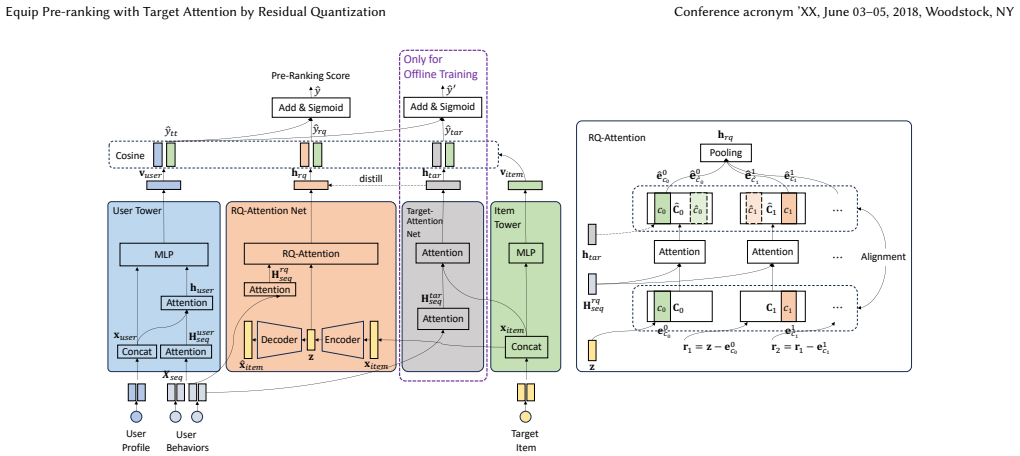
The load-bearing mechanism is the residual quantizer combined with the personalized codebook lookup. The quantizer decomposes a target item's embedding into m residuals r_0 through r_{m-1}, each assigned to the nearest entry in a codebook C_l, producing semantic IDs c_l = argmin_i ||r_l - e^i_l||; the selected entries sum to the quantized item representation. At inference the same IDs are looked up in user-specific codebooks Δ C_l = MHA(C_l, H_rq_seq, H_rq_seq), so the attention-like interaction is realized by a table read that costs exactly m K vector operations, here 8 times 16 equals 128, per request. An offline teacher's target vector h_tar, the distillation loss, and the level-wise KL alignment between the distributions P^l_z and P^l_h_tar keep the student's looked-up vector close to the true target-attention output.
What would settle it
On a held-out user-item set, compute the mean squared distance between the RQ-Attention vector h_rq and the full target-attention vector h_tar for the same input, and compare it with the same distance when the semantic IDs are replaced by random codebook indices. If the two distances are statistically indistinguishable, the claim that residual quantization approximates target attention is falsified.
Extended reading notes
Core claim
TARQ's central discovery is a way to approximate the user-target attention operation with a representation-focused architecture. A residual quantizer compresses each item's latent vector into a sequence of semantic IDs by successive codebook lookups; at serving time those IDs index a set of codebooks that have been personalized to the current user through attention over the user's behavior sequence. The approximate interaction vector is fused from the looked-up entries and scored against the item vector, so the online cost no longer depends on candidate-set size. An offline teacher network computes the true target-attention vector, and the student is trained toward it with a distillation loss; a level-wise KL alignment between the static and personalized codebooks keeps the two quantizers consistent and, as a side effect, raises codebook utilization from 59 percent to 98 percent. The paper argues that this joint design, rather than any single component, is what delivers the reported gains.
Load-bearing premise
The argument assumes the semantic IDs a static item quantizer assigns remain meaningful when looked up in codebooks personalized per user; if that index transfer is unreliable, the student's interaction vector can drift far from the teacher's and the approximation collapses.
Editorial extensions
If this is right
- Pre-ranking can keep a given latency budget while scoring far larger candidate sets, because the interaction cost per request no longer grows with candidate count.
- The performance ceiling of the pre-ranking stage shifts from representation-focused two-tower scoring toward interaction-focused modeling, so the downstream ranking stage receives a better candidate set.
- The fixed-lookup idea could apply wherever an expensive attention module is the bottleneck, since the residual-quantization decomposition is not specific to click-through rate prediction.
- Codebook utilization near 100 percent from the alignment objective suggests quantization-based architectures can avoid codebook collapse without adding online compute.
- The reported online gains in CVR and GMV, despite a CTR-only training objective, are attributed by the authors to selection bias in the exposed-item population, implying the model picks up latent transaction signals.
Reading between the lines
- A direct extension would be to measure per-item approximation error between the RQ-Attention vector h_rq and the full target-attention vector h_tar across the corpus; small errors would justify using RQ-Attention as a drop-in target-attention surrogate in ranking or matching, not just pre-ranking.
- The codebook-alignment loss appears to be doing double duty as a regularizer on the quantizer's geometry, so one could isolate its effect by training with alignment but random codebook initialization, or with k-means initialization but no alignment.
- A stress test for the index-transfer assumption is consistency across users with sparse behavior histories: if the same item's semantic IDs produce very different personalized vectors for different users, the approximation relies on user-specific interpolation of shared entries and should degrade for short sequences.
- The selection-bias explanation for CVR and GMV lifts is post-hoc; it could be tested by training on a de-biased label set or by holding the candidate set fixed while comparing expected-value ranking outcomes.
Signed reviews
Editorial analysis
A structured set of objections, weighed in public.
Referee Report
Summary. The paper proposes TARQ, a pre-ranking framework that aims to bring Target Attention (TA) into the latency-critical pre-ranking stage of industrial recommendation systems. The method uses a teacher-student setup: an offline TA teacher computes high-fidelity interaction representations, while an online student approximates TA via residual quantization (RQ) with codebooks that are personalized per user through attention over the user's behavior sequence. At inference, the student looks up precomputed semantic IDs in these personalized codebooks, avoiding per-candidate attention. The final score is an ensemble of a two-tower backbone and the RQ-attention student. Experiments on a large Taobao dataset report offline AUC gains over a two-tower baseline (0.785 to 0.799) and online A/B lifts in CTR, CVR, and GMV, with the model deployed in production. The paper also introduces a Codebook Alignment loss intended to improve consistency between static and personalized codebooks and to mitigate codebook collapse.
Significance. If the method works as described, TARQ would be a practically valuable contribution: it offers a concrete way to inject interaction modeling into pre-ranking with online cost that is independent of candidate set size, and the reported production deployment suggests real-world relevance. The paper also proposes a codebook-alignment technique that could generalize to other quantization-based architectures. The strength of the paper is its industrial scale and the clear architectural idea. However, the manuscript currently contains a sign error in the key alignment loss, an incorrect binary-cross-entropy formula, and no statistical significance testing, confidence intervals, or measured latency numbers. These issues are load-bearing for the central claims, so the paper requires substantial revision before the results can be trusted.
major comments (4)
- [§2.4, Eq. (18)] The Codebook Alignment loss is written as a negative sum of KL divergences: L_align = - Σ_l ( D_KL(P_z^l || P_hat^l) + D_KL(P_hat^l || P_z^l) ). Since every KL divergence is nonnegative, minimizing this loss maximizes the total divergence, which is the opposite of the stated goal of constraining the similarity between the two semantic-ID distributions. This sign error affects the central mechanism of the paper: the ablation in Table 1 and the reported codebook utilization jump from 59% to 98% in §3.3 are both attributed to this loss, but the equation as printed cannot produce that effect. The authors must correct the sign (likely to a positive sum of KL terms) or explicitly state that the implemented training objective differs from Eq. (18); otherwise the reader cannot know what was actually trained.
- [§2.5, Eqs. (20) and (22)] The binary cross-entropy losses are written incorrectly. Eq. (20) reads L_ctr = -y(ŷ) - (1-y)(1-ŷ), and Eq. (22) is analogous. If ŷ and ŷ' are probabilities as defined in Eqs. (19) and (21), the correct BCE is -[y log(ŷ) + (1-y) log(1-ŷ)], and similarly for ŷ'. The printed formula is linear in the predicted probability, giving a fundamentally different loss surface and gradient scaling than the standard BCE used in CTR prediction. This is a core training-objective error, not a notation nit, and it needs to be corrected or carefully clarified.
- [§3.2, §3.4, and Table 1] The empirical claims lack statistical grounding. Table 1 reports single AUC values with no confidence intervals or significance tests; differences such as 0.795 vs. 0.796 can easily be within run-to-run noise. The online A/B results in §3.4 report relative lifts of +0.57% CTR, +4.59% CVR, and +7.57% GMV without confidence intervals or p-values. Furthermore, the paper's central claim is a new state-of-the-art trade-off between accuracy and efficiency, yet no latency, throughput, or QPS measurements are reported anywhere in Section 3; §2.6 gives only a theoretical complexity argument. The authors should provide measured latency or serving-cost comparisons and statistical significance information for both offline and online experiments.
- [§2.2, Eq. (10) and Approximate Interaction] The core approximation relies on transferring semantic IDs c_l generated by the static Residual-Quantizer to the user-personalized codebooks ^C_l, but the paper gives no per-item approximation guarantee that ^e^l_{c_l} is close to the target residual r_l. The Codebook Alignment loss is a distributional constraint, not a per-example guarantee, and even after correcting the sign of Eq. (18) it would only encourage the two codebook distributions to be similar on average. If the index transfer is poor for a given item, h_rq can be far from h_tar, and the distillation loss in Eq. (15) has limited capacity to repair the gap because h_rq is constrained to a codebook lookup. The authors should provide at least an empirical analysis of the approximation error or a stronger justification for why the static semantic IDs remain informative in the personalized codebooks.
minor comments (5)
- [§3.3, Table 1] The row 'TARQ w/o Codebook Alignment & Target-Attention Net' is described in the text as 'TT with just RQ-Attention Net' (0.796), but the table label is ambiguous; please rename the row to 'TT + RQ-Attention Net' for clarity.
- [§2.4] The sentence containing 'Evidently,˝m−1ₗ₌₀' appears garbled and should be rewritten as a proper mathematical expression, e.g., the sum of the selected vectors from the personalized codebooks.
- [§2.2] The word 'resudual' should be 'residual', and in §2.4 'probablity' should be 'probability'.
- [Abstract and Conclusion] The phrase 'for the first time' appears in both the abstract and the conclusion; this is difficult to verify and should be softened or supported with an explicit comparison to prior work on pre-ranking with interaction modeling.
- [§1, Related Work] The related-work discussion is very brief; in particular, the relation to and distinction from prior generative-retrieval RQ works (e.g., [5,13,15,20]) would benefit from a more detailed exposition, especially regarding how 'repurposing RQ' changes the training objective and inference procedure.
Circularity Check
No circularity found: TARQ's claims rest on held-out offline/online evaluation and a distillation objective; the Eq. (18) sign issue is a correctness concern, not a circular reduction.
full rationale
TARQ's central approximation chain is: (i) a static residual quantizer assigns semantic IDs to target-item embeddings; (ii) a personalized codebook is obtained by attending static codebooks to user history; (iii) the student representation h_rq is formed by looking up the personalized entries and fusing them; (iv) L_distill and L_align train h_rq to imitate the teacher h_tar. None of these steps defines h_rq as h_tar or defines the reported AUC/lifts in terms of the training objective; the student is optimized, not constructed. The offline AUC gain (0.785 to 0.799) is measured on a held-out day against TT, IntTower, and MVKE, and the online CTR/CVR/GMV lifts are live A/B results against the production TT baseline, so the empirical claims are externally falsifiable rather than forced by construction. The teacher-student sharing a backbone is a standard distillation setup and is not circular because the student is not algebraically equal to the teacher. The cited generative-retrieval and RQ-VAE work is background, not a load-bearing self-citation; the only author-overlap citation, Ref. [6], appears in a list of TA-related ranking models and does not justify a premise. The sign inconsistency in Eq. (18) (a negative sum of KL terms) is a correctness/implementation risk, but it does not exhibit a reduction of a prediction to an input, so it is not circularity under the stated criteria.
Assumptions & free parameters
free parameters (4)
- lambda_4, lambda_5, lambda_6 =
0.1, 1.0, 0.8
- lambda_1, lambda_2, lambda_3 =
1.0 each
- number of codebooks m, entries per codebook K =
m=8, K=16
- fusion method in Eq (11) =
unspecified
assumptions (4)
- domain assumption The teacher-student distillation loss can transfer the behavior of a full Target Attention net to the fixed-cost RQ-Attention student.
- domain assumption Semantic IDs from the static codebook are valid indices into the personalized codebook.
- domain assumption The CTR BCE loss with the given positive/negative sampling is sufficient and the observed CVR/GMV gains are due to selection bias.
- standard math Softmax over squared Euclidean distances yields valid probability distributions over codebook entries for KL divergence.
Cite this review
Pith. "Pith review of Equip Pre-ranking with Target Attention by Residual Quantization." pith.science (2026). https://pith.science/paper/GDKBH27Q
@misc{pith2026250916931,
  author       = {Pith},
  title        = {Pith review of: Equip Pre-ranking with Target Attention by Residual Quantization},
  year         = {2026},
  howpublished = {\url{https://pith.science/paper/GDKBH27Q}},
  note         = {Machine review of arXiv:2509.16931}
}
read the original abstract
The pre-ranking stage in industrial recommendation systems faces a fundamental conflict between efficiency and effectiveness. While powerful models like Target Attention (TA) excel at capturing complex feature interactions in the ranking stage, their high computational cost makes them infeasible for pre-ranking, which often relies on simplistic vector-product models. This disparity creates a significant performance bottleneck for the entire system. To bridge this gap, we propose TARQ, a novel pre-ranking framework. Inspired by generative models, TARQ's key innovation is to equip pre-ranking with an architecture approximate to TA by Residual Quantization. This allows us to bring the modeling power of TA into the latency-critical pre-ranking stage for the first time, establishing a new state-of-the-art trade-off between accuracy and efficiency. Extensive offline experiments and large-scale online A/B tests at Taobao demonstrate TARQ's significant improvements in ranking performance. Consequently, our model has been fully deployed in production, serving tens of millions of daily active users and yielding substantial business improvements. The code and data are available at https://github.com/zyody/tarq_sigir2026.
Figures

Reference graph
Works this paper leans on
-
[1]
Yue Cao, Xiaojiang Zhou, Jiaqi Feng, Peihao Huang, Yao Xiao, Dayao Chen, and Sheng Chen. 2022. Sampling is all you need on modeling long-term user behaviors for CTR prediction. InProceedings of the 31st ACM International Conference on Information & Knowledge Management. 2974–2983
2022
-
[2]
Jianxin Chang, Chenbin Zhang, Zhiyi Fu, Xiaoxue Zang, Lin Guan, Jing Lu, Yiqun Hui, Dewei Leng, Yanan Niu, Yang Song, et al. 2023. TWIN: TWo-stage interest network for lifelong user behavior modeling in CTR prediction at kuaishou. In Proceedings of the 29th ACM SIGKDD Conference on Knowledge Discovery and Data Mining. 3785–3794
2023
-
[3]
Qiwei Chen, Changhua Pei, Shanshan Lv, Chao Li, Junfeng Ge, and Wenwu Ou
-
[4]
Qiwei Chen, Huan Zhao, Wei Li, Pipei Huang, and Wenwu Ou. 2019. Behavior sequence transformer for e-commerce recommendation in alibaba. InProceedings of the 1st international workshop on deep learning practice for high-dimensional sparse data. 1–4
2019
-
[5]
Chao Feng, Wuchao Li, Defu Lian, Zheng Liu, and Enhong Chen. 2022. Recom- mender forest for efficient retrieval.Advances in Neural Information Processing Systems35 (2022), 38912–38924
work page 2022
-
[6]
Yufei Feng, Fuyu Lv, Weichen Shen, Menghan Wang, Fei Sun, Yu Zhu, and Keping Yang. 2019. Deep session interest network for click-through rate prediction. arXiv preprint arXiv:1905.06482(2019)
arXiv 2019
-
[7]
Luke Gallagher, Ruey-Cheng Chen, Roi Blanco, and J Shane Culpepper. 2019. Joint optimization of cascade ranking models. InProceedings of the twelfth ACM international conference on web search and data mining. 15–23
work page 2019
-
[8]
Jiafeng Guo, Yixing Fan, Liang Pang, Liu Yang, Qingyao Ai, Hamed Zamani, Chen Wu, W Bruce Croft, and Xueqi Cheng. 2020. A deep look into neural ranking models for information retrieval.Information Processing & Management57, 6 (2020), 102067
2020
Show all 26 references
-
[9]
Doyup Lee, Chiheon Kim, Saehoon Kim, Minsu Cho, and Wook-Shin Han. 2022. Autoregressive image generation using residual quantization. InProceedings of the IEEE/CVF conference on computer vision and pattern recognition. 11523–11532
2022
-
[10]
Xiangyang Li, Bo Chen, HuiFeng Guo, Jingjie Li, Chenxu Zhu, Xiang Long, Sujian Li, Yichao Wang, Wei Guo, Longxia Mao, et al. 2022. Inttower: the next generation of two-tower model for pre-ranking system. InProceedings of the 31st ACM International Conference on Information & K...
2022
-
[11]
Shichen Liu, Fei Xiao, Wenwu Ou, and Luo Si. 2017. Cascade ranking for opera- tional e-commerce search. InProceedings of the 23rd ACM SIGKDD International Conference on Knowledge Discovery and Data Mining. 1557–1565
2017
-
[12]
Qi Pi, Guorui Zhou, Yujing Zhang, Zhe Wang, Lejian Ren, Ying Fan, Xiaoqiang Zhu, and Kun Gai. 2020. Search-based user interest modeling with lifelong sequential behavior data for click-through rate prediction. InProceedings of the 29th ACM International Conference on Informati...
2020
-
[13]
Shashank Rajput, Nikhil Mehta, Anima Singh, Raghunandan Hulikal Keshavan, Trung Vu, Lukasz Heldt, Lichan Hong, Yi Tay, Vinh Tran, Jonah Samost, et al
-
[14]
Zihua Si, Lin Guan, ZhongXiang Sun, Xiaoxue Zang, Jing Lu, Yiqun Hui, Xingchao Cao, Zeyu Yang, Yichen Zheng, Dewei Leng, et al. 2024. Twin v2: Scaling ultra- long user behavior sequence modeling for enhanced ctr prediction at kuaishou. InProceedings of the 33rd ACM Internation...
2024
-
[15]
Yi Tay, Vinh Tran, Mostafa Dehghani, Jianmo Ni, Dara Bahri, Harsh Mehta, Zhen Qin, Kai Hui, Zhe Zhao, Jai Gupta, et al. 2022. Transformer memory as a differentiable search index.Advances in Neural Information Processing Systems 35 (2022), 21831–21843
2022
-
[16]
Ashish Vaswani, Noam Shazeer, Niki Parmar, Jakob Uszkoreit, Llion Jones, Aidan N Gomez, Łukasz Kaiser, and Illia Polosukhin. 2017. Attention is all you need.Advances in neural information processing systems30 (2017)
2017
-
[17]
Chunqi Wang, Bingchao Wu, Zheng Chen, Lei Shen, Bing Wang, and Xiaoyi Zeng
-
[18]
Zhenhui Xu, Meng Zhao, Liqun Liu, Lei Xiao, Xiaopeng Zhang, and Bifeng Zhang
-
[19]
Neil Zeghidour, Alejandro Luebs, Ahmed Omran, Jan Skoglund, and Marco Tagliasacchi. 2021. Soundstream: An end-to-end neural audio codec.IEEE/ACM Transactions on Audio, Speech, and Language Processing30 (2021), 495–507
2021
-
[20]
Bowen Zheng, Yupeng Hou, Hongyu Lu, Yu Chen, Wayne Xin Zhao, Ming Chen, and Ji-Rong Wen. 2024. Adapting large language models by integrating collaborative semantics for recommendation. In2024 IEEE 40th International Conference on Data Engineering (ICDE). IEEE, 1435–1448
2024
-
[21]
Guorui Zhou, Na Mou, Ying Fan, Qi Pi, Weijie Bian, Chang Zhou, Xiaoqiang Zhu, and Kun Gai. 2019. Deep interest evolution network for click-through rate prediction. InProceedings of the AAAI conference on artificial intelligence, Vol. 33. 5941–5948
2019
-
[22]
Guorui Zhou, Xiaoqiang Zhu, Chenru Song, Ying Fan, Han Zhu, Xiao Ma, Yanghui Yan, Junqi Jin, Han Li, and Kun Gai. 2018. Deep interest network for click-through rate prediction. InProceedings of the 24th ACM SIGKDD international conference on knowledge discovery & data mining. ...
2018
-
[2021]
arXiv preprint arXiv:2108.04468(2021)
End-to-end user behavior retrieval in click-through rateprediction model. arXiv preprint arXiv:2108.04468(2021)
2021 arXiv
-
[2022]
InProceedings of the 28th ACM SIGKDD Conference on Knowledge Discovery and Data Mining
Mixture of virtual-kernel experts for multi-objective user profile modeling. InProceedings of the 28th ACM SIGKDD Conference on Knowledge Discovery and Data Mining. 4257–4267
-
[2023]
Recommender systems with generative retrieval.Advances in Neural Information Processing Systems36 (2023), 10299–10315
2023
-
[2025]
InProceedings of the 31st ACM SIGKDD Conference on Knowledge Discovery and Data Mining V
Scaling transformers for discriminative recommendation via generative pretraining. InProceedings of the 31st ACM SIGKDD Conference on Knowledge Discovery and Data Mining V. 2. 2893–2903
Reviewed August 15, 2026 · model on record in the stance chip above.
Discussion (0). Continue with ORCID to comment.