Beyond Performance Disparities: A Three-Level Audit of Representational Harm in CelebA
Pith reviewed 2026-05-19 16:12 UTC · model grok-4.3
The pith
Cultural double standards of beauty and aging in CelebA labels, features, and attention create representational harms for women and older men.
A machine-rendered reading of the paper's core claim, the machinery that carries it, and where it could break.
Core claim
The central claim is that cultural double standards of ageing and beauty pass from media representations into CelebA's dataset labels, then into learned feature weights, and finally into model attention patterns. This produces two representational harms: hyper-scrutiny of women under a narrow template of youth and femininity, and exclusion of older men from the scheme despite their high accuracy but low average precision. The three-level analysis using attribute clustering, SHAP effects, and Grad-CAM maps demonstrates that these harms are not captured by conventional performance disparity metrics.
What carries the argument
Three-level tracing of cultural archetypes through hierarchical clustering of the 39 attributes, SHAP-based feature effect analysis on attractiveness predictions, and Grad-CAM spatial attention maps.
If this is right
- Fairness metrics limited to performance disparities will fail to detect representational harms in how datasets encode evaluative templates.
- Models trained on CelebA will apply steeper penalties to women who deviate from youth and adornment clusters.
- Older male faces will be treated as outside the primary prediction scheme, yielding high accuracy but low precision.
- Attribute labels carry latent trait bundles that reproduce societal norms of femininity and masculinity.
- Audits must examine label structure, feature weights, and attention together to address harms beyond accuracy gaps.
Where Pith is reading between the lines
- Similar three-level audits applied to other media-sourced facial datasets could check whether the same encoding of double standards occurs systematically.
- Redesigning attribute annotation to break the alignment with performative gender clusters might reduce the identified harms at the source.
- Attention regularization techniques could be tested to force more balanced focus across age and gender subgroups in downstream models.
- The findings point toward integrating qualitative cultural analysis into quantitative fairness toolkits for vision datasets.
Load-bearing premise
That the observed clusters, gender-specific feature effects, and attention shifts can be directly interpreted as evidence of cultural double standards without substantial confounding from dataset collection processes or model architecture choices.
What would settle it
Re-annotating CelebA attributes to remove cultural connotations or switching to a different model architecture and finding that attribute clusters no longer align with femininity-masculinity archetypes and that attention maps no longer differ systematically by gender and age group.
Figures



read the original abstract
Large-scale facial datasets like CelebA are widely used in computer vision, yet the cultural biases embedded in their labels remain underexplored. Fairness research has distinguished representational from allocational harms, but audits of computer vision datasets have mostly examined categorical labels, leaving open how such harms appear in learned features and model attention. This paper examines CelebA at three levels: dataset structure, learned feature weights, and spatial attention, focusing on how gendered double standards of ageing and beauty are encoded in the data and reproduced in model behaviour. First, hierarchical clustering of 202,599 images shows that the 39 attributes organise into latent trait bundles aligned with cultural archetypes: performative femininity (youth, makeup, adornment) and professional masculinity (ageing, facial hair, formal attire). Female faces, though more often rated attractive overall, incur steep penalties when assigned to ageing or masculine-coded clusters. Second, XGBoost with SHAP analysis reveal gender-specific effects, such as adiposity reducing attractiveness only for females. Third, Grad-CAM finds that predictions for female and younger male subgroups concentrate on mid-face cues, whereas predictions for older males drift toward peripheral cues such as hair and clothing. Older males attain the highest accuracy but the lowest average precision, indicating categorical exclusion of groups outside the dataset's evaluative templates. Cultural double standards thus pass from media representation into dataset labels, feature weights, and model attention, producing two representational harms: hyper-scrutiny of women under a narrow evaluative template, and exclusion of older men from the scheme entirely. Fairness metrics focused on performance disparities mask both, underscoring the need to address representational harm in fairness research.
Editorial analysis
A structured set of objections, weighed in public.
Referee Report
Summary. The paper audits the CelebA dataset at three levels—attribute structure via hierarchical clustering of the 39 binary labels, feature importance via XGBoost+SHAP on attractiveness prediction, and spatial attention via Grad-CAM on a CNN—to argue that gendered double standards of beauty and ageing are encoded in the data and reproduced in model behavior. It reports that attributes cluster into bundles aligned with 'performative femininity' (youth, makeup) versus 'professional masculinity' (ageing, facial hair), that adiposity reduces attractiveness only for females, that attention concentrates on mid-face for females/young males but drifts peripherally for older males, and that older males show high accuracy but low precision, indicating exclusion. The authors conclude that these patterns constitute representational harms of hyper-scrutiny for women and categorical exclusion for older men, which standard performance-disparity metrics miss.
Significance. If the cultural interpretations are substantiated, the work is significant for extending dataset audits beyond categorical label bias to learned representations and attention mechanisms, using a public dataset and standard tools (hierarchical clustering, SHAP, Grad-CAM). It provides concrete, multi-level empirical evidence that fairness research focused solely on allocational harms may overlook representational harms, and it names two specific harms that could inform future metric design.
major comments (3)
- [Abstract and §4] Abstract and §4 (results on clustering): The claim that the 39 attributes 'organise into latent trait bundles aligned with cultural archetypes' (performative femininity vs. professional masculinity) and that female faces 'incur steep penalties' in ageing/masculine clusters is presented as direct evidence of representational harm, yet no quantitative cluster validation (e.g., silhouette scores, stability across linkage methods, or comparison to random attribute groupings) or control for CelebA's known celebrity-age/gender skew is reported; without these, the alignment could be a statistical artifact of the source media rather than cultural encoding.
- [Abstract and §5] Abstract and §5 (SHAP analysis): The gender-specific SHAP interaction (adiposity reducing attractiveness only for females) is interpreted as evidence of a double standard, but the manuscript does not report whether this interaction persists after controlling for the strong correlation between the 'Attractive' label and female gender in CelebA, nor does it compare against a baseline model trained on balanced subsamples; this leaves open whether the effect is an inductive bias of the chosen XGBoost architecture or a genuine encoding of media norms.
- [Abstract and §6] Abstract and §6 (Grad-CAM): The finding that attention drifts to peripheral cues for older males while concentrating on mid-face for other groups is used to support 'exclusion from the evaluative template,' but no ablation across alternative CNN backbones or attention visualization methods is provided to rule out architecture-dependent patterns; the high accuracy/low precision result for older males is also not accompanied by precision-recall curves or error analysis that would distinguish exclusion from simple class imbalance.
minor comments (3)
- [Abstract] The abstract states 'XGBoost with SHAP analysis reveal' (subject-verb agreement); correct to 'reveals'.
- [§3 or §4] Clarify the exact number of clusters chosen and the dendrogram cut height used in the hierarchical clustering; these are free parameters that affect the 'archetype' interpretation.
- [§2] Add a short discussion of how the 39 CelebA attributes were selected and any known labeling biases in the original dataset construction.
Simulated Author's Rebuttal
We thank the referee for their constructive comments, which highlight important areas for strengthening the empirical robustness of our three-level audit. We address each major comment below and indicate where revisions have been made to the manuscript.
read point-by-point responses
-
Referee: [Abstract and §4] Abstract and §4 (results on clustering): The claim that the 39 attributes 'organise into latent trait bundles aligned with cultural archetypes' (performative femininity vs. professional masculinity) and that female faces 'incur steep penalties' in ageing/masculine clusters is presented as direct evidence of representational harm, yet no quantitative cluster validation (e.g., silhouette scores, stability across linkage methods, or comparison to random attribute groupings) or control for CelebA's known celebrity-age/gender skew is reported; without these, the alignment could be a statistical artifact of the source media rather than cultural encoding.
Authors: We agree that explicit quantitative validation would strengthen the clustering analysis. In the revised manuscript we now report silhouette scores for the chosen linkage method and demonstrate stability by repeating the clustering with ward, complete, and average linkages; the primary bundles remain consistent. On the celebrity skew, we maintain that the representational harm we identify is precisely the encoding of media selection practices; however, we have added an explicit limitations paragraph acknowledging that future audits on non-celebrity corpora would help isolate cultural from sampling effects. revision: partial
-
Referee: [Abstract and §5] Abstract and §5 (SHAP analysis): The gender-specific SHAP interaction (adiposity reducing attractiveness only for females) is interpreted as evidence of a double standard, but the manuscript does not report whether this interaction persists after controlling for the strong correlation between the 'Attractive' label and female gender in CelebA, nor does it compare against a baseline model trained on balanced subsamples; this leaves open whether the effect is an inductive bias of the chosen XGBoost architecture or a genuine encoding of media norms.
Authors: This concern is well-taken. We have re-trained the XGBoost model on a gender-balanced subsample (equal numbers of male and female images) and recomputed SHAP values; the adiposity-by-gender interaction remains statistically significant and directionally unchanged. We also include a brief comparison to a model trained on the full data versus the balanced subset, showing that the interaction is not an artifact of label imbalance alone. These additional results appear in the revised §5. revision: yes
-
Referee: [Abstract and §6] Abstract and §6 (Grad-CAM): The finding that attention drifts to peripheral cues for older males while concentrating on mid-face for other groups is used to support 'exclusion from the evaluative template,' but no ablation across alternative CNN backbones or attention visualization methods is provided to rule out architecture-dependent patterns; the high accuracy/low precision result for older males is also not accompanied by precision-recall curves or error analysis that would distinguish exclusion from simple class imbalance.
Authors: We partially address this by adding precision-recall curves stratified by age-gender subgroup and a supplementary error analysis showing that false positives for older males are not uniformly distributed but disproportionately involve misclassification of younger or female faces. Full ablation across multiple backbones and visualization methods (e.g., Grad-CAM vs. Score-CAM on ResNet-50, VGG, and EfficientNet) exceeds the computational scope of the current study; we therefore list this as a limitation and recommend it for follow-up work. revision: partial
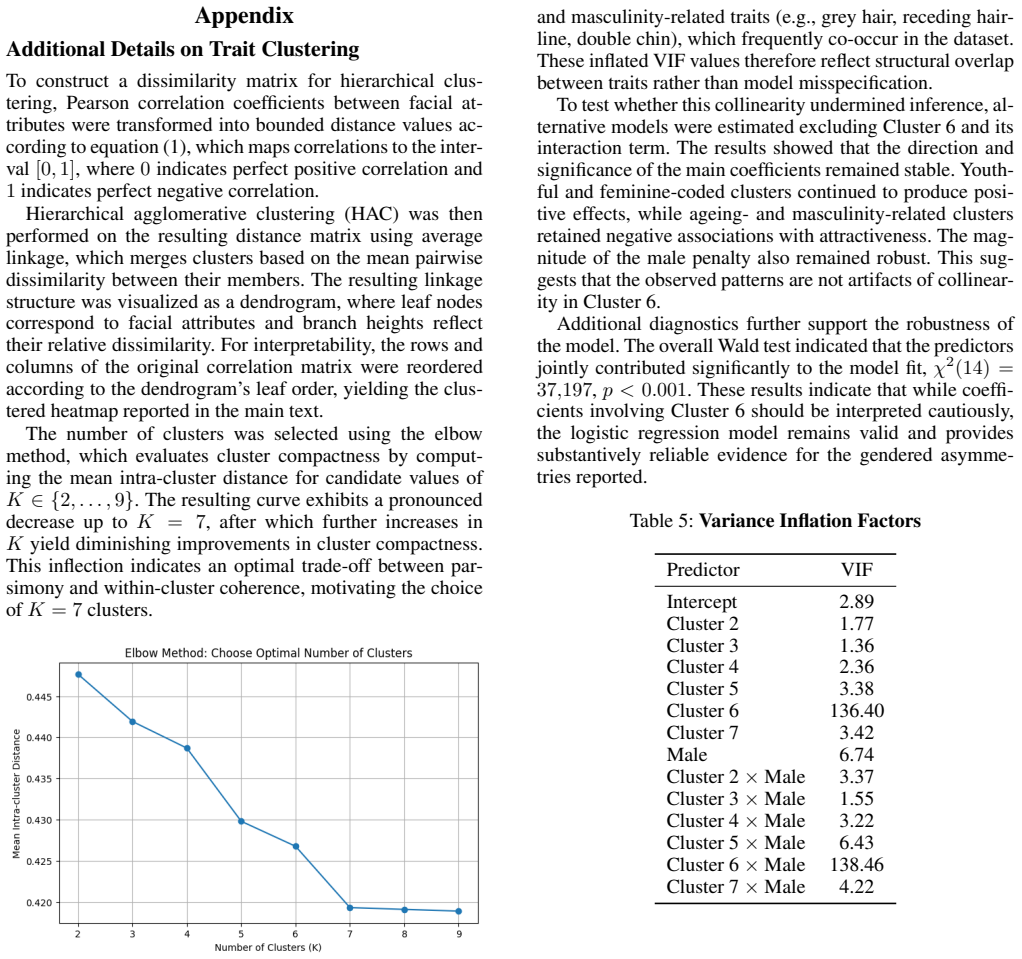
- Comprehensive ablation across alternative CNN backbones and attention visualization methods, which would require substantial additional compute beyond the resources available for this study.
Circularity Check
No circularity: empirical analysis of public dataset with standard tools
full rationale
The paper applies hierarchical clustering to the 39 CelebA attributes, XGBoost+SHAP for feature effects, and Grad-CAM for attention maps on a fixed public dataset. None of these steps involve a derivation, prediction, or first-principles result that reduces to its own inputs by construction. No equations are presented, no parameters are fitted and then relabeled as predictions, and no self-citations are invoked as load-bearing uniqueness theorems. The interpretive claims about cultural archetypes are offered as post-hoc readings of the observed clusters and attention patterns rather than as mathematically forced outcomes. The work is therefore self-contained empirical auditing.
Axiom & Free-Parameter Ledger
free parameters (1)
- Number of clusters or dendrogram cut height
axioms (1)
- domain assumption The 39 CelebA attributes can be meaningfully grouped into cultural archetypes of performative femininity and professional masculinity
Reference graph
Works this paper leans on
- [1]
- [2]
- [3]
- [4]
-
[5]
Margaret L. Hunter , title =. Sociology Compass , volume =. 2007 , doi =
work page 2007
- [6]
- [7]
- [8]
- [9]
- [10]
- [11]
- [12]
-
[13]
Distraction is All You Need for Fairness , year =
Mehdi Yazdani-Jahromi and AmirArsalan Rajabi and Ali Khodabandeh Yalabadi and Aida Tayebi and. Distraction is All You Need for Fairness , year =. 2203.07593 , archivePrefix =
-
[14]
Proceedings of the IEEE/CVF International Conference on Computer Vision Workshops , year =
Sabrina Fabbrizzi and others , title =. Proceedings of the IEEE/CVF International Conference on Computer Vision Workshops , year =
-
[15]
Proceedings of the ACM Conference on Fairness, Accountability, and Transparency (FAccT) , year =
Ryan Steed and Aylin Caliskan , title =. Proceedings of the ACM Conference on Fairness, Accountability, and Transparency (FAccT) , year =
-
[16]
Solon Barocas and Kate Crawford and Aaron Shapiro and Hanna Wallach , title =. Proceedings of the 9th Annual Conference of the Special Interest Group for Computing, Information and Society , year =
-
[17]
Proceedings of the 3rd Innovations in Theoretical Computer Science Conference , pages =
Cynthia Dwork and Moritz Hardt and Toniann Pitassi and Omer Reingold and Richard Zemel , title =. Proceedings of the 3rd Innovations in Theoretical Computer Science Conference , pages =
-
[18]
Friedler and John Moeller and Carlos Scheidegger and Suresh Venkatasubramanian , title =
Michael Feldman and Sorelle A. Friedler and John Moeller and Carlos Scheidegger and Suresh Venkatasubramanian , title =. Proceedings of the 21st ACM SIGKDD International Conference on Knowledge Discovery and Data Mining , pages =
-
[19]
Proceedings of the Conference on Fairness, Accountability, and Transparency (FAT) , pages =
Joy Buolamwini and Timnit Gebru , title =. Proceedings of the Conference on Fairness, Accountability, and Transparency (FAT) , pages =
-
[20]
Proceedings of the AAAI/ACM Conference on AI, Ethics, and Society , pages =
Inioluwa Deborah Raji and Joy Buolamwini , title =. Proceedings of the AAAI/ACM Conference on AI, Ethics, and Society , pages =
-
[21]
Kate Crawford , title =
- [22]
- [23]
- [24]
-
[25]
Nicola D. How gender-stereotypical are selfies? A content analysis and comparison with magazine adverts , journal =. 2016 , volume =
work page 2016
-
[26]
Social Media + Society , volume =
Brooke Erin Duffy and Emily Hund , title =. Social Media + Society , volume =
- [27]
-
[28]
Visibility Patterns of Gendered Age in Digital Media , journal =
Maria Edstr. Visibility Patterns of Gendered Age in Digital Media , journal =
-
[29]
Stacy L. Smith and others , title =. USC Annenberg Inclusion Initiative Report , year =
-
[30]
Laura Hurd Clarke and Alexandra Griffin and Paula Maliha , title =. Ageing & Society , volume =
-
[31]
Solon Barocas and Moritz Hardt and Arvind Narayanan , title =
-
[32]
Knowledge and Information Systems , volume =
Faisal Kamiran and Toon Calders , title =. Knowledge and Information Systems , volume =
-
[33]
Advances in Neural Information Processing Systems (NeurIPS) , year =
Moritz Hardt and Eric Price and Nati Srebro , title =. Advances in Neural Information Processing Systems (NeurIPS) , year =
-
[34]
Proceedings of the 30th International Conference on Machine Learning (ICML) , pages =
Richard Zemel and Yu Wu and Kevin Swersky and Toni Pitassi and Cynthia Dwork , title =. Proceedings of the 30th International Conference on Machine Learning (ICML) , pages =
-
[35]
Proceedings of the 35th International Conference on Machine Learning (ICML) , year =
David Madras and Elliot Creager and Toniann Pitassi and Richard Zemel , title =. Proceedings of the 35th International Conference on Machine Learning (ICML) , year =
-
[36]
Excavating AI (online essay) , year =
Kate Crawford and Trevor Paglen , title =. Excavating AI (online essay) , year =
-
[37]
Vinay Uday Prabhu and Abeba Birhane , title =. Proceedings of the IEEE/CVF Winter Conference on Applications of Computer Vision Workshops (WACVW) , year =
-
[38]
Jieyu Zhao and Tianlu Wang and Mark Yatskar and Vicente Ordonez and Kai-Wei Chang , title =. Proceedings of the 2017 Conference on Empirical Methods in Natural Language Processing (EMNLP) , pages =
work page 2017
-
[39]
Proceedings of the AAAI Conference on Artificial Intelligence , year =
Yusuke Hirota and others , title =. Proceedings of the AAAI Conference on Artificial Intelligence , year =
-
[40]
Proceedings of the IEEE International Conference on Computer Vision (ICCV) , pages =
Ziwei Liu and Ping Luo and Xiaogang Wang and Xiaoou Tang , title =. Proceedings of the IEEE International Conference on Computer Vision (ICCV) , pages =
-
[41]
Moon: A Mixed Objective Optimization Network for the Recognition of Facial Attributes , booktitle =
Ethan Rudd and Manuel G. Moon: A Mixed Objective Optimization Network for the Recognition of Facial Attributes , booktitle =
-
[42]
Proceedings of the IEEE Conference on Computer Vision and Pattern Recognition (CVPR) , pages =
Jiankang Deng and others , title =. Proceedings of the IEEE Conference on Computer Vision and Pattern Recognition (CVPR) , pages =
-
[43]
Proceedings of the European Conference on Computer Vision (ECCV) , year =
Yandong Guo and Lei Zhang and Yuxiao Hu and Xiaodong He and Jianfeng Gao , title =. Proceedings of the European Conference on Computer Vision (ECCV) , year =
-
[44]
IEEE Signal Processing Letters , volume =
Kaipeng Zhang and Zhanpeng Zhang and Zhifeng Li and Yu Qiao , title =. IEEE Signal Processing Letters , volume =
-
[45]
Proceedings of the IEEE Conference on Computer Vision and Pattern Recognition (CVPR) , pages =
Yunjey Choi and others , title =. Proceedings of the IEEE Conference on Computer Vision and Pattern Recognition (CVPR) , pages =
-
[46]
IEEE Transactions on Image Processing , volume =
Zhenliang He and others , title =. IEEE Transactions on Image Processing , volume =
-
[47]
Proceedings of the IEEE Conference on Computer Vision and Pattern Recognition (CVPR) , pages =
Yujun Shen and Jinjin Gu and Xiaoou Tang and Bolei Zhou , title =. Proceedings of the IEEE Conference on Computer Vision and Pattern Recognition (CVPR) , pages =
-
[48]
Chang and Shih-Wei Liao , title =
Po-Wei Wu and Yu-Jing Lin and Che-Han Chang and Edward Y. Chang and Shih-Wei Liao , title =. Proceedings of the IEEE/CVF International Conference on Computer Vision (ICCV) , year =
-
[49]
International Conference on Learning Representations (ICLR) , year =
Irina Higgins and others , title =. International Conference on Learning Representations (ICLR) , year =
-
[50]
European Conference on Computer Vision (ECCV) , series =
Xinchen Yan and Jimei Yang and Kihyuk Sohn and Honglak Lee , title =. European Conference on Computer Vision (ECCV) , series =
-
[51]
Mitigating Gender Bias in Face Recognition using the von Mises--Fisher Mixture Model , booktitle =
Jean-R. Mitigating Gender Bias in Face Recognition using the von Mises--Fisher Mixture Model , booktitle =
-
[52]
Proceedings of the AAAI/ACM Conference on AI, Ethics, and Society , year =
Brian Hu Zhang and Blake Lemoine and Margaret Mitchell , title =. Proceedings of the AAAI/ACM Conference on AI, Ethics, and Society , year =
-
[53]
Proceedings of the 2022 AAAI/ACM Conference on AI, Ethics, and Society (AIES) , pages =
Yu Yang and others , title =. Proceedings of the 2022 AAAI/ACM Conference on AI, Ethics, and Society (AIES) , pages =. 2022 , publisher =
work page 2022
-
[54]
Proceedings of the European Conference on Computer Vision (ECCV) Workshops , year =
Abhijit Das and Antitza Dantcheva and Francois Bremond , title =. Proceedings of the European Conference on Computer Vision (ECCV) Workshops , year =
-
[55]
Emily Denton and Ben Hutchinson and Margaret Mitchell and Timnit Gebru , title =. 2019 , eprint =
work page 2019
-
[56]
Kimmo K. FairFace: Face Attribute Dataset for Balanced Race, Gender, and Age for Bias Measurement and Mitigation , booktitle =
-
[57]
Proceedings of the IEEE/CVF International Conference on Computer Vision (ICCV) , pages =
Yunliang Chen and Jungseock Joo , title =. Proceedings of the IEEE/CVF International Conference on Computer Vision (ICCV) , pages =
-
[58]
European Conference on Computer Vision (ECCV) , pages =
Tian Xu and Jennifer White and Sinan Kalkan and Hatice Gunes , title =. European Conference on Computer Vision (ECCV) , pages =
-
[59]
Sixue Gong and Xiaoming Liu and Anil K. Jain , title =. European Conference on Computer Vision (ECCV) , pages =
-
[60]
Joseph P. Robinson and others , title =. Proceedings of the IEEE/CVF Conference on Computer Vision and Pattern Recognition Workshops (CVPRW) , year =
-
[61]
Proceedings of the European Conference on Computer Vision (ECCV) , pages =
Lisa Anne Hendricks and others , title =. Proceedings of the European Conference on Computer Vision (ECCV) , pages =
-
[62]
Robik Shrestha and Kushal Kafle and Christopher Kanan , title =. 2021 , eprint =
work page 2021
-
[63]
Proceedings of the 28th ACM International Conference on Multimedia (MM) , pages =
Yi Zhang and Jitao Sang , title =. Proceedings of the 28th ACM International Conference on Multimedia (MM) , pages =. 2020 , publisher =
work page 2020
- [64]
- [65]
-
[66]
Takuya Akiba and Shotaro Sano and Toshihiko Yanase and Takeru Ohta and Masanori Koyama , title =. Proceedings of the 25th ACM SIGKDD International Conference on Knowledge Discovery & Data Mining , pages =. 2019 , publisher =
work page 2019
-
[67]
Proceedings of the IEEE Conference on Computer Vision and Pattern Recognition (CVPR) , pages =
Xiangyu Zhang and Xinyu Zhou and Mengxiao Lin and Jian Sun , title =. Proceedings of the IEEE Conference on Computer Vision and Pattern Recognition (CVPR) , pages =
-
[68]
Mingxing Tan and Quoc V. Le , title =. Proceedings of the International Conference on Machine Learning (ICML) , pages =
-
[69]
Proceedings of the IEEE Conference on Computer Vision and Pattern Recognition (CVPR) , pages =
Kaiming He and Xiangyu Zhang and Shaoqing Ren and Jian Sun , title =. Proceedings of the IEEE Conference on Computer Vision and Pattern Recognition (CVPR) , pages =
-
[70]
Proceedings of the 36th International Conference on Machine Learning (ICML) , pages =
Benjamin Recht and Rebecca Roelofs and Ludwig Schmidt and Vaishaal Shankar , title =. Proceedings of the 36th International Conference on Machine Learning (ICML) , pages =
-
[71]
Nature Machine Intelligence , volume =
Robert Geirhos and others , title =. Nature Machine Intelligence , volume =
-
[72]
Reddi and Satyen Kale and Sanjiv Kumar , title =
Sashank J. Reddi and Satyen Kale and Sanjiv Kumar , title =. Proceedings of the International Conference on Learning Representations (ICLR) , year =
-
[73]
Jason Yosinski and Jeff Clune and Yoshua Bengio and Hod Lipson , title =. Proceedings of the 27th International Conference on Neural Information Processing Systems (NeurIPS) , pages =
-
[74]
Proceedings of the 39th International Conference on Machine Learning (ICML) , series =
Badr Youbi Idrissi and Martin Arjovsky and Mohammad Pezeshki and David Lopez-Paz , title =. Proceedings of the 39th International Conference on Machine Learning (ICML) , series =. 2022 , publisher =
work page 2022
-
[75]
Shades of Difference: Why Skin Color Matters , publisher =
Evelyn Nakano Glenn , title =. Shades of Difference: Why Skin Color Matters , publisher =
-
[76]
Proceedings of the ACM on Human-Computer Interaction (CSCW) , volume =
Os Keyes , title =. Proceedings of the ACM on Human-Computer Interaction (CSCW) , volume =
- [77]
-
[78]
Proceedings of the 2020 Conference on Fairness, Accountability, and Transparency (FAccT) , pages =
David Baker and Alex Hanna and Randi Denton , title =. Proceedings of the 2020 Conference on Fairness, Accountability, and Transparency (FAccT) , pages =
work page 2020
-
[79]
Proceedings of the 2020 AAAI/ACM Conference on AI, Ethics, and Society (AIES) , pages =
Alex Hanna and Emily Denton and Andrew Smart and Jamila Smith-Loud , title =. Proceedings of the 2020 AAAI/ACM Conference on AI, Ethics, and Society (AIES) , pages =
work page 2020
-
[80]
Proceedings of the IEEE Conference on Computer Vision and Pattern Recognition (CVPR) , pages =
Jie Hu and Li Shen and Gang Sun , title =. Proceedings of the IEEE Conference on Computer Vision and Pattern Recognition (CVPR) , pages =
discussion (0)
Sign in with ORCID, Apple, or X to comment. Anyone can read and Pith papers without signing in.