REVIEW 3 major objections 4 minor 2 cited by
Squeezing codes: robust fluctuation-stabilized memories
T0 review · 3 major / 4 minor · reviewed 2026-08-04 · deepseek-v4-flash
Pith's one-line read Squeezing codes show that local stochastic dynamics can store a bit of information without any symmetry to protect it, with order that is stabilized by fluctuations rather than destroyed by them.
desk verdict Squeezing codes are a genuinely new family of robust CA memories with a solid synchronous proof, but the z<2 critical exponent claim is not yet backed by the numerics. read the letter →
The pith
A machine-rendered reading of the paper's core claim, the machinery that carries it, and where it could break.
The reading
What carries the argument
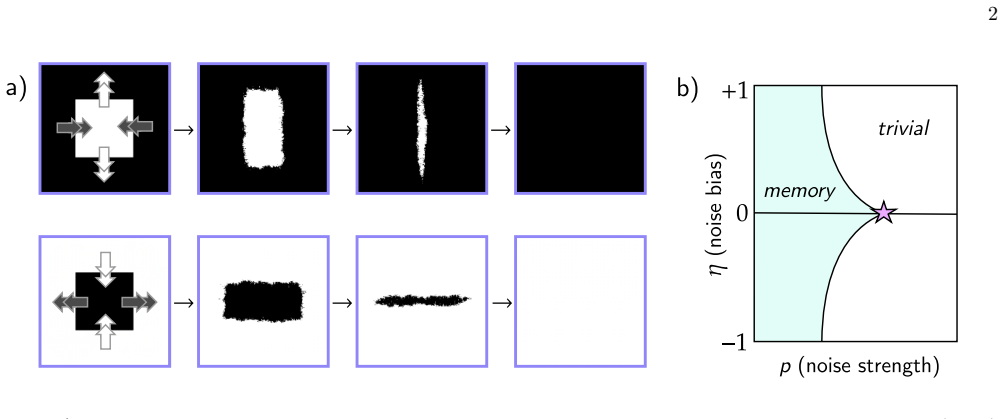
The carrying mechanism is the alternating squeezing update (e.g. R: even steps AND with vertical neighbors, odd steps OR with horizontal neighbors), which squeezes minority domains into thin strips that vanish. The dynamics are symmetric under XC, a spin flip combined with a spatial rotation (R), reflection (F, M), or identity (T); this symmetry plus monotonicity lets Toom's monotone-eroder theorem prove robustness under synchronous updates. Fluctuation-stabilization is captured via the cluster variational method (CVM), which keeps short-range correlation fields and yields a phase diagram matching numerics, including the d=2-only order of R3.
What would settle it
Run M dynamics at the estimated critical noise on larger systems (L ≥ 1000) for times t ≫ L^z and compute the time-dependent exponent θ(t) of Eq. (56). If θ(t) keeps drifting so that z = β/(νθ) rises to ≥ 2, the z < 2 claim is refuted; alternatively, measure the critical magnetization autocorrelation time and test whether it grows as L^z with z ≥ 2.
Extended reading notes
Core claim
Central claim: robust memories can be built by 'squeezing'—alternating AND/OR updates along orthogonal axes ballistically erode minority domains, with spin-flip-plus-rotation/reflection symmetry replacing ordinary Z2. Synchronously, R, F, M, T are proven robust via Toom's monotone-eroder theorem; asynchronously, R, F, M retain memory numerically. Order is fluctuation-stabilized: mean-field shows disorder, but cluster-variation with short-range correlations restores it; R3 orders only in d=2. At the zero-bias transition, dynamics are not model-A: z ≈ 1.93 (R3), 1.44 (F), 1.38 (M) vs z_A=2.167, with F and M below the rigorous z≥2 bound for detailed balance—intrinsically non-equilibrium critica
Load-bearing premise
For F and M the claim of intrinsically non-equilibrium critical points rests on fitted dynamic exponents z ≈ 1.44 and 1.38; the paper notes the scaling regime for M is not fully reached at L = 300, so if the true z is ≥ 2 that claim fails.
Editorial extensions
If this is right
- Robust memory does not require any symmetry: the squeezing mechanism alone can protect one bit against arbitrarily biased noise.
- Higher dimension hurts rather than helps: R3 orders only in d=2, and the critical noise for R2 scales as pc = 1/(1+4d^2) in the cluster analysis.
- The zero-bias transitions of F and M have z < 2, so no local equilibrium/detailed-balance model can describe them; these are genuinely non-equilibrium dynamic universality classes.
- Some rules are synchronicity-protected: T (and squeezing codes in odd d) lose their memory when updates are asynchronous, with a sharp transition at αc ≈ 0.385.
- Quenches into the memory phase of F and M can get stuck in long-lived propagating bands ('flocks'), while R always relaxes to a logical state.
Reading between the lines
- The non-reciprocal advection terms in the Langevin equations (e.g., γ∂x m + λm∂y m for M) are the likely relevant perturbations driving z below 2; one could try to construct a renormalization group about the model-A fixed point where these operators change the dynamic exponent.
- The same XC-symmetry-breaking between spin and space appears in active matter; fluctuation-stabilized ordering may be a general route to noise-robust order in nonreciprocal systems.
- The synchronicity transition at αc ≈ 0.385 resembles percolation; measuring its critical exponents (e.g. β, ν) would test whether it falls in the percolation universality class or defines a different one.
- The static vs dynamic dichotomy (similar ν,β but very different z for R2 vs R3) suggests the static critical behavior may be shared while dynamics split; verifying conformal invariance at the critical point would sharpen this.
Signed reviews
Editorial analysis
A structured set of objections, weighed in public.
Referee Report
Summary. This paper introduces a family of probabilistic cellular automata ('squeezing codes') in d≥2 that stabilize a bit without conventional symmetry or equilibrium mechanisms. The authors define R, F, M, T via alternating ∧/∨ updates, prove synchronous robustness (Theorem 1) using Toom's monotone-eroder theorem, and present Monte Carlo evidence for asynchronous memory phases for R, F, M. They then develop Doi–Peliti/cluster mean-field equations predicting fluctuation-stabilized order: R2 has pc∼1/d^2, and R3 orders only in d=2. At the zero-bias transition, Binder and magnetization collapses give ν, β near but not equal to 2d model-A values, and relaxation quenches yield z≈2.10, 1.93, 1.44, 1.38 for R2, R3, F, M, with z<2 for F and M claimed as intrinsically non-equilibrium universality classes. The paper also discusses coarsening, flocking stripes, and synchronicity-protected memories.
Significance. If established, the paper's results would be important: they provide a new class of simple robust memories with a rigorous synchronous threshold, a concrete mechanism of fluctuation-stabilized order (including the analytically derived CVM prediction pc=1/(1+4d^2) and R3's dc=2), and candidate non-equilibrium critical points. The paper is careful to distinguish rigorous results (synchronous robustness, unique absorbing states) from numerical evidence, and the CVM calculations are derived rather than fitted. However, the headline claim of new intrinsically non-equilibrium universality classes rests entirely on dynamic exponent estimates that are not yet supported by the data as presented.
major comments (3)
- [Sec. VI C, Eq. (55), Figs. 13–14, Table II] The values z_F=1.44 and z_M=1.38 are the sole evidence for the abstract's claim of intrinsically non-equilibrium universality classes. They come from a single L=300 quench. For M, tmax=50L=1.5×10^4, while the scaling form (55), valid for 1≪t≲L^z, gives L^z≈2.6×10^3 at z=1.38; the fit thus extends far beyond the scaling window. Fig. 14 also shows the local exponent θ(t) still drifting on the plotted range. Without multiple system sizes, fits restricted to t≲cL^z, or a corrections-to-scaling analysis, the z<2 result—and hence the central claim—is not established.
- [App. A1, Eqs. (A4)–(A7)] Theorem 1 is a central rigorous claim, but the proof reduces to unproved inclusions for the damage set. The text states 'We claim (A4)' and calls the verification 'straightforward', and analogous inclusions for F, M, T are asserted without derivation. The alternative zero-set proof is only illustrated in Fig. 16. Please either prove these inclusions as lemmas or provide a complete zero-set argument; as written, the eroder property—and therefore the theorem—cannot be fully checked.
- [Sec. VI B, Table II] The static exponents ν, β are obtained from Binder and magnetization collapses with no quantitative quality metric or uncertainty (Figs. 10–12). Because z is derived from θ=β/(νz), errors in β/ν propagate directly into the dynamic claim. The M data with model-A exponents shown in Fig. 12 is suggestive, but a formal comparison (e.g., collapse residuals, χ² values) and error bars are needed to support a distinct universality class.
minor comments (4)
- [Throughout] Typographical errors: 'Dol-Peliti' should be 'Doi-Peliti' (App. B); 'testible' should be 'testable' (App. D); 'loose' should be 'lose' (Sec. V).
- [Sec. III A] The sentence 'The proof is a consequence of a general result of Toom [6] about asynchronous eroders' should presumably read 'monotone eroders' or 'synchronous eroders'.
- [Fig. 14 caption/text] For M, the text states that θ remains close to 0.17 up to t=15,000, but only t≤3000 is shown. A longer time panel would help the reader assess the claimed plateau.
- [Eq. (47)] The notation f^2_− (superscript position vs. subscript sign) is easy to confuse with a power; a parenthetical definition or a different symbol would improve readability.
Circularity Check
No significant circularity: analytic results are derived from stated approximations, and exponents are measured quantities rather than fitted inputs.
full rationale
The paper's derivation chain is self-contained rather than circular. Theorem 1 is proved in Appendix A by explicit domain-wall inclusion bounds (A4)-(A7) and Toom's external monotone-eroder theorem [6], not by assuming the robustness conclusion. The cluster mean-field equations (47) and (B63) follow from the stated factorization ansatz (43) in the Doi-Peliti formalism; the R2 result pc=1/(1+4d^2) (Eq. 51) is obtained by linearizing about the disordered state, and the R3 critical-dimension prediction is a stability analysis, not a fit to the target result. The Table II exponents are measurements: theta is fit to the scaling form <m(t)>~t^{-theta} (Eq. 55), beta/nu is obtained from Binder-cumulant and magnetization collapses, and z=beta/(nu*theta) is then computed; this is a derived measurement chain, not a parameter forced to equal the advertised conclusion. Self-citations, chiefly to [4] in Secs. I, III and VII, are contextual/background and not load-bearing; no uniqueness theorem from the authors is invoked to forbid alternatives. The paper itself flags the main finite-size caveat for M in Sec. VI C, stating 'For M this does not hold, but the extracted value of theta gives a good fit to <m(t)> for the entire time range past the initial onset' and noting tmax=50L while L^z ~ 2600 at L=300. That is a correctness/error-bar concern about whether the quoted z<2 values are asymptotic, not a circularity: the limitation is disclosed and the exponents are presented as estimates.
Assumptions & free parameters
free parameters (9)
- pc(R3, async) =
0.025-0.029
- pc(R2, async) =
0.039 (2d)
- pc(F, async) =
0.0113
- pc(M, async) =
0.0032
- ν (R2, F, M) =
0.855, 1.0, 1.0
- β (R2, F, M) =
0.170, 0.165, 0.230
- θ (R2, R3, F, M) =
0.09, 0.10, 0.12, 0.17
- z (R2, R3, F, M) =
2.10, 1.93, 1.44, 1.38
- CVM truncation range a =
a=2 (R2), a=1 (R3)
assumptions (6)
- standard math Toom's monotone eroder theorem: if A and its dual are monotone eroders, A is a robust memory under synchronous updates.
- standard math Toom's zero-set theorem: eroder iff intersection of convex hulls of minimal zero sets is empty.
- domain assumption The z ≥ 2 lower bound for local Markov processes obeying detailed balance, as stated from Ref. [38].
- domain assumption Cluster mean-field factorization: correlation functions factorize beyond range a (Eq. 43); connected correlations beyond a vanish.
- domain assumption The asynchronous update scheme defines a continuous-time Markov process with local generator.
- domain assumption Finite-size numerics at L up to 192 (statics) and 300 (dynamics) capture asymptotic critical behavior.
Cite this review
Pith. "Pith review of Squeezing codes: robust fluctuation-stabilized memories." pith.science (2026). https://pith.science/paper/GEUOCGXY
@misc{pith2026250920730,
  author       = {Pith},
  title        = {Pith review of: Squeezing codes: robust fluctuation-stabilized memories},
  year         = {2026},
  howpublished = {\url{https://pith.science/paper/GEUOCGXY}},
  note         = {Machine review of arXiv:2509.20730}
}
read the original abstract
We introduce families of classical stochastic dynamics in two and higher dimensions which stabilize order in the absence of any symmetry. Our dynamics are qualitatively distinct from Toom's rule, and have the unusual feature of being fluctuation-stabilized: their order becomes increasingly fragile in larger dimensions. One of our models maintains an ordered phase only in two dimensions. The phase transitions that occur as the order is lost appear to realize new dynamical universality classes which are fundamentally non-equilibrium in character.
Figures


Figures from the paper (15 more)


Forward citations
Cited by 2 Pith papers
-
Perturbatively Stable Self-Correcting Classical Memory from Gauge Averaging
3D Wegner gauge theory's self-correcting classical memory is proven stable under all sufficiently small local Hamiltonian perturbations, via a new gauge-averaging cluster expansion.
-
Long-lived memory in sliding spin chains
Sliding two 1D Ising chains past one another at modest speed is claimed to increase memory time from e^{O(βJ)} to e^{O((βJ)^2 v ln v)}.
Reference graph
Works this paper leans on
-
[38]
Dinelli, J
A. Dinelli, J. O’Byrne, A. Curatolo, Y. Zhao, P. Sollich, and J. Tailleur, Non-reciprocity across scales in active mixtures, Nature Communications 14, 7035 (2023)
2023
-
[1]
Proving stability We now use this to prove theorem 1. Proof. If {si} are a set of Boolean variables, any function of the formf ({si}) = si1 ⊙1 si2 · · ·⊙n−1 sin with ⊙m ∈ {∨, ∧} is monotonic (non-monotonic functions would involve both variables si and their negations −si). Thus the R, F, M, T automata, as well as their duals, are all monotonic. Furthermor...
-
[2]
Proving non-robustness if R∨ = Rπ(R∧) In this subsection, we prove theorem 2 from the main text. Proof. To avoid getting bogged down in details, we will be slightly schematic. The basic idea is that, as explained below, dyanmics with this symmetry must erode minority domains in a curvature-driven way; when biased noise is added to drive ballistic expansio...
-
[3]
zero-set
Proving stability using zero sets Finally, we provide a quick alternate proof of theorem 1 using the “zero-set” technology developed by Toom [6]. Proof. For a site r, define a zero set Zr as a collection of sites for which sr′(t) = 0 ∀ r′ ∈ Zr =⇒ sr(t + 1) = 0. (A8) Define a minimal zero set to a zero set of minimal size. Then Toom’s zero-sert theorem [6]...
-
[4]
To lighten the notation somewhat, we will use itallic romain letters i, j,
Operator formalism of automaton dynamics In the calculations to follow, we will use the Doi-Peliti operator formalism [50] to derive dynamic cluster mean-field equations for general noisy two-state asynchronous automata. To lighten the notation somewhat, we will use itallic romain letters i, j, . . .for site indices rather than the boldface r, r′, . . .of...
-
[5]
The noiseless automaton possesses only a single type of update, for which a−1 spin at site i flips under the dynamics if both si+x, si+y are +1, and analogously for a +1 spin
W armup: T oom’s rule Before discussing how the truncation works for the squeezing codes—for which higher body correlation functions need to be inclued in the heirachry—we first review how mean field theory works for the simpler (and less interesting) case of Toom’s rule, which we will analyze in d = 2 (see also [51] and [44]). The noiseless automaton pos...
-
[6]
domain wall
R2 We now turn to theR2 squeezing code defined in (45). We will in fact consider a slightly more general setup in which ∧ squeezing (−1 expansion) occurs along the first ( d − r)/2 spatial directions, and ∨ squeezing (+1 expansion) occurs along the remaining ( d + r)/2 directions, with each direction of update occuring with equal probability qa = 1 /d, a ...
-
[7]
continuously connectible
R3 We now consider the three-variable rule R3, which as we will see has rather different physics. Like R2, similar arguments show that R3 is disordered under asynchronous updates in all cases where a Z2 symmetry is not present. 32 0.00 0.02 0.04 0.06 0.08 p 0.0 0.2 0.4 0.6 0.8 1.0 η 1.0 0.5 0.0 0.5 1.0 ⟨ m ⟩ 0.00 0.02 0.04 0.06 0.08 p 0.0 0.2 0.4 0.6 0.8 ...
Show all 64 references
-
[8]
During this stage, the automaton dynamics is a smooth interpolation between A ⊗1 and A ⊗ C, with the first factor remaining constant
Let Han evolve under an arbitrary memory-preserving automaton C which has the same number of locally- testible logical states as A, with Han initialized in an arbitrary logical state. During this stage, the automaton dynamics is a smooth interpolation between A ⊗1 and A ⊗ C, w...
-
[9]
This can be done using non-reciprocal dynamics in a smooth way by slowly turning on a bias which aligns bits in Han with bits in H
Copy the logical information preserved by A into Han. This can be done using non-reciprocal dynamics in a smooth way by slowly turning on a bias which aligns bits in Han with bits in H
-
[10]
Now that the original logical information is safely stored in Han, deform the automaton from A ⊗ Cto B ⊗ C along an arbitrary path which keeps the second factor fixed
-
[11]
Re-copy the information from Han to H
-
[12]
Finally, turn off the error-correcting dynamics on Han by moving along a path from B ⊗ Cto B ⊗1 that keeps the first factor fixed. This provides a map between a memory evolving under A (plus a collection of trivial ancillae) to a memory evolving under B (plus the same ancillae...
-
[13]
Ponselet, Phase transitions in probabilistic cellular au- tomata, arXiv preprint arXiv:1312.3612 (2013)
L. Ponselet, Phase transitions in probabilistic cellular au- tomata, arXiv preprint arXiv:1312.3612 (2013)
2013 arXiv
-
[14]
Rakovszky, S
T. Rakovszky, S. Gopalakrishnan, and C. Von Keyser- lingk, Defining stable phases of open quantum systems, Physical Review X 14, 041031 (2024)
2024
-
[15]
S. Sang, Y. Zou, and T. H. Hsieh, Mixed-state quantum phases: Renormalization and quantum error correction, Physical Review X 14, 031044 (2024)
2024
-
[16]
Pajouheshgar, A
E. Pajouheshgar, A. Bhardwaj, N. Selub, and E. Lake, Exploring the landscape of non-equilibrium memo- 21 If one does not want to double the number of bits, the ancillae in Han can be taken instead to be a subsystem of the original bits. ries with neural cellular automata, arXi...
2025
-
[17]
P. Gacs, G. L. Kurdyumov, and L. A. Levin, One- dimensional uniform arrays that wash out finite islands, Problemy Peredachi Informatsii 14, 92 (1978)
1978
-
[18]
A. L. Toom, Stable and attractive trajectories in multi- component systems, Multicomponent random systems 6, 549 (1980)
1980
-
[19]
B. Cirelson, Reliable storage of information in a system of unreliable components with local interactions, in Lo- cally Interacting Systems and Their Application in Biol- ogy (Springer, 2006) pp. 15–30
2006
-
[20]
Gacs, Reliable cellular automata with self- organization, Journal of Statistical Physics 103, 45 (2001)
P. Gacs, Reliable cellular automata with self- organization, Journal of Statistical Physics 103, 45 (2001). 38
2001
-
[21]
Mordvintsev, E
A. Mordvintsev, E. Randazzo, E. Niklasson, and M. Levin, Growing neural cellular automata, Distill 5, e23 (2020)
2020
-
[22]
Challa, D
A. Challa, D. Hao, J. C. Rozum, and L. M. Rocha, The effect of noise on the density classification task for vari- ous cellular automata rules, in Artificial Life Conference Proceedings 36, Vol. 2024 (MIT Press One Rogers Street, Cambridge, MA 02142-1209, USA journals-info . . . ,
2024
-
[23]
Pajouheshgar, Y
E. Pajouheshgar, Y. Xu, and S. S¨ usstrunk, Noisenca: Noisy seed improves spatio-temporal continuity of neural cellular automata, in Artificial Life Conference Proceed- ings 36 , Vol. 2024 (MIT Press One Rogers Street, Cam- bridge, MA 02142-1209, USA journals-info . . . , 2024) p. 57
2024
-
[24]
J. W. Harrington, Analysis of Quantum Error-Correcting Codes: Symplectic Lattice Codes and Toric Codes , Ph.D. thesis, Caltech (2004)
2004
-
[25]
A. Ray, R. Laflamme, and A. Kubica, Protecting infor- mation via probabilistic cellular automata, Physical Re- view E 109, 044141 (2024)
2024
-
[26]
Balasubramanian, M
S. Balasubramanian, M. Davydova, and E. Lake, A lo- cal automaton for the 2d toric code, arXiv preprint arXiv:2412.19803 (2024)
2024 arXiv
-
[27]
Paletta, A
L. Paletta, A. Leverrier, M. Mirrahimi, and C. Vuillot, High-performance local automaton decoders for defect matching in 1d, arXiv preprint arXiv:2505.10162 (2025)
2025
-
[28]
Lake, Fast offline decoding with local message-passing automata, arXiv preprint arXiv:2506.03266 (2025)
E. Lake, Fast offline decoding with local message-passing automata, arXiv preprint arXiv:2506.03266 (2025)
2025
-
[29]
Vasil’Ev, M
N. Vasil’Ev, M. Petrovskaya, and I. Piatetskii-Shapiro, Modelling of voting with random error, Avtomatika i Telemekhanika 10, 103 (1969)
1969
-
[30]
A. L. Toom, Nonergodic multidimensional system of au- tomata, Problemy Peredachi Informatsii 10, 70 (1974)
1974
-
[31]
J. M. Swart, R. Szab´ o, and C. Toninelli, Peierls bounds from toom contours, arXiv preprint arXiv:2202.10999 (2022)
2022 arXiv
-
[32]
Gacs, Self-correcting two-dimensional arrays., Adv
P. Gacs, Self-correcting two-dimensional arrays., Adv. Comput. Res. 5, 223 (1989)
1989
-
[33]
Poulin, R
D. Poulin, R. G. Melko, and M. B. Hastings, Self- correction in wegner’s three-dimensional ising lattice gauge theory, Physical Review B 99, 094103 (2019)
2019
-
[34]
Kubica and J
A. Kubica and J. Preskill, Cellular-automaton decoders with provable thresholds for topological codes, Physical review letters 123, 020501 (2019)
2019
-
[35]
Fern´ andez and A
R. Fern´ andez and A. Toom, Non-gibbsianness of the invariant measures of non-reversible cellular automata with totally asymmetric noise, arXiv preprint math- ph/0101014 (2001)
2001
-
[36]
M. J. Bowick, N. Fakhri, M. C. Marchetti, and S. Ra- maswamy, Symmetry, thermodynamics, and topology in active matter, Physical Review X 12, 010501 (2022)
2022
-
[37]
Fruchart, R
M. Fruchart, R. Hanai, P. B. Littlewood, and V. Vitelli, Non-reciprocal phase transitions, Nature 592, 363 (2021)
2021
-
[39]
O’Malley, B
L. O’Malley, B. Kozma, G. Korniss, Z. R´ acz, and T. Caraco, Fisher waves and front roughening in a two-species invasion model with preemptive competition, Physical Review E—Statistical, Nonlinear, and Soft Mat- ter Physics 74, 041116 (2006)
2006
-
[40]
Giometto, D
A. Giometto, D. R. Nelson, and A. W. Murray, An- tagonism between killer yeast strains as an experimen- tal model for biological nucleation dynamics, Elife 10, e62932 (2021)
2021
-
[41]
Kikuchi, A theory of cooperative phenomena, Physical review 81, 988 (1951)
R. Kikuchi, A theory of cooperative phenomena, Physical review 81, 988 (1951)
1951
-
[42]
Pelizzola, Cluster variation method in statistical physics and probabilistic graphical models, Journal of Physics A: Mathematical and General 38, R309 (2005)
A. Pelizzola, Cluster variation method in statistical physics and probabilistic graphical models, Journal of Physics A: Mathematical and General 38, R309 (2005)
2005
-
[43]
P. C. Hohenberg and B. I. Halperin, Theory of dynamic critical phenomena, Reviews of Modern Physics 49, 435 (1977)
1977
-
[44]
Grinstein, C
G. Grinstein, C. Jayaprakash, and Y. He, Statistical me- chanics of probabilistic cellular automata, Physical re- view letters 55, 2527 (1985)
1985
-
[45]
Bassler and B
K. Bassler and B. Schmittmann, Critical dynamics of nonconserved ising-like systems, Physical review letters 73, 3343 (1994)
1994
-
[46]
U. C. Tauber, V. K. Akkineni, and J. E. Santos, Effects of violating detailed balance on critical dynamics, Physical review letters 88, 045702 (2002)
2002
-
[47]
Makowiec, Study of continuous phase transition with toom cellular automata, TASK Quarterly 4, 19 (2000)
D. Makowiec, Study of continuous phase transition with toom cellular automata, TASK Quarterly 4, 19 (2000)
2000
-
[48]
L. T. Adzhemyan, D. Evdokimov, M. Hnatic, E. Ivanova, M. Kompaniets, A. Kudlis, and D. Zakharov, The dy- namic critical exponent z for 2d and 3d ising models from five-loop epsilon expansion, Physics Letters A 425, 127870 (2022)
2022
-
[49]
Nightingale and H
M. Nightingale and H. Blote, Dynamic exponent of the two-dimensional ising model and monte carlo computa- tion of the subdominant eigenvalue of the stochastic ma- trix, Physical review letters 76, 4548 (1996)
1996
-
[50]
Masaoka, T
R. Masaoka, T. Soejima, and H. Watanabe, Rigorous lower bound of dynamic critical exponents in critical frustration-free systems, arXiv preprint arXiv:2406.06415 (2024)
2024
-
[51]
N. A. Fates, Asynchronism induces second order phase transitions in elementary cellular automata, arXiv preprint nlin/0703044 (2007)
2007 arXiv
-
[52]
A. P. Solon and J. Tailleur, Flocking with discrete sym- metry: The two-dimensional active ising model, Physical Review E 92, 042119 (2015)
2015
-
[53]
Lake, Local active error correction from simulated con- finement, arXiv preprint arXiv:2510.08056 (2025)
E. Lake, Local active error correction from simulated con- finement, arXiv preprint arXiv:2510.08056 (2025)
2025
-
[54]
Marsan, M
H. Marsan, M. Sablik, and I. Torma, A perturbed cellular automaton with two phase transitions for the ergodicity, arXiv preprint arXiv:2507.03485 (2025)
2025 arXiv
-
[55]
Spirin, P
V. Spirin, P. Krapivsky, and S. Redner, Freezing in ising ferromagnets, Physical Review E 65, 016119 (2001)
2001
-
[56]
J. L. Lebowitz, C. Maes, and E. R. Speer, Statistical mechanics of probabilistic cellular automata, Journal of statistical physics 59, 117 (1990)
1990
-
[57]
J. T. Young, A. V. Gorshkov, M. Foss-Feig, and M. F. Maghrebi, Nonequilibrium fixed points of coupled ising models, Physical Review X 10, 011039 (2020)
2020
-
[58]
Agrawal, L
R. Agrawal, L. F. Cugliandolo, L. Faoro, L. B. Ioffe, and M. Picco, Dynamical critical behavior on the nishimori point of frustrated ising models, Physical Review E 110, 034120 (2024)
2024
-
[59]
Janssen, B
H. Janssen, B. Schaub, and B. Schmittmann, New uni- versal short-time scaling behaviour of critical relaxation processes, Zeitschrift fur Physik B Condensed Matter 73, 539 (1989)
1989
-
[60]
Hinrichsen, Non-equilibrium critical phenomena and phase transitions into absorbing states, Advances in 39 physics 49, 815 (2000)
H. Hinrichsen, Non-equilibrium critical phenomena and phase transitions into absorbing states, Advances in 39 physics 49, 815 (2000)
2000
-
[61]
Takeuchi, Can the ising critical behaviour survive in non-equilibrium synchronous cellular automata?, Physica D: Nonlinear Phenomena 223, 146 (2006)
K. Takeuchi, Can the ising critical behaviour survive in non-equilibrium synchronous cellular automata?, Physica D: Nonlinear Phenomena 223, 146 (2006)
2006
-
[62]
Doi, Second quantization representation for classical many-particle system, Journal of Physics A: Mathemat- ical and General 9, 1465 (1976)
M. Doi, Second quantization representation for classical many-particle system, Journal of Physics A: Mathemat- ical and General 9, 1465 (1976)
1976
-
[63]
C. H. Bennett and G. Grinstein, Role of irreversibility in stabilizing complex and nonergodic behavior in locally interacting discrete systems, Physical review letters 55, 657 (1985)
1985
-
[64]
Higashikawa, H
S. Higashikawa, H. Fujita, and M. Sato, Floquet engineer- ing of classical systems, arXiv preprint arXiv:1810.01103 (2018)
2018 arXiv
Reviewed August 4, 2026 · model on record in the stance chip above.
Discussion (0). Continue with ORCID to comment.