REVIEW 3 major objections 6 minor 3 cited by
DRiVE: Diffusion-based Rigging Empowers Generation of Versatile and Expressive Characters
T0 review · 3 major / 6 minor · reviewed 2026-08-12 · deepseek-v4-flash
Pith's one-line read Diffusion-based rigging predicts joint positions as spatial distributions, letting a single image or text prompt become an animated 3D character with independently moving hair and clothing.
desk verdict A promising rigging dataset and diffusion-based method for animatable 3D Gaussians, but the headline numbers depend on an unreported LGM fine-tuning split and need verification. read the letter →
The pith
A machine-rendered reading of the paper's core claim, the machinery that carries it, and where it could break.
The reading
What carries the argument
GSDiff is a conditional diffusion model for joint positions. At each denoising step, the current joint estimate gathers local geometry by k-nearest-neighbor interpolation from DGCNN features over the 3D Gaussian means, and appearance by CLIP features from four rendered views; cross-attention layers fuse the conditions. The reverse process therefore treats a skeleton as a sample from a learned distribution p(J | Gaussian, views), which the paper argues avoids the error accumulation and poor generalization of regression-based joint estimators. BoneFlow and the skinning network are secondary machinery built on top of the predicted joints.
What would settle it
Run DRiVE's joint and skinning evaluation on a held-out set of characters whose meshes were never used to fine-tune the generator, and compare the transferred AnimeRig labels against manually re-rigged ground truth on hair strands and skirt panels; if the joint IoU falls toward the 28 percent baseline or the skinning L1 on thin structures rises well above the 0.48 average, the label-transfer step, not the diffusion module, is carrying the reported improvement.
Extended reading notes
Core claim
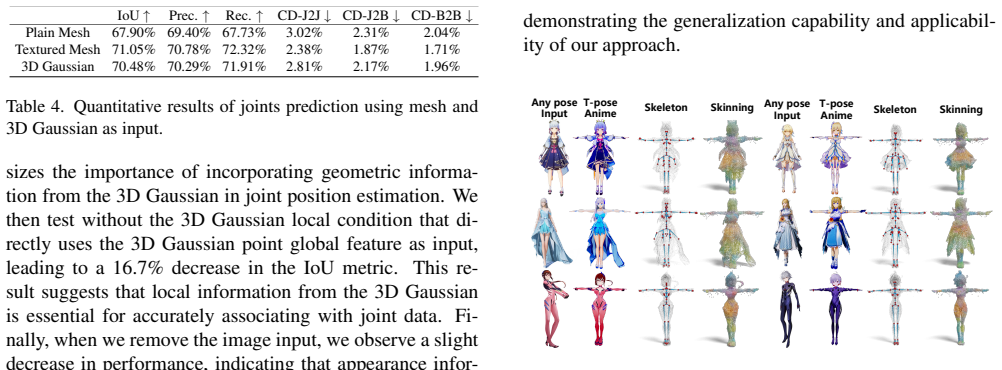
The paper's central claim is that 3D Gaussian characters can be rigged accurately by predicting joint positions with a diffusion process instead of a regression network. GSDiff denoises a set of joints conditioned on both the 3D Gaussian point means and four canonical-view renderings, combining geometric and appearance features at each denoising step. After joints are denoised, bone connectivity is obtained through a learned BoneFlow field followed by a minimum spanning tree, and skinning is estimated by a network that starts from a distance-based initialization and is regularized with a smoothness loss. The authors report that this pipeline outperforms prior mesh-based rigging methods on their AnimeRig test set, with joint IoU improving from around 28 percent to 70.48 percent and average skinning L1 falling from about 0.88–1.00 to 0.48. They also report that the same framework trained on plain meshes reaches similar joint accuracy (67.90 percent IoU for plain mesh versus 70.48 percent for 3D Gaussian), which they take as evidence of flexibility.
Load-bearing premise
The AnimeRig ground truth is created by converting rigged meshes to 3D Gaussians and then registering the meshes back to the Gaussians with scaled ICP to transfer skeleton and skinning labels; if that registration is inaccurate for fine structures or if the meshes used to fine-tune the generator appear again in the rigging test set, the reported joint and skinning numbers would overstate what the method can do.
Editorial extensions
If this is right
- A single image or text prompt can produce an immediately animatable character, cutting manual rigging out of the pipeline.
- Skirts, hair, and other loose parts receive their own joints and skinning, so they move naturally instead of being rigidly attached to the body.
- Because the rigging network consumes unordered point sets plus renderings, it can be retargeted from 3D Gaussians to plain meshes without architectural changes.
- Replacing regression with generation for joint prediction yields a large jump in joint IoU on the same dataset, suggesting the diffusion formulation, not just more training data, is driving the gain.
Reading between the lines
- The reported quality depends on the accuracy of the ICP label transfer from meshes to Gaussians; thin strands of hair or loose fabric are exactly where ICP registrations typically falter, so the true gain on such structures may be smaller than the aggregate IoU suggests (this is my reading, the paper does not analyze transfer error).
- The method is trained on a single visual style of humanoid characters, and the authors' any-pose results come from a small domain-gap test; a natural next check is whether it rigs realistic humans, creatures, or stylized non-human characters without retraining.
- The paper notes 3D Gaussian collision detection is unsolved, so its animated characters can self-intersect; adding a collision-aware deformation step would be a direct follow-up that the current pipeline does not address.
Signed reviews
Editorial analysis
A structured set of objections, weighed in public.
Referee Report
Summary. The paper presents DRiVE, a framework that generates and rigs 3D characters with heterogeneous skeletons (including hair and clothing) from a single image or text prompt. The authors curate AnimeRig, a dataset of 9,420 anime-style meshes with skeleton and skinning annotations, convert these to 3D Gaussians via a fine-tuned LGM model, and transfer annotations through scaled ICP. The core technical contribution is GSDiff, a diffusion module that predicts joint positions conditioned on Gaussian means and multi-view renderings, and a skinning network with an initial k-NN estimate. Experiments on AnimeRig report large improvements over RigNet, AnimSkelVolNet, and GeoVoxel, alongside ablations studying the diffusion formulation and conditioning choices.
Significance. The problem is timely and the proposed pipeline is ambitious: if the results are reliable, DRiVE would be a valuable step toward animatable 3D characters with detailed clothing and hair, and AnimeRig could serve as a useful benchmark. The diffusion-based joint prediction is a reasonable and interesting alternative to regression, and the paper includes a thorough ablation study, including a regression baseline, that supports the diffusion design. However, the headline quantitative claims rest on evaluation-protocol details that are not fully disclosed, so the significance is conditional on those details being resolved.
major comments (3)
- [Sec. 3 and Sec. 5.2] The train/test split for the LGM fine-tuning is not reported. The fine-tuned LGM is used both to produce the 3D Gaussians for the rigging test set and as the final generation model. If any test character's meshes were included in the LGM fine-tuning set, the test 3D Gaussians are reconstructions of memorized training geometry, which would give GSDiff an advantage over the mesh-based baselines (which consume ground-truth meshes) and inflate the reported IoU and skinning L1 differences in Tables 1 and 2. Please state explicitly whether the test characters were excluded from LGM fine-tuning, and if not, re-evaluate on a held-out set of characters whose meshes were never seen by LGM.
- [Sec. 3, stage 3] The accuracy of the scaled ICP label transfer is not analyzed. The ground-truth skeleton and skinning for both training and testing are transferred from meshes to 3D Gaussians via ICP. Thin structures such as hair strands or loose skirts are exactly the regions where the paper claims improvement, and these are also the most likely to be misregistered. Please report quantitative ICP error (e.g., distance between registered mesh and Gaussian means) stratified by region, and/or a manual inspection protocol. Without this, high agreement with the transferred labels does not necessarily imply correct rigging.
- [Sec. 5.2] The evaluation protocol for baselines is incompletely specified. It is unclear how RigNet and AnimSkelVolNet predictions on ground-truth meshes are compared to ground-truth labels defined on 3D Gaussians, and how the IoU and Chamfer metrics are computed across the two representations. Please clarify whether all methods are evaluated on the same 3D Gaussian test set, and if so, how mesh-based predictions are transferred to the Gaussian representation. This is necessary to interpret the large IoU gap in Table 1.
minor comments (6)
- [Sec. 5.1] The heading 'Metircs' should be 'Metrics'.
- [Sec. 4.2.1] The phrase 'Minimum Spanning Tre' should be 'Minimum Spanning Tree'.
- [Sec. 5.3, Table 3] The row 'Ours w/o C3dl' reports a CD-J2J of 4.14, which is worse than the regression baseline's 4.02; this is not discussed in the text and deserves a brief comment.
- [Sec. 5.2] No error bars or multiple-seed results are reported for any of the quantitative tables; given the large margins in Tables 1 and 2, the conclusions are likely robust, but the absence of variance information makes it difficult to assess statistical significance.
- [Sec. 5.3, Table 3] The regression baseline is described only as replacing RigNet's mesh encoder with a point cloud encoder; details of the training procedure (loss, schedule, hyperparameters) are omitted, which limits the strength of the diffusion-vs-regression conclusion.
- [Sec. 5.3, Table 4] The comparison between '3D Gaussian' and 'Mesh' inputs is not apples-to-apples because the Gaussian and mesh representations have different geometric structure; the text should note the representational differences more explicitly.
Circularity Check
No circular derivation found; the rigging pipeline is a supervised learning system with independent training and test phases, and the reported predictions are not constructed from the test labels.
full rationale
The paper's central derivation chain is a supervised rigging pipeline: AnimeRig provides meshes with artist-repaired skeletons and skinning; these are converted to 3D Gaussians by fine-tuning LGM, labels are transferred via scaled ICP; GSDiff is trained to denoise joint positions conditioned on Gaussian means and multi-view renderings; BoneFlow and MST produce bone connections; and a skinning network predicts per-point weights from geometry, appearance, and a distance-based initial estimate Sinit. No equation in the paper defines a predicted quantity in terms of the ground-truth target, and no fitted parameter is renamed as a prediction. The skinning initialization Sinit is derived from predicted joints, not from ground-truth skinning, and the losses compare predictions against independently transferred labels. The use of fine-tuned LGM to generate test 3D Gaussians and the unspecified split between LGM fine-tuning and evaluation is a legitimate evaluation-fairness concern, but it does not make the rigging output equivalent to the input by construction, and the paper does not claim the test labels are derived from the model's own outputs. Self-citations appear only as related work and are not load-bearing to the technical claims. Therefore, under the defined circularity criteria, the derivation is self-contained.
Assumptions & free parameters
free parameters (4)
- Body joint count (25) =
25
- k-NN neighborhood size k for GSDiff local feature aggregation
- Smooth-skinning loss weight lambda_2
- Diffusion denoising steps
assumptions (5)
- domain assumption The AnimeRig ground-truth skeleton and skinning annotations are accurate after artist repair and survive scaled-ICP transfer from mesh to 3D Gaussian.
- ad hoc to paper A fixed set of 25 body joints plus a variable set of external joints can represent the range of anime characters with hair and clothing.
- ad hoc to paper The k-NN distance-based initial skinning S_init is a sufficient initialization for the skinning network.
- domain assumption CLIP embeddings of four canonical-view renderings capture the appearance information needed for joint and skinning prediction.
- standard math Diffusion training and backbone follow standard DDPM and set transformer formulations, including cross-attention conditioning.
Cite this review
Pith. "Pith review of DRiVE: Diffusion-based Rigging Empowers Generation of Versatile and Expressive Characters." pith.science (2026). https://pith.science/paper/GF3DDXNO
@misc{pith2026241117423,
  author       = {Pith},
  title        = {Pith review of: DRiVE: Diffusion-based Rigging Empowers Generation of Versatile and Expressive Characters},
  year         = {2026},
  howpublished = {\url{https://pith.science/paper/GF3DDXNO}},
  note         = {Machine review of arXiv:2411.17423}
}
read the original abstract
Recent advances in generative models have enabled high-quality 3D character reconstruction from multi-modal. However, animating these generated characters remains a challenging task, especially for complex elements like garments and hair, due to the lack of large-scale datasets and effective rigging methods. To address this gap, we curate AnimeRig, a large-scale dataset with detailed skeleton and skinning annotations. Building upon this, we propose DRiVE, a novel framework for generating and rigging 3D human characters with intricate structures. Unlike existing methods, DRiVE utilizes a 3D Gaussian representation, facilitating efficient animation and high-quality rendering. We further introduce GSDiff, a 3D Gaussian-based diffusion module that predicts joint positions as spatial distributions, overcoming the limitations of regression-based approaches. Extensive experiments demonstrate that DRiVE achieves precise rigging results, enabling realistic dynamics for clothing and hair, and surpassing previous methods in both quality and versatility. The code and dataset will be made public for academic use upon acceptance.
Figures


Figures from the paper (5 more)


Forward citations
Cited by 3 Pith papers
-
DanceTogether! Identity-Preserving Multi-Person Interactive Video Generation
A diffusion model fuses per-person masks with pose keypoints to generate identity-preserving, two-person interactive videos from a single reference image, outperforming prior single-person-animation pipelines.
-
One Model to Rig Them All: Diverse Skeleton Rigging with UniRig
UniRig generates topologically valid skeleton trees and skinning weights for diverse 3D meshes with an autoregressive transformer, a tree tokenization scheme, and a bone-point cross attention, trained on the new Rig-X...
-
GAS: Generative Avatar Synthesis from a Single Image
GAS generates view-consistent, temporally coherent avatars from a single image by feeding NeRF renderings of the target view plus SMPL normal maps into a video diffusion model.
Reference graph
Works this paper leans on
-
[1]
www.autodesk.com/products/autodesk-maya/
Autodesk 2019 maya version. www.autodesk.com/products/autodesk-maya/. 2019. 6
work page 2019
-
[2]
Automatic rigging and anima- tion of 3d characters
Ilya Baran and Jovan Popovi´c. Automatic rigging and anima- tion of 3d characters. ACM Transactions on graphics (TOG), 26(3):72–es, 2007. 2, 3
2007
-
[3]
Sf3d: Stable fast 3d mesh reconstruction with uv-unwrapping and illumination disentanglement
Mark Boss, Zixuan Huang, Aaryaman Vasishta, and Varun Jampani. Sf3d: Stable fast 3d mesh reconstruction with uv-unwrapping and illumination disentanglement. arXiv preprint arXiv:2408.00653, 2024. 3
arXiv 2024
-
[4]
Dreamavatar: Text-and-shape guided 3d hu- man avatar generation via diffusion models
Yukang Cao, Yan-Pei Cao, Kai Han, Ying Shan, and Kwan- Yee K Wong. Dreamavatar: Text-and-shape guided 3d hu- man avatar generation via diffusion models. In Proceedings of the IEEE/CVF Conference on Computer Vision and Pat- tern Recognition, pages 958–968, 2024. 3
work page 2024
-
[5]
Z. Cao, G. Hidalgo Martinez, T. Simon, S. Wei, and Y . A. Sheikh. Openpose: Realtime multi-person 2d pose estima- tion using part affinity fields. IEEE Transactions on Pattern Analysis and Machine Intelligence, 2019. 2, 4
work page 2019
-
[6]
Idea23D: Collaborative LMM Agents Enable 3D Model Generation from Interleaved Multimodal Inputs
Junhao Chen, Xiang Li, Xiaojun Ye, Chao Li, Zhaoxin Fan, and Hao Zhao. Idea-2-3d: Collaborative lmm agents en- able 3d model generation from interleaved multimodal in- puts. arXiv preprint arXiv:2404.04363, 2024. 3
work page Pith review arXiv 2024
-
[7]
Ultraman: Single image 3d human reconstruction with ultra speed and detail
Mingjin Chen, Junhao Chen, Xiaojun Ye, Huan-ang Gao, Xi- aoxue Chen, Zhaoxin Fan, and Hao Zhao. Ultraman: Single image 3d human reconstruction with ultra speed and detail. arXiv preprint arXiv:2403.12028, 2024. 3
arXiv 2024
-
[8]
The trimmed iterative closest point algorithm
Dmitry Chetverikov, Dmitry Svirko, Dmitry Stepanov, and Pavel Krsek. The trimmed iterative closest point algorithm. In 2002 International Conference on Pattern Recognition , pages 545–548. IEEE, 2002. 3, 6
work page 2002
Show all 70 references
-
[9]
Geodesic voxel bind- ing for production character meshes
Olivier Dionne and Martin de Lasa. Geodesic voxel bind- ing for production character meshes. In Proceedings of the 12th ACM SIGGRAPH/Eurographics Symposium on Com- puter Animation, pages 173–180, 2013. 3, 6, 7
2013
-
[10]
Fast and robust multi-person 3d pose estima- tion from multiple views
Junting Dong, Wen Jiang, Qixing Huang, Hujun Bao, and Xiaowei Zhou. Fast and robust multi-person 3d pose estima- tion from multiple views. In Proceedings of the IEEE/CVF conference on computer vision and pattern recognition , pages 7792–7801, 2019. 3
2019
-
[11]
Sith: Single-view tex- tured human reconstruction with image-conditioned diffu- sion
I Ho, Jie Song, Otmar Hilliges, et al. Sith: Single-view tex- tured human reconstruction with image-conditioned diffu- sion. In Proceedings of the IEEE/CVF Conference on Com- puter Vision and Pattern Recognition, pages 538–549, 2024. 3
2024
-
[12]
Lrm: Large reconstruction model for single image to 3d
Yicong Hong, Kai Zhang, Jiuxiang Gu, Sai Bi, Yang Zhou, Difan Liu, Feng Liu, Kalyan Sunkavalli, Trung Bui, and Hao Tan. Lrm: Large reconstruction model for single image to 3d. In The Twelfth International Conference on Learning Representations, 2024. 3
2024
-
[13]
Gaussianavatar: Towards realistic human avatar modeling from a single video via animatable 3d gaussians
Liangxiao Hu, Hongwen Zhang, Yuxiang Zhang, Boyao Zhou, Boning Liu, Shengping Zhang, and Liqiang Nie. Gaussianavatar: Towards realistic human avatar modeling from a single video via animatable 3d gaussians. In Pro- ceedings of the IEEE/CVF Conference on Computer Vision and Pat...
2024
-
[14]
Sherf: Generalizable human nerf from a single image
Shoukang Hu, Fangzhou Hong, Liang Pan, Haiyi Mei, Lei Yang, and Ziwei Liu. Sherf: Generalizable human nerf from a single image. In Proceedings of the IEEE/CVF Interna- tional Conference on Computer Vision , pages 9352–9364,
-
[15]
Humannorm: Learning normal diffusion model for high-quality and realistic 3d hu- man generation
Xin Huang, Ruizhi Shao, Qi Zhang, Hongwen Zhang, Ying Feng, Yebin Liu, and Qing Wang. Humannorm: Learning normal diffusion model for high-quality and realistic 3d hu- man generation. In Proceedings of the IEEE/CVF Confer- ence on Computer Vision and Pattern Recognition , pages...
2024
-
[16]
TeCH: Text-guided Reconstruction of Lifelike Clothed Humans
Yangyi Huang, Hongwei Yi, Yuliang Xiu, Tingting Liao, Ji- axiang Tang, Deng Cai, and Justus Thies. TeCH: Text-guided Reconstruction of Lifelike Clothed Humans. InInternational Conference on 3D Vision (3DV), 2024. 3
2024
-
[17]
Sel- frecon: Self reconstruction your digital avatar from monoc- ular video
Boyi Jiang, Yang Hong, Hujun Bao, and Juyong Zhang. Sel- frecon: Self reconstruction your digital avatar from monoc- ular video. In Proceedings of the IEEE/CVF Conference on Computer Vision and Pattern Recognition , pages 5605– 5615, 2022. 3
2022
-
[18]
3d gaussian splatting for real-time radiance field rendering
Bernhard Kerbl, Georgios Kopanas, Thomas Leimk ¨uhler, and George Drettakis. 3d gaussian splatting for real-time radiance field rendering. ACM Transactions on Graphics, 42 (4), 2023. 2
2023
-
[19]
Era3d: High-resolution multiview diffusion using efficient row-wise attention
Peng Li, Yuan Liu, Xiaoxiao Long, Feihu Zhang, Cheng Lin, Mengfei Li, Xingqun Qi, Shanghang Zhang, Wenhan Luo, Ping Tan, et al. Era3d: High-resolution multiview diffusion using efficient row-wise attention. arXiv preprint arXiv:2405.11616, 2024. 3
2024 arXiv
-
[20]
Craftsman: High-fidelity mesh generation with 3d native generation and interactive geometry refiner
Weiyu Li, Jiarui Liu, Rui Chen, Yixun Liang, Xuelin Chen, Ping Tan, and Xiaoxiao Long. Craftsman: High-fidelity mesh generation with 3d native generation and interactive geometry refiner. arXiv preprint arXiv:2405.14979, 2024. 3
2024 arXiv
-
[21]
Neuroskinning: Automatic skin binding for production characters with deep graph networks
Lijuan Liu, Youyi Zheng, Di Tang, Yi Yuan, Changjie Fan, and Kun Zhou. Neuroskinning: Automatic skin binding for production characters with deep graph networks. ACM Transactions on Graphics (ToG), 38(4):1–12, 2019. 3
2019
-
[22]
One-2-3-45: Any single image to 3d mesh in 45 seconds without per-shape optimiza- tion
Minghua Liu, Chao Xu, Haian Jin, Linghao Chen, Mukund Varma T, Zexiang Xu, and Hao Su. One-2-3-45: Any single image to 3d mesh in 45 seconds without per-shape optimiza- tion. Advances in Neural Information Processing Systems , 36, 2024. 3
2024
-
[23]
Zero-1-to- 3: Zero-shot one image to 3d object
Ruoshi Liu, Rundi Wu, Basile Van Hoorick, Pavel Tok- makov, Sergey Zakharov, and Carl V ondrick. Zero-1-to- 3: Zero-shot one image to 3d object. In Proceedings of the IEEE/CVF international conference on computer vision, pages 9298–9309, 2023. 3
2023
-
[24]
Humangaus- sian: Text-driven 3d human generation with gaussian splat- ting
Xian Liu, Xiaohang Zhan, Jiaxiang Tang, Ying Shan, Gang Zeng, Dahua Lin, Xihui Liu, and Ziwei Liu. Humangaus- sian: Text-driven 3d human generation with gaussian splat- ting. arXiv preprint arXiv:2311.17061, 2023. 3
2023 arXiv
-
[25]
Syncdreamer: Gen- erating multiview-consistent images from a single-view im- age
Yuan Liu, Cheng Lin, Zijiao Zeng, Xiaoxiao Long, Lingjie Liu, Taku Komura, and Wenping Wang. Syncdreamer: Gen- erating multiview-consistent images from a single-view im- age. In The Twelfth International Conference on Learning Representations, 2024. 3
2024
-
[26]
Wonder3d: Sin- gle image to 3d using cross-domain diffusion
Xiaoxiao Long, Yuan-Chen Guo, Cheng Lin, Yuan Liu, Zhiyang Dou, Lingjie Liu, Yuexin Ma, Song-Hai Zhang, 9 Marc Habermann, Christian Theobalt, et al. Wonder3d: Sin- gle image to 3d using cross-domain diffusion. In Proceed- ings of the IEEE/CVF Conference on Computer Vision and ...
2024
-
[27]
Matthew Loper, Naureen Mahmood, Javier Romero, Ger- ard Pons-Moll, and Michael J. Black. SMPL: A skinned multi-person linear model. ACM Trans. Graphics (Proc. SIGGRAPH Asia), 34(6):248:1–248:16, 2015. 2, 3
2015
-
[28]
Tarig: Adaptive template- aware neural rigging for humanoid characters
Jing Ma and Dongliang Zhang. Tarig: Adaptive template- aware neural rigging for humanoid characters. Computers & Graphics, 114:158–167, 2023. 3, 4, 5
2023
-
[29]
Pc2: Projection-conditioned point cloud diffu- sion for single-image 3d reconstruction
Luke Melas-Kyriazi, Christian Rupprecht, and Andrea Vedaldi. Pc2: Projection-conditioned point cloud diffu- sion for single-image 3d reconstruction. In Proceedings of the IEEE/CVF Conference on Computer Vision and Pattern Recognition, pages 12923–12932, 2023. 5
2023
-
[30]
Georgios Pavlakos, Vasileios Choutas, Nima Ghorbani, Timo Bolkart, Ahmed A. A. Osman, Dimitrios Tzionas, and Michael J. Black. Expressive body capture: 3D hands, face, and body from a single image. In Proceedings IEEE Conf. on Computer Vision and Pattern Recognition (CVPR), pa...
2019
-
[31]
Charactergen: Efficient 3d character generation from single images with multi-view pose canon- icalization
Hao-Yang Peng, Jia-Peng Zhang, Meng-Hao Guo, Yan-Pei Cao, and Shi-Min Hu. Charactergen: Efficient 3d character generation from single images with multi-view pose canon- icalization. ACM Transactions on Graphics (TOG) , 43(4): 1–13, 2024. 1, 2, 3, 6, 8
2024
-
[32]
Ani- matable neural radiance fields for modeling dynamic human bodies
Sida Peng, Junting Dong, Qianqian Wang, Shangzhan Zhang, Qing Shuai, Xiaowei Zhou, and Hujun Bao. Ani- matable neural radiance fields for modeling dynamic human bodies. In Proceedings of the IEEE/CVF International Con- ference on Computer Vision, pages 14314–14323, 2021. 3
2021
-
[33]
Neural body: Implicit neural representations with structured latent codes for novel view synthesis of dynamic humans
Sida Peng, Yuanqing Zhang, Yinghao Xu, Qianqian Wang, Qing Shuai, Hujun Bao, and Xiaowei Zhou. Neural body: Implicit neural representations with structured latent codes for novel view synthesis of dynamic humans. In Proceed- ings of the IEEE/CVF Conference on Computer Vision a...
2021
-
[34]
Dgcnn: A convolutional neural network over large-scale labeled graphs
Anh Viet Phan, Minh Le Nguyen, Yen Lam Hoang Nguyen, and Lam Thu Bui. Dgcnn: A convolutional neural network over large-scale labeled graphs. Neural Networks, 108:533– 543, 2018. 5
2018
-
[35]
Sdxl: Improving latent diffusion models for high-resolution image synthesis
Dustin Podell, Zion English, Kyle Lacey, Andreas Blattmann, Tim Dockhorn, Jonas M ¨uller, Joe Penna, and Robin Rombach. Sdxl: Improving latent diffusion models for high-resolution image synthesis. In The Twelfth Interna- tional Conference on Learning Representations, 2024. 5
2024
-
[36]
Shortest connection networks and some generalizations
Robert Clay Prim. Shortest connection networks and some generalizations. The Bell System Technical Journal , 36(6): 1389–1401, 1957. 5
1957
-
[37]
Pointskelcnn: Deep learning-based 3d human skeleton extraction from point clouds
Hongxing Qin, Songshan Zhang, Qihuang Liu, Li Chen, and Baoquan Chen. Pointskelcnn: Deep learning-based 3d human skeleton extraction from point clouds. In Com- puter Graphics Forum , pages 363–374. Wiley Online Li- brary, 2020. 3
2020
-
[38]
Learning transferable visual models from natural language supervision
Alec Radford, Jong Wook Kim, Chris Hallacy, Aditya Ramesh, Gabriel Goh, Sandhini Agarwal, Girish Sastry, Amanda Askell, Pamela Mishkin, Jack Clark, Gretchen Krueger, and Ilya Sutskever. Learning transferable visual models from natural language supervision. In ICML, 2021. 5
2021
-
[39]
High-resolution image syn- thesis with latent diffusion models
Robin Rombach, Andreas Blattmann, Dominik Lorenz, Patrick Esser, and Bj¨orn Ommer. High-resolution image syn- thesis with latent diffusion models. In CVPR, 2022. 5
2022
-
[40]
Pifu: Pixel-aligned implicit function for high-resolution clothed human digitiza- tion
Shunsuke Saito, Zeng Huang, Ryota Natsume, Shigeo Mor- ishima, Angjoo Kanazawa, and Hao Li. Pifu: Pixel-aligned implicit function for high-resolution clothed human digitiza- tion. In Proceedings of the IEEE/CVF international confer- ence on computer vision, pages 2304–2314, 2019. 1, 3
2019
-
[41]
Pifuhd: Multi-level pixel-aligned implicit function for high-resolution 3d human digitization
Shunsuke Saito, Tomas Simon, Jason Saragih, and Hanbyul Joo. Pifuhd: Multi-level pixel-aligned implicit function for high-resolution 3d human digitization. In Proceedings of the IEEE/CVF conference on computer vision and pattern recognition, pages 84–93, 2020. 1, 3
2020
-
[42]
Splattingavatar: Realistic real-time human avatars with mesh-embedded gaussian splatting
Zhijing Shao, Zhaolong Wang, Zhuang Li, Duotun Wang, Xiangru Lin, Yu Zhang, Mingming Fan, and Zeyu Wang. Splattingavatar: Realistic real-time human avatars with mesh-embedded gaussian splatting. arXiv preprint arXiv:2403.05087, 2024. 3
2024 arXiv
-
[43]
Zero123++: a single image to consistent multi-view dif- fusion base model
Ruoxi Shi, Hansheng Chen, Zhuoyang Zhang, Minghua Liu, Chao Xu, Xinyue Wei, Linghao Chen, Chong Zeng, and Hao Su. Zero123++: a single image to consistent multi-view dif- fusion base model. arXiv preprint arXiv:2310.15110, 2023. 3
-
[44]
Caphy: Cap- turing physical properties for animatable human avatars
Zhaoqi Su, Liangxiao Hu, Siyou Lin, Hongwen Zhang, Shengping Zhang, Justus Thies, and Yebin Liu. Caphy: Cap- turing physical properties for animatable human avatars. In Proceedings of the IEEE/CVF International Conference on Computer Vision, pages 14150–14160, 2023. 3
2023
-
[45]
Distilling neural fields for real-time articulated shape reconstruction
Jeff Tan, Gengshan Yang, and Deva Ramanan. Distilling neural fields for real-time articulated shape reconstruction. In Proceedings of the IEEE/CVF Conference on Computer Vision and Pattern Recognition, pages 4692–4701, 2023. 3
2023
-
[46]
Lgm: Large multi-view gaussian model for high-resolution 3d content creation.arXiv preprint arXiv:2402.05054, 2024
Jiaxiang Tang, Zhaoxi Chen, Xiaokang Chen, Tengfei Wang, Gang Zeng, and Ziwei Liu. Lgm: Large multi-view gaussian model for high-resolution 3d content creation.arXiv preprint arXiv:2402.05054, 2024. 2, 3
2024 arXiv
-
[47]
Triposr: Fast 3d object reconstruction from a single image
Dmitry Tochilkin, David Pankratz, Zexiang Liu, Zixuan Huang, Adam Letts, Yangguang Li, Ding Liang, Christian Laforte, Varun Jampani, and Yan-Pei Cao. Triposr: Fast 3d object reconstruction from a single image. arXiv preprint arXiv:2403.02151, 2024. 3
2024 arXiv
-
[48]
Gecco: Geometrically-conditioned point diffusion models
Michał J Tyszkiewicz, Pascal Fua, and Eduard Trulls. Gecco: Geometrically-conditioned point diffusion models. In Pro- ceedings of the IEEE/CVF International Conference on Computer Vision, pages 2128–2138, 2023. 5
2023
-
[49]
Sv3d: Novel multi-view syn- thesis and 3d generation from a single image using latent video diffusion
Vikram V oleti, Chun-Han Yao, Mark Boss, Adam Letts, David Pankratz, Dmitry Tochilkin, Christian Laforte, Robin Rombach, and Varun Jampani. Sv3d: Novel multi-view syn- thesis and 3d generation from a single image using latent video diffusion. arXiv preprint arXiv:2403.12008, 2024. 6
2024 arXiv
-
[50]
Unique3d: High-quality and efficient 3d mesh generation from a single image
Kailu Wu, Fangfu Liu, Zhihan Cai, Runjie Yan, Hanyang Wang, Yating Hu, Yueqi Duan, and Kaisheng Ma. Unique3d: High-quality and efficient 3d mesh generation from a single image. arXiv preprint arXiv:2405.20343, 2024. 3 10
2024 arXiv
-
[51]
Point transformer v2: Grouped vector atten- tion and partition-based pooling
Xiaoyang Wu, Yixing Lao, Li Jiang, Xihui Liu, and Heng- shuang Zhao. Point transformer v2: Grouped vector atten- tion and partition-based pooling. Advances in Neural Infor- mation Processing Systems, 35:33330–33342, 2022. 7
2022
-
[52]
Casa: Category-agnostic skeletal an- imal reconstruction
Yuefan Wu, Zeyuan Chen, Shaowei Liu, Zhongzheng Ren, and Shenlong Wang. Casa: Category-agnostic skeletal an- imal reconstruction. Advances in Neural Information Pro- cessing Systems, 35:28559–28574, 2022. 3
2022
-
[53]
Icon: Implicit clothed humans obtained from nor- mals
Yuliang Xiu, Jinlong Yang, Dimitrios Tzionas, and Michael J Black. Icon: Implicit clothed humans obtained from nor- mals. In 2022 IEEE/CVF Conference on Computer Vi- sion and Pattern Recognition (CVPR), pages 13286–13296. IEEE, 2022. 1, 3
2022
-
[54]
Econ: Explicit clothed humans optimized via normal integration
Yuliang Xiu, Jinlong Yang, Xu Cao, Dimitrios Tzionas, and Michael J Black. Econ: Explicit clothed humans optimized via normal integration. InProceedings of the IEEE/CVF con- ference on computer vision and pattern recognition , pages 512–523, 2023. 1
2023
-
[55]
Puzzleavatar: Assembling 3d avatars from personal albums
Yuliang Xiu, Yufei Ye, Zhen Liu, Dimitrios Tzionas, and Michael J Black. Puzzleavatar: Assembling 3d avatars from personal albums. arXiv preprint arXiv:2405.14869, 2024. 1, 3
2024 arXiv
-
[56]
Instantmesh: Efficient 3d mesh generation from a single image with sparse-view large reconstruction models
Jiale Xu, Weihao Cheng, Yiming Gao, Xintao Wang, Shenghua Gao, and Ying Shan. Instantmesh: Efficient 3d mesh generation from a single image with sparse-view large reconstruction models. arXiv preprint arXiv:2404.07191 ,
-
[57]
Gaussian head avatar: Ultra high-fidelity head avatar via dynamic gaussians
Yuelang Xu, Benwang Chen, Zhe Li, Hongwen Zhang, Lizhen Wang, Zerong Zheng, and Yebin Liu. Gaussian head avatar: Ultra high-fidelity head avatar via dynamic gaussians. In Proceedings of the IEEE/CVF Conference on Computer Vision and Pattern Recognition, pages 1931–1941, 2024. 3
1931
-
[58]
Predicting animation skeletons for 3d articulated models via volumetric nets
Zhan Xu, Yang Zhou, Evangelos Kalogerakis, and Karan Singh. Predicting animation skeletons for 3d articulated models via volumetric nets. In 2019 international confer- ence on 3D vision (3DV), pages 298–307. IEEE, 2019. 2, 3, 4, 6
2019
-
[59]
Rignet: Neural rigging for articu- lated characters
Zhan Xu, Yang Zhou, Evangelos Kalogerakis, Chris Lan- dreth, and Karan Singh. Rignet: Neural rigging for articu- lated characters. arXiv preprint arXiv:2005.00559, 2020. 2, 3, 4, 5, 6, 7
2005 arXiv
-
[60]
Xagen: 3d expressive human avatars generation
Zhongcong Xu, Jianfeng Zhang, Jun Hao Liew, Jiashi Feng, and Mike Zheng Shou. Xagen: 3d expressive human avatars generation. Advances in Neural Information Processing Sys- tems, 36, 2024. 3
2024
-
[61]
Banmo: Building animatable 3d neural models from many casual videos
Gengshan Yang, Minh V o, Natalia Neverova, Deva Ra- manan, Andrea Vedaldi, and Hanbyul Joo. Banmo: Building animatable 3d neural models from many casual videos. In Proceedings of the IEEE/CVF Conference on Computer Vi- sion and Pattern Recognition, pages 2863–2873, 2022. 3
2022
-
[62]
Reconstructing animatable categories from videos
Gengshan Yang, Chaoyang Wang, N Dinesh Reddy, and Deva Ramanan. Reconstructing animatable categories from videos. In Proceedings of the IEEE/CVF Conference on Computer Vision and Pattern Recognition , pages 16995– 17005, 2023. 3
2023
-
[63]
Object wake- up: 3d object rigging from a single image
Ji Yang, Xinxin Zuo, Sen Wang, Zhenbo Yu, Xingyu Li, Bingbing Ni, Minglun Gong, and Li Cheng. Object wake- up: 3d object rigging from a single image. In European Conference on Computer Vision , pages 311–327. Springer,
-
[64]
S3: Neural shape, skeleton, and skin- ning fields for 3d human modeling
Ze Yang, Shenlong Wang, Sivabalan Manivasagam, Zeng Huang, Wei-Chiu Ma, Xinchen Yan, Ersin Yumer, and Raquel Urtasun. S3: Neural shape, skeleton, and skin- ning fields for 3d human modeling. In Proceedings of the IEEE/CVF conference on computer vision and pattern recognition, ...
2021
-
[65]
Ip- adapter: Text compatible image prompt adapter for text-to- image diffusion models
Hu Ye, Jun Zhang, Sibo Liu, Xiao Han, and Wei Yang. Ip- adapter: Text compatible image prompt adapter for text-to- image diffusion models. preprint arXiv:2308.06721, 2023. 4
2023 arXiv
-
[66]
Paint3d: Paint anything 3d with lighting-less texture diffusion models
Xianfang Zeng, Xin Chen, Zhongqi Qi, Wen Liu, Zibo Zhao, Zhibin Wang, Bin Fu, Yong Liu, and Gang Yu. Paint3d: Paint anything 3d with lighting-less texture diffusion models. In Proceedings of the IEEE/CVF Conference on Computer Vision and Pattern Recognition, pages 4252–4262, 2024. 2
2024
-
[67]
S3o: A dual-phase approach for reconstructing dy- namic shape and skeleton of articulated objects from single monocular video
Hao Zhang, Fang Li, Samyak Rawlekar, and Narendra Ahuja. S3o: A dual-phase approach for reconstructing dy- namic shape and skeleton of articulated objects from single monocular video. arXiv preprint arXiv:2405.12607, 2024. 3
2024 arXiv
-
[68]
Adding conditional control to text-to-image diffusion models
Lvmin Zhang, Anyi Rao, and Maneesh Agrawala. Adding conditional control to text-to-image diffusion models. In Proceedings of the IEEE/CVF International Conference on Computer Vision, pages 3836–3847, 2023. 4
2023
-
[69]
Clay: A controllable large-scale generative model for creat- ing high-quality 3d assets
Longwen Zhang, Ziyu Wang, Qixuan Zhang, Qiwei Qiu, Anqi Pang, Haoran Jiang, Wei Yang, Lan Xu, and Jingyi Yu. Clay: A controllable large-scale generative model for creat- ing high-quality 3d assets. ACM Transactions on Graphics (TOG), 43(4):1–20, 2024. 3
2024
-
[70]
Sifu: Side-view conditioned implicit function for real-world us- able clothed human reconstruction
Zechuan Zhang, Zongxin Yang, and Yi Yang. Sifu: Side-view conditioned implicit function for real-world us- able clothed human reconstruction. In Proceedings of the IEEE/CVF Conference on Computer Vision and Pattern Recognition, pages 9936–9947, 2024. 3 11
2024
Reviewed August 12, 2026 · model on record in the stance chip above.
Discussion (0). Continue with ORCID to comment.