REVIEW 7 minor 100 references
Brownian motion and beyond: first-passage, power spectrum, non-Gaussianity, and anomalous diffusion
T0 review · 0 major / 7 minor · reviewed 2026-08-14 · deepseek-v4-flash
Pith's one-line read This review argues that modern single-particle tracking demands diagnostics beyond ensemble means: full first-passage-time densities, fluctuation spectra of time-averaged displacements, and diffusing-diffusivity models that produce…
desk verdict A clear, honest review that consolidates recent stochastic-process results without adding new ones; worth refereeing as a survey, not as a research contribution. read the letter →
The pith
A machine-rendered reading of the paper's core claim, the machinery that carries it, and where it could break.
The reading
What carries the argument
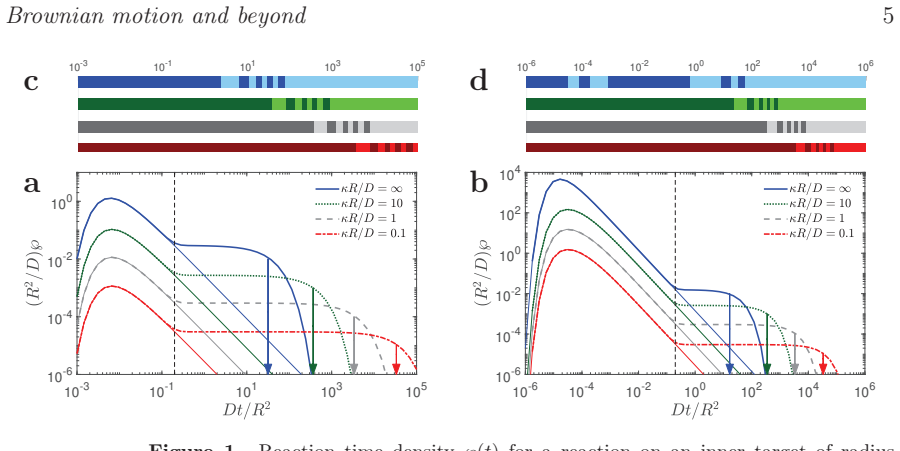
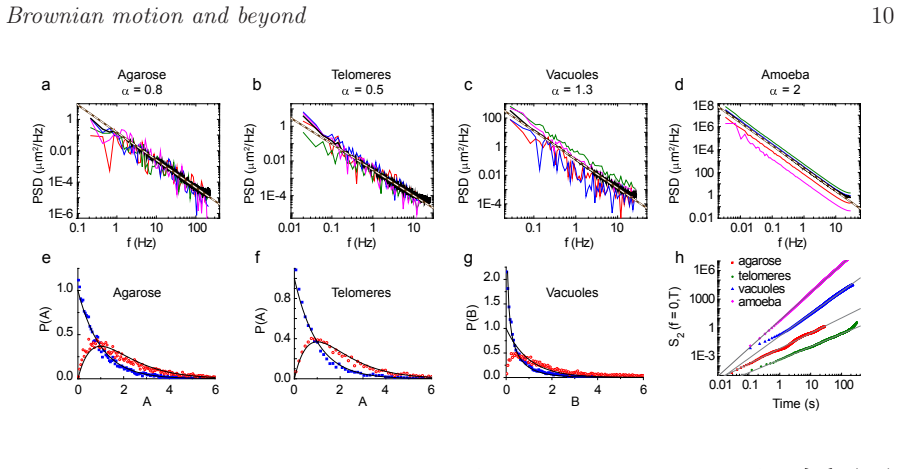
The machinery is a set of exactly solvable stochastic-process models and their fluctuation statistics. For first passage, the paper uses eigenfunction expansions of the diffusion equation in confining domains, which split reaction-time densities into geometry-controlled, process-controlled, and domain-controlled regimes. For time averages, the central objects are the time-averaged mean squared displacement, the dimensionless amplitude measuring how far an individual trajectory's time average deviates from the ensemble mean, the ergodicity-breaking parameter, and the ageing factor for scale-free continuous time random walks. For spectra, the central object is the single-trajectory power spectrum together with its amplitude distribution and coefficient of variation as a function of the product of frequency and observation time. For non-Gaussian diffusion, the load-bearing mechanism is the diffusing-diffusivity model: a coupled pair of stochastic equations in which the particle position follows white-noise driving with amplitude proportional to the square root of the time-dependent diffusivity, while that diffusivity is the square of a mean-reverting auxiliary process; a subordination formulation makes the short-time superstatistical Laplace regime and the long-time Gaussian crossover analytically tractable.
What would settle it
Recompute the key formulas from first principles or simulation: simulate a scale-free continuous time random walk and test whether the ageing time-averaged mean squared displacement equals the non-aged value times the predicted ageing factor, and simulate the minimal diffusing-diffusivity equations and check whether the one-dimensional kurtosis crosses from 9 to 3 at the correlation time. If either prediction fails, the review's central benchmarks are wrong. Alternatively, measure the coefficient of variation for a known subdiffusive system at high frequency; theory says it tends to 1, so a conflicting plateau would refute the spectral classification.
Extended reading notes
Core claim
The paper's central claim is that four recent lines of work form a coherent upgrade of diffusion analysis. First, for a particle diffusing in a bounded domain toward a partially reactive target, the full reaction-time density—not just its mean—has a three-regime structure: a short-time hump set by direct trajectories, an intermediate process-dependent power-law decay, and a terminal exponential shoulder set by the confining domain; lowering the target reactivity widens a plateau of nearly equiprobable reaction times, so the mean reaction time can be atypical. Second, for scale-free continuous time random walks the time-averaged mean squared displacement remains a random quantity even in the long-measurement limit, and its scatter, quantified by the amplitude distribution and the ergodicity-breaking parameter, distinguishes such non-ergodic processes from ergodic ones. Third, the single-trajectory power spectrum is proportional to the ensemble-averaged spectrum but carries a random amplitude, and its coefficient of variation tends in the high-frequency limit to the square root of 2 for superdiffusion, the square root of 5/2 for Brownian motion, and 1 for subdiffusion, allowing regime identification from few short tracks. Fourth, a minimal diffusing-diffusivity model—a particle driven by white noise whose diffusivity is the square of a mean-reverting auxiliary process—produces a linear mean squared displacement with Laplace-distributed displacements at short times and a crossover to Gaussian displacements at long times, quantified by a kurtosis drop from 9 to 3 in one dimension.
Load-bearing premise
The load-bearing premise is that the formulas and model predictions quoted from earlier papers—the reaction-time density, the ageing factor, the coefficient-of-variation limits, and the diffusing-diffusivity crossover—were transcribed correctly and that those models describe the single-particle-tracking experiments to which the review compares them.
Editorial extensions
If this is right
- At nanomolar concentrations, reaction kinetics should be described by the full first-reaction-time density; the mean reaction time can be unrepresentative, and both geometry-control and reaction-control set the typical times.
- Amplitude scatter and the ergodicity-breaking parameter give model-selection fingerprints: different stochastic mechanisms leave distinct scatter patterns in finite-time trajectories.
- Single-trajectory power spectra can classify subdiffusion, normal diffusion, and superdiffusion from few, short tracks via the coefficient of variation, with distinct high-frequency limits and quantitative agreement with telomere, agarose-gel, vacuole, and amoeba data.
- The diffusing-diffusivity model explains the coexistence of a linear mean squared displacement with non-Gaussian displacement statistics, and the kurtosis crossover provides a direct experimental estimate of the diffusivity correlation time.
- Bayesian and machine-learning parameter estimators, together with newer statistical tools, are positioned as the natural next step for identifying the underlying stochastic mechanism from measured time series.
Reading between the lines
- If fluctuation diagnostics are as informative as the review suggests, the same quantities could be used to infer spatial or temporal heterogeneity of the environment from a single trajectory, a step beyond the model-class identification the review emphasizes.
- The diffusing-diffusivity structure is mathematically the same stochastic-volatility structure used in financial mathematics; the first-passage and spectral diagnostics reviewed here could transfer to time-series analysis of volatility and returns.
- A testable extension follows directly: in any Brownian-yet-non-Gaussian experimental system, measure the kurtosis as a function of lag time; if the short-time value and crossover time do not match the diffusing-diffusivity prediction, then alternative mechanisms such as quenched-disorder heterogeneity are needed.
- The three-regime reaction-time structure suggests that search-and-reaction optimization should target the most probable reaction time rather than the mean; comparing the mean and mode of measured first-reaction-time distributions could reveal whether geometry-control or reaction-control dominates.
Signed reviews
Editorial analysis
A structured set of objections, weighed in public.
Referee Report
Summary. This invited-style review surveys recent developments in stochastic processes, organized around four areas: full first-passage-time densities in confined domains and for partially reactive targets; single-trajectory time-averaged mean squared displacements, ageing, and ergodicity breaking; single-trajectory power spectral densities and their amplitude fluctuations; and Brownian-yet-non-Gaussian diffusion via superstatistics and diffusing diffusivity. The review frames these developments by the new experimental possibilities of superresolution microscopy and single-particle tracking, and argues that the fluctuations of single-trajectory observables carry diagnostic information that complements ensemble averages. The paper contains no new derivations or data; its contribution is the selection, synthesis, and transcription of published results, with Figures 2 and 3 reproducing experimental and simulation data from the cited literature.
Significance. If the summary is accurate, the review has pedagogical and practical value for experimentalists entering single-particle tracking and for theorists seeking a compact map of recent developments. Its strengths are the clear separation of ensemble and time-averaged observables, the emphasis on amplitude fluctuations as model-selection tools, and the visual documentation in Figures 2 and 3. The equations and qualitative statements I spot-checked are consistent with standard results: the Lévy-Smirnov first-passage density, the ageing factor in Eq. (11), and the diffusing-diffusivity crossover and kurtosis behaviour in Section 5 are all recognizable from the cited literature. No free parameters or fitted quantities enter the presentation, and no new falsifiable prediction is made, so the paper should be judged as a review rather than as a primary research contribution.
minor comments (7)
- [Introduction] The roadmap in the Introduction misstates the section order: it assigns single-trajectory power spectra to Section 3 and non-Gaussian diffusion to Section 4, whereas the actual headings are Section 3 for time-averaged MSD, Section 4 for power spectra, Section 5 for non-Gaussian diffusion, and Section 6 for conclusions. Please correct the roadmap.
- [Equation (4)] As rendered, the prefactor in Eq. (4) appears to be x0/(4πDt)^{3/2}, but the normalized one-dimensional Lévy-Smirnov first-passage density requires the prefactor x0/√(4πDt^3). If the original PDF contains the square root, please ensure the typeset version is unambiguous; otherwise correct the prefactor.
- [Section 4, paragraph after Eq. (13)] The sentence "As function of ω=fT, γ has the unique value √2 independent of the anomalous diffusion exponent α" should be qualified as the small-frequency (ω→0) limit; in its present form it appears to contradict the three distinct large-ω limits stated immediately after Eq. (14).
- [Section 4, paragraph after Eq. (13)] The statement "For subdiffusion, the coefficient is negative" is ambiguous because the coefficient of variation γ is a nonnegative quantity. If the intended statement concerns the sign of the prefactor α(α−1)Kα in the noise autocorrelation written just before, please say so explicitly rather than referring to "the coefficient".
- [Section 5, around Figure 3] The caption says the kurtosis crosses over "from the value K=9 for a one-dimensional Laplace distribution", but a standard one-dimensional Laplace distribution has kurtosis 6. The value K=9 is consistent with a squared-Gaussian diffusivity distribution at short times. Please reconcile the wording with the actual model distribution shown in Figure 3.
- [Section 3, paragraph after Eq. (7)] In the sentence beginning "Thus, from a random walk perspective", the kernel is written as [r²(t′+t)−r²(t′)]²; the superscript on r inside the square brackets is inconsistent with Eq. (7) and should read [r(t′+t)−r(t′)]².
- [References] Reference [90] is listed as "unpublished". Because it is used to support a comparison in Section 5, it should be replaced by a published account or explicitly labelled as a personal communication so that the reader can assess the claim.
Circularity Check
No significant circularity: the paper is a self-labeled review summarizing externally published results, not a derivation whose predictions reduce to its inputs.
full rationale
This is a review article, not a derivation paper. It explicitly frames itself as a summary: 'Here we provide a summary of some of the recent developments highlighting both the experimental findings and theoretical frameworks.' The displayed results—Eq. (4) for the Lévy–Smirnov first-passage density, Eq. (5) for the mean reaction time, Eq. (11) for the ageing factor, Eq. (14) for the coefficient of variation, and the diffusing-diffusivity model (16a)–(16c)—are presented as previously published findings with citations, not as new predictions derived from fitted constants. No parameter is fitted to a subset of data and then renamed as a prediction; no quantity is defined in terms of the quantity it is said to explain. The paper does rely heavily on the author's own prior work (e.g., [21], [23], [38], [49], [50], [72]), but those are external peer-reviewed publications, and in several cases the review notes direct comparison with experimental data, as in Figure 2 taken from [50]. The unpublished reference [90] is used only in a passing comparative sentence and is not load-bearing for any stated claim. The review invokes no uniqueness theorem from the author's own work to forbid alternative models, and it does not present an ansatz under the cover of a citation: the diffusing-diffusivity model is attributed to Chubinsky and Slater and then analyzed in [72], with the review explicitly describing the model rather than claiming it is derived from first principles. Because the paper's central claim is descriptive rather than predictive, there is no constructed equivalence between inputs and outputs, and no circular step can be identified.
Assumptions & free parameters
assumptions (5)
- standard math The Gaussian propagator (2) and linear MSD (1) describe the reference Brownian motion behavior.
- standard math The Sparre Andersen theorem gives a universal t^(-3/2) tail for first-passage densities of Markovian symmetric random walks.
- standard math The central limit theorem ensures convergence of properly scaled sums of independent identically distributed random variables to a Gaussian distribution.
- domain assumption The diffusing diffusivity model in Eqs. (16a)-(16c) captures the physical mechanism of a fluctuating diffusion coefficient.
- domain assumption The single-trajectory power spectral density at finite observation time, Eq. (12), is a meaningful observable whose fluctuations carry information.
Cite this review
Pith. "Pith review of Brownian motion and beyond: first-passage, power spectrum, non-Gaussianity, and anomalous diffusion." pith.science (2026). https://pith.science/paper/GFAMS7DB
@misc{pith2026190806233,
  author       = {Pith},
  title        = {Pith review of: Brownian motion and beyond: first-passage, power spectrum, non-Gaussianity, and anomalous diffusion},
  year         = {2026},
  howpublished = {\url{https://pith.science/paper/GFAMS7DB}},
  note         = {Machine review of arXiv:1908.06233}
}
read the original abstract
Brownian motion is a ubiquitous physical phenomenon across the sciences. After its discovery by Brown and intensive study since the first half of the 20th century, many different aspects of Brownian motion and stochastic processes in general have been addressed in Statistical Physics. In particular, there now exist a very large range of applications of stochastic processes in various disciplines. Here, we highlight some of the advances in stochastic processes prompted by novel experimental methods such as superresolution microscopy. Here we provide a summary of some of the recent developments highlighting both the experimental findings and theoretical frameworks.
Figures

Reference graph
Works this paper leans on
-
[90]
I. M. Sokolov and A. V. Chechkin (unpublished)
-
[1]
Brown, Phil
R. Brown, Phil. Mag. 4, 161 (1828); Ann. Phys. Chem. 14, 294 (1828)
-
[2]
Einstein, Ann
A. Einstein, Ann. Phys. (Leipzig) 322, 549 (1905)
1905
-
[3]
Sutherland, Philos
W. Sutherland, Philos. Mag. 9, 781 (1905)
1905
-
[4]
von Smoluchowski, Ann
M. von Smoluchowski, Ann. Phys. (Leipzig) 21, 756 (1906)
1906
-
[5]
Langevin, C
P. Langevin, C. R. Acad. Sci. Paris 146, 530 (1908)
1908
-
[6]
Pearson, Nature 72, 294 (1905)
K. Pearson, Nature 72, 294 (1905). Rayleigh, Nature 72, 318 (1905)
1905
-
[7]
Perrin, Compt
J. Perrin, Compt. Rend. (Paris) 146, 967 (1908). J. Perrin, Ann. Chim. Phys. 18, 5 (1909)
1908
Show all 100 references
-
[8]
Nordlund, Z
I. Nordlund, Z. Phys. Chem. 87, 40 (1914)
1914
-
[9]
Kappler, Ann
E. Kappler, Ann. Phys. (Leipzig) 11, 233 (1931)
1931
-
[10]
W. E. Moerner and M. Orrit, Science 238, 1670 (1999). M. J. Saxton and K. Jacobsen, Ann. Rev. Biophys. Biomol. Stru ct. 26, 373 (1997). X. S. Xie, P. J. Choi, G.-W. Li, N. K. Lee, and G. Lia, Annu. Rev. Biophys. 37, 417 (2008). C. Bräuchle, D. C. Lamb, and J. Michaelis, Single...
1999
-
[11]
Nørregaard, R
K. Nørregaard, R. Metzler, C. M. Ritter, K. Berg-Sørens en, and L. B. Oddershede, Chem. Rev. 117, 4342 (2017). F. Höfling and T. Franosch, Rep. Prog. Phys. 76 046602 (2013). Brownian motion and beyond 16
2017
-
[12]
di Rienzo et al , Nature Comm
C. di Rienzo et al , Nature Comm. 5, 5891 (2014)
2014
-
[13]
Metzler, J.-H
R. Metzler, J.-H. Jeon, and A. G. Cherstvy, Biochimica e t Biophysica Acta - Biomembranes 1858, 2451 (2016)
2016
-
[14]
Redner, A Guide to First Passage Processes (Cambridg e University Press, Cambridge, UK, 2001)
S. Redner, A Guide to First Passage Processes (Cambridg e University Press, Cambridge, UK, 2001)
2001
-
[15]
Koren, M
T. Koren, M. A. Lomholt, A. V. Chechkin, J. Klafter, and R . Metzler, Phys. Rev. Lett. 99, 160602 (2007). A. V. Chechkin, R. Metzler, J. Klafter, V. Yu. Gonchar, and L. V. Tanatarov, J. Phys. A 36, L537 (2003)
2007
-
[16]
Bénichou and R
O. Bénichou and R. Voituriez, Phys. Rep. 539, 225 (2014). S. Condamin, O. Bénichou, V. Tejedor, R. Voituriez, and J. Kl after, Nature 450, 77 (2007). O. Bénichou, C. Chevalier, J. Klafter, B. Meyer, and R. Voitu riez, Nature Chem. 2, 472-477 (2010)
2014
-
[17]
Mejía-Monasterio, G
C. Mejía-Monasterio, G. Oshanin, and G. Schehr, J. Stat . Mech. P06022 (2011). T. Mattos, C. Mejía-Monasterio, R. Metzler, and G. Oshanin, Phys. Rev. E 86, 031143 (2012)
2011
-
[18]
Kolesov, Z
G. Kolesov, Z. Wunderlich, O. N. Laikova, M. S. Gelfand, and L. A. Mirny, Proc. Natl. Acad. Sci. USA 104, 13948 (2007). O. Pulkkinen and R. Metzler, Phys. Rev. Lett. 110, 198101 (2013)
2007
-
[19]
Bauer, E
M. Bauer, E. S. Rasmussen, M. A. Lomholt, and R. Metzler, Sci. Rep. 5, 10072 (2015)
2015
-
[20]
J. Yu, J. Xiao, X. Ren, K. Lao, and X. S. Xie, Science 311, 1600, (2006)
2006
-
[21]
Godec and R
A. Godec and R. Metzler, Phys. Rev. X 6, 041037 (2016). A. Godec and R. Metzler, Sci. Rep. 6, 20349 (2016)
2016
-
[22]
D. S. Grebenkov, R. Metzler and G. Oshanin, Phys. Chem. C hem. Phys. 20, 16393 (2018)
2018
-
[23]
Grebenkov, R
D. Grebenkov, R. Metzler, and G. Oshanin, Comm. Chem. 1, 96 (2018)
2018
-
[24]
F. C. Collins and G. E. Kimball, J. Colloid Sci. 4, 425 (1949)
1949
-
[25]
Bouchaud and A
J.-P. Bouchaud and A. Georges, Phys. Rep. 195, 127 (1990)
1990
-
[26]
Metzler and J
R. Metzler and J. Klafter, Phys. Rep. 339, 1 (2000)
2000
-
[27]
Metzler, J.-H
R. Metzler, J.-H. Jeon, A. G. Cherstvy, and E. Barkai, Ph ys. Chem. Chem. Phys. 16, 24128 (2014)
2014
-
[28]
Scher and E
H. Scher and E. W. Montroll, Phys. Rev. B 12, 2455 (1975)
1975
-
[29]
Schubert, E
M. Schubert, E. Preis, J. C. Blakesley, P. Pingel, U. Sch erf, and D. Neher, Phys. Rev. B 87, 024203 (2013)
2013
-
[30]
Edery, H
Y. Edery, H. Scher, A. Guadagnini, and B. Berkowitz, Wat er Res. Res. 50, 1490 (2014). B. Berkowitz, H. Scher, and S. E. Silliman, Water Res. Res. 36, 149 (2000). R. Schumer, D. A. Benson, and M. Meerschaert, Water Res. Res. 39, 13 (2003)
2014
-
[31]
Weiss, M
M. Weiss, M. Elsner, F. Kartberg, and T. Nilsson, Biophy s. J. 87, 3518 (2004). I. Golding and E. C. Cox, Phys. Rev. Lett. 96, 098102 (2006). I. Bronstein, Y. Israel, E. Kepten, S. Mai, Y. Shav-Tal, E. Ba rkai and Y. Garini, Phys. Rev. Lett. 103, 018102 (2009). G. Guigas, C. K...
2004
-
[32]
T. H. Solomon, E. R. Weeks, and H. L. Swinney, Phys. Rev. L ett. 71, 3975 (1993). G. M. Zaslavsky, Phys. Rep. 371, 461 (2002). L. F. Richardson, Proc. Roy. Soc. A 110, 709 (1926)
1993
-
[33]
Caspi, R
A. Caspi, R. Granek, and M. Elbaum. Phys. Rev. Lett. 85, 5655 (2000). G. Seisenberger, M. U. Ried, T. Endreß, H. Büning, M. Hallek, and C. Bräuchle, Science 294, Brownian motion and beyond 17 1929 (2001). D. Robert, T. H. Nguyen, F. Gallet, and C. Wilhelm, PLoS ONE 4, e10046 (...
2000
-
[34]
Tejedor, O
V. Tejedor, O. Benichou, R. Voituriez, R. Jungmann, F. S immel, C. Selhuber-Unkel, L. Oddershede and R. Metzler, Biophys. J. 98, 1364 (2010)
2010
-
[35]
Y. He, S. Burov, R. Metzler, and E. Barkai, Phys. Rev. Let t. 101, 058101 (2008)
2008
-
[36]
Barkai, Y
E. Barkai, Y. Garini, and R. Metzler, Phys. Today 65(8), 29 (2012)
2012
-
[37]
A. V. Weigel, B. Simon, M. M. Tamkun, and D. Krapf, Proc. N atl. Acad. Sci. U. S. A. 108, 6438 (2011). A. V. Weigel, M. M. Tamkun, and D. Krapf, Proc. Natl. Acad. Sci . U. S. A. 110, E4591 (2013)
2011
-
[38]
J. H. P. Schulz, E. Barkai, and R. Metzler, Phys. Rev. Let t. 110, 020602 (2013). J. H. P. Schulz, E. Barkai, and R. Metzler, Phys. Rev. X 4, 011028 (2014)
2013
-
[39]
Barkai, Phys
E. Barkai, Phys. Rev. Lett. 90, 104101 (2003). E. Barkai and Y. C. Cheng, J. Chem. Phys. 118, 6167 (2003)
2003
-
[40]
Mardoukhi, J.-H
Y. Mardoukhi, J.-H. Jeon, and R. Metzler, Phys. Chem. Ch em. Phys. 17, 30134 (2015). Y. Mardoukhi, J.-H. Jeon, A. V. Chechkin, and R. Metzler, Phy s. Chem. Chem. Phys. 20, 20427 (2018)
2015
-
[41]
S. C. Lim and S. V. Muniandy, Phys. Rev. E 66, 021114 (2002). A. Fuliński, J. Chem. Phys. 138, 021101 (2013). J.-H. Jeon, A. V. Chechkin, and R. Metzler, Phys. Chem. Chem. Phys. 16, 15811 (2014)
2002
-
[42]
A. G. Cherstvy, A. V. Chechkin, and R. Metzler, New J. Phy s. 15, 083039 (2013). A. G. Cherstvy and R. Metzler, Phys. Rev. E 90, 012134 (2014). A. G. Cherstvy, A. V. Chechkin, and R. Metzler, J. Phys. A 47, 485002 (2014)
2013
-
[43]
A. G. Cherstvy and R. Metzler, Phys. Chem. Chem. Phys. 15, 20220 (2013)
2013
-
[44]
Krüsemann, A
H. Krüsemann, A. Godec, and R. Metzler, Phys. Rev. E 89, 040101(R) (2014). H. Krüsemann, A. Godec, and R. Metzler, J. Phys. A 48, 285001 (2015). H. Krüsemann, R. Schwarzl, and R. Metzler, Transp. Porous Me dia 115, 327 (2016)
2014
-
[45]
B. B. Mandelbrot and J. W. van Ness, SIAM Rev. 10, 422 (1968)
1968
-
[46]
Deng and E
W. Deng and E. Barkai, Phys. Rev. E 79, 011112 (2009). M. Schwarzl, A. Godec, and R. Metzler, Sci Rep. 7, 3878 (2017)
2009
-
[47]
Goychuk, Phys
I. Goychuk, Phys. Rev. E 80, 046125 (2009). I. Goychuk, Adv. Chem. Phys. 150 187 (2012)
2009
-
[48]
M. P. Norton and D. G. Karczub, Fundamentals of Noise and Vibration Analysis for Engineers (Cambridge University Press, Cambridge UK, 2003)
2003
-
[49]
Krapf, E
D. Krapf, E. Marinari, R. Metzler, G. Oshanin, X. Xu, and S. Squarcini, New J. Phys. 20, 023029 (2018)
2018
-
[50]
Krapf, N
D. Krapf, N. Lukat, E. Marinari, R. Metzler, G. Oshanin, C. Selhuber-Unkel, A. Squarcini, L. Stadler, M. Weiss, and X. Xu, Phys. Rev. X 9, 011019 (2019)
2019
-
[51]
Sposini, R
V. Sposini, R. Metzler, and G. Oshanin, New J. Phys. 21, 073043 (2019)
2019
-
[52]
Feller, An introduction to probability theory and it s application (Wiley, New York, NY, 1970)
W. Feller, An introduction to probability theory and it s application (Wiley, New York, NY, 1970)
1970
-
[53]
van Kampen, Stochastic processes in physics and chem istry (North Holland, Amsterdam, 1981)
N. van Kampen, Stochastic processes in physics and chem istry (North Holland, Amsterdam, 1981)
1981
-
[54]
B. Wang, J. Kuo, S. C. Bae, and S. Granick, Nat. Mater. 11, 481 (2012)
2012
-
[55]
B. Wang, S. M. Antony, S. C. Bae, and S. Granick, Proc. Nat l. Acad. Sci. U.S.A. 106, 15160 (2009)
2009
-
[56]
K. C. Leptos, J. S. Guasto, J. P. Gollub, A. I. Pesci, and R . E. Goldstein, Phys. Rev. Lett. 103, 198103 (2009)
2009
-
[57]
C. Xue, X. Zheng, K. Chen, Y. Tian, and G. Hu, J. Phys. Chem . Lett. 7, 514 (2016)
2016
-
[58]
D. Wang, R. Hu, M. J. Skaug, and D. Schwartz, J. Phys. Chem . Lett. 6 54 (2015)
2015
-
[59]
Dutta and J
S. Dutta and J. Chakrabarti, EPL 116, 38001 (2016)
2016
-
[60]
Hapca, J
S. Hapca, J. W. Crawford, and I. M. Young, J. R. Soc. Inter face 6, 111 (2009). Brownian motion and beyond 18
2009
-
[61]
A. G. Cherstvy, O. Günther, C. Beta, and R. Metzler, Phys . Chem. Chem. Phys. 20, 23034 (2018)
2018
-
[62]
Kob and H
W. Kob and H. C. Andersen, Phys. Rev. E 51, 4626 (1995)
1995
-
[63]
Chaudhuri, L
P. Chaudhuri, L. Berthier, and W. Kob, Phys. Rev. Lett. 99, 060604 (2007)
2007
-
[64]
Roldàn-Vargas, L
S. Roldàn-Vargas, L. Rovigatti, and F. Sciortino, Soft Matt. 13, 514 (2017)
2017
-
[65]
Samanta and R
N. Samanta and R. Chakrabarti, Soft Matt. 12, 8563 (2016)
2016
-
[66]
M. J. Skaug, L. Wang, Y. Ding, and D. K. Schwartz, ACS Nano 9, 2148 (2015)
2015
-
[67]
Beck and E
C. Beck and E. D. B. Cohen, Physica A 322, 267 (2003)
2003
-
[68]
Beck, Prog
C. Beck, Prog. Theor. Phys. Suppl. 162, 29 (2006)
2006
-
[69]
van der Straeten and C
E. van der Straeten and C. Beck, Phys. Rev. E 80, 036108 (2009)
2009
-
[70]
A. Mura, M. S. Taqqu, and F. Mainardi, Physica A 387, 5033 (2008). A. Mura and G. Pagnini, J. Phys. A: Math. Theor. 41, 285003 (2008). A. Mura and F. Mainardi, Int. Transf. Spe. Funct. 20, 185 (2009). D. Molina-García, T. M. Pham, P. Paradisi, and G. Pagnini, Ph ys. Rev. E 94,...
2008
-
[71]
Sposini, A
V. Sposini, A. V. Chechkin, F. Seno, G. Pagnini, and R. Me tzler, New J. Phys. 20, 043044 (2018)
2018
-
[72]
A. V. Chechkin, F. Seno, R. Metzler, and I. M. Sokolov, Ph ys. Rev. X 7, 021002 (2017)
2017
-
[73]
Beck, Physica A 365, 96 (2006)
C. Beck, Physica A 365, 96 (2006)
2006
-
[74]
M. V. Chubynsky and G. W. Slater, Phys. Rev. Lett. 113, 098302 (2014)
2014
-
[75]
Jain and K
R. Jain and K. L. Sebastian, J. Phys. Chem. B 120, 3988 (2016). R. Jain and K. L. Sebastian, J. Chem. Sci. 129, 929 (2017)
2016
-
[76]
Tyagi and B
N. Tyagi and B. J. Cherayil, J. Phys. Chem. B, 121, 7204 (2017)
2017
-
[77]
Lanoiselée and D
Y. Lanoiselée and D. Grebenkov, J. Phys. A 51, 145602 (2018)
2018
-
[78]
Lanoiselée, N
Y. Lanoiselée, N. Moutal, and D. Grebenkov, Nature Comm . 9, 4398 (2018)
2018
-
[79]
Sposini, A
V. Sposini, A. V. Chechkin, and R. Metzler, J. Phys. A 52, 04LT01 (2019)
2019
-
[80]
Fouqué, G
J.-P. Fouqué, G. Papanicolaou, and K. R. Sircar, Deriva tives in financial markets with stochastic volatility (Cambridge University Press, Cambridge, UK, 20 00). J. C. Cox, J. E. Ingersoll, and S. A. Ross, Econometrica. 53, 385 (1985). See also S. L. Heston, Rev. Financial Stud...
1985
-
[81]
Lutz, Phys
E. Lutz, Phys. Rev. E 64, 051106 (2001)
2001
-
[82]
J.-H. Jeon, H. M.-S. Monne, M. Javanainen, and R. Metzle r, Phys. Rev. Lett. 109, 188103 (2012). G. R. Kneller, K. Baczynski, and M. Pasenkiewicz-Gierula, J . Chem. Phys. 135, 141105 (2011)
2012
-
[83]
J.-H. Jeon, M. Javanainen, H. Martinez-Seara, R. Metzl er, and I. Vattulainen, Phys. Rev. X 6, 021006 (2016)
2016
-
[84]
W. He, H. Song, Y. Su, L. Geng, B. J. Ackerson, H. B. Peng, a nd P. Tong, Nat. Comm. 7, 11701 (2016)
2016
-
[85]
Lampo, S
T. Lampo, S. Stylianido, M. P. Backlund, P. A. Wiggins, a nd A. J. Spakowitz, Biophys. J. 112, 532 (2017)
2017
-
[86]
van der Straeten and C
E. van der Straeten and C. Beck, Physica A 390, 951 (2011)
2011
-
[87]
Ślęzak, R
J. Ślęzak, R. Metzler, and M. Magdziarz, New J. Phys. 20, 023026 (2018)
2018
-
[88]
A. G. Cherstvy and R. Metzler, Phys. Chem. Chem. Phys. 18, 23840 (2016)
2016
-
[89]
Stylianido, T
S. Stylianido, T. J. Lampo, A. J. Spakowitz, and P. A. Wig gins, Phys. Rev. E 97, 062410 (2018)
2018
- [91]
-
[92]
Ślęzak, K
J. Ślęzak, K. Burnecki, and R. Metzler, New J. Phys. 21, 073056 (2019)
2019
-
[93]
Havlin and D
S. Havlin and D. Ben-A vraham, Adv. Phys. 36, 695 (1987)
1987
-
[94]
A. H. O. Wada and T. Vojta, Phys. Rev. E 97, 020102(R) (2018). T. Guggenberger, G. Pagnini, T. Vojta, and R. Metzler, New J. Phys 21, 022002 (2019)
2018
-
[95]
Robson, K
A. Robson, K. Burrage, and M. C. Leake, Philos. Trans. R. Soc. B 368, 20120029 (2012). J. Krog and M. A. Lomholt, Phys. Rev. E 96, 062106 (2017). S. Thapa, M. A. Lomholt, J. Krog, A. G. Cherstvy, and R. Metzle r, Phys. Chem. Chem. Phys. 20, 29018 (2018). A. G. Cherstvy, S. Tha...
2012
-
[96]
Granik, E
N. Granik, E. Nehme, L. E. Weiss, M. Levin, M. Chein, E. Pe rlson, Y. Roichman, and Y. Shechtman, Biophys. J. 117, 185 (2019). G. Muñoz-Gil, M. A. Garcia-March, C. Manzo, J. D. Martín-Gue rrero, and M. Lewenstein, E-print arXiv:1903.02850
2019 arXiv
-
[97]
Magdziarz, A
M. Magdziarz, A. Weron, K. Burnecki and J. Klafter, Phys . Rev. Lett. 103, 180602 (2009). M. Magdziarz and J. Klafter, Phys. Rev. E 82, 011129 (2010)
2009
-
[98]
Heidernaetsch, M
M. Heidernaetsch, M. Bauer, and G. Radons, J. Chem. Phys . 139, 184105 (2013)
2013
-
[99]
C. L. Vestergaard, P. C. Blainey, and H. Flyvbjerg, Phys . Rev. E 89, 022726 (2014)
2014
-
[100]
Ślęzak, R
J. Ślęzak, R. Metzler, and M. Magdziarz, New J. Phys. 21, 053008 (2019)
2019
Reviewed August 14, 2026 · model on record in the stance chip above.
Discussion (0). Continue with ORCID to comment.