REVIEW 2 major objections 5 minor 3 cited by
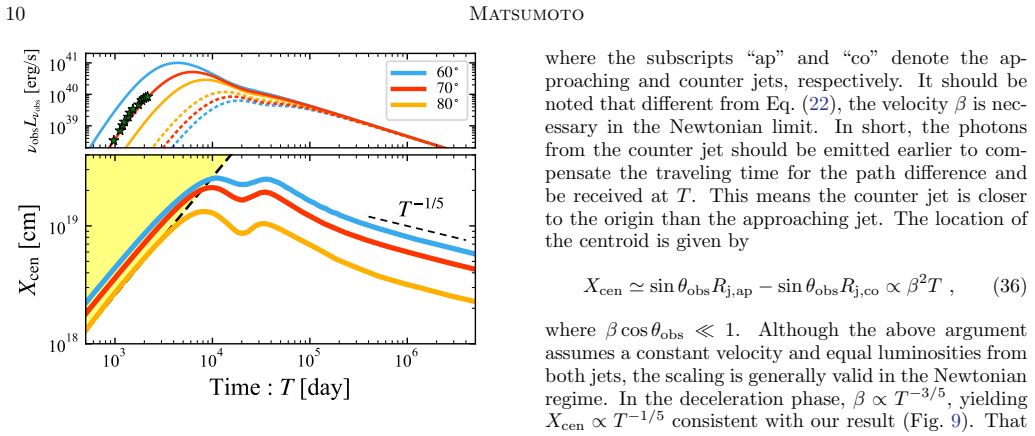
In the off-axis jet model of AT2018hyz's late radio flare, the radio emission centroid moves with apparent superluminal speed until the counter-jet dominates, while a delayed spherical outflow keeps the centroid within a non-relativistic di
Reviewed by Pith at T0; open to challenge. T0 means a machine referee read the full paper against a public rubric. the ladder, T0–T4 →
T0 review · deepseek-v4-flash
2026-08-03 14:01 UTC pith:GFXZQA2D
load-bearing objection Useful, honest synthetic-imaging paper that gives a clean VLBI discriminator for AT2018hyz; the main caveat is lateral spreading during the superluminal phase. the 2 major comments →
VLBI Diagnostics of Off-axis Jets in Radio Flares of Tidal Disruption Events
The pith
A machine-rendered reading of the paper's core claim, the machinery that carries it, and where it could break.
Core claim
The paper claims that in the off-axis relativistic jet scenario, the centroid of the radio image exhibits apparent superluminal motion, X_cen >= cT, until the counter-jet begins to contribute significantly; in the delayed spherical outflow scenario, the centroid is confined within roughly (c beta) T and never exceeds the non-relativistic distance. This contrast is robust because the relativistic Doppler effect and the geometry of the equal-arrival-time surface place the jet's bright approaching side far from the origin, whereas a spherical Newtonian outflow is symmetric. The paper also finds that the jet image's aspect ratio evolves non-monotonically: it starts near unity, decreases as the j
What carries the argument
The central object is the synthetic radio image computed via the equal-arrival-time surface (EATS) of a top-hat jet, combined with the relativistic Doppler factor and synchrotron emissivity/absorption. The emission centroid is the flux-weighted mean position on the sky, and its evolution is tracked over time. The image aspect ratio is defined as the ratio of widths in the X (jet-axis) and Y (perpendicular) directions. The EATS geometry—egg-shaped for relativistic outflows and spherical for Newtonian ones—drives the predicted centroid superluminal motion and the non-monotonic aspect ratio.
Load-bearing premise
The jet is assumed to keep its original top-hat geometry and not spread sideways during the entire evolution, including the Newtonian phase; if lateral expansion occurs as expected when the Lorentz factor drops below 1/theta_j, the image geometry and centroid trajectory could change, possibly blurring the predicted superluminal signature.
What would settle it
A VLBI monitoring campaign of AT2018hyz's radio centroid over the next several years: if the centroid offset stays below cT at all observed epochs, the off-axis jet scenario with moderate viewing angles is excluded; if the offset exceeds cT, the delayed outflow scenario is excluded. Additionally, a high-resolution numerical simulation that includes lateral jet expansion could test whether the superluminal centroid phase survives in a more realistic jet geometry.
If this is right
- If VLBI observes a centroid offset exceeding cT in AT2018hyz, the delayed outflow scenario is ruled out and the off-axis jet interpretation is confirmed.
- If the centroid remains within cT, the off-axis jet scenario with moderate viewing angles is excluded; only extreme viewing angles (theta_obs >~83 degrees) remain viable, and those predict a later backward centroid motion that still distinguishes the jet from a delayed outflow.
- The non-monotonic aspect ratio evolution provides an independent imaging diagnostic that can be tested once the source is resolved, and it is generic to off-axis jets in other transients.
- VLBI centroid astrometry, or precision IR astrometry with facilities like JWST, could detect the superluminal motion even when the source is not spatially resolved.
- The same modeling framework can be applied to other jetted events such as microquasars and gamma-ray bursts to predict their radio image and centroid evolution.
Where Pith is reading between the lines
- The clean separation between the two scenarios rests on the assumption that the jet retains its top-hat geometry without lateral expansion; if sideways spreading occurs as the jet decelerates, the centroid trajectory and aspect ratio may change, so testing this prediction with simulations that include lateral spreading would be a valuable next step.
- The existence of a 'confusion zone' near theta_obs ~83 degrees, where the centroid speed becomes subluminal, suggests that some off-axis jets could masquerade as Newtonian outflows in centroid-only studies; the predicted backward centroid motion is then the only distinguishing feature and should be searched for in long-term monitoring.
- The apparent superluminal motion is a projection effect, not a physical violation of relativity; any detection must be carefully disentangled from host-galaxy contamination and proper-motion systematics, which the paper partially addresses by suggesting IR observations.
- The method could be extended to distinguish prompt outflows interacting with a non-monotonic CNM from delayed outflows, since that third scenario would produce yet another centroid evolution pattern.
Editorial analysis
A structured set of objections, weighed in public.
Referee Report
Summary. The paper presents synthetic radio images and light curves for two competing explanations of the late-time radio flare in AT2018hyz: a delayed, non-relativistic spherical outflow and an off-axis relativistic top-hat jet. The calculation uses a piecewise-spherical thin-shell dynamics, synchrotron emission with SSA, equal-arrival-time surfaces, and full image-plane integration. The central diagnostic is the motion of the radio emission centroid: in the delayed-outflow scenario the centroid is confined to a non-relativistic distance ≲βcT, whereas in the off-axis jet scenario it exhibits apparent superluminal motion X_cen ≥ cT. The paper also predicts a non-monotonic evolution of the jet image aspect ratio and discusses late-time centroid recession. Parameter sets for AT2018hyz are chosen by manual forward modeling rather than formal fitting.
Significance. If the predicted superluminal centroid is robust, this is an important and timely result: it offers a concrete way to break the current light-curve/spectral degeneracy between the two leading AT2018hyz models, using VLBI astrometry rather than microphysical-fitting details. The derivation is transparent and internally consistent: the analytic scalings, e.g. F_ν∝T^{4.2} in Eq. (23), the critical viewing angle in Eqs. (28)–(29), and the aspect-ratio limits in Eq. (32), match the computed numerical images. The core diagnostic indeed does not depend on the fitted microphysical parameters; it follows from relativistic beaming geometry. The approach is also transferable to other off-axis jetted transients such as microquasars and GRBs. The main weakness is that the top-hat, no-lateral-expansion geometry is assumed throughout, including in the trans-relativistic epoch where the authors themselves note that sideways expansion is expected.
major comments (2)
- [Sec. 2.1, Sec. 4, Eqs. (24), Fig. 6] The no-lateral-expansion assumption is load-bearing for the smoking-gun centroid prediction. For the adopted AT2018hyz off-axis jet parameters (Γ0=30, θ_j=0.1, θ_obs=70°, E_iso=10^56 erg, n=2 cm^-3), the jet reaches Γ≈1/θ_j=10 at T~10^3 days (order-of-magnitude from Eq. 24 with R≈cT/(1−cosθ_obs)), i.e. during the observed flare and during the superluminal phase shown in Fig. 6. At T≈2000 days Γ is already a few, so the centroid remains superluminal well into the trans-relativistic regime where Sec. 2.1 states that lateral expansion is expected (Rhoads 1999). Because the centroid is a flux-weighted average over the jet surface, lateral spreading can change the brightness distribution across the approaching and counter-jet sides and could shorten, delay, or erase the X_cen ≥ cT phase. The citing of Mou (2025) in Sec. 4 addresses already-Newtonian conical outflows, not the trans-relativisti
- [Secs. 2.1 and 4, Eqs. (30)–(36)] The long-time predictions — the non-monotonic aspect ratio and the gradual centroid recession — are also computed under the fixed top-hat geometry all the way into the Newtonian phase. The paper admits in Sec. 4 that the no-expansion assumption “may not be justified in the Newtonian phase” and asserts that the findings “could remain unchanged,” but no calculation or simulation is supplied for this regime. Since these secondary claims are explicitly presented as generic predictions for microquasars/GRBs, they need either a dedicated robustness check or a clearly stated validity cutoff. The current text is too optimistic about the regime of applicability.
minor comments (5)
- [Eq. (29)] The label “p=2.5” under the expression for the critical viewing angle appears to be a typo; all other calculations use p=2.2, and the numerical value 83° corresponds to p=2.2.
- [Sec. 3.1, paragraph on AT2018hyz observations] “slower pase” should be “slower pace.”
- [Fig. 6] The y-axis tick labels “100, 101” should be typeset as 10^0, 10^1 (or similar) to avoid confusion.
- [Sec. 4, first paragraph] The phrase “exceeds the period over which a single human researcher can work” is informal; consider replacing with a neutral statement about practical observational timescales.
- [Table 1] For the delayed outflow row, θ_j is listed as “π”; this is understandable but could be clarified as “spherical (full sky).”
Circularity Check
No significant circularity: the centroid diagnostic follows from the forward model and relativistic geometry, not from the fitted light-curve parameters.
full rationale
The paper's central diagnostic—that an off-axis jet produces apparent superluminal centroid motion (X_cen ≳ cT) while a delayed outflow is confined to ≲(cβ)T—is derived from the model equations themselves, not from the data fits. Equation (27) is the standard apparent-velocity formula; Eq. (28) is a flux-weighted centroid estimate built from the model emissivity (Eq. 21); Eq. (29) gives a critical viewing angle. These analytical results are consequences of the assumed jet dynamics and Doppler beaming, and they are not inverted from or fitted to the observed centroid. The light-curve/spectrum fits in Sec. 3.1 only select model parameters (Table 1); they do not constrain the image centroid, and the paper does not rename a fitted parameter as a prediction. The off-axis jet scenario is motivated by the author's earlier work (T. Matsumoto & T. Piran 2023), but the image calculation here is self-contained: it integrates the radiative-transfer equations, constructs equal-arrival-time surfaces, and computes synthetic intensity maps directly. The no-lateral-expansion assumption is explicitly flagged in Sec. 2.1 and Sec. 4 as a caveat, supported by a cited simulation (G. Mou 2025); this is a modeling robustness concern, not a circular reduction. No uniqueness theorem is imported, no ansatz is smuggled in via citation, and no known result is merely renamed. The derivation is therefore self-contained, with only benign self-citations that do not carry the argument.
Axiom & Free-Parameter Ledger
free parameters (12)
- Delayed outflow: E_ej = 1e52 erg =
1e52 erg
- Delayed outflow: beta_0 = 0.25 =
0.25 c
- Delayed outflow: CNM density normalization n = 8 cm^-3 at 3e17 cm =
8 cm^-3
- Delayed outflow: CNM slope k = 1/3 =
1/3
- Delayed outflow: epsilon_e = 0.3, epsilon_B = 0.1 =
0.3, 0.1
- Delayed outflow launch time T_0 = 700 days =
700 d
- Off-axis jet: E_iso = 1e56 erg =
1e56 erg (E_j ~ 1e54 erg)
- Off-axis jet: Gamma_0 = 30 =
30
- Off-axis jet: viewing angle theta_obs = 70 deg =
70 deg
- Off-axis jet: CNM density n = 2 cm^-3, k = 0 =
2 cm^-3, k = 0
- Off-axis jet: epsilon_e = 0.07, epsilon_B = 0.001 =
0.07, 0.001
- Electron power-law slope p = 2.2 =
2.2
axioms (5)
- domain assumption Piecewise-spherical / thin-shell outflow approximation, Eq. (2) with no radiative losses and solid-angle-invariant energy
- domain assumption Top-hat jet with uniform energy and Lorentz factor, no lateral expansion
- domain assumption Synchrotron emissivity/absorption in a homogeneous shell with constant downstream density and standard Sari et al. (1998) microphysics, including the deep-Newtonian f_DN factor
- domain assumption The CNM density is a single power law n(r) = n r^-k out to the jet radius
- domain assumption The flare emission is optically thin at 5 GHz over the epochs relevant for the centroid diagnostic
read the original abstract
The origin of late-time radio flares in tidal disruption events remains unclear. In particular, the peculiar radio flare observed in AT2018hyz has motivated two leading scenarios: a delayed outflow launched $\sim1000\,\rm days$ after discovery, or an off-axis relativistic jet directed far from our line of sight. Very long baseline interferometry (VLBI) imaging provides the most direct way to distinguish between these scenarios. In this paper, we calculate synthetic radio images for both models and examine their observational signatures. The motion of the emission centroid is the most powerful diagnostic for breaking the degeneracy. In the delayed-outflow scenario, the centroid motion is confined within a non-relativistic distance, whereas in the off-axis jet scenario it exhibits apparent superluminal motion. Detecting such superluminal motion would therefore provide a smoking-gun signature of the off-axis jet interpretation. We also find that the jet image exhibits characteristic features, including a non-monotonic evolution of the image aspect ratio. These results are expected to be generic and applicable to other jetted explosions, such as microquasars and gamma-ray bursts.
Figures


Forward citations
Cited by 3 Pith papers
-
Simulations of interaction between outflow and surrounding broken power-law circumnuclear medium: implications for different radio light curves of TDEs
3D hydro simulations show that TDE outflow interactions with a broken power-law CNM can reproduce the range of observed radio light curves via early flares inside the Bondi radius and possible late rebrightenings outside it.
-
On the Faint Early-time Radio and X-ray Emissions in TDE2025aarm
The faint radio and X-ray emission of TDE2025aarm can be explained by a narrow unbound-debris outflow and shock-accelerated electrons, challenging spherical-wind and obscured-disk interpretations.
-
On the Faint Early-time Radio and X-ray Emissions in TDE2025aarm
Faint radio emission in TDE2025aarm implies a collimated outflow from unbound debris with solid angle ≲0.1 sr, while X-rays can arise from the same shock via synchrotron or inverse-Compton scattering.
Reference graph
Works this paper leans on
-
[1]
D., Margutti, R., Gomez, S., et al
Alexander, K. D., Margutti, R., Gomez, S., et al. 2025, arXiv e-prints, arXiv:2506.12729, doi: 10.48550/arXiv.2506.12729 Barniol Duran, R., Nakar, E., & Piran, T. 2013, ApJ, 772, 78, doi: 10.1088/0004-637X/772/1/78
-
[2]
2023, MNRAS, 524, 1386, doi: 10.1093/mnras/stad1950
Beniamini, P., Piran, T., & Matsumoto, T. 2023, MNRAS, 524, 1386, doi: 10.1093/mnras/stad1950
-
[3]
Berger, E., Zauderer, A., Pooley, G. G., et al. 2012, ApJ, 748, 36, doi: 10.1088/0004-637X/748/1/36
-
[4]
2021, MNRAS, 505, L41, doi: 10.1093/mnrasl/slab046
Bruni, G., O’Connor, B., Matsumoto, T., et al. 2021, MNRAS, 505, L41, doi: 10.1093/mnrasl/slab046
-
[5]
2021, ApJ, 908, 125, doi: 10.3847/1538-4357/abd323
Cendes, Y., Eftekhari, T., Berger, E., & Polisensky, E. 2021, ApJ, 908, 125, doi: 10.3847/1538-4357/abd323
-
[6]
Cendes, Y., Berger, E., Alexander, K. D., et al. 2022, ApJ, 938, 28, doi: 10.3847/1538-4357/ac88d0
-
[7]
Cendes, Y., Berger, E., Alexander, K. D., et al. 2024, ApJ, 971, 185, doi: 10.3847/1538-4357/ad5541
-
[8]
2025, arXiv e-prints, arXiv:2507.08998, doi: 10.48550/arXiv.2507.08998
Cendes, Y., Berger, E., Beniamini, P., et al. 2025, arXiv e-prints, arXiv:2507.08998, doi: 10.48550/arXiv.2507.08998
-
[9]
Christy, C. T., Alexander, K. D., Margutti, R., et al. 2024, ApJ, 974, 18, doi: 10.3847/1538-4357/ad675b
-
[10]
Alexander, K. D. 2018, ApJ, 854, 86, doi: 10.3847/1538-4357/aaa8e0
-
[11]
2006, in Compact stellar X-ray sources, ed
Fender, R. 2006, in Compact stellar X-ray sources, ed. W. H. G. Lewin & M. van der Klis, Vol. 39, 381–419, doi: 10.48550/arXiv.astro-ph/0303339 Fern´ andez, J. J., Kobayashi, S., & Lamb, G. P. 2022, MNRAS, 509, 395, doi: 10.1093/mnras/stab2879
-
[12]
Ghirlanda, G., Salafia, O. S., Paragi, Z., et al. 2019, Science, 363, 968, doi: 10.1126/science.aau8815
-
[14]
2018, MNRAS, 478, 4128, doi: 10.1093/mnras/sty1214
Gill, R., & Granot, J. 2018, MNRAS, 478, 4128, doi: 10.1093/mnras/sty1214
-
[15]
W., Berger, E., Cendes, Y., et al
Golay, W. W., Berger, E., Cendes, Y., et al. 2025, arXiv e-prints, arXiv:2508.16756, doi: 10.48550/arXiv.2508.16756
-
[16]
2020, MNRAS, 497, 1925, doi: 10.1093/mnras/staa2099
Gomez, S., Nicholl, M., Short, P., et al. 2020, MNRAS, 497, 1925, doi: 10.1093/mnras/staa2099
-
[17]
Goodwin, A. J., Alexander, K. D., Miller-Jones, J. C. A., et al. 2023, MNRAS, 522, 5084, doi: 10.1093/mnras/stad1258
-
[18]
J., Mummery, A., Laskar, T., et al
Goodwin, A. J., Mummery, A., Laskar, T., et al. 2025, ApJ, 981, 122, doi: 10.3847/1538-4357/adb0b1
-
[19]
2023, MNRAS, 524, 403, doi: 10.1093/mnras/stad1628
Govreen-Segal, T., & Nakar, E. 2023, MNRAS, 524, 403, doi: 10.1093/mnras/stad1628
-
[20]
2018, MNRAS, 481, 2711, doi: 10.1093/mnras/sty2454 Image of TDE Radio Flare13
Granot, J., De Colle, F., & Ramirez-Ruiz, E. 2018, MNRAS, 481, 2711, doi: 10.1093/mnras/sty2454 Image of TDE Radio Flare13
-
[21]
2012, MNRAS, 421, 570, doi: 10.1111/j.1365-2966.2011.20335.x
Granot, J., & Piran, T. 2012, MNRAS, 421, 570, doi: 10.1111/j.1365-2966.2011.20335.x
arXiv 2012
-
[22]
1999, ApJ, 513, 679, doi: 10.1086/306884
Granot, J., Piran, T., & Sari, R. 1999, ApJ, 513, 679, doi: 10.1086/306884
doi:10.1086/306884 1999
-
[23]
Hajela, A., Alexander, K. D., Margutti, R., et al. 2025, ApJ, 983, 29, doi: 10.3847/1538-4357/adb620
-
[24]
2023, ApJ, 942, 9, doi: 10.3847/1538-4357/aca283
Hammerstein, E., van Velzen, S., Gezari, S., et al. 2023, ApJ, 942, 9, doi: 10.3847/1538-4357/aca283
-
[25]
Ho, A. Y. Q., Yao, Y., Matsumoto, T., et al. 2025, ApJ, 989, 54, doi: 10.3847/1538-4357/ade8f2
-
[26]
Horesh, A., Cenko, S. B., & Arcavi, I. 2021a, Nature Astronomy, 5, 491, doi: 10.1038/s41550-021-01300-8
-
[27]
2021b, ApJL, 920, L5, doi: 10.3847/2041-8213/ac25fe
Horesh, A., Sfaradi, I., Fender, R., et al. 2021b, ApJL, 920, L5, doi: 10.3847/2041-8213/ac25fe
-
[28]
Hu, F. F., Goodwin, A., Price, D. J., et al. 2025, ApJL, 988, L24, doi: 10.3847/2041-8213/adeb79
-
[29]
Huang, Y. F., & Cheng, K. S. 2003, MNRAS, 341, 263, doi: 10.1046/j.1365-8711.2003.06430.x
arXiv 2003
-
[30]
Lu, W., Matsumoto, T., & Matzner, C. D. 2024, MNRAS, 533, 979, doi: 10.1093/mnras/stae1770
-
[31]
Matsumoto, T., & Metzger, B. D. 2023, MNRAS, 522, 4028, doi: 10.1093/mnras/stad1182
-
[32]
2021, MNRAS, 507, 4196, doi: 10.1093/mnras/stab2418
Matsumoto, T., & Piran, T. 2021, MNRAS, 507, 4196, doi: 10.1093/mnras/stab2418
-
[33]
2023, MNRAS, 522, 4565, doi: 10.1093/mnras/stad1269
Matsumoto, T., & Piran, T. 2023, MNRAS, 522, 4565, doi: 10.1093/mnras/stad1269
-
[34]
2024, ApJ, 971, 49, doi: 10.3847/1538-4357/ad58ba
Matsumoto, T., & Piran, T. 2024, ApJ, 971, 49, doi: 10.3847/1538-4357/ad58ba
-
[35]
Matsumoto, T., Piran, T., & Krolik, J. H. 2022, MNRAS, 511, 5085, doi: 10.1093/mnras/stac382
-
[36]
Mimica, P., Giannios, D., Metzger, B. D., & Aloy, M. A. 2015, MNRAS, 450, 2824, doi: 10.1093/mnras/stv825
-
[37]
Mirabel, I. F., & Rodr ´ ıguez, L. F. 1994, Nature, 371, 46, doi: 10.1038/371046a0
doi:10.1038/371046a0 1994
-
[38]
Mooley, K. P., Anderson, J., & Lu, W. 2022, Nature, 610, 273, doi: 10.1038/s41586-022-05145-7
-
[39]
Mooley, K. P., Deller, A. T., Gottlieb, O., et al. 2018, Nature, 561, 355, doi: 10.1038/s41586-018-0486-3
-
[40]
2025, arXiv e-prints, arXiv:2510.14715, doi: 10.48550/arXiv.2510.14715
Mou, G. 2025, arXiv e-prints, arXiv:2510.14715, doi: 10.48550/arXiv.2510.14715
-
[41]
2025, arXiv e-prints, arXiv:2510.25033, doi: 10.48550/arXiv.2510.25033
Mou, G., & Shu, X. 2025, arXiv e-prints, arXiv:2510.25033, doi: 10.48550/arXiv.2510.25033
-
[42]
2023, MNRAS, 524, 5514, doi: 10.1093/mnras/stad2128
Nedora, V., Dietrich, T., & Shibata, M. 2023, MNRAS, 524, 5514, doi: 10.1093/mnras/stad2128
-
[43]
2013, MNRAS, 430, 2121, doi: 10.1093/mnras/stt037
Piran, T., Nakar, E., & Rosswog, S. 2013, MNRAS, 430, 2121, doi: 10.1093/mnras/stt037
-
[44]
Rees, M. J. 1966, Nature, 211, 468, doi: 10.1038/211468a0
doi:10.1038/211468a0 1966
-
[45]
Rees, M. J. 1988, Nature, 333, 523, doi: 10.1038/333523a0
doi:10.1038/333523a0 1988
-
[46]
Rhoads, J. E. 1999, ApJ, 525, 737, doi: 10.1086/307907
doi:10.1086/307907 1999
-
[47]
2021, MNRAS, 500, 1708, doi: 10.1093/mnras/staa3241
Ricci, R., Troja, E., Bruni, G., et al. 2021, MNRAS, 500, 1708, doi: 10.1093/mnras/staa3241
-
[48]
B., & Lightman, A
Rybicki, G. B., & Lightman, A. P. 1979, Radiative processes in astrophysics
1979
-
[49]
2024, MNRAS, 531, 3279, doi: 10.1093/mnras/stae1286
Sadeh, G., Linder, N., & Waxman, E. 2024, MNRAS, 531, 3279, doi: 10.1093/mnras/stae1286
-
[50]
1998, ApJL, 494, L49, doi: 10.1086/311160
Sari, R. 1998, ApJL, 494, L49, doi: 10.1086/311160
doi:10.1086/311160 1998
-
[51]
1998, ApJL, 497, L17, doi: 10.1086/311269
Sari, R., Piran, T., & Narayan, R. 1998, ApJL, 497, L17, doi: 10.1086/311269
doi:10.1086/311269 1998
-
[52]
2024, PhRvD, 110, L061307, doi: 10.1103/PhysRevD.110.L061307
Sato, Y., Murase, K., Bhattacharya, M., et al. 2024, PhRvD, 110, L061307, doi: 10.1103/PhysRevD.110.L061307
-
[53]
2024, MNRAS, 527, 7672, doi: 10.1093/mnras/stad3717
Sfaradi, I., Beniamini, P., Horesh, A., et al. 2024, MNRAS, 527, 7672, doi: 10.1093/mnras/stad3717
-
[54]
2020, MNRAS, 498, 4119, doi: 10.1093/mnras/staa2065
Short, P., Nicholl, M., Lawrence, A., et al. 2020, MNRAS, 498, 4119, doi: 10.1093/mnras/staa2065
-
[55]
2013, ApJ, 778, 107, doi: 10.1088/0004-637X/778/2/107
Sironi, L., & Giannios, D. 2013, ApJ, 778, 107, doi: 10.1088/0004-637X/778/2/107
-
[56]
Takahashi, K., Ioka, K., Ohira, Y., & van Eerten, H. J. 2022, MNRAS, 517, 5541, doi: 10.1093/mnras/stac3022
-
[57]
Tchekhovskoy, A., Metzger, B. D., Giannios, D., & Kelley, L. Z. 2014, MNRAS, 437, 2744, doi: 10.1093/mnras/stt2085
-
[58]
Teboul, O., & Metzger, B. D. 2023, ApJL, 957, L9, doi: 10.3847/2041-8213/ad0037
-
[59]
Tingay, S. J., Jauncey, D. L., Preston, R. A., et al. 1995, Nature, 374, 141, doi: 10.1038/374141a0 van Eerten, H., Zhang, W., & MacFadyen, A. 2010, ApJ, 722, 235, doi: 10.1088/0004-637X/722/1/235 van Velzen, S., Gezari, S., Hammerstein, E., et al. 2021, ApJ, 908, 4, doi: 10.3847/1538-4357/abc258
doi:10.1038/374141a0 1995
-
[60]
C., Tsuna, D., Mockler, B., & Piro, A
Wu, S. C., Tsuna, D., Mockler, B., & Piro, A. L. 2025, arXiv e-prints, arXiv:2511.14008, doi: 10.48550/arXiv.2511.14008
-
[61]
2024, ApJL, 962, L18, doi: 10.3847/2041-8213/ad1d61
Zhang, F., Shu, X., Yang, L., et al. 2024, ApJL, 962, L18, doi: 10.3847/2041-8213/ad1d61
-
[62]
2025, ApJ, 979, 109, doi: 10.3847/1538-4357/ad9b98
Zhuang, J., Shen, R.-F., Mou, G., & Lu, W. 2025, ApJ, 979, 109, doi: 10.3847/1538-4357/ad9b98
-
[63]
2018, ApJL, 865, L2, doi: 10.3847/2041-8213/aaddf8
Zrake, J., Xie, X., & MacFadyen, A. 2018, ApJL, 865, L2, doi: 10.3847/2041-8213/aaddf8
discussion (0)
Sign in with ORCID, Apple, or X to comment. Anyone can read and Pith papers without signing in.