Mpemba effect in a sheared granular gas with velocity-dependent restitution
Pith reviewed 2026-05-20 01:10 UTC · model grok-4.3
The pith
A hotter isotropic granular gas relaxes its temperature faster than a cooler sheared steady state when restitution depends on velocity.
A machine-rendered reading of the paper's core claim, the machinery that carries it, and where it could break.
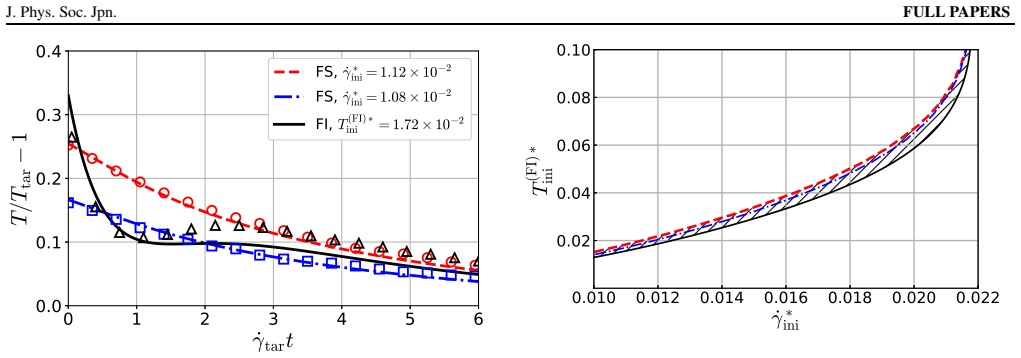
Core claim
Despite having a higher initial temperature, a system starting from an isotropic state can relax faster than a system prepared in a sheared steady state, demonstrating a clear Mpemba effect in the temperature evolution. Multiple crossings arise due to an additional intrinsic timescale introduced by the velocity dependence of the restitution coefficient, providing a minimal kinetic mechanism for multiple Mpemba effects in driven granular gases.
What carries the argument
Grad's moment method applied to the Boltzmann equation, which tracks the evolution of temperature and shear stress after an abrupt change in shear rate.
If this is right
- Temperature relaxation curves cross at least once and can cross multiple times.
- Shear viscosity also displays a Mpemba effect with crossings in its relaxation curve.
- The velocity dependence of restitution supplies an extra timescale that enables multiple Mpemba crossings.
- The mechanism works in the dilute limit under sudden changes of shear rate.
Where Pith is reading between the lines
- Similar velocity-dependent dissipation could produce multiple Mpemba crossings in other driven dissipative gases or suspensions.
- The extra timescale might be tuned by choosing different restitution laws to control the number of crossings observed.
- If confirmed, the effect could be used to accelerate cooling or stress relaxation in granular processing by choosing appropriate initial states.
Load-bearing premise
Grad's moment method accurately captures the relaxation dynamics and the velocity distribution under velocity-dependent restitution in the dilute limit.
What would settle it
Molecular dynamics simulation of the same granular gas that shows the isotropic initial condition relaxing no faster than the sheared initial condition.
Figures

read the original abstract
We investigate the Mpemba effect in a dilute sheared granular gas with a velocity-dependent restitution coefficient. Using kinetic theory based on Grad's moment method, we analyze the relaxation dynamics following a sudden change in the shear rate. We show that, despite having a higher initial temperature, a system starting from an isotropic state can relax faster than a system prepared in a sheared steady state, demonstrating a clear Mpemba effect in the temperature evolution. We further demonstrate the emergence of a viscosity Mpemba effect, characterized by crossings in the relaxation curves of the shear viscosity. Remarkably, multiple crossings arise due to an additional intrinsic timescale introduced by the velocity dependence of the restitution coefficient, providing a minimal kinetic mechanism for multiple Mpemba effects in driven granular gases.
Editorial analysis
A structured set of objections, weighed in public.
Referee Report
Summary. The manuscript investigates the Mpemba effect in a dilute sheared granular gas with velocity-dependent restitution coefficient. Using kinetic theory based on Grad's moment method, the authors analyze relaxation dynamics after a sudden change in shear rate. They claim that an isotropic initial state relaxes faster in temperature than a sheared steady state despite higher initial temperature, demonstrating a Mpemba effect, and report a viscosity Mpemba effect with multiple crossings in relaxation curves arising from an additional intrinsic timescale due to the velocity dependence of the restitution coefficient.
Significance. If the moment closure remains accurate, the work supplies a minimal kinetic mechanism for multiple Mpemba effects in driven granular gases by linking an extra relaxation timescale to the velocity dependence of restitution. This extends prior studies on constant-restitution cases and could inform understanding of anomalous relaxation in non-equilibrium systems with speed-dependent interactions.
major comments (2)
- [Kinetic theory analysis] Kinetic theory analysis section: the central claims rest on the closed moment equations obtained via Grad's moment method, yet the manuscript provides no comparison with direct simulation Monte Carlo solutions of the Boltzmann equation or extension to higher-order moments. With velocity-dependent restitution the collision integrals acquire explicit speed dependence that couples higher moments more strongly; without such a check the reported ordering of isotropic versus sheared trajectories and the multiple crossings may be artifacts of the truncation rather than robust features of the underlying kinetic equation.
- [Results] Results on temperature and viscosity evolution: the paper does not report error estimates, sensitivity to the parameters that define the velocity dependence of the restitution coefficient, or tests that the crossings survive when those parameters are varied within the dilute limit; this weakens the assertion that the additional intrinsic timescale is a generic minimal mechanism.
minor comments (2)
- [Abstract and Introduction] The abstract states that the approach relies on an established method but the main text should include a brief derivation or explicit statement of the moment closure ansatz and the form of the velocity-dependent restitution coefficient for reproducibility.
- [Figures] Figure captions and axis labels should explicitly indicate the units or dimensionless groups used for temperature and shear rate to aid clarity.
Simulated Author's Rebuttal
We thank the referee for the careful reading of our manuscript and the constructive comments. We address each major comment below, indicating where revisions will be incorporated to improve clarity and robustness while maintaining the core analytical approach.
read point-by-point responses
-
Referee: [Kinetic theory analysis] Kinetic theory analysis section: the central claims rest on the closed moment equations obtained via Grad's moment method, yet the manuscript provides no comparison with direct simulation Monte Carlo solutions of the Boltzmann equation or extension to higher-order moments. With velocity-dependent restitution the collision integrals acquire explicit speed dependence that couples higher moments more strongly; without such a check the reported ordering of isotropic versus sheared trajectories and the multiple crossings may be artifacts of the truncation rather than robust features of the underlying kinetic equation.
Authors: We appreciate the referee's concern regarding the accuracy of the Grad closure for velocity-dependent restitution. Grad's moment method is a standard tool in kinetic theory for granular gases and has been shown to capture the essential relaxation dynamics, including non-Gaussian effects, in prior studies with both constant and velocity-dependent restitution. The additional intrinsic timescale arises explicitly from the velocity dependence in the collision integrals already at this level, leading to the observed multiple crossings. While a direct DSMC validation or higher-moment extension would provide further confirmation, such numerical work lies outside the scope of the present analytical investigation and would require a separate study. In the revised manuscript we will expand the discussion of the closure's validity, referencing its performance in related constant-restitution cases, and clarify why the qualitative features are expected to be robust rather than truncation artifacts. revision: partial
-
Referee: [Results] Results on temperature and viscosity evolution: the paper does not report error estimates, sensitivity to the parameters that define the velocity dependence of the restitution coefficient, or tests that the crossings survive when those parameters are varied within the dilute limit; this weakens the assertion that the additional intrinsic timescale is a generic minimal mechanism.
Authors: We agree that explicit sensitivity tests would strengthen the claim of a generic mechanism. In the revised manuscript we will add a new subsection (or appendix) showing the temperature and viscosity relaxation curves for several values of the parameters that control the velocity dependence of the restitution coefficient, while remaining within the dilute regime. These additional results confirm that the multiple crossings persist and that the extra timescale remains operative. Because the moment equations are deterministic, conventional statistical error bars do not apply; we will instead discuss the systematic approximation error associated with the Grad closure in the methods section. revision: yes
Circularity Check
No significant circularity; derivation proceeds from standard moment closure to numerical integration of resulting ODEs
full rationale
The paper starts from the Boltzmann equation for a dilute granular gas, applies Grad's moment method to obtain a closed set of ODEs for the relevant moments (including temperature and shear stress), and integrates those ODEs forward in time for two different initial conditions to exhibit the Mpemba crossings. The velocity dependence of the restitution coefficient enters the collision integrals as an explicit functional form and thereby supplies an extra intrinsic timescale; this is an input assumption, not a quantity fitted to or derived from the target relaxation curves. No equation is shown to be identical to its own input by algebraic rearrangement, no parameter is fitted to a subset of the reported trajectories and then relabeled as a prediction, and no load-bearing uniqueness theorem or ansatz is imported solely via self-citation. The reported crossings are therefore genuine outputs of the truncated dynamical system rather than tautological restatements of its construction.
Axiom & Free-Parameter Ledger
free parameters (1)
- parameters defining velocity dependence of restitution coefficient
axioms (1)
- domain assumption Grad's moment method supplies a sufficient closure for the velocity distribution function during relaxation after a shear-rate jump.
Lean theorems connected to this paper
-
IndisputableMonolith/Cost/FunctionalEquation.leanwashburn_uniqueness_aczel unclear?
unclearRelation between the paper passage and the cited Recognition theorem.
Using kinetic theory based on Grad’s moment method, we analyze the relaxation dynamics... explicit expressions for ζ and ν are given by [Eqs. (13a,b)] with x ≡ mv_c²/(4T)
What do these tags mean?
- matches
- The paper's claim is directly supported by a theorem in the formal canon.
- supports
- The theorem supports part of the paper's argument, but the paper may add assumptions or extra steps.
- extends
- The paper goes beyond the formal theorem; the theorem is a base layer rather than the whole result.
- uses
- The paper appears to rely on the theorem as machinery.
- contradicts
- The paper's claim conflicts with a theorem or certificate in the canon.
- unclear
- Pith found a possible connection, but the passage is too broad, indirect, or ambiguous to say the theorem truly supports the claim.
Reference graph
Works this paper leans on
-
[1]
Introduction The Mpemba e ffect1–8) refers to the counterintuitive relax- ation phenomenon in which a system initially prepared at a higher temperature reaches equilibrium faster than an iden - tical system prepared at a lower temperature. Originally ob - served in water freezing, 1–3) it is now recognized as a generic feature4, 9, 10) of nonequilibrium re...
-
[2]
Mpemba effect in a sheared granular gas with velocity-dependent restitution
Model and setup We study a dilute granular gas composed of identical, fric- tionless hard spheres of mass m and diameter d. The system is assumed to be su fficiently rarefied so that binary collisions dominate, and the solid volume fraction is fixed at ϕ= 0. 01. The position and velocity of particle i are denoted by ri and vi, respectively. For a binary colli...
work page internal anchor Pith review Pith/arXiv arXiv 2026
-
[3]
Kinetic theory In the uniformly sheared regime, the single-particle veloc - ity distribution function f (V, t) obeys the Boltzmann equa- tion28, 30, 38) ( ∂ ∂t −˙γVy ∂ ∂Vx ) f (V, t) = J( f, f ), (4) where J( f, f ) denotes the nonlinear collision operator. For hard-sphere interactions, it takes the form J( f, f ) = d2 ∫ dV2 ∫ d ˆkΘ ( V12 ·ˆk ) ( V12 ·ˆk ...
-
[4]
The first protocol starts from a uniformly sheared steady state
Mpemba protocol In the following, we investigate the temporal evolution of the granular temperature starting from two distinct initial con- ditions and examine whether their relaxation curves cross a t a finite time, which would signal the occurrence of the Mpemba effect. The first protocol starts from a uniformly sheared steady state. Specifically, for t < 0...
-
[5]
The two curves clearly cross at a finite time, demon- strating the Mpemba e ffect
Results Figure 1 displays typical temporal evolutions of the granu- lar temperature for systems initialized from the FS and FI pro- tocols. The two curves clearly cross at a finite time, demon- strating the Mpemba e ffect. For the FS protocol, the initial steady state at t < 0 is characterized by a negative shear stress (Pxy < 0), so that immediately after ...
-
[6]
Discussion In the present study, the shear rate is changed discontinu- ously at t = 0 from ˙γ= ˙γini or 0 to ˙γtar. In doing so, we assume that the velocity field of the entire system instantaneously ad- justs to a uniform shear flow, as given by Eq. (3). 4 J. Phys. Soc. Jpn. FULL PAPERS However, in realistic situations such as experiments or sim- ulations,...
-
[7]
Summary The present results provide a minimal and analytically tractable example in which multiple Mpemba e ffects arise from purely kinetic mechanisms under shear. We have investi- gated the Mpemba e ffect in a dilute sheared granular gas with a velocity-dependent restitution coe fficient using kinetic the- ory. By analyzing the relaxation dynamics following...
-
[8]
E. B. Mpemba and D. G. Osborne, Phys. Educ. 4, 172 (1969)
work page 1969
-
[9]
H. C. Burridge and P . F. Linden, Sci. Rep. 6, 37665 (2016)
work page 2016
-
[10]
J. I. Katz, arXiv:1701.03219
work page internal anchor Pith review Pith/arXiv arXiv
- [11]
- [12]
- [13]
- [14]
- [15]
- [16]
-
[17]
D. M. Busiello, D. Gupta, and A. Maritan, New J. Phys. 23, 103012 (2021)
work page 2021
-
[18]
A. Lasanta, F. V ega Reyes, A. Prados, and A. Santos, Phys. Rev. Lett. 119, 148001 (2017)
work page 2017
-
[19]
A. Torrente, M. A. L ´ opez-Casta˜ no, A. Lasanta, F. V ega Reyes, A. Prados, and A. Santos, Phys. Rev. E 99, 060901(R) (2019)
work page 2019
- [20]
-
[21]
E. Momp´ o, M. A. L ´ opez Casta˜ no, A. Torrente, F. V ega Reyes, A. Lasanta, Phys. Fluids 33, 062005 (2021)
work page 2021
- [22]
-
[23]
A. Patr´ on, B. S´ anchez-Rey, C. A. Plata, and A. Prados, EPL 143, 61002 (2023)
work page 2023
-
[24]
M. Baity-Jesi, E. Calore, A. Cruz, L. A. Fernandez, J. M. G il-Narvi´ on, A. Gordillo-Guerrero, D. I˜ niguez, A. Lasanta, A. Maiorano, E. Marinari, V . Martin-Mayor, J. Moreno-Gordo, A. Mu˜ noz Sudupe, D. Navarro, G. Parisi, S. Perez-Gaviro, F. Ricci-Tersenghi, J. J. Ruiz-Lorenzo, S. F. Schi- fano, B. Seoane, A. Taranc´ on, R. Tripiccione, and D. Yllanes,...
work page 2019
-
[25]
F. Carollo, A. Lasanta, and I. Lesanovsky, Phys. Rev. Let t. 127, 060401 (2021)
work page 2021
-
[26]
D. J. Strachan, A. Purkayastha, and S. R. Clark, Phys. Rev . Lett. 134, 220403 (2025)
work page 2025
-
[27]
F. Ares, P . Calabrese, and S. Murciano, Nat. Rev. Phys. 7, 451 (2025)
work page 2025
-
[28]
A. K. Chatterjee, S. Takada, and H. Hayakawa, Phys. Rev. L ett. 131, 080402 (2023)
work page 2023
-
[29]
A. K. Chatterjee, S. Takada, and H. Hayakawa, Phys. Rev. A 110, 022213 (2024)
work page 2024
- [30]
-
[31]
T. P¨ oschel, N. V . Brilliantov, and T. Schwager, Physica A 325, 274 (2003)
work page 2003
- [32]
- [33]
-
[34]
M. R. Kikuchi, Y . Kobayashi, and S. Takada, J. Phys. Soc. J pn. 95, 053801 (2026)
work page 2026
-
[35]
S. Chapman and T. G. Cowling, The Mathematical Theory of N onuni- form Gases (Cambridge University Press, New Y ork, 1970) 3rd ed
work page 1970
-
[36]
N. V . Brilliantov and T. P¨ oschel, Kinetic Theory of Granular Gases (Ox- ford University Press, New Y ork, 2004). 5 J. Phys. Soc. Jpn. FULL PAPERS
work page 2004
-
[37]
V . Garz´ o, Granular Gaseous Flows — A Kinetic Theory Appr oach to Granular Gaseous Flows — (Springer Cham, 2019)
work page 2019
- [38]
-
[39]
G. A. Bird, Molecular Gas Dynamics and the Direct Simulat ion of Gas Flows (Oxford University Press, New Y ork, 1994)
work page 1994
-
[40]
A. J. Garcia, Numerical Methods for Physics Second Editi on (Prentice Hall, Englewood Cliffs, NJ, 2000)
work page 2000
-
[41]
T. P¨ oschel and T. Schwager, Computational Granular Dyn amics (Springer, Berlin, 2005)
work page 2005
-
[42]
D. J. Evans and G. P . Morriss, Phys. Rev. A 30, 1528 (1984)
work page 1984
-
[43]
D. J. Evans and G. Morriss, Statistical Mechanics of None quilibrium Liquids, 2nd ed. (Cambridge University Press, Cambridge, 2 008)
-
[44]
A. W. Lees and S. F. Edwards, J. Phys. C 5, 1921 (1972)
work page 1921
- [45]
-
[46]
H. Hayakawa and S. Takada, Prog. Theor. Exp. Phys. 2019, 083J01 (2019)
work page 2019
-
[47]
H. Hayakawa, S. Takada, and V . Garz´ o, Phys. Rev. E96, 042903 (2017), [Erratum] 101, 069904 (2020)
work page 2017
- [48]
- [49]
-
[50]
Y . Kobayashi, S. Iizuka, and S. Takada, EPJ Web Conf. 340, 03003 (2025)
work page 2025
-
[51]
Y . Kobayashi, M. R. Kikuchi, S. Iizuka, and S. Takada, Eur . Phys. J. E 49, 34 (2026). 6
work page 2026
discussion (0)
Sign in with ORCID, Apple, or X to comment. Anyone can read and Pith papers without signing in.