REVIEW 4 major objections 5 minor 17 references
Prompt Tuning Vision Language Models with Margin Regularizer for Few-Shot Learning under Distribution Shifts
T0 review · 4 major / 5 minor · reviewed 2026-08-07 · deepseek-v4-flash
Pith's one-line read PromptMargin, a source-free prompt-tuning method with a multimodal margin regularizer, adapts CLIP to few-shot tasks under distribution shift and outperforms MaPLe on 11 of 15 benchmarks.
desk verdict Solid empirical paper with a useful source-free CLIP adaptation recipe, but the 'margin' regularizer is a variance equalizer that can shrink class separation, and the paper lacks a decision rule for when to use it. read the letter →
The pith
A machine-rendered reading of the paper's core claim, the machinery that carries it, and where it could break.
The reading
What carries the argument
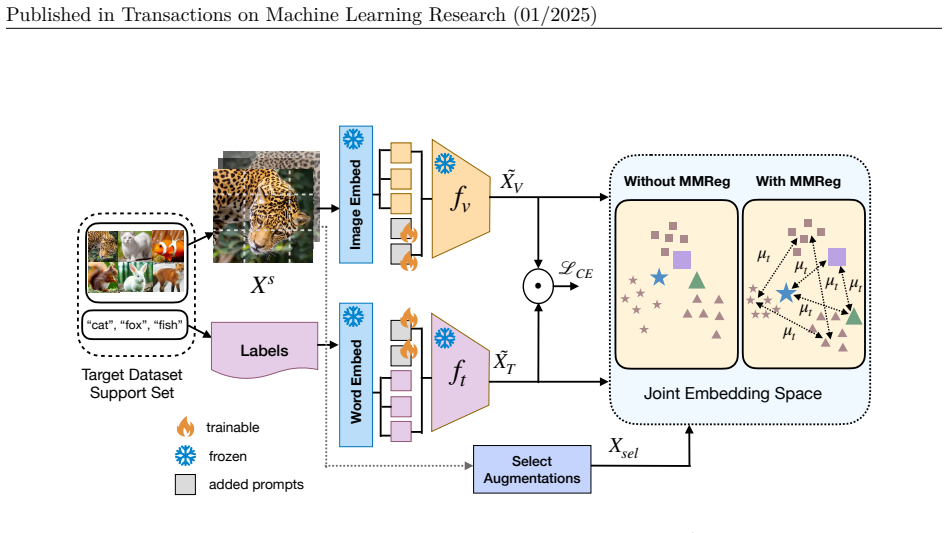
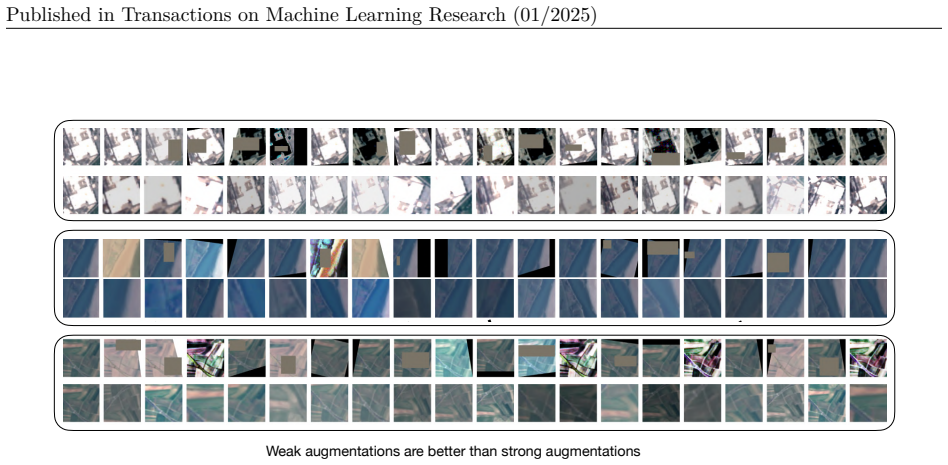
The Multimodal Margin Regularizer (MMReg) is the load-bearing component: it enforces that every pair of class text embeddings and every pair of class image prototypes are separated by the same squared L2 distance, namely the current mean inter-class text distance $\mu_t$. In formulas, it adds $\sum_{i<j} (\|\tilde{X}_{T_i} - \tilde{X}_{T_j}\|_2^2 - \mu_t)^2$ plus the analogous image-prototype term to the prompt-tuning loss. The second component is the Selective Augmentation module, which picks the augmentations whose embeddings are closest to their class text embeddings, aiming to expand the 1-shot training set without adding harmful distortions. Together they steer the joint vision-language space toward uniform class separation while keeping the encoder frozen, so the only trained parameters are the prompts.
What would settle it
On a fresh target dataset, record the frozen-CLIP inter-class mean distances $m_T$ and $m_V$ before training. The paper's analysis predicts that when $\operatorname{diff}(m_T,m_V)=(1/m_T+1/m_V-2)$ is near zero, MaPLe will match or beat PromptMargin, and when it is large, PromptMargin will improve over MaPLe; a dataset where the pattern is reversed would contradict the claimed correlation and the regularizer's benefit.
Extended reading notes
Core claim
PromptMargin directly adapts a frozen CLIP model to N-way k-shot episodes sampled from target datasets whose classes and domains may be far from CLIP's pretraining data. It learns deep textual and visual prompts via the MaPLe coupling function, and augments the standard cross-entropy loss with two terms: a text regularizer that pulls all pairwise class-name embedding distances toward their current mean $\mu_t$ and an image regularizer that does the same for class-wise image prototypes, both measured in the joint embedding space. A selective augmentation module first generates candidate perturbed images and keeps only those whose cosine similarity to the corresponding class text embedding is highest, enlarging the support set without introducing unrepresentative transformations. The paper reports that this recipe outperforms the MaPLe baseline and the full-finetuning methods FDAlign and Wise-FT on most of fifteen benchmark datasets, with the largest gains on datasets where class names are missing or semantically opaque.
Load-bearing premise
Equalizing every pairwise distance between class text embeddings and image prototypes to the current mean distance $\mu_t$ is a safe inductive bias for arbitrary out-of-distribution target domains; the paper shows this can backfire on datasets whose classes are already well separated, such as Aircraft and mini-ImageNet.
Editorial extensions
If this is right
- Source-free prompt tuning of CLIP handles simultaneous novel classes and domain shift: at 1-shot it reaches 72.00% average accuracy across the fifteen benchmarks, above the meta-trained baselines.
- The diff metric computed from frozen inter-class text and image distances gives a usable pre-training estimate of when fine-tuning will help, with a Pearson correlation near -0.71 with zero-shot accuracy.
- MMReg delivers its largest gains when class names are missing or semantically opaque, adding up to 10.79 percentage points over MaPLe on datasets like Plantae and Traffic Signs.
- PromptMargin outperforms full-finetuning methods FDAlign and Wise-FT on most datasets even though it never sees a source dataset, showing that parameter-efficient adaptation can beat full fine-tuning in this setting.
Reading between the lines
- The diff metric could be turned into a decision rule: disable or soften MMReg when diff is low, which would avoid the observed drops on Aircraft and mini-ImageNet; the paper only notes the failures without proposing such a rule.
- Because MMReg acts only on the embeddings and not on the encoder architecture, it should transfer to other contrastive vision-language models; the paper only demonstrates it on CLIP ViT-B/16 and OpenCLIP B/16, leaving ALIGN and larger ViT variants untested.
- Selective augmentation could be reused outside prompt learning as a cheap filtering step for any few-shot pipeline that has access to class text embeddings.
- The regularizer's uniform-distance target is a form of feature-space equalization; a natural extension the paper does not pursue is to make the target distance adaptive to per-class dispersion rather than the global mean.
Editorial analysis
A structured set of objections, weighed in public.
Referee Report
Summary. The paper studies few-shot classification with CLIP under distribution shift, in a source-free setting where no meta-training on a source dataset is used. It first analyzes the CLIP representation space by measuring mean inter-class L2 distances of text embeddings (mT) and image prototypes (mV) for several target datasets, proposing a heuristic difference metric (Eq. 3) that correlates negatively with zero-shot accuracy. Based on this analysis, the paper proposes PromptMargin, built on MaPLe, with two modules: (i) selective augmentation, which picks augmentations whose image embeddings are closest to the corresponding text embeddings, and (ii) a Multimodal Margin Regularizer (MMReg, Eqs. 6-8) that penalizes deviations of pairwise text-text and image-image distances from the current text mean distance mu_t. Experiments on fifteen datasets in 5-way 1-shot and 5-shot settings show that PromptMargin outperforms MaPLe on average (72.00 vs 69.02 at 1-shot, 82.76 vs 81.92 at 5-shot), with larger gains on OOD datasets and on datasets with pseudo class names, while losing on Aircraft and mini-ImageNet. Ablations, sensitivity analyses, and an OpenCLIP experiment are included.
Significance. If the findings hold, the paper makes a useful practical contribution: it demonstrates that a source-free prompt-tuning method can improve CLIP's few-shot accuracy on several shifted domains without meta-training, and it provides an inexpensive representation-space heuristic (Eq. 3) for predicting when fine-tuning will help. The paper ships code, reports results on fifteen datasets, and includes a cross-backbone validation on OpenCLIP, which strengthens confidence in the empirical claims. The proposed method is simple and reproducible, and the paper honestly acknowledges failure cases and open issues in its scope-for-future-work paragraph. However, the central mechanistic claim that MMReg increases inter-class margin is not supported by the regularizer's form, and the average improvement is partly a consequence of dataset-specific geometry rather than a robust inductive bias.
major comments (4)
- [Sec. 5.2, Eqs. (6)-(8)] The regularizer is described as a 'Multimodal Margin Regularizer' that 'increases the inter-class margin', but Eqs. (6) and (8) minimize the variance of pairwise squared distances around the current text mean mu_t. This is an equalization, not a margin enlargement, objective. In particular, Eq. (8) pulls image-prototype distances toward mu_t, so when the frozen CLIP image prototypes are already better separated than the text embeddings (mV > mT), the regularizer actively reduces inter-class image separation. The paper's own Table 1 shows that Aircraft (mT=0.700, mV=0.770) and mini-ImageNet (mT=0.860, mV=1.010) are exactly the two datasets where PromptMargin underperforms MaPLe in Table 4, while the largest gains occur where mV < mT. The 'Scope for future work' paragraph acknowledges this, but the abstract and introduction still claim robust margin-based discrimination. The authors should either revise the mechanistic claim, provide a criterion for disabling or softening R(XV) in the well-separated regime, or present evidence that the equalization bias is beneficial beyond the specific datasets where it happens to help.
- [Sec. 6.2, Table 4] The headline claim that PromptMargin outperforms MaPLe in 11 of 15 datasets at 1-shot relies on average accuracies over 600 episodes, but no paired significance test is reported. Several comparisons show overlapping 95% confidence intervals (e.g., ChestX: 21.30±0.10 vs 21.51±0.10; Textures: 79.28±0.18 vs 78.99±0.20; CUB: 96.96±0.22 vs 96.97±0.22 at 1-shot), and some datasets show significant drops (e.g., Aircraft and mini-ImageNet). Since the protocol states that episodes are randomly sampled, it is unclear whether the same 600 episodes are used for all methods; if not, the dataset-level win count is noisy. The authors should state whether the evaluation episodes are identical across methods and, ideally, report paired differences or a sign test across datasets.
- [Sec. 3 and Sec. 6.2] The representation-space analysis in Table 1 is used to motivate MMReg, but the motivation and the main evaluation share the same datasets (EuroSAT, ISIC, Omniglot, Quickdraw, Aircraft, mini-ImageNet, and the pseudo-classname datasets appear in both). This creates a selection-on-evaluation risk: the design choices (e.g., using mu_t as the target for image distances) are informed by the same data on which the headline improvement is measured. While the query-set evaluation itself is held out, the regularizer's form and the decision to apply it to all datasets are not independently justified. The authors should clarify whether the analysis in Section 3 was performed before or independently of the main experiments, and ideally validate the proposed geometric heuristic on a held-out set of datasets.
- [Sec. 5.1, Eq. (5)] The selective augmentation procedure selects augmentations by cosine similarity between image embeddings and class text embeddings. The text mentions that learnable prompts are appended to classname texts and that the support images include the original and augmented samples, but it is not clear whether the text embeddings used for selection are obtained with the current (possibly partially trained) prompts or with the initial zero-shot prompts. If the selection is a one-time pre-training step, that should be stated explicitly; if the selection changes during prompt training, the implementation details are missing. This ambiguity affects reproducibility of the module.
minor comments (5)
- [Sec. 3, Eqs. (1)-(2)] The notation for the zero-shot text and image features (tilde X with superscript z) is not defined after the equations; the subscript notation is also inconsistent with the later use of tilde XT and tilde XV in Section 5.2.
- [Sec. 3, Table 1] The Pearson correlation of -0.713 between ZS-CLIP accuracy and diffDtarget is computed over only nine datasets, several of which have mT set to 0.1 as a placeholder. The correlation is likely dominated by those placeholder rows; reporting the correlation with and without those datasets would be informative.
- [Sec. 6.2, Table 4] The method name is spelled 'WiSE-FT' in the table and 'Wise-FT' in the text; please standardize. Also, the appendix Table 11 reports confidence intervals with three decimals (e.g., 76.33±0.095, 77.61±0.019), which is an unrealistic precision for accuracies over 600 episodes.
- [Sec. 5.2] The regularizer is credited to Hayat et al. (2019), but the connection is loose. Hayat et al. encourage uniform separation of classifier weights in a max-margin sense, whereas the proposed R(XV) explicitly targets the current text mean mu_t and can shrink already well-separated image distances. Please clarify the relationship or cite it as inspiration rather than as the same formulation.
- [Appendix D, Table 9] The OpenCLIP experiment is a valuable robustness check, but only one seed or one set of episodes appears to be reported. Please state the number of episodes and whether the same protocol as the main experiments was used.
Circularity Check
No significant circularity: the headline accuracy claim is evaluated on held-out query sets, and the regularizer is a hand-designed loss, not a fitted parameter or a self-citation chain.
full rationale
The paper makes no first-principles derivation claim; its central claim is an empirical accuracy improvement over MaPLe on fifteen datasets. Evaluation in Table 4 uses held-out query sets from 600 episodes per dataset, so the headline result is not forced by construction. The Section 3 analysis computes mT and mV from frozen zero-shot CLIP embeddings and correlates them with ZS-CLIP accuracy; this is a descriptive correlation on the same benchmarks, but it is not used to fit any parameter that is then reported as a prediction. The MMReg terms in Eqs. (6)-(8) penalize squared deviations from the current mean text distance mu_t; this is a self-referential variance-type loss, but the paper does not claim to derive it from CLIP's objective, and its effect is empirically tested. The target mu_t is computed from the embeddings being optimized, but that is standard for regularization and does not make the query-set evaluation circular. There are no load-bearing self-citations (the reference list contains no papers by the authors). The acknowledged failures on Aircraft and mini-ImageNet are a correctness/generalization caveat, not a circularity. No specific circular step can be exhibited under the required standard of showing that an equation or fitted parameter reduces to its own input.
Assumptions & free parameters
free parameters (3)
- Number of selected augmentations r =
15 (1-shot), 3 per class (5-shot)
- Regularizer weights alpha, beta =
1, 1
- Placeholder mT for missing class names =
0.1
assumptions (4)
- domain assumption CLIP's frozen text and image encoders provide a meaningful joint space for OOD target classes, so similarities between class-name text and image prototypes are informative.
- standard math Query classes in each episode are the same set of N classes as the support set, and the support distribution is representative enough to tune prompts for the query set.
- domain assumption When class names are unavailable, pseudo labels like C1, C2 preserve enough structure for prompt learning plus MMReg to improve discrimination.
- ad hoc to paper Equalizing pairwise inter-class distances around the mean is a beneficial inductive bias for few-shot classification under shift.
Cite this review
Pith. "Pith review of Prompt Tuning Vision Language Models with Margin Regularizer for Few-Shot Learning under Distribution Shifts." pith.science (2026). https://pith.science/paper/GGQF5MMK
@misc{pith2026250515506,
  author       = {Pith},
  title        = {Pith review of: Prompt Tuning Vision Language Models with Margin Regularizer for Few-Shot Learning under Distribution Shifts},
  year         = {2026},
  howpublished = {\url{https://pith.science/paper/GGQF5MMK}},
  note         = {Machine review of arXiv:2505.15506}
}
read the original abstract
Recently, Vision-Language foundation models like CLIP and ALIGN, which are pre-trained on large-scale data have shown remarkable zero-shot generalization to diverse datasets with different classes and even domains. In this work, we take a step further and analyze whether these models can be adapted to target datasets having very different distributions and classes compared to what these models have been trained on, using only a few labeled examples from the target dataset. In such scenarios, finetuning large pretrained models is challenging due to problems of overfitting as well as loss of generalization, and has not been well explored in prior literature. Since, the pre-training data of such models are unavailable, it is difficult to comprehend the performance on various downstream datasets. First, we try to answer the question: Given a target dataset with a few labelled examples, can we estimate whether further fine-tuning can enhance the performance compared to zero-shot evaluation? by analyzing the common vision-language embedding space. Based on the analysis, we propose a novel prompt-tuning method, PromptMargin for adapting such large-scale VLMs directly on the few target samples. PromptMargin effectively tunes the text as well as visual prompts for this task, and has two main modules: 1) Firstly, we use a selective augmentation strategy to complement the few training samples in each task; 2) Additionally, to ensure robust training in the presence of unfamiliar class names, we increase the inter-class margin for improved class discrimination using a novel Multimodal Margin Regularizer. Extensive experiments and analysis across fifteen target benchmark datasets, with varying degrees of distribution shifts from natural images, shows the effectiveness of the proposed framework over the existing state-of-the-art approaches applied to this setting. github.com/debarshigit/PromptMargin.
Figures


Figures from the paper (5 more)


Reference graph
Works this paper leans on
-
[6]
Bingyu Liu, Zhen Zhao, Zhenpeng Li, Jianan Jiang, Yuhong Guo, and Jieping Ye. Feature transformation ensemble model with batch spectral regularization for cross-domain few-shot classification.arXiv preprint arXiv:2005.08463,
work page Pith review arXiv 2005
-
[8]
Optimization as a model for few-shot learning
13 Published in Transactions on Machine Learning Research (01/2025) Sachin Ravi and Hugo Larochelle. Optimization as a model for few-shot learning. InInternational conference on learning representations,
work page 2025
-
[9]
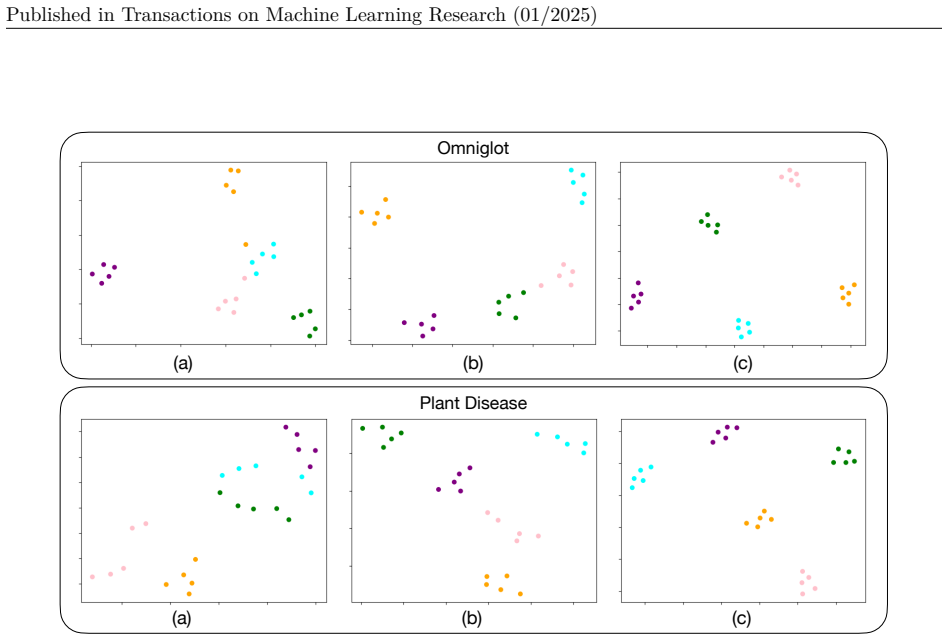
We observe that although MaPLe improves over the zero-shot performance, PromptMargin outperforms MaPLe in all the datasets, further justifying the effectiveness of the proposed framework. E t-SNE Visualizations The t-SNE visualizations of the image embeddings after training with our proposed MMReg module is shown in Fig. 6 for two benchmark datasets, Omni...
work page 2025
-
[10]
Eleni Triantafillou, Tyler Zhu, Vincent Dumoulin, Pascal Lamblin, Utku Evci, Kelvin Xu, Ross Goroshin, Carles Gelada, Kevin Swersky, Pierre-Antoine Manzagol, et al. Meta-dataset: A dataset of datasets for learning to learn from few examples.arXiv preprint arXiv:1903.03096,
arXiv 1903
- [11]
-
[14]
Renrui Zhang, Rongyao Fang, Wei Zhang, Peng Gao, Kunchang Li, Jifeng Dai, Yu Qiao, and Hong- sheng Li. Tip-adapter: Training-free clip-adapter for better vision-language modeling.arXiv preprint arXiv:2111.03930,
-
[15]
Conditional prompt learning for vision- language models
Kaiyang Zhou, Jingkang Yang, Chen Change Loy, and Ziwei Liu. Conditional prompt learning for vision- language models. InProceedings of the IEEE/CVF Conference on Computer Vision and Pattern Recog- nition, pp. 16816–16825, 2022a. Kaiyang Zhou, Jingkang Yang, Chen Change Loy, and Ziwei Liu. Learning to prompt for vision-language models.International Journal...
work page 2025
-
[16]
16 Published in Transactions on Machine Learning Research (01/2025) Table 9: Experiments on OpenCLIP B/16. Dataset Omniglot Quickdraw EuroSAT Plant Disease ChestX Zero-shot (%) 27.79 66.49 48.93 24.65 20.08 MaPLe (%) 80.61 72.21 71.60 77.50 21.09 PromptMargin (%)89.44 77.08 73.28 82.26 22.75 Table 10: Effect of MMReg when classnames are not available. Dat...
work page 2025
Show all 17 references
-
[2011]
Chestx- ray8: Hospital-scale chest x-ray database and benchmarks on weakly-supervised classification and local- ization of common thorax diseases
Xiaosong Wang, Yifan Peng, Le Lu, Zhiyong Lu, Mohammadhadi Bagheri, and Ronald M Summers. Chestx- ray8: Hospital-scale chest x-ray database and benchmarks on weakly-supervised classification and local- ization of common thorax diseases. InProceedings of the IEEE conference on ...
-
[2014]
Skin lesion analysis toward melanoma detection 2018: A challenge hosted by the international skin imaging collaboration (isic).arXiv preprint arXiv:1902.03368,
Noel Codella, Veronica Rotemberg, Philipp Tschandl, M Emre Celebi, Stephen Dusza, David Gutman, Brian Helba, Aadi Kalloo, Konstantinos Liopyris, Michael Marchetti, et al. Skin lesion analysis toward melanoma detection 2018: A challenge hosted by the international skin imaging ...
2018 arXiv
-
[2015]
Fgvcx fungi classification challenge 2018.Available online: github
Brigit Schroeder and Yin Cui. Fgvcx fungi classification challenge 2018.Available online: github. com/visipedia/fgvcx_fungi_comp (accessed on 14 July 2021),
2018
-
[2016]
The caltech-ucsd birds- 200-2011 dataset
Catherine Wah, Steve Branson, Peter Welinder, Pietro Perona, and Serge Belongie. The caltech-ucsd birds- 200-2011 dataset
2011
-
[2017]
A broader study of cross-domain few-shot learning
Yunhui Guo, Noel C Codella, Leonid Karlinsky, James V Codella, John R Smith, Kate Saenko, Tajana Rosing, and Rogerio Feris. A broader study of cross-domain few-shot learning. InComputer Vision– 12 Published in Transactions on Machine Learning Research (01/2025) ECCV 2020: 16th...
2025
-
[2019]
Detection of traffic signs in real-world images: The german traffic sign detection benchmark
Sebastian Houben, Johannes Stallkamp, Jan Salmen, Marc Schlipsing, and Christian Igel. Detection of traffic signs in real-world images: The german traffic sign detection benchmark. InThe 2013 international joint conference on neural networks (IJCNN), pp. 1–8. Ieee,
2013
-
[2020]
Fine-grained visual classification of aircraft.arXiv preprint arXiv:1306.5151,
Subhransu Maji, Esa Rahtu, Juho Kannala, Matthew Blaschko, and Andrea Vedaldi. Fine-grained visual classification of aircraft.arXiv preprint arXiv:1306.5151,
-
[2021]
Microsoft coco: Common objects in context
Tsung-Yi Lin, Michael Maire, Serge Belongie, James Hays, Pietro Perona, Deva Ramanan, Piotr Dollár, and C Lawrence Zitnick. Microsoft coco: Common objects in context. InComputer Vision–ECCV 2014: 13th European Conference, Zurich, Switzerland, September 6-12, 2014, Proceedings,...
2014
-
[2022]
The quick, draw!-ai experiment.Mount View, CA, accessed Feb, 17(2018):4,
Jonas Jongejan, Henry Rowley, Takashi Kawashima, Jongmin Kim, and Nick Fox-Gieg. The quick, draw!-ai experiment.Mount View, CA, accessed Feb, 17(2018):4,
2018
Reviewed August 7, 2026 · model on record in the stance chip above.
Discussion (0). Continue with ORCID to comment.