When the black holes align: a subpopulation of aligned massive binary black holes observed via gravitational waves
Pith reviewed 2026-06-26 07:36 UTC · model grok-4.3
The pith
Non-parametric analysis of gravitational-wave data supports two subpopulations of binary black holes with distinct effective-spin distributions.
A machine-rendered reading of the paper's core claim, the machinery that carries it, and where it could break.
Core claim
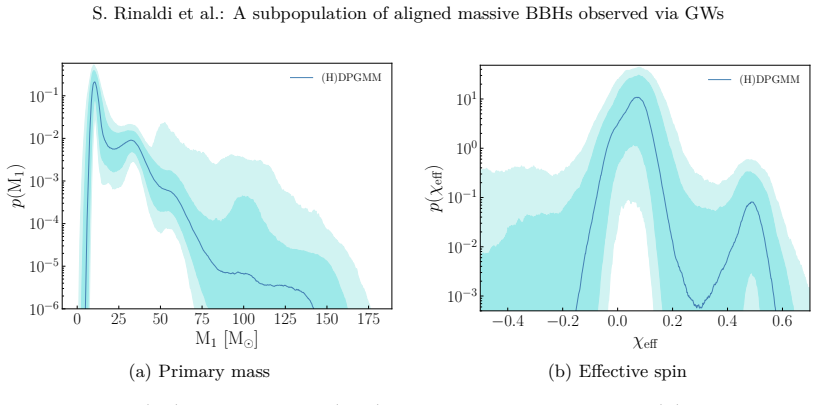
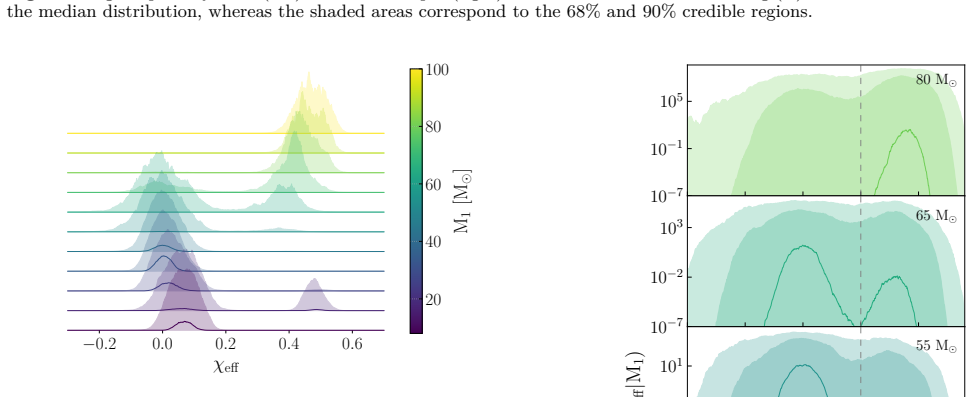
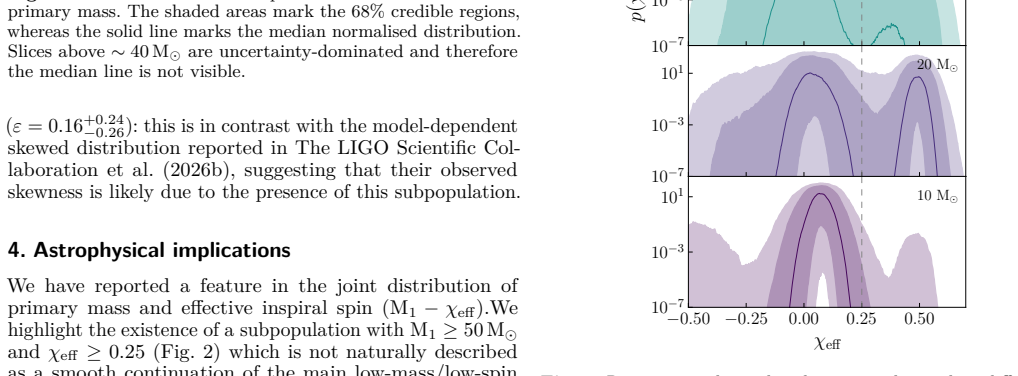
Our analysis supports the presence of at least two separate sub-population of binary black holes showing different effective spin distributions: one of them, preferring positive χ_eff values, points towards the direction of systems formed in a non-spherically-symmetric, dynamical environment.
What carries the argument
Non-parametric density estimation applied to the joint primary mass and effective spin distribution of binary black holes.
If this is right
- The observed mass-spin distribution requires at least two components to describe the data.
- One subpopulation is consistent with formation in non-spherically-symmetric dynamical environments.
- Effective spin serves as a discriminator between different black hole formation channels.
- Expanded catalogs will permit sharper separation of these subpopulations.
Where Pith is reading between the lines
- If confirmed, the positive-spin subpopulation would suggest dynamical encounters in dense environments produce more aligned systems than isolated binary evolution.
- The same non-parametric approach could be applied to additional parameters such as mass ratio to uncover further population structure.
- Validation against simulated populations that include detector selection effects would strengthen or refute the subpopulation separation.
Load-bearing premise
Non-parametric density estimation methods applied to GWTC-5.0 can reliably separate subpopulations in the joint mass-spin distribution without being dominated by selection effects or statistical fluctuations in the current catalog.
What would settle it
A future catalog with more events showing that the preference for positive effective spins in one subpopulation disappears after improved modeling of selection biases.
Figures
read the original abstract
In this work, we investigate the features present in the joint primary mass and effective spin distribution of binary black holes without relying on specific modelling assumptions. We make use of non-parametric methods, flexible models capable of approximating arbitrary probability densities with minimal mathematical assumptions, applying it to the newly released GWTC-5.0. Our analysis supports the presence of at least two separate sub-population of binary black holes showing different effective spin distributions: one of them, preferring positive $\chi_\mathrm{eff}$ values, points towards the direction of systems formed in a non-spherically-symmetric, dynamical environment.
Editorial analysis
A structured set of objections, weighed in public.
Referee Report
Summary. The manuscript applies non-parametric density estimation to the joint primary-mass and effective-spin (χ_eff) distribution of binary black hole mergers in the GWTC-5.0 catalog. It concludes that the data indicate at least two subpopulations with different χ_eff distributions, one of which prefers positive χ_eff and is interpreted as evidence for dynamical formation in non-spherically symmetric environments.
Significance. A robust identification of subpopulations would support the presence of multiple formation channels for stellar-mass black holes, with the positive-χ_eff group pointing to dynamical assembly. The non-parametric framing is a methodological strength if the separation is shown to be insensitive to selection biases and sample variance.
major comments (1)
- [Methods and Results] The non-parametric density estimation is applied to GWTC-5.0 without described validation against realistic mock catalogs that include the strong mass-dependent selection function and χ_eff measurement uncertainties. This is load-bearing for the central claim of distinct subpopulations, as the ~80–100 event sample makes it possible that the recovered positive-χ_eff feature is an artifact of selection or Poisson fluctuations rather than an intrinsic population feature.
Simulated Author's Rebuttal
We thank the referee for their constructive comments on our manuscript. The main concern regarding validation of the non-parametric method is addressed point-by-point below. We agree that additional checks will strengthen the analysis and will incorporate them in revision.
read point-by-point responses
-
Referee: [Methods and Results] The non-parametric density estimation is applied to GWTC-5.0 without described validation against realistic mock catalogs that include the strong mass-dependent selection function and χ_eff measurement uncertainties. This is load-bearing for the central claim of distinct subpopulations, as the ~80–100 event sample makes it possible that the recovered positive-χ_eff feature is an artifact of selection or Poisson fluctuations rather than an intrinsic population feature.
Authors: We acknowledge that the original manuscript did not include explicit validation on mock catalogs that incorporate the full selection function and measurement uncertainties. The GWTC-5.0 posterior samples already encode the χ_eff uncertainties, and our non-parametric approach was chosen precisely to avoid parametric assumptions about the underlying distribution. However, we agree that demonstrating that the positive-χ_eff subpopulation is not induced by selection biases or small-number statistics is essential for the robustness of the claim. In the revised version we will add a dedicated section applying the identical non-parametric pipeline to simulated catalogs drawn from known population models (including mass-dependent selection and realistic spin measurement errors) and show that the recovered subpopulations match the input structure rather than arising as artifacts. This will directly address the concern while preserving the non-parametric character of the analysis. revision: yes
Circularity Check
No significant circularity in non-parametric subpopulation analysis
full rationale
The paper applies non-parametric density estimation directly to the external GWTC-5.0 catalog to identify features in the joint primary-mass / χ_eff distribution. No equations, derivations, or first-principles results are presented that reduce by construction to fitted parameters, self-definitions, or self-citation chains. The subpopulation claim is an output of the data-driven method rather than an input renamed as a prediction. The analysis is self-contained against the observational catalog with no load-bearing self-referential steps.
Axiom & Free-Parameter Ledger
Reference graph
Works this paper leans on
-
[1]
Impact of gas hardening on the population properties of hierarchical black hole mergers in active galactic nucleus disks. , keywords =. doi:10.1051/0004-6361/202348509 , archivePrefix =. 2311.18548 , primaryClass =
-
[2]
AGN-driven BBH mergers: Black hole populations and hierarchical growth across the AGN parameter space. arXiv e-prints , keywords =. doi:10.48550/arXiv.2606.10823 , archivePrefix =. 2606.10823 , primaryClass =
work page internal anchor Pith review Pith/arXiv arXiv doi:10.48550/arxiv.2606.10823
-
[3]
Bouffanais and Nicola Giacobbo and Manuel Arca Sedda and Maria Celeste Artale and
Michela Mapelli and Marco Dall’Amico and Y. Bouffanais and Nicola Giacobbo and Manuel Arca Sedda and Maria Celeste Artale and. Hierarchical black hole mergers in young, globular and nuclear star clusters: the effect of metallicity, spin and cluster properties , volume=. , publisher=. 2021 , month=. doi:10.1093/mnras/stab1334 , number=
-
[4]
The cosmic evolution of binary black holes in young, globular, and nuclear star clusters: rates, masses, spins, and mixing fractions. , keywords =. doi:10.1093/mnras/stac422 , archivePrefix =. 2109.06222 , primaryClass =
-
[5]
Hierarchical binary black hole mergers in globular clusters: Mass function and evolution with redshift. , keywords =. doi:10.1051/0004-6361/202449272 , archivePrefix =. 2401.14837 , primaryClass =
-
[6]
Hierarchical mergers of stellar-mass black holes and their gravitational-wave signatures
Hierarchical mergers of stellar-mass black holes and their gravitational-wave signatures. Nature Astronomy , keywords =. doi:10.1038/s41550-021-01398-w , archivePrefix =. 2105.03439 , primaryClass =
-
[7]
and Haster, Carl-Johan and Ng, Ken K
The Binary Black Hole Spin Distribution Likely Broadens with Redshift. , keywords =. doi:10.3847/2041-8213/ac71a8 , archivePrefix =. 2204.01578 , primaryClass =
-
[8]
Who Ordered That? Unequal-mass Binary Black Hole Mergers Have Larger Effective Spins. , keywords =. doi:10.3847/2041-8213/ac2ccc , archivePrefix =. 2106.00521 , primaryClass =
-
[9]
GWTC-4.0: Updating the Gravitational-Wave Transient Catalog with Observations from the First Part of the Fourth LIGO-Virgo-KAGRA Observing Run. arXiv e-prints , keywords =. doi:10.48550/arXiv.2508.18082 , archivePrefix =. 2508.18082 , primaryClass =
work page internal anchor Pith review Pith/arXiv arXiv doi:10.48550/arxiv.2508.18082
-
[10]
Observation of Gravitational Waves from a Binary Black Hole Merger , author =. , volume =. 2016 , month =. doi:10.1103/PhysRevLett.116.061102 , url =
-
[11]
(H)DPGMM: a hierarchy of Dirichlet process Gaussian mixture models for the inference of the black hole mass function. , keywords =. doi:10.1093/mnras/stab3224 , archivePrefix =. 2109.05960 , primaryClass =
-
[12]
FIGARO: hierarchical non-parametric inference for population studies. JOSS , keywords =. doi:10.21105/joss.06589 , adsurl =
-
[13]
High resolution nonparametric inference of gravitational-wave populations in multiple dimensions. , keywords =. doi:10.1103/PhysRevD.111.063043 , archivePrefix =. 2406.16813 , primaryClass =
-
[14]
Compact binary coalescence sensitivity estimates with injection campaigns during the LIGO-Virgo-KAGRA Collaborations' fourth observing run. , keywords =. doi:10.1103/44x3-hv3y , archivePrefix =. 2508.10638 , primaryClass =
-
[15]
Extracting distribution parameters from multiple uncertain observations with selection biases
Extracting distribution parameters from multiple uncertain observations with selection biases. , keywords =. doi:10.1093/mnras/stz896 , archivePrefix =. 1809.02063 , primaryClass =
work page internal anchor Pith review Pith/arXiv arXiv doi:10.1093/mnras/stz896
-
[16]
GWTC-4.0: Population Properties of Merging Compact Binaries
GWTC-4.0: Population Properties of Merging Compact Binaries. arXiv e-prints , keywords =. doi:10.48550/arXiv.2508.18083 , archivePrefix =. 2508.18083 , primaryClass =
work page internal anchor Pith review Pith/arXiv arXiv doi:10.48550/arxiv.2508.18083
- [17]
-
[18]
Stochastic Relaxation, Gibbs Distributions, and the Bayesian Restoration of Images , year=
Geman, Stuart and Geman, Donald , journal=. Stochastic Relaxation, Gibbs Distributions, and the Bayesian Restoration of Images , year=
-
[19]
Inferring the pair-instability mass gap from gravitational wave data , author =. Phys. Rev. D , volume =. 2025 , month =. doi:10.1103/nxnr-pdyx , url =
-
[20]
Nature Astronomy , year = 2026, month = may, doi =
Gravitational-wave constraints on the pair-instability mass gap and nuclear burning in massive stars. Nature Astronomy , year = 2026, month = may, doi =
2026
-
[21]
Parameter-Free Tour of the Binary Black Hole Population. Physical Review X , keywords =. doi:10.1103/PhysRevX.14.021005 , archivePrefix =. 2302.07289 , primaryClass =
-
[22]
The chemically homogeneous evolutionary channel for binary black hole mergers: rates and properties of gravitational-wave events detectable by advanced LIGO. , keywords =. doi:10.1093/mnras/stw1219 , archivePrefix =. 1603.02291 , primaryClass =
work page internal anchor Pith review Pith/arXiv arXiv doi:10.1093/mnras/stw1219
-
[23]
A new route towards merging massive black holes
A new route towards merging massive black holes. , keywords =. doi:10.1051/0004-6361/201628133 , archivePrefix =. 1601.03718 , primaryClass =
work page internal anchor Pith review Pith/arXiv arXiv doi:10.1051/0004-6361/201628133
-
[24]
An upper limit on the spins of merging binary black holes formed through isolated binary evolution
An upper limit on the spins of merging binary black holes formed through isolated binary evolution. , keywords =. doi:10.1051/0004-6361/202348190 , archivePrefix =. 2311.14041 , primaryClass =
-
[25]
Population synthesis of black hole binary mergers from star clusters. , keywords =. doi:10.1093/mnras/stz3584 , archivePrefix =. 1906.11855 , primaryClass =
-
[26]
, keywords =
Edwin Sirko and Jeremy Goodman , title = ". , keywords =
-
[27]
pAGN: the one-stop solution for AGN disc modelling. , keywords =. doi:10.1093/mnras/stae1117 , archivePrefix =. 2403.00060 , primaryClass =
-
[28]
Compact object mergers: exploring uncertainties from stellar and binary evolution with SEVN. , keywords =. doi:10.1093/mnras/stad1630 , archivePrefix =. 2211.11774 , primaryClass =
-
[29]
Orbital alignment of highly inclined satellites
Hydrodynamic simulations of black hole evolution in AGN discs ─ I. Orbital alignment of highly inclined satellites. , keywords =. doi:10.1093/mnras/staf1449 , archivePrefix =. 2505.23739 , primaryClass =
-
[30]
The role of migration traps in the formation of binary black holes in AGN disks , DOI= "10.1051/0004-6361/202556761", url= "https://doi.org/10.1051/0004-6361/202556761", journal =
-
[31]
Dynamical Friction Models for Black Hole Binary Formation in Active Galactic Nucleus Disks. , keywords =. doi:10.3847/1538-4357/ad1b53 , archivePrefix =. 2310.12208 , primaryClass =
-
[32]
Gravitational wave mergers of accreting binary black holes in AGN discs. , keywords =. doi:10.1093/mnras/stae569 , archivePrefix =. 2412.01925 , primaryClass =
-
[33]
Leigh, N W C and Geller, A M and McKernan, B and Ford, K E S and Mac Low, M-M and Bellovary, J and Haiman, Z and Lyra, W and Samsing, J and O'Dowd, M and Kocsis, B and Endlich, S , title = ". , volume =. 2017 , month =. doi:10.1093/mnras/stx3134 , url =
-
[34]
The Predictive Power of Computational Astrophysics as a Discover Tool , year = 2023, editor =
Modeling gravitational few-body problems with tsunami and okinami. The Predictive Power of Computational Astrophysics as a Discover Tool , year = 2023, editor =. doi:10.1017/S1743921322001818 , archivePrefix =. 2206.10583 , primaryClass =
-
[35]
Three-body encounters in black hole discs around a supermassive black hole. The disc velocity dispersion and the Keplerian tidal field determine the eccentricity and spin-orbit alignment of gravitational wave mergers. , keywords =. doi:10.1051/0004-6361/202347920 , archivePrefix =. 2312.13281 , primaryClass =
-
[36]
Gravitational Radiation and the Motion of Two Point Masses , author = ". Phys. Rev. , volume =. 1964 , month =. doi:10.1103/PhysRev.136.B1224 , url =
-
[37]
2018 , publisher=
Gravitational Waves: Volume 2: Astrophysics and Cosmology , author=. 2018 , publisher=
2018
-
[38]
Hierarchical data-driven approach to fitting numerical relativity data for nonprecessing binary black holes with an application to final spin and radiated energy , author =. Phys. Rev. D , volume =. 2017 , month =. doi:10.1103/PhysRevD.95.064024 , url =
-
[39]
and Gupta, Anuradha and Ajith, P
Johnson-McDaniel, Nathan K. and Gupta, Anuradha and Ajith, P. and Keitel, David and Birnholtz, Ofek and Ohme, Frank and Husa, Sascha , title =. 2016 , url =
2016
-
[40]
The Astrophysical Journal , volume =
Spin─Orbit Alignment in Merging Binary Black Holes Following Collisions with Massive Stars. , keywords =. doi:10.3847/2041-8213/adc263 , archivePrefix =. 2501.09068 , primaryClass =
-
[41]
Jenny E. Greene and Luis C. Ho , title =. , abstract =. 2007 , month =. doi:10.1086/520497 , url =
-
[42]
Constraining the AGN formation channel for detected black hole binary mergers up to z = 1.5 with the Quaia catalogue. , keywords =. doi:10.1093/mnras/stae2575 , archivePrefix =. 2407.21568 , primaryClass =
-
[43]
AGN flares as counterparts to LIGO/Virgo mergers: no confident causal connection in spatial correlation analysis. , keywords =. doi:10.1093/mnras/stae2787 , archivePrefix =. 2405.05318 , primaryClass =
-
[44]
The most luminous AGN do not produce the majority of the detected stellar-mass black hole binary mergers in the local Universe. , keywords =. doi:10.1093/mnras/stad3157 , archivePrefix =. 2306.09415 , primaryClass =
-
[45]
Evidence for mass-dependent spin subpopulations in GWTC-4
Evidence for mass-dependent spin subpopulations in GWTC-4. arXiv e-prints , keywords =. doi:10.48550/arXiv.2605.24281 , archivePrefix =. 2605.24281 , primaryClass =
work page internal anchor Pith review Pith/arXiv arXiv doi:10.48550/arxiv.2605.24281
-
[46]
and Fragos, Tassos and Qin, Ying and Zapartas, Emmanouil and Neijssel, Coenraad J
The origin of spin in binary black holes - Predicting the distributions of the main observables of Advanced LIGO , DOI= "10.1051/0004-6361/201936204", url= "https://doi.org/10.1051/0004-6361/201936204", journal =
-
[47]
van Son, L. A. C. and de Mink, S. E. and Renzo, M. and Justham, S. and Zapartas, E. and Breivik, K. and Callister, T. and Farr, W. M. and Conroy, C. , year=. No Peaks without Valleys: The Stable Mass Transfer Channel for Gravitational-wave Sources in Light of the Neutron Star–Black Hole Mass Gap , volume=. The Astrophysical Journal , publisher=. doi:10.38...
-
[48]
Evidence of the pair instability gap from black hole masses
Evidence of the pair-instability gap from black-hole masses. , keywords =. doi:10.1038/s41586-026-10359-0 , archivePrefix =. 2509.04151 , primaryClass =
work page internal anchor Pith review Pith/arXiv arXiv doi:10.1038/s41586-026-10359-0
-
[49]
AGN-driven BBH mergers I: Black hole populations and hierarchical growth across the AGN parameter space , note =
-
[50]
GWTC-5.0: Observations from the Second Part of the Fourth LIGO-Virgo-KAGRA Observing Run and Updates to the Gravitational-Wave Transient Catalog. arXiv e-prints , keywords =. doi:10.48550/arXiv.2605.27225 , archivePrefix =. 2605.27225 , primaryClass =
work page internal anchor Pith review Pith/arXiv arXiv doi:10.48550/arxiv.2605.27225
-
[51]
GWTC-5.0: Population Properties of Merging Compact Binaries
GWTC-5.0: Population Properties of Merging Compact Binaries. arXiv e-prints , keywords =. doi:10.48550/arXiv.2605.27226 , archivePrefix =. 2605.27226 , primaryClass =
work page internal anchor Pith review Pith/arXiv arXiv doi:10.48550/arxiv.2605.27226
-
[52]
Evidence for additional structure in the effective spin distribution hints at multiple formation pathways in GWTC-5.0. arXiv e-prints , keywords =. doi:10.48550/arXiv.2606.12205 , archivePrefix =. 2606.12205 , primaryClass =
work page internal anchor Pith review Pith/arXiv arXiv doi:10.48550/arxiv.2606.12205
-
[53]
arXiv e-prints , keywords =
Transitions in the Mass-ratio and Spin Properties of Binary Black Holes in GWTC-5. arXiv e-prints , keywords =
-
[54]
Evidence for Three Subpopulations of Merging Binary Black Holes at Different Primary Masses
Evidence for Three Subpopulations of Merging Binary Black Holes at Different Primary Masses. arXiv e-prints , keywords =. doi:10.48550/arXiv.2509.15646 , archivePrefix =. 2509.15646 , primaryClass =
work page internal anchor Pith review Pith/arXiv arXiv doi:10.48550/arxiv.2509.15646
-
[55]
Signatures of a subpopulation of hierarchical mergers in the GWTC-4 gravitational-wave dataset
Signatures of a subpopulation of hierarchical mergers in the GWTC-4 gravitational-wave dataset. arXiv e-prints , keywords =. doi:10.48550/arXiv.2601.07908 , archivePrefix =. 2601.07908 , primaryClass =
work page internal anchor Pith review Pith/arXiv arXiv doi:10.48550/arxiv.2601.07908
-
[56]
Structure and Skewness of the Effective Inspiral Spin Distribution of Binary Black Hole Mergers. , keywords =. doi:10.3847/1538-4357/adf4c6 , archivePrefix =. 2501.06712 , primaryClass =
-
[57]
Accounting for Source Uncertainties in Analyses of Astronomical Survey Data. Bayesian Inference and Maximum Entropy Methods in Science and Engineering: 24th International Workshop on Bayesian Inference and Maximum Entropy Methods in Science and Engineering , year = 2004, editor =. doi:10.1063/1.1835214 , archivePrefix =. astro-ph/0409387 , primaryClass =
work page internal anchor Pith review Pith/arXiv arXiv doi:10.1063/1.1835214 2004
-
[58]
BBH-Genesis: Disentangling Binary Black Hole Formation Channels with GWTC-4
BBH-Genesis: Disentangling Binary Black Hole Formation Channels with GWTC-4. arXiv e-prints , keywords =. doi:10.48550/arXiv.2606.00234 , archivePrefix =. 2606.00234 , primaryClass =
work page internal anchor Pith review Pith/arXiv arXiv doi:10.48550/arxiv.2606.00234
-
[59]
Reversible-jump MCMC reveals binary black hole subpopulations with distinct redshift evolution
Reversible-jump MCMC reveals binary black hole subpopulations with distinct redshift evolution. arXiv e-prints , keywords =. doi:10.48550/arXiv.2605.25980 , archivePrefix =. 2605.25980 , primaryClass =
work page internal anchor Pith review Pith/arXiv arXiv doi:10.48550/arxiv.2605.25980
-
[60]
The first decade of gravitational-wave measurements of black hole spins
The first decade of gravitational-wave measurements of black hole spins. arXiv e-prints , keywords =. doi:10.48550/arXiv.2606.06209 , archivePrefix =. 2606.06209 , primaryClass =
work page internal anchor Pith review Pith/arXiv arXiv doi:10.48550/arxiv.2606.06209
-
[61]
Open Data from LIGO, Virgo, and KAGRA through the Second Part of the Fourth Observing Run
Open Data from LIGO, Virgo, and KAGRA through the Second Part of the Fourth Observing Run. arXiv e-prints , keywords =. doi:10.48550/arXiv.2605.27090 , archivePrefix =. 2605.27090 , primaryClass =
work page internal anchor Pith review Pith/arXiv arXiv doi:10.48550/arxiv.2605.27090
-
[62]
Where did Heavy Binaries Go? Gravitational-wave Populations Using Delaunay Triangulation with Optimized Complexity. , keywords =. doi:10.3847/2041-8213/ae1cbd , archivePrefix =. 2509.19466 , primaryClass =
-
[63]
Aligned hierarchical black hole mergers in active-galactic-nuclei disks revealed by GWTC-4
Aligned hierarchical black hole mergers in active-galactic-nuclei disks revealed by GWTC-4. arXiv e-prints , keywords =. doi:10.48550/arXiv.2509.23897 , archivePrefix =. 2509.23897 , primaryClass =
work page internal anchor Pith review Pith/arXiv arXiv doi:10.48550/arxiv.2509.23897
-
[64]
Revealing the _ eff ─q Correlation among Coalescing Binary Black Holes and Tentative Evidence for AGN-driven Hierarchical Mergers. , keywords =. doi:10.3847/1538-4357/add535 , archivePrefix =. 2501.09495 , primaryClass =
-
[65]
Compactness Peaks and Subpopulations: Probing Stellar Physics and Formation Channels of Merging Binary Black Holes. arXiv e-prints , keywords =. doi:10.48550/arXiv.2605.25994 , archivePrefix =. 2605.25994 , primaryClass =
work page internal anchor Pith review Pith/arXiv arXiv doi:10.48550/arxiv.2605.25994
-
[66]
A new group of low-spin $50-70M_\odot$ Black Holes and the high pair-instability mass cutoff
A new group of low-spin 50M _ ─70M _ black holes and the high pair-instability mass cutoff. Science China Physics, Mechanics, and Astronomy , keywords =. doi:10.1007/s11433-026-3004-6 , archivePrefix =. 2510.22698 , primaryClass =
work page internal anchor Pith review Pith/arXiv arXiv doi:10.1007/s11433-026-3004-6
-
[67]
Mass and effective spin distributions of binary black hole events: Evidence for a population of hierarchical black hole mergers in active galactic nuclei disks. arXiv e-prints , keywords =. doi:10.48550/arXiv.2110.10838 , archivePrefix =. 2110.10838 , primaryClass =
discussion (0)
Sign in with ORCID, Apple, or X to comment. Anyone can read and Pith papers without signing in.