REVIEW 1 major objections 2 minor 13 references
Airy beams in near-field wideband THz show frequency-dependent shifts of both focal point and self-bending trajectory that a closed-form expression and TTD structure can characterize and control.
Reviewed by Pith at T0; open to challenge. T0 means a machine referee read the full paper against a public rubric. the ladder, T0–T4 →
T0 review · grok-4.3
2026-06-30 13:37 UTC pith:GGY2R4KS
load-bearing objection Closed-form Airy trajectory from Fresnel plus TTD control is the actual addition, but the paraxial wideband assumption needs direct checks against frequency-dependent losses. the 1 major comments →
Airy Beam Dispersion in Near-Field Wideband Terahertz Communications
The pith
A machine-rendered reading of the paper's core claim, the machinery that carries it, and where it could break.
Core claim
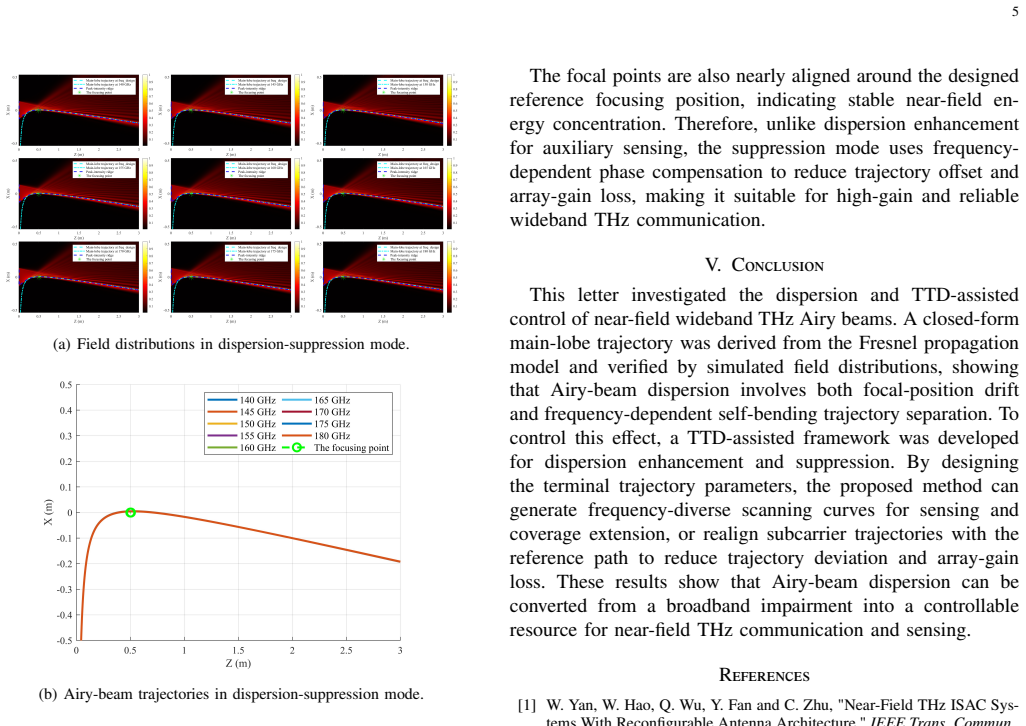
Based on the Fresnel diffraction integral, a closed-form trajectory expression is derived to characterize the dispersion behavior across subcarriers. Furthermore, a true-time-delay (TTD)-assisted Airy beamforming structure is developed to actively control the trajectory dispersion. By properly designing the time delay parameters, the proposed scheme can either generate frequency-dependent curved trajectory clusters for sensing-oriented scanning or suppress trajectory drift for reliable communication.
What carries the argument
The closed-form trajectory expression obtained from the Fresnel diffraction integral, which tracks the frequency-dependent location of the self-bending main lobe, together with the TTD-assisted beamforming structure that adjusts per-element time delays to steer or stabilize that location.
Load-bearing premise
The Fresnel diffraction integral provides a sufficiently accurate model for Airy beam propagation in the near-field THz regime across the considered bandwidth, without dominant unmodeled effects such as frequency-dependent material losses or array imperfections.
What would settle it
A laboratory measurement of actual main-lobe positions at several subcarrier frequencies in a near-field THz testbed, compared directly against the positions predicted by the closed-form trajectory formula; systematic mismatch would show the model does not capture the dispersion.
If this is right
- Trajectory dispersion can be harnessed to produce multiple curved paths at different frequencies for sensing-oriented scanning.
- Time delay parameters can be chosen to eliminate trajectory drift, supporting reliable wideband communication.
- The reference focusing point shift can be treated separately from control of the main-lobe bending path.
- The same structure applies to both sensing and communication use cases by simple choice of the delay values.
Where Pith is reading between the lines
- The derived trajectory formula could be used to set bandwidth limits beyond which Airy beams become unsuitable for wideband THz links without compensation.
- Hardware realization would require calibration of the time delays to match the exact array geometry and frequency range.
- Similar dispersion control might be explored for other accelerating beams in optical or millimeter-wave regimes.
- Full-wave electromagnetic simulations could be compared with the Fresnel-based formula to identify the distance or bandwidth at which higher-order effects appear.
Editorial analysis
A structured set of objections, weighed in public.
Referee Report
Summary. This letter investigates Airy beam dispersion in near-field wideband terahertz communications. Unlike conventional beams, Airy beams exhibit frequency-dependent shifts in both the reference focusing point and the self-bending main-lobe trajectory. Based on the Fresnel diffraction integral, a closed-form trajectory expression is derived to characterize dispersion across subcarriers. A true-time-delay (TTD)-assisted Airy beamforming structure is proposed to control the dispersion, enabling either frequency-dependent curved trajectory clusters for sensing or suppression of drift for communication.
Significance. If the closed-form derivation holds and the TTD structure provides effective control without unmodeled effects dominating, the work would offer a useful analytical tool and practical beamforming approach for managing dispersion in wideband near-field THz systems, which is relevant for both reliable links and sensing applications. The explicit derivation from the Fresnel integral is a positive feature when it avoids fitted parameters.
major comments (1)
- [Derivation of closed-form trajectory expression (abstract and associated section)] The central claim rests on deriving a closed-form trajectory expression directly from the Fresnel diffraction integral. The manuscript provides no explicit error bound, comparison against the Rayleigh-Sommerfeld integral, or full-wave simulation results to confirm that paraxial and frequency-independent assumptions remain dominant across the THz bandwidth, where atmospheric absorption, dielectric dispersion, and array frequency response could alter the effective trajectory (see skeptic note on weakest assumption).
minor comments (2)
- [Abstract] The abstract would benefit from specifying the considered frequency range, array aperture, and propagation distances to allow readers to assess the regime of validity.
- [Main text] Notation for the trajectory expression and TTD parameters should be defined consistently when first introduced to improve readability.
Simulated Author's Rebuttal
We thank the referee for the constructive comment on validating the closed-form derivation. We address the concern point-by-point below and outline planned revisions.
read point-by-point responses
-
Referee: [Derivation of closed-form trajectory expression (abstract and associated section)] The central claim rests on deriving a closed-form trajectory expression directly from the Fresnel diffraction integral. The manuscript provides no explicit error bound, comparison against the Rayleigh-Sommerfeld integral, or full-wave simulation results to confirm that paraxial and frequency-independent assumptions remain dominant across the THz bandwidth, where atmospheric absorption, dielectric dispersion, and array frequency response could alter the effective trajectory (see skeptic note on weakest assumption).
Authors: We agree that explicit validation strengthens the central claim. The Fresnel integral is the standard starting point for obtaining a tractable closed-form trajectory under the paraxial near-field regime; the frequency-independent array response is justified because each subcarrier is narrowband in typical THz OFDM. In revision we will add a dedicated subsection that (i) numerically compares the closed-form trajectory against direct quadrature of the Fresnel integral across the full bandwidth and reports explicit L2 error bounds for the considered array sizes and distances, and (ii) discusses the expected influence of atmospheric absorption and dielectric dispersion, showing that for the short-range scenarios targeted these effects shift the absolute path loss but do not materially alter the normalized trajectory shape derived from the phase term. Full-wave (Rayleigh-Sommerfeld or FDTD) validation lies outside the letter’s analytical scope and would require resources disproportionate to the contribution; we will note this limitation and cite relevant full-wave studies on THz near-field beams for readers interested in quantitative deviation estimates. revision: partial
Circularity Check
No circularity: derivation from external Fresnel integral
full rationale
The paper derives a closed-form trajectory from the Fresnel diffraction integral (an external standard result) and then proposes a TTD beamforming structure. No steps reduce by construction to fitted inputs, self-definitions, or self-citation chains. The central claim remains independent of the paper's own outputs.
Axiom & Free-Parameter Ledger
axioms (1)
- domain assumption Fresnel diffraction integral accurately models near-field Airy beam propagation in the THz band across subcarriers
Cite this review
Pith. "Pith review of Airy Beam Dispersion in Near-Field Wideband Terahertz Communications." pith.science (2026). https://pith.science/paper/GGY2R4KS
@misc{pith2026260603999,
  author       = {Pith},
  title        = {Pith review of: Airy Beam Dispersion in Near-Field Wideband Terahertz Communications},
  year         = {2026},
  howpublished = {\url{https://pith.science/paper/GGY2R4KS}},
  note         = {Machine review of arXiv:2606.03999}
}
read the original abstract
This letter investigates Airy beam dispersion in near-field wideband terahertz communications. Unlike conventional focusing beams, whose dispersion mainly appears as focal-point migration, Airy beams exhibit frequency-dependent shifts of both the reference focusing point and the self-bending main-lobe trajectory. Based on the Fresnel diffraction integral, a closed-form trajectory expression is derived to characterize the dispersion behavior across subcarriers. Furthermore, a true-time-delay (TTD)-assisted Airy beamforming structure is developed to actively control the trajectory dispersion. By properly designing the time delay parameters, the proposed scheme can either generate frequency-dependent curved trajectory clusters for sensing-oriented scanning or suppress trajectory drift for reliable communication.
Figures


Reference graph
Works this paper leans on
-
[1]
Near-Field THz ISAC Sys- tems With Reconfigurable Antenna Architecture,
W. Yan, W. Hao, Q. Wu, Y . Fan and C. Zhu, "Near-Field THz ISAC Sys- tems With Reconfigurable Antenna Architecture,"IEEE Trans. Commun., vol. 73, no. 11, pp. 10811-10823, Nov. 2025
work page 2025
-
[2]
Terahertz Integrated Sensing and Communication: Sensing Comes Before and For Communi- cation,
C. Han, Y . Lyu, Z. Yu, G. Wang and C. -X. Wang, "Terahertz Integrated Sensing and Communication: Sensing Comes Before and For Communi- cation,"IEEE Wireless Commun., pp. 1-7, 2026
work page 2026
-
[3]
Robust Beamforming Optimization for RIS-Assisted THz ISAC Systems,
W. Hao, L. Yang, G. Sun, Q. Wu and C. Huang, "Robust Beamforming Optimization for RIS-Assisted THz ISAC Systems,"IEEE Trans. V eh. Technol., vol. 74, no. 11, pp. 17754-17764, Nov. 2025
work page 2025
-
[4]
THz ISAC: A Physical- Layer Perspective of Terahertz Integrated Sensing and Communication,
C. Han, Y . Wu, Z. Chen, Y . Chen and G. Wang, "THz ISAC: A Physical- Layer Perspective of Terahertz Integrated Sensing and Communication," IEEE Commun. Mag., vol. 62, no. 2, pp. 102-108, February 2024
work page 2024
-
[5]
H. Luo, F. Gao, W. Yuan and S. Zhang, “Beam squint assisted user lo- calization in near-field integrated sensing and communications systems," IEEE Trans. Wireless Commun., vol. 23, no. 5, pp. 4504–4517, 2023
work page 2023
-
[6]
Sensing-assisted physical layer security for near-field terahertz systems with beam squint,
S. Ma, W. Hao, G. Sun, and Q. Wu, “Sensing-assisted physical layer security for near-field terahertz systems with beam squint,” inProc. IEEE/CIC Int. Conf. Commun. China (ICCC), Shanghai, China, 2025, pp. 1–6
work page 2025
-
[7]
H. Chen, A. Kludze, and Y . Ghasempour, “A physics-informed Airy beam learning framework for blockage avoidance in sub-terahertz wireless networks,"Nat. Commun., vol. 16, no. 1, Art. no. 7387, 2025
work page 2025
-
[8]
Terahertz wireless data center: Gaussian beam or Airy beam?
W. Zhao, S. Abadal, G. Song, J. Jiang, and C. Han, “Terahertz wireless data center: Gaussian beam or Airy beam?"IEEE Trans. Wireless Commun., vol. 25, pp. 7922–7938, 2026
work page 2026
-
[9]
Near-field THz bending beamforming: A convex optimization perspective,
A. Liu, W. Mei, P. Wang, D. Wang, Y .-F. Wu, Z. Chen, and B. Ning, “Near-field THz bending beamforming: A convex optimization perspective," inProc. IEEE 102nd V eh. Technol. Conf. (VTC2025-Fall), Chengdu, China, 2025, pp. 1–5
work page 2025
-
[10]
Bending beams for 6G near- field communications,
S. Droulias, G. Stratidakis, and A. Alexiou, “Bending beams for 6G near- field communications,"IEEE Trans. Wireless Commun., vol. 24, no. 2, pp. 1467–1480, 2024
work page 2024
-
[11]
Efficient Airy Beam Training for Quasi-LoS Terahertz Near-Field Communications
W. Zhao, C. Han, "Efficient Airy Beam Training for Quasi-LoS Terahertz Near-Field Communications,"arXiv preprint arXiv:2605.09895, 2026
work page internal anchor Pith review Pith/arXiv arXiv 2026
-
[12]
W. Zhao, C. Han, and E. Björnson, “Airy beam engineering in near-field communications: A tractable closed-form analysis in the terahertz band," arXiv preprint arXiv:2603.13866, 2026
-
[13]
NirvaWave: An accurate and efficient near field wave propagation simulator for 6G and beyond,
V . Yazdnian and Y . Ghasempour, “NirvaWave: An accurate and efficient near field wave propagation simulator for 6G and beyond," inProc. IEEE Wireless Commun. Netw. Conf. (WCNC), Milan, Italy, 2025, pp. 1–7
work page 2025
discussion (0)
Sign in with ORCID, Apple, or X to comment. Anyone can read and Pith papers without signing in.