REVIEW 2 major objections 5 minor 1 cited by
Nonaffine lattice dynamics with the Ewald method reveals strongly nonaffine elasticity of {\alpha}-quartz
T0 review · 2 major / 5 minor · reviewed 2026-08-14 · deepseek-v4-flash
Pith's one-line read Ewald-based nonaffine lattice dynamics predicts quartz elastic constants from static configurations; nonaffine relaxation cuts affine values by 70–90%, leaving true constants 3–4 times smaller (up to 15 times for C12/C13).
desk verdict Genuinely new Ewald extension of nonaffine lattice dynamics and a striking quartz result, but the printed strain-derivative formulas for the Ewald force miss terms from V and G, so the analytic nonaffine correction is not established. read the letter →
The pith
A machine-rendered reading of the paper's core claim, the machinery that carries it, and where it could break.
The reading
What carries the argument
The carrying object is the nonaffine response sum rule, $C_{\alpha\beta\kappa\chi}=C^{\rm Born}_{\alpha\beta\kappa\chi}-\frac{1}{V}\sum_{m=1}^{3N-3} C_{m,\alpha\beta}C_{m,\kappa\chi}/\omega_m^2$, where the mode tensor $C_{m,\kappa\chi}$ is built from the nonaffine force field $\Xi^{\alpha}_{j,\kappa\chi}=\partial F^{\alpha}_i/\partial \epsilon_{\kappa\chi}$ projected onto eigenvectors of the dynamical matrix. The new machinery is the analytic strain differentiation of the Ewald long-range term $E_{LR}$ of Eq. (2), the Fourier-space part of the Coulomb energy. For an orthogonal cell, affine deformation changes the volume $V$, the reciprocal vectors $G$, and the interatomic separations $R_{ij}$, but leaves the dot products $G\cdot R_{ij}$ and hence the structure factor $S(G)$ invariant; that invariance is what keeps derivatives tractable. Working from the Ewald force $F_i = \frac{q_i}{V\epsilon_0}\sum_{G\ne 0} I(G^2) G \sum_j q_j \sin(G\cdot R_{ij})$, the paper derives closed-form expressions for the nonaffine force fields under tensile strain (Eq. 10) and shear strain (Eq. 14), and for the corresponding affine elastic constants (Eqs. 12, 13, 16). These expressions, together with the short-range pair part, are the inputs to the sum rule.
What would settle it
Compute the derivative of the Ewald force in Eq. (8) with respect to a tensile or shear strain by keeping the full dependence of $V$ and $G$ on strain, and compare term by term with Eqs. (10), (14) and (16) at the α-quartz lattice constants used here. If the extra terms are nonzero, the analytic nonaffine correction changes; an independent check would be to recompute the six elastic constants by finite strain at fixed cell shape with full Ewald sums and compare with Table III.
Extended reading notes
Core claim
The central claim, stated the way the authors would state it, is that the Ewald long-range Coulomb contribution can be treated analytically in nonaffine response theory, and that when this is done for α-quartz the elastic constants come out right only if the nonaffine term is included. Starting from one equilibrated static cell, the authors evaluate $C_{\alpha\beta\kappa\chi}=C^{\rm Born}_{\alpha\beta\kappa\chi}-\frac{1}{V}\sum_m C_{m,\alpha\beta}C_{m,\kappa\chi}/\omega_m^2$ with the reciprocal-space Ewald part of the dynamical matrix, the affine constants, and the nonaffine force field all expressed in closed form. The resulting constants $C_{11}=90.5$, $C_{33}=107.0$, $C_{44}=50.2$, $C_{66}=41.1$, $C_{12}=8.1$, $C_{13}=15.2$ GPa sit close to experimental values, whereas the affine-only values $375.6$, $329.6$, $189.2$, $125.4$, $125.2$, $189.1$ GPa are much too large. The nonaffine correction therefore removes about 70% of the affine stiffness for $C_{11}$, $C_{33}$, $C_{44}$, $C_{66}$, and about 90% for $C_{12}$ and $C_{13}$, and the paper reads this as evidence that non-centrosymmetry, not disorder, suffices to make nonaffine elasticity strong.
Load-bearing premise
The formulas for how the long-range Coulomb force changes under strain assume that all contributions from the changing box volume and reciprocal-lattice vectors have been included; if one such contribution was missed, the predicted softening would be wrong.
Editorial extensions
If this is right
- For α-quartz, the six independent elastic constants can be obtained from a single equilibrated static configuration, without simulating a deformation, and they match experimental values closely.
- The affine-only Born-Huang estimate overestimates $C_{11}$, $C_{33}$, $C_{44}$, $C_{66}$ by a factor of 3–4 and $C_{12}$, $C_{13}$ by up to about 15, so omitting nonaffine relaxation is not an option for non-centrosymmetric crystals.
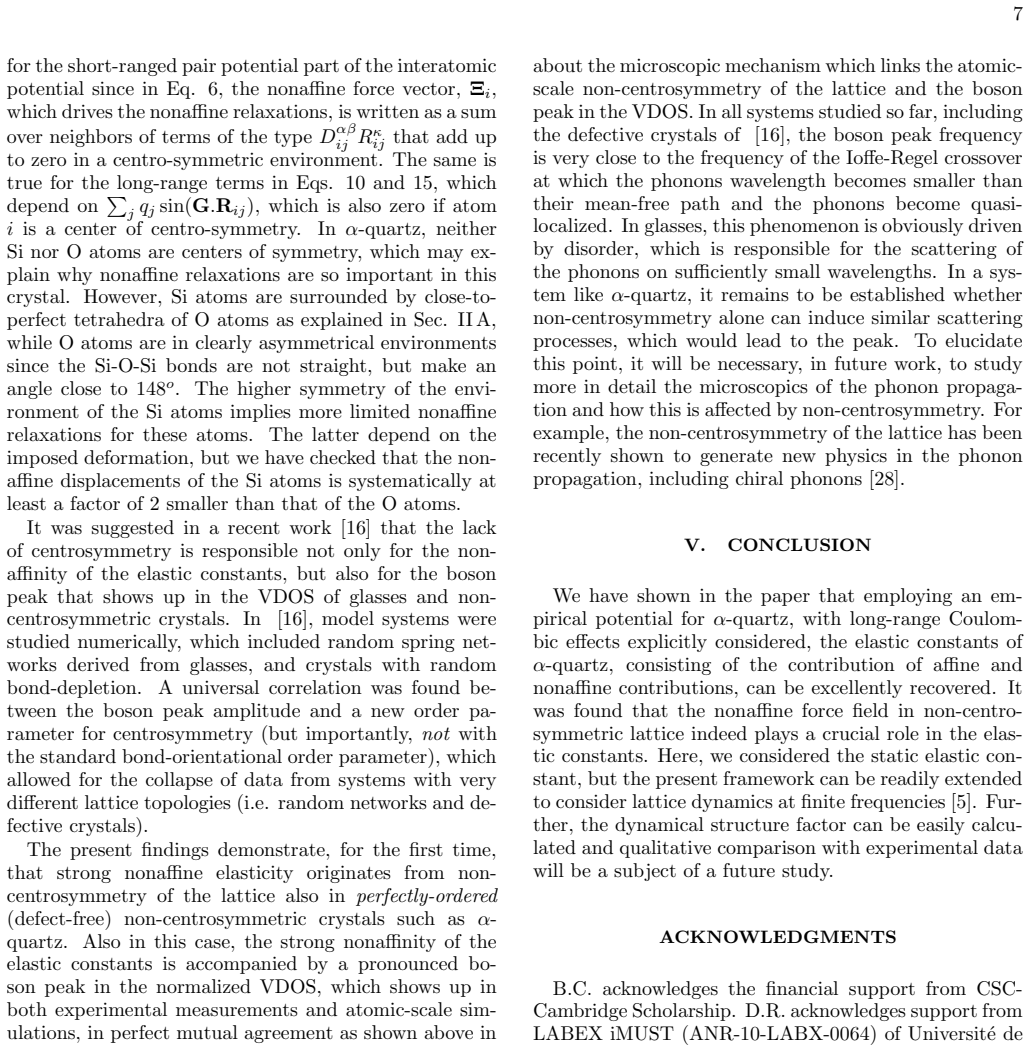
- The nonaffine softening of about 70% (90% for $C_{12}$, $C_{13}$) arises because no atom sits at an inversion center; oxygen atoms, in the most asymmetric environments, undergo the largest nonaffine displacements.
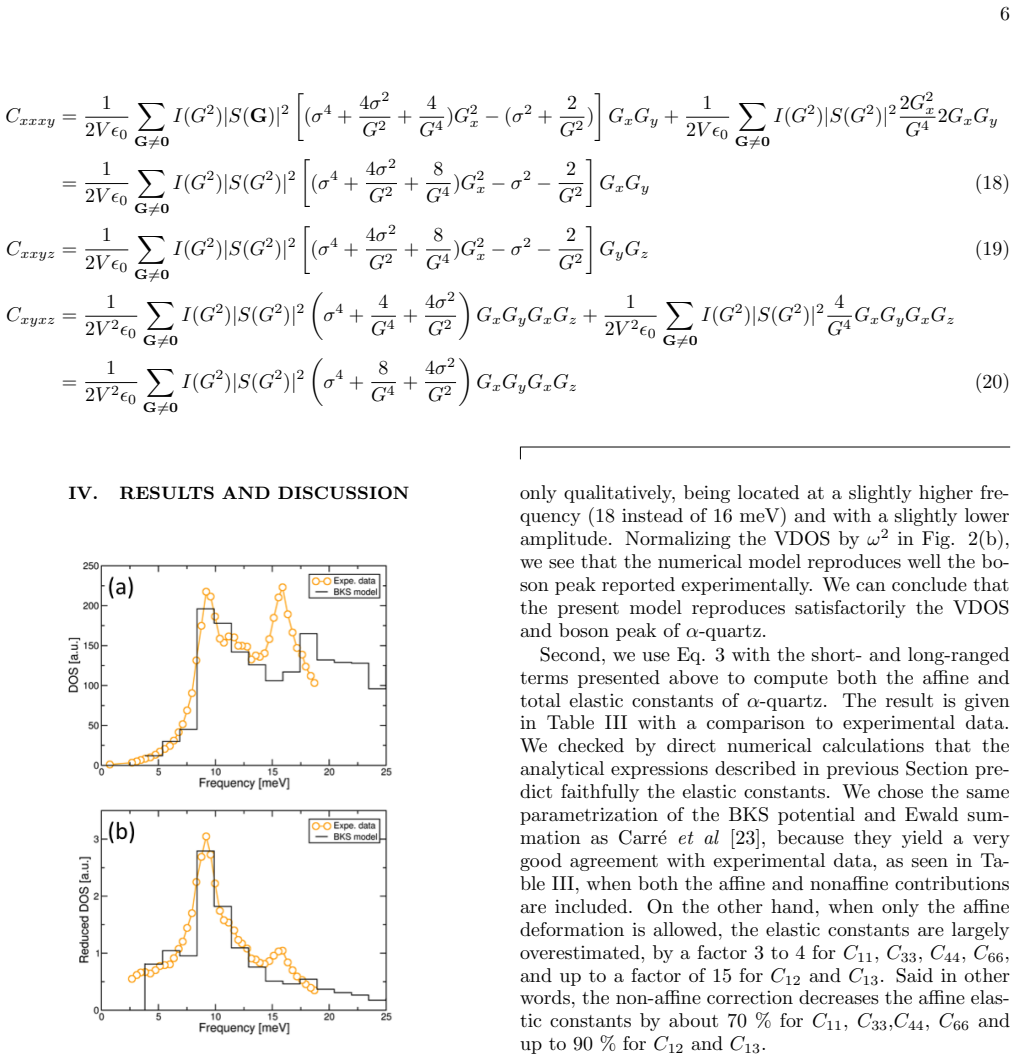
- The same model reproduces the experimental vibrational density of states and boson peak of α-quartz, supporting the proposed link between non-centrosymmetry, strong nonaffine elasticity, and the boson peak.
Reading between the lines
- Not pursued in the paper: because the derivation of the reciprocal-space terms uses only the form $I(G^2)$ and the invariance of $G\cdot R_{ij}$, the same analytic structure should extend to screened-Coulomb or dipole-dipole kernels; testing this on another ionic crystal would show whether the strong nonaffine softening is generic.
- Not pursued in the paper: affine-only estimates for other non-centrosymmetric piezoelectric crystals with partial charges are likely inflated by a comparable factor, so existing Born-Huang calculations for wurtzite or perovskite structures may deserve revisiting with the Ewald nonaffine terms.
- Not pursued in the paper: a finite-frequency extension of this formalism should show frequency-dependent elastic moduli that soften most near the boson-peak frequency; that prediction could be tested by comparing dynamic moduli from molecular dynamics with the static values reported here.
Signed reviews
Editorial analysis
A structured set of objections, weighed in public.
Referee Report
Summary. This paper extends the nonaffine response theory of Lemaitre and Maloney to crystals with long-range Coulomb interactions treated by Ewald summation. The authors derive analytic expressions for the Ewald contribution to the affine elastic constants and to the nonaffine force field, apply them to alpha-quartz modeled with the BKS potential, and report static elastic constants that agree reasonably with experiment. The central physical result is that the nonaffine correction reduces the affine Born-Huang estimates by 70-90% for the elastic constants of alpha-quartz, which the authors attribute to the lack of centrosymmetry and connect to the boson peak.
Significance. If the Ewald extension is correct, the paper offers a useful formalism for computing elastic constants of non-centrosymmetric crystals from a single relaxed configuration, without explicit deformation simulations. The reported magnitude of nonaffine softening in a perfectly ordered crystal is a striking result with potential implications for piezoelectric materials and for the physics of the boson peak. The paper is also commendable for comparing directly with experimental data and for separating affine and nonaffine contributions. However, the analytic derivation is the load-bearing element of the method, and the manuscript as written does not make that derivation verifiable: the printed strain derivatives appear incomplete, and the claimed numerical checks are not documented.
major comments (2)
- [Section III B 2-3, Eqs. (8), (10), (14)] The derivative of the Ewald force in Eq. (8) under strain is not complete. For the uniaxial case, using V -> V(1+epsilon) and reciprocal vectors G -> (G_x/(1+epsilon), G_y, G_z), with G.R_ij invariant, direct differentiation gives, up to the sign convention for Xi, an extra term -I(G^2)G - I(G^2)G_x e_x inside the sum over G, in addition to the retained I(G^2)(sigma^2+2/G^2)G_x^2 G term. Equation (10) contains only the last term. The omitted '-G' term is exactly -F_i^Ewald, which is not zero at the relaxed positions because only the total force (short-range plus Ewald) vanishes in alpha-quartz; the '-G_x e_x' term has the same order as the retained term. No cancellation argument is provided. The same omission affects the shear derivative in Eq. (14), where the derivative of the reciprocal vectors contributes a term of order I(G^2)G_x that is not shown, and it propagates into the second derivatives behind Eqs. (12), (13), and (16). Since Table III reports nonaffine corrections of 70-90% of the affine values, the printed analytic Xi vectors and the central methodological claim are not established by the manuscript as written.
- [Section IV, second paragraph] The sentence 'We checked by direct numerical calculations that the analytical expressions described in previous Section predict faithfully the elastic constants' is the only numerical validation of the Ewald formulas, but no comparison is shown and no code, input files, or raw data are provided. Because Eqs. (10)-(16) are the paper's main new contribution, a quantitative comparison between the analytic and finite-strain values of Xi, C_Born, and the final elastic constants is necessary, or at minimum a reproducible data repository. As it stands, the agreement in Table III cannot be traced to the correctness of the Ewald formalism, especially given the incomplete derivative terms identified above.
minor comments (5)
- [Table III] The experimental row labeled Exp. [26] is missing the C66 entry; the row reads '86.6 106.4 58 6.74 12.4', which appears to omit or merge a value. Please reformat so all six elastic constants are listed.
- [Eqs. (18)-(20)] The structure factor is written as 'S(G2)' in several places; this should be S(G).
- [Section II B] The numerical value of the Ewald Gaussian width sigma (or alpha) is never stated, although the real-space cutoff Rcut = 10 Angstrom is given. The Ewald calculation cannot be reproduced without this parameter.
- [Eqs. (6) and (10)] The sign convention for Xi is inconsistent between Eq. (6), which defines Xi as dF/depsilon, and Eq. (10), which appears to use -dF/depsilon for the Ewald part. Please state the convention explicitly.
- [Sections II B and IV] The paper states that the original BKS parameters were chosen because they provide the best agreement with experimental elastic constants of alpha-quartz [23]. If any of the experimental data in Table III were used in that selection, the comparison is not fully a posteriori and this should be stated clearly.
Circularity Check
Elastic-constant agreement is partly constructed by choosing the BKS parametrization that best matches the same experimental elastic constants; the nonaffine softening itself is not fitted.
-
fitted input called prediction
[Section II B (Empirical potential) and Section IV, paragraph above Table III]
"Different parametrizations of this potential exist [8, 22]. We have used the original parameters [8], which do not include any direct Si-Si interaction, because they provide the best agreement with experimental measurements of elastic constants of α-quartz [23]. ... We chose the same parametrization of the BKS potential and Ewald summation as Carré et al [23], because they yield a very good agreement with experimental data, as seen in Table III"
The BKS parametrization and the 10 Å short-range cutoff are explicitly selected because they give the best agreement with the experimental elastic constants, and Table III then lists those same experimental values as the reference for the method's 'prediction'. The agreement of the computed C11, C33, C44, C66, C12 and C13 with experiment is therefore partly a consequence of the input choice, not an independent test of the framework. By contrast, the central nonaffine softening (70-90% reduction relative to the affine Born-Huang values) is not fitted and remains a nontrivial model output, so the circularity is partial rather than total.
full rationale
The main methodological derivation, the Ewald-based nonaffine force formulas and the elastic-constant expressions, is self-contained: the nonaffine correction is computed from the dynamical matrix and the nonaffine force field, not fitted to the target elastic constants. The paper's citations to its own prior work [3,5,6,16] support the nonaffine framework and boson-peak discussion, but they are not uniquely load-bearing; the present derivation extends rather than assumes the central result. The potential-selection issue above is the only genuine circularity: the reported 'excellent agreement with experimental data' is weakened by the paper's own statement that the parametrization was chosen for best agreement with those data. The reader's take also flags that Eqs. 10, 14 and 16 may omit strain derivatives of the volume prefactor and reciprocal vectors; that is a correctness and reproducibility concern, not a circularity, and is not counted in the score. Overall, the quantitative nonaffine-elasticity claim retains independent content, but the experimental validation is partly circular, giving a score of 3.
Assumptions & free parameters
free parameters (4)
- BKS short-range potential parameters (A, rho, C) =
O-O: 1388.773 eV, 0.3623 A, 175.0 eV A^6; Si-O: 18003.7572 eV, 0.2052 A, 133.5381 eV A^6
- BKS partial charges q_Si, q_O =
q_Si=+2.4 e, q_O=-1.2 e (standard BKS)
- Short-range cutoff rc,sh =
10 A
- Ewald Gaussian width parameter sigma (alpha) =
not specified; Rcut=10 A and reciprocal cutoff n_kappa,max used
assumptions (4)
- domain assumption Validity of nonaffine response theory (Lemaitre-Maloney) for static zero-temperature response
- domain assumption BKS potential faithfully represents alpha-quartz interatomic forces
- standard math The Ewald summation with chosen cutoffs is converged
- domain assumption The crystal is a perfect periodic lattice at 0 K with zero internal stress after relaxation
Cite this review
Pith. "Pith review of Nonaffine lattice dynamics with the Ewald method reveals strongly nonaffine elasticity of {\alpha}-quartz." pith.science (2026). https://pith.science/paper/GIQWKXPG
@misc{pith2026190807982,
  author       = {Pith},
  title        = {Pith review of: Nonaffine lattice dynamics with the Ewald method reveals strongly nonaffine elasticity of \alpha-quartz},
  year         = {2026},
  howpublished = {\url{https://pith.science/paper/GIQWKXPG}},
  note         = {Machine review of arXiv:1908.07982}
}
read the original abstract
A lattice dynamical formalism based on nonaffine response theory is derived for non-centrosymmetric crystals, accounting for long-range interatomic interactions using the Ewald method. The framework takes equilibrated static configurations as input to compute the elastic constants in excellent agreement with both experimental data and calculations under strain. Besides this methodological improvement, which enables faster evaluation of elastic constants without the need of explicitly simulating the deformation process, the framework provides insights into the nonaffine contribution to the elastic constants of {\alpha}-quartz. It turns out that, due to the non-centrosymmetric lattice structure, the nonaffine (softening) correction to the elastic constants is very large, such that the overall elastic constants are at least 3-4 times smaller than the affine Born-Huang estimat
Figures

Forward citations
Cited by 1 Pith paper
-
Comparison of the Helmholtz, Gibbs, and Collective-modes methods to obtain nonaffine elastic constants
Born-Huang, Lemaitre-Maloney, and collective-mode derivations of nonaffine elastic constants coincide for unstressed equilibrium lattices, and a reduced-Hessian shortcut reproduces the same values.
Reference graph
Works this paper leans on
-
[1]
Forces and dynamical matrix The long-ranged energy ELR produces atomic forces due to the dependence of the structure factor, S(G) =∑ jqj exp(iG· Rj), on atomic positions. The expression of the resulting force is [13, 24]: Fi =−∂ELR ∂Ri =− 1 2Vε 0 ∑ G⁄=0 exp (−σ2G2/2) G2 [S(G)(−iG)qie−iG·Ri +S(−G)qi(iG)eiG·Ri)] =− 1 Vε 0 ∑ G⁄=0 exp (−σ2G2/2) G2 GqiIm[S(G)e...
-
[2]
i⁄=j: Dαβ ij = ∂2ELR ∂Rα i∂Rβ j = qiqj Vε 0 ∑ G⁄=0 I(G2)GαGβ cos (G· Rij) (9)
-
[3]
i =j: Dαβ ii =− qi Vε 0 ∑ G⁄=0 I(G2)GαGβ∑ j⁄=i qj cos(G· Rij) =− ∑ j⁄=i Dαβ ij
-
[4]
8 when an incremental affine strain is applied to the system
Tensile deformation To find the long-range effect on the nonaffine forces, we need to express the variation of the atomic force in Eq. 8 when an incremental affine strain is applied to the system. We consider first a uniaxial strain ϵ along direc- tionx. The dependence on ϵ is due to the dependence of three terms: • the volume, V →V (1 +ϵ) • the reciprocal vecto...
-
[5]
The applied strain is noted γxy≡γ
Shear deformation We now consider the case of an affine shear strain par- allel to the y planes with displacements along the x di- rection. The applied strain is noted γxy≡γ. Under this strain, the axis of the box become: a′ 1 = (Lx, 0, 0) = a1, a′ 2 = ( Lxγ,Ly, 0), a′ 3 = (0 , 0,Lz) = a3 while the reciprocal vectors become: G′ = 2π(nx Lx , ny Ly − nxγ Lx ,...
-
[6]
Some other affine elastic constants from ELR We note that the formula of Born approximation hold for a generic strain tensor η [2]: CBorn αβκχ = lim η→0 1 V ∂ELR ∂ηαβ∂ηκχ (17) ForC16 =Cxxxy,C14 =Cxxyz andC56 =Cxyxz, we have respectively, 6 Cxxxy = 1 2Vϵ 0 ∑ G⁄=0 I(G2)|S(G)|2 [ (σ4 + 4σ2 G2 + 4 G4 )G2 x− (σ2 + 2 G2 ) ] GxGy + 1 2Vϵ 0 ∑ G⁄=0 I(G2)|S(G2)|2 2G2...
-
[7]
M. Born and K. Huang. Dynamical Theory of Crystal Lattices. Oxford University Press, Oxford, 1954
work page 1954
-
[8]
A. Lemaitre and C. Maloney. Sum rules for the quasi- static and visco-elastic response of disordered solids at zero temperature. J. Stat. Phys., 123:415, 2006
work page 2006
Show all 34 references
-
[9]
Zaccone and E
A. Zaccone and E. Scossa-Romano. Approximate analyt- ical description of the nonaffine response of amorphous solids. Phys. Rev. B, 83:184205, 2011
2011
-
[10]
Zaccone and E
A. Zaccone and E. M. Terentjev. Disorder-assisted melt- ing and the glass transition in amorphous solids. Phys. Rev. Lett., 110:178002, 2013
2013
-
[11]
Damart, A
T. Damart, A. Tanguy, and D. Rodney. Theory of har- monic dissipation in disordered solids. Phys. Rev. B, 95:054203, 2017
2017
-
[12]
Palyulin, C
V.V. Palyulin, C. Ness, R. Milkus, R.M. Elder, T.W. Sirk, and A. Zaccone. Parameter-free predictions of the viscoelastic response of glassy polymers from nonaffine lattice dynamics. Soft Matter, 14:8475, 2018
2018
-
[13]
Kholkin, N
A. Kholkin, N. Pertsev, and A. Goltsev. Piezoelectric- ity and crystal symmetry. In Piezoelectric and Acoustic 8 Materials for Transducer Applications, Boston, 2008. Springer
2008
-
[14]
B. W. H. van Beest, G. J. Kramer, and R. A. van Santen. Force fields for silicas and aluminophosphates based on ab initio calculations. Phys. Rev. Lett., 64:1955, 1990
1955
-
[15]
D. Wolf, P. Keblinski, S. R. Phillpot, and J. Eggebrecht. Exact method for the simulation of coulombic systems by spherically truncated, pairwise r-1 summation. J. Chem. Phys., 110:8254, 1999
1999
-
[16]
C. J. Fennell and J. D. Gezelter. Is the ewald summa- tion still necessary? pairwise alternatives to the accepted standard for long-range electrostatics. J. Chem. Phys., 124:234104, 2006
2006
-
[17]
Carr´ e, L
A. Carr´ e, L. Berthier, J. Horbach, S. Ispas, and W. Kob. Amorphous silica modeled with truncated and screened coulomb interactions: A molecular dynamics simulation study. J. Chem. Phys., 127:114512, 2007
2007
-
[18]
P. P. Ewald. The calculation of optical and electrostatic grid potential. Ann. Phys. (Leipzig), 64:253, 1921
1921
-
[19]
Lee and W
H. Lee and W. Cai. Ewald summation for coulomb inter- actions in a periodic supercell. Lecture notes, Stanford University, 2009
2009
-
[20]
Bosak et al
A. Bosak et al. New insights into the lattice dynamics of α-quartz. Z. Kristallogr., 227:84, 2012
2012
-
[21]
Chumakov et al
V.I. Chumakov et al. Role of disorder in the thermody- namics and atomic dynamics of glasses. Phys. Rev. Lett., 112:025502, 2014
2014
-
[22]
Milkus and A
R. Milkus and A. Zaccone. Local inversion-symmetry breaking controls the boson peak in glasses and crystals. Phys. Rev. B, 93:094204, 2016
2016
-
[23]
Senguly and S
S. Senguly and S. Sengupta. Excess vibrational modes of a crystal in an external non-affine field. J. Chem. Sci., 129:891, 2017
2017
-
[24]
J. P. Sutter and H. Yavas. Material properties ofα-quartz that are relevant for its potential use in x-ray monochro- mators and analyzers. arXiv:1612.07049, 2017
2017 arXiv
-
[25]
Bragg and R
W. Bragg and R. E. Gibbs. The structure of α and β quartz. Proc. Roy. Soc. Lond. A, 109:405, 1925
1925
-
[26]
R. W. G. Wyckoff. Crystal Structures, volume 1. John Wiley & Sons, New York, 1963
1963
-
[27]
K. Kihara. An x-ray study of the temperature depen- dence of the quartz structure. Eur. J. Mineral., 2:63, 1990
1990
-
[28]
Mantisi, A
B. Mantisi, A. Tanguy, G. Kermouche, and E. Barthel. Atomistic response of a model silica glass under shear and pressure. Eur. Phys. J. B, 85:304, 2012
2012
-
[29]
Carr´ e, J
A. Carr´ e, J. Horbach, S. Ispas, and W. Kob. New fitting scheme to obtain effective potential from car-parrinello molecular-dynamics simulations: Application to silica. Europhys. Lett., 82:17001, 2008
2008
-
[30]
A. Y. Toukmaji and J. A. Board. Ewald summation tech- niques in perspective: a survey. Comput. Phys. Comm., 95:73, 1996
1996
-
[31]
Heyliger, H
P. Heyliger, H. Ledbetter, and S. Kim. Elastic constants of natural quartz. J. Acous. Soc. Am., 114:644, 2003
2003
-
[32]
J. Wang, Z. Mao, F. Jiang, and T. S. Duffy. Elasticity of single-crystal quartz to 10 GPa. Phys. Chem. Min., 42:203, 2015
2015
-
[33]
G. Will, M. Bellotto, W. Parrish, and M. Hart. Crys- tal structures of quartz and magnesium germanate by profile analysis of synchroton-radiation high resolution power data. J. Appl. Cryst., 21:182, 1988
1988
-
[34]
Kaindl, Lain-Jong Li, Yuan Wang, and Xiang Zhang
Hanyu Zhu, Jun Yi, Ming-Yang Li, Jun Xiao, Lifa Zhang, Chih-Wen Yang, Robert A. Kaindl, Lain-Jong Li, Yuan Wang, and Xiang Zhang. Observation of chiral phonons. Science, 359(6375):579–582, 2018
2018
Reviewed August 14, 2026 · model on record in the stance chip above.
Discussion (0). Continue with ORCID to comment.