REVIEW 4 major objections 5 minor 20 references
Multi-owner Secure Encrypted Search Using Searching Adversarial Networks
T0 review · 4 major / 5 minor · reviewed 2026-08-14 · deepseek-v4-flash
Pith's one-line read This paper claims a multi-owner encrypted-search scheme that keeps query precision above 95 percent, brings search cost close to $\mathcal{O}(\log N)$ with a probability-learned balanced tree, and cuts dynamic update overhead by splitting…
desk verdict Plausible engineering combination, but the O(log N) search claim is asserted rather than derived and the 95% precision is tuned, so the headline results need serious revision before they hold up. read the letter →
The pith
A machine-rendered reading of the paper's core claim, the machinery that carries it, and where it could break.
The reading
What carries the argument
The load-bearing objects are three. First, the searching adversarial network: a searcher network generates search results from random noise while a discriminator network tries to tell accurate search results from padded ones, and the minimax equilibrium of this game sets the probability distribution for pseudo-keyword padding, balancing precision against privacy. Second, the maximum likelihood search balanced tree (MLSB-Tree): index vectors are sorted by scores computed against random query vectors, then assembled into a balanced tree by a bottom-up greedy strategy, with the intent that frequently searched vectors sit near the top and search converges to $\mathcal{O}(\log N)$ as the number of random queries grows. Third, the balanced index forest (BIF): fast clustering partitions all indexes into $s$ groups, each with its own sub-dictionary and balanced tree, so dynamic maintenance, communication, and storage overhead scale with one partition rather than the whole index set.
What would settle it
Build synthetic document sets of increasing size, construct MLSB-Tree with an increasing number of random query samples, and measure the average number of tree nodes visited per real query; if the node count does not approach a logarithmic curve and instead grows linearly with $N$, the central search-efficiency claim is false. A second check is to rerun the precision/privacy experiments on an independent dataset and see whether the reported 95 percent precision and roughly 80 percent rank privacy at the chosen $\sigma$ values reproduce.
Extended reading notes
Core claim
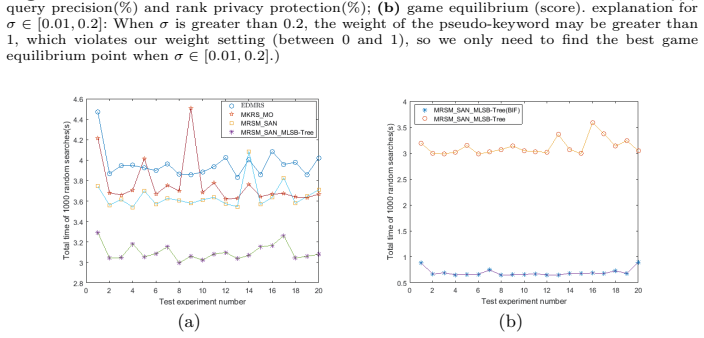
The central claim is that the three longstanding goals of multi-owner SSE, precise ranked search, strong query and keyword privacy, and cheap dynamic updates, can be achieved simultaneously by coupling three mechanisms. Adversarial learning selects the noise distribution for pseudo-keyword padding, reaching a measured equilibrium (for example, query precision 98/97/93 percent with rank-privacy 78/79/84 percent at specific noise variances) where padded and unpadded searches are hard to distinguish. A maximum likelihood search balanced tree, built by sorting index vectors by their relevance scores against randomly generated query vectors and then constructing a balanced tree bottom-up with a greedy method, is claimed to make search approach binary-search efficiency, with measured speedups of 21.72 percent over EDMRS and 17.69 percent over MKRS-MO. The balanced index forest then reduces the dynamic update cost from about $2\mathcal{O}(\log N)$ to $(2/s)\mathcal{O}(\log(N/s))$ for $s$ index partitions, and the paper projects over 100-fold search efficiency gains on very large, sparse datasets.
Load-bearing premise
The efficiency claim rests on an unproved heuristic: sorting index vectors by relevance scores from many random queries and then building a balanced tree bottom-up with a greedy method makes search complexity converge to $\mathcal{O}(\log N)$, and this convergence is not formally analyzed.
Editorial extensions
If this is right
- Query precision above 95 percent and rank privacy around 80 percent can coexist under a tuned pseudo-keyword padding distribution, addressing the precision-privacy trade-off that earlier ranked-search schemes left open.
- Search on encrypted indexes can approach $\mathcal{O}(\log N)$ complexity even when the index tree is built once and reused, rather than requiring a fully ordered structure that is expensive to maintain.
- Dynamic updates cost only $(2/s)\mathcal{O}(\log(N/s))$ instead of $2\mathcal{O}(\log N)$, making frequent insertions and deletions feasible in a multi-owner setting.
- On large, sparse datasets with many owners, the projected efficiency ratio between a single tree and an $s$-partition forest grows to about $\eta = s\log N/(\log N - \log s)$, exceeding 100 when $N=20000$ and $s=80$.
- The same adversarial-learning equilibrium can be tuned by adjusting noise variance $\sigma$ per index partition, giving system operators a concrete knob for trading query precision against privacy strength.
Reading between the lines
- The $\mathcal{O}(\log N)$ convergence claim is distribution-dependent: the tree is trained on random queries, so if real users' queries are highly skewed or shift over time, the learned leaf ordering may no longer match search popularity and the practical speedup could degrade toward linear search.
- The adversarial padding equilibrium is found empirically; a natural extension would be to prove a formal indistinguishability bound for the padded index distribution, or to apply the same minimax training to choose other parameters such as the number of pseudo-keywords per partition.
- The balanced index forest's advantage is amplified by data sparsity, since sparse vectors make similarity scores near zero and make a single global tree inefficient; in dense, small datasets the clustering overhead might outweigh the search gain.
- Because the scheme relies on ASPE-style inner-product encryption, its security inherits the same limitations of that approach; a concrete follow-up could test whether the learned padding distribution leaks information through the distribution of non-zero similarity scores.
Signed reviews
Editorial analysis
A structured set of objections, weighed in public.
Referee Report
Summary. The paper proposes MRSM SAN, a multi-owner searchable symmetric encryption (SSE) scheme that combines three mechanisms: (i) a searching adversarial network (SAN) to determine the pseudo-keyword padding distribution, claimed to reach an optimal trade-off between query precision and privacy; (ii) a maximum likelihood search balanced tree (MLSB-Tree) built by sorting index vectors according to relevance scores computed with randomly generated queries, claimed to bring search complexity close to O(log N); and (iii) a balanced index forest (BIF) that partitions the index into clusters to support dynamic updates and distributed search. The encryption core uses the standard asymmetric scalar-product-preserving encryption (ASPE) technique for secure inner-product computation. The abstract claims query precision above 95%, adequate privacy protection, and low computational, communication, and storage overhead. The paper provides algorithms, security arguments delegated to prior work, and experiments on a 20,000-document IEEE Xplore dataset.
Significance. If the efficiency and precision claims were rigorously supported, the paper would be a genuinely useful contribution to multi-owner SSE, addressing a practical gap: simultaneous precision, privacy, and dynamic maintenance. The ASPE-based encrypted inner-product algebra appears standard and is a solid foundation. The paper also makes an honest attempt to test the scheme empirically and reports concrete numbers. However, the central claims are currently supported by heuristic assertions and evaluation practices that are circular in places, rather than by formal analysis or robust experiments. The O(log N) search complexity is not derived, the 'optimal game equilibrium' is computed by tuning three sigma parameters on the evaluation data, and the security analysis is largely copied from prior works without adaptation to the multi-owner, multi-partition setting. These issues are load-bearing because they underpin the abstract's headline assertions. The paper's contribution is therefore interesting but not yet substantiated to the standard required by a journal publication.
major comments (4)
- [§2.3, Algorithm 4; Fig. 5b caption; §4] The central efficiency claim that MLSB-Tree search complexity converges to O(log N) is asserted, not derived. Algorithm 4 builds the tree by computing relevance scores of index vectors against randomly generated query vectors, sorting the leaves, and then constructing a balanced tree bottom-up with the greedy method from [16]. The paper's own Fig. 5b caption states that 'the closer the number of random searches is to infinity, the higher the search efficiency of obtained index tree, this makes the computational complexity of search can converge to O(log N)' — that is a heuristic belief, not a proof. The GDFS algorithm (Algorithm 6) prunes using the score of the actual query against a moving threshold, but the tree structure is fixed by training on random queries; no distributional assumption links the training queries to real user queries, and no argument shows that GDFS visits only O(log N) nodes for queries outside the training distribution. The experiments report wall-clock time for 1000 random queries but do not report visited-node counts or any worst-case/node-count analysis. This concern is load-bearing because the 'low overhead on computation' claim and the 'near O(log N)' statement in the abstract rest on this unproven heuristic. Please provide either a formal analysis of the tree construction and search pruning, or substantially weaken the efficiency claim to match what is actually demonstrated.
- [§3, 'Optimal Pseudo-keyword Padding' (Fig. 3) and §2.4] The claimed 'optimal game equilibrium' and the 95% precision result are obtained by fitting the parameters sigma1, sigma2, sigma3 on the evaluation data. The paper defines an objective function f(x,y) = (1/95)x^2 + (1/80)y^2, where 95% and 80% are chosen as benchmarks, and then searches over sigma to maximize f on the same dataset for which the precision numbers are reported. This makes the precision claim circular and does not establish that the scheme will maintain 'query precision above 95%' on unseen data. No held-out validation set, cross-validation, or confidence intervals are reported. Since the abstract's 'query precision above 95%' is a central selling point, the evaluation protocol must be corrected: report precision on a test set not used for tuning, or provide a parametric analysis showing the claimed precision is not simply an artifact of selecting the best sigma on the test data.
- [§2.4 'Security Analysis' and §2.2 'Setup'] The security analysis is delegated to prior works rather than established for this scheme. The text states that 'ASPE approach [15] is widely used ... and its security has been proven' and then refers to [16] and [1] for keyword privacy and unlinkability. However, the proposed scheme introduces several new elements not covered by those prior proofs: the SAN-based pseudo-keyword distribution, the segmentation of the dictionary into s sub-dictionaries, the MLSB-Tree ordering that leaks ranking scores to the server, and the multi-owner KDO weight model. No formal security definition (e.g., indistinguishability against chosen-keyword attacks, or a known-background model simulation) is given for this combined construction, and the one algebraic argument in the section (the central-limit-theorem approximation for sum_{epsilon_i}) is a heuristic about score distributions, not a proof of privacy. Because 'adequate privacy protection' is a headline claim, this gap needs to be addressed, either by providing a rigorous security proof for the full MRSM SAN scheme or by clearly stating the exact security guarantees inherited from which prior work under which assumptions.
- [§3, 'Search Efficiency of MLSB-Tree' and Fig. 4/5] The experimental evaluation of search efficiency is conducted under the same random-query distribution used to build the MLSB-Tree. The paper reports that the tree is trained on randomly generated query vectors, and the experiments also use 1000 random queries. This is circular with respect to the claim that the learned ordering matches real query traffic. The paper does not measure the sensitivity of the reported 21.72% and 17.69% improvements to the choice of query distribution, nor does it report the number of nodes visited by GDFS, which would be the directly relevant quantity for assessing whether the O(log N) behavior actually occurs. Please add experiments with realistic query distributions distinct from the training distribution, report node-visit counts and their variance, and provide a theoretical or empirical bound on search cost as a function of N and k.
minor comments (5)
- [Abstract and §4] The abstract states 'maintains query precision above 95%' as a categorical claim, but the experiments show 93% precision at sigma3=0.12 (Fig. 3a). The claim should be qualified to reflect the parameter-dependent behavior.
- [Algorithm 5, line 12] The line reads 'return Encrypted Encrypted BIF ~F = {...}'; the word 'Encrypted' is duplicated. Please fix the typo.
- [§1, Related Work] The text contains several language issues, e.g., 'only realized the linean search efficiency' (should be 'linear'), 'builded' (should be 'built'), and 'the closer the number of random searches is to infinity' (awkward phrasing). A thorough language edit is recommended.
- [§2.4, 'Keyword privacy'] The notation is dense and partly undefined: for example, the symbol 'sum epsilon_i' is not clearly tied to the actual padding vectors, and the role of alpha_i in the range [0,1] is not explained in the algebra. Please clarify the notation and make the derivation self-contained.
- [§3, Fig. 3 caption] The caption for Fig. 3(b) is a run-on sentence that also contains an explanatory note about sigma in the caption; this material should be moved to the main text or presented more clearly.
Circularity Check
No demonstrated circularity: reported precision and efficiency numbers are experimental measurements or external benchmark comparisons, not algebraic consequences of the paper's own definitions.
full rationale
The only candidate for a definitional reduction is the game-equilibrium objective f(x,y)=1/95 x^2 + 1/80 y^2, which is built from the paper's 95% precision and 80% privacy benchmarks. But the reported precisions are measured values at fixed sigma, not outputs of f; the paper itself reports 93% at sigma3=0.12, so the 95% threshold is not forced by the objective. The subsequent choice of sigma that satisfies the query-precision requirement is a selection, not a prediction, and therefore does not meet the standard of a fitted parameter renamed as a prediction. The O(log N) claim for MLSB-Tree (Fig. 5b) is an unproved heuristic: the paper asserts that enough random searches make search complexity converge to O(log N) without a distributional argument, but that is a correctness/evidence gap, not a circular reduction. Self-citations [2,17,18,19] are present, but the load-bearing security analysis also invokes external ASPE [15] and the security analysis of [16]; no central claim reduces to a self-citation chain. The experimental comparisons against EDMRS [16] and MKRS-MO [6] are external benchmarks, so the derivation chain is not circular in the sense defined by the review criteria.
Assumptions & free parameters
free parameters (3)
- sigma1, sigma2, sigma3 =
0.05, 0.08, 0.12
- Number of pseudo-keywords U_i =
Not specified; set by trusted proxy based on privacy requirements
- Objective weights 1/95 and 1/80 =
1/95, 1/80
assumptions (5)
- domain assumption ASPE encryption provides secure inner-product computation for index and trapdoor matrices
- domain assumption Known-background security of prior MRSE-style schemes transfers to MRSM SAN
- standard math Central limit theorem applies to sums of independent bounded uniform noise variables
- ad hoc to paper Clustering index vectors with TWSVM and k-means preserves ranking quality after dictionary segmentation
- ad hoc to paper Sorting index vectors by scores from random queries yields a tree whose search complexity converges to O(log N)
Cite this review
Pith. "Pith review of Multi-owner Secure Encrypted Search Using Searching Adversarial Networks." pith.science (2026). https://pith.science/paper/GIWSIWU3
@misc{pith2026190802784,
  author       = {Pith},
  title        = {Pith review of: Multi-owner Secure Encrypted Search Using Searching Adversarial Networks},
  year         = {2026},
  howpublished = {\url{https://pith.science/paper/GIWSIWU3}},
  note         = {Machine review of arXiv:1908.02784}
}
abstract
Searchable symmetric encryption (SSE) for multi-owner model draws much attention as it enables data users to perform searches over encrypted cloud data outsourced by data owners. However, implementing secure and precise query, efficient search and flexible dynamic system maintenance at the same time in SSE remains a challenge. To address this, this paper proposes secure and efficient multi-keyword ranked search over encrypted cloud data for multi-owner model based on searching adversarial networks. We exploit searching adversarial networks to achieve optimal pseudo-keyword padding, and obtain the optimal game equilibrium for query precision and privacy protection strength. Maximum likelihood search balanced tree is generated by probabilistic learning, which achieves efficient search and brings the computational complexity close to $\mathcal{O}(\log N)$. In addition, we enable flexible dynamic system maintenance with balanced index forest that makes full use of distributed computing. Compared with previous works, our solution maintains query precision above 95% while ensuring adequate privacy protection, and introduces low overhead on computation, communication and storage.
Figures


Figures from the paper (2 more)

Reference graph
Works this paper leans on
-
[16]
IEEE TPDS 27(2), 340–352 (2016)
Xia, Z., Wang, X., Sun, X., Wang, Q.: A secure and dynamic m ulti-keyword ranked search scheme over encrypted cloud data. IEEE TPDS 27(2), 340–352 (2016)
work page 2016
-
[15]
In: ACM SIGMOD 2009
Wong, W.K., Cheung, D.W., Kao, B., Mamoulis, N.: Secure k nn computation on encrypted databases. In: ACM SIGMOD 2009. pp. 139–152. ACM ( 2009)
2009
-
[1]
IEEE TPDS 25(1), 222–233 (2014) 12 Kai Chen et al
Cao, N., Wang, C., Li, M., Ren, K., Lou, W.: Privacy-preser ving multi-keyword ranked search over encrypted cloud data. IEEE TPDS 25(1), 222–233 (2014) 12 Kai Chen et al
work page 2014
-
[2]
IACR Cryptology ePr int Archive 2019, 900 (2019)
Chen, K., Lin, Z., Wan, J., Xu, L., Xu, C.: Multi-client sec ure encrypted search using searching adversarial networks. IACR Cryptology ePr int Archive 2019, 900 (2019)
work page 2019
-
[3]
IEEE Access 7, 86555–86569 (2019)
Chen, S., Cao, J., Huang, Z., Shen, C.: Entropy-based fuzz y twin bounded support vector machine for binary classification. IEEE Access 7, 86555–86569 (2019)
work page 2019
-
[4]
Goodfellow, I.J., Pouget-Abadie, J., Mirza, M., Xu, B., W arde-Farley, D., Ozair, S., Courville, A.C., Bengio, Y.: Generative adversa rial networks. CoRR abs/1406.2661 (2014)
arXiv 2014
-
[5]
Goyal, V., Pandey, O., Sahai, A., Waters, B.: Attribute-b ased encryption for fine- grained access control of encrypted data. In: ACM CCS 2006. p p. 89–98. ACM (2006)
work page 2006
-
[6]
Journal of Systems and Soft- ware 137(3), 380–395 (2018)
Guo, Z., Zhang, H., Sun, C., Wen, Q., Li, W.: Secure multi-k eyword ranked search over encrypted cloud data for multiple data owners. Journal of Systems and Soft- ware 137(3), 380–395 (2018)
2018
Show all 20 references
-
[7]
Addison- Wesley (1998)
Knuth, D.E.: The art of computer programming, Volume III, 2nd Edition. Addison- Wesley (1998)
1998
-
[8]
FGCS 30, 179–190 (2014)
Li, R., Xu, Z., Kang, W., Yow, K., Xu, C.: Efficient multi-key word ranked query over encrypted data in cloud computing. FGCS 30, 179–190 (2014)
2014
-
[9]
ACM Comput
Poh, G.S., Chin, J., Yau, W., Choo, K.R., Mohamad, M.S.: Se archable symmetric encryption: Designs and challenges. ACM Comput. Surv. 50(3), 40:1–40:37 (2017)
2017
-
[10]
Computers & Electrical Engineering 68, 463–483 (2018)
Salem, S.B., Naouali, S., Chtourou, Z.: A fast and effecti ve partitional clustering al- gorithm for large categorical datasets using a k -means based approach. Computers & Electrical Engineering 68, 463–483 (2018)
2018
-
[11]
Salton, G., Wong, A., Yang, C.: A vector space model for au tomatic indexing. Commun. ACM 18(11), 613–620 (1975)
1975
-
[12]
In: IEEE S & P 2000
Song, D.X., Wagner, D.A., Perrig, A.: Practical techniq ues for searches on en- crypted data. In: IEEE S & P 2000. pp. 44–55. IEEE Computer Soc iety (2000)
2000
-
[13]
IEEE TPDS 25(11), 3025–3035 (2014)
Sun, W., Wang, B., Cao, N., Li, M., Lou, W., Hou, Y.T., Li, H .: Verifiable privacy- preserving multi-keyword text search in the cloud supporti ng similarity-based rank- ing. IEEE TPDS 25(11), 3025–3035 (2014)
2014
-
[14]
In: IEEE INFOCOM 2 010
Wang, C., Wang, Q., Ren, K., Lou, W.: Privacy-preserving public auditing for data storage security in cloud computing. In: IEEE INFOCOM 2 010. pp. 525–533. IEEE (2010)
2010
-
[17]
I EEE TETC (2019)
Xu, L., Sun, S., Yuan, X., Liu, J.K., Zuo, C., Xu, C.: Enabl ing authorized encrypted search for multi-authority medical databases. I EEE TETC (2019). https://doi.org/10.1109/TETC.2019.2905572
2019
-
[18]
Xu, L., Xu, C., Liu, J.K., Zuo, C., Zhang, P.: Building a dy namic searchable encrypted medical database for multi-client. I nf. Sci. (2019). https://doi.org/10.1016/j.ins.2019.05.056
2019 doi
-
[19]
In: IEEE INFOCOM 2019
Xu, L., Yuan, X., Wang, C., Wang, Q., Xu, C.: Hardening dat abase padding for searchable encryption. In: IEEE INFOCOM 2019. pp. 2503–251 1. IEEE (2019)
2019
-
[20]
In: IEEE INFOCOM 201 0
Yu, S., Wang, C., Ren, K., Lou, W.: Achieving secure, scal able, and fine-grained data access control in cloud computing. In: IEEE INFOCOM 201 0. pp. 534–542. IEEE (2010)
2010
Reviewed August 14, 2026 · model on record in the stance chip above.
Discussion (0). Continue with ORCID to comment.