REVIEW 1 major objections 2 minor 9 references
Generating in the Limit with Infinitely Many Hallucinations
T0 review · 1 major / 2 minor · reviewed 2026-06-30 · grok-4.3
Pith's one-line read Allowing infinitely many hallucinations with vanishing frequency strictly raises recall in language generation in the limit when the adversary withholds part of the language.
desk verdict The paper shows that allowing infinitely many hallucinations with frequency tending to zero can strictly increase recall in generation in the limit, but only under permanent adversary withholding. read the letter →
The pith
A machine-rendered reading of the paper's core claim, the machinery that carries it, and where it could break.
The reading
What carries the argument
Asymptotic validity: the requirement that the frequency of invalid outputs tends to zero rather than that invalid outputs eventually cease.
What would settle it
A concrete language class and adversary strategy in which every asymptotically valid learner attains higher recall than every eventually valid learner when a fixed fraction of strings is permanently withheld.
Extended reading notes
Core claim
In the generation-in-the-limit setting, learners that produce infinitely many invalid strings yet maintain precision one through a vanishing error rate can achieve strictly higher recall than eventually valid learners whenever the adversary permanently withholds a positive fraction of the target language.
Load-bearing premise
The adversary must permanently withhold a large portion of the target language; the strict recall gain disappears if the adversary eventually reveals everything.
Editorial extensions
If this is right
- Precision remains exactly one even though the learner never becomes valid.
- The set of languages that can be generated with high recall enlarges under permanent withholding adversaries.
- A continuous novelty constraint requiring only a fixed fraction of outputs to be novel still permits positive recall.
- Enumeration, novelty, and validity constraints can be traded off while keeping precision one.
Reading between the lines
- In practice this suggests that models allowed controlled repetition and rare errors could cover more of an underlying distribution than strictly valid generators.
- The advantage is tied to permanent withholding; if the withheld set eventually appears the recall ordering may reverse.
- The same asymptotic-precision idea could be applied to other partial-information learning settings beyond formal languages.
Editorial analysis
A structured set of objections, weighed in public.
Referee Report
Summary. The paper extends the language generation in the limit framework by relaxing the validity (precision) constraint to permit infinitely many hallucinations provided their asymptotic frequency tends to zero, thereby preserving precision one. Under this relaxation it proves a conditional existence result: recall can be strictly higher than in the eventually-valid case when the adversary permanently withholds a large portion of the target language. The manuscript also analyzes a continuous relaxation of the novelty constraint that requires only a fixed positive fraction of outputs to be novel, and situates both relaxations within the classic recall-precision trade-off for settings closer to large language models.
Significance. If the derivations hold, the work supplies a theoretically grounded relaxation that aligns the formal model more closely with practical language generation, where occasional errors and repetitions are inevitable. The conditional strict-increase result under permanent withholding is a precise, falsifiable statement that clarifies when the precision-recall tension can be mitigated without sacrificing the limit guarantee.
major comments (1)
- Theorem on relaxed precision (presumably the central result following the definitions of precision-1 learners): the strict increase in recall is shown only under the permanent-withholding adversary; the manuscript should state explicitly whether the construction fails or becomes non-strict when the withheld set is eventually revealed, as this boundary condition is load-bearing for the claimed advantage over eventually-valid learners.
minor comments (2)
- Notation for the frequency-of-hallucinations limit (e.g., lim freq(hallucinations) = 0) should be introduced with a displayed equation and cross-referenced in the statement of the main theorem to avoid ambiguity with the classic “eventually valid” definition.
- The continuous novelty relaxation is introduced late; a short paragraph in the introduction contrasting the discrete and continuous novelty constraints would improve readability.
Simulated Author's Rebuttal
We thank the referee for the detailed reading and for identifying this important boundary condition in our central result. We address the comment below and will revise the manuscript accordingly.
read point-by-point responses
-
Referee: Theorem on relaxed precision (presumably the central result following the definitions of precision-1 learners): the strict increase in recall is shown only under the permanent-withholding adversary; the manuscript should state explicitly whether the construction fails or becomes non-strict when the withheld set is eventually revealed, as this boundary condition is load-bearing for the claimed advantage over eventually-valid learners.
Authors: We agree that the strict-increase result is proved only for the permanent-withholding case. The construction in the proof exploits the fact that the withheld strings are never revealed, allowing the learner to produce them at a vanishing rate without ever being contradicted by the adversary. If the withheld set is eventually revealed, the same learner would eventually be forced to output strings already seen in the enumeration, causing recall to drop to the level achieved by eventually-valid learners; the strict separation therefore disappears. We will add an explicit paragraph after the theorem statement clarifying this boundary condition and noting that the advantage is conditional on permanent partial revelation. revision: yes
Circularity Check
No significant circularity; derivation is self-contained
full rationale
The paper defines new notions of precision (allowing infinitely many hallucinations whose frequency tends to zero) and recasts the generation problem as a recall-precision tradeoff. The central result is an explicitly conditional existence theorem: the relaxation strictly increases recall only when the adversary permanently withholds a large portion of the target language. This is a standard theoretical analysis building on the classic language identification in the limit framework and related work on generation in the limit. No equations reduce a prediction to a fitted parameter by construction, no self-citation is load-bearing for the main claim, and no ansatz or uniqueness result is smuggled in via prior author work. The analysis depends on external prior definitions but remains independent of its own outputs.
Assumptions & free parameters
assumptions (1)
- domain assumption Standard definitions and results from language identification in the limit and the recently introduced generation in the limit framework.
Cite this review
Pith. "Pith review of Generating in the Limit with Infinitely Many Hallucinations." pith.science (2026). https://pith.science/paper/GJCTILVO
@misc{pith2026260628354,
  author       = {Pith},
  title        = {Pith review of: Generating in the Limit with Infinitely Many Hallucinations},
  year         = {2026},
  howpublished = {\url{https://pith.science/paper/GJCTILVO}},
  note         = {Machine review of arXiv:2606.28354}
}
read the original abstract
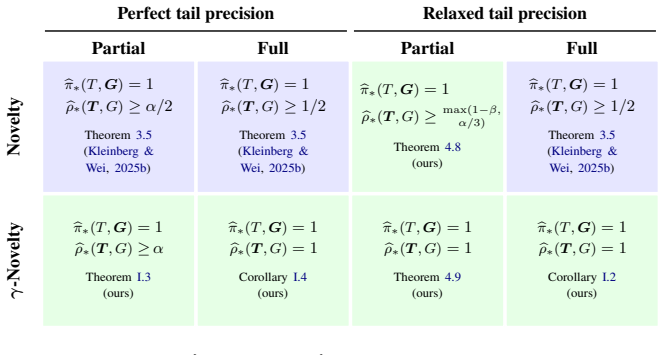
The classic paradigm of language identification in the limit models learning as a game between an adversary, who reveals strings from an unknown target language, and a learner tasked with identifying that language. The recently introduced framework of language generation in the limit shifted the objective to better reflect modern language modeling, requiring the learner to produce valid, unseen strings from the target language. Related work highlighted a fundamental tension: a broad coverage of the target often comes at the cost of validity. We introduce a new notion of precision and recast this problem as the classic recall-precision trade-off. We analyze generation in the limit under varying constraints on enumeration, novelty, and validity, aimed at reflecting settings closer to those encountered by large language models. A key contribution is our analysis of learners that are not eventually valid: we allow infinitely many mistakes, provided their frequency tends to zero so that precision remains one. We show that this relaxation can strictly increase recall when the adversary permanently withholds a large portion of the target language. We also study a continuous relaxation of the novelty constraint that requires only a fixed fraction of outputs to be novel. Taken together, our results move toward a more realistic model of language generation where occasional errors and repetitions are unavoidable, but their rates are controlled.
Figures
Reference graph
Works this paper leans on
- [1]
-
[2]
Advances in Neural Information Processing Systems , volume =
Language Generation in the Limit , author =. Advances in Neural Information Processing Systems , volume =. 2024 , url =. 2404.06757 , archivePrefix =
-
[3]
Information and Control , volume =
Inductive inference of formal languages from positive data , author =. Information and Control , volume =. 1980 , url =
work page 1980
-
[4]
Density Measures for Language Generation , year=
Kleinberg, Jon and Wei, Fan , booktitle=. Density Measures for Language Generation , year=
-
[5]
Proceedings of Thirty Eighth Conference on Learning Theory , series =
Exploring Facets of Language Generation in the Limit , author =. Proceedings of Thirty Eighth Conference on Learning Theory , series =. 2025 , publisher =
work page 2025
- [6]
-
[7]
Bell System Technical Journal , volume =
On Non-Computable Functions , author =. Bell System Technical Journal , volume =. 1962 , url =
work page 1962
-
[8]
Kleinberg, Jon and Wei, Fan , year =. Language Generation and Identification From Partial Enumeration: Tight Density Bounds and Topological Characterizations , url =
Show all 9 references
-
[9]
On Characterizations for Language Generation: Interplay of Hallucinations, Breadth, and Stability , url =
Kalavasis, Alkis and Mehrotra, Anay and Velegkas, Grigoris , year =. On Characterizations for Language Generation: Interplay of Hallucinations, Breadth, and Stability , url =
Reviewed June 30, 2026 · model on record in the stance chip above.
Discussion (0). Continue with ORCID to comment.