REVIEW 4 major objections 5 minor 28 references
Can Language Models Identify Shadow Trading Targets? An NLP Evaluation of SEC Enforcement Theory
T0 review · 4 major / 5 minor · reviewed 2026-08-06 · deepseek-v4-flash
Pith's one-line read Across 30 M&A deals and 217 peers, 10-K similarity shows no link to announcement-day returns, undercutting the SEC's shadow trading premise.
desk verdict A model null is honestly reported but not yet interpretable: single-shot unvalidated LLM scores could explain the zero correlation by themselves. read the letter →
The pith
A machine-rendered reading of the paper's core claim, the machinery that carries it, and where it could break.
The reading
What carries the argument
The load-bearing machinery is a two-stage LLM pipeline that converts the SEC's 'economic linkage' doctrine into a measurable quantity. Stage 1 gives the long-context model (Gemini 3.1 Pro) only the target's Item 7 (MD&A) text from its latest pre-announcement 10-K and asks for ten comparable public peers. Stage 2 loads all peers' Item 7 sections into one prompt and scores each peer 0–1 on a fixed rubric (technical/product overlap 40%, financial stage 30%, risk/market exposure 30%), weighting technical overlap to mirror the Panuwat testimony. Scores are paired with announcement-day abnormal returns benchmarked to sector ETFs, and the verdict rests on the within-event Spearman rank correlation
What would settle it
Re-run the same 30 events with an open-weight long-context model and a TNIC-style bag-of-words baseline, using five-day cumulative abnormal returns benchmarked to firm-specific market models; if either baseline yields a mean per-event Spearman correlation whose confidence interval excludes zero and exceeds the paper's upper bound of $\rho \approx 0.18$, the claim that filing similarity cannot flag economically linked peers is overturned.
Extended reading notes
Core claim
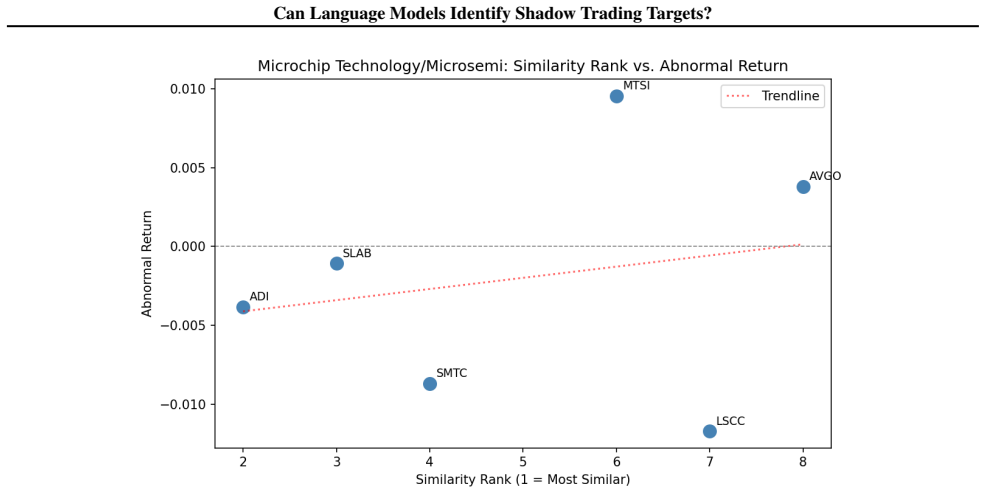
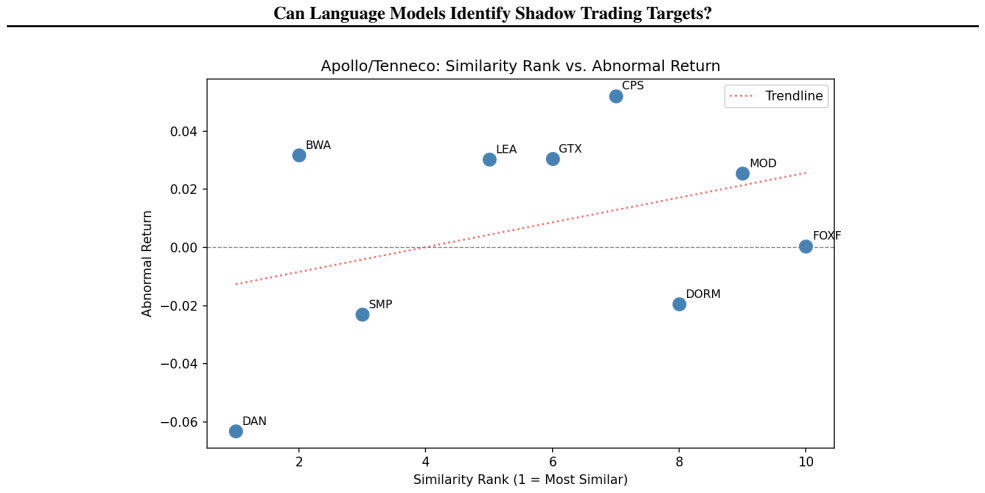
Central discovery: 'economic linkage,' operationalized as filing-text similarity, does not identify the firms that react to a deal announcement. On the Panuwat fact pattern the pipeline recovers Incyte as the third-closest peer (+5.04% return), a sanity check the authors qualify: the case is widely reported and that event's correlation is slightly negative ($\rho = -0.10$). Across 30 events the association is absent: pooled within-event rank correlation $+0.07$ ($p = 0.37$), mean per-event Spearman $+0.05$ with 95% CI $[-0.08, +0.18]$, excluding a moderate association. It also corrects the record: Incyte's pre-announcement capitalization was 14.3B, outside the 2B–10B mid-cap band the 'mid-ca
Load-bearing premise
The result rests on treating a one-day abnormal return, measured against a sector ETF, as an adequate stand-in for the legal construct of 'economic linkage'; the paper concedes (Section 7) that if linked firms react on longer horizons, through options, or in ways a sector benchmark masks, the null indicts the proxy rather than identifiability.
Editorial extensions
If this is right
- If the null holds, the fair-notice premise of shadow trading liability fails: an insider of ordinary intelligence could not have determined from public filings which peer securities were off-limits before trading.
- The confidence interval bounds any real association below roughly 0.18, far weaker than an enforcement heuristic would need; a standard right about as often as it is wrong cannot justify targeted watchlists replacing market-wide surveillance.
- Because a linkage argument is cheap to construct once the price move is known, the post hoc / ex ante asymmetry survives the SEC's January 2026 CAT amendments, which removed names and taxpayer identifiers but not the search-first, identify-later architecture.
- The mid-cap correction is independent of the NLP result: under every mainstream mid-cap definition in force in 2016, Incyte at 14.3B was not mid-cap, so the category could not have put an insider on notice ex ante.
Reading between the lines
- The null may indict the outcome measure as much as the text: testing longer windows, options-implied signals, or firm-specific beta benchmarks could recover an association this design shades, and that is the most direct next experiment rather than a refutation.
- The paper's suggested inversion — start from the largest abnormal movers around each announcement, then ask which were publicly knowable in advance — is the sharper test of the doctrine because it removes the pipeline's peer-discovery stage from the chain of inference.
- If the missing baselines (TNIC bag-of-words, SIC/GICS peers, embedding similarity) all reproduce the null, the finding would generalize from 'this pipeline fails' to 'public filings do not encode economic linkage,' a much stronger statement against the doctrine that the authors deliberately did not run.
- The sector asymmetry — zero supporting cases in Technology, zero contradictions in Automotive — is suggestive enough to motivate a targeted study of supplier-chain industries, where spillover co-movement may be text-detectable in a way platform industries are not; five events per sector is too few to conclude anything.
Signed reviews
Editorial analysis
A structured set of objections, weighed in public.
Referee Report
Summary. The paper asks whether semantic similarity of 10-K MD&A text, computed by a two-stage Gemini 3.1 Pro pipeline, can identify economically linked peer firms ex ante, as the SEC's shadow-trading theory in SEC v. Panuwat presumes. The authors construct 30 M&A events (217 peer observations) across five industries, score each target's peer candidates with an LLM rubric (40/30/30 weights), compute announcement-day abnormal returns against sector ETFs, and report a pooled within-event Spearman correlation of +0.066 (permutation p=0.37) and a mean per-event Spearman correlation of +0.046 with 95% CI [-0.084, +0.175]. They interpret the CI as excluding any moderate association, report a case-level reading of 14/30 supportive, and provide a correction showing Incyte fell outside standard mid-cap definitions in 2016. The paper is explicitly exploratory and repeatedly scopes the claim to this pipeline, corpus, and return measure, while drawing broader implications for fair notice and CAT surveillance.
Significance. If the headline null were supported by validated similarity measurements and appropriate baselines, this would be a novel and important empirical input to live legal debates about shadow trading, fair notice, and the constitutionality of mass market surveillance. The paper's strengths are real: full prompts and per-event outputs are reproduced, the permutation tests are exact for small events, the mid-cap market-capitalization correction is a concrete factual contribution, and the limitations section is unusually candid. However, the central inference is currently blocked by an unvalidated measurement instrument: single-shot, closed-weight LLM scores with no variance, no prompt sensitivity analysis, and no human agreement check. Absent a reliability study, the reported null cannot be distinguished from attenuation caused by measurement error. The paper's own Section 7 identifies this and the absence of baselines as severe gaps. The contribution is therefore better framed as a documented null result for this specific pipeline than as evidence against the SEC theory's empirical premise.
major comments (4)
- [§3.3, §4.5, §7] The headline correlation analysis treats one-shot Gemini 3.1 Pro similarity scores as exact values. Section 3.3 reports a single run per event, and Section 7 concedes there is no run-to-run variance, no prompt/rubric sensitivity analysis, no second model, and no agreement with human expert judgments, describing the scores as 'structured qualitative judgments rather than deterministic measurements.' Classical measurement error in the regressor attenuates Spearman correlations toward zero. Therefore the observed rho=+0.066 and the CI [-0.084, +0.175] bound the association between this particular set of LLM outputs and returns, not the association between latent filing similarity and returns. Attenuation alone can produce the reported null even if a true association exists. The Section 4.5 claim that the CI 'excludes any moderate relationship' is not yet supported. A stability study, repeat
- [§7 (No baselines)] The paper's wider relevance to the shadow-trading debate depends on showing the null is not an artifact of this one pipeline. Section 7 itself calls the absence of baselines 'the most consequential gap in the study' and lists three alternative explanations: filings do not encode linkage, the LLM pipeline fails to extract it, or announcement-day abnormal returns are too noisy. Without TNIC-style bag-of-words, embedding, SIC/GICS, or random-peer comparisons on the same return measure, the paper cannot distinguish these. Because the LLM is the only text measure tested, the conclusion should be narrowed to 'this pipeline yields no signal' rather than implying broader pressure on the SEC theory. Adding even one simple baseline would materially change the interpretability of the null.
- [§3.1, §3.2, §7 (event selection and peer discovery)] The event set was generated by prompting Gemini 3.1 Pro and was not pre-registered or drawn mechanically from a deal database, as Section 3.1 discloses. Stage 1 peer discovery also ran with Google Search grounding enabled and without logging retrieved sources, so the claimed filings-only ex ante condition is not cleanly tested. The authors acknowledge parametric recall of widely reported deals, which is especially problematic for the Panuwat sanity check (Section 4.1). These issues bear directly on the external-validity claim that 'an insider could not determine from public disclosures which securities are off-limits.' A mechanical sample of deals from a database and a filings-only peer-discovery run with logged sources would be needed to make that claim load-bearing.
- [§3.4, §7 (outcome proxy)] The paper equates 'economic linkage' with same-day abnormal return benchmarked to a sector ETF, and Section 7 concedes the expected sign is deal-dependent and that effects could appear over longer windows or through options markets. This is not a minor caveat: the Panuwat case itself involved call options, and the SEC's own expert relied on announcement-day price movement. If the true economic linkage manifests in options volumes or multi-day windows, the current null says nothing about identifiability. The abstract and conclusions partially acknowledge this, but the broader statement that the results 'put pressure on the empirical premise of shadow trading enforcement' remains too strong without either an options-market outcome test or an explicit multi-day-window robustness check.
minor comments (5)
- [Tables 4, 5, 6] The sector is labeled 'Automotives' in the tables but 'automotive' in Section 3.1; please standardize.
- [§3.4, footnote 1] The footnote reports 318 peer-event rows, while Section 4.5 and Table 4 use 217 peer observations. The relationship between these numbers (e.g., initial candidates vs. final usable sample) should be stated explicitly to avoid an apparent inconsistency.
- [Table 4 / §4.2 / §4.5] The trendline arrows use the opposite sign convention from the Spearman rho because rank runs opposite to score. The explanation appears only in Section 4.5; a one-sentence footnote to Table 4 would prevent reader confusion.
- [§4.2] The supports/contradicts/mixed labels are assigned after inspecting returns with researcher degrees of freedom. The paper is transparent about this and does not rest the main claim on the labels, but the phrase 'we state plainly that step (iii) involves judgment' is buried; consider moving this caveat immediately before Table 4.
- [Appendix D.5.5] The ticker 'FRBKQ' appears in the abnormal returns table for WSFS/Beneficial; verify that this is a deliberate ticker for a delisted entity and not a typo.
Circularity Check
No equation-level circularity; the headline null is independent of the outcome data, but the Panuwat reference-case sanity check is contaminated by possible pretraining recall, a mild and explicitly acknowledged circularity in that illustrative step.
-
other
[Section 4.1, Reference Case: Pfizer/Medivation (2016); see also Section 7, Limitations]
"SEC v. Panuwat has been widely reported since 2021, so a model with parametric knowledge of the case may associate Medivation with Incyte for reasons unrelated to the filing text we supply."
The reference-case 'sanity check' treats the pipeline's recovery of Incyte as evidence that the filings encode the economic linkage, but the LLM's parameters were trained on text that includes the Panuwat outcome. The high similarity ranking for Incyte may therefore be produced by memorization of the case rather than by Item 7 content, so the check is not independent confirmation. The paper explicitly concedes this and labels it a sanity check, not validation; the headline null (rho=+0.07, CI [-0.08,+0.18]) is computed over 30 events and does not depend on this case, so the circularity is confined and non-load-bearing.
full rationale
The paper's central derivation chain is not circular. The LLM similarity scores are generated from Item 7 filings under a fixed rubric (40/30/30 weights chosen before abnormal returns were computed), and the abnormal returns are computed independently from market data. The Spearman correlations and permutation p-values are deterministic functions of these two inputs, with no parameter fitted to the outcome. The paper does not invoke any author self-citation as load-bearing evidence; its citations to Hoberg-Phillips, Koval et al., and Mehta et al. are external and do not supply the conclusion. The 'Augmented Hoberg-Phillips' framing is a disclosed design choice rather than an imported uniqueness theorem. The main validity threats are measurement-noise attenuation and construct validity of the one-day abnormal-return proxy, both acknowledged in Section 7; these are limitations that weaken interpretation but do not make the derivation circular. The only mild circularity is the Panuwat sanity check, where the model's parametric knowledge of the widely reported case could drive the Incyte ranking. The paper flags this itself and does not rest the central claim on it, so the appropriate score is low.
Assumptions & free parameters
free parameters (2)
- Stage 2 rubric weights =
Technical 40%, Financial 30%, Risk/Market 30%
- Stage 1 candidate peer count =
10
assumptions (4)
- domain assumption Item 7 MD&A text is a sufficient corpus for recovering economic linkage between firms.
- domain assumption Announcement-day abnormal return, benchmarked to a sector ETF, is a valid measure of economic linkage.
- ad hoc to paper Unvalidated LLM similarity scores can be treated as measurements without independent validation.
- standard math Standard permutation test assumptions: under the null, any return could equally attach to any peer within an event.
Cite this review
Pith. "Pith review of Can Language Models Identify Shadow Trading Targets? An NLP Evaluation of SEC Enforcement Theory." pith.science (2026). https://pith.science/paper/GKGZGA5N
@misc{pith2026260801322,
  author       = {Pith},
  title        = {Pith review of: Can Language Models Identify Shadow Trading Targets? An NLP Evaluation of SEC Enforcement Theory},
  year         = {2026},
  howpublished = {\url{https://pith.science/paper/GKGZGA5N}},
  note         = {Machine review of arXiv:2608.01322}
}
abstract
Shadow trading -- trading in a peer firm's securities on the basis of material nonpublic information (MNPI) about an "economically linked" company -- is a novel and contested theory of insider trading liability, first prosecuted in SEC v. Panuwat (2023). Enforcing it requires identifying economically linked firms ex ante, a determination the SEC makes only after the fact using mass market surveillance infrastructure. We ask whether NLP can do what the SEC's theory presumes insiders already know: identify peer firms ex ante from publicly mandated disclosures. Using a two-stage LLM pipeline applied to Item 7 (Management's Discussion and Analysis) sections of SEC 10-K filings, we score semantic similarity across 30 M&A events spanning five industries and relate similarity to announcement-day abnormal stock returns. On the Panuwat fact pattern itself the pipeline recovers Incyte among the closest peers, a sanity check on the one case with a known outcome. Across the full dataset, however, we find no association: pooling 217 peer observations, the within-event rank correlation between similarity and abnormal return is +0.07 (permutation p = 0.37), and the mean per-event Spearman correlation is +0.05 with a 95% confidence interval of [-0.08, +0.18] -- narrow enough to exclude any moderate relationship rather than merely failing to detect one. A case-level reading agrees: 14 of 30 events support the hypothesis, 12 contradict it, and 4 are ambiguous. We also find that Incyte fell outside the standard \$2B-\$10B mid-cap band on the day before the announcement, complicating the "mid-cap oncology" category the SEC invoked. These results are exploratory and bound to this pipeline, corpus, and return measure, but they put pressure on the empirical premise of shadow trading enforcement and bear on constitutional questions surrounding the SEC's financial surveillance infrastructure.
Figures


Figures from the paper (29 more)





Reference graph
Works this paper leans on
-
[1]
2012 , month = jul, institution =
work page 2012
-
[2]
2019 , month = oct, howpublished =
Peirce, Hester , title =. 2019 , month = oct, howpublished =
work page 2019
- [3]
-
[4]
Acquisti, Alessandro and Brandimarte, Laura and Loewenstein, George , title =. Science , volume =. 2015 , doi =
work page 2015
- [5]
- [6]
-
[7]
Journal of Political Economy , volume =
Hoberg, Gerard and Phillips, Gordon , title =. Journal of Political Economy , volume =. 2016 , doi =
work page 2016
-
[8]
arXiv preprint arXiv:1908.10063 , year=
Finbert: Financial sentiment analysis with pre-trained language models , author=. arXiv preprint arXiv:1908.10063 , year=
arXiv 1908
Show all 28 references
-
[9]
The Review of Financial Studies , volume=
Dynamic interpretation of emerging risks in the financial sector , author=. The Review of Financial Studies , volume=. 2019 , publisher=
2019
-
[10]
and Reeb, David M
Mehta, Mihir N. and Reeb, David M. and Zhao, Wanli , title =. The Accounting Review , volume =. 2021 , url =
2021
-
[11]
arXiv preprint arXiv:2303.17564 , year=
Bloomberggpt: A large language model for finance , author=. arXiv preprint arXiv:2303.17564 , year=
-
[12]
2025 , month = nov, howpublished =
Shadow Trading: Economic Evidence and Potential Implications from Recent. 2025 , month = nov, howpublished =
2025
-
[13]
2024 , eprint=
Large Language Models Cannot Self-Correct Reasoning Yet , author=. 2024 , eprint=
2024
-
[14]
2026 , eprint=
Self-Anchoring Calibration Drift in Large Language Models: How Multi-Turn Conversations Reshape Model Confidence , author=. 2026 , eprint=
2026
-
[15]
2023 , eprint=
Decomposed Prompting: A Modular Approach for Solving Complex Tasks , author=. 2023 , eprint=
2023
-
[16]
2025 , issn =
Shadow trading detection: A graph-based surveillance approach , journal =. 2025 , issn =. doi:https://doi.org/10.1016/j.frl.2025.108524 , url =
2025
-
[17]
2026 , month = feb, url =
2026
-
[18]
2023 , eprint=
Chain-of-Thought Prompting Elicits Reasoning in Large Language Models , author=. 2023 , eprint=
2023
-
[19]
A Semantic Approach to Financial Fundamentals
Chen, Jiafeng and Sarkar, Suproteem. A Semantic Approach to Financial Fundamentals. Proceedings of the Second Workshop on Financial Technology and Natural Language Processing. 2020
2020
-
[20]
2024 , eprint=
The Dawn After the Dark: An Empirical Study on Factuality Hallucination in Large Language Models , author=. 2024 , eprint=
2024
-
[21]
1 and 2 and by the Commission, Regarding Customer and Account Information , howpublished =
Order Approving an Amendment to the National Market System Plan Governing the Consolidated Audit Trail, as Modified by Amendment Nos. 1 and 2 and by the Commission, Regarding Customer and Account Information , howpublished =. 2026 , month = jan, note =
2026
-
[22]
2026 , month = jan, note =
Memorandum in Support of Renewed Motion for a Preliminary Injunction and Stay Pursuant to 5. 2026 , month = jan, note =
2026
-
[23]
2026 , month = jun, note =
2026
-
[24]
and Verleysen, Michel and Blondel, Vincent D
de Montjoye, Yves-Alexandre and Hidalgo, C\'esar A. and Verleysen, Michel and Blondel, Vincent D. , title =. Scientific Reports , volume =. 2013 , doi =
2013
-
[25]
, title =
Augustin, Patrick and Brenner, Menachem and Subrahmanyam, Marti G. , title =. Management Science , volume =
-
[26]
Findings of the Association for Computational Linguistics: EACL 2024 , pages =
Koval, Ross and Andrews, Nicholas and Yan, Xifeng , title =. Findings of the Association for Computational Linguistics: EACL 2024 , pages =. 2024 , address =
2024
-
[27]
Proceedings of the 62nd Annual Meeting of the Association for Computational Linguistics (Volume 1: Long Papers) , pages =
Wang, Peiyi and Li, Lei and Chen, Liang and Cai, Zefan and Zhu, Dawei and Lin, Binghuai and Cao, Yunbo and Kong, Lingpeng and Liu, Qi and Liu, Tianyu and Sui, Zhifang , title =. Proceedings of the 62nd Annual Meeting of the Association for Computational Linguistics (Volume 1: ...
2024
-
[28]
2026 , month = jul, howpublished =
2026
Reviewed August 6, 2026 · model on record in the stance chip above.
Discussion (0). Continue with ORCID to comment.