REVIEW 3 major objections 7 minor 222 references
This paper establishes a uniform 11-element abundance catalog for 32 FGK stars hosting brown dwarfs and finds a wide, non-solar dispersion in their C/O ratios.
Reviewed by Pith at T0; open to challenge. T0 means a machine referee read the full paper against a public rubric. the ladder, T0–T4 →
T0 review · deepseek-v4-flash
2026-08-02 07:29 UTC pith:GLC265DR
load-bearing objection A genuinely useful uniform abundance catalog for 32 benchmark brown-dwarf hosts, but the C/O-dispersion headline is not yet supported by the analysis as written. the 3 major comments →
Benchmark Brown Dwarf Systems I: Chemical Abundance Analysis of FGK Stars with Wide-Separation Brown Dwarf Companions Using PEPSI
The pith
A machine-rendered reading of the paper's core claim, the machinery that carries it, and where it could break.
Core claim
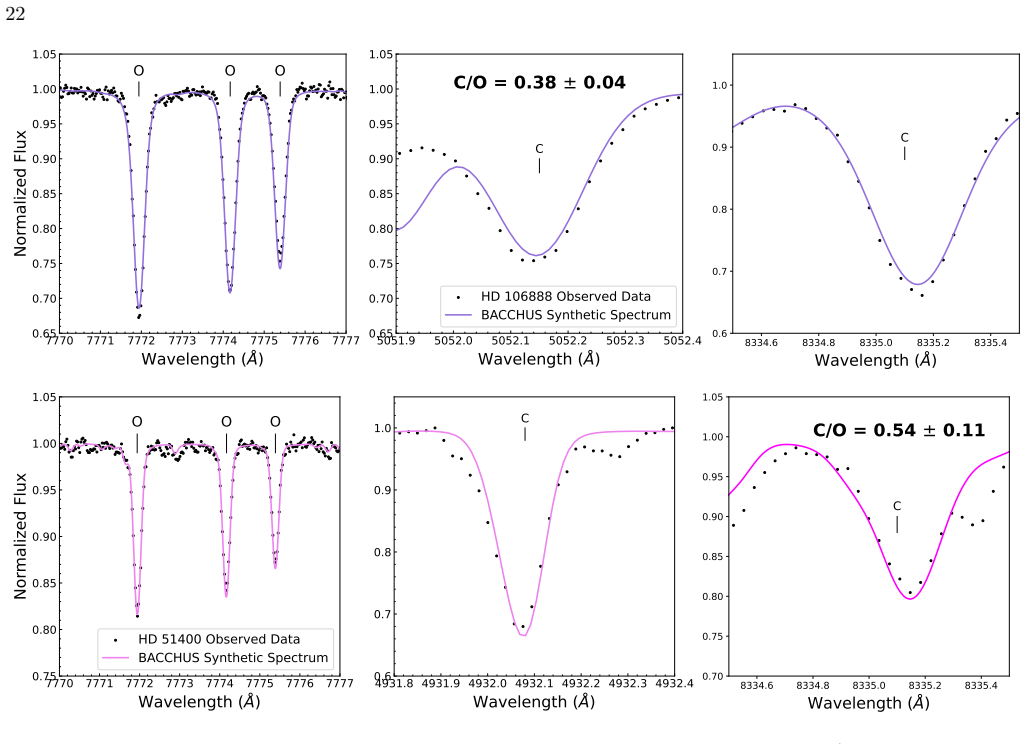
On the authors' account, a homogeneous spectroscopic survey of 32 FGK stars with mostly wide-separation brown dwarf companions yields precise parameters and abundances for 11 elements (C, O, Mg, Si, Ca, Al, Ti, Fe, Y, S, N), with typical errors of 42 K in Teff and 0.03 dex in [Fe/H]. The defining result is a 'significant dispersion from a solar C/O ratio': derived C/O spans 0.27–0.91 against the solar 0.59, including sub-solar (HD 106888) and super-solar (HD 116012) systems, with cool K dwarfs giving only limits. The authors then predict each companion's silicate cloud species from host Mg/Si — enstatite plus forsterite for most, quartz in five systems — and compute a median oxygen-sink frac
What carries the argument
The engine is the BACCHUS spectral-synthesis framework run on PEPSI spectra, anchored by a PEPSI solar spectrum. A per-element solar offset (Eq. 4; Table 6), ranging from +0.18 dex for O to −0.22 dex for Y and +0.20 dex for S, corrects the line list to solar values and is applied to every star, assuming the corrections are temperature-independent. The diagnostic ratios built on these abundances — C/O, Mg/Si, Ca/Al, S/N, and [Y/Mg] — carry the argument: C/O for formation pathway, Mg/Si for cloud species, Ca/Al for condensate seeding, and [Y/Mg] for age. The oxygen-sink relation (ΣO_cloud = 2ΣSi + ΣMg + ΣCa + 1.5ΣAl + 2ΣTi + ΣV) converts host chemistry into the predicted cloud-deleted oxygen f
Load-bearing premise
That the per-element offsets measured from the Sun (up to 0.2 dex) correct the 1D-LTE spectral synthesis accurately for every star in the sample, including the cool K dwarfs far from solar temperature where carbon and nitrogen come from molecules.
What would settle it
Re-measure carbon and oxygen in the coolest targets (NLTT 1011, BD+06 2986, StKM 2-1777, BD+24 4329) using near-infrared CO and OH features instead of optical C2 and OI lines; if the resulting C/O ratios disagree with this paper's values by more than the quoted errors, the empirical offsets are temperature-dependent and the reported C/O dispersion is not astrophysical.
If this is right
- Brown dwarf retrievals that assume solar C/O for wide companions are biased for a substantial fraction of this population; the catalog supplies the correct priors.
- JWST programs on these companions have specific, falsifiable cloud predictions: enstatite-plus-forsterite decks for most, quartz for HD 89744, BD+60 1417, GJ 417, and LSPM J0632+5053.
- The uniform catalog supersedes heterogeneous literature abundances, which the paper shows can disagree by more than 0.3 dex in C/O for the same star.
- For systems where [Y/Mg] yields a physical age, benchmark brown dwarf masses are constrained tightly enough to test evolutionary models.
Where Pith is reading between the lines
- The C/O dispersion claim hinges on the solar-offset corrections being valid in the cool, molecule-blanketed K dwarfs; if those offsets drift with temperature, the catalog's spread would shrink — the paper's own >3σ disagreements for BD+13 2269 and V* HN Peg, and the extreme ratios occurring in the coolest stars, mark this as the untested edge.
- A direct test of the inheritance assumption: when JWST retrievals measure Mg/Si or C/O in the companions, they should match the host values; any disagreement would force a formation story with selective accretion or rainout rather than simple inheritance.
- The oxygen-sink estimates predict a specific offset between retrieved and true C/O for each companion; comparing retrieved C/O to the host C/O would quantify how much cloud rainout actually hides.
- Extending the same analysis to a solar-twin calibration sample or to a broader Teff range would reveal whether the per-element offsets are truly universal or merely solar-neighborhood averages.
Editorial analysis
A structured set of objections, weighed in public.
Referee Report
Summary. The paper presents a uniform BACCHUS spectral-synthesis analysis of high-resolution PEPSI spectra of 32 FGK stars hosting wide-separation brown dwarf companions. It derives spectroscopic stellar parameters, abundances of C, N, O, Mg, Si, Ca, Al, Ti, Fe, Y, and S, and uses them to compute C/O, Mg/Si, Ca/Al, S/N, and [Y/Mg] ratios. These ratios are then used to predict silicate cloud species in the companions, estimate oxygen-sink fractions, and test the [Y/Mg] chemical clock. The central claims are: a typical precision of 42 K in Teff and ~0.03 dex in [Fe/H]; a significant dispersion of host-star C/O ratios from solar; and that most systems should form enstatite/forsterite clouds, with a few quartz-cloud systems.
Significance. If the abundance catalog is accurate, it has clear value: it is a uniform, high-resolution sample specifically selected for benchmark brown dwarf systems with planned or existing JWST observations, and it provides directly testable cloud-composition predictions. The paper has genuine strengths: the analysis is anchored to a PEPSI solar spectrum, and six stars are validated against the independent Brewer catalog with generally good agreement. The [Y/Mg] age application uses external age-metallicity relations and literature mass estimates, so I do not see a circularity problem. However, the central astrophysical claims—especially the C/O dispersion and the most extreme Mg/Si values—depend on the least-calibrated part of the sample, namely the cool K dwarfs. The internal upper/lower-limit inconsistencies in the tables would also need to be fixed before the catalog can be used as a benchmark.
major comments (3)
- [§3.3.2, Eq. (4), Table 6] The per-element solar offsets in Eq. (4) are measured at Teff = 5774 K from a solar PEPSI spectrum, but they are applied to all 32 stars. For the six coolest K dwarfs (StKM 2-1777, StKM 1-1526, HIP 63506, NLTT 1011, BD+06 2986, BD+24 4329), carbon is derived from C2 Swan bands, which do not appear in the solar calibration; oxygen comes from the OI triplet with 1D-LTE models plus NLTE corrections. Any Teff- or line-set-dependent error in C2, CN, or OI is therefore not removed by the solar offset. This is load-bearing for the headline C/O dispersion and for Table 9's cloud predictions: the most extreme values in Table 8 (e.g., NLTT 1011 Mg/Si = 2.64, StKM 2-1777 C/O < 1.00) come from exactly these cool stars. The paper's own validation in §4.3 shows a >3σ C/O disagreement for BD+13 2269 and a ~2σ disagreement for HIP 9269 relative to literature, consistent with residual temperature-depende
- [Abstract; §3.2.1, Table 3] The abstract's claim of '~0.03 dex for [Fe/H]' is not representative of the paper's own Table 3. The median σ[Fe/H] across the 32 stars is approximately 0.065 dex, with values as large as 0.32 dex (HD 89744), 0.18 dex (BD+01 299), and 0.12 dex (NLTT 1011). If the 0.03 dex figure refers only to the best-observed subset, the subset should be defined and its statistics quoted. As written, the precision claim overstates the catalog and propagates into the abundance-ratio uncertainties in Tables 8–10.
- [§3.3.4 vs. Tables 7–8] The upper/lower-limit bookkeeping is internally inconsistent on exactly the quantities used for the dispersion claim. For StKM 2-1777, §3.3.4 reports [C/H] upper limit −2.67 and C/O >1.005, whereas Table 7 lists [C/H] = −2.57 and Table 8 lists C/O <1.00. For StKM 1-1526, the text says C/O >1.04 but Table 8 says C/O <1.04. For NLTT 1011, the text gives C/O >0.76 while Table 8 gives >0.94, and its Mg/Si = 2.64 is derived from an upper limit on [Si/H], so it should be reported as a lower limit rather than a measured ratio in Table 9. These contradictions must be resolved before the C/O dispersion or cloud-species predictions can be evaluated.
minor comments (7)
- [§2.2] The five R = 50,000 targets are listed as HD 46588, HD 126054, GJ 417, HD 116012, BD+60 1417, but Table 1 has HD 126053, not HD 126054. Please correct the typo.
- [Tables 2 and 9] Table 2 lists the companion of HD 203030 as 'HD 202030 B'; it should be HD 203030 B. BD+49 2561 appears twice in Table 9.
- [Eq. (5)] Eq. (5) includes a ΣV term, but vanadium is not measured in this paper. Please state the assumed V abundance or remove the term if it is negligible.
- [§3.3.4] For StKM 2-1777, the line at 5149.1 Å is described as 'CI' but it is in the C2 line list of §3.3.2. Also, 'with leads to' appears multiple times and should be corrected.
- [Table 11] The entry 'SkTKM 2-1777' should be 'StKM 2-1777'.
- [References] The first entry in the reference list, '2004, in International Geophysics...', lacks author names. Please complete the citation.
- [Data availability] For a benchmark catalog paper, machine-readable versions of Tables 3, 7, and 8 would greatly increase usability. A data availability statement is not present.
Circularity Check
No significant circularity: PEPSI/BACCHUS abundances are data-derived and externally validated; Eq. 4 solar offsets are a zero-point calibration, not a fitted prediction.
full rationale
The central derivation chain is observational: PEPSI spectra → BACCHUS line-by-line spectral synthesis → element abundances → Eq. 4 solar zero-point correction → abundance ratios. No equation defines a target quantity in terms of itself. Eq. 4 subtracts constant per-element offsets measured from the PEPSI solar spectrum (Table 6); this is an empirical zero-point calibration anchored at the Sun, not a parameter fit to the sample's C/O, Mg/Si, or [Y/Mg], and it cannot by construction produce the reported dispersion. The sample ratios retain the information content of the measured line depths. Independent validation against Brewer & Fischer (2016), Rice & Brewer (2020), Luck, Delgado Mena et al., and others is shown, including unresolved disagreements that are reported rather than forced (e.g., BD+13 2269 C/O, HIP 9269). The interpretive cloud-species and oxygen-sink sections use the co-authored Calamari et al. (2024) framework as a mapping from measured abundances to equilibrium condensates; that mapping is not used to derive the abundances, so the self-citation is not load-bearing for the central catalog claim. The paper itself flags its main limitations—'The difficulty in measuring C and O makes determining these C/O ratios significantly challenging' (§3.3.2) and 'this assumption remains largely untested' (§5.2.1)—which are correctness/robustness risks (e.g., Teff-dependent line-list systematics in cool K dwarfs), not circularity. The [Y/Mg] age estimates use the independently calibrated Berger et al. (2022)/Brewer & Fischer (2018) relation and literature masses, again without circular feedback into the abundance derivation.
Axiom & Free-Parameter Ledger
free parameters (2)
- Per-element solar offset corrections =
[O/H] +0.18, [Y/H] -0.22, [S/H] +0.20, [C/H] +0.08, [N/H] +0.10 dex (Table 6)
- Microturbulent velocity of BD+06 2986 =
1.00 km/s
axioms (7)
- domain assumption 1D-LTE MARCS atmospheres plus Turbospectrum synthesis reproduce FGK photospheres well enough that zero-point offsets are temperature-independent (Eq. 4 applied globally)
- domain assumption Brown dwarf companions inherit host-star elemental abundances
- domain assumption Excitation-ionization balance in Fe I/Fe II yields unbiased Teff, log g, and metallicity (BACCHUS method)
- domain assumption The Berger et al. (2022) [Y/Mg]-age relation (slope -0.228, intercept 0.121) applies to this sample
- domain assumption Calamari et al. (2024) Mg/Si thresholds map host chemistry to companion silicate cloud species
- domain assumption Sitnova et al. (2013) NLTE OI correction tables are accurate at the 0.01-0.03 dex level
- domain assumption Grevesse et al. (2007) solar abundances are the correct absolute zero point for [X/H] and all ratios
read the original abstract
We present results from a spectroscopic survey of 32 FGK stars hosting brown dwarfs, using high-resolution optical spectra (R = 130,000 and 50,000) obtained with the PEPSI spectrograph on the Large Binocular Telescope. The primary goal of this survey is to determine precise stellar parameters and abundances for 11 elements (C, O, Mg, Si, Ca, Al, Ti, Fe, Y, S, and N) in these systems. We employ spectral synthesis within the BACCHUS framework to derive precise stellar properties and elemental abundance ratios. For our average S/N $>$ 200 data, we achieve a typical error of 42 K in T$_\mathrm{eff}$ and $\sim$0.03 dex for [Fe/H]. We observe a significant dispersion from a solar C/O ratio among the sample of brown dwarf host stars that host primarily wide-orbit brown dwarfs. Using established theoretical chemical frameworks, we discuss the implications of the observed Mg/Si and Ca/Al ratios for cloud properties in the brown dwarf companions. Finally, we evaluate the applicability of the [Y/Mg] stellar clock for our sample and discuss the broader implications of our results. This work provides a timely and uniform abundance analysis of host stars, supporting extended wavelength brown dwarf observations in the era of JWST.
Figures




Reference graph
Works this paper leans on
-
[1]
Astronomische Nachrichten , keywords =
PEPSI: The high-resolution \'e chelle spectrograph and polarimeter for the Large Binocular Telescope. Astronomische Nachrichten , keywords =. doi:10.1002/asna.201512172 , archivePrefix =. 1505.06492 , primaryClass =
-
[2]
The Gaia-ESO survey: Calibrating a relationship between age and the [C/N] abundance ratio with open clusters. , keywords =. doi:10.1051/0004-6361/201935282 , archivePrefix =. 1907.07350 , primaryClass =
Pith/arXiv arXiv 1907
-
[3]
The Gaia-ESO Survey: CNO abundances in the open clusters Trumpler 20, NGC 4815, and NGC 6705. , keywords =. doi:10.1051/0004-6361/201424989 , archivePrefix =. 1411.2831 , primaryClass =
-
[5]
Astronomy Letters , keywords =
Influence of departures from LTE on oxygen abundance determination in the atmospheres of A-K stars. Astronomy Letters , keywords =. doi:10.1134/S1063773713020084 , adsurl =
-
[6]
89 New Ultracool Dwarf Co-Moving Companions Identified With The Backyard Worlds: Planet 9 Citizen Science Project. arXiv e-prints , keywords =. doi:10.48550/arXiv.2403.04592 , archivePrefix =. 2403.04592 , primaryClass =
work page internal anchor Pith review Pith/arXiv arXiv doi:10.48550/arxiv.2403.04592
-
[7]
Photometric brown-dwarf classification. II. A homogeneous sample of 1361 L and T dwarfs brighter than J = 17.5 with accurate spectral types. , keywords =. doi:10.1051/0004-6361/201527359 , archivePrefix =. 1602.08582 , primaryClass =
-
[8]
2019 , eprint=
EXOFASTv2: A public, generalized, publication-quality exoplanet modeling code , author=. 2019 , eprint=
2019
-
[9]
EXOFAST: Fast transit and/or RV fitter for single exoplanet
-
[10]
MESA Isochrones and Stellar Tracks (MIST) 0: Methods for the Construction of Stellar Isochrones. , keywords =. 2016. doi:10.3847/0067-0049/222/1/8 , archivePrefix =. 1601.05144 , primaryClass =
Pith/arXiv arXiv 2016
-
[11]
arXiv e-prints , keywords =
Gaia Data Release 3: Summary of the content and survey properties. arXiv e-prints , keywords =
-
[12]
VizieR Online Data Catalog , keywords =
VizieR Online Data Catalog: 2MASS All-Sky Catalog of Point Sources (Cutri+ 2003). VizieR Online Data Catalog , keywords =
2003
-
[13]
The Wide-field Infrared Survey Explorer (WISE): Mission Description and Initial On-orbit Performance. , keywords =. doi:10.1088/0004-6256/140/6/1868 , archivePrefix =. 1008.0031 , primaryClass =
-
[14]
Ground-based and Airborne Instrumentation for Astronomy VII , year = 2018, series =
Want a PEPSI? Performance status of the recently commissioned high-resolution spectrograph and polarimeter for the 2x8.4m Large Binocular Telescope. Ground-based and Airborne Instrumentation for Astronomy VII , year = 2018, series =. doi:10.1117/12.2311627 , adsurl =
-
[15]
and Visscher, Channon and Gemma, Marina E
Calamari, Emily and Faherty, Jacqueline K. and Visscher, Channon and Gemma, Marina E. and Burningham, Ben and Rothermich, Austin , title =. The Astrophysical Journal , abstract =. 2024 , month =. doi:10.3847/1538-4357/ad1f6d , url =
-
[16]
, keywords =
Structure and evolution of low-mass stars. , keywords =
-
[17]
Trends with stellar age and elemental condensation temperature
High-precision abundances of elements in solar twin stars. Trends with stellar age and elemental condensation temperature. , keywords =. doi:10.1051/0004-6361/201526269 , archivePrefix =. 1504.07598 , primaryClass =
-
[18]
The Solar Twin Planet Search. III. The [Y/Mg] clock: estimating stellar ages of solar-type stars. , keywords =. doi:10.1051/0004-6361/201527848 , archivePrefix =. 1604.05733 , primaryClass =
-
[19]
CH in stellar atmospheres: an extensive linelist. , keywords =. doi:10.1051/0004-6361/201423956 , archivePrefix =. 1410.4005 , primaryClass =
-
[20]
A blue M2 + T5 wide binary and a probable young [M4 + M4] + [T7 + T8] hierarchical quadruple
Benchmark brown dwarfs I. A blue M2 + T5 wide binary and a probable young [M4 + M4] + [T7 + T8] hierarchical quadruple. , keywords =. doi:10.1093/mnras/staf895 , archivePrefix =. 2505.24560 , primaryClass =
-
[21]
Brandt, G. Mirek and Dupuy, Trent J. and Li, Yiting and Chen, Minghan and Brandt, Timothy D. and Wong, Tin Long Sunny and Currie, Thayne and Bowler, Brendan P. and Liu, Michael C. and Best, William M. J. and Phillips, Mark W. , title =. The Astronomical Journal , abstract =. 2021 , month =. doi:10.3847/1538-3881/ac273e , url =
-
[22]
Retrieving Young Cloudy L Dwarfs: A Nearby Planetary-mass Companion BD+60 1417B and its Isolated Red Twin W0047. , keywords =. doi:10.3847/1538-4357/ad5d57 , archivePrefix =. 2407.01694 , primaryClass =
-
[23]
The cool brown dwarf Gliese 229 B is a close binary. , keywords =. doi:10.1038/s41586-024-08064-x , archivePrefix =. 2410.11953 , primaryClass =
-
[24]
Assessing the C/O Ratio Formation Diagnostic: A Potential Trend with Companion Mass. , keywords =. doi:10.3847/1538-3881/ace442 , archivePrefix =. 2212.04557 , primaryClass =
-
[25]
Brown Dwarfs in Young Moving Groups from Pan-STARRS1. I. AB Doradus. , keywords =. doi:10.3847/0004-637X/821/2/120 , archivePrefix =. 1604.04284 , primaryClass =
-
[26]
Monthly Notices of the Royal Astronomical Society , volume =
Fontanive, Clémence and Bedin, Luigi R and De Furio, Matthew and Biller, Beth and Anderson, Jay and Bonavita, Mariangela and Allers, Katelyn and Pantoja, Blake , title =. Monthly Notices of the Royal Astronomical Society , volume =. 2023 , month =. doi:10.1093/mnras/stad2870 , url =
-
[27]
Statistics of Long Period Gas Giant Planets in Known Planetary Systems. , keywords =. doi:10.3847/0004-637X/821/2/89 , archivePrefix =. 1601.07595 , primaryClass =
-
[28]
Exoplanet Statistics and Theoretical Implications. , keywords =. doi:10.1146/annurev-astro-112420-020055 , archivePrefix =. 2103.02127 , primaryClass =
-
[29]
WiseView: Visualizing motion and variability of faint WISE sources
-
[30]
Exploring the brown dwarf desert: new substellar companions from the SDSS-III MARVELS survey. , keywords =. doi:10.1093/mnras/stx334 , archivePrefix =. 1702.01784 , primaryClass =
-
[31]
Seven new brown dwarfs and constraints on the brown dwarf desert
Detection and characterisation of 54 massive companions with the SOPHIE spectrograph. Seven new brown dwarfs and constraints on the brown dwarf desert. , keywords =. doi:10.1051/0004-6361/201935113 , archivePrefix =. 1909.00739 , primaryClass =
Pith/arXiv arXiv 1909
-
[32]
3D Selection of 167 Substellar Companions to Nearby Stars. , keywords =. doi:10.3847/1538-4365/ac7e57 , archivePrefix =. 2208.12720 , primaryClass =
-
[33]
Population Properties of Brown Dwarf Analogs to Exoplanets. , keywords =. doi:10.3847/0067-0049/225/1/10 , archivePrefix =. 1605.07927 , primaryClass =
-
[34]
and Hsu, Chih-Chun and Finnerty, Luke and Wang, Jason and Ruffio, Jean-Baptiste and Zhang, Yapeng and Knutson, Heather A
Xuan, Jerry W. and Hsu, Chih-Chun and Finnerty, Luke and Wang, Jason and Ruffio, Jean-Baptiste and Zhang, Yapeng and Knutson, Heather A. and Mawet, Dimitri and Mamajek, Eric E. and Inglis, Julie and Wallack, Nicole L. and Bryan, Marta L. and Blake, Geoffrey A. and Mollière, Paul and Hejazi, Neda and Baker, Ashley and Bartos, Randall and Calvin, Benjamin a...
2024
-
[35]
Revisiting the Atmosphere of HD-149026 b: The Role of Stellar Abundances and Choice of Opacities in Exoplanet Atmosphere Modeling. , keywords =. doi:10.1093/mnras/staf1671 , archivePrefix =. 2509.25785 , primaryClass =
-
[36]
Measuring Elemental Abundances of JWST Target Stars for Exoplanet Characterization. I. FGK Stars. , keywords =. doi:10.3847/1538-3881/ac7de3 , archivePrefix =. 2112.02031 , primaryClass =
-
[37]
Ariel stellar characterisation. II. Chemical abundances of carbon, nitrogen, and oxygen for 181 planet-host FGK dwarf stars. , keywords =. doi:10.1051/0004-6361/202450604 , archivePrefix =. 2406.12393 , primaryClass =
-
[38]
PEPSI deep spectra. I. The Sun-as-a-star. , keywords =. doi:10.1051/0004-6361/201731631 , archivePrefix =. 1712.06960 , primaryClass =
-
[39]
Research Notes of the American Astronomical Society , keywords =
Chemical Abundances for 25 JWST Exoplanet Host Stars with KeckSpec. Research Notes of the American Astronomical Society , keywords =. doi:10.3847/2515-5172/ac8676 , archivePrefix =. 2207.13662 , primaryClass =
-
[40]
Chemical abundances, systematic offsets, and clues as to planet formation
Planets Around Solar Twins/Analogs (PASTA): II. Chemical abundances, systematic offsets, and clues as to planet formation. , keywords =. doi:10.1051/0004-6361/202556272 , archivePrefix =. 2508.06976 , primaryClass =
-
[41]
The Chemical Homogeneity of Sun-like Stars in the Solar Neighborhood. , keywords =. doi:10.3847/1538-4357/aad908 , archivePrefix =. 1802.02576 , primaryClass =
-
[42]
Titanium and Vanadium Chemistry in Low-Mass Dwarf Stars. , keywords =. doi:10.1086/342241 , adsurl =
-
[43]
Transmission spectral properties of clouds for hot Jupiter exoplanets. , keywords =. doi:10.1051/0004-6361/201424207 , archivePrefix =. 1409.7594 , primaryClass =
-
[44]
The Limiting Effects of Dust in Brown Dwarf Model Atmospheres. , keywords =. doi:10.1086/321547 , archivePrefix =. astro-ph/0104256 , primaryClass =
-
[45]
Lefèvre, Maxence and Tan, Xianyu and Lee, Elspeth K. H. and Pierrehumbert, R. T. , title =. The Astrophysical Journal , abstract =. 2022 , month =. doi:10.3847/1538-4357/ac5e2d , url =
-
[46]
Dust in brown dwarfs and extra-solar planets. I. Chemical composition and spectral appearance of quasi-static cloud layers. , keywords =. doi:10.1051/0004-6361:20078220 , archivePrefix =. 0803.4315 , primaryClass =
-
[47]
Dust in brown dwarfs and extra-solar planets. VII. Cloud formation in diffusive atmospheres. , keywords =. doi:10.1051/0004-6361/201936281 , archivePrefix =. 1911.03777 , primaryClass =
Pith/arXiv arXiv 1911
-
[48]
The [Y/Mg] chemical clock in the Galactic disk: The influence of metallicity and the Galactic population in the solar neighbourhood. , keywords =. doi:10.1051/0004-6361/202449669 , archivePrefix =. 2407.07283 , primaryClass =
-
[49]
A grid of MARCS model atmospheres for late-type stars. I. Methods and general properties. , keywords =. doi:10.1051/0004-6361:200809724 , archivePrefix =. 0805.0554 , primaryClass =
-
[50]
Turbospectrum: Code for spectral synthesis
-
[51]
Near-infrared narrow-band photometry of M-giant and Mira stars: models meet observations. , keywords =. doi:10.48550/arXiv.astro-ph/9710157 , archivePrefix =. astro-ph/9710157 , primaryClass =
-
[52]
Accuracy and Precision of Industrial Stellar Abundances. , keywords =. doi:10.1146/annurev-astro-091918-104509 , archivePrefix =. 1811.08041 , primaryClass =
-
[53]
Atomic data for the Gaia-ESO Survey. , keywords =. doi:10.1051/0004-6361/201936291 , archivePrefix =. 2011.02049 , primaryClass =
Pith/arXiv arXiv 2011
-
[54]
BACCHUS Analysis of Weak Lines in APOGEE Spectra (BAWLAS). , keywords =. doi:10.3847/1538-4365/ac839f , archivePrefix =. 2208.00071 , primaryClass =
-
[55]
Spectral Properties of Cool Stars: Extended Abundance Analysis of 1,617 Planet-search Stars. , keywords =. doi:10.3847/0067-0049/225/2/32 , archivePrefix =. 1606.07929 , primaryClass =
-
[56]
C/O and Mg/Si Ratios of Stars in the Solar Neighborhood. , keywords =. doi:10.3847/0004-637X/831/1/20 , adsurl =
-
[57]
NLTE abundances of Mn in a sample of metal-poor stars. , keywords =. doi:10.1051/0004-6361:200810098 , archivePrefix =. 0811.0681 , primaryClass =
-
[58]
NLTE analysis of CoI/CoII lines in spectra of cool stars with new laboratory hyperfine splitting constants. , keywords =. doi:10.1111/j.1365-2966.2009.15736.x , archivePrefix =. 0909.2178 , primaryClass =
arXiv 2009
-
[59]
Chromium: NLTE abundances in metal-poor stars and nucleosynthesis in the Galaxy. , keywords =. doi:10.1051/0004-6361/201014250 , archivePrefix =. 1006.0243 , primaryClass =
-
[61]
Red Supergiant Stars as Cosmic Abundance Probes: NLTE Effects in J-band Iron and Titanium Lines. , keywords =. doi:10.1088/0004-637X/751/2/156 , archivePrefix =. 1204.0511 , primaryClass =
-
[62]
Red Supergiant Stars as Cosmic Abundance Probes. II. NLTE Effects in J-band Silicon Lines. , keywords =. doi:10.1088/0004-637X/764/2/115 , archivePrefix =. 1212.2649 , primaryClass =
-
[63]
Standard stars with 1D and <3D> model atmospheres
Non-LTE line formation of Fe in late-type stars - I. Standard stars with 1D and <3D> model atmospheres. , keywords =. doi:10.1111/j.1365-2966.2012.21687.x , archivePrefix =. 1207.2455 , primaryClass =
arXiv 2012
-
[64]
Red Supergiant Stars as Cosmic Abundance Probes. III. NLTE effects in J-band Magnesium Lines. , keywords =. doi:10.1088/0004-637X/804/2/113 , archivePrefix =. 1412.6527 , primaryClass =
-
[65]
Non-local Thermodynamic Equilibrium Stellar Spectroscopy with 1D and <3D> Models. I. Methods and Application to Magnesium Abundances in Standard Stars. , keywords =. doi:10.3847/1538-4357/aa88cb , archivePrefix =. 1612.07355 , primaryClass =
-
[66]
A non-LTE study of neutral and singly-ionized calcium in late-type stars. , keywords =. doi:10.1051/0004-6361:20065999 , archivePrefix =. astro-ph/0609527 , primaryClass =
-
[67]
Berger, Travis A. and van Saders, Jennifer L. and Huber, Daniel and Gaidos, Eric and Schlieder, Joshua E. and Claytor, Zachary R. , title =. The Astrophysical Journal , abstract =. 2022 , month =. doi:10.3847/1538-4357/ac8746 , url =
-
[68]
On the validity of the spectroscopic age indicators [Y/Mg], [Y/Al], [Y/Si], [Y/Ca], and [Y/Ti] for giant stars. , keywords =. doi:10.1093/mnras/stac1183 , archivePrefix =. 2208.12891 , primaryClass =
-
[69]
Stellar Abundances in the Solar Neighborhood: The Hypatia Catalog. , keywords =. doi:10.1088/0004-6256/148/3/54 , archivePrefix =. 1405.6719 , primaryClass =
-
[70]
The Effects of Snowlines on C/O in Planetary Atmospheres. , keywords =. doi:10.1088/2041-8205/743/1/L16 , archivePrefix =. 1110.5567 , primaryClass =
Pith/arXiv arXiv 2041
-
[71]
The Dependence of Brown Dwarf Radii on Atmospheric Metallicity and Clouds: Theory and Comparison with Observations. , keywords =. doi:10.1088/0004-637X/736/1/47 , archivePrefix =. 1102.3922 , primaryClass =
-
[72]
Reviews of Modern Physics , keywords =
The theory of brown dwarfs and extrasolar giant planets. Reviews of Modern Physics , keywords =. doi:10.1103/RevModPhys.73.719 , archivePrefix =. astro-ph/0103383 , primaryClass =
-
[73]
Evolutionary models for low-mass stars and brown dwarfs: Uncertainties and limits at very young ages. , keywords =. doi:10.1051/0004-6361:20011638 , archivePrefix =. astro-ph/0111385 , primaryClass =
-
[74]
Turrini, D. and Schisano, E. and Fonte, S. and Molinari, S. and Politi, R. and Fedele, D. and Panić, O. and Kama, M. and Changeat, Q. and Tinetti, G. , title =. The Astrophysical Journal , abstract =. 2021 , month =. doi:10.3847/1538-4357/abd6e5 , url =
-
[75]
Atmospheric Chemistry in Giant Planets, Brown Dwarfs, and Low-Mass Dwarf Stars. II. Sulfur and Phosphorus. , keywords =. doi:10.1086/506245 , archivePrefix =. astro-ph/0511136 , primaryClass =
-
[76]
Ross 458c: Gas Giant or Brown Dwarf?. arXiv e-prints , keywords =. doi:10.48550/arXiv.2509.22803 , archivePrefix =. 2509.22803 , primaryClass =
-
[77]
Monthly Notices of the Royal Astronomical Society , volume =
Ma, Bo and Ge, Jian , title =. Monthly Notices of the Royal Astronomical Society , volume =. 2014 , month =. doi:10.1093/mnras/stu134 , url =
-
[78]
ELemental abundances of Planets and brown dwarfs Imaged around Stars (ELPIS). I. Potential Metal Enrichment of the Exoplanet AF Lep b and a Novel Retrieval Approach for Cloudy Self-luminous Atmospheres. , keywords =. doi:10.3847/1538-3881/acf768 , archivePrefix =. 2309.02488 , primaryClass =
-
[79]
ELemental Abundances of Planets and Brown Dwarfs Imaged around Stars (ELPIS). II. The Jupiter-like Inhomogeneous Atmosphere of the First Directly Imaged Planetary-mass Companion 2MASS 1207 b. , keywords =. doi:10.3847/1538-3881/addfcb , archivePrefix =. 2502.18559 , primaryClass =
-
[80]
Adams, Arthur D. and Meyer, Michael R. and Howe, Alex R. and Burningham, Ben and Daemgen, Sebastian and Fortney, Jonathan and Line, Mike and Marley, Mark and Quanz, Sascha P. and Todorov, Kamen , title =. The Astronomical Journal , abstract =. 2023 , month =. doi:10.3847/1538-3881/acfb87 , url =
-
[81]
A High-resolution Spectroscopic Survey of Directly Imaged Companion Hosts. I. Determination of Diagnostic Stellar Abundances for Planet Formation and Composition. , keywords =. doi:10.3847/1538-3881/ad8dfc , archivePrefix =. 2409.14239 , primaryClass =
-
[82]
Stellar Characterization and Chemical Abundances of Exoplanet-hosting M Dwarfs from APOGEE Spectra: Future JWST Targets. , keywords =. doi:10.3847/1538-4357/ad5004 , archivePrefix =. 2406.00111 , primaryClass =
discussion (0)
Sign in with ORCID, Apple, or X to comment. Anyone can read and Pith papers without signing in.