Trapped Surface as a Cosmic Censor
Pith reviewed 2026-06-27 05:57 UTC · model grok-4.3
The pith
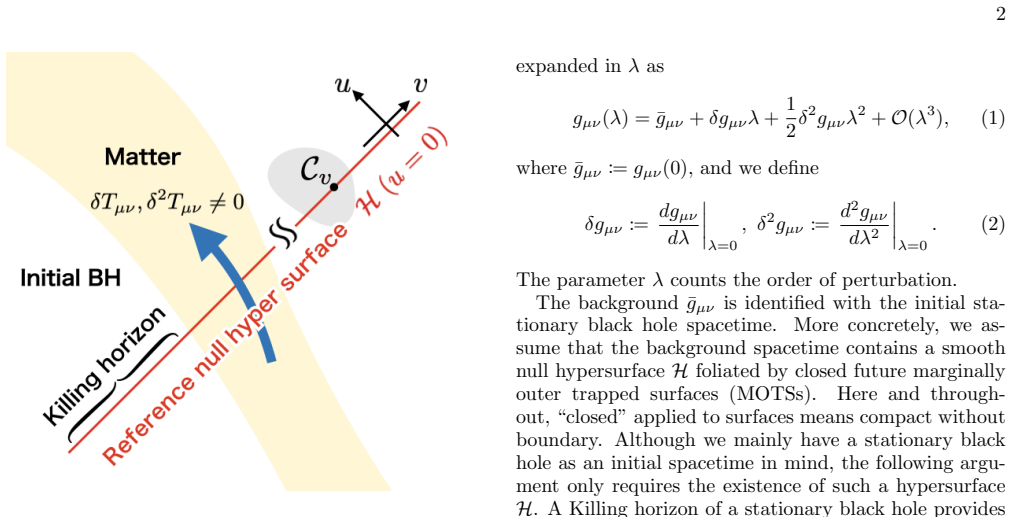
Matter injection converts a horizon cross-section into a closed trapped surface that rules out certain overcharged black holes and naked singularities.
A machine-rendered reading of the paper's core claim, the machinery that carries it, and where it could break.
Core claim
Under the null convergence and generic conditions, matter injection turns a horizon cross section into a closed trapped surface. Any final spacetime unable to accommodate this surface is ruled out. This trapped surface criterion excludes superextremal Reissner-Nordström, Reissner-Nordström-de Sitter, and Kerr-Newman final states, as well as Weyl-class naked singularities. The criterion does not rely on asymptotic charges or on an extremal condition characterizing naked singularities.
What carries the argument
The closed trapped surface obtained by converting a horizon cross-section through matter injection, which functions as a local geometric test for whether a spacetime can serve as a valid final state under weak cosmic censorship.
If this is right
- Superextremal Reissner-Nordström spacetimes are ruled out as possible final states.
- Reissner-Nordström-de Sitter and Kerr-Newman final states cannot occur.
- Weyl-class naked singularities are excluded.
- The test applies to overcharging and overspinning thought experiments without using global charges.
- It provides a local criterion independent of extremality conditions.
Where Pith is reading between the lines
- Numerical simulations of matter infall could directly check whether a trapped surface forms and thereby test the censorship outcome.
- The approach shifts emphasis from global conserved quantities to the local geometry of trapped surfaces.
- The same logic might extend to dynamical horizons or to spacetimes in modified gravity theories.
- It could connect to existing singularity theorems by supplying a concrete mechanism that forces trapped surfaces during evolution.
Load-bearing premise
That matter injection under the null convergence condition and generic conditions necessarily turns a horizon cross-section into a closed trapped surface.
What would settle it
An explicit example of matter injection into a horizon cross-section that fails to produce a closed trapped surface while obeying the null convergence condition, or a spacetime that contains such a surface yet permits a naked singularity.
Figures
read the original abstract
We formulate a local geometric criterion for weak cosmic censorship in black hole overcharging and overspinning thought experiments. Under the null convergence and generic conditions, matter injection turns a horizon cross section into a closed trapped surface. Any final spacetime unable to accommodate this surface is ruled out. This trapped surface criterion excludes superextremal Reissner-Nordstr\"om, Reissner-Nordstr\"om-de Sitter, and Kerr-Newman final states, as well as Weyl-class naked singularities. Our criterion does not rely on asymptotic charges or on an extremal condition characterizing naked singularities.
Editorial analysis
A structured set of objections, weighed in public.
Referee Report
Summary. The manuscript formulates a local geometric criterion for weak cosmic censorship applicable to black-hole overcharging and overspinning thought experiments. Under the null convergence condition and generic conditions, matter injection is asserted to convert a horizon cross-section into a closed trapped surface; any candidate final spacetime unable to contain such a surface is thereby ruled out. The criterion is used to exclude superextremal Reissner-Nordström, Reissner-Nordström-de Sitter, and Kerr-Newman geometries as well as Weyl-class naked singularities, and is stated to be independent of asymptotic charges and extremality conditions.
Significance. If the central conversion step is rigorously established, the result supplies a charge-independent, purely local test for cosmic censorship that relies only on standard null-convergence and genericness assumptions. This would strengthen existing arguments against certain naked-singularity candidates by showing that they cannot accommodate the trapped surface produced by horizon perturbation, without invoking global conserved quantities.
major comments (1)
- [Abstract] Abstract, paragraph 2: the claim that 'matter injection turns a horizon cross section into a closed trapped surface' under the null convergence and generic conditions is the load-bearing step for all subsequent exclusions, yet the manuscript provides no explicit derivation of this conversion. The steps that show how the cross-section becomes trapped while preserving the null convergence condition must be supplied before the exclusions of superextremal RN, RNdS, overspun KN, and Weyl naked singularities can be assessed.
Simulated Author's Rebuttal
We thank the referee for the careful reading and for identifying the need to make the central conversion step fully explicit. We agree that this derivation is essential for assessing the subsequent exclusions and will supply it in the revised manuscript.
read point-by-point responses
-
Referee: [Abstract] Abstract, paragraph 2: the claim that 'matter injection turns a horizon cross section into a closed trapped surface' under the null convergence and generic conditions is the load-bearing step for all subsequent exclusions, yet the manuscript provides no explicit derivation of this conversion. The steps that show how the cross-section becomes trapped while preserving the null convergence condition must be supplied before the exclusions of superextremal RN, RNdS, overspun KN, and Weyl naked singularities can be assessed.
Authors: We agree that an explicit derivation of the conversion from horizon cross-section to closed trapped surface is required. In the revised manuscript we will insert a dedicated section (or appendix) that derives this step from the Raychaudhuri equation applied to the perturbed generators, using the null convergence condition to obtain focusing and the generic condition to ensure the surface is closed and trapped. The argument will be written so that the null convergence condition is preserved at every stage. With this addition the exclusions of the listed final states can be re-examined on a fully rigorous footing. revision: yes
Circularity Check
No significant circularity; derivation relies on standard GR conditions
full rationale
The paper's central claim formulates a trapped-surface criterion under the null convergence condition and generic conditions (standard, externally verifiable assumptions in general relativity) to rule out certain final spacetimes by their inability to contain the surface produced by matter injection. No step reduces by construction to a fitted parameter, self-definition, or self-citation chain; the exclusions follow from the listed spacetimes' known geometric properties (absence of horizons or trapped surfaces), and the criterion is stated to be independent of asymptotic charges. The derivation chain is self-contained against external benchmarks with no load-bearing self-referential steps.
Axiom & Free-Parameter Ledger
axioms (2)
- domain assumption null convergence condition
- domain assumption generic conditions
Reference graph
Works this paper leans on
-
[1]
Penrose, Gravitational collapse: The role of general relativity, Riv
R. Penrose, Gravitational collapse: The role of general relativity, Riv. Nuovo Cim.1, 252 (1969)
1969
-
[2]
Wald, Gedanken experiments to destroy a black hole, Annals Phys.82, 548 (1974)
R. Wald, Gedanken experiments to destroy a black hole, Annals Phys.82, 548 (1974)
1974
-
[3]
J. M. Cohen and R. Gautreau, Naked singularities, event horizons, and charged particles, Phys. Rev. D19, 2273 (1979)
1979
-
[4]
Needham, COSMIC CENSORSHIP AND TEST PARTICLES, Phys
T. Needham, COSMIC CENSORSHIP AND TEST PARTICLES, Phys. Rev. D22, 791 (1980)
1980
-
[5]
W. A. Hiscock, Magnetic charge, black holes, and cosmic censorship, Annals of Physics131, 245 (1981)
1981
-
[6]
B. Gwak and B.-H. Lee, Cosmic Censorship of Ro- tating Anti-de Sitter Black Hole, JCAP02, 015, arXiv:1509.06691 [gr-qc]
-
[7]
D¨ uzta¸ s, Overspinning BTZ black holes with test particles and fields, Phys
K. D¨ uzta¸ s, Overspinning BTZ black holes with test particles and fields, Phys. Rev. D94, 124031 (2016), arXiv:1701.07241 [gr-qc]
Pith/arXiv arXiv 2016
- [8]
-
[9]
S.-J. Yang, J. Chen, J.-J. Wan, S.-W. Wei, and Y.-X. Liu, Weak cosmic censorship conjecture for a Kerr-Taub-NUT black hole with a test scalar field and particle, Phys. Rev. D101, 064048 (2020), arXiv:2001.03106 [gr-qc]
arXiv 2020
- [10]
-
[11]
V. E. Hubeny, Overcharging a black hole and cosmic censorship, Phys. Rev. D59, 064013 (1999), arXiv:gr- qc/9808043
arXiv 1999
-
[12]
de Felice and Y.-Q
F. de Felice and Y.-Q. Yu, Turning a black hole into a naked singularity, Class. Quant. Grav.18, 1235 (2001)
2001
-
[13]
Hod, Cosmic censorship, area theorem, and selfenergy of particles, Phys
S. Hod, Cosmic censorship, area theorem, and selfenergy of particles, Phys. Rev. D66, 024016 (2002), arXiv:gr- qc/0205005
arXiv 2002
-
[14]
T. Jacobson and T. P. Sotiriou, Over-spinning a black hole with a test body, Phys. Rev. Lett.103, 141101 (2009), [Erratum: Phys.Rev.Lett. 103, 209903 (2009)], arXiv:0907.4146 [gr-qc]
Pith/arXiv arXiv 2009
-
[15]
G. Chirco, S. Liberati, and T. P. Sotiriou, Gedanken ex- periments on nearly extremal black holes and the Third Law, Phys. Rev. D82, 104015 (2010), arXiv:1006.3655 [gr-qc]
Pith/arXiv arXiv 2010
-
[16]
A. Saa and R. Santarelli, Destroying a near-extremal Kerr-Newman black hole, Phys. Rev. D84, 027501 (2011), arXiv:1105.3950 [gr-qc]
Pith/arXiv arXiv 2011
-
[17]
S. Gao and Y. Zhang, Destroying extremal Kerr-Newman black holes with test particles, Phys. Rev. D87, 044028 (2013), arXiv:1211.2631 [gr-qc]
Pith/arXiv arXiv 2013
-
[18]
J. Sorce and R. M. Wald, Gedanken experiments to de- stroy a black hole. II. Kerr-Newman black holes cannot be overcharged or overspun, Phys. Rev. D96, 104014 (2017), arXiv:1707.05862 [gr-qc]
Pith/arXiv arXiv 2017
-
[19]
J. An, J. Shan, H. Zhang, and S. Zhao, Five- dimensional Myers-Perry black holes cannot be over- spun in gedanken experiments, Phys. Rev. D97, 104007 (2018), arXiv:1711.04310 [hep-th]
Pith/arXiv arXiv 2018
-
[20]
B. Ge, Y. Mo, S. Zhao, and J. Zheng, Higher- dimensional charged black holes cannot be over-charged by gedanken experiments, Phys. Lett. B783, 440 (2018), arXiv:1712.07342 [hep-th]
Pith/arXiv arXiv 2018
-
[21]
K. D¨ uzta¸ s, M. Jamil, S. Shaymatov, and B. Ahmedov, Testing cosmic censorship conjecture for extremal and near-extremal (2 + 1)-dimensional MTZ black holes, Class. Quant. Grav.37, 175005 (2020), arXiv:1808.04711 [gr-qc]. 8
arXiv 2020
-
[22]
B. Chen, F.-L. Lin, and B. Ning, Gedanken Experiments to Destroy a BTZ Black Hole, Phys. Rev. D100, 044043 (2019), arXiv:1902.00949 [gr-qc]
arXiv 2019
-
[23]
S. Shaymatov, N. Dadhich, B. Ahmedov, and M. Jamil, Five dimensional charged rotating minimally gauged su- pergravity black hole cannot be over-spun and/or over- charged in non-linear accretion, Eur. Phys. J. C80, 481 (2020), arXiv:1908.01195 [gr-qc]
arXiv 2020
-
[24]
S. Shaymatov, N. Dadhich, and B. Ahmedov, Six- dimensional Myers-Perry rotating black hole cannot be overspun, Phys. Rev. D101, 044028 (2020), arXiv:1908.07799 [gr-qc]
arXiv 2020
- [25]
- [26]
-
[27]
X.-Y. Wang and J. Jiang, Examining the weak cosmic censorship conjecture of RN-AdS black holes via the new version of the gedanken experiment, JCAP07, 052, arXiv:1911.03938 [hep-th]
arXiv 1911
- [28]
-
[29]
J. Jiang, Static charged Gauss-Bonnet black holes can- not be overcharged by the new version of gedanken experiments, Phys. Lett. B804, 135365 (2020), arXiv:1912.10826 [gr-qc]
arXiv 2020
-
[30]
Jiang and M
J. Jiang and M. Zhang, Weak cosmic censorship conjec- ture in Einstein–Maxwell gravity with scalar hair, Eur. Phys. J. C80, 196 (2020)
2020
-
[31]
J. Jiang and Y. Gao, Investigating the gedanken experi- ment to destroy the event horizon of a regular black hole, Phys. Rev. D101, 084005 (2020), arXiv:2003.07501 [hep- th]
arXiv 2020
-
[32]
X.-Y. Wang and J. Jiang, Gedanken experiments at high-order approximation: nearly extremal Reissner- Nordstr¨ om black holes cannot be overcharged, JHEP05, 161, arXiv:2004.12120 [hep-th]
arXiv 2004
-
[33]
S. Shaymatov and N. Dadhich, Weak cosmic censorship conjecture in the pure Lovelock gravity, JCAP10, 060, arXiv:2008.04092 [gr-qc]
arXiv 2008
-
[34]
J. Jiang and M. Zhang, Testing the Weak Cosmic Censor- ship Conjecture in Lanczos-Lovelock gravity, Phys. Rev. D102, 084033 (2020), arXiv:2008.04906 [gr-qc]
arXiv 2020
- [35]
-
[36]
J. Jiang and M. Zhang, New version of the gedanken ex- periments to test the weak cosmic censorship in charged dilaton-Lifshitz black holes, Eur. Phys. J. C80, 822 (2020), arXiv:2008.12415 [gr-qc]
arXiv 2020
-
[37]
M. Zhang and J. Jiang, New gedanken experiment on higher-dimensional asymptotically AdS Reissner- Nordstr¨ om black hole, Eur. Phys. J. C80, 890 (2020), arXiv:2009.07681 [gr-qc]
arXiv 2020
-
[38]
Z. Li, Y. Gao, and X.-K. Guo, Weak cosmic censorship conjecture in higher-dimensional black holes with nonlin- ear electrodynamic sources, Phys. Lett. B817, 136303 (2021), arXiv:2009.09385 [gr-qc]
arXiv 2021
-
[39]
H.-F. Ding and X.-H. Zhai, Examining the weak cosmic censorship conjecture by gedanken experiments for an Einstein–Maxwell–Dilaton–Axion black hole, Mod. Phys. Lett. A35, 2050335 (2020), arXiv:2012.06120 [gr-qc]
arXiv 2020
-
[40]
K. D¨ uzta¸ s, The variational method, backreactions, and the absorption probability in Wald type problems, Eur. Phys. J. C81, 49 (2021), arXiv:2101.07790 [gr-qc]
arXiv 2021
-
[41]
Y. Qu, J. Tao, and J. Wu, New Gedanken experiment on RN-AdS black holes surrounded by quintessence, Eur. Phys. J. C82, 185 (2022), arXiv:2103.09183 [gr-qc]
arXiv 2022
-
[42]
A. Sang and J. Jiang, Gedanken experiments at high- order approximation: Kerr black hole cannot be over- spun, JHEP09, 095, arXiv:2108.03454 [gr-qc]
- [43]
-
[44]
A. Sang and J. Jiang, Weak Cosmic Censorship Conjec- ture of Hairy Black Holes in Einstein Gravity, (2022), arXiv:2206.04410 [gr-qc]
arXiv 2022
-
[45]
A. K. Ahmed, S. Shaymatov, and B. Ahmedov, Weak cosmic censorship conjecture for the (2+1)- dimensional charged BTZ black hole in the Ein- stein–Gauss–Bonnet Gravity, Phys. Dark Univ.37, 101082 (2022), arXiv:2207.01694 [gr-qc]
arXiv 2022
-
[46]
Wang and J
X.-Y. Wang and J. Jiang, Gedanken experiments at high- order approximations: Kerr-Newman black hole cannot be overcharged and overspun, Phys. Rev. D106, 064050 (2022)
2022
-
[47]
Jiang, Testing the weak cosmic censorship conjecture in the massive gravitational theories, Nucl
J. Jiang, Testing the weak cosmic censorship conjecture in the massive gravitational theories, Nucl. Phys. B984, 115963 (2022)
2022
-
[48]
S.-J. Yang, W.-D. Guo, S.-W. Wei, and Y.-X. Liu, First law of black hole thermodynamics and the weak cosmic censorship conjecture for Kerr–Newman Taub–NUT black holes, Eur. Phys. J. C83, 1111 (2023), arXiv:2306.05266 [gr-qc]
arXiv 2023
-
[49]
D¨ uzta¸ s, Spin-2 fields and cosmic censorship, Phys
K. D¨ uzta¸ s, Spin-2 fields and cosmic censorship, Phys. Rev. D110, 024081 (2024), arXiv:2403.15830 [gr-qc]
arXiv 2024
-
[50]
D. Yoshida and K. Yoshimura, The first law and weak cosmic censorship for de Sitter black holes, Class. Quant. Grav.42, 115008 (2025), arXiv:2411.19535 [gr-qc]
arXiv 2025
-
[51]
Penrose, Gravitational collapse and space-time singu- larities, Phys
R. Penrose, Gravitational collapse and space-time singu- larities, Phys. Rev. Lett.14, 57 (1965)
1965
-
[52]
S. W. Hawking and G. F. R. Ellis,The Large Scale Struc- ture of Space-Time, Cambridge Monographs on Mathe- matical Physics (Cambridge University Press, 2023)
2023
-
[53]
R. M. Wald,General Relativity(Chicago Univ. Pr., Chicago, USA, 1984)
1984
-
[54]
C.-M. Claudel, Black holes and closed trapped sur- faces: A Revision of a classic theorem, (2000), arXiv:gr- qc/0005031
arXiv 2000
-
[55]
M. Mars and J. M. M. Senovilla, Trapped surfaces and symmetries, Class. Quant. Grav.20, L293 (2003), arXiv:gr-qc/0309055
Pith/arXiv arXiv 2003
-
[56]
Penrose,Techniques of differential topology in rela- tivity(Society for Industrial and Applied Mathematics, Philadelphia, USA, 1972)
R. Penrose,Techniques of differential topology in rela- tivity(Society for Industrial and Applied Mathematics, Philadelphia, USA, 1972)
1972
-
[57]
S. Hollands, A. Ishibashi, and R. M. Wald, A Higher di- mensional stationary rotating black hole must be axisym- metric, Commun. Math. Phys.271, 699 (2007), arXiv:gr- qc/0605106
arXiv 2007
-
[58]
S. Hollands and R. M. Wald, Stability of Black Holes and Black Branes, Commun. Math. Phys.321, 629 (2013), arXiv:1201.0463 [gr-qc]. 9
Pith/arXiv arXiv 2013
-
[59]
H. E. J. Curzon, Cylindrical solutions of einstein’s gravi- tation equations, Proceedings of the London Mathemat- ical Societys2-23, 477 (1925)
1925
-
[60]
Chazy, Sur le champ de gravitation de deux masses fixes dans la th´ eorie de la relativit´ e , Bulletin de la Soci´ et´ e Math´ ematique de France52, 17 (1924)
J. Chazy, Sur le champ de gravitation de deux masses fixes dans la th´ eorie de la relativit´ e , Bulletin de la Soci´ et´ e Math´ ematique de France52, 17 (1924)
1924
-
[61]
D. M. Zipoy, Topology of Some Spheroidal Metrics, J. Math. Phys.7, 1137 (1966)
1966
-
[62]
B. H. Voorhees, Static axially symmetric gravitational fields, Phys. Rev. D2, 2119 (1970)
1970
-
[63]
J. B. Griffiths and J. Podolsky,Exact Space-Times in Einstein’s General Relativity, Cambridge Monographs on Mathematical Physics (Cambridge University Press, Cambridge, 2009)
2009
-
[64]
D. Saito and D. Yoshida, Removing naked singulari- ties in static axially symmetric spacetimes by patching with flat spacetimes, Phys. Rev. D111, 024031 (2025), arXiv:2409.18520 [gr-qc]
arXiv 2025
-
[65]
R. Emparan and H. S. Reall, A Rotating black ring so- lution in five-dimensions, Phys. Rev. Lett.88, 101101 (2002), arXiv:hep-th/0110260
Pith/arXiv arXiv 2002
-
[66]
Izumi, Orthogonal black di-ring solution, Prog
K. Izumi, Orthogonal black di-ring solution, Prog. Theor. Phys.119, 757 (2008), arXiv:0712.0902 [hep-th]
Pith/arXiv arXiv 2008
-
[67]
H. K. Kunduri and J. Lucietti, Supersymmetric Black Holes with Lens-Space Topology, Phys. Rev. Lett.113, 211101 (2014), arXiv:1408.6083 [hep-th]
Pith/arXiv arXiv 2014
-
[68]
S. Tomizawa and M. Nozawa, Supersymmetric black lenses in five dimensions, Phys. Rev. D94, 044037 (2016), arXiv:1606.06643 [hep-th]
Pith/arXiv arXiv 2016
-
[69]
R. Emparan and H. S. Reall, Black Holes in Higher Di- mensions, Living Rev. Rel.11, 6 (2008), arXiv:0801.3471 [hep-th]
Pith/arXiv arXiv 2008
-
[70]
S. Hollands and A. Ishibashi, Black hole uniqueness the- orems in higher dimensional spacetimes, Class. Quant. Grav.29, 163001 (2012), arXiv:1206.1164 [gr-qc]
Pith/arXiv arXiv 2012
-
[71]
R. M. Wald, Black hole in a uniform magnetic field, Phys. Rev. D10, 1680 (1974)
1974
-
[72]
F. J. Ernst, Black holes in a magnetic universe, J. Math. Phys.17, 54 (1976)
1976
-
[73]
F. J. Ernst and W. J. Wild, Kerr black holes in a mag- netic universe, J. Math. Phys.17, 182 (1976)
1976
-
[74]
Aliev and D
A. Aliev and D. Gal’Tsov, Energetics of magnetized black holes: effective ergospheres and superradiance, Astro- physics and space science143, 301 (1988)
1988
-
[75]
A. N. Aliev and D. V. Galtsov, Exact Solutions For Magnetized Black Holes, Astrophys. Space Sci.155, 181 (1989)
1989
-
[76]
G. W. Gibbons, A. H. Mujtaba, and C. N. Pope, Er- goregions in Magnetised Black Hole Spacetimes, Class. Quant. Grav.30, 125008 (2013), arXiv:1301.3927 [gr-qc]
Pith/arXiv arXiv 2013
-
[77]
J. Podolsky and H. Ovcharenko, Kerr Black Hole in a Uniform Bertotti-Robinson Magnetic Field: An Ex- act Solution, Phys. Rev. Lett.135, 181401 (2025), arXiv:2507.05199 [gr-qc]
arXiv 2025
-
[78]
H. Ovcharenko and J. Podolsk´ y, New class of rotat- ing charged black holes with nonaligned electromagnetic field, Phys. Rev. D112, 064076 (2025), arXiv:2508.04850 [gr-qc]
arXiv 2025
-
[79]
R. Bousso, Z. Fisher, S. Leichenauer, and A. C. Wall, Quantum focusing conjecture, Phys. Rev. D93, 064044 (2016), arXiv:1506.02669 [hep-th]
Pith/arXiv arXiv 2016
-
[80]
A. C. Wall, A Second Law for Higher Curvature Gravity, Int. J. Mod. Phys. D24, 1544014 (2015), arXiv:1504.08040 [gr-qc]
Pith/arXiv arXiv 2015
discussion (0)
Sign in with ORCID, Apple, or X to comment. Anyone can read and Pith papers without signing in.