REVIEW 3 major objections 4 minor 75 references
On the Planckian bound for heat diffusion in insulators
T0 review · 3 major / 4 minor · reviewed 2026-08-14 · deepseek-v4-flash
Pith's one-line read A quantum cap on sound velocity explains Planckian heat transport in insulators.
desk verdict A useful empirical correlation and a fresh way to think about Planckian transport, but the central 'derivation' of Eq. (10) is actually a fit; the velocity bound alone does not imply the Planckian bound. read the letter →
The pith
A machine-rendered reading of the paper's core claim, the machinery that carries it, and where it could break.
The reading
What carries the argument
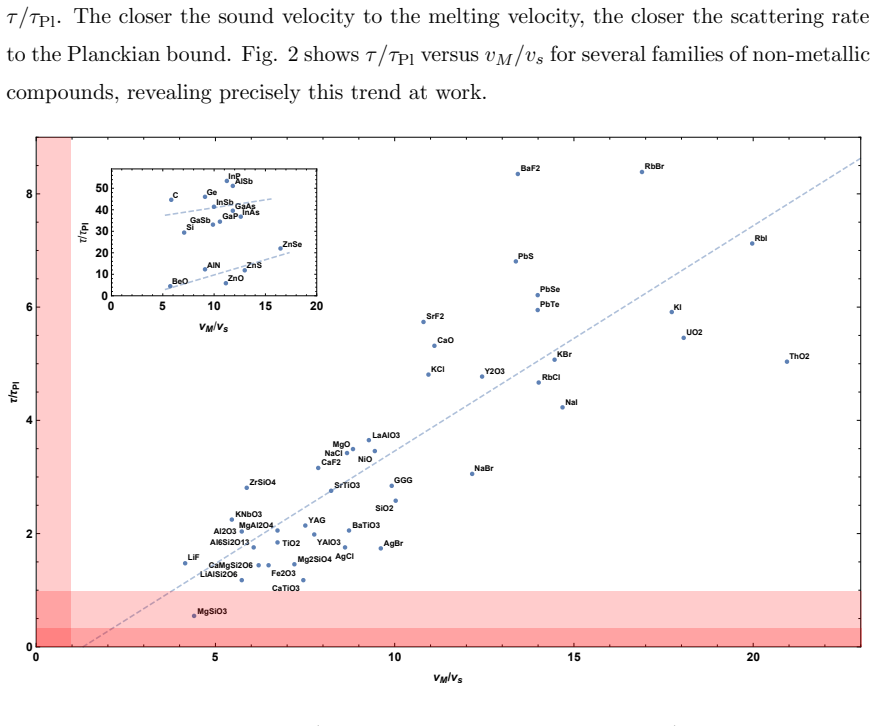
The load-bearing object is the melting velocity $v_M \equiv (k_B T_M)a/\hbar$, a Lieb-Robinson-style maximal velocity for crystals. It is derived by applying the Heisenberg uncertainty principle to the Lindemann energy cap for a single vibrating atom, and it plays the role that the coupling $J$ plays in the Lieb-Robinson bound for spin systems. The classical phonon scattering rate $1/\tau = v_s/\ell$ with $\ell \sim 1/T$ is then combined with $v_s \lesssim v_M$, converting a velocity cap into the Planckian lifetime bound. In the comparison with data, $v_M/v_s$ is the one quantity that organizes the materials: the ratio runs from about 5 to 19, and $\tau/\tau_{\mathrm{Pl}}$ runs with it.
What would settle it
Measure the thermal diffusivity $D$ and the elastic sound velocity $v_s$ of any insulating crystal at a temperature safely above its Debye temperature, and compare the extracted $\tau/\tau_{\mathrm{Pl}}$ with $v_M/v_s$ computed from tabulated $T_M$ and density. A single crystal with $\tau/\tau_{\mathrm{Pl}}$ below unity, or one that systematically violates the $\tau/\tau_{\mathrm{Pl}} \sim v_M/v_s$ trend while still obeying the classical scattering law, would falsify the claimed reduction. The same test can be run in a classical molecular-dynamics simulation of a model atomistic solid, where $T_M$ and the anharmonic scattering rate are both computable from first principles.
Extended reading notes
Core claim
The paper's central claim is equation (10): a Lieb-Robinson-type bound on the sound velocity implies a Planckian bound on scattering, $\tau/\tau_{\mathrm{Pl}} \sim v_M/v_s \gtrsim 1$. The derivation begins with a classical anharmonic-lattice Hamiltonian and the textbook result that above the Debye temperature the phonon umklapp scattering rate is $1/\tau = v_s/\ell$ with a mean free path $\ell \sim a^3 K/(\gamma^2 k_B T)$. The purely classical sound velocity is then bounded from above by combining the Lindemann melting criterion, written as an energy cap $k_B T_M \gtrsim p^2/2M + K(x-x_{\mathrm{eq}})^2/2$, with the Heisenberg uncertainty principle. The result is $v_s \lesssim v_M \equiv (k_B T_M)a/\hbar$. Using the scattering rate, this velocity bound becomes the Planckian bound. The paper verifies the proportionality $\tau/\tau_{\mathrm{Pl}} \approx \frac{1}{3} v_M/v_s$ across alkali halides, oxides, perovskites, and semiconductors, with a separate cluster of high-conductivity adamantine crystals that have anomalously long mean free paths.
Load-bearing premise
The load-bearing premise is equation (6), which treats the Lindemann melting criterion as a per-atom energy cap $k_B T_M \gtrsim p^2/2M + K(x-x_{\mathrm{eq}})^2/2$; melting is in reality a collective instability, so the sound-velocity bound is exactly as strong as this single-atom idealization.
Editorial extensions
If this is right
- Wherever $v_M/v_s$ is small, heat diffusion in an insulator is predicted to be Planckian, $\tau \sim \tau_{\mathrm{Pl}}$, independent of structural complexity; this explains why simple LiF and complex oxides can appear in the same near-Planckian class.
- The slope $\frac{1}{3}$ in the material plot implies that, with the conventional three-dimensional definition $D = \frac{1}{3}v_s^2\tau'$, the phonon mean free path near melting is $\ell' \approx (T_M/T)a$.
- The velocity bound is orthogonal to the Slack-Kittel mean-free-path bound: the latter limits the magnitude of the thermal diffusivity, while the velocity bound limits the slope of $D^{-1}$ with temperature.
- Because zero-point motion brings light-atom crystals closer to spontaneous melting, the largest sound velocities are the ones that most strongly push the transport lifetime toward the Planckian value.
- Adamantine crystals such as diamond, silicon, and GaAs are the expected outliers: their measured lifetimes are several multiples of the Planckian time, revealing an anomalously long mean free path within the same velocity-based logic.
Reading between the lines
- Going beyond the paper, the same $v_M$ bound suggests a design rule for thermal management: the maximum high-temperature heat diffusivity of an insulating crystal above the Debye temperature is controlled by melting temperature and lattice spacing alone, up to the numerical factor measured here.
- The analogy with electron-phonon Planckian transport in metals invites a test beyond phonons: if the Fermi velocity $v_F$ is the relevant sound proxy, then metals with small $v_F/v_M$ should also show large $\tau/\tau_{\mathrm{Pl}}$, connecting two currently separate Planckian phenomenologies.
- Because the paper's derivation uses only the energy cap per atom, one can test the mechanism directly in classical molecular-dynamics simulations: compute $v_s$, the Lindemann melting temperature, and the high-temperature scattering rate for a model crystal, and check whether $\tau/\tau_{\mathrm{Pl}} \approx v_M/v_s$ emerges without any fit parameter.
- The exception of the adamantine crystals is left unexplained; a natural extension would be to check whether their anomalously long mean free paths correlate with a suppressed Gr\"uneisen parameter or with a particular anisotropy of the umklapp phase space, which are the two numerical factors the paper deliberately drops.
Signed reviews
Editorial analysis
A structured set of objections, weighed in public.
Referee Report
Summary. The paper proposes that the near-Planckian thermal transport lifetimes observed in many insulating crystals at high temperatures follow from a quantum mechanical bound on the sound velocity, v_s < v_M ≡ k_B T_M a/ℏ. The authors derive this velocity bound from the Lindemann melting criterion combined with the Heisenberg uncertainty principle, combine it with a classical anharmonic-phonon scattering estimate for the mean free path, and obtain τ/τ_Pl ∼ v_M/v_s ≳ 1. They support the relation with a compilation of elastic, thermodynamic, and thermal-transport data for roughly seventy compounds, and they show that most non-adamantine crystals follow τ/τ_Pl ≈ (1/3) v_M/v_s, while a family of high-conductivity zincblende/wurtzite compounds lies well above this trend.
Significance. If the proposed relation were quantitatively robust, it would give a simple organizing principle for phonon transport: the ratio of melting velocity to sound velocity, rather than detailed anharmonic calculations, would control the proximity to Planckian dissipation in insulators. The paper's strengths are its clear physical picture, the explicit 'melting velocity' scale that ties transport to melting, a large and carefully referenced data table, and a falsifiable correlation that can be tested on additional materials. The manuscript is also transparent about its approximations, explicitly stating when numerical factors are dropped and verified a posteriori. However, the central step from the velocity bound to the Planckian relation drops prefactors that are not order one, and the universality of the claim is weakened by the structured exclusion of the adamantine compounds; the result is best regarded as a heuristic scaling law with an empirically fitted slope rather than a derivation of the Planckian bound.
major comments (3)
- [From the velocity bound to the Planckian bound, Eq. (10); see also Eq. (4) and the Lindemann estimate below Eq. (2)] Equation (10) does not follow from the velocity bound unless the omitted prefactors are genuinely of order one, but the paper's own estimates give a large prefactor. Combining the mean free path estimate l ~ a^3 K/(gamma^2 k_B T) in Eq. (4) with the Lindemann relation k_B T_M ~ c_L^2 K a^2 yields l ~ a T_M/(gamma^2 c_L^2 T), and hence tau/tau_Pl = l k_B T/(hbar v_s) ~ [1/(gamma^2 c_L^2)] v_M/v_s. With c_L ~ 0.1-0.3 and gamma ~ O(1), this prefactor is of order 10-100, not the empirical slope 1/3. The statement that the dropped factors 'tend to cancel out on average' is an a posteriori consistency check after fitting Fig. 2, and the alternative definition tau' = 3 tau would change the slope by construction. The observed near-Planckian values therefore require an unexplained cancellation of the explicit c_L^2 and gamma^2 factors; the relation (10) is an empirical fit rather than a consequence of the velocity bound alone.
- [The melting velocity, Eq. (6)] The velocity bound rests on the single-atom energy cap k_B T_M >= p^2/(2M) + (K/2)(x - x_eq)^2, which is an idealization of the Lindemann criterion. Melting is a collective instability, and the total energy that binds an atom in the crystal is not simply k_B T_M; the inequality suppresses the fact that the Lindemann constant c_L enters the relation between T_M and K a^2. Since the derivation of Eq. (8) uses only this assumption plus the uncertainty relation, the bound v_s < v_M is exactly as strong as the per-atom Lindemann input and is not obtained from the Lieb-Robinson theorem, which the paper correctly notes does not apply to the unbounded oscillator Hilbert space. A concrete way to test this load-bearing assumption would be to compare k_B T_M with the per-atom kinetic plus potential energy in classical molecular dynamics at the melting temperature; if the energy cap is not approximately saturated, the velocity bound and all subsequent claims would need revision.
- [Fig. 2 and the accompanying data table in the Supplementary Material] The central correlation is demonstrated only after excluding a large, structured family of crystals. The adamantine compounds in the inset (Si, Ge, diamond, III-V, II-VI, BeO, AlN) have v_M/v_s values between about 5 and 16, but their tau/tau_Pl values are an order of magnitude larger than the main-panel trend; for instance the table gives diamond v_M/v_s = 5.78 versus tau/tau_Pl = 44.5, Si 7.10 versus 29.4, and GaAs 11.84 versus 39.5. Because these are ordinary insulating crystals, the claim that the velocity ratio determines Planckian scattering is not universal, and the explanation in terms of 'numerical factors' in the scattering calculation does not predict which materials will obey the trend. At minimum, the paper should state the empirical scope precisely and discuss whether the bound (8) or the scattering estimate (4) is the point at which the adamantine family fails.
minor comments (4)
- [Fig. 2] The linear fits are described as guides to the eye, but no slopes, intercepts, or uncertainties are reported; given that the slope 1/3 is quoted as evidence for the relation, the fit parameters and the list of included materials should be given explicitly.
- [Supplementary Material, material data table] Several diffusivities are evaluated at T = 300 K (CaF2, SrF2, BaF2, Y2O3, Gd3Ga5O12, Y3Al5O12) or 350 K (MgSiO3), which may be below or near the Debye temperature and outside the regime where the T-linear umklapp scattering rate is established. The high-temperature criterion used to select the evaluation temperature should be stated and checked against T_D for each compound.
- [Introduction and text around Eq. (1)] The 'Planckian bound' is formulated as an inequality on the lifetime, tau >= tau_Pl, so the scattering rate inequality 1/tau <= k_B T/hbar is correct, but the phrase 'bound' is used interchangeably for an empirical near-saturation ('Planckian transport') and a hard inequality; this distinction should be made explicit throughout.
- [Discussion, Eq. (11)] The statement that l' = (T_M/T)a is 'consistent with the observation that mean free paths typically approach the interatomic spacing close to the melting temperature' should acknowledge that this is the same Lindemann-scale input used to construct v_M, so Eq. (11) is a repackaging of the melting criterion rather than an independent prediction.
Circularity Check
The central Eq. (10) is not a logical consequence of the velocity bound; its O(1) prefactor is obtained by dropping the Lindemann and anharmonic coefficients and then absorbing the missing numerical factor through the linear fit in Fig. 2.
-
fitted input called prediction
[Section 'From the velocity bound to the Planckian bound', Eq. (10); Discussion, Eq. (11) and Fig. 2 fit]
"If we use the velocity bound (8) in the scattering rate (4) and furthermore drop all dimensionless numerical factors (including γ2, c2L and phase space factors in the scattering computation, the correctness of this procedure will be verified a posteriori), then we obtain a Planckian bound on the phonon lifetime τ/τPl ∼ vM/vs & 1."
Combining the paper's own Eq. (4), ℓ ∼ a³K/(γ²kBT), with the Lindemann relation used in the text, kBTM ∼ cL²Ka², gives identically τ/τPl = ℓkBT/(ℏvs) = (1/(γ²cL²))(kBTM a)/(ℏvs) = (1/(γ²cL²)) vM/vs. With cL ≈ 0.1–0.3 and γ = O(1), this prefactor is 10–100, not 1. Equation (10) is obtained only by explicitly dropping γ² and cL²; the missing numerical content is then supplied by the linear fit in Fig. 2, whose slope τ/τPl ≈ (1/3)vM/vs is presented as an a posteriori verification. Thus the central claim that the velocity bound implies the Planckian bound is not derived from the bound; the coefficient that makes the relation hold is imported from the same data being 'predicted'.
full rationale
The early chain is self-contained and non-circular: the classical scattering rate (3)–(4) is a standard textbook computation, and the velocity bound (8) follows (as an assumption, not circularly) from the Lindemann-type energy cap (6) plus the uncertainty principle. There is no load-bearing self-citation chain: the cited Lieb-Robinson results are used only as an analogy, and the paper explicitly notes that its oscillator model falls outside the theorem. The circularity enters at Eq. (10). From the paper's own equations, the exact consequence of the scattering rate and the Lindemann relation is τ/τPl = (1/γ²cL²) vM/vs, with a numerically large prefactor. Setting that prefactor to 1 is the step that makes the Planckian bound appear to follow from the velocity bound; the subsequent Fig. 2 fit (slope 1/3) supplies the coefficient that the derivation dropped. The 'a posteriori verification' is therefore not an independent check of a derived prediction but the source of the missing numerical factor. The adamantine outlier class is treated post hoc, which weakens the empirical claim but is not itself a circular step. Overall: one central prediction reduces to a fit plus dropped prefactors, so the paper is partially circular but not tautological.
Assumptions & free parameters
free parameters (4)
- γ (Grüneisen parameter) =
O(1) (not measured precisely; folded into dropped factors)
- c_L (Lindemann constant) =
0.1-0.3 (literature range)
- Umklapp phase-space factor Q² =
~1/a² (estimated)
- Slope in τ/τ_Pl vs v_M/v_s =
1/3 (from linear fit in Fig. 2)
assumptions (8)
- domain assumption Anharmonic Hamiltonian (2) with only cubic anharmonicity, and K ~ λ a
- domain assumption Lindemann criterion: melting occurs when RMS displacement reaches c_L a, with c_L ~ 0.1-0.3
- ad hoc to paper Single atom energy is bounded by k_B T_M (Eq. 6)
- standard math Uncertainty principle (Heisenberg)
- standard math High temperature Bose-Einstein limit n_B(ω) ≈ k_B T/(ℏ ω) for T > T_D
- domain assumption Umklapp scattering rate formula (3)/(16) with Q ~ 1/a and v_s² ~ a² K/M
- domain assumption Binding energy scale K a² ~ ℏ²/(m a²)
- domain assumption Room temperature elastic moduli (K, G) and density describe the high temperature sound velocity
invented entities (1)
-
Melting velocity v_M = (k_B T_M) a/ℏ
independent evidence
Cite this review
Pith. "Pith review of On the Planckian bound for heat diffusion in insulators." pith.science (2026). https://pith.science/paper/GLOM7WPT
@misc{pith2026190804792,
  author       = {Pith},
  title        = {Pith review of: On the Planckian bound for heat diffusion in insulators},
  year         = {2026},
  howpublished = {\url{https://pith.science/paper/GLOM7WPT}},
  note         = {Machine review of arXiv:1908.04792}
}
abstract
High temperature thermal transport in insulators has been conjectured to be subject to a Planckian bound on the transport lifetime $\tau \gtrsim \tau_\text{Pl} \equiv \hbar/(k_B T)$, despite phonon dynamics being entirely classical at these temperatures. We argue that this Planckian bound is due to a quantum mechanical bound on the sound velocity: $v_s < v_M$. The `melting velocity' $v_M$ is defined in terms of the melting temperature of the crystal, the interatomic spacing and Planck's constant. We show that for several classes of insulating crystals, both simple and complex, $\tau/\tau_\text{Pl} \approx v_M/v_s$ at high temperatures. The velocity bound therefore implies the Planckian bound.
Figures

Reference graph
Works this paper leans on
-
[1]
V. Martelli, J. L. Jim´ enez, M. Continentino, E. Baggio-Saitovitch and K. Behnia, Thermal Transport and Phonon Hydrodynamics in Strontium Titanate, Phys. Rev. Lett. 120, 125901, 2018
work page 2018
-
[2]
K. Behnia and A. Kapitulnik, A lower bound to the thermal diffusivity of insulators, J. Phys.: Cond. Matt. 31, 405702, 2019
work page 2019
- [3]
-
[4]
Zaanen, Why the temperature is high, Nature 430, 512–513, 2004
J. Zaanen, Why the temperature is high, Nature 430, 512–513, 2004
work page 2004
-
[5]
S. A. Hartnoll, Theory of universal incoherent metallic transport, Nature Physics 11, 54, 2014
work page 2014
-
[6]
Peierls, On the Statistical Basis for the Electron Theory of Metals, Helv
R. Peierls, On the Statistical Basis for the Electron Theory of Metals, Helv. Phys. Act. (Supp.) 7, 24, 1934
work page 1934
-
[7]
Peierls, Remarks on the Theory of Metals, Z
R. Peierls, Remarks on the Theory of Metals, Z. Phys 88, 786, 1934
work page 1934
-
[8]
Sachdev, Quantum Phase Transitions
S. Sachdev, Quantum Phase Transitions . CUP, 1999. 11
work page 1999
Show all 75 references
-
[9]
J. A. N. Bruin, H. Sakai, R. S. Perry and A. P. Mackenzie, Similarity of Scattering Rates in Metals Showing T-Linear Resistivity, Science 339, 804–807, 2013
2013
-
[10]
Zhang, E
J. Zhang, E. M. Levenson-Falk, B. J. Ramshaw, D. A. Bonn, R. Liang, W. N. Hardy, S. A. Hartnoll and A. Kapitulnik, Anomalous thermal diffusivity in underdoped YBa2Cu3O6+x, PNAS 114, 5378–5383, 2017
2017
-
[11]
Zhang, E
J. Zhang, E. D. Kountz, E. M. Levenson-Falk, D. Song, R. L. Greene and A. Kapitulnik, Thermal Diffusivity Above Mott-Ioffe-Regel Limit, [arXiv:1808.07564 [cond-mat.str-el]]
-
[12]
Legros, S
A. Legros, S. Benhabib, W. Tabis, F. Lalibert´ e, M. Dion, M. Lizaire, B. Vignolle, D. Vignolles, H. Raffy, Z. Z. Li, P. Auban-Senzier, N. Doiron-Leyraud, P. Fournier et al., Universal T-linear resistivity and Planckian dissipation in overdoped cuprates, Nature Physics 15, 142–...
2019
-
[13]
Y. Cao, D. Chowdhury, D. Rodan-Legrain, O. Rubies-Bigord` a, K. Watanabe, T. Taniguchi, T. Senthil and P. Jarillo-Herrero, Strange metal in magic-angle graphene with near Planckian dissipation, 2019, [arXiv:1901.03710 [cond-mat.str-el]]
2019 arXiv
-
[14]
L. Feng, T. Shiga and J. Shiomi, Phonon transport in perovskite SrTiO3 from first principles, Appl. Phys. Expr. 8, 071501, 2015
2015
-
[15]
Tadano and S
T. Tadano and S. Tsuneyuki, Self-consistent phonon calculations of lattice dynamical properties in cubic SrTiO 3 with first-principles anharmonic force constants, Phys. Rev. B 92, 054301, 2015
2015
-
[16]
G. A. Slack, The thermal conductivity of nonmetallic crystals, vol. 34 of Solid State Physics, pp. 1 – 71. Academic Press, 1979. DOI
1979
-
[17]
Grimvall and S
G. Grimvall and S. Sjodin, Correlation of properties of materials to debye and melting temperatures, Phys. Scr. 10, 340–352, 1974
1974
-
[18]
Poirier, Lindemann law and the melting temperature of perovskites, Phys
J. Poirier, Lindemann law and the melting temperature of perovskites, Phys. Earth Planet. Inter. 54, 364 – 369, 1989
1989
-
[19]
J. M. Ziman, Electrons and phonons: the theory of transport phenomena in solids . Oxford university press, 1960
1960
-
[20]
Auerbach and P
A. Auerbach and P. B. Allen, Universal high-temperature saturation in phonon and electron transport, Phys. Rev. B 29, 2884–2890, 1984. 12
1984
-
[21]
Kittel, Interpretation of the thermal conductivity of glasses, Phys
C. Kittel, Interpretation of the thermal conductivity of glasses, Phys. Rev. 75, 972–974, 1949
1949
-
[22]
D. G. Cahill, S. K. Watson and R. O. Pohl, Lower limit to the thermal conductivity of disordered crystals, Phys. Rev. B 46, 6131–6140, 1992
1992
-
[23]
P. B. Allen, X. Du, L. Mihaly and L. Forro, Thermal conductivity of insulating Bi2Sr2YCu2O8 and superconducting Bi 2Sr2CaCu2O8: Failure of the phonon-gas picture, Phys. Rev. B 49, 9073–9079, 1994
1994
-
[24]
A. J. C. Ladd, B. Moran and W. G. Hoover, Lattice thermal conductivity: A comparison of molecular dynamics and anharmonic lattice dynamics, Phys. Rev. B 34, 5058–5064, 1986
1986
-
[25]
Sun and P
T. Sun and P. B. Allen, Lattice thermal conductivity: Computations and theory of the high-temperature breakdown of the phonon-gas model, Phys. Rev. B 82, 224305, 2010
2010
-
[26]
E. H. Lieb and D. W. Robinson, The finite group velocity of quantum spin systems, Comm. Math. Phys. 28, 251–257, 1972
1972
-
[27]
Hartman, S
T. Hartman, S. A. Hartnoll and R. Mahajan, Upper Bound on Diffusivity, Phys. Rev. Lett. 119, 141601, 2017, [arXiv:1706.00019 [hep-th]]
2017 arXiv
-
[28]
Nachtergaele, H
B. Nachtergaele, H. Raz, B. Schlein and R. Sims, Lieb-robinson bounds for harmonic and anharmonic lattice systems, Comm. Math. Phys. 286, 1073–1098, 2009
2009
-
[29]
C. J. Martin and D. A. O’Connor, An experimental test of Lindemann’s melting law, Journal of Physics C: Solid State Physics 10, 3521–3526, 1977
1977
-
[30]
Yu and A
X. Yu and A. M. Hofmeister, Thermal diffusivity of alkali and silver halide crystals as a function of temperature, J. Appl. Phys. 109, 033516, 2011
2011
-
[31]
Slack, Nonmetallic crystals with high thermal conductivity, J
G. Slack, Nonmetallic crystals with high thermal conductivity, J. Phys. Chem. Solids 34, 321 – 335, 1973
1973
-
[32]
Wehinger, A
B. Wehinger, A. Bosak, S. Nazzareni, D. Antonangeli, A. Mirone, S. L. Chaplot, R. Mittal, E. Ohtani, A. Shatskiy, S. Saxena, S. Ghose and M. Krisch, Dynamical and elastic properties of MgSiO3 perovskite (bridgmanite), Geophys. Res. Lett. 43, 2568–2575, 2016. 13
2016
-
[33]
J. Suda, O. Kamishima, K. Hamaoka, I. Matsubara, T. Hattori and T. Sato, The First-Order Raman Spectra and Lattice Dynamics for YAlO3 Crystal, J. Phys. Soc. Jap. 72, 1418–1422, 2003
2003
-
[34]
J. J. Wortman and R. A. Evans, Young’s Modulus, Shear Modulus, and Poisson’s Ratio in Silicon and Germanium, J. of Appl. Phys. 36, 153–156, 1965
1965
-
[35]
W. M. Haynes, CRC handbook of chemistry and physics . CRC press, 2016
2016
-
[36]
Maycock, Thermal conductivity of silicon, germanium, IIIV compounds and IIIV alloys, Solid State Electron
P. Maycock, Thermal conductivity of silicon, germanium, IIIV compounds and IIIV alloys, Solid State Electron. 10, 161 – 168, 1967
1967
-
[37]
N. M. Ravindra, S. R. Marthi and A. Ba˜ nobre, Radiative Properties of Semiconductors. 2053-2571. Morgan & Claypool Publishers, 2017, 10.1088/978-1-6817-4112-3
2017 doi
-
[38]
J. D. Bass, Elasticity of Minerals, Glasses, and Melts , pp. 45–63. American Geophysical Union (AGU), 2013. 10.1029/RF002p0045
2013 doi
-
[39]
J. R. Olson, R. O. Pohl, J. W. Vandersande, A. Zoltan, T. R. Anthony and W. F. Banholzer, Thermal conductivity of diamond between 170 and 1200 k and the isotope effect, Phys. Rev. B 47, 14850–14856, 1993
1993
-
[40]
A. C. Victor, Heat capacity of diamond at high temperatures, J. Chem. Phys. 36, 1903–1911, 1962
1903
-
[41]
Azuhata, T
T. Azuhata, T. Sota and K. Suzuki, Elastic constants of III - V compound semiconductors: modification of Keyes’ relation, J. Phys.: Cond. Mat. 8, 3111–3119, 1996
1996
-
[42]
P¨ assler, Non-Debye heat capacity formula refined and applied to GaP, GaAs, GaSb, InP, InAs, and InSb, AIP Advances 3, 082108, 2013
R. P¨ assler, Non-Debye heat capacity formula refined and applied to GaP, GaAs, GaSb, InP, InAs, and InSb, AIP Advances 3, 082108, 2013
2013
-
[43]
Vassiliev, B
V. Vassiliev, B. Legendre and V. Zlomanov, The critical analysis and mutual coherence of the thermodynamic data of the AIIIBV phases, Intermetallics 19, 1891 – 1901, 2011
1901
-
[44]
Tsubouchi and N
K. Tsubouchi and N. Mikoshiba, Zero-Temperature-Coefficient SAW Devices on AlN Epitaxial Films, IEEE Trans. Sonics Ultrason. 32, 634–644, 1985. 14
1985
-
[45]
A. M. Hofmeister, Thermal diffusivity and thermal conductivity of single-crystal MgO and Al2O3 and related compounds as a function of temperature, Phys. Chem. Miner. 41, 361–371, 2014
2014
-
[46]
D. C. Harris, M. Baronowski, L. Henneman, L. V. LaCroix, C. Wilson, S. C. Kurzius, B. Burns, K. Kitagawa, J. Gembarovic, S. M. Goodrich et al., Thermal, structural, and optical properties of Cleartran R© multispectral zinc sulfide, Optical Engineering 47, 114001, 2008
2008
-
[47]
B. H. Lee, Pressure Dependence of the Second-Order Elastic Constants of ZnTe and ZnSe, J. of Appl. Phys. 41, 2988–2990, 1970
1970
-
[48]
Lugueva, S
N. Lugueva, S. Luguev and A. Dunaev, Thermal conductivity of polycrystalline zinc selenide, Physics of the Solid State 45, 449–452, 2003
2003
-
[49]
P¨ assler, Non-Debye behaviours of heat capacities of cubic II-VI materials, J
R. P¨ assler, Non-Debye behaviours of heat capacities of cubic II-VI materials, J. Phys. Chem. Solids 72, 1296 – 1311, 2011
2011
-
[50]
W. D. Kingery, J. Francl, R. L. Coble and T. Vasilos, Thermal conductivity: X, data for several pure oxide materials corrected to zero porosity, J. Amer. Ceram. Soc. 37, 107–110, 1954
1954
-
[51]
K. K. Kelley, Contributions to the Data on Theoretical Metallurgy: High-temperature heat-content, heat-capacity, and entropy data for inorganic compounds. X . No. 476. US Government Printing Office, 1949
1949
-
[52]
Gupta and V
B. Gupta and V. Kumar, Analysis of effective compressibilities in PbS, PbSe, PbTe and SnTe, Solid State Commun. 45, 745 – 747, 1983
1983
-
[53]
Pei and Y
Y.-L. Pei and Y. Liu, Electrical and thermal transport properties of pb-based chalcogenides: Pbte, pbse, and pbs, Journal of Alloys and Compounds 514, 40 – 44, 2012
2012
-
[54]
B. Hemingway, Thermodynamic properties for bunsenite, NiO, magnetite, Fe3O4, and hematite, Fe2O3, with comments on selected oxygen buffer reactions, American Mineralogist 75, 781–790, 1990
1990
-
[55]
S. M. Lang, Properties of high-temperature ceramics and cermets. elasticity and density at room temperature, tech. rep., DEPARTMENT OF COMMERCE WASHINGTON DC, 1958. 15
1958
-
[56]
Powell, C
R. Powell, C. Y. Ho and P. E. Liley, Thermal conductivity of selected materials , vol. 8. US Department of Commerce, National Bureau of Standards Washington, DC, 1966
1966
-
[57]
Popov, P
P. Popov, P. Fedorov and V. Osiko, Thermal conductivity of single crystals with a fluorite structure: cadmium fluoride, Physics of the Solid State 52, 504–508, 2010
2010
-
[58]
Berke, A
A. Berke, A. Mayer and R. Wehner, Spontaneous decay of acoustic phonons in calcium fluoride and silicon, Solid State Commun. 54, 395 – 397, 1985
1985
-
[59]
Yeheskel and O
O. Yeheskel and O. Tevet, Elastic moduli of transparent yttria, J. Amer. Ceram. Soc. 82, 136–144, 1999
1999
-
[60]
T. Y. Fan, D. J. Ripin, R. L. Aggarwal, J. R. Ochoa, B. Chann, M. Tilleman and J. Spitzberg, Cryogenic Yb 3+-Doped Solid-State Lasers, IEEE Journal of Selected Topics in Quantum Electronics 13, 448–459, 2007
2007
-
[61]
D. L. Anderson, Theory of the Earth . Blackwell scientific publications, 1989
1989
-
[62]
A. M. Hofmeister, Thermal diffusivity of oxide perovskite compounds at elevated temperature, J. of App. Phys. 107, 103532, 2010
2010
-
[63]
M. A. Carpenter, S. V. Sinogeikin, J. D. Bass, D. L. Lakshtanov and S. D. Jacobsen, Elastic relaxations associated with the Pm ¯3m -R¯3c transition in LaAlO3: I. Single crystal elastic moduli at room temperature, J. Phys.: Cond. Mat. 22, 035403, 2009
2009
-
[64]
A. G. Kalinichev, J. D. Bass, C. S. Zha, P. D. Han and D. A. Payne, Elastic properties of orthorhombic KNbO3 single crystals by Brillouin scattering, J. App. Phys. 74, 6603–6608, 1993
1993
-
[65]
Osako and E
M. Osako and E. Ito, Thermal diffusivity of MgSiO3 perovskite, Geophys. Res. Lett. 18, 239–242, 1991
1991
-
[66]
Chiker, F
F. Chiker, F. Boukabrine, H. Khachai, R. Khenata, C. Mathieu, S. B. Omran, S. Syrotyuk, W. Ahmed and G. Murtaza, Investigating the Structural, Thermal, and Electronic Properties of the Zircon-Type ZrSiO4, ZrGeO4 and HfSiO4 Compounds, J. Elec. Mater. 45, 5811–5821, 2016
2016
-
[67]
Dorogokupets, E
P. Dorogokupets, E. Ponomarev and E. Melekhova, Optimization of experimental data on the heat capacity, volume, and bulk moduli of minerals, PETROLOGY C/C OF PETROLOGIIA 7, 574–591, 1999. 16
1999
-
[68]
Schulz and M
B. Schulz and M. Hoffmann, Thermophysical properties of the system Al2O3-MgO, High Temp. High Press 34, 203–212, 2002
2002
-
[69]
A. M. Hofmeister and M. Pertermann, Thermal diffusivity of clinopyroxenes at elevated temperature, Eur. J. Miner. 20, 537–549, 2008
2008
-
[70]
V. F. Kitaeva, E. V. Zharikov and I. L. Chistyi, The properties of crystals with garnet structure, Phys. Status Solidi (a) 92, 475–488, 1985
1985
-
[71]
Ledbetter, S
H. Ledbetter, S. Kim, D. Balzar, S. Crudele and W. Kriven, Elastic properties of mullite, J. Amer. Ceram. Soc. 81, 1025–1028, 1998
1998
-
[72]
Pabst, E
W. Pabst, E. Gregorov, T. Uhlirova and A. Musilov, Elastic properties of mullite and mullite-containing ceramics part 1: Theoretical aspects and review of monocrystal data, Ceramics - Silikaty 57, 265–274, 2013
2013
-
[73]
Patnaik, Handbook of inorganic chemicals
P. Patnaik, Handbook of inorganic chemicals . McGraw-Hill, 2002
2002
-
[74]
Navrotsky, Thermodynamic Properties of Minerals , pp
A. Navrotsky, Thermodynamic Properties of Minerals , pp. 18–28. American Geophysical Union (AGU), 2013. 10.1029/RF002p0018
2013 doi
-
[75]
R. C. Linares, Growth of garnet laser crystals, Solid State Commun. 2, 229 – 231, 1964. 17 Supplementary Material A Scattering above the Debye temperature Simple compounds It will be convenient to work with the Lagrangian for the normal phonon modes. If a† sq creates a phonon ...
1964
Reviewed August 14, 2026 · model on record in the stance chip above.
Discussion (0). Continue with ORCID to comment.