SFMambaNet: Spectral-Frequency Enhanced Selective State Space Model for Correspondence Pruning
Pith reviewed 2026-06-28 06:54 UTC · model grok-4.3
The pith
Frequency gating inside Mamba hidden states lets a network suppress noise while keeping geometric signals for pruning correspondences.
A machine-rendered reading of the paper's core claim, the machinery that carries it, and where it could break.
Core claim
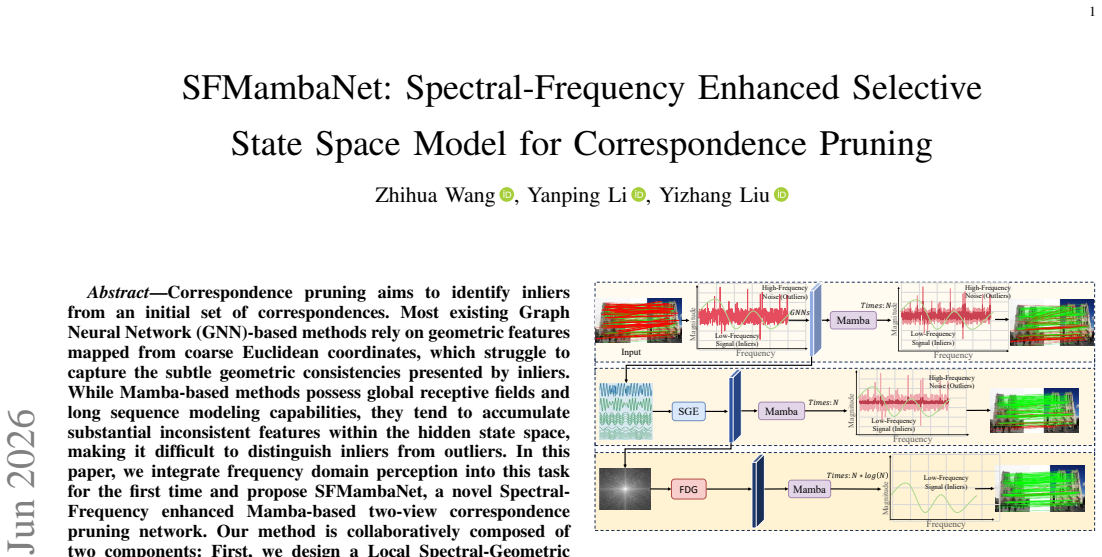
SFMambaNet is built from an LSGA block that adds spectral positional encoding to local graph interactions and applies multi-scale Mamba processing, followed by an SIGM block that inserts a frequency gate into the selective state-space model. The gate receives frequency cues from LSGA and uses them to suppress high-frequency noise accumulation inside the hidden states, thereby reducing propagation of inconsistent features while retaining useful geometric signal. The resulting architecture models global context with nearly linear complexity and improves inlier-outlier separability.
What carries the argument
The Spectral-Integrated Global Mamba (SIGM) block, which embeds a frequency gating mechanism inside the selective state-space update so that frequency cues supplied by the preceding LSGA block can attenuate high-frequency noise in the hidden-state trajectory.
If this is right
- Global context is modeled at nearly linear complexity instead of quadratic cost of graph networks.
- High-frequency noise is prevented from accumulating and propagating inside the hidden state.
- Local feature discriminability improves through spectral positional encoding and multi-scale Mamba processing.
- Inlier-outlier separability increases on challenging two-view correspondence tasks.
Where Pith is reading between the lines
- The same frequency-gating idea could be tested on other selective state-space tasks that suffer from accumulating inconsistent signals, such as long-horizon tracking or video correspondence.
- If the gate proves effective, similar spectral conditioning might be added to other linear-time sequence models to handle noisy geometric data without explicit graph construction.
- The approach suggests that frequency-domain cues can serve as an auxiliary control signal for any state-space model whose hidden trajectory must remain geometrically coherent.
Load-bearing premise
Frequency information extracted by the LSGA block can be routed into the SIGM frequency gate to suppress high-frequency noise accumulation inside Mamba hidden states without also discarding useful geometric signal.
What would settle it
Run the model with the frequency gate removed or with its input frequency cues replaced by random values and measure whether inlier recall on standard benchmarks drops by more than the margin reported between SFMambaNet and prior Mamba baselines.
Figures


read the original abstract
Correspondence pruning aims to identify inliers from an initial set of correspondences. Most existing Graph Neural Network (GNN)-based methods rely on geometric features mapped from coarse Euclidean coordinates, which struggle to capture the subtle geometric consistencies presented by inliers. While Mamba-based methods possess global receptive fields and long sequence modeling capabilities, they tend to accumulate substantial inconsistent features within the hidden state space, making it difficult to distinguish inliers from outliers. In this paper, we integrate frequency domain perception into this task for the first time and propose SFMambaNet, a novel Spectral-Frequency enhanced Mamba-based two-view correspondence pruning network. Our method is collaboratively composed of two components: First, we design a Local Spectral-Geometric Attention (LSGA) block. LSGA incorporates spectral positional encoding into local graph interactions and introduces multi-scale Mamba processing to enhance the capture of subtle geometric consistencies and improve local feature discriminability. Building upon this, we design a Spectral-Integrated Global Mamba (SIGM) block. SIGM embeds a frequency gating mechanism within the state space, utilizing the frequency information provided by LSGA to explicitly suppress high-frequency noise accumulation within hidden states and mitigate the propagation of inconsistent features. This enhances inlier-outlier separability and achieves robust global context modeling capabilities with nearly linear complexity. Extensive experiments demonstrate that SFMambaNet outperforms current state-of-the-art methods on several challenging tasks. The code is available at https://github.com/Kirito14IT/SFMambaNet.
Editorial analysis
A structured set of objections, weighed in public.
Referee Report
Summary. The paper proposes SFMambaNet, a Mamba-based architecture for two-view correspondence pruning. It introduces a Local Spectral-Geometric Attention (LSGA) block that incorporates spectral positional encoding into local graph interactions and multi-scale Mamba processing, and a Spectral-Integrated Global Mamba (SIGM) block that embeds a frequency gating mechanism using LSGA outputs to suppress high-frequency noise in hidden states while preserving geometric signal. The method claims nearly linear complexity and superior performance over SOTA methods on challenging tasks, with code released at the provided GitHub link.
Significance. If the performance gains and mechanism hold under scrutiny, the work would be significant for introducing frequency-domain perception to Mamba-based correspondence pruning for the first time. The LSGA and SIGM design offers a way to enhance local discriminability and global context modeling with explicit noise control, potentially benefiting tasks requiring robust inlier-outlier separation. Explicit credit is due for releasing reproducible code.
major comments (2)
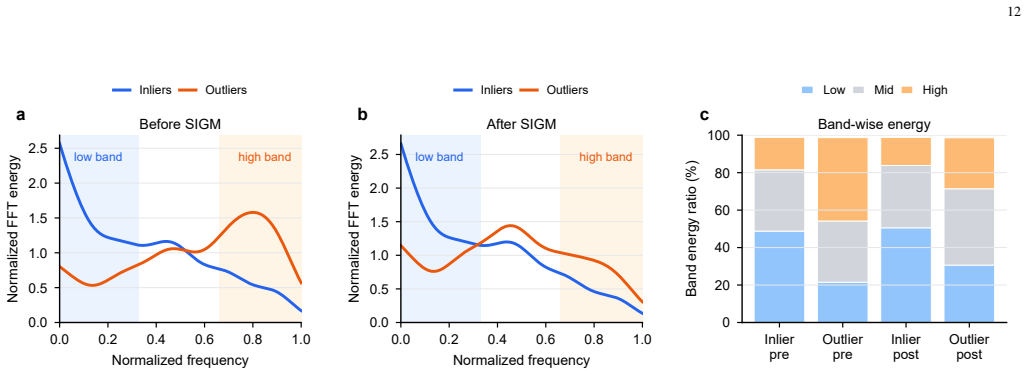
- [§3.3] §3.3 (SIGM block description): The central claim that the frequency gating mechanism 'explicitly suppress[es] high-frequency noise accumulation within hidden states' and 'mitigate[s] the propagation of inconsistent features' without discarding useful geometric signal is load-bearing for the contribution, yet the manuscript provides neither frequency-domain visualizations of hidden states pre/post-gating nor a targeted ablation isolating this suppression effect from other components (e.g., LSGA alone or standard Mamba). This leaves the asserted noise-suppression property as an untested modeling assumption.
- [§4] §4 (Experiments): The abstract asserts that 'extensive experiments demonstrate that SFMambaNet outperforms current state-of-the-art methods,' but without ablations that specifically validate the frequency-gating contribution (as opposed to overall architecture or hyperparameter choices), it is difficult to attribute reported gains to the SIGM mechanism. Standard error-bar reporting and dataset details would strengthen this section.
minor comments (1)
- [§1] The introduction could more explicitly contrast the frequency integration against prior spectral methods in related vision tasks to better situate the novelty claim.
Simulated Author's Rebuttal
We thank the referee for the constructive feedback and for recognizing the novelty of integrating frequency-domain perception into Mamba-based correspondence pruning. We address each major comment below and will incorporate revisions to strengthen the manuscript.
read point-by-point responses
-
Referee: [§3.3] §3.3 (SIGM block description): The central claim that the frequency gating mechanism 'explicitly suppress[es] high-frequency noise accumulation within hidden states' and 'mitigate[s] the propagation of inconsistent features' without discarding useful geometric signal is load-bearing for the contribution, yet the manuscript provides neither frequency-domain visualizations of hidden states pre/post-gating nor a targeted ablation isolating this suppression effect from other components (e.g., LSGA alone or standard Mamba). This leaves the asserted noise-suppression property as an untested modeling assumption.
Authors: We agree that the manuscript currently lacks frequency-domain visualizations of hidden states and a targeted ablation isolating the frequency gating effect. To address this, the revised version will add visualizations comparing hidden states pre- and post-gating, along with an ablation that fixes LSGA and other components while varying only the frequency gating within SIGM. These additions will provide direct empirical support for the noise-suppression claim. revision: yes
-
Referee: [§4] §4 (Experiments): The abstract asserts that 'extensive experiments demonstrate that SFMambaNet outperforms current state-of-the-art methods,' but without ablations that specifically validate the frequency-gating contribution (as opposed to overall architecture or hyperparameter choices), it is difficult to attribute reported gains to the SIGM mechanism. Standard error-bar reporting and dataset details would strengthen this section.
Authors: We concur that more targeted ablations are needed to attribute gains specifically to the frequency-gating component of SIGM. The revision will expand Section 4 with ablations isolating this mechanism, include standard error bars from multiple runs, and add further dataset details. While the existing results already demonstrate overall outperformance, these enhancements will better substantiate the contribution of the proposed mechanism. revision: yes
Circularity Check
No circularity: architectural proposal with independent empirical claims
full rationale
The paper presents SFMambaNet as a novel architecture with LSGA and SIGM blocks that incorporate spectral-frequency elements into Mamba processing for correspondence pruning. No equations, derivations, or first-principles predictions appear in the provided text. The frequency gating in SIGM is described as an explicit design choice using outputs from LSGA, not a quantity defined in terms of itself or fitted parameters. Performance claims rest on experiments rather than any self-referential reduction. None of the enumerated circularity patterns (self-definitional, fitted-input prediction, self-citation load-bearing, etc.) are present. The derivation chain is self-contained as an engineering proposal.
Axiom & Free-Parameter Ledger
axioms (1)
- domain assumption Deep networks trained on geometric and frequency features can separate inliers from outliers more effectively than prior GNN or Mamba designs.
Reference graph
Works this paper leans on
-
[1]
Benchmarking 6dof outdoor visual localization in changing conditions,
T. Sattler, W. Maddern, C. Toft, A. Torii, L. Hammarstrand, E. Stenborg, D. Safari, M. Okutomi, M. Pollefeys, J. Sivicet al., “Benchmarking 6dof outdoor visual localization in changing conditions,” inProc. IEEE/CVF Conf. Comput. Vis. Pattern Recognit. (CVPR), 2018, pp. 8601–8610
2018
-
[2]
Robust feature matching for remote sensing image registration via locally linear transforming,
J. Ma, H. Zhou, J. Zhao, Y . Gao, J. Jiang, and J. Tian, “Robust feature matching for remote sensing image registration via locally linear transforming,”IEEE Trans. Geosci. Remote Sens., vol. 53, no. 12, pp. 6469–6481, 2015
2015
-
[3]
Multi-granularity consensus network for remote sensing image correspondence pruning,
F. Zhuang, Y . Liu, X. Li, J. Zhou, R. Chen, L. Wei, C. Yang, and J. Ma, “Multi-granularity consensus network for remote sensing image correspondence pruning,”ISPRS J. Photogramm. Remote Sens., vol. 219, pp. 38–51, 2025
2025
-
[4]
Orb-slam: A versatile and accurate monocular slam system,
R. Mur-Artal, J. M. M. Montiel, and J. D. Tardos, “Orb-slam: A versatile and accurate monocular slam system,”IEEE Trans. Robot., vol. 31, no. 5, pp. 1147–1163, 2015
2015
-
[5]
Structure-from-motion revisited,
J. L. Schonberger and J.-M. Frahm, “Structure-from-motion revisited,” inProc. IEEE/CVF Conf. Comput. Vis. Pattern Recognit. (CVPR), 2016, pp. 4104–4113
2016
-
[6]
Pg- net: Progressive guidance network via robust contextual embedding for efficient point cloud registration,
J. Wang, X. Liu, L. Dai, J. Ma, L. Wei, C. Yang, and R. Chen, “Pg- net: Progressive guidance network via robust contextual embedding for efficient point cloud registration,”IEEE Trans. Geosci. Remote Sens., vol. 61, pp. 1–12, 2023
2023
-
[7]
Distinctive image features from scale-invariant keypoints,
D. G. Lowe, “Distinctive image features from scale-invariant keypoints,” Int. J. Comput. Vis., vol. 60, pp. 91–110, 2004
2004
-
[8]
Superpoint: Self- supervised interest point detection and description,
D. DeTone, T. Malisiewicz, and A. Rabinovich, “Superpoint: Self- supervised interest point detection and description,” inProc. IEEE/CVF Conf. Comput. Vis. Pattern Recognit. Workshops (CVPRW), 2018, pp. 224–236
2018
-
[9]
Random sample consensus: a paradigm for model fitting with applications to image analysis and automated cartography,
M. A. Fischler and R. C. Bolles, “Random sample consensus: a paradigm for model fitting with applications to image analysis and automated cartography,”Commun. ACM, vol. 24, no. 6, pp. 381–395, 1981
1981
-
[10]
Mlesac: A new robust estimator with application to estimating image geometry,
P. H. Torr and A. Zisserman, “Mlesac: A new robust estimator with application to estimating image geometry,”Comput. Vis. Image Under- stand., vol. 78, no. 1, pp. 138–156, 2000
2000
-
[11]
Usac: A universal framework for random sample consensus,
R. Raguram, O. Chum, M. Pollefeys, J. Matas, and J.-M. Frahm, “Usac: A universal framework for random sample consensus,”IEEE Trans. Pattern Anal. Mach. Intell., vol. 35, no. 8, pp. 2022–2038, 2012
2022
-
[12]
Learning to find good correspondences,
K. M. Yi, E. Trulls, Y . Ono, V . Lepetit, M. Salzmann, and P. Fua, “Learning to find good correspondences,” inProc. IEEE/CVF Conf. Comput. Vis. Pattern Recognit. (CVPR), 2018, pp. 2666–2674
2018
-
[13]
Vsformer: Visual- spatial fusion transformer for correspondence pruning,
T. Liao, X. Zhang, L. Zhao, T. Wang, and G. Xiao, “Vsformer: Visual- spatial fusion transformer for correspondence pruning,” inProc. AAAI Conf. Artif. Intell., vol. 38, no. 4, 2024, pp. 3369–3377
2024
-
[14]
Transmatch: Transformer-based correspon- dence pruning via local and global consensus,
Y . Liu, Y . Li, and S. Zhao, “Transmatch: Transformer-based correspon- dence pruning via local and global consensus,”Pattern Recognit., vol. 159, p. 111120, 2025
2025
-
[15]
Nm-net: Mining reliable neighbors for robust feature correspondences,
C. Zhao, Z. Cao, C. Li, X. Li, and J. Yang, “Nm-net: Mining reliable neighbors for robust feature correspondences,” inProc. IEEE/CVF Conf. Comput. Vis. Pattern Recognit. (CVPR), 2019, pp. 215–224
2019
-
[16]
Progressive correspondence pruning by consensus learning,
C. Zhao, Y . Ge, F. Zhu, R. Zhao, H. Li, and M. Salzmann, “Progressive correspondence pruning by consensus learning,” inProc. IEEE/CVF Int. Conf. Comput. Vis. (ICCV), 2021, pp. 6464–6473
2021
-
[17]
Progressive neighbor consistency mining for correspondence pruning,
X. Liu and J. Yang, “Progressive neighbor consistency mining for correspondence pruning,” inProc. IEEE/CVF Conf. Comput. Vis. Pattern Recognit. (CVPR), 2023, pp. 9527–9537
2023
-
[18]
Mamba: Linear-Time Sequence Modeling with Selective State Spaces
A. Gu and T. Dao, “Mamba: Linear-time sequence modeling with selective state spaces,” arXiv preprint arXiv:2312.00752, 2023
work page internal anchor Pith review Pith/arXiv arXiv 2023
-
[19]
Efficiently modeling long sequences with structured state spaces,
A. Gu, K. Goel, and C. R ´e, “Efficiently modeling long sequences with structured state spaces,” inProc. Int. Conf. Learn. Represent., 2022
2022
-
[20]
Matchmamba: Correspondence pruning via selective state space model,
Y . Wu, X. Li, H. Chen, C. Yang, L. Wei, and R. Chen, “Matchmamba: Correspondence pruning via selective state space model,”IEEE Trans. Circuits Syst. Video Technol., 2025
2025
-
[21]
Learning two-view correspondences and geometry using order-aware network,
J. Zhang, D. Sun, Z. Luo, A. Yao, L. Zhou, T. Shen, Y . Chen, L. Quan, and H. Liao, “Learning two-view correspondences and geometry using order-aware network,” inProc. IEEE/CVF Int. Conf. Comput. Vis. (ICCV), 2019, pp. 5845–5854
2019
-
[22]
Smoothness-driven consensus based on compact representation for robust feature matching,
A. Fan, X. Jiang, Y . Ma, X. Mei, and J. Ma, “Smoothness-driven consensus based on compact representation for robust feature matching,” IEEE Trans. Neural Netw. Learn. Syst., vol. 34, no. 8, pp. 4460–4472, 2023
2023
-
[23]
Gms: Grid-based motion statistics for fast, ultra-robust feature correspondence,
J. Bian, W.-Y . Lin, Y . Matsushita, S.-K. Yeung, T.-D. Nguyen, and M.-M. Cheng, “Gms: Grid-based motion statistics for fast, ultra-robust feature correspondence,” inProc. IEEE/CVF Conf. Comput. Vis. Pattern Recognit. (CVPR), 2017, pp. 4181–4190
2017
-
[24]
Matching with prosac-progressive sample consensus,
O. Chum and J. Matas, “Matching with prosac-progressive sample consensus,” inProc. IEEE/CVF Conf. Comput. Vis. Pattern Recognit. (CVPR), vol. 1. IEEE, 2005, pp. 220–226
2005
-
[25]
Magsac: marginalizing sample consensus,
D. Barath, J. Matas, and J. Noskova, “Magsac: marginalizing sample consensus,” inProc. IEEE/CVF Conf. Comput. Vis. Pattern Recognit. (CVPR), 2019, pp. 10 197–10 205
2019
-
[26]
Robust point matching via vector field consensus,
J. Ma, J. Zhao, J. Tian, A. L. Yuille, and Z. Tu, “Robust point matching via vector field consensus,”IEEE Trans. Image Process., vol. 23, no. 4, pp. 1706–1721, 2014
2014
-
[27]
Locality preserving matching,
J. Ma, J. Zhao, J. Jiang, H. Zhou, and X. Guo, “Locality preserving matching,”Int. J. Comput. Vis., vol. 127, pp. 512–531, 2019
2019
-
[28]
Ms2dg-net: Progressive correspondence learning via multiple sparse semantics dy- namic graph,
L. Dai, Y . Liu, J. Ma, L. Wei, T. Lai, C. Yang, and R. Chen, “Ms2dg-net: Progressive correspondence learning via multiple sparse semantics dy- namic graph,” inProc. IEEE/CVF Conf. Comput. Vis. Pattern Recognit. (CVPR), 2022, pp. 8973–8982
2022
-
[29]
Clg-net: Rethinking local and global perception in lightweight two-view correspondence learning,
M. Shen, G. Xiao, C. Yang, J. Guo, and L. Zhu, “Clg-net: Rethinking local and global perception in lightweight two-view correspondence learning,”IEEE Trans. Circuits Syst. Video Technol., 2024
2024
-
[30]
Mgca-net: Multi-graph contextual attention network for two-view correspondence learning,
S. Lin, M. Lo, H. Chen, Y . Liang, and Q. Wu, “Mgca-net: Multi-graph contextual attention network for two-view correspondence learning,” inProc. Int. Joint Conf. Artif. Intell., ser. IJCAI-2025. International Joint Conferences on Artificial Intelligence Organization, Sep. 2025, p. 1539–1547
2025
-
[31]
Vision mamba: Efficient visual representation learning with bidirectional state space model,
L. Zhu, B. Liao, Q. Zhang, X. Wang, W. Liu, and X. Wang, “Vision mamba: Efficient visual representation learning with bidirectional state space model,” inProc. Int. Conf. Mach. Learn., 2024
2024
-
[32]
Vmamba: Visual state space model,
Y . Liu, Y . Tian, Y . Zhao, H. Yu, L. Xie, Y . Wang, Q. Ye, J. Jiao, and Y . Liu, “Vmamba: Visual state space model,” inProc. Adv. Neural Inf. Process. Syst., 2024
2024
-
[33]
An image is worth 16x16 words: Transformers for image recognition at scale,
A. Dosovitskiy, “An image is worth 16x16 words: Transformers for image recognition at scale,” inProc. Int. Conf. Learn. Represent., 2021
2021
-
[34]
Pointmamba: A simple state space model for point cloud analysis,
D. Liang, X. Zhou, W. Xu, X. Zhu, Z. Zou, X. Ye, X. Tan, and X. Bai, “Pointmamba: A simple state space model for point cloud analysis,” arXiv preprint arXiv:2402.10739, 2024
-
[35]
Spatial- frequency enhanced mamba for multi-modal image fusion,
H. Sun, L. Lv, P. Zhang, T. Tang, F. Tian, W. Sun, and H. Lu, “Spatial- frequency enhanced mamba for multi-modal image fusion,”IEEE Trans. Image Process., vol. 34, pp. 7684–7696, 2025
2025
-
[36]
Fmnet: Frequency-assisted mamba-like linear attention network for camouflaged object detection,
M. Deng, S. Sun, Z. Li, X. Hu, and X. Wu, “Fmnet: Frequency-assisted mamba-like linear attention network for camouflaged object detection,” arXiv preprint arXiv:2503.11030, 2025
-
[37]
Grid-guided sparse laplacian consensus for robust feature matching,
Y . Xia and J. Ma, “Grid-guided sparse laplacian consensus for robust feature matching,”IEEE Trans. Image Process., 2025
2025
-
[38]
Fourier features let networks learn high frequency functions in low dimensional domains,
M. Tancik, P. Srinivasan, B. Mildenhall, S. Fridovich-Keil, N. Raghavan, U. Singhal, R. Ramamoorthi, J. Barron, and R. Ng, “Fourier features let networks learn high frequency functions in low dimensional domains,” Proc. Adv. Neural Inf. Process. Syst., vol. 33, pp. 7537–7547, 2020
2020
-
[39]
Hierarchical graph representation learning with differentiable pooling,
Z. Ying, J. You, C. Morris, X. Ren, W. Hamilton, and J. Leskovec, “Hierarchical graph representation learning with differentiable pooling,” Proc. Adv. Neural Inf. Process. Syst., vol. 31, 2018
2018
-
[40]
Graph-mamba: Towards long-range graph sequence modeling with selective state spaces
C. Wang, O. Tsepa, J. Ma, and B. Wang, “Graph-mamba: Towards long-range graph sequence modeling with selective state spaces,” arXiv preprint arXiv:2402.00789, 2024
-
[41]
Graph mamba: Towards learning on graphs with state space models,
A. Behrouz and F. Hashemi, “Graph mamba: Towards learning on graphs with state space models,” inProc. ACM SIGKDD Conf. Knowl. Discovery Data Mining (KDD), 2024, pp. 119–130
2024
-
[42]
Global filter networks for image classification,
Y . Rao, W. Zhao, Z. Zhu, J. Lu, and J. Zhou, “Global filter networks for image classification,”Proc. Adv. Neural Inf. Process. Syst., vol. 34, pp. 980–993, 2021
2021
-
[43]
Efficient token mixing for transformers via adaptive fourier neural operators,
J. Guibas, M. Mardani, Z. Li, A. Tao, A. Anandkumar, and B. Catanzaro, “Efficient token mixing for transformers via adaptive fourier neural operators,” inProc. Int. Conf. Learn. Represent., 2021
2021
-
[44]
Adam: A Method for Stochastic Optimization
D. P. Kingma, “Adam: A method for stochastic optimization,” arXiv preprint arXiv:1412.6980, 2014
work page internal anchor Pith review Pith/arXiv arXiv 2014
-
[45]
Yfcc100m: The new data in multimedia research,
B. Thomee, D. A. Shamma, G. Friedland, B. Elizalde, K. Ni, D. Poland, D. Borth, and L.-J. Li, “Yfcc100m: The new data in multimedia research,”Commun. ACM, vol. 59, no. 2, pp. 64–73, 2016
2016
-
[46]
Sun3d: A database of big spaces reconstructed using sfm and object labels,
J. Xiao, A. Owens, and A. Torralba, “Sun3d: A database of big spaces reconstructed using sfm and object labels,” inProc. IEEE/CVF Int. Conf. Comput. Vis. (ICCV), 2013, pp. 1625–1632. 14
2013
-
[47]
Scannet: Richly-annotated 3d reconstructions of indoor scenes,
A. Dai, A. X. Chang, M. Savva, M. Halber, T. Funkhouser, and M. Niess- ner, “Scannet: Richly-annotated 3d reconstructions of indoor scenes,” in Proc. IEEE/CVF Conf. Comput. Vis. Pattern Recognit. (CVPR), July 2017
2017
-
[48]
Pointnet++: Deep hierarchical feature learning on point sets in a metric space,
C. R. Qi, L. Yi, H. Su, and L. J. Guibas, “Pointnet++: Deep hierarchical feature learning on point sets in a metric space,”Proc. Adv. Neural Inf. Process. Syst., vol. 30, 2017
2017
-
[49]
Super- glue: Learning feature matching with graph neural networks,
P.-E. Sarlin, D. DeTone, T. Malisiewicz, and A. Rabinovich, “Super- glue: Learning feature matching with graph neural networks,” inProc. IEEE/CVF Conf. Comput. Vis. Pattern Recognit. (CVPR), 2020, pp. 4938–4947
2020
-
[50]
Acne: Atten- tive context normalization for robust permutation-equivariant learning,
W. Sun, W. Jiang, E. Trulls, A. Tagliasacchi, and K. M. Yi, “Acne: Atten- tive context normalization for robust permutation-equivariant learning,” inProc. IEEE/CVF Conf. Comput. Vis. Pattern Recognit. (CVPR), 2020, pp. 11 286–11 295
2020
-
[51]
T-net: Effective permutation-equivariant network for two-view correspondence learning,
Z. Zhong, G. Xiao, L. Zheng, Y . Lu, and J. Ma, “T-net: Effective permutation-equivariant network for two-view correspondence learning,” inProc. IEEE/CVF Int. Conf. Comput. Vis. (ICCV), 2021, pp. 1950– 1959
2021
-
[52]
U-match: Two-view correspondence learning with hierarchy-aware local context aggregation,
Z. Li, S. Zhang, and J. Ma, “U-match: Two-view correspondence learning with hierarchy-aware local context aggregation,” inProc. Int. Joint Conf. Artif. Intell., 2023, pp. 1169–1176
2023
-
[53]
Pgfnet: Preference-guided filtering network for two-view correspondence learning,
X. Liu, G. Xiao, R. Chen, and J. Ma, “Pgfnet: Preference-guided filtering network for two-view correspondence learning,”IEEE Trans. Image Process., vol. 32, pp. 1367–1378, 2023
2023
-
[54]
Mgnet: Learning correspon- dences via multiple graphs,
L. Dai, X. Du, H. Zhang, and J. Tang, “Mgnet: Learning correspon- dences via multiple graphs,” inProc. AAAI Conf. Artif. Intell., vol. 38, no. 4, 2024, pp. 3945–3953
2024
-
[55]
Multi-stage network with geometric semantic attention for two-view correspondence learning,
S. Lin, X. Chen, G. Xiao, H. Wang, F. Huang, and J. Weng, “Multi-stage network with geometric semantic attention for two-view correspondence learning,”IEEE Trans. Image Process., 2024
2024
-
[56]
Bclnet: Bilateral consensus learning for two-view correspondence pruning,
X. Miao, G. Xiao, S. Wang, and J. Yu, “Bclnet: Bilateral consensus learning for two-view correspondence pruning,” inProc. AAAI Conf. Artif. Intell., vol. 38, no. 5, 2024, pp. 4225–4232
2024
-
[57]
Graph context transformation learning for progressive correspondence pruning,
J. Guo, G. Xiao, S. Wang, and J. Yu, “Graph context transformation learning for progressive correspondence pruning,” inProc. AAAI Conf. Artif. Intell., vol. 38, no. 3, 2024, pp. 1968–1975
2024
-
[58]
Hpatches: A benchmark and evaluation of handcrafted and learned local descriptors,
V . Balntas, K. Lenc, A. Vedaldi, and K. Mikolajczyk, “Hpatches: A benchmark and evaluation of handcrafted and learned local descriptors,” inProc. IEEE/CVF Conf. Comput. Vis. Pattern Recognit. (CVPR), 2017, pp. 5173–5182. BIOGRAPHYSECTION Zhihua Wang is currently an undergraduate stu- dent in Computer Science and Technology at the School of Optical-Electr...
2017
discussion (0)
Sign in with ORCID, Apple, or X to comment. Anyone can read and Pith papers without signing in.