REVIEW 3 major objections 7 minor 38 references
First Steps Towards Overhearing LLM Agents: A Case Study With Dungeons & Dragons Gameplay
T0 review · 3 major / 7 minor · reviewed 2026-08-07 · deepseek-v4-flash
Pith's one-line read Large audio-language models can act as 'overhearing agents' that listen to human-to-human conversation and make background suggestions, with the biggest model using tone, pauses, and speaker identity that transcripts cannot capture.
desk verdict A genuinely new paradigm and a serious empirical study, but the headline audio-vs-text claim is confounded by checkpoint differences in the only models that show the effect. read the letter →
The pith
A machine-rendered reading of the paper's core claim, the machinery that carries it, and where it could break.
The reading
What carries the argument
The load-bearing machinery is a real-time tool-calling loop: gameplay audio is fed to a multimodal model in 10-second intervals appended to one running conversation (capped at 15 minutes), and each round the model must write chain-of-thought reasoning and then either call a tool or output "None." The three tasks are exposed as functions (search D&D data, manage NPCs on a virtual stage, generate an improvised NPC), so the model can only "speak" by making suggestions through those calls. What makes the paradigm work is the reasoning step: the model formulates an internal belief about the conversational goal before acting, and the paper shows that removing that step costs most of the performance. The audio itself carries the decisive cues, speaker identity and in-character voice for the stage-director task, pauses and filler words for NPC generation, which is why transcript-based systems hit a ceiling that the audio models pass.
What would settle it
Take the recorded gameplay audio and strip out exactly the cues the paper says matter, for example flattening pitch and speaking rate or scrambling which voice is the DM's while keeping the words identical, and rerun GPT-4o on the audio-input setting; if its F1 does not drop materially below 0.369, the audio-channel advantage is not being driven by tone, pause, and speaker-identity cues as claimed.
Extended reading notes
Core claim
On the paper's own terms, the discovery is that overhearing-agent behavior, inferring what a group of people needs and acting on it without joining the conversation, is not something that must be engineered task by task; it emerges in sufficiently large audio-language models. The paper argues this is specifically an audio-channel ability: a model that hears the game can tell when the Dungeon Master is speaking in character versus out of character, can notice pauses and fillers that signal the DM is improvising, and can track long-term conversational goals across 15-minute windows of context. Three lines of evidence carry the claim: the audio-over-text performance gap for the largest models, the collapse (more than 70% average F1 loss) when chain-of-thought reasoning is removed, and the failure-mode analysis showing that text-only pipelines either hallucinate NPC dialogue or slip into a "conversational default" of replying to the players directly. Smaller models and an ASR-pretrained audio model do not show the ability, which the paper attributes to instruction-tuning and pretraining objectives that do not prepare models for the overhearing role.
Load-bearing premise
The evaluation counts a model suggestion as correct when it falls within 300 seconds of a matching human-annotated gold suggestion, and those gold suggestions come from the Dungeon Master's own stopwatch notes plus players' subjective ratings of helpfulness, so the whole "emergent ability" conclusion rests on that window and those human judgments being trustworthy.
Editorial extensions
If this is right
- If the claim holds, transcription-based pipelines are not just a practical shortcut but a ceiling: any task that depends on who said something, how they said it, or when they hesitated will need models that hear the audio itself.
- Real-time overhearing agents must budget for chain-of-thought reasoning, since removing it costs more than 70% of F1 on average; the paper's speed numbers show the two can overlap, but only within a narrow window.
- The paradigm generalizes by swapping tools: the same passive-listening model, given calendar or meeting tools instead of D&D tools, is claimed to direct the same emergent reasoning toward scheduling and meeting support.
- Smaller audio models as they exist today are not usable for this task, they degenerate into repeated suggestions or silence, so the paper's implication is that distillation, not just scaling, is the next lever.
Reading between the lines
- Editorial inference: the 300-second matching window is generous enough that near-duplicate suggestions minutes apart count as hits; tightening the window to, say, 60 seconds would likely compress the gap between models and is the single most direct robustness check a skeptic could run.
- Editorial inference: the audio advantage should be portable to other group settings with high cognitive load, such as negotiation tables, medical consultations, and live interviews, and a cheap test would be a Wizard-of-Oz calendar agent that only ever acts when conversationally appropriate, mirroring the DM-assistant design.
- Editorial inference: the "conversational default" failure of text models suggests that instruction-tuned models carry a strong prior toward replying; an overhearing agent may need its output channel (tool calls only, never visible text) to be enforced at the decoding level, not just the prompt level.
Editorial analysis
A structured set of objections, weighed in public.
Referee Report
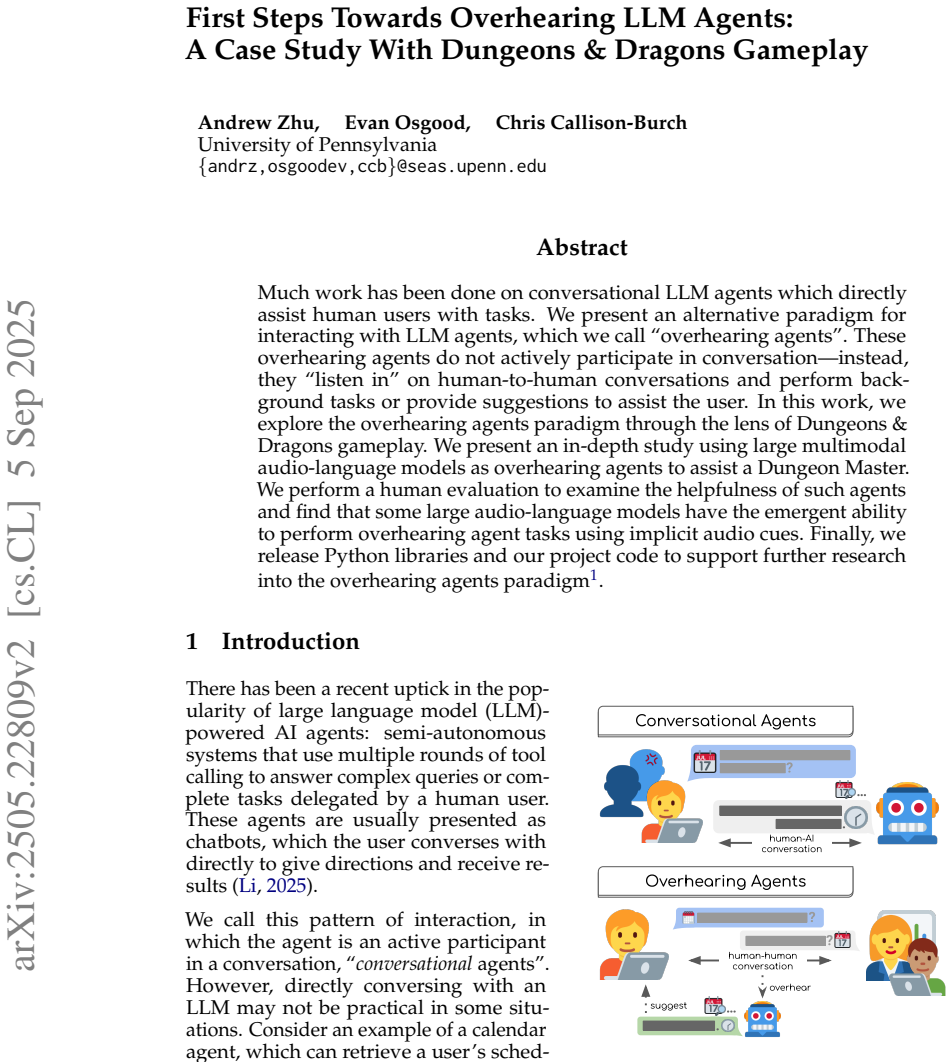
Summary. The paper introduces "overhearing agents," an interaction paradigm in which an LLM-based agent passively listens to human-to-human conversation and performs background tasks via tool calls, rather than conversing directly with the user. The paradigm is instantiated as a Dungeon Master's assistant for live D&D games, with three tasks: game-data retrieval, NPC stage direction, and improvised NPC generation. The authors recorded 41.5 hours of gameplay, ran five audio-language models in both audio and text-transcription conditions, and evaluated suggestions through stopwatch-based recall annotation and post-hoc human precision annotation. They report F1 scores per model and task, speed measurements, and ablations (removing reasoning, adding transcription). The headline claim is that some large audio-language models have an emergent ability to use implicit audio cues, such as speaker identity, tone, and hesitation, to perform these overhearing tasks. The paper also releases open-source libraries and project code.
Significance. The overhearing-agent paradigm is a genuinely new framing for LLM agent interaction, and the D&D setting is a rich, naturalistic test bed. The study has real strengths: a large novel dataset, human evaluation with two complementary annotation mechanisms (stopwatch recall and post-hoc precision), a moderate inter-annotator agreement of alpha=0.67, multiple model families and sizes, and a public code and library release. If the audio-cue claim were solidly supported, this would be a notable result for multimodal agents and for understanding how audio signals beyond words can be exploited by LLMs. However, as presented, the central evidence for the audio advantage is not yet convincing because the audio and text conditions for the two OpenAI models use different model checkpoints, and the open-weight models, which are checkpoint-matched, show no audio advantage. The evaluation also lacks confidence intervals and significance tests, and the 300-second matching window is loose enough to require sensitivity analysis.
major comments (3)
- [Appendix B, Table 5] The audio-vs-text comparison for GPT-4o and GPT-4o-mini, which is the primary quantitative support for the "implicit audio cues" claim, is confounded by model checkpoint differences. The audio condition uses gpt-4o-realtime-preview-2024-12-17 and gpt-4o-mini-realtime-preview-2024-12-17, while the text condition uses gpt-4o-2024-11-20 and gpt-4o-mini-2024-07-18. These are different model versions with potentially different post-training, tool-calling behavior, and decoding characteristics, so the F1 gaps in Figure 3 (GPT-4o: 0.369 audio vs 0.236 text; GPT-4o-mini: 0.159 vs 0.042) cannot be attributed to audio modality alone. This matters because the open-weight models, which do use identical weights across modalities, show either no audio advantage (Ultravox: text 0.343 vs audio 0.132) or near-zero performance in both modalities (Qwen2.5, Phi-4). The only positive quantitative evidence for the headline claim therefore rests on the confounded comparison. The authors should either run a checkpoint-matched comparison (for example, using a model that accepts both audio and text inputs under identical weights, or matching the text model version to the realtime-preview version if the API permits), or provide a separate controlled experiment that manipulates audio cues (e.g., same transcript with different prosody or speaker diarization) to isolate their effect, and should revise the abstract's claim if such evidence is not available.
- [Section 4, Figure 3] The F1 scores are reported as point estimates without confidence intervals or significance tests. Given that the dataset is a single continuous game with 14,939 turns and 940 gold suggestions, the differences between conditions may be within sampling noise; for example, Ultravox-text (0.343) and GPT-4o-audio (0.369) are close, and several small-model scores are near zero. The paper's qualitative conclusions about model ordering and about which models "significantly" benefit from audio would be substantially stronger with bootstrap confidence intervals or an appropriate paired significance test across sessions or time intervals. Without these, the reader cannot tell whether the reported F1 differences are reliable, which is load-bearing for the central claim.
- [Section 4, evaluation metrics] The 300-second matching window for a suggestion to be considered correct is very generous relative to both the 10-second input intervals and the real-time nature of the assistive task. Over a 41.5-hour corpus, a model that periodically guesses common entities or repeatedly emits suggestions could match gold events almost by chance, especially for the Generate NPCs task. The paper should report how F1 changes as a function of the matching window (e.g., 30s, 60s, 120s, 300s) and should present precision and recall separately for each task and model, rather than only aggregate F1 and one task-specific precision table. In addition, Section 3.3 is ambiguous about whether the 940 gold suggestions come from the DM's stopwatch events or from filtered positive post-hoc annotations; this distinction should be clarified because it directly affects how recall is computed.
minor comments (7)
- [Title page] The title contains a spacing typo: "T owards" should be "Towards."
- [Abstract] The phrase "presentoverhearingAI agents" is missing a space; it should be "present overhearing AI agents."
- [Section 5] The sentence "the agent in which the agent converses directly with the user" repeats "the agent" and is grammatically broken; it should be "in which the agent converses directly with the user."
- [Section 5] "audio-langauge models" is a typo for "audio-language models."
- [Section 3.1] The heading "T asks" should read "Tasks."
- [Figure 4] The y-axis label "Times Realtime" should be "Times real-time" and the measurement basis (relative to what reference for open-weight models) should be stated more precisely in the caption.
- [Table 2] The table caption refers to errors "marked in red," but the reproduced table does not show color; please mark the erroneous span or otherwise indicate it clearly in print.
Circularity Check
No significant circularity: the overhearing-agent results rest on external human annotations and off-the-shelf model outputs; self-citations are software/background only.
full rationale
The paper makes an empirical claim about off-the-shelf models; there is no derivation chain that reduces to its inputs. Gold suggestions were produced by DM stopwatch annotations and post-hoc player ratings (Section 3.3), independent of model outputs, and the 300-second equivalence window and the 80% string-similarity threshold are evaluation criteria applied symmetrically, not fitted to produce the headline result. The model comparisons use external checkpoints and human labels, so the central F1 scores are not constructed from the claim being tested. Self-citations (Zhu et al. 2023a for Kani; Zhu et al. 2023b for CALYPSO; Callison-Burch et al. 2022 for D&D as a challenge setting) are software/background references and are not load-bearing for the empirical finding. The audio-vs-text comparison for GPT-4o and GPT-4o-mini uses different checkpoint versions (Appendix B, Table 5), which is a potential experimental confound for the 'implicit audio cues' interpretation, but a confound is not circularity: the reported F1 values are not equivalent to the conclusion by construction, and the open-weight models with matched weights show no audio advantage. No quoted step exhibits an equation that reduces to its own input or a fitted parameter renamed as a prediction; therefore the circularity score is 0.
Assumptions & free parameters
free parameters (2)
- Suggestion matching window =
300 seconds
- NPC speech equivalence threshold =
>80% string similarity
assumptions (3)
- domain assumption Human ratings on a -2 to +2 scale correspond to true helpfulness of a suggestion in context.
- domain assumption Dungeons & Dragons gameplay is representative of overhearing-agent use cases.
- ad hoc to paper The 300-second temporal window and 80% string-similarity threshold define 'correct' suggestions.
invented entities (1)
-
Overhearing agent
Cite this review
Pith. "Pith review of First Steps Towards Overhearing LLM Agents: A Case Study With Dungeons & Dragons Gameplay." pith.science (2026). https://pith.science/paper/GMF3HJWS
@misc{pith2026250522809,
  author       = {Pith},
  title        = {Pith review of: First Steps Towards Overhearing LLM Agents: A Case Study With Dungeons & Dragons Gameplay},
  year         = {2026},
  howpublished = {\url{https://pith.science/paper/GMF3HJWS}},
  note         = {Machine review of arXiv:2505.22809}
}
read the original abstract
Much work has been done on conversational LLM agents which directly assist human users with tasks. We present an alternative paradigm for interacting with LLM agents, which we call "overhearing agents". These overhearing agents do not actively participate in conversation -- instead, they "listen in" on human-to-human conversations and perform background tasks or provide suggestions to assist the user. In this work, we explore the overhearing agents paradigm through the lens of Dungeons & Dragons gameplay. We present an in-depth study using large multimodal audio-language models as overhearing agents to assist a Dungeon Master. We perform a human evaluation to examine the helpfulness of such agents and find that some large audio-language models have the emergent ability to perform overhearing agent tasks using implicit audio cues. Finally, we release Python libraries and our project code to support further research into the overhearing agents paradigm at https://github.com/zhudotexe/overhearing_agents.
Figures


Figures from the paper (4 more)


Reference graph
Works this paper leans on
-
[1]
Marco Aiello, Paolo Busetta, Antonia Doná, and Luciano Serafini. Ontological Overhearing . In John-Jules Ch. Meyer and Milind Tambe (eds.), Intelligent Agents VIII , pp.\ 175--189, Berlin, Heidelberg, 2002. Springer. ISBN 978-3-540-45448-9. doi:10.1007/3-540-45448-9_13
-
[2]
Homogenization Effects of Large Language Models on Human Creative Ideation
Barrett R Anderson, Jash Hemant Shah, and Max Kreminski. Homogenization Effects of Large Language Models on Human Creative Ideation . Creativity and Cognition, pp.\ 413--425, 2024. doi:10.1145/3635636.3656204. URL https://dl.acm.org/doi/10.1145/3635636.3656204
arXiv 2024
-
[3]
Investigating Proactive Search Support in Conversations
Salvatore Andolina, Valeria Orso, Hendrik Schneider, Khalil Klouche, Tuukka Ruotsalo, Luciano Gamberini, and Giulio Jacucci. Investigating Proactive Search Support in Conversations . In Proceedings of the 2018 Designing Interactive Systems Conference , DIS '18, pp.\ 1295--1307, New York, NY, USA, 2018. Association for Computing Machinery. ISBN 978-1-4503-...
arXiv 2018
-
[4]
Shraddha Barke, Michael B. James, and Nadia Polikarpova. Grounded copilot: How programmers interact with code-generating models. Proc. ACM Program. Lang., 7 0 (OOPSLA1), April 2023. doi:10.1145/3586030. URL https://doi-org.proxy.library.upenn.edu/10.1145/3586030
doi:10.1145/3586030 2023
-
[5]
o m, Staffan Jonsson, and Staffan Bj \
Karl Bergstr \" o m, Staffan Jonsson, and Staffan Bj \" o rk. Undercurrents: A computer-based gameplay tool to support tabletop roleplaying. In Proceedings of Nordic DiGRA 2010 Conference, Nordic DiGRA 2010, Stockholm, Sweden, August 16-17, 2010, 2010. Digital Games Research Association, 2010. URL https://dl.digra.org/index.php/dl/article/view/507
work page 2010
-
[6]
Extending Multi -agent Cooperation by Overhearing
Paolo Busetta, Luciano Serafini, Dhirendra Singh, and Floriano Zini. Extending Multi -agent Cooperation by Overhearing . In Carlo Batini, Fausto Giunchiglia, Paolo Giorgini, and Massimo Mecella (eds.), Cooperative Information Systems , pp.\ 40--52, Berlin, Heidelberg, 2001. Springer. ISBN 978-3-540-44751-1. doi:10.1007/3-540-44751-2_5
-
[7]
Martin, Daphne Ippolito, Suma Bailis, and David Reitter
Chris Callison-Burch, Gaurav Singh Tomar, Lara J. Martin, Daphne Ippolito, Suma Bailis, and David Reitter. Dungeons and dragons as a dialog challenge for artificial intelligence. In Yoav Goldberg, Zornitsa Kozareva, and Yue Zhang (eds.), Proceedings of the 2022 Conference on Empirical Methods in Natural Language Processing, pp.\ 9379--9393, Abu Dhabi, Uni...
-
[8]
Mark Chen, Jerry Tworek, Heewoo Jun, Qiming Yuan, Henrique Ponde de Oliveira Pinto, Jared Kaplan, Harri Edwards, Yuri Burda, Nicholas Joseph, Greg Brockman, Alex Ray, Raul Puri, Gretchen Krueger, Michael Petrov, Heidy Khlaaf, Girish Sastry, Pamela Mishkin, Brooke Chan, Scott Gray, Nick Ryder, Mikhail Pavlov, Alethea Power, Lukasz Kaiser, Mohammad Bavarian...
arXiv 2021
Show all 38 references
-
[9]
D&D Basic Rules
Jeremy Crawford, Mike Mearls, and Christopher Perkins. D&D Basic Rules. Wizards of the Coast, Renton, WA, 2018. URL https://media.wizards.com/2018/dnd/downloads/DnD_BasicRules_2018.pdf
2018
-
[10]
Ferreira, Levi H
Lucas N. Ferreira, Levi H. S. Lelis, and Jim Whitehead. Computer-generated music for tabletop role-playing games. In Proceedings of the Sixteenth AAAI Conference on Artificial Intelligence and Interactive Digital Entertainment , AIIDE '20, pp.\ 59--65. AAAI Press, 2020. ISBN 9...
2020
-
[11]
Introducing ultravox v0.5: Taking the lead in speech understanding, 2025
Fixie AI . Introducing ultravox v0.5: Taking the lead in speech understanding, 2025. URL https://www.ultravox.ai/blog/ultravox-v0-5-taking-the-lead-in-speech-understanding. Accessed: 2025-05-07
2025
-
[12]
Yannakakis
Roberto Gallotta, Graham Todd, Marvin Zammit, Sam Earle, Antonios Liapis, Julian Togelius, and Georgios N. Yannakakis. Large Language Models and Games : A Survey and Roadmap . IEEE Transactions on Games, pp.\ 1--18, 2024. ISSN 2475-1510. doi:10.1109/TG.2024.3461510. URL https:...
2024
-
[13]
The curious case of neural text degeneration
Ari Holtzman, Jan Buys, Li Du, Maxwell Forbes, and Yejin Choi. The curious case of neural text degeneration. In 8th International Conference on Learning Representations, ICLR 2020, Addis Ababa, Ethiopia, April 26-30, 2020 . OpenReview.net, 2020. URL https://openreview.net/foru...
2020
-
[14]
Creative Writing with an AI - Powered Writing Assistant : Perspectives from Professional Writers , 2022
Daphne Ippolito, Ann Yuan, Andy Coenen, and Sehmon Burnam. Creative Writing with an AI - Powered Writing Assistant : Perspectives from Professional Writers , 2022. URL https://arxiv.org/abs/2211.05030
2022 arXiv
-
[15]
Towards Computational Support with Language Models for TTRPG Game Masters
Jack Kelly, Michael Mateas, and Noah Wardrip-Fruin. Towards Computational Support with Language Models for TTRPG Game Masters . In Proceedings of the 18th International Conference on the Foundations of Digital Games , FDG '23, pp.\ 1--4, New York, NY, USA, 2023. Association fo...
2023
-
[16]
A review of prominent paradigms for LLM -based agents: Tool use, planning (including RAG ), and feedback learning
Xinzhe Li. A review of prominent paradigms for LLM -based agents: Tool use, planning (including RAG ), and feedback learning. In Owen Rambow, Leo Wanner, Marianna Apidianaki, Hend Al-Khalifa, Barbara Di Eugenio, and Steven Schockaert (eds.), Proceedings of the 31st Internation...
2025
-
[17]
Moira McGregor and John C. Tang. More to Meetings : Challenges in Using Speech - Based Technology to Support Meetings . Proceedings of the 2017 ACM Conference on Computer Supported Cooperative Work and Social Computing, pp.\ 2208--2220, 2017. doi:10.1145/2998181.2998335. URL h...
2017
-
[18]
Phi-4-mini technical report: Compact yet powerful multimodal language models via mixture-of-loras, 2025
Microsoft , Abdelrahman Abouelenin, Atabak Ashfaq, Adam Atkinson, Hany Awadalla, Nguyen Bach, Jianmin Bao, Alon Benhaim, Martin Cai, Vishrav Chaudhary, Congcong Chen, Dong Chen, Dongdong Chen, Junkun Chen, Weizhu Chen, Yen-Chun Chen, Yi ling Chen, Qi Dai, Xiyang Dai, Ruchao Fa...
2025 arXiv
-
[19]
Novick and Karen Ward
David G. Novick and Karen Ward. Mutual Beliefs of Multiple Conversants : A Computational Model of Collaboration in Air Traffic Control . In Proceedings of the Eleventh National Conference on Artificial Intelligence, AAAI'93, pp.\ 196–201. AAAI Press, 1993. ISBN 0262510715
1993
-
[20]
Gpt-4o system card, 2024
OpenAI . Gpt-4o system card, 2024. URL https://arxiv.org/abs/2410.21276
2024 arXiv
-
[21]
Bardo: Emotion - Based Music Recommendation for Tabletop Role - Playing Games
Rafael Padovani, Lucas Ferreira, and Levi Lelis. Bardo: Emotion - Based Music Recommendation for Tabletop Role - Playing Games . In Proceedings of the AAAI Conference on Artificial Intelligence and Interactive Digital Entertainment , volume 13, pp.\ 214--220, 2017. doi:10.1609...
2017 doi
-
[22]
Robust speech recognition via large-scale weak supervision
Alec Radford, Jong Wook Kim, Tao Xu, Greg Brockman, Christine McLeavey, and Ilya Sutskever. Robust speech recognition via large-scale weak supervision. In Andreas Krause, Emma Brunskill, Kyunghyun Cho, Barbara Engelhardt, Sivan Sabato, and Jonathan Scarlett (eds.), Internation...
2023
-
[23]
Toolformer: Language models can teach themselves to use tools
Timo Schick, Jane Dwivedi - Yu, Roberto Dess \` , Roberta Raileanu, Maria Lomeli, Eric Hambro, Luke Zettlemoyer, Nicola Cancedda, and Thomas Scialom. Toolformer: Language models can teach themselves to use tools. In Alice Oh, Tristan Naumann, Amir Globerson, Kate Saenko, Morit...
2023
-
[24]
Understanding by addressees and overhearers
Michael F Schober and Herbert H Clark. Understanding by addressees and overhearers. Cognitive Psychology, 21 0 (2): 0 211--232, 1989. ISSN 0010-0285. doi:10.1016/0010-0285(89)90008-X. URL https://www.sciencedirect.com/science/article/pii/001002858990008X
1989
-
[25]
Abigail See, Aneesh Pappu, Rohun Saxena, Akhila Yerukola, and Christopher D. Manning. Do massively pretrained language models make better storytellers? In Mohit Bansal and Aline Villavicencio (eds.), Proceedings of the 23rd Conference on Computational Natural Language Learning...
2019 doi
-
[26]
Investigating Users ' Preferences and Expectations for Always - Listening Voice Assistants
Madiha Tabassum, Tomasz Kosiński, Alisa Frik, Nathan Malkin, Primal Wijesekera, Serge Egelman, and Heather Richter Lipford. Investigating Users ' Preferences and Expectations for Always - Listening Voice Assistants . Proceedings of the ACM on Interactive, Mobile, Wearable and ...
2019 doi
-
[27]
Chi, Quoc V
Jason Wei, Xuezhi Wang, Dale Schuurmans, Maarten Bosma, Brian Ichter, Fei Xia, Ed H. Chi, Quoc V. Le, and Denny Zhou. Chain-of-thought prompting elicits reasoning in large language models. In Sanmi Koyejo, S. Mohamed, A. Agarwal, Danielle Belgrave, K. Cho, and A. Oh (eds.), Ad...
2022
-
[28]
Willard and Rémi Louf
Brandon T. Willard and Rémi Louf. Efficient guided generation for large language models, 2023. URL https://arxiv.org/abs/2307.09702
2023 arXiv
-
[29]
Qwen2.5-omni technical report, 2025
Jin Xu, Zhifang Guo, Jinzheng He, Hangrui Hu, Ting He, Shuai Bai, Keqin Chen, Jialin Wang, Yang Fan, Kai Dang, Bin Zhang, Xiong Wang, Yunfei Chu, and Junyang Lin. Qwen2.5-omni technical report, 2025. URL https://arxiv.org/abs/2503.20215
2025 arXiv
-
[30]
Narasimhan, and Yuan Cao
Shunyu Yao, Jeffrey Zhao, Dian Yu, Nan Du, Izhak Shafran, Karthik R. Narasimhan, and Yuan Cao. React: Synergizing reasoning and acting in language models. In The Eleventh International Conference on Learning Representations, ICLR 2023, Kigali, Rwanda, May 1-5, 2023 . OpenRevie...
2023
-
[31]
Wordcraft: Story writing with large language models
Ann Yuan, Andy Coenen, Emily Reif, and Daphne Ippolito. Wordcraft: Story writing with large language models. In Proceedings of the 27th International Conference on Intelligent User Interfaces, IUI '22, pp.\ 841–852, New York, NY, USA, 2022. Association for Computing Machinery....
2022
-
[32]
I cast detect thoughts: Learning to converse and guide with intents and theory-of-mind in dungeons and dragons
Pei Zhou, Andrew Zhu, Jennifer Hu, Jay Pujara, Xiang Ren, Chris Callison-Burch, Yejin Choi, and Prithviraj Ammanabrolu. I cast detect thoughts: Learning to converse and guide with intents and theory-of-mind in dungeons and dragons. In Anna Rogers, Jordan Boyd-Graber, and Naoak...
2023
-
[33]
Kani: A lightweight and highly hackable framework for building language model applications
Andrew Zhu, Liam Dugan, Alyssa Hwang, and Chris Callison-Burch. Kani: A lightweight and highly hackable framework for building language model applications. In Liling Tan, Dmitrijs Milajevs, Geeticka Chauhan, Jeremy Gwinnup, and Elijah Rippeth (eds.), Proceedings of the 3rd Wor...
2023 doi
-
[34]
CALYPSO : LLMs as dungeon masters' assistants
Andrew Zhu, Lara Martin, Andrew Head, and Chris Callison-Burch. CALYPSO : LLMs as dungeon masters' assistants. In Proceedings of the Nineteenth AAAI Conference on Artificial Intelligence and Interactive Digital Entertainment , volume 19 of AIIDE '23 , pp.\ 380--390, Salt Lake ...
2023 doi
-
[35]
write newline
" write newline "" before.all 'output.state := FUNCTION n.dashify 't := "" t empty not t #1 #1 substring "-" = t #1 #2 substring "--" = not "--" * t #2 global.max substring 't := t #1 #1 substring "-" = "-" * t #2 global.max substring 't := while if t #1 #1 substring * t #2 gl...
-
[36]
@esa (Ref
\@ifxundefined[1] #1\@undefined \@firstoftwo \@secondoftwo \@ifnum[1] #1 \@firstoftwo \@secondoftwo \@ifx[1] #1 \@firstoftwo \@secondoftwo [2] @ #1 \@temptokena #2 #1 @ \@temptokena \@ifclassloaded agu2001 natbib The agu2001 class already includes natbib coding, so you should ...
-
[37]
\@lbibitem[] @bibitem@first@sw\@secondoftwo \@lbibitem[#1]#2 \@extra@b@citeb \@ifundefined br@#2\@extra@b@citeb \@namedef br@#2 \@nameuse br@#2\@extra@b@citeb \@ifundefined b@#2\@extra@b@citeb @num @parse #2 @tmp #1 NAT@b@open@#2 NAT@b@shut@#2 \@ifnum @merge>\@ne @bibitem@firs...
-
[38]
@open @close @open @close and [1] URL: #1 \@ifundefined chapter * \@mkboth \@ifxundefined @sectionbib * \@mkboth * \@mkboth\@gobbletwo \@ifclassloaded amsart * \@ifclassloaded amsbook * \@ifxundefined @heading @heading NAT@ctr thebibliography [1] @ \@biblabel @NAT@ctr \@bibset...
Reviewed August 7, 2026 · model on record in the stance chip above.
Discussion (0). Sign in to comment.