REVIEW 2 major objections 5 minor 20 references
An Unsupervised Search for Novel Instrumental Glitches in LIGO O4a: Multi-Scale Sensitization, Empirical Physical Vetoes, and Rate Upper Limits
T0 review · 2 major / 5 minor · reviewed 2026-08-01 · deepseek-v4-flash
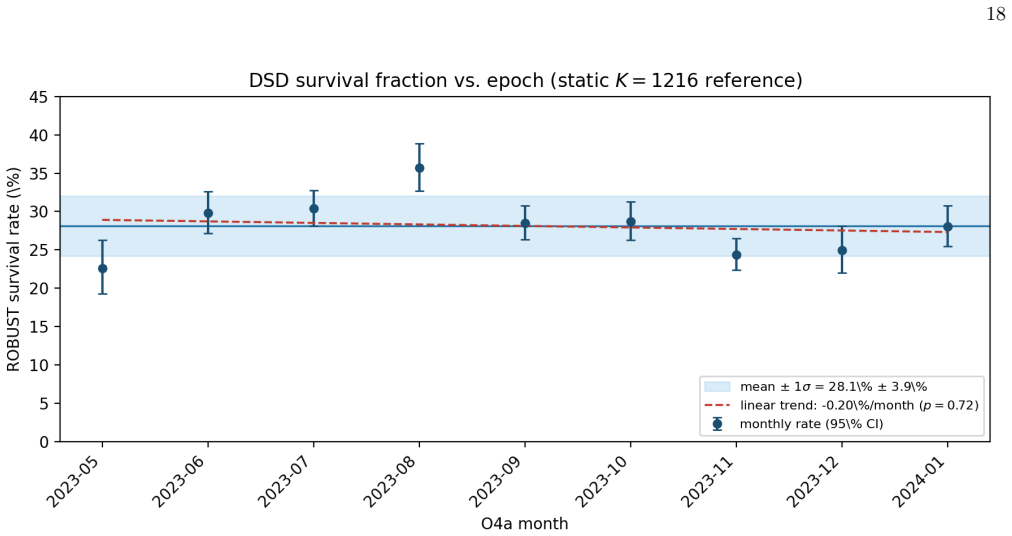
Pith's one-line read Early O4a data, once recalibrated against native background and physically vetoed, show no discrete novel glitch family and no cross-detector coincident event; 90% upper limits are 5.83 yr−1 (H1) and 5.63 yr−1 (L1).
desk verdict A self-correcting null result that earns serious review, but the quoted rate limits silently drop the paper's own surviving L1 outlier. read the letter →
The pith
A machine-rendered reading of the paper's core claim, the machinery that carries it, and where it could break.
The reading
What carries the argument
The argument is carried by the DANTE V3 pipeline. Its load-bearing parts: (1) multi-scale Q-transform spectrograms at 0.5–4 s plus a 32 s window, fed into a frozen self-supervised vision transformer with Top-k multiple-instance pooling to flag candidates; (2) a vector-quantized native background index (K=1216) with block-bootstrap percentile thresholds to re-score candidates and reject domain-shift artifacts; (3) an empirical family-wise PEM coherence veto calibrated per event from time-shifted surrogate pairs; and (4) a physical coincidence statistic—normalized cross-correlation of whitened strain in the candidate's band over the light-travel lag window—thresholded at the pooled 99th percen
What would settle it
For a random sample of candidates, build a dense per-event null using 100+ time shifts instead of the 4–8 available (for example, shifts of ±0.1, ±0.2, ..., ±8 s). If more than about 1% of on-source events exceed their per-event 99th percentile, the pooled-threshold design is masking event-level coincidences and the zero-coincidence claim fails. A second check: compare per-event null means between early and late O4a sessions; if they differ beyond sampling noise, the pooled null is not exchangeable.
Extended reading notes
Core claim
After expanding the search to four temporal scales and correcting for the non-stationary drift of the detector noise manifold with a native-background index, the author finds that the apparent novel glitch families reported by uncalibrated unsupervised pipelines do not survive: 71.7% of candidates are statistically indistinguishable from background, and the rest coalesce into a single macro-cluster with no discrete recurring substructure—a topology shared by pristine background. A physically calibrated PEM veto removes one isolated candidate via control-line coupling, leaving one uncatalogued instrumental outlier. The author then replaces the embedding-similarity coincidence test, which cann
Load-bearing premise
The 'no coincident event' result rests on the assumption that the pooled time-shifted noise measurements across 8,749 events form one valid reference distribution, even though each event supplies only 4–8 shifted samples; if the detectors' noise statistics change between events, the shared threshold could conceal a real coincidence or create false assurance.
Editorial extensions
If this is right
- Raw unsupervised candidate counts in O4a are dominated by noise-manifold drift: roughly 72% of multi-scale candidates are indistinguishable from native background after recalibration, so any unsupervised glitch claim on this epoch must include a native-background defense.
- Within the morphologies the pipeline can see, there is no evidence of a discrete, recurring novel instrumental glitch family in early O4a; all survivors merge into one macro-cluster that pristine background exhibits even more strongly.
- No cross-detector coincident unmodeled transient was found among 8,749 candidates, with the physical statistic validated to recover 100% of injected coincident structured morphologies at sufficient SNR; the null is a statement with demonstrated power for structured transients and is weaker for incoherent broadband bursts.
- The 90% upper limits R90 ≤ 5.83 yr−1 (H1) and ≤ 5.63 yr−1 (L1) bound the rate of novel uncatalogued per-detector instrumental morphologies over CAT1-gated livetime, and carry no astrophysical interpretation.
- The embedding-similarity coincidence test is retired; a physical normalized cross-correlation over the light-travel lag window is the validated replacement, because injected identical waveforms score 1.00 while independent noise scores 0.043.
Reading between the lines
- If the central claim holds, earlier unsupervised reports of exotic glitch families in early O4a may have been measuring uncorrected domain shift; re-running those analyses with a native-background re-scoring stage should collapse their surviving families accordingly.
- The surviving L1 singleton—the highest-anomaly candidate, outside the macro-cluster, with no PEM coupling—is a concrete target for future public O4a glitch catalogs: matching it, if such a catalog becomes available, would test whether it is truly uncatalogued.
- A causal variant of the domain-shift defense, with a rolling trailing-window background index, could turn this retrospective survey into low-latency glitch monitoring; the paper flags this as a natural extension, and its viability would hinge on how much the 28.3% survival fraction drifts with shorter baselines.
- The coincidence result's pooled null is the natural stress point: a public release of per-event dense shift ladders would either confirm or refute the zero-coincidence claim, since the paper itself notes that per-candidate significance requires a denser shift ladder than the 4–8 shifts used here.
Editorial analysis
A structured set of objections, weighed in public.
Referee Report
Summary. The paper presents DANTE V3, a fully retrospective unsupervised detector-characterization search for novel instrumental glitches in early LIGO O4a data. A multi-scale Q-transform/MIL pipeline extracts 10,372 candidates; a block-bootstrap Domain Shift Defense against a vector-quantized native background index leaves 2,937 robust survivors. The survivors form one macro-cluster; the authors show that this topology is shared by pristine background and explicitly retire an earlier morphological-diffusivity test as circular. An empirical family-wise PEM veto removes one singleton via a control-line coupling, while one L1 singleton survives as an uncatalogued instrumental outlier. A physical cross-correlation coincidence test, validated with 2,400 injections and a 200-trial null, finds no cross-detector coincidence among 8,749 candidates. The paper quotes 90% Poisson upper limits on the rate of novel instrumental morphologies of R90≤5.83 yr−1 (H1) and R90≤5.63 yr−1 (L1).
Significance. If the results hold, the main contributions are methodological: a self-critical validation of an unsupervised glitch search under domain shift, including a directly measured coincidence-statistic efficiency (2,400 injections, ten morphologies), a 200-trial null, an empirically calibrated PEM null, and a like-for-like falsification control showing that the single-macro-cluster topology is a property of the embedding geometry rather than of anomaly status. The paper is unusually transparent: it ships pinned open-source code and archived artifacts, discloses bugs and retires its own earlier statistic. However, the headline L1 rate limit is internally inconsistent with the paper's own surviving L1 outlier, and the pooled coincidence null needs stationarity support. The central negative result is defensible, but one principal quantitative claim is currently overstated.
major comments (2)
- [Sec. VII B / Eq. (3) / Table I] The zero-event Poisson limit for L1 is inconsistent with Sec. VII A, where GPS 1382955228.0 survives as an uncatalogued instrumental morphological outlier — exactly the population Eq. (3) is said to bound ('novel, uncatalogued, per-detector instrumental morphologies that survive the DSD and PEM vetoes'). Table I's 'Final unexplained events: 0' contradicts this. With N=1, the 90% Poisson upper limit is λ90=0.5·χ²_0.9(4)=3.889, giving R90≈3.889/(149.4/365)≈9.5 yr⁻¹, not 5.63 yr⁻¹. Either count the L1 singleton or explicitly relabel the limits as coincident-only; as written, the abstract overstates the constraint by about 70%.
- [Sec. IV B / Limitation 11] The 'no coincident event' conclusion depends on a pooled coincidence null. Because each event contributes only 4–8 usable time shifts, the threshold τ_cc=0.405 is the 99th percentile of the pooled null max-statistic distribution, not a per-event false-alarm threshold. This assumes exchangeability of the null across 8,749 events in a dataset the paper itself emphasizes is non-stationary. The authors should demonstrate that the null max-statistic distribution is stable across sessions or months (e.g., a per-session comparison, or a random-effects model). Without this, the 0.149% on-source exceedance is not a calibrated per-candidate false-alarm rate, and the global threshold could be miscalibrated in quiet versus noisy epochs. Limitation 11 notes the per-event significance issue but does not resolve it; this is load-bearing for the headline null result.
minor comments (5)
- [Sec. VII B] The text says the coincidence stage recovers coherent waveform injections 'with efficiency consistent with zero (ε_coh ≈0)', which directly contradicts Table IV, where all ten morphologies reach ε_coh=100% at sufficient SNR. Please rephrase to indicate that efficiency is strongly morphology- and SNR-dependent.
- [Sec. V] With 9,999 Mantel permutations, the smallest attainable p-value is 10^-4; reporting p<10^-4 is not possible. Please report the exact p-value (or use a larger permutation count).
- [Sec. IV B / Abstract] The abstract says 'below both the 1% nominal false-alarm rate and the 1.01% realized by the null itself.' Since τ_cc is a pooled threshold rather than an event-specific false-alarm probability, please clarify in the abstract or text that this is a population-level statement, not a per-candidate significance.
- [Fig. 2 / Sec. IV B] The tail counts 13 (on-source) vs 88 (null) are small; adding Poisson confidence intervals or a zoom panel would help the reader assess the statistical weight of the 'deficit' claim.
- [Sec. VIII, Limitation 16] Please state explicitly whether the released code tag 3.5.0 uses the corrected frequency-band constant in the coincidence test and in Table VII, so that the reported frequency parameters and the coincidence null are reproducible from the archived artifacts.
Circularity Check
Rate upper limit is defined down to zero: the L1 survivor that the limit is supposed to bound is excluded by switching the target from per-detector morphologies to coincident transients; the native background also absorbs pervasive contaminants by construction.
-
self definitional
[Sec. VII.A (Singleton Disposition) and Sec. VII.B (Poisson Upper Limits), Eq. (3)]
"Having mathematically filtered the domain shift and physically vetoed the remaining instrumental singletons, the number of unexplained, morphologically novel coincident transients in the early O4a sample collapses to zero (N_unexplained = 0). ... We therefore quote the limit for what it actually bounds — the rate of novel, uncatalogued, per-detector instrumental morphologies that survive the domain-shift and PEM vetoes — with R90 = λ90/T ≤ 5.63 yr−1 for L1."
Sec. VII.A first states that the L1 singleton (GPS 1382955228.0) 'survived the PEM veto' and 'we conservatively classify it as an uncatalogued instrumental morphological outlier.' That event is exactly a novel, uncatalogued, per-detector instrumental morphology surviving DSD and PEM — the population Eq. (3) claims to bound. Yet N_unexplained is set to 0 by inserting the word 'coincident' into the count while keeping the per-detector interpretation for the limit. The L1 bound therefore reduces to the zero-observation Poisson formula by redefinition, not by measurement; a consistent Poisson count with N=1 would give R90 ≈ 3.889/(149.4/365) ≈ 9.5 yr−1.
-
self definitional
[Sec. VIII, Limitation 2 (Calibration-contamination risk of the native background)]
"The native K=1216 index is built from CAT1-clean intervals with all taxonomy candidates excluded (±96 s), but an undetected, pervasive contaminant below the detection threshold would be absorbed into the background definition by construction."
The DSD re-scores candidates against an index drawn from the same O4a run. Therefore 'novel relative to native background' is defined relative to a background that already contains any widespread contaminant that did not trigger the first stage. The paper acknowledges this as a circularity risk ('bounds, but cannot eliminate'), which is honest, but it means the survival fractions and the resulting rate limits cannot independently certify the absence of pervasive novel morphologies.
full rationale
The central physical cross-detector coincidence result is not circular: it is validated by 2,400 dual-detector injections, has a measured null, and is compared against a time-shifted threshold. The paper also explicitly identifies and retires the formerly load-bearing morphological diffusivity test, noting that Family A is defined by the same threshold used to claim cohesion. No external uniqueness theorem or self-citation chain is used to force the main conclusion, and the DSD methodology is described and tested rather than merely imported. However, the headline per-detector rate upper limit is partially circular by construction: Eq. (3) uses the zero-event Poisson factor λ90 = 2.303 while Sec. VII.A simultaneously classifies the L1 singleton as a novel, uncatalogued, per-detector instrumental morphology surviving the DSD and PEM vetoes — precisely the population the limit claims to bound. The zero count is obtained by silently restricting to 'coincident transients,' changing the target class between the prose and the equation. In addition, the native-background defense has an acknowledged built-in absorption of pervasive contaminants, so the DSD cannot independently exclude the presence of a widespread novel morphology. These issues affect the secondary rate-limit claim, not the independently validated coincidence null, so the overall circularity is partial rather than total.
Assumptions & free parameters
free parameters (6)
- VQ native background index size K =
1216
- Top-k MIL pooling count =
68
- Single-linkage clustering cut D_cut =
0.25
- DPMM concentration alpha =
0.01
- DSD P99 flagging threshold =
99th percentile
- Pooled coincidence threshold tau_cc =
0.405
assumptions (5)
- domain assumption DINOv2 embeddings of Q-transform spectrograms provide a meaningful morphological representation of glitches.
- domain assumption The native K=1216 background index built from CAT1-clean intervals is representative of the full noise manifold.
- domain assumption The GWOSC public auxiliary channels are 'safe', i.e., insensitive to gravitational-wave strain.
- domain assumption Time-shifted surrogate pairs preserve the detector noise character and are valid nulls for PEM coherence and cross-detector correlation.
- domain assumption Single-linkage hierarchical clustering on cosine distance at D_cut=0.25 extracts meaningful morphological families.
Cite this review
Pith. "Pith review of An Unsupervised Search for Novel Instrumental Glitches in LIGO O4a: Multi-Scale Sensitization, Empirical Physical Vetoes, and Rate Upper Limits." pith.science (2026). https://pith.science/paper/GN37I7R4
@misc{pith2026260718136,
  author       = {Pith},
  title        = {Pith review of: An Unsupervised Search for Novel Instrumental Glitches in LIGO O4a: Multi-Scale Sensitization, Empirical Physical Vetoes, and Rate Upper Limits},
  year         = {2026},
  howpublished = {\url{https://pith.science/paper/GN37I7R4}},
  note         = {Machine review of arXiv:2607.18136}
}
abstract
The fourth observing run (O4) of Advanced LIGO, Virgo, and KAGRA presents unparalleled sensitivity, rendering unsupervised pipelines highly vulnerable to the non-stationary domain shift of the detectors' noise manifolds. We present DANTE V3, concluding a longitudinal investigation into unmodeled anomalies during early O4a. By expanding to a multi-scale geometric framework (0.5 s to 4.0 s), we amplify morphological sensitivity, extracting 10,372 unique candidates. To mitigate domain-shift artifacts, we introduce a block-bootstrap Domain Shift Defense (DSD) against a vector-quantized native background index. While 28.3% of candidates survive recalibration, global topological analysis reveals they lack discrete morphological cohesion. The survivors coalesce into a single macro-cluster without compact substructure; we show explicitly that morphological "diffusivity" comparisons used previously are confounded and retire them. Pristine background is even more monolithic (100% in one cluster vs 99.77% for survivors): this topology is a property of the embedding geometry, not of anomaly status. Executing a definitive physical environment monitoring (PEM) cross-correlation defense using an empirically calibrated null, one singleton is vetoed by a control-line coupling, while another survives as an uncatalogued instrumental outlier. Replacing the embedding-similarity cross-detector coincidence test with a physical normalized cross-correlation test, we find no coincident events among 8,749 candidates. We quote 90% frequentist Poisson upper limits on the rate of novel uncatalogued instrumental morphologies --- $R_{90} \le 5.83 \mathrm{yr}^{-1}$ (H1) and $R_{90} \le 5.63 \mathrm{yr}^{-1}$ (L1). This underscores the absolute necessity of native background recalibration and physical auxiliary vetoes in unsupervised gravitational-wave astronomy.
Figures


Figures from the paper (10 more)



Reference graph
Works this paper leans on
-
[2]
(2015), acernese, F., Agathos, M., Agatsuma, K., et al. 2015 (Virgo Collaboration), Classical and Quantum Gravity, 32, 024001, doi:10.1088/0264- 9381/32/2/024001
doi:10.1088/0264- 2015
-
[3]
(2021), akutsu, T., Ando, M., Arai, K., et al. 2021 (KAGRA Collaboration), Progress of Theoret- ical and Experimental Physics, 2021, 05A101, doi: 10.1093/ptep/ptaa125
-
[4]
2019, Physical Review Letters, 123, 231107, doi: 10.1103/PhysRevLett.123.231107
(2019), tse, M., Yu, H., Kijbunchoo, N., et al. 2019, Physical Review Letters, 123, 231107, doi: 10.1103/PhysRevLett.123.231107
-
[5]
(2018), nuttall, L. K. 2018, Philosophical Transac- tions of the Royal Society A, 376, 20170286, doi: 10.1098/rsta.2017.0286
arXiv 2018
-
[6]
(2021), davis, D., Areeda, J. S., Berger, B. K., et al. 2021, Classical and Quantum Gravity, 38, 135014, doi: 10.1088/1361-6382/abfd85
-
[7]
2015, Classical and Quantum Gravity, 32, 215012, doi: 10.1088/0264-9381/32/21/215012
(2015), powell, J., Trifir` o, D., Cuoco, E., et al. 2015, Classical and Quantum Gravity, 32, 215012, doi: 10.1088/0264-9381/32/21/215012
-
[8]
(2018), pankow, C., Chatziioannou, K., Chase, E. A., et al. 2018, Physical Review D, 98, 084016, doi: 10.1103/PhysRevD.98.084016
-
[9]
2017, Classical and Quantum Gravity, 34, 064003, doi: 10.1088/1361-6382/aa5cea
(2017), zevin, M., Coughlin, S., Bahaadini, S., et al. 2017, Classical and Quantum Gravity, 34, 064003, doi: 10.1088/1361-6382/aa5cea
Show all 20 references
-
[10]
B., et al
(2023), glanzer, J., Banagiri, S., Coughlin, S. B., et al. 2023, Classical and Quantum Gravity, 40, 065004, doi: 10.1088/1361-6382/acb633
2023 doi
-
[11]
D., Acernese, F., et al
(2021), abbott, R., Abbott, T. D., Acernese, F., et al. 2021 (LIGO Scientific, Virgo, and KAGRA Col- laborations), Physical Review D, 104, 122004, doi: 10.1103/PhysRevD.104.122004
2021 doi
-
[12]
2021, International Conference on Learning Representa- tions (ICLR), arXiv:2010.11929
(2021), dosovitskiy, A., Beyer, L., Kolesnikov, A., et al. 2021, International Conference on Learning Representa- tions (ICLR), arXiv:2010.11929. 21
2021 arXiv
-
[13]
(2025), soni, S., Berry, C. P. L., Coughlin, S. B., et al. 2025, LIGO Detector Characterization in the first half of the fourth Observing run, arXiv:2409.02831
2025
-
[14]
LIGO Scientific Collaboration, Virgo Collaboration and KAGRA Collaboration, All-sky search for short gravitational-wave bursts in the first part of the fourth ligo-virgo-kagra observing run (2025), arXiv:2507.12374 [gr-qc]
2025 arXiv
-
[15]
LIGO Scientific Collaboration, Virgo Collaboration and KAGRA Collaboration, Open data from ligo, virgo, and kagra through the first part of the fourth observing run (2025), arXiv:2508.18079 [gr-qc]
2025 arXiv
-
[16]
further from every known stationary noise centroid
(hereafter referred to asv1). A. Findings of the Single-Scale Pipeline Inv1, we deployed an unsupervised hierarchical clus- tering algorithm operating at a fixed 32-second tempo- ral resolution over early O4a bulk data. That pipeline isolated 140 unique anomaly candidates. A p...
-
[17]
Cirfeta, DANTE: Domain-Adaptive Network for Transient Evaluation — Unsupervised Discovery of Gravitational-Wave Anomalies in O4a (2026), arXiv:2606.25702v1
L. Cirfeta, DANTE: Domain-Adaptive Network for Transient Evaluation — Unsupervised Discovery of Gravitational-Wave Anomalies in O4a (2026), arXiv:2606.25702v1
2026 arXiv
-
[18]
2024, Transactions on Machine Learning Research (TMLR), arXiv:2304.07193
(2024), oquab, M., Darcet, T., Moutakanni, T., et al. 2024, Transactions on Machine Learning Research (TMLR), arXiv:2304.07193
2024 arXiv
-
[19]
2024, International Conference on Learning Represen- tations (ICLR), arXiv:2309.16588
(2024), darcet, T., Oquab, M., Doup´ e, E., Bourdoukan, R. 2024, International Conference on Learning Represen- tations (ICLR), arXiv:2309.16588
2024 arXiv
-
[20]
P. Hall, J. L. Horowitz, and B.-Y. Jing, Biometrika82, 561 (1995)
1995
-
[21]
(2025), gravitational Wave Open Science Center 2025, O4 Auxiliary Channel Data Release, doi:10.7935/kt51-6n86, https://gwosc.org/auxiliary/
2025 doi
Reviewed August 1, 2026 · model on record in the stance chip above.
Discussion (0). Sign in to comment.