REVIEW 4 major objections 5 minor 89 references
Slowly Rotating and Tidal Deformation of Nonlocal Modified Tolman VII Star
T0 review · 4 major / 5 minor · reviewed 2026-08-07 · deepseek-v4-flash
Pith's one-line read In a nonlocal-gravity neutron star model, tidal deformability matches GW170817 and GW190425 bounds only for $\alpha \gtrsim 1.6$ and $\beta < 1\,\mathrm{km}^2$, while I-Love-Q universality breaks at $\beta \gtrsim 10\,\mathrm{km}^2$.
desk verdict First I-Love-Q computation for the NEMTVII nonlocal star, cleanly done and honestly reported, but the whole enterprise rests on an unverified reduction of nonlocal gravity to GR with a smeared source. read the letter →
The pith
A machine-rendered reading of the paper's core claim, the machinery that carries it, and where it could break.
The reading
What carries the argument
The central object is the NEMTVII mass model: the modified Tolman VII density $\rho = \rho_c[1 - \alpha r^2/R^2 + (\alpha-1) r^4/R^4]$ acted on by the nonlocal operator $A^{-2}(\Box) = (1-\Box)^{-1}$, evaluated through a flat-space Green's function integral that produces smeared interior and exterior density and mass functions with exponential tails. This smeared profile feeds the Tolman-Oppenheimer-Volkoff equations; slow rotation is handled by the Hartle-Thorne expansion at first and second order, and the tidal response by the even-parity $h_2$ master equation, whose surface value gives the tidal Love number $k_2$ and the tidal deformability $\lambda_{\mathrm{tid}}$.
What would settle it
A precise measurement of the tidal deformability of a roughly $1.4\,M_\odot$ neutron star from a future binary inspiral that falls outside the model's allowed $\lambda_{\mathrm{tid}}$ band for $\alpha \gtrsim 1.6$ and $\beta < 1\,\mathrm{km}^2$ would rule out the claimed consistency region.
Extended reading notes
Core claim
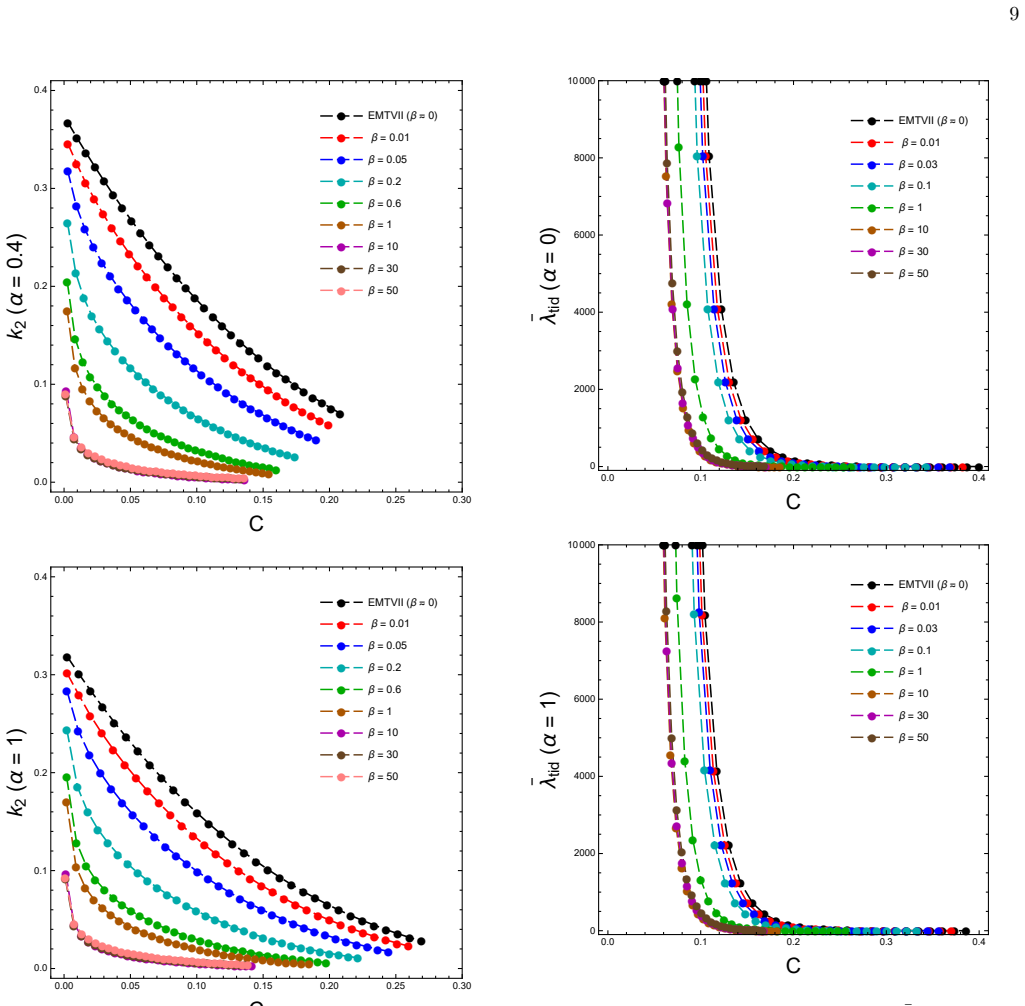
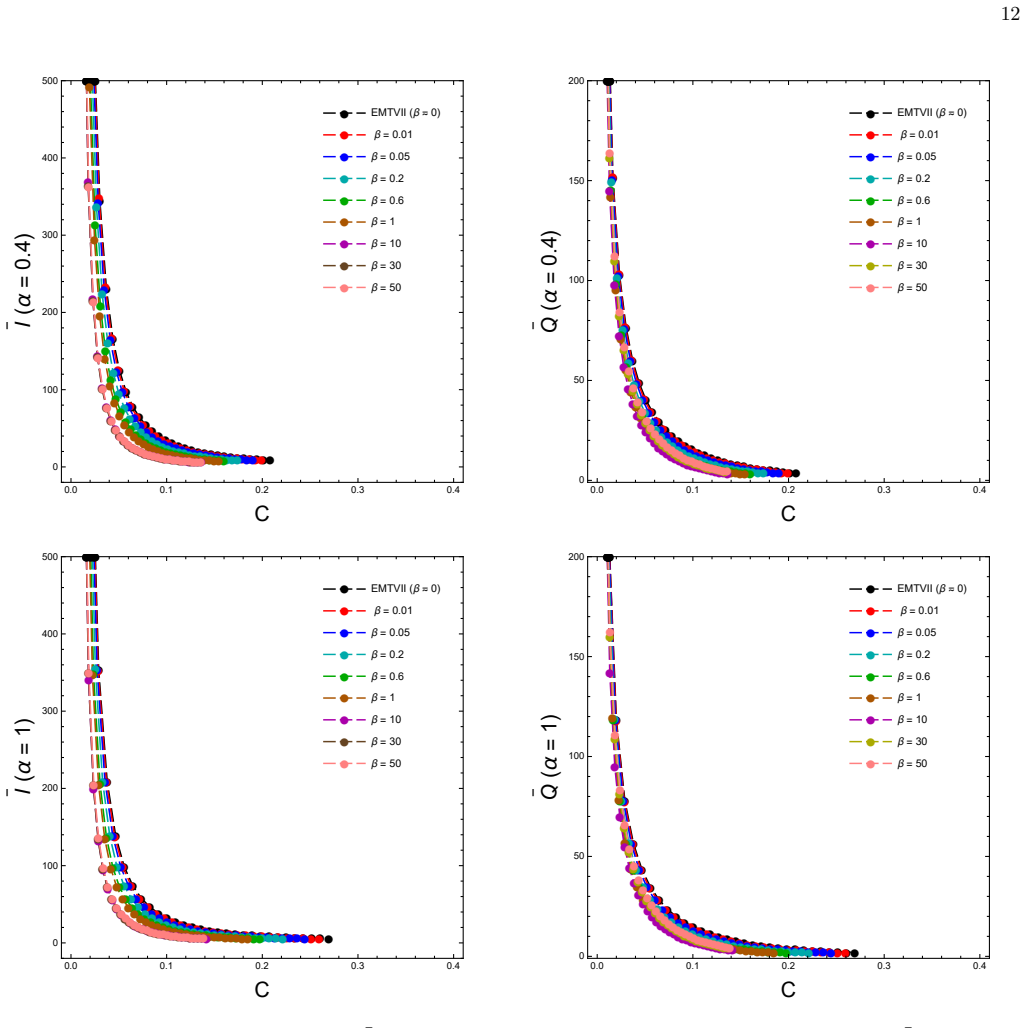
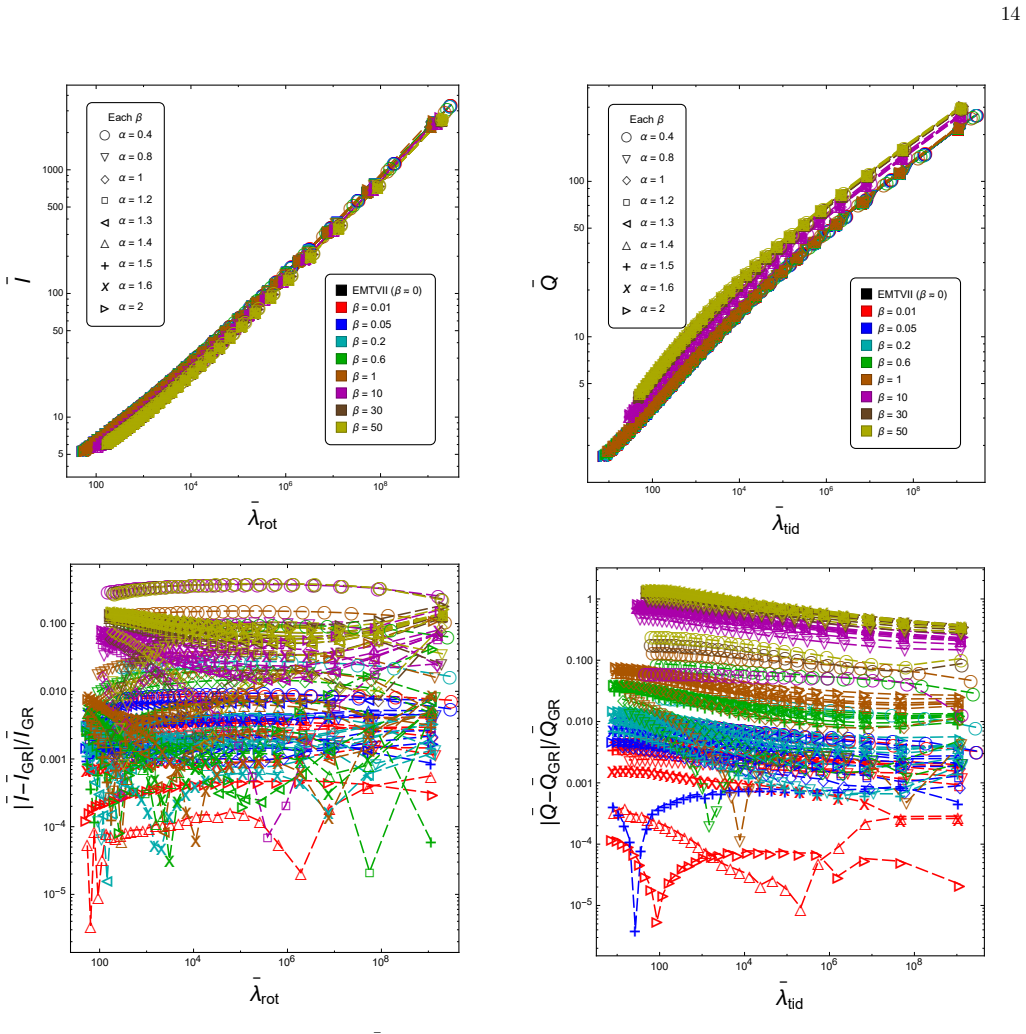
The paper claims that in the NEMTVII model, nonlocal smearing with parameter $\beta$ increases the neutron-star radius and lowers compactness relative to the local EMTVII model; consequently $k_2$, $\bar{\lambda}_{\mathrm{tid}}$, $\bar{I}$, and $\bar{Q}$ all shift. For fixed $\beta$, the dimensionless I-Love-Q relations are universal across the density-shape parameter $\alpha$, but changing $\beta$ breaks that universality for $\beta \gtrsim 10\,\mathrm{km}^2$. Comparing the tidal deformability to GW170817 and GW190425 constraints selects $\alpha \gtrsim 1.6$ with $\beta < 1\,\mathrm{km}^2$.
Load-bearing premise
The central assumption is that nonlocal gravity can be written as Einstein equations with the energy-momentum tensor smeared by $A^{-2}(\Box)$, and that the flat-space Green's function used to evaluate that smearing remains valid inside the curved spacetime of the star.
Editorial extensions
If this is right
- Tidal deformability measurements from binary neutron star mergers can act as a direct bound on the nonlocal smearing scale, not just on the equation of state.
- For fixed nonlocal scale, the I-Love-Q relations stay universal, so they cannot discriminate $\alpha$ within this model, but they become a nonlocality detector once $\beta$ exceeds about $10\,\mathrm{km}^2$.
- The predicted increase in radius with $\beta$ means mass-radius measurements provide an independent cross-check of the allowed parameter region.
- The roughly linear, equation-of-state-insensitive rotational-to-tidal Love relation is preserved even when other I-Love-Q branches deviate, making it a robust observable.
- If the nonlocal scale is macroscopic ($\ell_\beta \gtrsim 3\,\mathrm{km}$), deviations from general relativity in $k_2$ and the deformabilities should be detectable in future gravitational-wave events.
Reading between the lines
- If the flat-space Green's function evaluation inside the star is replaced by a fully curved-space kernel, the quoted $\alpha \gtrsim 1.6$ and $\beta < 1\,\mathrm{km}^2$ window could shift, so the constraint should be read as model-dependent until that step is checked.
- The $\beta \gtrsim 10\,\mathrm{km}^2$ breakdown of I-Love-Q universality offers a clean observational test: measuring $I$, $Q$, and $\lambda$ for several neutron stars of different masses and seeing scatter beyond the equation-of-state spread would point to nonlocality.
- The same formalism could be applied with other ghost-free entire functions $A(\Box)$; whether the universality-breaking threshold is robust to that choice is a testable extension not addressed in the paper.
- Because nonlocal smearing increases radius, the model predicts systematically larger radii at fixed mass than general relativity, so combining precise radius and tidal measurements on the same star would help separate nonlocal effects from equation-of-state effects.
Editorial analysis
A structured set of objections, weighed in public.
Referee Report
Summary. The paper studies slowly rotating neutron stars and tidal deformation in a nonlocal gravity framework, using the NEMTVII density model. It computes the moment of inertia, rotational Love number, quadrupole moment, and tidal Love number k2 via standard perturbative methods, analyzes I-Love-Q universality, and compares tidal deformability with GW170817 and GW190425. The main claims are: (i) for fixed nonlocal parameter beta, the I-Love-Q relations are universal across the model parameter alpha; (ii) varying beta breaks universality for beta greater than about 10 km^2; (iii) consistency with the gravitational-wave tidal constraints requires alpha greater than about 1.6 and beta below 1 km^2.
Significance. If the nonlocal gravity reduction and the NEMTVII density prescription were established, the paper would provide a concrete, falsifiable bridge between nonlocal gravity smearing scales and neutron-star observables. The use of standard Hartle-Thorne and Hinderer perturbation theory, the broad parameter scan, and the explicit comparison with GW170817/GW190425 and mass constraints are strengths. The main results, however, rest on two assumptions imported from prior work: the effective field equation T-tilde = A^{-2}(box)T and the flat-space Green's function evaluation of the smearing. Until these are derived or validated, the quantitative predictions, including radii, Love numbers, and the alpha-beta allowed region, remain conditional.
major comments (4)
- [IV.B, Eqs. (45)-(46) and surrounding text] Equation (46) is stated as 'the nonlocal Einstein field equation' with T_{mu nu} = A^{-2}(box) T_{mu nu}, but it is not obtained by varying the action (45). For a nonlocal action of the form A^2(box)R, the field equation contains nonlocal curvature terms rather than simply 8pi A^{-2}(box) T_{mu nu}. Please provide the explicit variation or state clearly that Eq. (46) is a phenomenological definition of the model. This is load-bearing because all subsequent TOV equations and density profiles derive from Eq. (46).
- [IV.B, Eq. (51)] The smeared density is evaluated using the flat-space Helmholtz Green's function in the radial coordinate, with the integral extending from 0 to R. The operator defined in Eq. (46), however, is beta g^{mu nu} grad_mu grad_nu on the curved TOV background. The paper refers to Ref. [52] but gives no estimate of the magnitude of omitted metric-dependent terms, no expansion parameter, and no proof that smearing a perfect-fluid T_{mu nu} yields a perfect-fluid energy-momentum tensor as assumed in Eq. (47). Because Eq. (51) determines the density profile (52)-(55), the stellar radius R_N, and hence all compactness-dependent observables, this gap must be addressed.
- [IV.B, text after Eq. (55)] The actual radius R_N is defined as the point where the nonlocal density falls to 10^{-7} km^{-2}. This cutoff is an ad hoc input; no physical justification or sensitivity study is given. Since the compactness C = M_N / R_N enters the dimensionless Love numbers, moments of inertia, and the GW constraint comparison, the authors should either derive the radius from the theory, for example from the vanishing of pressure, or demonstrate that the results are insensitive to the cutoff over several orders of magnitude.
- [V, Figures 6-7 compared with Eqs. (37)-(38)] The text compares the plotted quantity, labeled lambda_tid, with the GW170817/GW190425 bounds lambda_tid < 800 and lambda_tid < 600. In Eqs. (37)-(38), however, lambda_tid has units of length^5, while the standard observational bound is on the dimensionless tidal deformability Lambda = lambda_tid / M^5 = (2/3) k2 C^{-5}. The plotted values (0 to 4000) and the claimed consistency indicate the figures actually show the dimensionless quantity. Please relabel the figures, for example as Lambda or bar{lambda}_tid, and state the definition explicitly; otherwise the observational comparison cannot be checked.
minor comments (5)
- [Eq. (41)] In the expression for B2, the first occurrence of 'y' should be 'y_R' (B2 = ... [13 - 11 y_R + C(3 y_R - 2) + 2 C^2 (1 + y_R)]); as written, the dependence on y_R is inconsistent.
- [Eqs. (29)-(30)] The notation nu'^2 is ambiguous: it appears to mean (d nu/dr)^2, but nu_2 is also used for a metric perturbation. Please use an unambiguous notation such as (nu')^2.
- [V, paragraph on Figures 12-16] The universality claim for fixed beta is supported only visually. Provide a quantitative measure, for example the maximum fractional spread of the I-Love-Q curves across alpha for each beta, to substantiate the claimed universality.
- [Introduction and Section II.A] The Introduction contains a duplicated word ('from from GW170817'), and Eq. (5) in Section II.A appears garbled in the typesetting ('(r,r)-(theta,theta)' and the derivative terms); please check the derivation and formatting.
- [Eq. (27)] The definition of bar{Q} uses the constant K; please clarify the sign convention and the relation to the standard quadrupole moment to make the bar{Q} -> 1 black-hole limit transparent.
Circularity Check
The nonlocal smearing prescription (Eq. 51) is adopted from the authors' own prior work and is load-bearing for all β-dependent results, though the I-Love-Q and GW comparisons are not fitted inputs.
-
ansatz smuggled in via citation
[Section IV.B, Eq. (51)]
"Thus, the modified density can be written as [52] ρ~ = A^{-2}ρ = 1/(2√β x) ∫_0^R dx′ x′ ρ(x′) [e^{−|x−x′|/√β} − e^{−|x+x′|/√β}]. (51)"
This equation is the only place the nonlocal parameter β enters the background, so it controls the radius, compactness, and every derived quantity (k2, λtid, Ī, Q̄) shown in the paper. It is not derived in the present work: the stated operator in Eq. (46) is the curved-space d'Alembertian □ = β g^{μν}∇_μ∇_ν, but Eq. (51) evaluates the smearing with a flat-space Helmholtz kernel, and the only justification is the citation to the authors' own Ref. [52]. The claimed findings—that β increases the radius, that β ≳ 10 km² breaks I-Love-Q universality, and that α ≳ 1.6 with small β satisfies GW170817/GW190425—are thus consequences of a self-cited ansatz rather than an independent derivation.
full rationale
The paper does not fit α or β to the I-Love-Q or tidal data; it scans the parameter space and compares with the GW170817, GW190425, PSR J0348+0432, and PSR J0740+6620 constraints, so the main universality and consistency claims are not fitted-input predictions. The tidal and rotational perturbation calculations use standard, externally established formalism (Hartle-Thorne and Hinderer), which is independent of the authors' prior work. However, every β-dependent result depends on the smeared density profile Eqs. (52)-(55), which is introduced through Eq. (51) and cited only to the authors' own Ref. [52]; the paper does not derive this flat-space Green's function prescription from the curved-space operator defined in Eq. (46), nor does it quantify the omitted metric-dependent terms. Thus the central observational conclusions inherit an unverified self-cited ansatz. This is a load-bearing self-citation but not a complete circularity, because the relation between the background and the I-Love-Q quantities is computed rather than assumed. Score 4.
Assumptions & free parameters
free parameters (3)
- alpha =
not fitted; scanned over [0,2]
- beta =
not fitted; scanned over [0,50] km^2
- density_cutoff =
10^-7 km^-2
assumptions (4)
- domain assumption The nonlocal gravity field equations reduce to R_mu_nu - 1/2 g_mu_nu R = 8 pi T-tilde, with T-tilde = A^{-2}(box)T (Eq. 46).
- domain assumption The nonlocal smearing operator acts as (1 - beta nabla^2) in flat space, with the Green's function leading to Eq. (51), even though the star is described by a curved spacetime metric.
- ad hoc to paper The star radius is defined by the density cutoff rho = 10^-7 km^-2 in the nonlocal density tail.
- standard math The standard Hartle-Thorne and Hinderer perturbation equations apply to the nonlocal background metric, with the same matter perturbation formalism.
Cite this review
Pith. "Pith review of Slowly Rotating and Tidal Deformation of Nonlocal Modified Tolman VII Star." pith.science (2026). https://pith.science/paper/GNF5VIR3
@misc{pith2026250520886,
  author       = {Pith},
  title        = {Pith review of: Slowly Rotating and Tidal Deformation of Nonlocal Modified Tolman VII Star},
  year         = {2026},
  howpublished = {\url{https://pith.science/paper/GNF5VIR3}},
  note         = {Machine review of arXiv:2505.20886}
}
abstract
We investigate the moment of inertia, quadrupole deformation, and tidal deformation within the framework of nonlocal gravity, utilizing the exact modified Tolman-VII (NEMTVII) density model with an isotropic perfect fluid. The Love number~$(k_{2})$ is derived using standard even-parity perturbation theory. Additionally, we explore the observational implications by analyzing the tidal deformability parameter~$( \lambda_{\textrm{tid}} )$ in comparison with the constraints from GW170817, GW190425, PSR J0348+0432, and PSR J0740+6620. We found that the results are consistent with the tidal constraint when $\alpha \gtrsim 1.6$ with the small $\beta$. For slowly rotating object, the dimensionless moment of inertia~$( \bar{I} )$, rotational Love parameter~$( \bar{\lambda}_{\textrm{rot}} )$, and quadrupole moment~$( \bar{Q} )$ are fully determined by the perturbed metric. Our findings reveal that the nonlocal parameter~$( \beta )$ significantly affects the star radius. For a fixed $\beta$ and varying $\alpha$, the $I$-Love-$Q$ relations are found to be universal. For varying $\beta$, the $I$-Love-$Q$ relations become non-universal.
Figures


Figures from the paper (6 more)




Reference graph
Works this paper leans on
-
[52]
B. N. Jayawiguna and P. Burikham, Eur. Phys. J. C 84 (2024) no.3, 226
work page 2024
-
[1]
¨Ozel and P
F. ¨Ozel and P. Freire, Ann. Rev. Astron. Astrophys. 54 (2016), 401-440
2016
-
[2]
Oertel, M
M. Oertel, M. Hempel, T. Kl¨ ahn and S. Typel, Rev. Mod. Phys. 89 (2017) no.1, 015007
2017
-
[3]
G. Baym, T. Hatsuda, T. Kojo, P. D. Powell, Y. Song and T. Takatsuka, Rept. Prog. Phys. 81 (2018) no.5, 056902
2018
-
[4]
J. M. Lattimer, Universe 5 (2019) no.7, 159
2019
-
[5]
A. E. H. Love, Proc. R. Soc., A 82, 73 (1909)
1909
-
[6]
Postnikov, M
S. Postnikov, M. Prakash and J. M. Lattimer, Phys. Rev. D 82 (2010), 024016
2010
-
[7]
M. C. Miller, F. K. Lamb, A. J. Dittmann, S. Bogdanov, Z. Arzoumanian, K. C. Gendreau, S. Guillot, A. K. Hard- ing, W. C. G. Ho and J. M. Lattimer, et al. Astrophys. J. Lett. 887 (2019) no.1, L24
2019
Show all 89 references
-
[8]
T. E. Riley, A. L. Watts, S. Bogdanov, P. S. Ray, R. M. Ludlam, S. Guillot, Z. Arzoumanian, C. L. Baker, A. V. Bilous and D. Chakrabarty, et al. Astrophys. J. Lett. 887 (2019) no.1, L21
2019
-
[9]
E. E. Flanagan and T. Hinderer, Phys. Rev. D 77 (2008), 021502
2008
-
[10]
K. S. Thorne, Phys. Rev. D 58 (1998), 124031 doi:10.1103/PhysRevD.58.124031 [arXiv:gr-qc/9706057 [gr-qc]]
1998 arXiv
-
[11]
Hinderer, Astrophys
T. Hinderer, Astrophys. J. 677 (2008), 1216-1220
2008
-
[12]
Hinderer, B
T. Hinderer, B. D. Lackey, R. N. Lang and J. S. Read, Phys. Rev. D 81 (2010), 123016
2010
-
[13]
Damour, A
T. Damour, A. Nagar and L. Villain, Phys. Rev. D 85 (2012), 123007
2012
-
[14]
B. P. Abbott et al. [LIGO Scientific and Virgo], Phys. Rev. Lett. 119 (2017) no.16, 161101
2017
-
[15]
B. P. Abbott et al. [LIGO Scientific and Virgo], Phys. Rev. X 9 (2019) no.1, 011001
2019
-
[16]
J. B. Hartle, Astrophys. J. 150 (1967), 1005-1029 doi:10.1086/149400
1967 doi
-
[17]
J. B. Hartle and K. S. Thorne, Astrophys. J. 153 (1968), 807 doi:10.1086/149707
1968 doi
-
[18]
Yagi and N
K. Yagi and N. Yunes, Science 341 (2013), 365-368 doi:10.1126/science.1236462 [arXiv:1302.4499 [gr-qc]]
2013 arXiv
-
[19]
Yagi and N
K. Yagi and N. Yunes, Phys. Rev. D 88 (2013) no.2, 023009 doi:10.1103/PhysRevD.88.023009 [arXiv:1303.1528 [gr-qc]]
2013 arXiv
-
[20]
Schwarzschild, K. (1916). Sitzber. Deut. Akad. Wiss. Berlin. Kl. Math.-Phys. Tech. 424
1916
-
[21]
W., Thorne, K
Misner, C. W., Thorne, K. S., and Wheeler, J. A. (1973). Gravitation, (San Francisco: W H Freeman and Com- pany)
1973
-
[22]
Stuchlik, Acta Phys
Z. Stuchlik, Acta Phys. Slov. 50 (2000) no.2, 219-228
2000
-
[23]
R. F. Tooper, Astrophys. J. 140, 434 (1964)
1964
-
[24]
Stuchl ´ ık, S
Z. Stuchl ´ ık, S. Hled ´ ık and J. Novotn´ y, Phys. Rev. D94 (2016) no.10, 103513
2016
-
[25]
R. C. Tolman, Phys. Rev. 55 (1939), 364-373
1939
-
[26]
Burikham, E
P. Burikham, E. Hirunsirisawat and S. Pinkanjanarod, JHEP 06 (2010), 040 doi:10.1007/JHEP06(2010)040 [arXiv:1003.5470 [hep-ph]]
2010 arXiv
-
[27]
Burikham, S
P. Burikham, S. Pinkanjanarod and S. Ponglert- sakul, Phys. Rev. D 105 (2022) no.10, 104018 doi:10.1103/PhysRevD.105.104018 [arXiv:2111.00712 [gr-qc]]
2022 arXiv
-
[28]
Pinkanjanarod and P
S. Pinkanjanarod and P. Burikham, Eur. Phys. J. C 81 (2021) no.8, 705 doi:10.1140/epjc/s10052-021-09479- w [arXiv:2007.10615 [nucl-th]]
2021 arXiv
-
[29]
Pinkanjanarod, P
S. Pinkanjanarod, P. Burikham and S. Ponglert- sakul, Eur. Phys. J. C 82 (2022) no.2, 141 doi:10.1140/epjc/s10052-022-10106-5 [arXiv:2106.13450 [gr-qc]]
2022 arXiv
-
[30]
Demircik, C
T. Demircik, C. Ecker, M. J¨ arvinen, L. Rez- zolla, S. Tootle and K. Topolski, EPJ Web Conf. 274 (2022), 07006 doi:10.1051/epjconf/202227407006 [arXiv:2211.10118 [astro-ph.HE]]
2022
-
[31]
Spheres with vary- ing density in general relativity,
M. C. Durgapal and G. L. Gehlot, “Spheres with vary- ing density in general relativity,” Journal of Physics A: General Physics 4, 749–755 (1971)
1971
-
[32]
A. M. Raghoonundun and D. W. Hobill, Phys. Rev. D 92 (2015) no.12, 124005
2015
-
[33]
C. C. Moustakidis, Gen. Rel. Grav. 49 (2017) no.5, 68
2017
-
[34]
J. M. Lattimer and M. Prakash, Astrophys. J. 550 (2001), 426
2001
-
[35]
Jiang and K
N. Jiang and K. Yagi, Phys. Rev. D 101 (2020) no.12, 124006
2020
-
[36]
Jiang and K
N. Jiang and K. Yagi, Phys. Rev. D 99, 124029 (2019)
2019
-
[37]
T. K. Chan, A. P. O. Chan and P. T. Leung, Phys. Rev. D 91 (2015) no.4, 044017
2015
-
[38]
Posada, J
C. Posada, J. Hlad ´ ık and Z. Stuchl ´ ık, Phys. Rev. D103 (2021) no.10, 104067
2021
-
[39]
Posada, J
C. Posada, J. Hlad ´ ık and Z. Stuchl ´ ık, Phys. Rev. D105, 104020 (2022)
2022
-
[40]
Brans and R
C. Brans and R. H. Dicke, Phys. Rev. 124 (1961), 925- 935
1961
-
[41]
Damour and G
T. Damour and G. Esposito-Farese, Phys. Rev. D 54 (1996), 1474-1491 doi:10.1103/PhysRevD.54.1474 [arXiv:gr-qc/9602056 [gr-qc]]
1996 arXiv
-
[42]
H. O. Silva, H. Sotani, E. Berti and M. Horbatsch, Phys. Rev. D 90 (2014) no.12, 124044
2014
- [43]
-
[44]
Sotani, Phys
H. Sotani, Phys. Rev. D 81 (2010), 084006
2010
-
[45]
Sotani, Phys
H. Sotani, Phys. Rev. D 82 (2010), 124061
2010
-
[46]
Sotani, Phys
H. Sotani, Phys. Rev. D 86 (2012), 124036
2012
-
[47]
K. V. Staykov, D. D. Doneva, S. S. Yazadjiev and K. D. Kokkotas, JCAP 10 (2014), 006
2014
-
[48]
H. O. Silva, C. F. B. Macedo, E. Berti and L. C. B. Crispino, Class. Quant. Grav. 32 (2015), 145008
2015
-
[49]
S. S. Yazadjiev, D. D. Doneva and D. Popchev, Phys. Rev. D 93 (2016) no.8, 084038
2016
-
[50]
K. V. Staykov, D. Popchev, D. D. Doneva and S. S. Yazadjiev, Eur. Phys. J. C 78 (2018) no.7, 586
2018
-
[51]
Murshid and M
M. Murshid and M. Kalam, JCAP 09 (2024), 030
2024
-
[53]
M. V. Battisti and G. Montani, Phys. Lett. B 656, 96 (2007)
2007
-
[54]
Shibusa, Int
Y. Shibusa, Int. J. Mod. Phys. A 22, 5279 (2007)
2007
-
[55]
M. V. Battisti and G. Montani, Phys. Rev. D 77, 023518 (2008)
2008
-
[56]
Nozari and S
K. Nozari and S. Akhshabi, Int. J. Mod. Phys. D 19, 513 (2010)
2010
-
[57]
Bojowald and A
M. Bojowald and A. Kempf, Phys. Rev. D 86, 085017 (2012)
2012
-
[58]
Huang, Acta Phys
H. Huang, Acta Phys. Sin. 61, 110403 (2012)
2012
-
[59]
Sprenger, P
M. Sprenger, P. Nicolini and M. Bleicher, Eur. J. Phys. 33, 853 (2012)
2012
-
[60]
M. Isi, J. Mureika and P. Nicolini, JHEP 11, 139 (2013)
2013
-
[61]
A. F. Ali and A. Tawfik, Adv. High Energy Phys. 2013, 18 126528 (2013)
2013
-
[62]
A. N. Tawfik and A. M. Diab, Int. J. Mod. Phys. D 23, 1430025 (2014)
2014
-
[63]
J. P. Bruneton and J. Larena, Gen. Rel. Grav. 49, 56 (2017)
2017
-
[64]
J. L. Li and C. F. Qiao, Annalen Phys. 533, 2000335 (2021)
2021
-
[65]
B. N. Jayawiguna, I. Prasetyo, A. Sulaksono and H. S. Ramadhan, Phys. Rev. D 106 (2022) no.10, 104020
2022
-
[66]
S. De, D. Finstad, J. M. Lattimer, D. A. Brown, E. Berger and C. M. Biwer, Phys. Rev. Lett. 121 (2018) no.9, 091102 [erratum: Phys. Rev. Lett. 121 (2018) no.25, 259902]
2018
-
[67]
One loop divergencies in the theory of gravitation,
G. ’t Hooft and M. J. G. Veltman, “One loop divergencies in the theory of gravitation,” Ann. Inst. H. Poincare A Phys. Theor. 20, 69-94 (1974)
1974
-
[68]
One Loop Di- vergences of Quantized Einstein-Maxwell Fields,
S. Deser and P. van Nieuwenhuizen, “One Loop Di- vergences of Quantized Einstein-Maxwell Fields,” Phys. Rev. D 10, 401 (1974)
1974
-
[69]
Nonrenormalizabil- ity of the Quantized Dirac-Einstein System,
S. Deser and P. van Nieuwenhuizen, “Nonrenormalizabil- ity of the Quantized Dirac-Einstein System,” Phys. Rev. D 10, 411 (1974)
1974
-
[70]
The Ultraviolet Behavior of Einstein Gravity,
M. H. Goroff and A. Sagnotti, “The Ultraviolet Behavior of Einstein Gravity,” Nucl. Phys. B 266, 709-736 (1986)
1986
- [71]
-
[72]
Gaete, J
P. Gaete, J. A. Helayel-Neto and E. Spallucci, Phys. Lett. B 693 (2010), 155-158
2010
-
[73]
J. R. Mureika and E. Spallucci, Phys. Lett. B 693 (2010), 129-133
2010
-
[74]
J. W. Moffat, Eur. Phys. J. Plus 126 (2011), 43
2011
-
[75]
Modesto, J
L. Modesto, J. W. Moffat and P. Nicolini, Phys. Lett. B 695 (2011), 397-400
2011
-
[76]
M. Isi, J. Mureika and P. Nicolini, JHEP 11, 139 (2013) doi:10.1007/JHEP11(2013)139 [arXiv:1310.8153 [hep-th]]
2013 arXiv
-
[77]
Kempf, G
A. Kempf, G. Mangano and R. B. Mann, Phys. Rev. D 52, 1108-1118 (1995)
1995
-
[78]
Sprenger, P
M. Sprenger, P. Nicolini and M. Bleicher, Eur. J. Phys. 33 (2012), 853-862
2012
-
[79]
Modesto, Phys
L. Modesto, Phys. Rev. D 86, 044005 (2012)
2012
-
[80]
Biswas, E
T. Biswas, E. Gerwick, T. Koivisto and A. Mazumdar, Phys. Rev. Lett. 108, 031101 (2012)
2012
-
[81]
Damour and A
T. Damour and A. Nagar, Phys. Rev. D 80 (2009), 084035
2009
-
[82]
Cardoso, E
V. Cardoso, E. Franzin, A. Maselli, P. Pani and G. Ra- poso, Phys. Rev. D 95 (2017) no.8, 084014
2017
-
[83]
B. P. Abbott et al. [LIGO Scientific and Virgo], Astro- phys. J. Lett. 892 (2020) no.1, L3
2020
-
[84]
Antoniadis, P
J. Antoniadis, P. C. C. Freire, N. Wex, T. M. Tauris, R. S. Lynch, M. H. van Kerkwijk, M. Kramer, C. Bassa, V. S. Dhillon and T. Driebe, et al. Science 340 (2013), 6131
2013
-
[85]
H. T. Cromartie et al. [NANOGrav], Nature Astron. 4 (2019) no.1, 72-76
2019
-
[86]
Fonseca, H
E. Fonseca, H. T. Cromartie, T. T. Pennucci, P. S. Ray, A. Y. Kirichenko, S. M. Ransom, P. B. Demorest, I. H. Stairs, Z. Arzoumanian and L. Guillemot, et al. Astrophys. J. Lett. 915 (2021) no.1, L12
2021
-
[87]
D. D. Doneva and G. Pappas, Astrophys. Space Sci. Libr. 457 (2018), 737-806
2018
-
[88]
Stuchl ´ ık and J
Z. Stuchl ´ ık and J. Vrba, Eur. Phys. J. Plus 136 (2021) no.9, 977
2021
-
[89]
Posada and Z
C. Posada and Z. Stuchl ´ ık, Class. Quant. Grav.40 (2023) no.13, 135009
2023
Reviewed August 7, 2026 · model on record in the stance chip above.
Discussion (0). Sign in to comment.