REVIEW 3 major objections 5 minor 26 references
Moving Collinear Cracks in a Prestressed Dry Sandy Medium Fracture Response under Traveling Punch Loads
T0 review · 3 major / 5 minor · reviewed 2026-08-01 · deepseek-v4-flash
Pith's one-line read The paper derives closed-form formulas for the Mode-I stress intensity factors and crack opening displacement of two collinear cracks moving in a pre-stressed dry sandy strip under a moving punch, with explicit finite-thickness corrections.
desk verdict The paper offers a new analytical configuration but solves a boundary-value problem different from the one it states, and its 'closed-form' SIFs contain unevaluated constants. read the letter →
The pith
A machine-rendered reading of the paper's core claim, the machinery that carries it, and where it could break.
The reading
What carries the argument
The mechanism carrying the argument is the asymptotic kernel reduction of Section 4.1. The exact transform-domain kernel multipliers N₁₁, N₁₂, N₂₁ contain 1/sinh(r_j ζh) factors; for a thick strip the paper reduces them, using the series identities for 1/k² and 1/(2k+1)², to simple linear forms proportional to P s/h². That reduction changes two coupled Cauchy-type singular integral equations into four algebraic conditions, which are inverted in closed form by the finite Hilbert transform, an integral inversion technique for Cauchy principal-value equations. All physical parameters enter through the effective elastic coefficients D₁–D₅, the sandiness-dependent shear coefficient S = µ/χ, the i
What would settle it
Solve the coupled integral equations with the exact kernels numerically for the same parameters as Section 5 and compare the resulting stress intensity factors against the closed-form formulas; if the difference is not O(h⁻²) or does not vanish as h/e increases, the asymptotic reduction is refuted. A cheaper check is to expand the kernel multipliers around ζ = 0 and confirm that the 1/ζ poles cancel exactly, leaving the claimed coefficient P.
Extended reading notes
Core claim
The central claim is that the coupled problem can be solved, not just reduced, after a thick-strip simplification: for large h the regular kernels collapse to linear forms proportional to s/h² with one common material-loading constant P, and the density functions then split into an unbounded-strip part plus an h⁻² correction. Substitution into the near-tip limits gives the Mode-I stress intensity factor at the inner tip, K_I^(c) = (π/(2Q₁)) (1/(√c√(e²−c²))) (D₁ + D₃/h²), and an analogous closed-form expression at the outer tip, with punch loading and crack interaction entering through constants H₁ and H₂. The crack opening displacement follows as an elliptic-integral expression with the same
Load-bearing premise
The load-bearing premise is that the exact thick-strip kernels reduce to the simple O(h⁻²) linear forms with the single constant P using only two series identities; the paper does not exhibit the cancellation of the kernel poles at ζ = 0 or verify the reduction numerically, so if that reduction is incomplete the finite-thickness corrections in the stress-intensity-factor formulas are wrong.
Editorial extensions
If this is right
- If the paper is correct, the Mode-I stress intensity factors at both crack tips of a thick sandy strip can be computed from closed-form expressions instead of solving singular integral equations.
- The formulas quantify a specific asymmetry: the outer crack tip carries a larger stress intensity factor than the inner tip because the moving concentrated load sits closer to it.
- The results show a common dynamic pattern: crack-tip intensity remains nearly flat until the crack speed approaches the effective shear-wave speed, then rises sharply across all material and geometric parameters.
- The limiting cases V = 0, zero initial stress, and the zero-sandiness/punch-free configuration reproduce earlier simpler models, providing internal consistency checks.
- The finite-thickness correction couples punch loading and inner-tip intensity through the constants H₁ and H₂, so the model captures the interaction between boundary loading and crack interaction at the first nontrivial order.
Reading between the lines
- Beyond the paper: the thick-strip kernel reduction could be tested numerically by discretizing the exact integral equations; a mismatch that is not O(h⁻²) would map out where the asymptotic window ends.
- Beyond the paper: because the sandiness and initial-stress effects enter only through effective coefficients, the closed-form structure should survive for any isotropic medium with a modified shear modulus; the geometrical form of the formulas is set by the crack configuration, not by the material model.
- Beyond the paper: the same reduction-and-Hilbert-transform route could extend to periodic collinear crack arrays, where the two-crack ligament is replaced by a lattice spacing and the Hilbert-transform weights would need only modest changes.
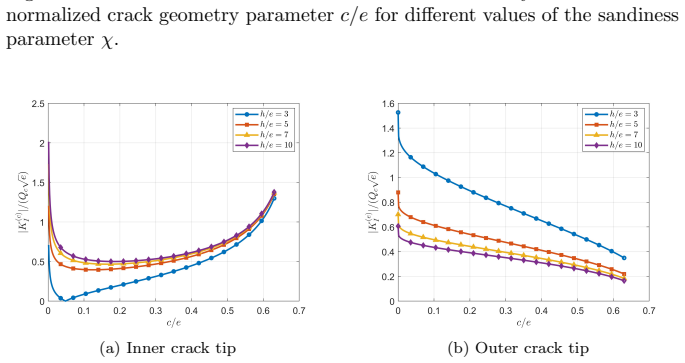
- Beyond the paper: the predicted non-monotonic inner-tip response as a function of crack length, with a minimum near c/e ≈ 0.10–0.15, is a specific signature that targeted simulations or experiments on crack interaction could confirm or refute.
Editorial analysis
A structured set of objections, weighed in public.
Referee Report
Summary. The paper treats two steadily moving collinear Mode-I Griffith cracks in an initially stressed dry sandy strip of finite thickness, with concentrated crack-face loads and a moving punch pressure on the outer surfaces. The authors use a moving coordinate frame, Fourier transforms, and a large-thickness asymptotic reduction to convert the mixed boundary-value problem into coupled Cauchy singular integral equations (58)-(59), which they solve analytically with the finite Hilbert transform. The output consists of the crack-density functions (81)-(82), closed-form Mode-I stress intensity factors at the inner and outer crack tips (87)-(88), and a crack-opening-displacement expression (89), all to O(h^{-2}), together with parametric studies of the effects of crack speed, sandiness, initial stress, strip thickness, geometry, and loading position. The derivation is self-contained and the algebra connecting the integral equations to the asymptotic solution is internally consistent; the main weaknesses are in the statement of the boundary conditions and in the unproved large-thickness kernel reduction.
Significance. If the results are correct, this is a useful analytical benchmark for a fairly complicated configuration: two interacting moving cracks in a pre-stressed, sand-modified elastic strip under combined concentrated and distributed moving loads. The paper provides explicit, closed-form expressions rather than purely numerical results, and it contains several limiting-case checks, including a claimed reduction to a previously published monoclinic-strip problem. These are genuine strengths. However, the significance is conditional on resolving two load-bearing issues: the boundary-value problem actually solved differs from the one stated, and the asymptotic kernel formulas that generate the finite-thickness/punch corrections are asserted without derivation or numerical verification.
major comments (3)
- [§2.4 and §3.3, Eqs. (19), (23), (49)-(54)] The stated boundary-value problem and the problem actually solved are not the same. Eq. (19) requires u1(x1,h)=0 for |x1|<c and |x1|>e, and Eq. (23) similarly requires u1(x1,0)=0 outside the cracks. The transform solution never imposes these conditions: the amplitude relations (49)-(54) enforce σ12=0 at x2=0 and x2=h and use the representations (50)-(51) to enforce u2=0 on the relevant intervals, but U(ζ,h) and U(ζ,0) remain unconstrained. Consequently the SIE system (58)-(59) and all subsequent SIF/COD formulas correspond to the smooth-punch/Mode-I problem with u2=0 and σ12=0 prescribed, not to the clamped conditions in (19) and (23). In fact, for a Mode-I crack the correct mid-plane condition is u2=0 outside the cracks, not u1=0; so Eq. (23) is not a Mode-I condition either. The manuscript must either delete the u1=0 conditions from the problem statement or extend the transform solutio
- [§4.1, Eqs. (70)-(72)] The large-thickness asymptotic reduction is the only source of the finite-thickness and punch-coupling corrections in the final SIFs, yet it is asserted without derivation. The exact kernel multipliers in (63)-(67) contain F1, F2, F3, F4 built from 1/sinh(r_j ζh), which near ζ=0 behave as 1/(r_j ζh), giving 1/ζ poles. For the leading terms to be O(h^{-2}) and linear in s as claimed in (70)-(72), these poles must cancel after combining Π_j, Λ_j, r_j, and the finite parts must collapse to the single constant P in (73). None of this cancellation is exhibited, and no numerical check of (70)-(72) is reported. Because H1 and H2 in (83)-(84) and the h^{-2} contributions to K_I^(c) and K_I^(e) in (87)-(88) depend directly on these forms, this is a load-bearing gap. Please provide the derivation or an appendix, or verify the asymptotic kernels numerically against the exact integral representation
- [§4.5.3, Eq. (106)] The 'sandiness-free' limiting case is mis-specified. The constitutive relation (4) contains the factor 2µ/χ with χ>1, and §2.2 explicitly states that χ=1 recovers the classical isotropic response. Setting χ=0 in Eq. (106), and subsequently in (107)-(111), makes the effective shear modulus singular and is not a well-defined limit. If the intended consistency check is a sandiness-free medium, the parameter should be χ=1 throughout this subsection; otherwise the claimed reduction to the corresponding case in [9] is not established. This also propagates into the formulas for H_1^(b) and H_2^(b) in (114)-(115).
minor comments (5)
- [§1.6] The second objective states that the solution uses the 'Schmidt method', but the paper actually uses the finite Hilbert transform technique. Please correct the wording.
- [§4.2, after Eq. (82)] The sentence defining the coefficients H1 and H2 ('The coefficients H1 and H2 ... are given by') appears twice in succession. Please remove the duplication.
- [§2.3 and §4.2] The symbol D_j is used for two different sets of quantities: the effective coefficients in Eq. (31) and the integration constants in Eqs. (81)-(82). This is confusing and should be changed, e.g., to A_j for the integration constants.
- [§5, Table 1] The quantity Q_s/Q_c is repeatedly called the 'tangential loading ratio', but Q_s is the normal punch pressure in Eq. (80) and Q_c is the concentrated normal crack-face load. A neutral term such as 'punch-to-concentrated load ratio' would be more accurate.
- [§4.1, Eq. (73)] The constant P is defined in (73) as a combination of the Π_j, Λ_j, r_j, and C, but the text does not explain why the same P appears in all three kernel asymptotics (70)-(72). A sentence indicating the algebraic origin of this common factor would help.
Circularity Check
No circularity: the SIF/COD results are derived from the stated boundary-value problem, not fitted or defined in terms of the targets.
full rationale
The derivation is self-contained. The constitutive law (4) is taken from external reference [21]; the moving-frame field equations (15)-(16) follow from it. The transform-domain amplitudes are reduced using the stated boundary conditions, and the auxiliary density functions g1,g2 are determined from the coupled Cauchy singular integral equations (58)-(59) together with the consistency conditions (68), not from the target SIFs. The large-thickness kernel reduction (70)-(72) is an asymptotic approximation asserted after the series identities (69); although the pole cancellations are not exhibited and the reduction is not numerically verified, this is a completeness/correctness risk, not a circular step, because the claimed kernel forms are not defined in terms of the final stress-intensity-factor outputs. The closed-form SIFs (87)-(88) and COD (89) are obtained by solving those integral equations via the finite Hilbert transform; the constants D_j are integration constants fixed by the supplementary conditions (68), not fitted parameters. The only self-citation is the consistency check in Sec. 4.5.3 claiming reduction to the authors' prior model [9]; that comparison is not load-bearing in the derivation, which does not assume the SIF/COD values from [9]. A separate concern that the stated upper-surface condition u1=0 (Eq. 19) is not enforced in Sec. 3.3 is a boundary-condition correctness issue, not a circularity.
Assumptions & free parameters
free parameters (3)
- Sandiness parameter χ =
1.30 (reference value, from [21])
- Initial stresses σ⁰₁₁, σ⁰₂₂ =
1.0×10⁹ Pa each (reference values)
- Loading ratio Qs/Qc and load position x₀/e =
Qs/Qc = 2.1, x₀/e = 0.96 (Table 1); x₀/e = 0.5 (Table 2)
assumptions (7)
- domain assumption Steady-state assumption: cracks, crack-face loads, and surface punch translate together at constant speed V, so ∂/∂t → −V∂/∂x₁ (Eq. 14)
- domain assumption Small-on-large incremental equations with initial stress: σij,j + (u_i,k Σ⁰_kj),j = ρ ü_i (Eq. 11)
- domain assumption Sandiness constitutive law (Eq. 4): σij = λ εkk δij + 2μ/χ εij, χ > 1
- ad hoc to paper Large-thickness kernel asymptotics (Eqs. 70-72): Kij(x,s) = O(h⁻²) linear-in-s kernels with a common constant P
- domain assumption Distinct real characteristic roots r₁ ≠ r₂ (Eq. 40)
- standard math Finite Hilbert transform inversion technique (as in [23])
- domain assumption Plane strain, infinitesimal deformation, no body forces (Section 2.1)
Cite this review
Pith. "Pith review of Moving Collinear Cracks in a Prestressed Dry Sandy Medium Fracture Response under Traveling Punch Loads." pith.science (2026). https://pith.science/paper/GNLSJLNZ
@misc{pith2026260717155,
  author       = {Pith},
  title        = {Pith review of: Moving Collinear Cracks in a Prestressed Dry Sandy Medium Fracture Response under Traveling Punch Loads},
  year         = {2026},
  howpublished = {\url{https://pith.science/paper/GNLSJLNZ}},
  note         = {Machine review of arXiv:2607.17155}
}
read the original abstract
The dynamic fracture behaviour of two moving collinear Griffith cracks in an initially stressed dry sandy medium subjected to concentrated crack-face loading and moving punch pressure is investigated. A moving coordinate system transforms the transient problem into a steady state formulation, while the effects of initial stress and sandiness are incorporated into the governing equations. Fourier integral transforms are employed to obtain the characteristic equation and the transformed traction displacement relations. The crack face, symmetry, and outer surface conditions reduce the problem to coupled Cauchy type singular integral equations. For a sufficiently thick strip, an asymptotic kernel reduction is developed, and the resulting equations are solved analytically using the finite Hilbert transform. Closed form expressions are derived for the crack density functions, Mode I stress intensity factors at the inner and outer crack tips, and the crack opening displacement. Several limiting cases are recovered from the general formulation, providing analytical consistency checks. The results demonstrate the combined influence of crack speed, crack geometry, initial stress, sandiness, and moving punch loading on crack tip intensification and crack opening. The proposed analytical framework provides useful insights for fracture assessment and the design of transportation infrastructure, geotechnical systems, underground excavations, and other engineering structures involving dry sandy media subjected to moving loads.
Figures


Figures from the paper (18 more)




Reference graph
Works this paper leans on
-
[9]
Fatigue & Fracture of Engineering Materials & Structures 49(1), 284–304 (2026)
Diksha, ., Chaudhary, S., Othmani, C., Kumar Sharma, P.: Dynamic fracture analysis of moving mode i collinear cracks in monoclinic crystalline strip: An analytical approach using hilbert transform. Fatigue & Fracture of Engineering Materials & Structures 49(1), 284–304 (2026)
2026
-
[1]
Physical Review E60(2), 2366 (1999)
Adda-Bedia, M., Arias, R., Amar, M.B., Lund, F.: Generalized griffith criterion for dynamic fracture and the stability of crack motion at high velocities. Physical Review E60(2), 2366 (1999)
1999
-
[2]
Applied Mathematics and Mechanics38(9), 1313–1328 (2017)
Alam, P., Kundu, S., Gupta, S.: Dispersion and attenuation of torsional wave in a viscoelastic layer bonded between a layer and a half-space of dry sandy media. Applied Mathematics and Mechanics38(9), 1313–1328 (2017)
2017
-
[3]
In: ARMA US Rock Mechanics/Geomechanics Symposium, p
Amir Hosseini, M., Tahmasebi, P.: A new approach to model irregular particles breakage with deploying image analysis techniques on discrete element method. In: ARMA US Rock Mechanics/Geomechanics Symposium, p. D022S023R009. ARMA (2024)
2024
-
[4]
Powder Technology162(3), 208– 229 (2006)
Campbell, C.S.: Granular material flows–an overview. Powder Technology162(3), 208– 229 (2006)
2006
-
[5]
i: Theory
Chang, C.S., Chang, Y., Kabir, M.G.: Micromechanics modeling for stress-strain behav- ior of granular soils. i: Theory. Journal of geotechnical engineering118(12), 1959–1974 (1992)
1959
-
[6]
Applied Mathematical Modelling140, 115916 (2025) 42 Diksha et al
Chaudhary, S., Sharma, P.K., et al.: Crack dynamics in rotating, initially stressed ma- terial strip: A mathematical approach. Applied Mathematical Modelling140, 115916 (2025) 42 Diksha et al
2025
-
[7]
International Journal of Solids and Structures43(25-26), 7880–7890 (2006)
Das, S.: Interaction of moving interface collinear griffith cracks under antiplane shear. International Journal of Solids and Structures43(25-26), 7880–7890 (2006)
2006
Show all 26 references
-
[8]
Mathematical Methods in the Applied Sciences (2026)
Das, S., Murshid AK, M., Mondal, S.: Magnetoelastic plane wave propagation in an initially stressed anisotropic strip through collinear mode i griffith cracks with punch loading. Mathematical Methods in the Applied Sciences (2026)
2026
-
[10]
International Journal for Numerical and Analytical Methods in Geomechanics40(1), 105–116 (2016)
Druckrey, A.M., Alshibli, K.A.: 3d finite element modeling of sand particle fracture based on in situ x-ray synchrotron imaging. International Journal for Numerical and Analytical Methods in Geomechanics40(1), 105–116 (2016)
2016
-
[11]
Proceedings of the Royal So- ciety A: Mathematical, Physical and Engineering Sciences463(2087), 3021–3035 (2007)
Einav, I.: Fracture propagation in brittle granular matter. Proceedings of the Royal So- ciety A: Mathematical, Physical and Engineering Sciences463(2087), 3021–3035 (2007)
-
[12]
Cambridge university press (1998)
Freund, L.B., Freud, L.: Dynamic fracture mechanics. Cambridge university press (1998)
1998
-
[13]
European Journal of Soil Science46(4), 591–599 (1995)
Hallett, P., Dexter, A., Seville, J.: The application of fracture mechanics to crack prop- agation in dry soil. European Journal of Soil Science46(4), 591–599 (1995)
1995
-
[14]
Tumu Gongcheng Xuebao/China Civil Engineering Journal49(7), 9–35 (2016)
Huang, M., Yao, Y., Yin, Z., Liu, E., Lei, H.: An overview on elementary mechani- cal behaviors, constitutive modeling and failure criterion of soils. Tumu Gongcheng Xuebao/China Civil Engineering Journal49(7), 9–35 (2016)
2016
-
[15]
CRC press (2020)
Iwashita, K., Oda, M.: Mechanics of granular materials: an introduction. CRC press (2020)
2020
-
[16]
Acta Mechanica227(12), 3671–3686 (2016)
Li, Y.: Multiple collinear griffith cracks in a one-dimensional hexagonal quasicrystalline layer. Acta Mechanica227(12), 3671–3686 (2016)
2016
-
[17]
Theoretical and applied fracture mechanics 56(1), 49–57 (2011)
Monfared, M., Ayatollahi, M.: Dynamic stress intensity factors of multiple cracks in a functionally graded orthotropic half-plane. Theoretical and applied fracture mechanics 56(1), 49–57 (2011)
2011
-
[18]
Journal of Geophysical Research: Solid Earth125(1), e2019JB018604 (2020)
Muqtadir, A., Al-Dughaimi, S., Dvorkin, J.: Deformation of granular aggregates: Static and dynamic bulk moduli. Journal of Geophysical Research: Solid Earth125(1), e2019JB018604 (2020)
2020
-
[19]
In: Crack Dynamics in Metallic Materials, pp
Nilsson, F.: Dynamic fracture theory. In: Crack Dynamics in Metallic Materials, pp. 1–68. Springer (1990)
1990
-
[20]
Journal of Vibration Engineering & Technologies14(4), 199 (2026)
Rahul, A.K., et al.: Love wave propagation across slip interfaces in a viscoelastic or- thotropic layer bounded by dry sandy and transversely isotropic media. Journal of Vibration Engineering & Technologies14(4), 199 (2026)
2026
-
[21]
Waves in Random and Complex Media 35(6), 10803–10820 (2025)
Singh, A.K., Singh, A.K.: Mathematical study on the propagation of griffith crack in a dry sandy strip subjected to punch pressure. Waves in Random and Complex Media 35(6), 10803–10820 (2025)
2025
-
[22]
Journal of Thermal Stresses44(4), 433–455 (2020)
Singh, R., Das, S.: Investigation of interactions among collinear griffith cracks situated in a functionally graded medium under thermo-mechanical loading. Journal of Thermal Stresses44(4), 433–455 (2020)
2020
-
[23]
Proceedings of the Royal Society of Edinburgh Section A: Mathematics68(4), 309–321 (1970)
Srivastava, K., Lowengrub, M.: Xx.—finite hilbert transform technique for triple integral equations with trigonometric kernels. Proceedings of the Royal Society of Edinburgh Section A: Mathematics68(4), 309–321 (1970)
1970
-
[24]
Progress in materials science138, 101157 (2023)
Tahmasebi, P.: A state-of-the-art review of experimental and computational studies of granular materials: Properties, advances, challenges, and future directions. Progress in materials science138, 101157 (2023)
2023
-
[25]
Advances in Civil Engineering2018(1), 5459307 (2018)
Wang, C., Zhao, Y., Zhao, Y., Wan, W.: Study on the interaction of collinear cracks and wing cracks and cracking behavior of rock under uniaxial compression. Advances in Civil Engineering2018(1), 5459307 (2018)
2018
-
[26]
the moving griffith crack
Yoffe, E.H.: Lxxv. the moving griffith crack. The London, Edinburgh, and Dublin Philosophical Magazine and Journal of Science42(330), 739–750 (1951)
1951
Reviewed August 1, 2026 · model on record in the stance chip above.
Discussion (0). Continue with ORCID to comment.