Direct Imaging Discovery of Giant Exoplanet β Pictoris d: A Decade-Long Game of Hide-and-Seek
Pith reviewed 2026-06-26 06:58 UTC · model grok-4.3
The pith
A third giant exoplanet has been directly imaged in the β Pictoris system.
A machine-rendered reading of the paper's core claim, the machinery that carries it, and where it could break.
Core claim
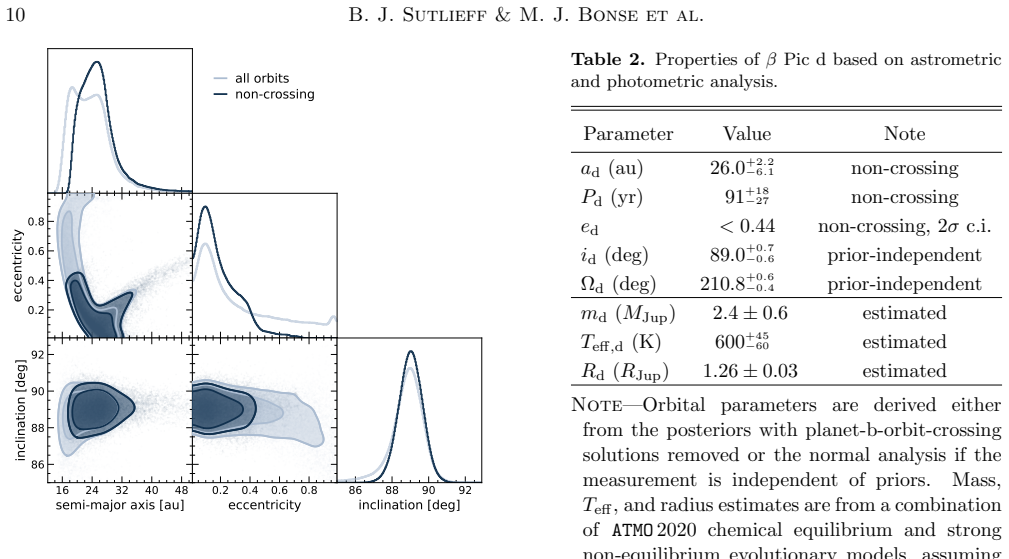
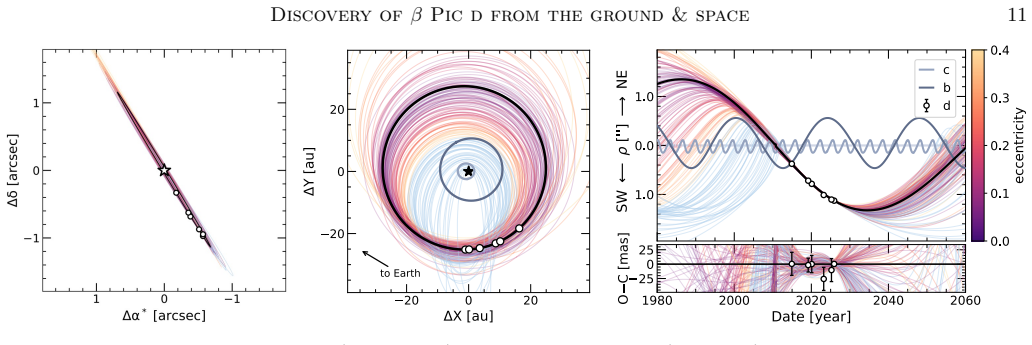
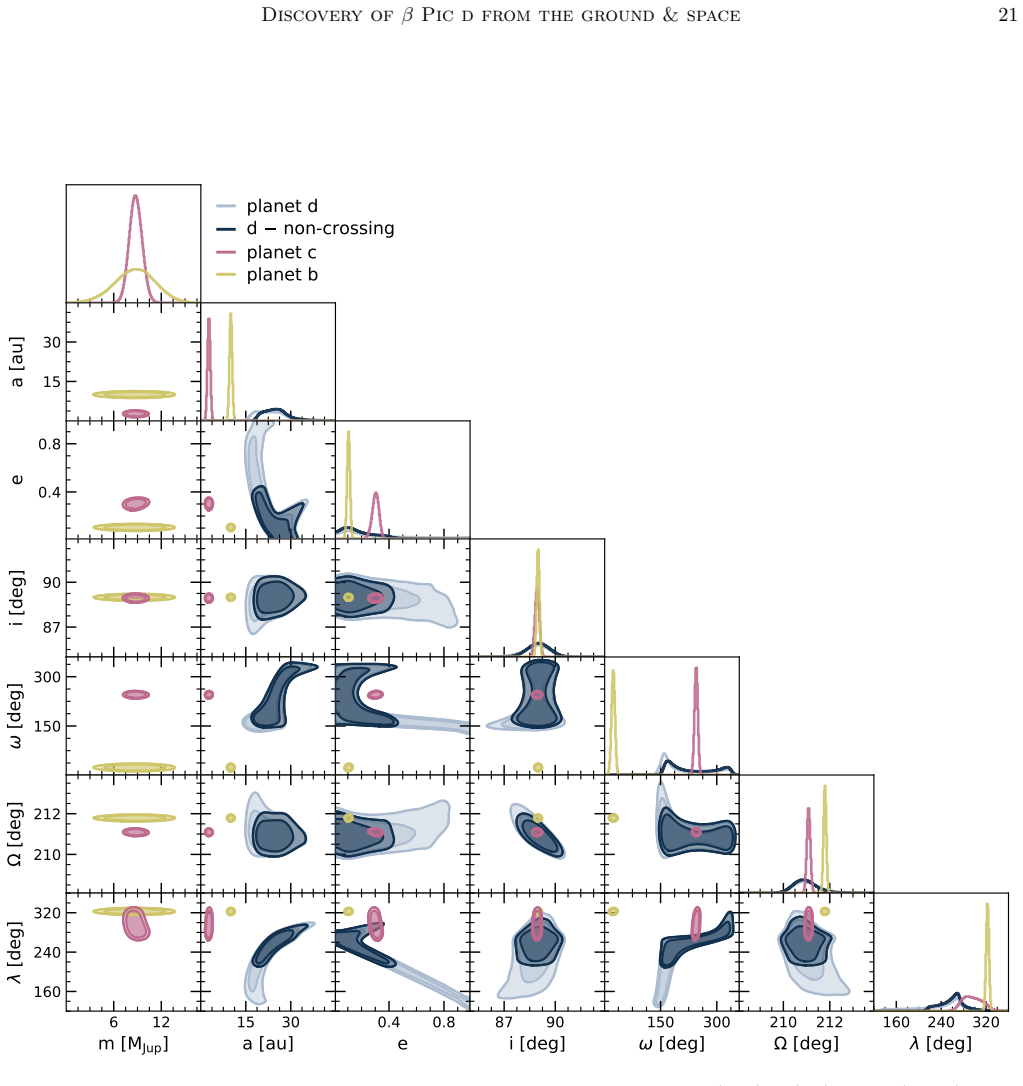
We report the direct imaging discovery of a third exoplanet in the β Pictoris system. Joint multi-planet orbit fits yield a semi-major axis of 26.0+2.2−6.1 au and inclination 89.0+0.7−0.6 deg for planet d. From the ATMO hot-start evolutionary models, we estimate an effective temperature of 600+45−60 K and mass of 2.4±0.6 MJup.
What carries the argument
Direct imaging detection combined with multi-epoch astrometry and joint multi-planet orbit fitting to establish bound orbit and parameters.
If this is right
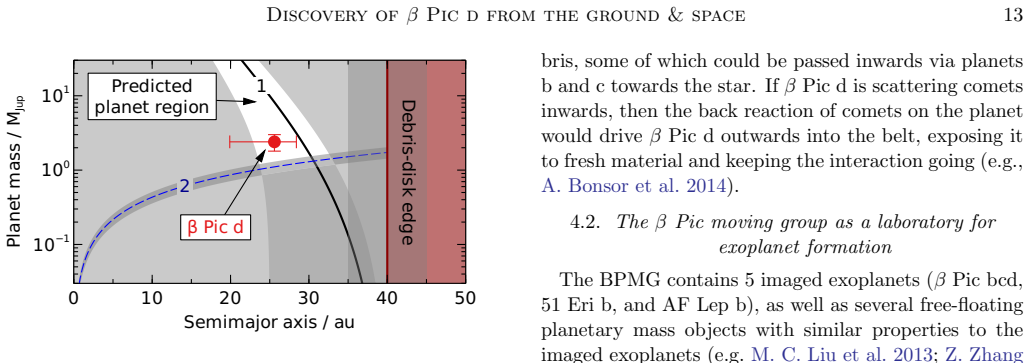
- Planet d is coplanar with the inner planets and consistent with sculpting the inner edge of the debris disk.
- The planet is among the lowest-mass exoplanets imaged from the ground.
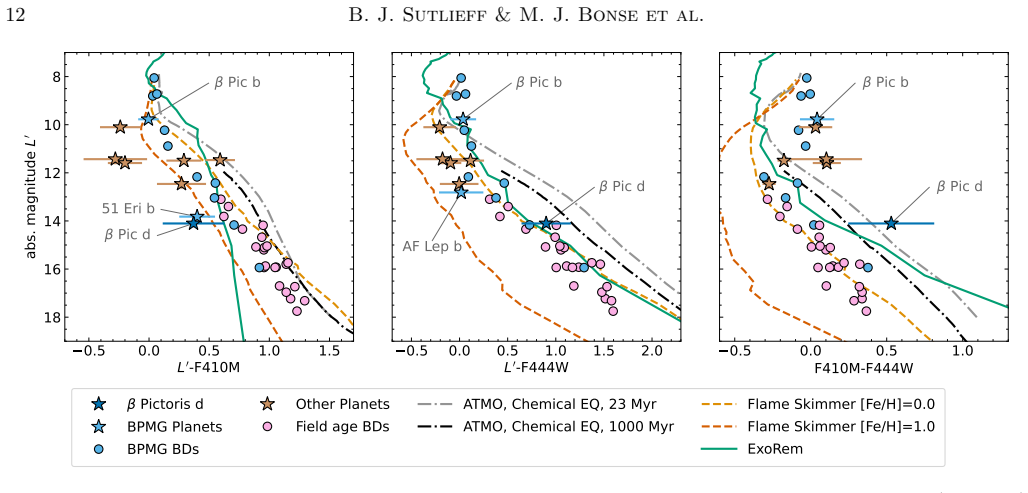
- Its red color indicates strong CO2 absorption and metal enhancement compared to free-floating objects.
- Highlights sensitivity of ground-based mid-infrared imaging for such discoveries.
Where Pith is reading between the lines
- Similar planets may be detectable around other young stars with current and upcoming telescopes.
- The atmospheric similarities to 51 Eri b suggest shared formation pathways in the moving group.
- Longer baseline observations could refine the mass and orbit further.
Load-bearing premise
The detected source is a gravitationally bound member of the β Pictoris system rather than a background contaminant.
What would settle it
Future astrometric measurements showing the source does not follow the predicted orbital motion or lacks common proper motion with the system.
Figures
read the original abstract
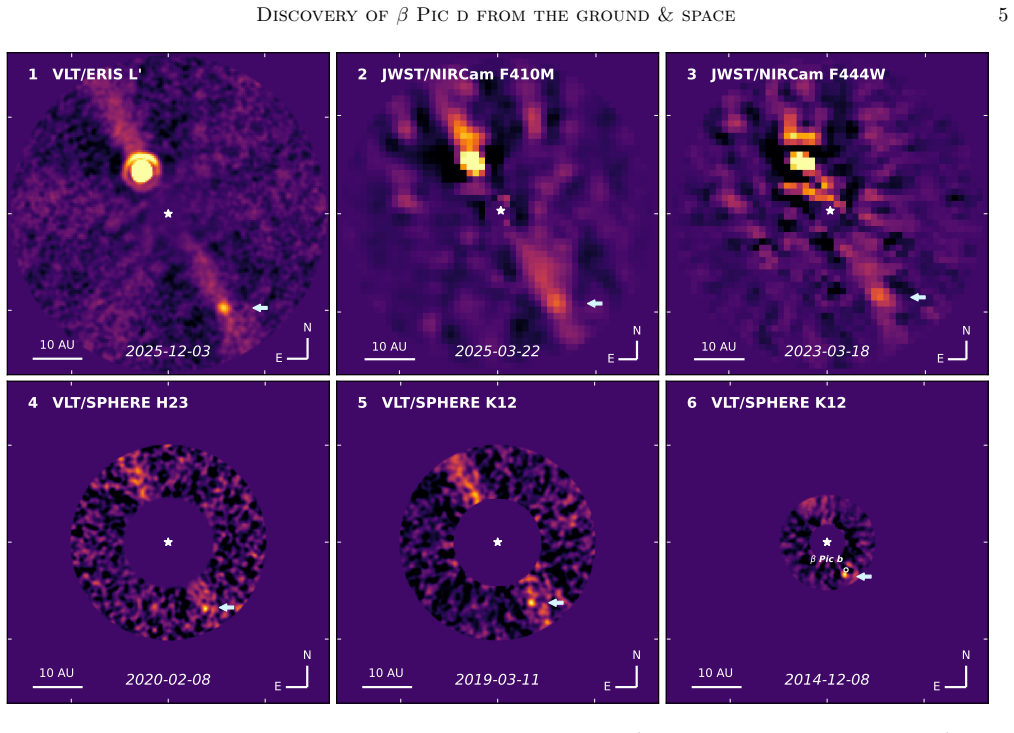
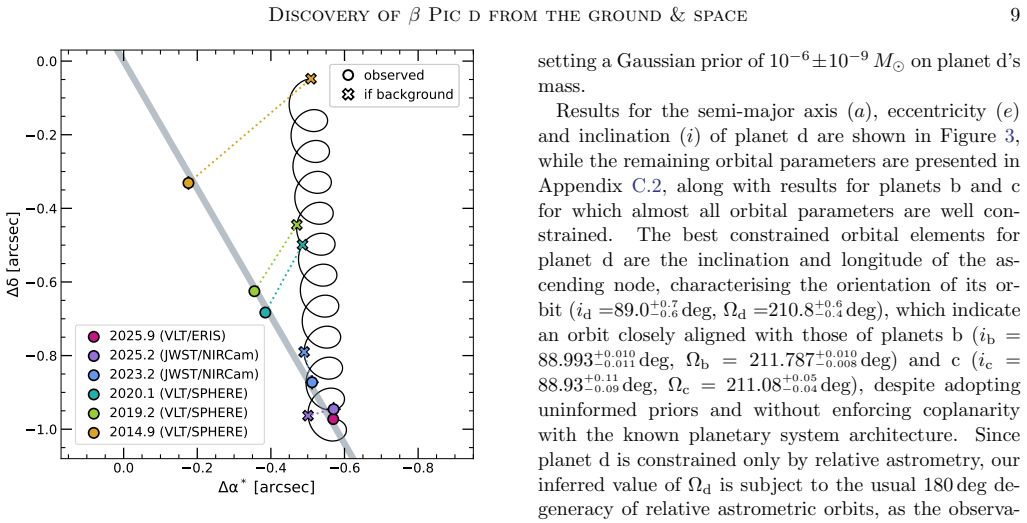
We report the direct imaging discovery of a third exoplanet in the $\beta$ Pictoris system. We detect $\beta$ Pictoris d in non-coronagraphic observations obtained with VLT/ERIS as well as multi-epoch archival datasets from JWST/NIRCam and VLT/SPHERE. Astrometric measurements over an 11-year baseline demonstrate that it is consistent with a gravitationally-bound source with orbital motion. Joint multi-planet orbit fits of all three planets in the system yield a semi-major axis of $26.0^{+2.2}_{-6.1}$ au and inclination $89.0^{+0.7}_{-0.6}$ deg for planet d. $\beta$ Pictoris d has a larger orbital semi-major axis than the other known planets in the system, but is coplanar with the inner two planets, and its orbit is consistent with sculpting the inner edge of the debris disk. $\beta$ Pictoris d has a contrast of $\Delta L^{\prime}=12.11\pm0.15$ mag, with colors and luminosity that closely match those of 51 Eri b, another exoplanet in the $\beta$ Pictoris moving group. Its VLT/ERIS and JWST/NIRCam colors are distinct from those of free-floating planetary-mass objects of a similar age and temperature. Its red $F410M-F444W$ color indicates strong CO$_2$ absorption in its atmosphere and suggests significant enhancement in metals compared to free-floating objects. From the ATMO hot-start evolutionary models, we estimate an effective temperature of $600^{+45}_{-60}$ K and mass of $2.4\pm0.6$ $M_{\rm Jup}$, which also closely matches similar estimates for 51 Eri b. $\beta$ Pictoris d is among the lowest-mass exoplanets imaged from the ground. This discovery highlights the deep sensitivity achievable with ground-based imaging in the mid-infrared and the discovery potential of future high-contrast observations with the Extremely Large Telescope.
Editorial analysis
A structured set of objections, weighed in public.
Referee Report
Summary. The paper reports the direct imaging discovery of a third exoplanet, β Pictoris d, in the β Pictoris system. Detections are presented from VLT/ERIS non-coronagraphic observations plus archival JWST/NIRCam and VLT/SPHERE data spanning an 11-year baseline. Astrometry is stated to be consistent with a bound source; joint three-planet Keplerian orbit fits yield a = 26.0^{+2.2}_{-6.1} au and i = 89.0^{+0.7}_{-0.6} deg. Photometry (ΔL' = 12.11 ± 0.15 mag) and colors are compared to 51 Eri b; ATMO hot-start models give T_eff = 600^{+45}_{-60} K and M = 2.4 ± 0.6 M_Jup. The orbit is noted to be coplanar with the inner planets and consistent with sculpting the debris-disk inner edge.
Significance. If the bound-orbit confirmation is robust, the result would be significant as one of the lowest-mass planets directly imaged from the ground and the third planet in a benchmark system. Strengths include the multi-facility, multi-epoch dataset, joint multi-planet fitting, and atmospheric color analysis that distinguishes the source from free-floating objects. These elements support the discovery claim when the astrometric membership test is quantitatively secure.
major comments (2)
- [Astrometry and orbit-fitting section] Astrometry and orbit-fitting section: the manuscript asserts that the 11-year astrometry is 'consistent with a gravitationally-bound source with orbital motion' and that joint fits yield the reported a and i, but provides no explicit quantitative test (χ² comparison, false-alarm probability, or Bayes factor) against the background hypothesis of linear relative proper motion set by the star's known PM. This test is load-bearing for the central discovery claim.
- [Photometric and color analysis section] § on photometric and color analysis: while colors are stated to be distinct from free-floating objects and to indicate CO₂ absorption, the manuscript does not quantify the significance of the color difference or provide a direct comparison table of photometry against both bound and unbound templates at the same age and temperature.
minor comments (2)
- The abstract and text use asymmetric uncertainties for a and i but symmetric for mass; clarify whether the mass uncertainty is 1σ or derived differently.
- Figure captions should explicitly state the number of epochs and instruments contributing to each astrometric point.
Simulated Author's Rebuttal
We thank the referee for their detailed and constructive report. We agree that the two major comments identify areas where the manuscript can be strengthened with additional quantitative analysis, and we will incorporate these changes in the revised version.
read point-by-point responses
-
Referee: [Astrometry and orbit-fitting section] Astrometry and orbit-fitting section: the manuscript asserts that the 11-year astrometry is 'consistent with a gravitationally-bound source with orbital motion' and that joint fits yield the reported a and i, but provides no explicit quantitative test (χ² comparison, false-alarm probability, or Bayes factor) against the background hypothesis of linear relative proper motion set by the star's known PM. This test is load-bearing for the central discovery claim.
Authors: We agree that an explicit quantitative test is needed to support the bound-orbit claim. In the revised manuscript we will add a direct χ² comparison of the observed astrometry against both the joint Keplerian three-planet model and a linear relative proper-motion model (using the known stellar proper motion), together with the associated false-alarm probability. This will be placed in the astrometry and orbit-fitting section. revision: yes
-
Referee: [Photometric and color analysis section] § on photometric and color analysis: while colors are stated to be distinct from free-floating objects and to indicate CO₂ absorption, the manuscript does not quantify the significance of the color difference or provide a direct comparison table of photometry against both bound and unbound templates at the same age and temperature.
Authors: We acknowledge the value of a quantitative comparison. The revised version will include a table of photometry for β Pictoris d alongside 51 Eri b and representative free-floating objects of comparable age and effective temperature, plus a statistical measure (e.g., χ² or significance) of the color differences. These additions will appear in the photometric and color analysis section. revision: yes
Circularity Check
No significant circularity: observational discovery driven by independent astrometric data
full rationale
This is an observational discovery paper reporting direct imaging detection, 11-year multi-epoch astrometry, and standard joint Keplerian orbit fitting to measured positions of three planets. Orbital parameters, mass, and temperature are outputs of data-driven fits and external ATMO evolutionary models, with no equations or steps that reduce by construction to a fitted input, self-defined quantity, or load-bearing self-citation. The binding confirmation rests on consistency with orbital motion versus background, which is a direct comparison to observed positions rather than a tautological derivation. The analysis is self-contained against external benchmarks.
Axiom & Free-Parameter Ledger
free parameters (2)
- semi-major axis of planet d
- mass from ATMO models
axioms (2)
- domain assumption Astrometric motion over 11 years is consistent with gravitational binding to β Pictoris rather than a background object
- domain assumption ATMO hot-start evolutionary models accurately predict mass and temperature from observed luminosity and colors for young planets
Reference graph
Works this paper leans on
-
[1]
Amara, A., & Quanz, S. P. 2012, MNRAS, 427, 948, doi: 10.1111/j.1365-2966.2012.21918.x Astropy Collaboration, Robitaille, T. P., Tollerud, E. J., et al. 2013, A&A, 558, A33, doi: 10.1051/0004-6361/201322068 Astropy Collaboration, Price-Whelan, A. M., Sip˝ ocz, B. M., et al. 2018, AJ, 156, 123, doi: 10.3847/1538-3881/aabc4f Astropy Collaboration, Price-Whe...
-
[2]
Balmer, W. O., Otten, G. P. P. L., & Stolker, T. 2025a, backtracks: a python package to compare relative astrometry with background helical motion: v0.6, v0.6 Zenodo, doi: 10.5281/zenodo.14838369
-
[3]
O., Kammerer, J., Pueyo, L., et al
Balmer, W. O., Kammerer, J., Pueyo, L., et al. 2025b, AJ, 169, 209, doi: 10.3847/1538-3881/adb1c6
-
[4]
O., Pueyo, L., Messier, A., et al
Balmer, W. O., Pueyo, L., Messier, A., et al. 2026, ApJL, 1001, L26, doi: 10.3847/2041-8213/ae374a Bardalez Gagliuffi, D. C., Balmer, W. O., Pueyo, L., et al. 2025, ApJL, 988, L18, doi: 10.3847/2041-8213/ade30f
-
[5]
2015, A&A, 582, A83, doi: 10.1051/0004-6361/201526332
Baudino, J.-L., B´ ezard, B., Boccaletti, A., et al. 2015, A&A, 582, A83, doi: 10.1051/0004-6361/201526332
-
[6]
Beiler, S. A., Cushing, M. C., Kirkpatrick, J. D., et al. 2024, ApJ, 973, 107, doi: 10.3847/1538-4357/ad6301
-
[7]
Best, W. M. J., Dupuy, T. J., Liu, M. C., et al. 2025, The UltracoolSheet: Photometry, Astrometry, Spectroscopy, and Multiplicity for 4000+ Ultracool Dwarfs and Imaged Exoplanets, 2.1.0 Zenodo, doi: 10.5281/zenodo.15802304
-
[8]
2024, A&A, 683, A89, doi: 10.1051/0004-6361/202348203
Beust, H., Milli, J., Morbidelli, A., et al. 2024, A&A, 683, A89, doi: 10.1051/0004-6361/202348203
-
[9]
2019, A&A, 631, A155, doi: 10.1051/0004-6361/201935251
Beuzit, J.-L., Vigan, A., Mouillet, D., et al. 2019, A&A, 631, A155, doi: 10.1051/0004-6361/201935251
-
[10]
Blunt, S., Wang, J. J., Angelo, I., et al. 2020, AJ, 159, 89, doi: 10.3847/1538-3881/ab6663
-
[11]
2024, The Journal of Open Source Software, 9, 6756, doi: 10.21105/joss.06756
Blunt, S., Wang, J., Hirsch, L., et al. 2024, The Journal of Open Source Software, 9, 6756, doi: 10.21105/joss.06756
-
[12]
Bock, J. J., Aboobaker, A. M., Adamo, J., et al. 2026, ApJ, 999, 139, doi: 10.3847/1538-4357/ae2be2
-
[13]
Bohn, A. J., Kenworthy, M. A., Ginski, C., et al. 2020, ApJL, 898, L16, doi: 10.3847/2041-8213/aba27e
-
[14]
2013, A&A, 555, A107, doi: 10.1051/0004-6361/201220838
Bonnefoy, M., Boccaletti, A., Lagrange, A.-M., et al. 2013, A&A, 555, A107, doi: 10.1051/0004-6361/201220838
-
[15]
Bonse, M. J., Garvin, E. O., Gebhard, T. D., et al. 2023, AJ, 166, 71, doi: 10.3847/1538-3881/acc93c
-
[16]
Bonse, M. J., Gebhard, T. D., Dannert, F. A., et al. 2025, AJ, 169, 194, doi: 10.3847/1538-3881/adab79
-
[17]
N., Augereau, J.-C., & Ormel, C
Bonsor, A., Raymond, S. N., Augereau, J.-C., & Ormel, C. W. 2014, MNRAS, 441, 2380, doi: 10.1093/mnras/stu721 Discovery ofβPic d from the ground & space23
-
[18]
2021, The Messenger, 182, 22, doi: 10.18727/0722-6691/5218
Brandl, B., Bettonvil, F., van Boekel, R., et al. 2021, The Messenger, 182, 22, doi: 10.18727/0722-6691/5218
-
[19]
2021, AJ, 161, 179, doi: 10.3847/1538-3881/abdc2e
Michalik, D. 2021, AJ, 161, 179, doi: 10.3847/1538-3881/abdc2e
-
[20]
Brandt, T. D. 2021, ApJS, 254, 42, doi: 10.3847/1538-4365/abf93c
-
[21]
Brandt, T. D., Dupuy, T. J., Li, Y., et al. 2021, AJ, 162, 186, doi: 10.3847/1538-3881/ac042e
-
[22]
B., Maire, A.-L., Molli` ere, P., et al
Brown-Sevilla, S. B., Maire, A.-L., Molli` ere, P., et al. 2023, A&A, 673, A98, doi: 10.1051/0004-6361/202244826
-
[23]
Bryden, G., Llop-Sayson, J., Beichman, C. A., et al. 2026, AJ, 171, 301, doi: 10.3847/1538-3881/ae43e8
-
[24]
J., Krist, J
Burrows, C. J., Krist, J. E., Stapelfeldt, K. R., & WFPC2 Investigation Definition Team. 1995, in American Astronomical Society Meeting Abstracts, Vol. 187, American Astronomical Society Meeting Abstracts, 32.05
1995
-
[25]
2024, in Society of Photo-Optical Instrumentation Engineers (SPIE) Conference Series, Vol
Cantalloube, F., Christiaens, V., Cantero, C., et al. 2024, in Society of Photo-Optical Instrumentation Engineers (SPIE) Conference Series, Vol. 13097, Adaptive Optics Systems IX, ed. K. J. Jackson, D. Schmidt, & E. Vernet, 1309713, doi: 10.1117/12.3020278
-
[26]
L., Hinkley, S., Kammerer, J., et al
Carter, A. L., Hinkley, S., Kammerer, J., et al. 2023, ApJL, 951, L20, doi: 10.3847/2041-8213/acd93e
-
[27]
2018, ApJ, 854, 172, doi: 10.3847/1538-4357/aaac7d
Charnay, B., B´ ezard, B., Baudino, J.-L., et al. 2018, ApJ, 854, 172, doi: 10.3847/1538-4357/aaac7d
-
[28]
2012, A&A, 542, A41, doi: 10.1051/0004-6361/201118346
Chauvin, G., Lagrange, A.-M., Beust, H., et al. 2012, A&A, 542, A41, doi: 10.1051/0004-6361/201118346
-
[29]
Cheetham, A. C., Samland, M., Brems, S. S., et al. 2019, A&A, 622, A80, doi: 10.1051/0004-6361/201834112
-
[30]
Chilcote, J., Pueyo, L., De Rosa, R. J., et al. 2017, AJ, 153, 182, doi: 10.3847/1538-3881/aa63e9
-
[31]
2019, MNRAS, 486, 5819
Christiaens, V., Casassus, S., Absil, O., et al. 2019, MNRAS, 486, 5819
2019
-
[32]
Christiansen, J. L., McElroy, D. L., Harbut, M., et al. 2025, PSJ, 6, 186, doi: 10.3847/PSJ/ade3c2
-
[33]
U., Turatto, M., Gratton, R
Claudi, R. U., Turatto, M., Gratton, R. G., et al. 2008, in Proc. SPIE, Vol. 7014, Ground-based and Airborne Instrumentation for Astronomy II, 70143E
2008
-
[34]
Close, L. M., van Capelleveen, R. F., Weible, G., et al. 2025, ApJL, 990, L9, doi: 10.3847/2041-8213/adf7a5
-
[35]
Crotts, K. A., Carter, A. L., Lawson, K., et al. 2025, ApJL, 987, L41, doi: 10.3847/2041-8213/ade798
-
[36]
2023a, in Astronomical Society of the Pacific Conference Series, Vol
Currie, T., Biller, B., Lagrange, A., et al. 2023a, in Astronomical Society of the Pacific Conference Series, Vol. 534, Protostars and Planets VII, ed. S. Inutsuka, Y. Aikawa, T. Muto, K. Tomida, & M. Tamura, 799, doi: 10.48550/arXiv.2205.05696
-
[37]
Currie, T., Lada, C. J., Plavchan, P., et al. 2009, ApJ, 698, 1, doi: 10.1088/0004-637X/698/1/1
-
[38]
2011, ApJL, 736, L33, doi: 10.1088/2041-8205/736/2/L33
Currie, T., Thalmann, C., Matsumura, S., et al. 2011, ApJL, 736, L33, doi: 10.1088/2041-8205/736/2/L33
-
[39]
2013, ApJ, 776, 15, doi: 10.1088/0004-637X/776/1/15
Currie, T., Burrows, A., Madhusudhan, N., et al. 2013, ApJ, 776, 15, doi: 10.1088/0004-637X/776/1/15
-
[40]
Currie, T., Brandt, G. M., Brandt, T. D., et al. 2023b, Science, 380, 198, doi: 10.1126/science.abo6192
-
[41]
2023, A&A, 674, A207, doi: 10.1051/0004-6361/202346559 De Rosa, R
Davies, R., Absil, O., Agapito, G., et al. 2023, A&A, 674, A207, doi: 10.1051/0004-6361/202346559 De Rosa, R. J., Nielsen, E. L., Wahhaj, Z., et al. 2023, A&A, 672, A94, doi: 10.1051/0004-6361/202345877
-
[42]
2026, A&A, 707, L13, doi: 10.1051/0004-6361/202658862
Denis, A., Vigan, A., Chauvin, G., et al. 2026, A&A, 707, L13, doi: 10.1051/0004-6361/202658862
-
[43]
Dent, W. R. F., Wyatt, M. C., Roberge, A., et al. 2014, Science, 343, 1490, doi: 10.1126/science.1248726
-
[44]
Doelman, D. S., Snik, F., Por, E. H., et al. 2021, ApOpt, 60, D52, doi: 10.1364/AO.422155
-
[45]
2008, in Society of Photo-Optical Instrumentation Engineers (SPIE) Conference Series, Vol
Dohlen, K., Langlois, M., Saisse, M., et al. 2008, in Society of Photo-Optical Instrumentation Engineers (SPIE) Conference Series, Vol. 7014, Ground-based and Airborne Instrumentation for Astronomy II, ed. I. S. McLean & M. M. Casali, 70143L, doi: 10.1117/12.789786
-
[46]
Dupuy, T. J., Brandt, G. M., & Brandt, T. D. 2022, MNRAS, 509, 4411, doi: 10.1093/mnras/stab3148
-
[47]
Dupuy, T. J., Liu, M. C., Evans, E. L., et al. 2023, MNRAS, 519, 1688, doi: 10.1093/mnras/stac3557
-
[48]
Durisen, R. H., Boss, A. P., Mayer, L., et al. 2007, in Protostars and Planets V, ed. B. Reipurth, D. Jewitt, & K. Keil, 607, doi: 10.48550/arXiv.astro-ph/0603179
-
[49]
2014, A&A, 563, A72, doi: 10.1051/0004-6361/201322469
Faramaz, V., Beust, H., Th´ ebault, P., et al. 2014, A&A, 563, A72, doi: 10.1051/0004-6361/201322469
-
[50]
M., & Vidal-Madjar, A
Ferlet, R., Hobbs, L. M., & Vidal-Madjar, A. 1987, A&A, 185, 267
1987
-
[51]
Foreman-Mackey, D., Hogg, D. W., Lang, D., & Goodman, J. 2013, PASP, 125, 306, doi: 10.1086/670067
doi:10.1086/670067 2013
-
[52]
Franson, K., Bowler, B. P., Zhou, Y., et al. 2023, ApJL, 950, L19, doi: 10.3847/2041-8213/acd6f6
-
[53]
Franson, K., Balmer, W. O., Bowler, B. P., et al. 2024, ApJL, 974, L11, doi: 10.3847/2041-8213/ad736a Gagn´ e, J., Mamajek, E. E., Malo, L., et al. 2018, ApJ, 856, 23, doi: 10.3847/1538-4357/aaae09 Gagn´ e, J., Faherty, J. K., Ruiz Diaz, A., et al. 2026, arXiv e-prints, arXiv:2604.22012, doi: 10.48550/arXiv.2604.22012 24B. J. Sutlieff & M. J. Bonse et al....
-
[54]
Gardner, J. P., Mather, J. C., Clampin, M., et al. 2006, SSRv, 123, 485, doi: 10.1007/s11214-006-8315-7
-
[55]
Gardner, J. P., Mather, J. C., Abbott, R., et al. 2023, PASP, 135, 068001, doi: 10.1088/1538-3873/acd1b5
-
[56]
Gebhard, T. D., Bonse, M. J., Quanz, S. P., & Sch¨ olkopf, B. 2022, A&A, 666, A9, doi: 10.1051/0004-6361/202142529
-
[57]
Ginsburg, A., Sip˝ ocz, B. M., Brasseur, C. E., et al. 2019, AJ, 157, 98, doi: 10.3847/1538-3881/aafc33
-
[58]
H., Leisenring, J., Kammerer, J., et al
Girard, J. H., Leisenring, J., Kammerer, J., et al. 2022, in Society of Photo-Optical Instrumentation Engineers (SPIE) Conference Series, Vol. 12180, Space Telescopes and Instrumentation 2022: Optical, Infrared, and Millimeter Wave, ed. L. E. Coyle, S. Matsuura, & M. D. Perrin, 121803Q, doi: 10.1117/12.2629636
-
[59]
Girard, J. H. V., O’Neal, J., Mawet, D., et al. 2012, in Society of Photo-Optical Instrumentation Engineers (SPIE) Conference Series, Vol. 8447, Adaptive Optics Systems III, ed. B. L. Ellerbroek, E. Marchetti, & J.-P. V´ eran, 84470L, doi: 10.1117/12.925660
-
[60]
Golimowski, D. A., Ardila, D. R., Krist, J. E., et al. 2006, AJ, 131, 3109, doi: 10.1086/503801 Gomez Gonzalez, C. A., Wertz, O., Absil, O., et al. 2017, AJ, 154, 7 GRAVITY Collaboration, Nowak, M., Lacour, S., et al. 2020, A&A, 633, A110, doi: 10.1051/0004-6361/201936898
doi:10.1086/503801 2006
-
[61]
Haffert, S. Y., Bohn, A. J., de Boer, J., et al. 2019, Nature Astronomy, 3, 749, doi: 10.1038/s41550-019-0780-5
-
[62]
Han, Y., Wyatt, M. C., & Dent, W. R. F. 2023, MNRAS, 519, 3257, doi: 10.1093/mnras/stac3769
-
[63]
2026, A&A, 705, A196, doi: 10.1051/0004-6361/202556450
Han, Y., Mansell, E., Jennings, J., et al. 2026, A&A, 705, A196, doi: 10.1051/0004-6361/202556450
-
[64]
Harris, C. R., Millman, K. J., van der Walt, S. J., et al. 2020, Nature, 585, 357, doi: 10.1038/s41586-020-2649-2
-
[65]
Heap, S. R., Lindler, D. J., Lanz, T. M., et al. 2000, ApJ, 539, 435, doi: 10.1086/309188
doi:10.1086/309188 2000
-
[66]
2023, A&A, 671, L5, doi: 10.1051/0004-6361/202244727 Houll´ e, M., Millour, F., Berio, P., et al
Hinkley, S., Lacour, S., Marleau, G.-D., et al. 2023, A&A, 671, L5, doi: 10.1051/0004-6361/202244727 Houll´ e, M., Millour, F., Berio, P., et al. 2025, A&A, 704, A182, doi: 10.1051/0004-6361/202453323
-
[67]
Hunter, J. D. 2007, Computing in Science & Engineering, 9, 90, doi: 10.1109/MCSE.2007.55
-
[68]
A., & Mandel, E
Joye, W. A., & Mandel, E. 2003, in Astronomical Society of the Pacific Conference Series, Vol. 295, Astronomical Data Analysis Software and Systems XII, ed. H. E
2003
-
[69]
Kammerer, J., Girard, J., Carter, A. L., et al. 2022, in Society of Photo-Optical Instrumentation Engineers (SPIE) Conference Series, Vol. 12180, Space Telescopes and Instrumentation 2022: Optical, Infrared, and Millimeter Wave, ed. L. E. Coyle, S. Matsuura, & M. D. Perrin, 121803N, doi: 10.1117/12.2628865
-
[70]
Kammerer, J., Lawson, K., Perrin, M. D., et al. 2024, AJ, 168, 51, doi: 10.3847/1538-3881/ad4ffe
-
[71]
Kammerer, J., Winterhalder, T. O., Lacour, S., et al. 2025, A&A, 704, A318, doi: 10.1051/0004-6361/202556860
-
[72]
2025, A&A, 701, A104, doi: 10.1051/0004-6361/202556170
Kenworthy, M., Stolker, T., Kammerer, J., et al. 2025, A&A, 701, A104, doi: 10.1051/0004-6361/202556170
-
[73]
Kenworthy, M. A., Mellon, S. N., Bailey, J. I., et al. 2021, A&A, 648, A15, doi: 10.1051/0004-6361/202040060
-
[74]
Kenworthy, M. A., Dannert, F. A., Hayoz, J., et al. 2026, A&A, 708, A239, doi: 10.1051/0004-6361/202558510
-
[75]
2018, A&A, 617, A44, doi: 10.1051/0004-6361/201832957
Keppler, M., Benisty, M., M¨ uller, A., et al. 2018, A&A, 617, A44, doi: 10.1051/0004-6361/201832957
-
[76]
Kirkpatrick, J. D., Gelino, C. R., Faherty, J. K., et al. 2021, ApJS, 253, 7, doi: 10.3847/1538-4365/abd107
-
[77]
Krist, J. E., Golimowski, D. A., Schroeder, D. J., & Henry, T. J. 1998, PASP, 110, 1046, doi: 10.1086/316221
doi:10.1086/316221 1998
-
[78]
Lacour, S., Wang, J. J., Rodet, L., et al. 2021, A&A, 654, L2, doi: 10.1051/0004-6361/202141889
-
[79]
2025, A&A, 694, A236, doi: 10.1051/0004-6361/202452632
Lacquement, A., Beust, H., Faramaz-Gorka, V., & Duchˆ ene, G. 2025, A&A, 694, A236, doi: 10.1051/0004-6361/202452632
-
[80]
2009, A&A, 493, L21, doi: 10.1051/0004-6361:200811325
Lagrange, A.-M., Gratadour, D., Chauvin, G., et al. 2009, A&A, 493, L21, doi: 10.1051/0004-6361:200811325
discussion (0)
Sign in with ORCID, Apple, or X to comment. Anyone can read and Pith papers without signing in.