REVIEW 4 major objections 4 minor 43 references
Spin-Based Modeling of Perception as Emergent from contextualized Internal Evaluation
T0 review · 4 major / 4 minor · reviewed 2026-08-06 · deepseek-v4-flash
Pith's one-line read The paper derives a Landau-type free energy from spin models of internal evaluation and shows that adding a neutral spin-0 state lowers the perceptual threshold, flattens the landscape, and can create first-order transitions with…
desk verdict Correct mean-field derivations applied to a new domain; the paper is honest but overreaches when it claims hysteresis and clinical relevance from an equilibrium calculation. read the letter →
The pith
A machine-rendered reading of the paper's core claim, the machinery that carries it, and where it could break.
The reading
What carries the argument
The argument is carried by a coarse-graining procedure: a Hubbard-Stratonovich transformation decouples the spin-spin interactions, a saddle-point expansion gives the homogeneous mean-field solution, and a small-momentum expansion on a $d$-dimensional hypercubic lattice yields the Landau-Ginzburg action $S_{\text{eff}}[\phi] = \int d^dx \left[\frac{a}{2}\phi^2 + \frac{\kappa}{2}(\nabla\phi)^2 + \frac{b}{4}\phi^4\right]$. The load-bearing identity is the Blume-Capel quartic coefficient $b(\Delta) = \frac{4 - e^{\beta\Delta}}{3(e^{\beta\Delta}+2)^2}\left(\frac{2dJ}{T}\right)^4$, whose sign change as $\Delta$ crosses a moderate positive value is what converts a second-order transition into a first-order one. The stiffness $\kappa = J\ell_0^2/T$, an additional parameter beyond the phenomenological model, is interpreted as a proxy for mental rigidity.
What would settle it
A psychophysical experiment that varied the availability and perceived cost of a 'neutral/undecided' response option could check the predicted drop in the critical ambiguity threshold and the appearance of hysteresis loops in repeated judgments; observing no such threshold shift or bistability when a neutral option is introduced would falsify the sign-change mechanism.
Extended reading notes
Core claim
The central claim is that allowing an organism to evaluate a vital norm as neutral (spin 0) qualitatively changes the perceptual landscape. In the spin-1 model, the critical temperature drops from $T_0 = 2dJ$ to $4dJ/3$ and the quartic coefficient falls from $(1/3)(2dJ/T)^4$ to $(1/9)(2dJ/T)^4$, reflecting a flatter, more context-sensitive potential. In the Blume-Capel extension, the quartic coefficient becomes $b(\Delta) = \frac{4 - e^{\beta\Delta}}{3(e^{\beta\Delta}+2)^2}\left(\frac{2dJ}{T}\right)^4$, which is negative for moderate positive $\Delta$. A negative $b$ forces the sixth-order term to stabilize the free energy and yields a first-order transition with symmetry-preserving bistability and hysteresis. This provides a microscopic route to the bistability and threshold shifts identified phenomenologically in chronic pain and related conditions, without requiring any explicit symmetry-breaking term.
Load-bearing premise
The whole derivation presupposes that perception of a sensation is the equilibrium statistical mechanics of spin-like evaluative units on a regular lattice, with temperature standing for the richness of sensory context; if the real process is out of equilibrium, asymmetric, or topologically complex, the derived Landau coefficients and conclusions about neutrality and bistability would not carry over.
Editorial extensions
If this is right
- The spin-1 and Blume-Capel models predict that simply having a neutral option lowers the critical threshold $T_0$ and flattens the free-energy landscape, making polarized perception harder to trigger.
- For moderate positive $\Delta$, the model yields a first-order transition and hysteresis without any cubic term, offering a mechanism for perceptual trapping in chronic pain.
- The derived stiffness $\kappa$ links microscopic coupling strength and lattice spacing to cognitive rigidity or flexibility, giving a new parameter for clinical modeling.
- Closed-form expressions for all Landau coefficients in terms of $J$, $d$, $T$, and $\Delta$ allow the framework to be fit to behavioral or neural data.
Reading between the lines
- If the mapping holds, interventions that increase tolerance of ambiguity (raising $\Delta$) might push an individual from a regime of gradual perceptual shifts into sudden, first-order transitions—a testable prediction for therapy outcomes.
- The same coarse-graining route, applied to asymmetric couplings or three-spin interactions, would generate the cubic term and thus embed personal history directly into the microscopic Hamiltonian.
- The model's zero-temperature limit, in which sensory input vanishes and the system commits to a polarized state, suggests a formal account of dissociative or stereotyped percepts in sensory deprivation—an inference beyond the paper's explicit claims.
Editorial analysis
A structured set of objections, weighed in public.
Referee Report
Summary. The paper develops a microscopic spin-model foundation for a previously proposed phenomenological Landau model of interoceptive perception. It considers three progressively richer Z2-symmetric Hamiltonians: the spin-1/2 Ising model, the spin-1 Ising model with a neutral S=0 state, and the Blume-Capel model with a tunable single-site energy Δ. Using a Hubbard-Stratonovich transformation and saddle-point expansion, the authors derive Landau-Ginzburg coefficients a, κ, and b in closed form. The central results are: the neutral state lowers the critical temperature T0 and the quartic coefficient b, flattening the effective potential; in the Blume-Capel model, positive Δ can make b(Δ) negative, which the paper interprets as a first-order transition with bistability and hysteresis; and the stiffness κ is proposed as a proxy for mental rigidity. The paper then maps these parameters to perceptual and clinical concepts, notably chronic pain and mental disorders.
Significance. If the main claims are accepted, the paper would provide a valuable bridge between condensed-matter field theory and a phenomenological model of perception, showing how neutral evaluative states and first-order transitions can arise from simple microscopic interactions. The derivations are internally consistent: the coefficients reduce to standard mean-field results, the spin-1/2 and spin-1 limits are correctly recovered, and the sign change of b(Δ) is physically meaningful. The paper is also commendable for presenting closed-form expressions with no fitted parameters, making the microscopic-to-macroscopic mapping explicit and reproducible. However, the significance is currently limited by two gaps: the paper's central claims about hysteresis and clinical trapping rely on dynamical behavior that is never modeled, and the mapping from model parameters to perceptual constructs is asserted rather than empirically grounded with falsifiable predictions. The contribution is therefore best seen as a plausible theoretical scaffold rather than a demonstrated explanation of perception.
major comments (4)
- [Section III.C and Section V] The claim that the Blume-Capel model 'can undergo a first-order phase transition, characterized by bistability and hysteresis' (Section III.C) is not a consequence of the derived equilibrium free energy. A negative quartic coefficient in Eq. (9) gives coexisting minima, but hysteresis is a nonequilibrium, history-dependent phenomenon requiring a dynamical rule (e.g., Glauber dynamics or time-dependent Ginzburg-Landau) and a protocol for sweeping a control parameter. The paper's own Section V lists 'time-dependent changes' as future work, conceding that no dynamics is included. This is load-bearing because the clinical interpretations of chronic pain and perceptual trapping depend on persistent, history-dependent states. The authors should either introduce and analyze a dynamical extension, or explicitly reframe hysteresis as a plausible consequence of the derived bistability rather than a demonstrated property of the model.
- [Methods, paragraph on sixth-order stability] For the first-order transition claim, the sixth-order coefficient is invoked but never computed. The Methods state that when the quartic coefficient becomes negative, 'the sixth-order term must be retained to ensure thermodynamic stability,' and the figure caption asserts that 'a stable landscape is obtained once the six-th order coefficient is computed and verified to be positive.' However, the manuscript never provides this sixth-order coefficient for the Blume-Capel model, nor a proof of its positivity. Without this, the existence of a bounded free energy supporting a first-order transition is asserted rather than derived. The authors should compute c(Δ) in the expansion log[1 + 2 exp(-βΔ) cosh φ] and show that c(Δ) > 0 in the regime where b(Δ) < 0, or provide a standard reference as a proof.
- [Section IV.A and Abstract] The mapping from model ingredients to perception and clinical constructs is largely definitional and unvalidated. The abstract's claim that the results 'establish a principled link between microscopic evaluative processes and large-scale perceptual organization' is stronger than what is shown: the order parameter is identified with perceptual stance, Δ with salience, κ with rigidity, and T with contextual richness, but no independent empirical evidence or quantitative prediction is offered. For example, Section IV.A suggests that mindfulness 'may act by dynamically modulating Δ,' and that positive Δ may model disengagement or flatness, but these are plausibility arguments rather than derivations. To make the link principled, the authors should state falsifiable predictions, such as a predicted shift in the perceptual critical threshold as a function of context ambiguity, or a predicted relationship between hysteresis-loop area and the parameters Δ or κ, and indicate how these could be measured behaviorally or neurally. Without such predictions, the clinical interpretations remain an interpretive overlay.
- [Section III, introductory paragraph] The model's applicability to real perception rests on the assumption that equilibrium statistical mechanics on a regular hypercubic lattice, with temperature identified as contextual richness, captures the essential structure of evaluative processes. The paper acknowledges that the lattice is conceptual and that equilibrium, symmetric, nearest-neighbor interactions are simplifications. This is a legitimate idealization, but it means the derived coefficients and the predicted bistability apply only to this idealized setting. The authors should more carefully delimit the scope of the claims, e.g., by noting that asymmetric couplings, non-regular topologies, or explicit out-of-equilibrium drive could change the coefficients and the transition order. As written, the paper sometimes moves from the idealized model to clinical statements without this caveat in view.
minor comments (4)
- [Abstract and Introduction] There is a typographical comma in 'key phenomenological features of perception, emerge from microscopic evaluative interactions'; the comma after 'perception' should be removed. Also, the final sentence of the abstract has a dangling participle: 'providing novel theoretical insights' does not attach grammatically to the subject.
- [Table I and Figure 2] The name of the model is spelled 'Blume-Capel' throughout the text but 'Blume-Campel' in the figure 2 caption and in the Table I caption. Please make the spelling consistent.
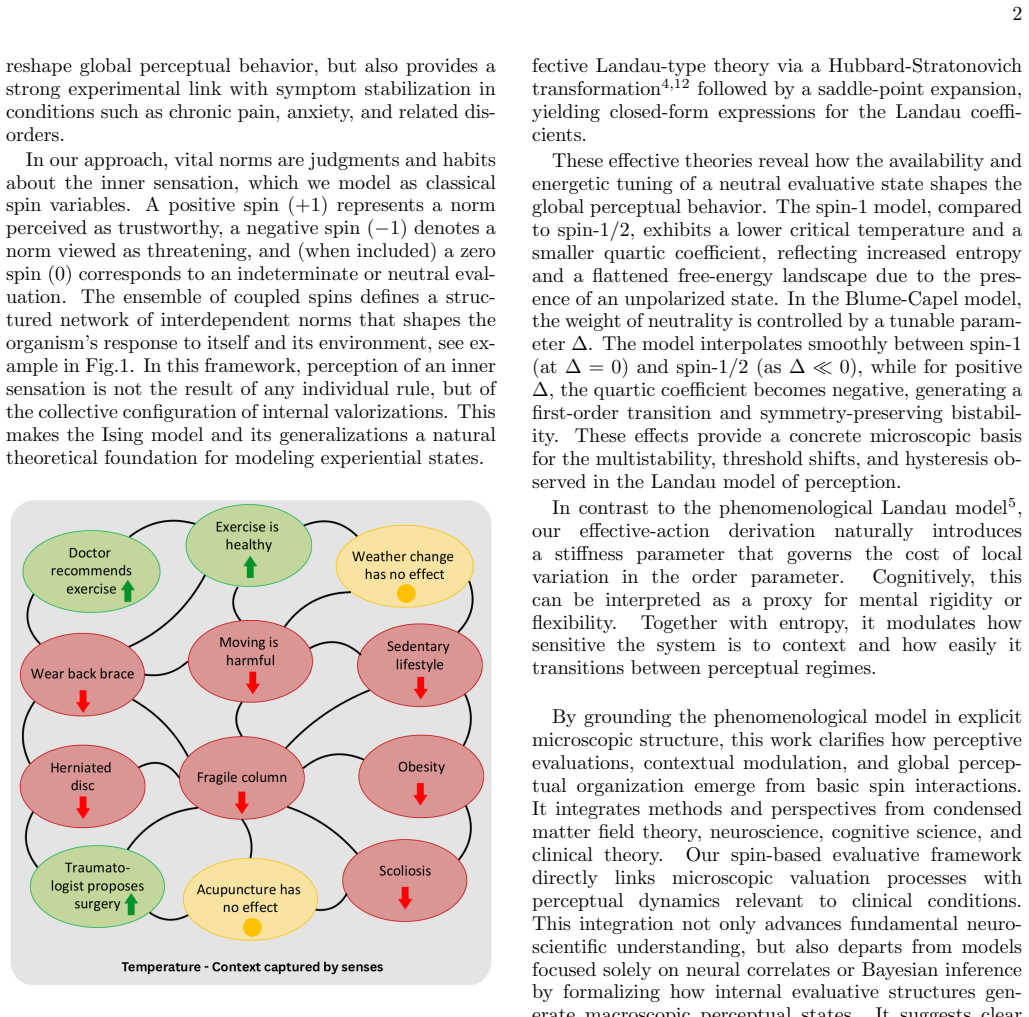
- [Figure 1 caption] 'propioceptive' should be 'proprioceptive'.
- [Section V] The sentence 'A vector-valued models, like the classical Heisenberg model' has a subject-verb agreement error; it should be 'A vector-valued model' or 'Vector-valued models.'
Circularity Check
No circular reduction: the Landau coefficients are computed from the three spin Hamiltonians by Hubbard-Stratonovich and saddle-point expansion; the only self-citation (Ref. [5]) supplies the phenomenological target, not the derived result.
full rationale
The derivation chain is self-contained at the level of its formal results. Starting from the stated Hamiltonians (Eq. (2) for spin-1/2, Eq. (5) for spin-1, Eq. (7) for Blume-Capel), the Methods section performs a Hubbard-Stratonovich transformation (Eq. (13)), obtains the local log-cosh actions (Eqs. (14), (25), (26)), expands around the saddle point (Eq. (17)), and computes the coefficients a0, T0, b, and kappa (Eqs. (22)-(23) and Table I). None of these coefficients is imported from the phenomenological potential Eq. (1) or fitted to data; the closed forms b = (1/3)(2dJ/T)^4, b = (1/9)(2dJ/T)^4, and b(Delta) of Eq. (9) are direct algebraic consequences of the microscopic parameters J, T, d, and Delta. The self-citation to Ref. [5] (same author) is used only to supply the phenomenological Landau potential that the microscopic theory is intended to reproduce; the derivation does not borrow its coefficients from that paper, so the self-citation is not load-bearing. The interpretive identifications (phi = perceptual stance, T = contextual richness, Delta = salience tuning) are modeling choices, not fitted inputs, and the paper does not claim to have measured these parameters from perception data. A genuine limitation, acknowledged in Sec. V ('The current models can be extended to include time-dependent changes'), is that no time-dependent dynamics is included, so the hysteresis language in Sec. III.C extrapolates beyond the equilibrium free-energy calculation; this is an inference gap rather than a circular reduction. No equation in the paper is equivalent to its input by construction, and no prediction is a renamed fit.
Assumptions & free parameters
free parameters (4)
- J (ferromagnetic coupling between evaluative spins) =
not fitted
- Delta (Blume-Capel single-site energy) =
not fitted
- lattice dimension d =
not fitted
- lattice spacing ell_0 =
not fitted
assumptions (5)
- standard math Hubbard-Stratonovich transformation and saddle-point expansion are valid for these partition functions.
- domain assumption Vital norms can be represented as Z2-symmetric ferromagnetic spin variables on a regular lattice with nearest-neighbor interactions.
- domain assumption Perceptual states correspond to thermal equilibrium configurations of the evaluative spin system, with T measuring sensory context richness.
- ad hoc to paper The coarse-grained order parameter phi corresponds directly to the global perceptual stance.
- ad hoc to paper Delta maps to attentional salience modulation, and kappa maps to mental rigidity.
invented entities (1)
-
Evaluative spin unit representing a vital norm
Cite this review
Pith. "Pith review of Spin-Based Modeling of Perception as Emergent from contextualized Internal Evaluation." pith.science (2026). https://pith.science/paper/GOHOLBX6
@misc{pith2026250706041,
  author       = {Pith},
  title        = {Pith review of: Spin-Based Modeling of Perception as Emergent from contextualized Internal Evaluation},
  year         = {2026},
  howpublished = {\url{https://pith.science/paper/GOHOLBX6}},
  note         = {Machine review of arXiv:2507.06041}
}
read the original abstract
We develop a microscopic model of perception of an interoceptive sensation in which spin-like variables encode an organism's internal evaluation of embodied vital norms associated with the sensation. Spins can take positive, negative, or neutral values. These local valorizations interact on a lattice embedded in the environmental context, and their collective configuration gives rise to a macroscopic perceptual state. By applying a coarse-graining procedure to a family of symmetric spin models, we derive a macroscopic Landau-type functional that makes explicit the mechanism by which key phenomenological features of perception, emerge from microscopic evaluative interactions. A central result is that the inclusion of a neutral evaluative state fundamentally alters the structure of the perceptual landscape, enhancing entropy, lowering the critical threshold, and increasing sensitivity to contextual input. These results establish a principled link between microscopic evaluative processes and large-scale perceptual organization, offering a flexible framework for integrating perceptual regulation and neurobiological modeling. The model integrates notions of neuroscience and cognitive science using the formalism of condensed matter field theory and providing novel theoretical insights and experimental predictions for conditions such as mental disorders and chronic pain.
Figures

Reference graph
Works this paper leans on
-
[5]
author B. Valenzuela , journal Frontiers in Pain Research volume 5 ( year 2024 ), ISSN issn 2673-561X , ://www.frontiersin.org/journals/pain-research/articles/10.3389/fpain.2024.1307532
-
[1]
author G. Longo and author M. Mont \'e vil , journal Progress in Biophysics and Molecular Biology volume 106 , pages 340 ( year 2011 ), ://www.sciencedirect.com/science/article/pii/S007961071100023X
work page 2011
-
[2]
author M. Levin , journal Anim Cogn volume 26 , pages 1865 ( year 2023 ), ISSN issn 1435-9456 (Electronic); 1435-9448 (Print); 1435-9448 (Linking)
work page 2023
-
[3]
author E. R. Francisco J. Varela and author E. Thompson , title The Embodied Mind ( publisher MIT Press , year 1992 )
work page 1992
-
[4]
author A. Altland and author B. D. Simons , title Condensed Matter Field Theory ( publisher Cambridge University Press , address Cambridge , year 2010 ), edition 2nd ed., ISBN isbn 9780521769754 , ://www.cambridge.org/core/books/condensed-matter-field-theory/0A8DE6503ED868D96985D9E7847C63FF
work page 2010
-
[6]
author L. F. Barrett and author W. K. Simmons , journal Nature Reviews Neuroscience volume 16 , pages 419 ( year 2015 ), ://doi.org/10.1038/nrn3950
doi:10.1038/nrn3950 2015
-
[7]
author P. Sterling , title What is Health? Allostasis and the Evolution\\ of Human Design ( publisher MIT Press , year 2020 ), ISBN isbn 9780262043304
work page 2020
-
[8]
author E. Garc \' a and author X. E. Barandiaran , journal Synthese volume 205 , pages 53 ( year 2025 ), ://doi.org/10.1007/s11229-024-04854-y
Show all 43 references
-
[9]
Di Paolo and author E
author E. Di Paolo and author E. Thompson , title The Enactive Approach ( year 2017 )
2017
-
[10]
Blume , journal Physical Review volume 141 , pages 517 ( year 1966 )
author M. Blume , journal Physical Review volume 141 , pages 517 ( year 1966 )
1966
-
[11]
author H. W. Capel , journal Physica volume 32 , pages 966 ( year 1966 )
1966
-
[12]
author J. W. Negele and author H. Orland , title Quantum Many-Particle Systems , Advanced Book Classics ( publisher Westview Press , year 1998 )
1998
-
[13]
author P. M. Chaikin and author T. C. Lubensky , title Principles of Condensed Matter Physics ( publisher Cambridge University Press , year 1995 ), ISBN isbn 9780521337069
1995
-
[14]
author B. A. Strukov and author A. P. Levanyuk , title Ferroelectric Phenomena in Crystals: Physical Foundations ( publisher Springer , year 1998 ), ISBN isbn 978-3-642-64340-8
1998
-
[15]
Binder , journal Reports on Progress in Physics volume 50 , pages 783 ( year 1987 ), ://dx.doi.org/10.1088/0034-4885/50/7/001
author K. Binder , journal Reports on Progress in Physics volume 50 , pages 783 ( year 1987 ), ://dx.doi.org/10.1088/0034-4885/50/7/001
1987 doi
-
[16]
Wang , in booktitle Ferroelectrics , edited by editor I
author C. Wang , in booktitle Ferroelectrics , edited by editor I. Coondoo ( publisher IntechOpen , address Rijeka , year 2010 ), chap. chapter 16 , ://doi.org/10.5772/13359
2010 doi
-
[17]
Allen and author K
author M. Allen and author K. J. Friston , journal Synthese volume 195 , pages 2459 ( year 2018 ), ://doi.org/10.1007/s11229-016-1288-5
2018 doi
-
[18]
author I. R. Kleckner , author J. Zhang , author A. Touroutoglou , author L. Chanes , author C. Xia , author W. K. Simmons , author K. S. Quigley , author B. C. Dickerson , and author L. Feldman Barrett , journal Nature Human Behaviour volume 1 , pages 0069 ( year 2017 ), ://d...
2017 doi
-
[19]
author A. D. Craig , journal Nature Reviews Neuroscience volume 10 , pages 59 ( year 2009 ), ://doi.org/10.1038/nrn2555
2009 doi
-
[20]
author W. W. Seeley , author V. Menon , author A. F. Schatzberg , author J. Keller , author G. H. Glover , author H. Kenna , author A. L. Reiss , and author M. D. Greicius , journal Journal of Neuroscience volume 27 , pages 2349 ( year 2007 ), ://doi.org/10.1523/JNEUROSCI.5587-06.2007
2007 doi
-
[21]
author C. M. Kaplan , author E. Kelleher , author A. Irani , author A. Schrepf , author D. J. Clauw , and author S. E. Harte , journal Nature Reviews Neurology volume 20 , pages 347 ( year 2024 ), ://doi.org/10.1038/s41582-024-00966-8
2024 doi
-
[22]
author M. G. Craske , author M. B. Stein , author T. C. Eley , author M. R. Milad , author A. Holmes , author R. M. Rapee , and author H.-U. Wittchen , journal Nature Reviews Disease Primers volume 3 , pages 17024 ( year 2017 ), ://doi.org/10.1038/nrdp.2017.24
2017 doi
-
[23]
Fiorio , author M
author M. Fiorio , author M. Braga , author A. Marotta , author B. Villa-S \'a nchez , author M. J. Edwards , author M. Tinazzi , and author D. Barbiani , journal Nature Reviews Neurology volume 18 , pages 624 ( year 2022 ), ://doi.org/10.1038/s41582-022-00711-z
2022 doi
-
[24]
Keng , author M
author S.-L. Keng , author M. J. Smoski , and author C. J. Robins , journal Clinical Psychology Review volume 31 , pages 1041 ( year 2011 ), ://doi.org/10.1016/j.cpr.2011.04.006
2011 doi
-
[25]
author B. M. Greenwood and author S. N. Garfinkel , journal Annual Review of Psychology volume 76 , pages 28.1 ( year 2025 ), ://doi.org/10.1146/annurev-psych-020924-125202
2025 doi
-
[26]
Posner , author J
author J. Posner , author J. A. Russell , and author B. S. Peterson , journal Dev Psychopathol volume 17 , pages 715 ( year 2005 ), ISSN issn 0954-5794 (Print); 1469-2198 (Electronic); 0954-5794 (Linking)
2005
-
[27]
Etkin , author A
author A. Etkin , author A. Gyurak , and author R. O'Hara , journal Dialogues in Clinical Neuroscience volume 17 , pages 275 ( year 2015 )
2015
-
[28]
Whitfield-Gabrieli , author J
author S. Whitfield-Gabrieli , author J. Gabriele , author A. Nieto-Castanon , and author etc. , journal PNAS volume 106 , pages 1279 ( year 2009 )
2009
-
[29]
Schlosser , author B
author R. Schlosser , author B. Gesierich , author C. Kaufmann , author S. Haegele-Link , author J. Hennig , and author etc. , journal NeuroImage: Clinical volume 3 , pages 241 ( year 2013 )
2013
-
[30]
di Santo , author P
author S. di Santo , author P. Villegas , author R. Burioni , and author M. A. Mu\ n oz , journal Proceedings of the National Academy of Sciences volume 115 , pages E1356 ( year 2018 ), ://doi.org/10.1073/pnas.1712989115
2018 doi
-
[31]
Ruffini , author G
author G. Ruffini , author G. Damiani , author D. Lozano-Soldevilla , author G. Deco , author F. E. Rosas , author N. A. Kiani , author A. Ponce-Alvarez , author M. L. Kringelbach , author R. Carhart-Harris , and author G. Deco , journal PLoS Computational Biology volume 19 , ...
2023 doi
-
[32]
author M. A. Mu\ n oz , journal Reviews of Modern Physics volume 90 , pages 031001 ( year 2018 ), ://doi.org/10.1103/RevModPhys.90.031001
2018 doi
-
[33]
McGann , author E
author M. McGann , author E. A. Di Paolo , author M. Heras-Escribano , and author A. Chemero , journal Frontiers in Psychology volume 11 , pages 2522 ( year 2020 ), ://doi.org/10.3389/fpsyg.2020.02522
2020
-
[34]
Chalmers , journal Journal of Consciousness Studies volume 2 , pages 200 ( year 1995 )
author D. Chalmers , journal Journal of Consciousness Studies volume 2 , pages 200 ( year 1995 )
1995
-
[35]
author R. L. Carhart-Harris and author K. J. Friston , journal Pharmacol Rev volume 71 , pages 316 ( year 2019 ), ISSN issn 1521-0081 (Electronic); 0031-6997 (Print); 0031-6997 (Linking)
2019
-
[36]
Carhart-Harris , author S
author R. Carhart-Harris , author S. Chandaria , author D. Erritzoe , author A. Gazzaley , author M. Girn , author H. Kettner , author P. Mediano , author D. Nutt , author F. Rosas , author L. Roseman , et al. , journal Neuropharmacology volume 226 , pages 109398 ( year 2023 )...
2023
-
[37]
Borsboom , journal World Psychiatry volume 16 , pages 5 ( year 2017 )
author D. Borsboom , journal World Psychiatry volume 16 , pages 5 ( year 2017 )
2017
-
[38]
Dalege , author D
author J. Dalege , author D. Borsboom , author F. van Harreveld , author H. van den Berg , author M. Conner , and author H. L. J. van der Maas , journal Psychological Review volume 123 , pages 2 ( year 2016 )
2016
-
[39]
author A. O. Savi , author M. Marsman , author H. L. J. van der Maas , and author G. K. J. Maris , journal Perspectives on Psychological Science volume 14 , pages 1034 ( year 2019 )
2019
-
[40]
author H. L. J. van der Maas , author D. Borsboom , and author L. Waldorp , journal preprint ( year 2025 )
2025
-
[41]
Aguilera and author M
author M. Aguilera and author M. G. Bedia , journal Scientific Reports volume 8 , pages 7723 ( year 2018 ), ://doi.org/10.1038/s41598-018-25925-4
2018 doi
-
[42]
Kanter and author H
author I. Kanter and author H. Sompolinsky , journal Physical Review A volume 35 , pages 380 ( year 1987 )
1987
-
[43]
author J. J. Hopfield , journal Proceedings of the National Academy of Sciences volume 79 , pages 2554 ( year 1982 )
1982
Reviewed August 6, 2026 · model on record in the stance chip above.
Discussion (0). Continue with ORCID to comment.